

RocketReach vs Xverum: A Comparison That Doesn't Work the Way You Think
RocketReach and Xverum show up in the same conversations because they're both "B2B data." But they solve different problems, for different buyers, with different delivery models.
RocketReach is a self-serve prospecting product: search, click, export, send. Xverum is data-as-a-service: bulk datasets delivered by API for teams that build enrichment, analytics, or data products.
Let's break this down the way we'd explain it to a teammate who just got pulled into a vendor eval at the worst possible time.
Quick comparison
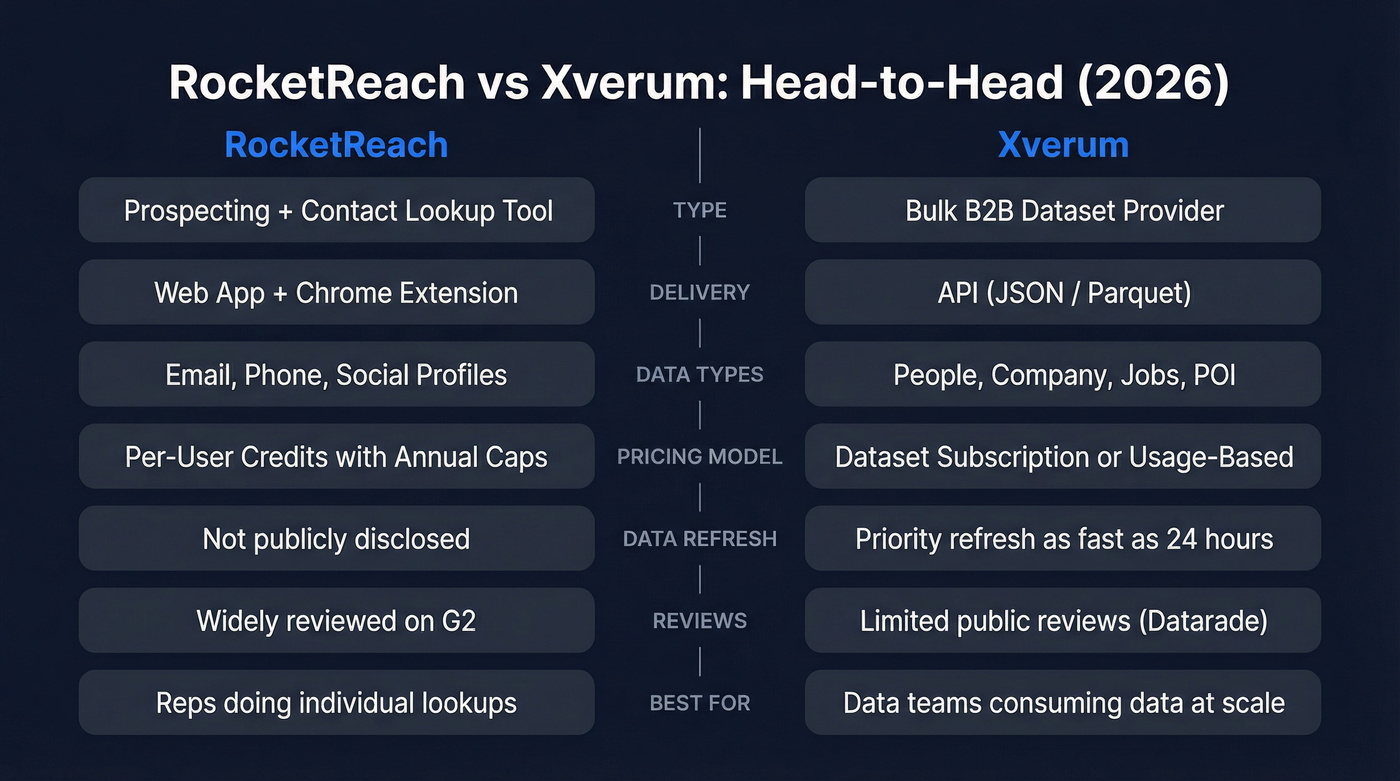
| Category | RocketReach | Xverum |
|---|---|---|
| What it is | Prospecting + contact lookup tool | Bulk B2B dataset provider |
| Delivery | Web app + Chrome extension | API (JSON/Parquet) |
| Data types | Email, phone, social | People, company, jobs, POI |
| Pricing model | Per-user credits (annual caps) | Dataset subscription / usage-based |
| Data refresh | Not public | Priority refresh as fast as 24 hours |
| Reviews | G2 reviews available | Limited public reviews (Datarade) |
| Best for | Reps doing individual lookups | Data teams consuming data at scale |
What RocketReach is (and isn't)
RocketReach is the tool most people mean when they say "I need to find someone's email." You get a searchable UI, a Chrome extension, and a workflow that's built for reps: look up a person, grab an email/phone, move on.
Where it tends to work well:
- Small teams that want a familiar UI and quick setup
- Moderate-volume prospecting where you can tolerate some misses and verify before sending
Where teams get burned:
- Data quality and freshness. G2 reviewers repeatedly call out inaccurate and outdated contact info. If your deliverability is already fragile, this gets frustrating fast. (If you’re troubleshooting bounces, see our guide on email bounce rate.)
- Scaling cost. Per-seat plans with annual lookup caps can look fine for one rep and feel painful once you roll it out to a pod.
Pricing is typically presented as: Free (5 lookups/month), Essentials (~$33/mo, email only), Pro (~$83/mo, email + phone), and Ultimate (~$207/mo with API access), billed annually. For the most current plan details, check RocketReach's pricing page directly.
One real scenario we've seen: a team rolled RocketReach out to three SDRs, then added two more seats mid-quarter. Nobody changed process, but bounce rates crept up, warmup got messy, and suddenly the "cheap" tool was costing them meetings. The fix wasn't fancy - they just started verifying every address and tightened their targeting - but it was an avoidable week of chaos.
What Xverum is (and isn't)
Xverum isn't trying to be a rep's daily prospecting tool. It's built for data teams that want bulk access to B2B datasets via API, delivered in formats like JSON and Parquet.
That changes everything: you don't buy it for a Chrome extension or a nice search UI. You buy it because you need raw data at scale, you want to pipe it into your own systems, and you care about refresh cycles, coverage, and compliance.
Xverum's pitch is closer to "data infrastructure" than "sales tool." It includes people and company data, plus signals that matter more to product and data teams than to individual reps: job changes, hiring trends, leadership changes, and other company-level events you can use for enrichment or analytics.
Good fit:
- Data teams building internal enrichment, scoring, or analytics pipelines
- Platforms that need datasets to power a product feature
- Teams that can actually use an API delivery model (and have someone who'll own it)
Bad fit:
- Individual reps and small teams who just want to find 20 emails and send a sequence
- Anyone who needs transparent, self-serve pricing and a "start in 10 minutes" workflow
Xverum pricing isn't as simple as "Plan A vs Plan B." Public listings commonly describe ranges from usage-based API pricing (for example, a few dollars per 1,000 calls) up to enterprise agreements that can reach six figures annually, depending on scope and refresh requirements. Expect a sales conversation.
And yes, Xverum has far fewer mainstream SaaS reviews than RocketReach. That's normal for this category. People don't review dataset providers the way they review sales tools; they evaluate them in procurement, in pilots, and in data quality checks that never make it to G2.

RocketReach's accuracy issues tank deliverability. Xverum's bulk API isn't built for reps. Prospeo sits right in the middle: 98% verified emails, 125M+ direct dials, and a 7-day refresh cycle - all self-serve at $0.01/email.
Stop comparing tools that weren't built for your workflow.
Are you comparing the right category?
Probably not.
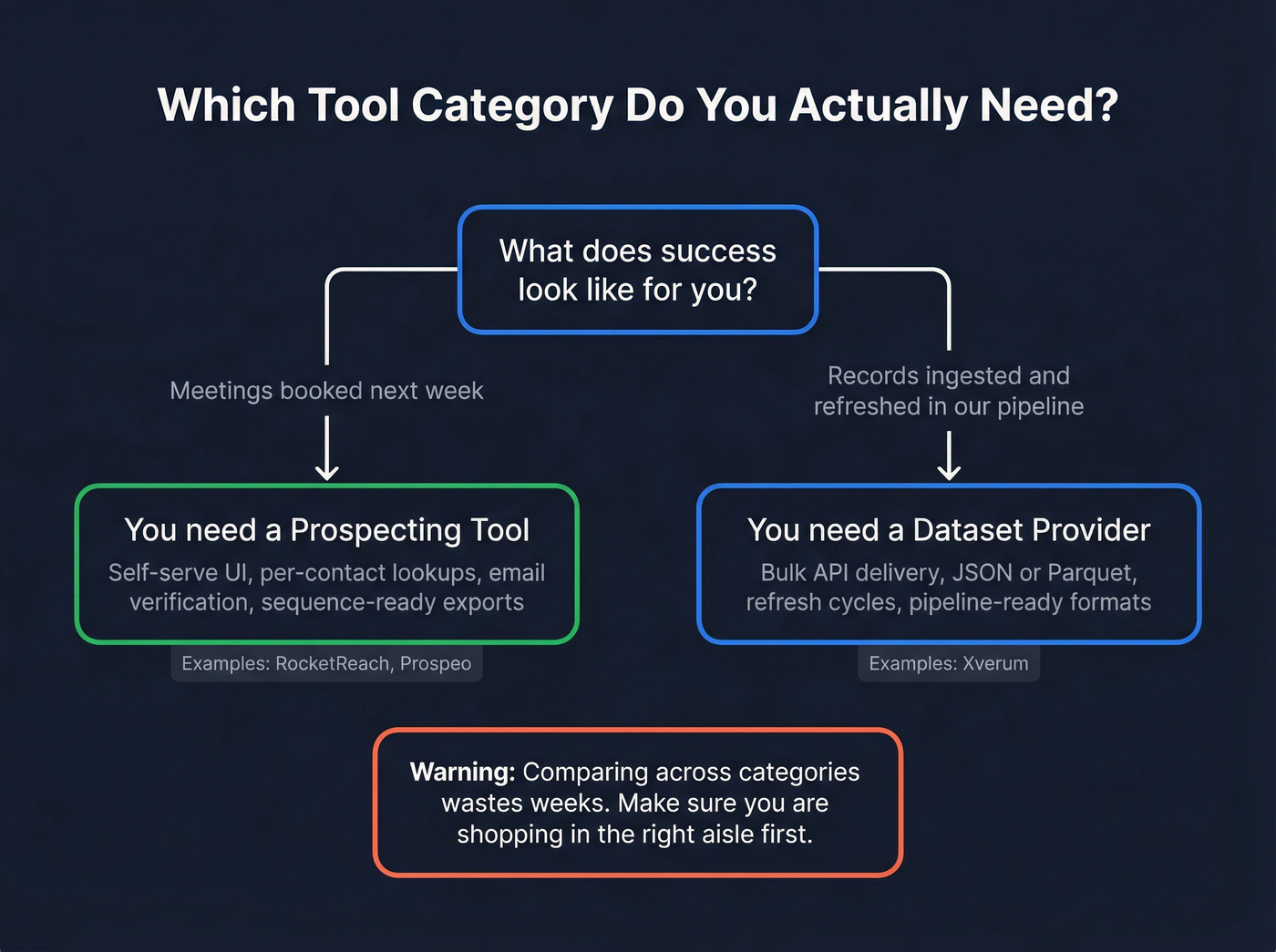
If you're an SDR who needs verified emails to load into Instantly or Lemlist, Xverum's API-first bulk delivery is the wrong shape for your workflow. It's a firehose when you need a faucet. (If you’re building a stack, start with our list of SDR tools.)
If you're a data engineer building enrichment into a product, RocketReach's per-seat credit model and extension-based workflow won't help much. You need bulk access, predictable refresh, and data formats your stack can ingest without duct tape.
We've tested tools across both categories, and this is the part that drives us nuts: teams waste weeks arguing about "which is better" when they're not even shopping in the same aisle. If you want a broader shortlist, see our breakdown of sales prospecting databases.
One quick gut-check:
- If your success metric is "meetings booked next week," you're in prospecting-tool land. (More tactics here: sales prospecting techniques.)
- If your success metric is "records ingested, matched, and refreshed in our pipeline," you're in dataset-provider land.
Where Prospeo fits (for most people reading this)
Look, most people landing on a "RocketReach vs Xverum" page aren't actually trying to buy a bulk dataset. They want accurate contact data for outbound, without signing an enterprise data contract or gambling on freshness. If you’re doing outbound at scale, it helps to understand the basics of cold email marketing.
That's exactly where Prospeo tends to win in practice: self-serve prospecting plus verification that protects deliverability. Our team has run it side-by-side with other databases, and the difference shows up where it matters: fewer bounces, fewer dead ends, and less time wasted second-guessing whether the email you found is real. (If you’re tightening your sending, our email deliverability guide is a good companion.)
Prospeo includes:
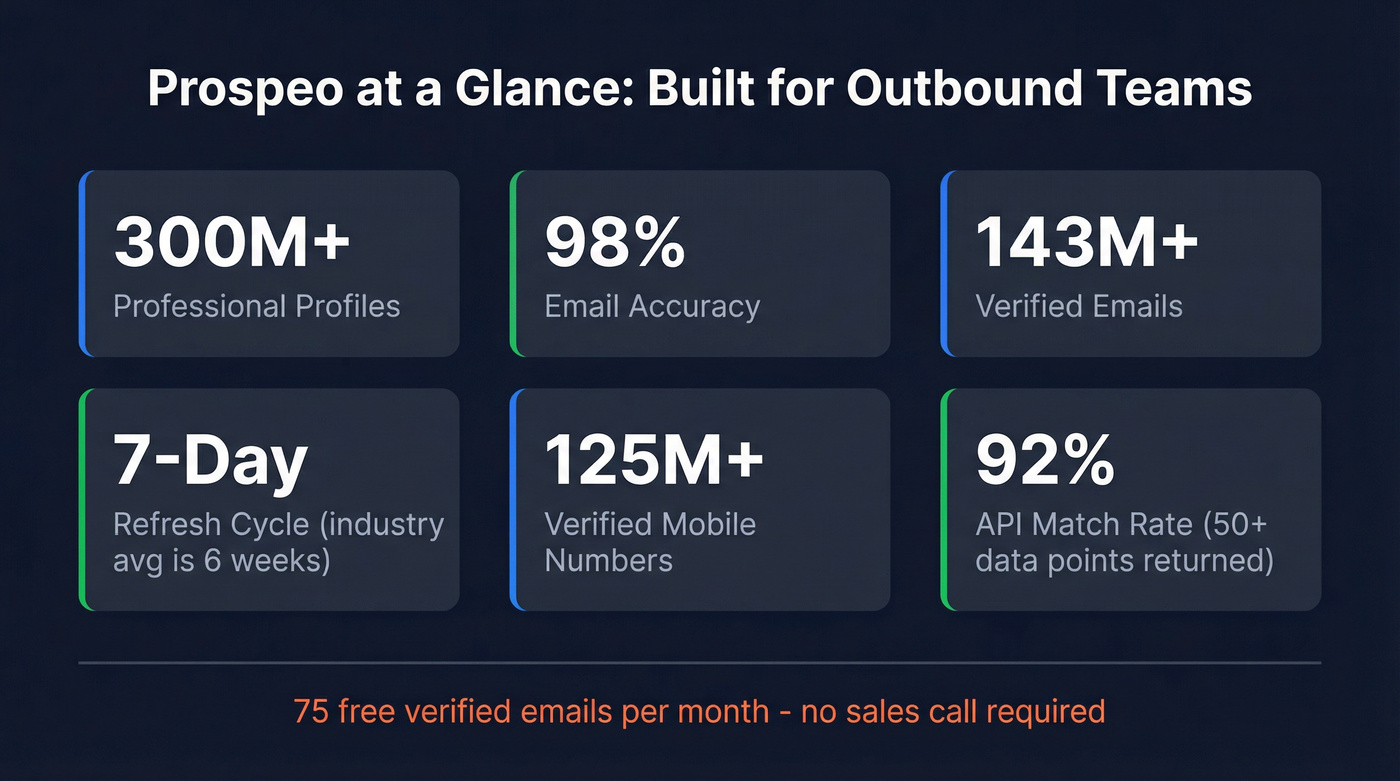
- 300M+ professional profiles
- 143M+ verified emails and 125M+ verified mobile numbers
- 98% email accuracy
- A 7-day refresh cycle (industry average is about 6 weeks)
- 30+ search filters (including intent, technographics, and job-change signals)
- Enrichment and API access (92% API match rate; enrichment returns 50+ data points)
Skip Prospeo if you're specifically buying bulk datasets to train models or resell data inside a product. That's not the job. But if your job is outbound and pipeline, it's one of the cleanest "start now, scale later" options we've used.

If your real goal is meetings booked - not bulk datasets ingested - you need data that's accurate enough to protect your domain and fresh enough to reach real inboxes. Prospeo's 5-step verification and weekly refresh keep bounce rates under control where other tools can't.
75 free verified emails per month, no sales call required.
Final verdict
Choose RocketReach if you want a familiar prospecting UI and you're willing to verify aggressively to avoid deliverability issues. It's fine for moderate-volume lookups, especially for small teams that won't feel the per-seat caps right away.
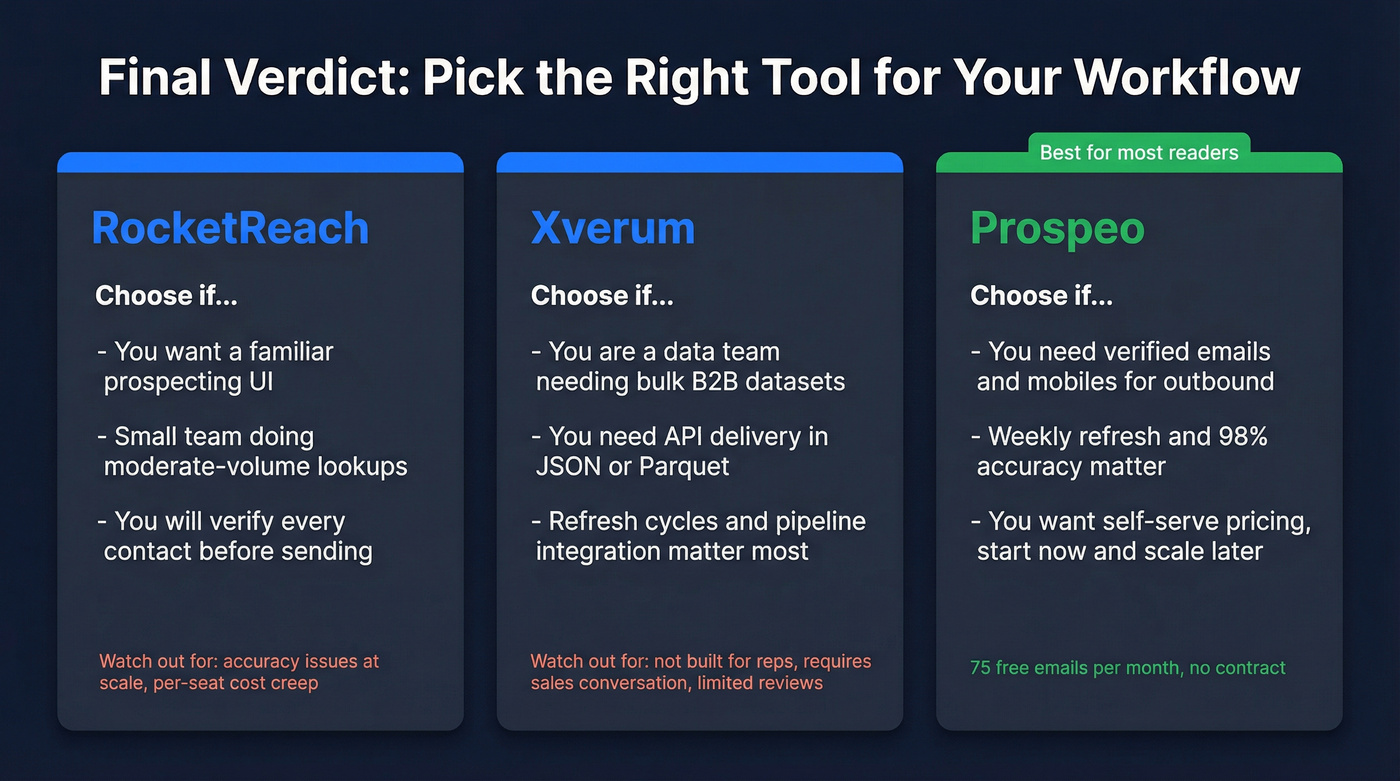
Choose Xverum if you're a data team that needs bulk B2B datasets via API, with refresh controls and delivery formats built for pipelines. It's not a rep tool, and it doesn't pretend to be.
If what you really need is verified emails and mobiles for outbound, with weekly refresh and self-serve pricing, use a tool built for that workflow. That's the category where Prospeo sits.
FAQ
Is Xverum a direct competitor to RocketReach?
No. Xverum is a dataset provider (API delivery, bulk formats like JSON/Parquet) aimed at data teams. RocketReach is a prospecting tool aimed at reps. Different buyers, different workflows, different success metrics.
How accurate is RocketReach in 2026?
RocketReach markets high accuracy, but public user reviews regularly complain about outdated or inaccurate records. Treat it as "good enough if you verify," not "safe to send without checks."
Can I use Xverum for cold email prospecting?
Not in a practical, day-to-day way. Xverum is built for bulk ingestion via API, not for per-contact lookups, list-building in a UI, or quick exports for sequences.
What's the simplest alternative for outbound teams?
A self-serve database with built-in verification and frequent refresh. Prospeo is designed for that: 98% email accuracy, 7-day refresh, 75 free emails/month, and integrations for common outbound and CRM workflows.
Sources
- RocketReach reviews on G2: https://www.g2.com/products/rocketreach/reviews
- Xverum profile on Datarade: https://datarade.ai/data-providers/xverum/profile
- RocketReach pricing guide (third-party): https://www.cleanlist.ai/blog/2026-03-19-rocketreach-pricing-guide