

SaaS Cold Email: Why Your Campaigns Fail (and How to Fix Them in 2026)
You're spending $30/mo on Instantly, feeding it a list you scraped from who-knows-where, and wondering why your reply rate is 0.8%. The copy isn't the problem. The data is.
Benchmark data from billions of cold email interactions puts the average reply rate at 3.43%. Most SaaS teams don't hit that - not because they can't write a decent email, but because they're sending to bad addresses, from poorly warmed domains, with zero infrastructure discipline. Fix the plumbing first. Then worry about your subject line.
What You Actually Need
Three things determine whether SaaS cold email works, in order of importance:
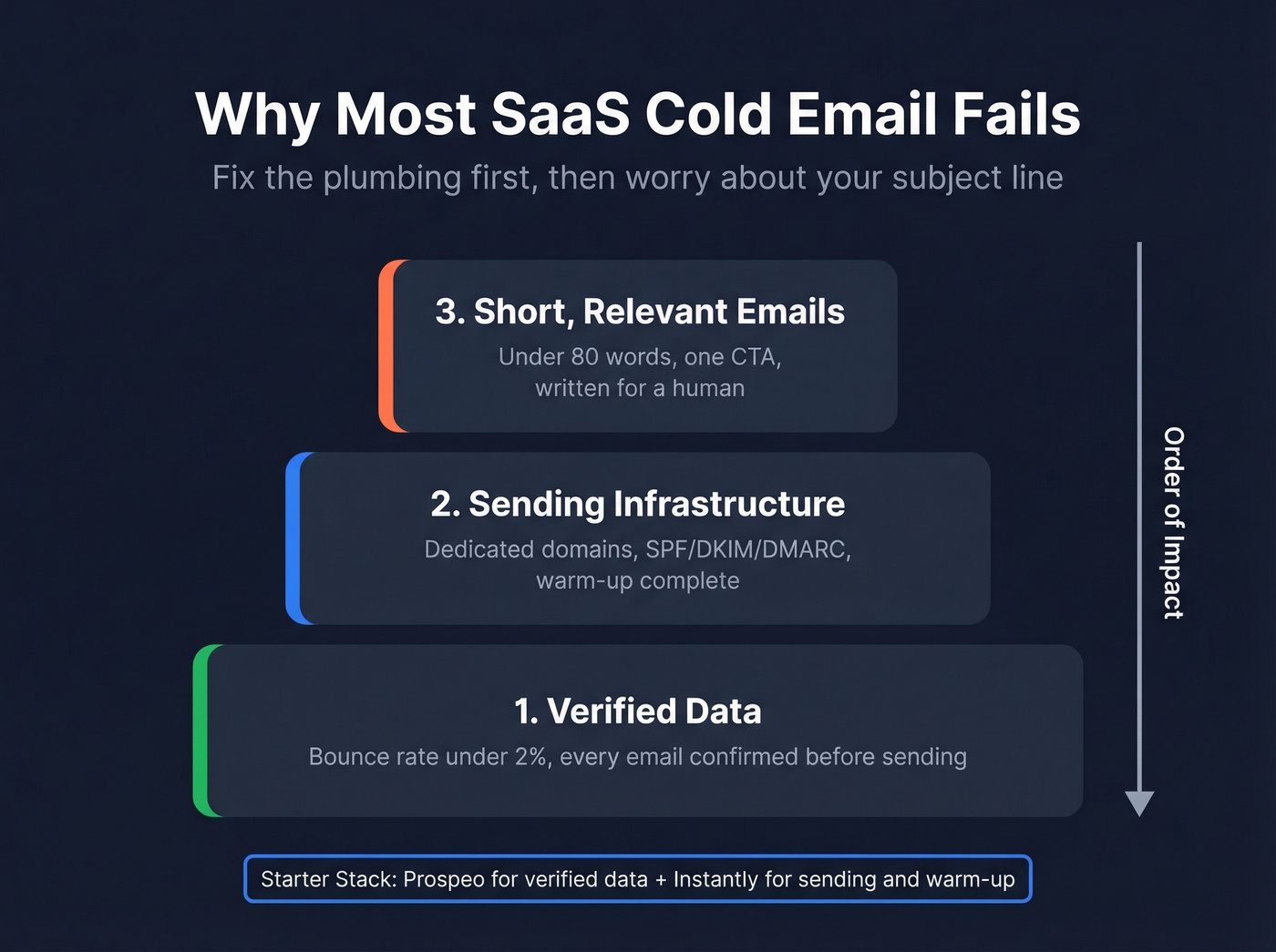
- Verified data - bounce rate under 2%, every email confirmed before it sends
- Proper sending infrastructure - dedicated domains, SPF/DKIM/DMARC, warm-up complete
- Short, relevant emails - under 80 words, one CTA, written for a human
Starter stack: Prospeo for verified contact data, Instantly for sending and warm-up. Everything else is optimization on top of that foundation.
Why Cold Email Still Works for SaaS
Cold email isn't dying. It's getting harder for people who do it badly.
SaaS companies still see 80.9% inbox placement - better than most industries. Every domain you warm up and every list you verify makes the next campaign cheaper and more effective. Paid ads stop the moment you stop spending. A well-built outreach system keeps producing pipeline at a marginal cost that drops over time.
The teams that "can't make cold email work" are almost always skipping data and infrastructure to jump straight to copy tweaks.
The 5-Step Playbook
Define Your ICP (Stop Emailing Everyone)
The fastest way to tank your reply rate is to email a broad list. Targeting SMB decision-makers yields 20-40% higher reply rates than spraying enterprise orgs, because there are fewer inbox filters and shorter decision chains.
Build two tiers:
- Tier 1: Best-fit accounts - they match your ideal company size, tech stack, and pain point. These get your most personalized sequences.
- Tier 2: Adjacent accounts - right industry, close enough on firmographics. These get your templated-but-relevant sequences.
Here's the thing: if your deal size is under five figures, you probably don't need ZoomInfo-level data or enterprise sequencing tools. A lean stack with accurate data will outperform a bloated one with stale contacts every time.
Layer trigger events to prioritize outreach timing. Prospects who just raised funding, posted relevant job openings, or adopted a competing technology are 3-5x more likely to engage. Intent data tracking 15,000 research topics lets you catch buyers actively evaluating solutions like yours - that's the difference between interrupting someone and arriving at the right moment. If you can't articulate why a prospect should care in one sentence, they shouldn't be on your list.
Set Up Sending Infrastructure
This is where most SaaS teams cut corners and pay for it later. The math: each sending inbox should handle 10-15 cold emails per day. You can run 2-3 inboxes per domain, giving you 30-45 sends per domain daily. To hit 400 emails/day, you need 10-12 dedicated domains.
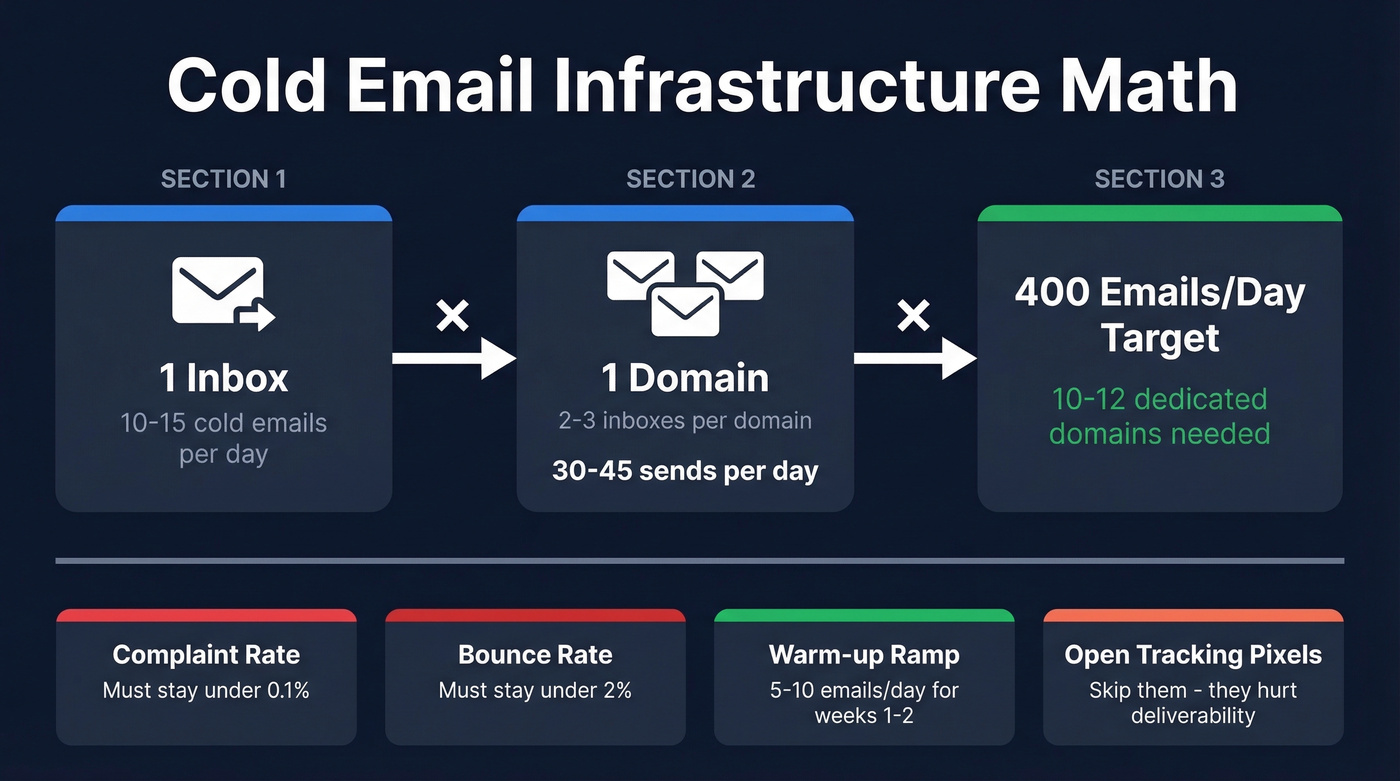
The non-negotiable checklist:
- Google Workspace or Microsoft 365 only. Cheap inbox resellers get suspended constantly.
- SPF + DKIM + DMARC on every domain. Start DMARC at
p=none, then move top=quarantineonce legitimate mail passes. - Dedicated sending domains. Never cold email from your primary domain. If a sending domain gets flagged, your transactional email stays safe.
- Warm-up ramp: 5-10 emails/day for weeks 1-2, scaling to max 50/day by week 7.
- Skip open-tracking pixels. They hurt deliverability more than the data is worth. (If you want the technical why, see tracking pixels.)
- Complaint rate under 0.1%. At 0.3%, Google and Yahoo block you entirely.
- Bounce rate under 2%. Above 5% means your data is the problem.
One more thing we've learned the hard way: limit platform access to people who need it, and vet every integration's data handling before connecting it to your sending infrastructure. One compromised tool can torch months of warm-up work.
Build a Verified Prospect List
Bad data doesn't just waste sends. It triggers a cascade: bounces damage sender reputation, ISPs start throttling, and the campaign dies. If you get blocked, recovery takes weeks, not days.
Verify every email before sending. Prospeo's database covers 300M+ professional profiles with 98% email accuracy, verified through a 5-step process that handles catch-all domains, removes spam traps, and filters honeypots. Data refreshes every 7 days - the industry average is 6 weeks, which means most providers serve you stale contacts by default.
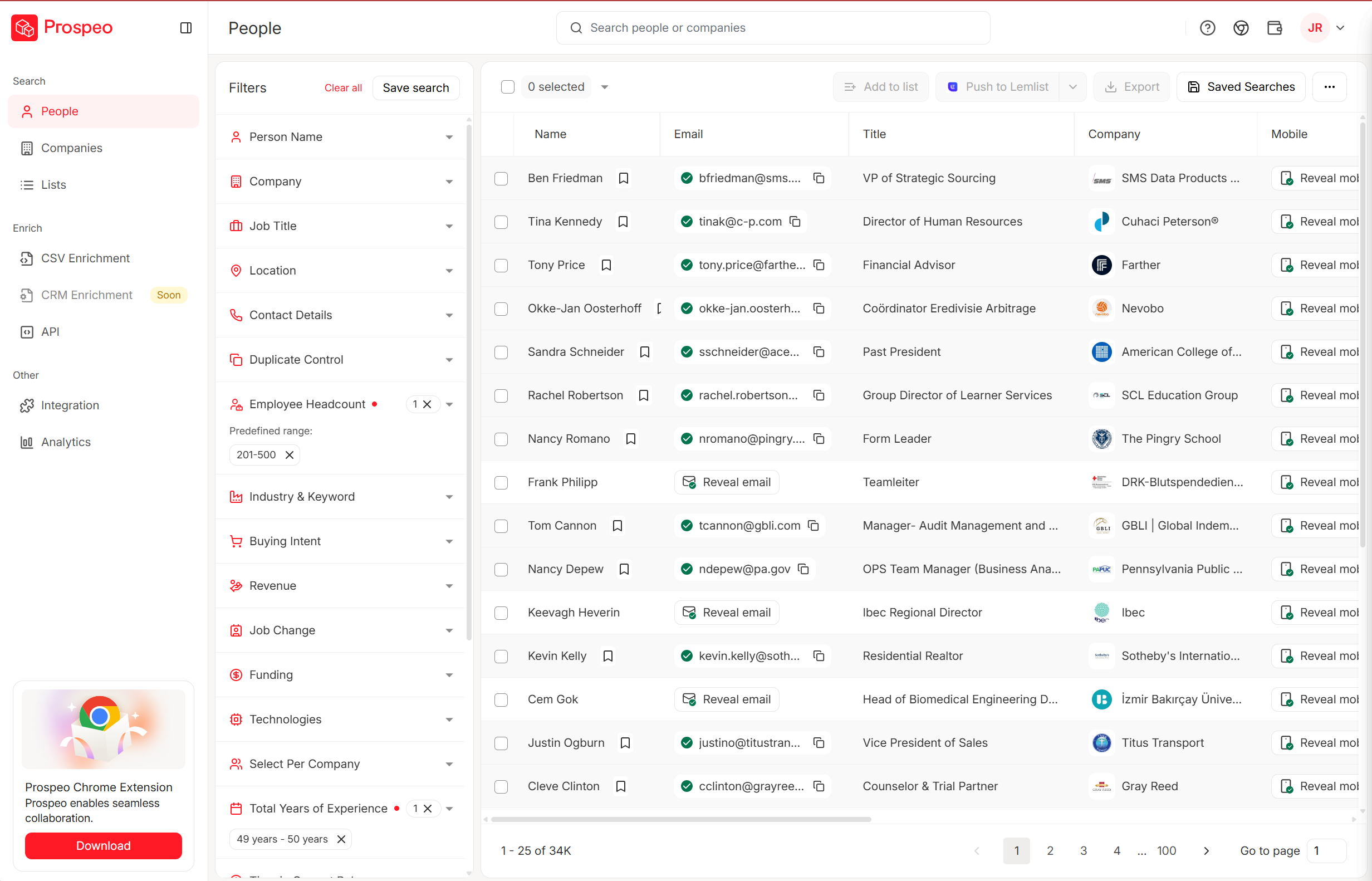
Snyk rolled this out across 50 AEs - bounce rates dropped from 35-40% to under 5%, AE-sourced pipeline jumped 180%, and they generated 200+ new opportunities per month. That's what clean data looks like at scale.
Skip this step if you're only sending to a handful of warm contacts you already know. But the moment you're emailing strangers at volume, verification isn't optional. If you're re-enriching lists from another provider, verify everything again before sending. Stale data from a 6-week refresh cycle is the #1 source of preventable bounces.
Write Emails That Get Replies
Stop obsessing over subject lines. If your open rate is below 30%, the problem is sender reputation, not your subject line.
The best-performing cold emails are under 80 words. Personalized cold emails perform 5x better than generic ones, and writing at a 6th-grade reading level lifts replies by 67%. The consensus on r/coldemail is blunt: nobody reads your third paragraph, so don't write one.
Rules that actually move the needle:
- One CTA per email. "Worth a quick Loom?" beats "Let's schedule a 30-minute demo." (More examples: email call to action.)
- Focus on "you," not "I." Every sentence should be about their problem, not your product.
- No exclamation marks in subject lines. They trigger spam filters and look desperate. (If you need options, pull from cold email subject line examples.)
- Personalize in the P.S. - it lifts response rates by ~35% and feels less formulaic than a personalized first line.
For teams sending 200+ emails daily, AI personalization is no longer optional. The workflow is straightforward: scrape a prospect's recent activity or company news, feed it to GPT with a prompt template, and merge the output into your first line or P.S. field. Teams running this report roughly 3x the response rate of fully templated sends. Keep the AI output to one sentence - anything longer reads like a robot wrote your email, because it did.
Build Your Sequence
58% of replies come from the first email. But the other 42% come from follow-ups, and most teams either don't follow up or send "just checking in" messages that add nothing.
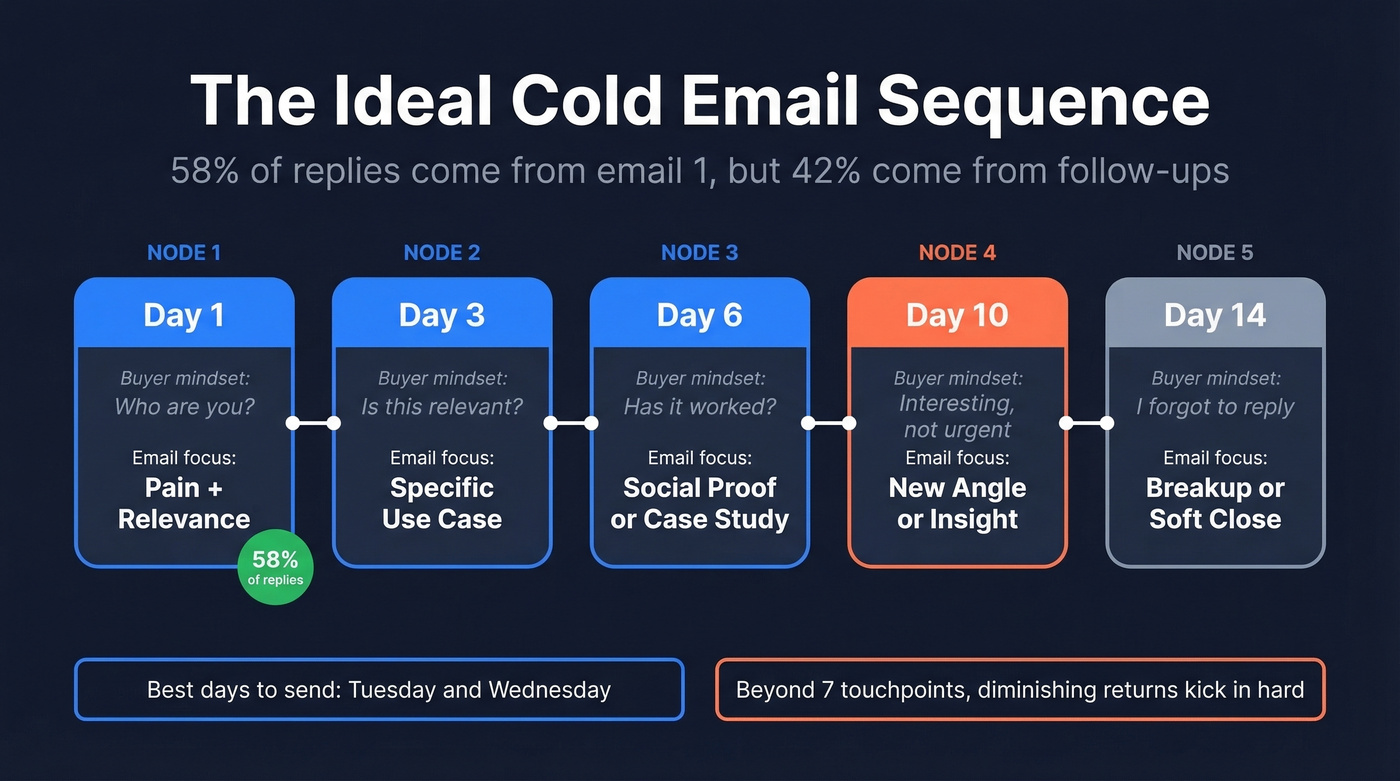
The sweet spot is 4-7 touchpoints. Each follow-up must introduce a new angle:
| Day | Buyer Mindset | Email Focus |
|---|---|---|
| 1 | "Who are you?" | Pain + relevance |
| 3 | "Is this relevant?" | Specific use case |
| 6 | "Has it worked?" | Social proof / case study |
| 10 | "Interesting, not urgent" | New angle or insight |
| 14 | "I forgot to reply" | Breakup / soft close |
Tuesday and Wednesday are peak days for replies. Beyond 7 touchpoints, diminishing returns kick in hard. (If you want a deeper framework, use a B2B cold email sequence.)
Reply handling matters as much as the sequence itself. Categorize every response - interested, objection, not now, wrong person - and have templates ready for each. The fastest path to a booked meeting is responding to a warm reply within 5 minutes, not 5 hours.

Snyk's 50 AEs dropped bounce rates from 35-40% to under 5% and generated 200+ opportunities/month with Prospeo's verified data. 300M+ profiles, 98% email accuracy, 7-day refresh cycle - the infrastructure your SaaS outbound needs.
Stop burning sending domains on bad data. Start at $0.01/email.
3 Templates That Convert
Template 1: The Pain Opener
Subject: {{company}} + [specific pain]
Hi {{first_name}},
Most {{job_title}}s at {{industry}} companies spend 10+ hours/week on {{pain_point}} - and still miss targets.
We help teams like {{similar_company}} cut that by 30% in the first month.
Worth a quick Loom showing how?
P.S. Noticed {{personalized detail}} - impressive.
Template 2: The Social Proof Lead
Subject: How {{similar_company}} fixed {{problem}}
Hi {{first_name}},
{{similar_company}} was dealing with {{specific problem}}. After switching to {{your product}}, they {{specific result}}.
Would a free pilot make sense for {{company}}?
Template 3: The Direct Ask
Subject: Quick question about {{process}}
{{first_name}} - are you handling {{process}} manually or using something?
We built {{product}} specifically for {{ICP description}}. Takes 15 minutes to set up.
Happy to show you in a 5-min Loom. Want me to send one over?
All three land under ~80 words. Swap the variables, keep the structure.
2026 Benchmarks Worth Knowing
| Metric | Average | Good | Elite |
|---|---|---|---|
| Open rate | 30-45% | 45-60% | 60%+ |
| Reply rate | 1.5-3% | 3-5% | 5%+ |
| Positive reply | 0.5-1.5% | 1.5-3% | 3%+ |
| Meeting booked | 0.3-1% | 1-2% | 2%+ |
| Bounce rate | 3-5% | 1-3% | <1% |
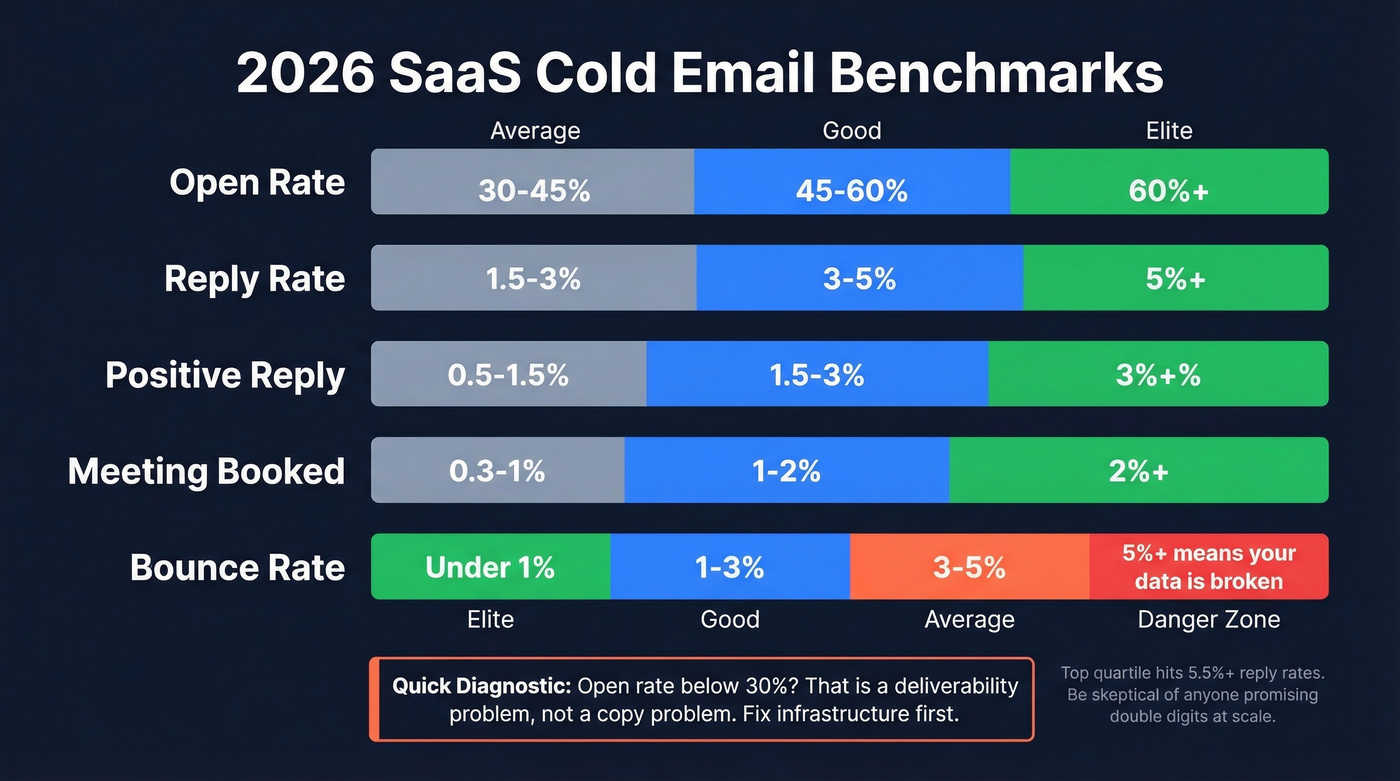
The top quartile hits 5.5%+ reply rates, and elite campaigns exceed 10.7%. But be skeptical of anyone promising double-digit reply rates at scale - those numbers typically come from hyper-targeted lists of 50-100 people, not campaigns sending 400/day. Reddit practitioners on r/coldemail consistently confirm that 2-4% is realistic at volume, and anything above 5% sustained means your targeting is genuinely dialed in.
The diagnostic that saves the most time: if your open rate is below 30%, you've got a deliverability problem, not a copy problem. Fix infrastructure first. Inbox placement varies by provider - Gmail lands 87.2%, Outlook 75.6%, Yahoo 86%, and Apple Mail 76.3%. If your list skews Microsoft-heavy, expect lower opens regardless of subject line quality. (More on the mechanics: email deliverability.)
The Recommended Tool Stack
| Function | Tool | Starting Price | Why |
|---|---|---|---|
| Data + Verification | Prospeo | Free-~$0.01/email | 98% accuracy, 7-day refresh |
| Data + Outreach | Apollo.io | Free-$79/user/mo | Database + sequencing combo |
| Email Finding | Hunter.io | Free-$49/mo | Simple domain search |
| Sending | Instantly | $30/mo | Best volume-to-cost ratio |
| Sending | Lemlist | $55/user/mo | Creative personalization |
| Sending | Smartlead | $94/mo | Multi-client / agencies |
| Sending | Saleshandy | $25/user/mo | Budget option |
| Sending | Woodpecker | $29/mo | Simple, reliable |
| Sending | Reply.io | $49/mo | Multichannel sequences |
| Sending | QuickMail | $49/mo | Agency-friendly |
| Warm-up | Mailreach | ~$25-50/mo | Dedicated warm-up |
| Warm-up | Warmbox | ~$15-50/mo | Affordable warm-up |
| CRM | HubSpot | Free tier | Starter CRM |
| CRM | Salesforce | ~$25-$165/user/mo | Enterprise standard |
| CRM | Pipedrive | ~$15-$30/user/mo | Sales-focused CRM |
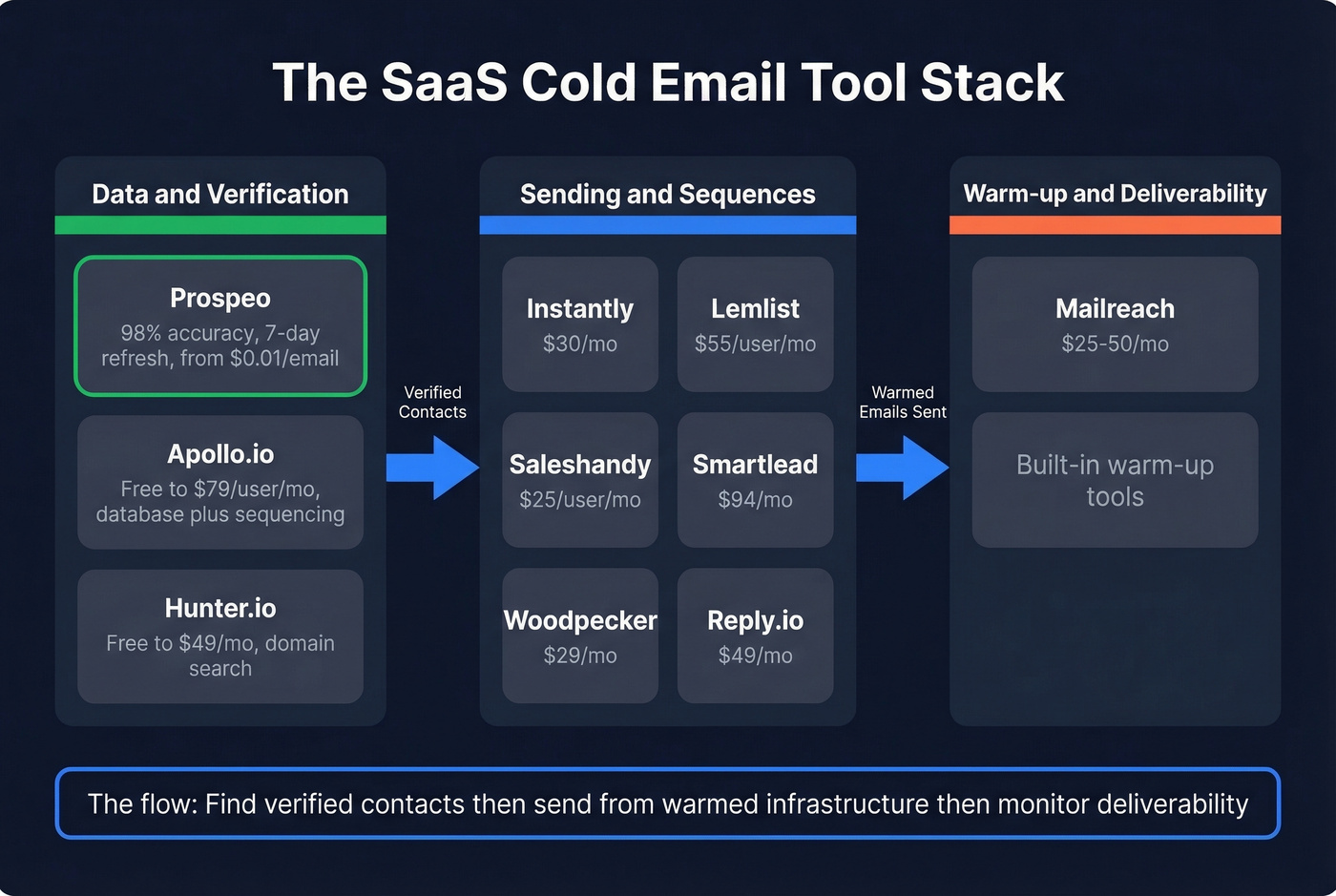
The data layer matters most. Apollo is the obvious alternative if you want data and sending in one platform, but its email accuracy sits around 79%, which means more bounces downstream. In our experience, verified contacts that push directly into your sequencer without manual CSV exports eliminate the stale-data gap that kills campaigns between list-building and sending. (If you're comparing providers, start with B2B company data.)
Is Cold Email Legal for SaaS?
Yes - with guardrails that vary by jurisdiction.
US (CAN-SPAM): No prior consent needed. You must include a valid physical address, a working unsubscribe link, honest subject lines, and clear sender identity. Violations run tens of thousands of dollars per email.
EU (GDPR): Cold email isn't banned, but it requires documented legitimate interest. You need to demonstrate relevance, respect data subject rights, and honor opt-outs immediately.
Canada (CASL): The strictest regime. Requires express or implied consent. Penalties reach millions of CAD.
The most common compliance failure we see: re-adding unsubscribed contacts via a data refresh. If someone opts out, they stay out - regardless of what your enrichment tool imports next week. Run every list through verification with spam-trap and honeypot filtering before importing. If you're operating across multiple jurisdictions, default to the strictest applicable standard. (Related: Is it illegal to buy email lists.)
Layer intent data across 15,000 topics with 30+ filters - funding, tech stack, job changes, headcount growth - to find SaaS buyers actively evaluating solutions like yours. Prospeo refreshes every 7 days so your sequences never hit stale contacts.
Arrive when prospects are ready to buy, not when your list expires.
FAQ
What reply rate should I expect?
At volume, 1.5-3% is the realistic average for SaaS cold email. Hitting 3-5% consistently is genuinely good and means your targeting and data are dialed in. Anyone promising 15% at scale is either lying or emailing 50 people.
How many domains do I need?
Plan for 2-3 inboxes per domain x 10-15 emails per inbox = 30-45 sends per domain daily. For 400 emails/day, that's 10-12 dedicated domains close to your brand name but distinct from your primary domain.
Can I use my primary domain?
No. Always use dedicated sending domains. If a cold outreach domain gets flagged, your transactional email - password resets, invoices, onboarding - stays unaffected. This is non-negotiable for any SaaS company running outbound.
How do I keep bounce rate under 2%?
Verify every email before sending with a tool that handles catch-all domains, spam traps, and honeypots. Re-verify any list older than 30 days. Addresses go stale faster than most teams realize, especially if your provider refreshes on a 6-week cycle.
What's the best free tool for building prospect lists?
Prospeo's free tier includes 75 verified emails per month with full enrichment - enough to test campaigns before scaling. Hunter offers 25 free searches monthly but caps enrichment. Apollo has a free tier with broader features but lower email accuracy at 79%, which means more bounces eating into your sender reputation.