

SaaS Sales Cycle: Benchmarks, Stage Timing, and How to Close Faster in 2026
It's the quarterly business review. The CRO pulls up the pipeline report and asks why average cycle length jumped 20% this quarter. You look at the data - deals are stalling in "Proposal Sent" for three weeks, enterprise opportunities are bleeding into the next quarter, and nobody can explain why. The answer is almost always the same: your SaaS sales cycle isn't broken in one place. It's leaking time at every stage.
An AE on r/sales described cramming discovery and demo into a single 30-minute call - "speed fishing" for pain points in the first 15 minutes - because when your cycle is supposed to be 14 days, every unnecessary meeting is a 50% extension. That's the tension every SaaS sales team lives with: compress the cycle without butchering the buyer experience.
Here's how to benchmark yours, find the leaks, and compress what you can.
Quick Version
- The median B2B SaaS sales cycle is 84 days - up 22% since 2022.
- SMB deals under $15K ACV should close in 14-30 days. Mid-market ($15K-$50K) runs 30-60 days. Enterprise ($100K+) takes 90-180+ days.
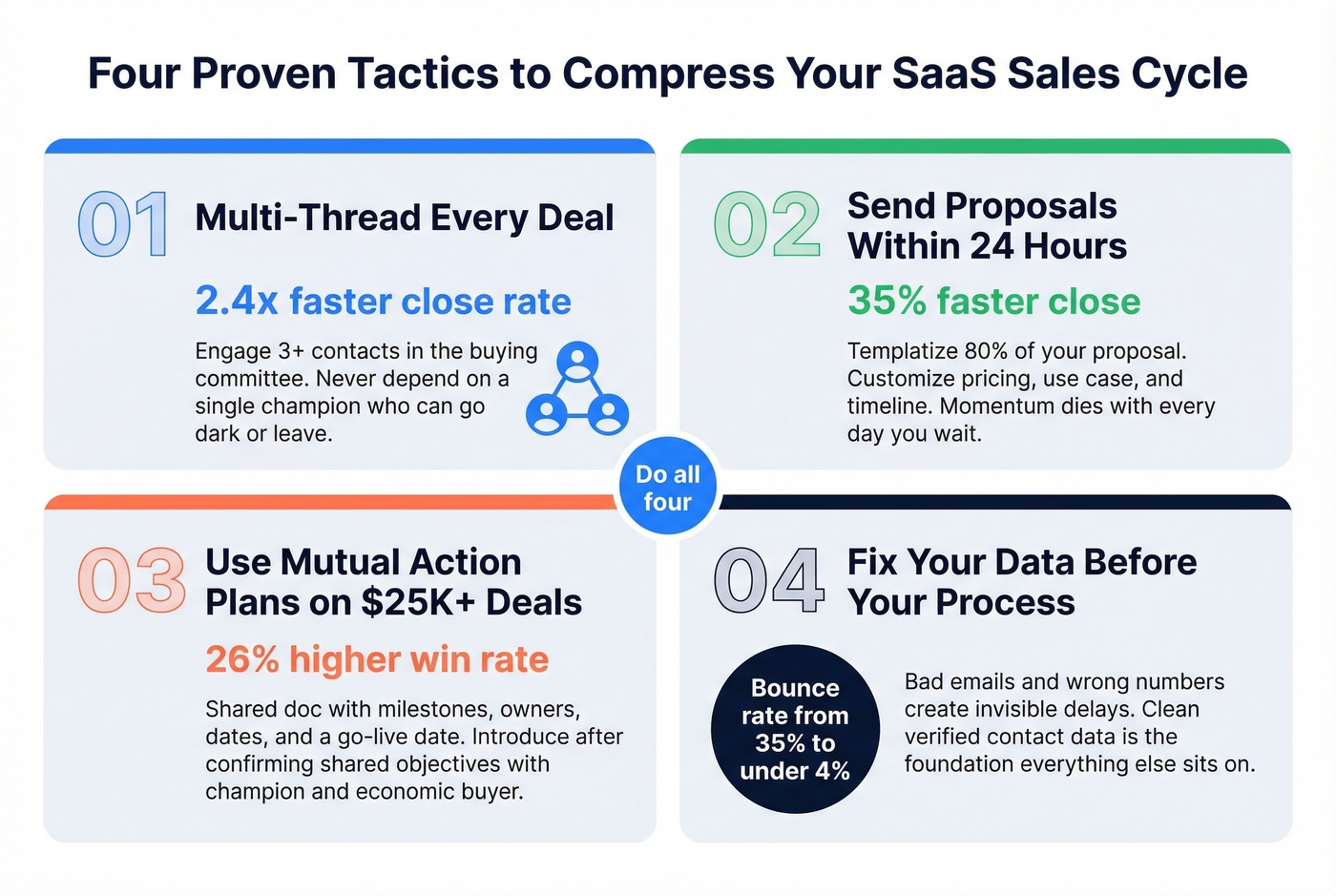
- Multi-threading - engaging 3+ contacts - closes deals 2.4x faster than single-threading.
- Proposals sent within 24 hours of the demo close 35% faster.
- Mutual Action Plans on $25K+ deals lift win rates by 26%.
- Teams tracking pipeline velocity weekly see 34% revenue growth vs. 11% for ad-hoc trackers.
- Stop obsessing over adding more pipeline. Start obsessing over cycle velocity - compressing from 90 to 45 days increases revenue per day by 38%.
What Is a SaaS Sales Cycle?
The SaaS sales cycle is the time from first meaningful contact with a prospect to a signed contract. It's distinct from traditional software sales because you're selling a subscription, not a perpetual license. The buyer's risk is lower (they can churn), but the evaluation bar is higher because they're committing to an ongoing relationship.
Some frameworks extend the cycle through onboarding and expansion, but for benchmarking purposes, first contact to signed contract is the measurement that matters. Don't confuse the sales cycle with the sales funnel either - the funnel describes the stages prospects move through, while the cycle measures how long that journey takes. You need both to diagnose problems, but cycle length is the metric that directly impacts revenue velocity and forecasting accuracy.
2026 Benchmarks by Deal Size
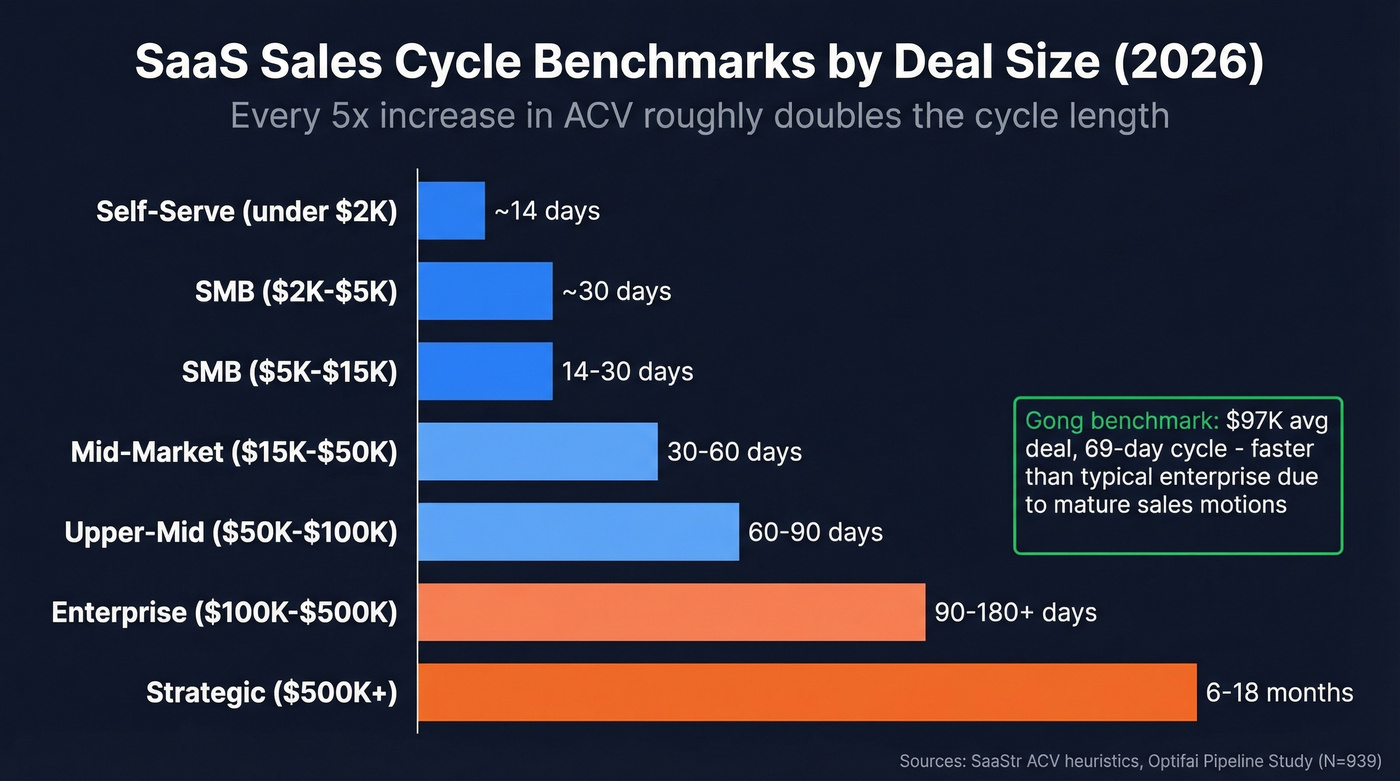
Here are the benchmark ranges, drawn from SaaStr's ACV heuristics and the Optifai Pipeline Study (N=939):
| ACV Range | Cycle Length | Segment |
|---|---|---|
| < $2K | ~14 days | Self-serve |
| $2K-$5K | ~30 days | SMB |
| $5K-$15K | 14-30 days | SMB |
| $15K-$50K | 30-60 days | Mid-market |
| $50K-$100K | 60-90 days | Upper-mid |
| $100K-$500K | 90-180+ days | Enterprise |
| $500K+ | 6-18 months | Strategic |
A useful cross-reference: across Gong's customer base, the average deal size is $97K with a 69-day cycle. That's faster than the enterprise benchmarks above, which tells you Gong's customers skew toward companies with mature, optimized sales process motions.
The rule of thumb that's held up in every pipeline review we've run: every 5x increase in ACV roughly doubles the cycle. If your $25K deal takes more than 90 days, you don't have a market problem - you have a process problem.
Stage-by-Stage Breakdown
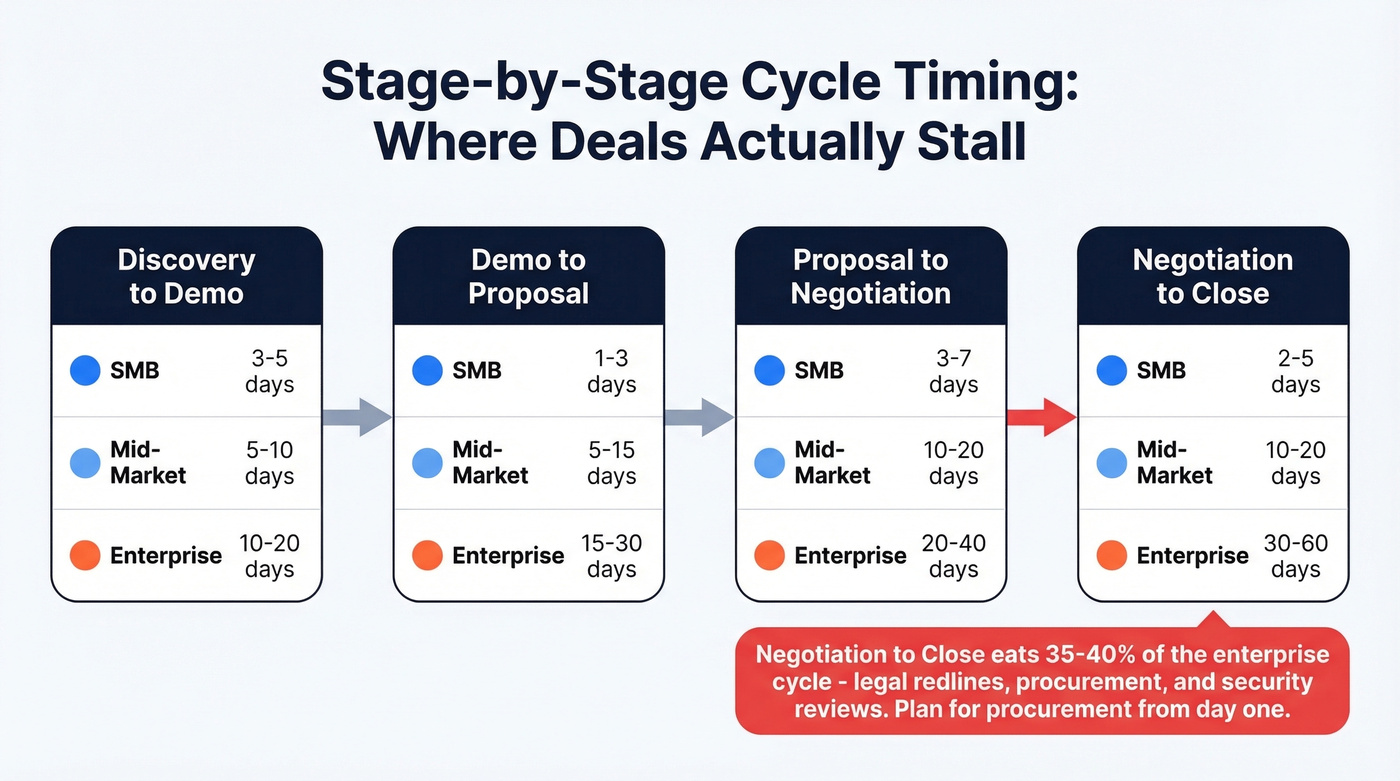
The Optifai study tracked CRM timestamps across won deals to produce stage-level durations by segment:
| Stage Transition | SMB (days) | Mid-Market | Enterprise |
|---|---|---|---|
| Discovery -> Demo | 3-5 | 5-10 | 10-20 |
| Demo -> Proposal | 1-3 | 5-15 | 15-30 |
| Proposal -> Negotiation | 3-7 | 10-20 | 20-40 |
| Negotiation -> Close | 2-5 | 10-20 | 30-60 |
The pattern that jumps out: Negotiation to Close eats 35-40% of the total enterprise cycle. That's legal redlines, procurement workflows, and security reviews. If you aren't planning for procurement from day one on enterprise deals, you're building three to six weeks of delay into every opportunity.
For SMB, the entire cycle can compress into a single week when the product is straightforward and the decision-maker is on the first call. The moment you need a second meeting to "loop in the team," you've doubled your cycle.
Why Cycles Keep Getting Longer
Three structural forces are stretching deal timelines, and none of them are going away.
Buying committees keep expanding. The average B2B buying group has grown from 5.4 in 2020 to 6.8 per Gartner's 2024 data. More people means more calendars to coordinate, more objections to address, and more internal selling your champion has to do without you in the room. We've seen deals where the champion was fully bought in on day three but couldn't get the CFO and security lead aligned for another six weeks.
Security and compliance reviews are table stakes. SOC 2 questionnaires, GDPR assessments, and vendor risk reviews add two to four weeks to mid-market and enterprise deals. These reviews are getting longer, not shorter, as companies tighten vendor management.
Pilots and POCs are the new normal. 70% of enterprise deals now require a pilot or proof of concept before procurement will sign off. That's four to eight weeks of evaluation baked into every deal before negotiation even starts.

Multi-threading closes deals 2.4x faster - but only if you can actually reach those 3+ stakeholders. Prospeo gives you verified emails (98% accuracy) and direct dials (125M+ mobiles) for every member of the buying committee, so your champion isn't the only thread keeping the deal alive.
Cut weeks off your cycle by reaching the full buying committee on day one.
Pipeline Velocity and Conversion Rates
Cycle length is one variable in the pipeline velocity equation - and the most actionable one. Here are the B2B funnel benchmarks from FirstPageSage (65% B2B dataset; your SaaS-specific numbers will differ by segment):
- Lead to MQL: 39%
- MQL to SQL: 38%
- SQL to Opportunity: 42%
- SQL to Closed: 37%
One caveat worth flagging: Digital Bloom's compilation pegs MQL-to-SQL as low as 15-21% for some segments. If your conversion at this stage is below 30%, that's your biggest leak - fix it before worrying about cycle length.
The formula that ties it together:
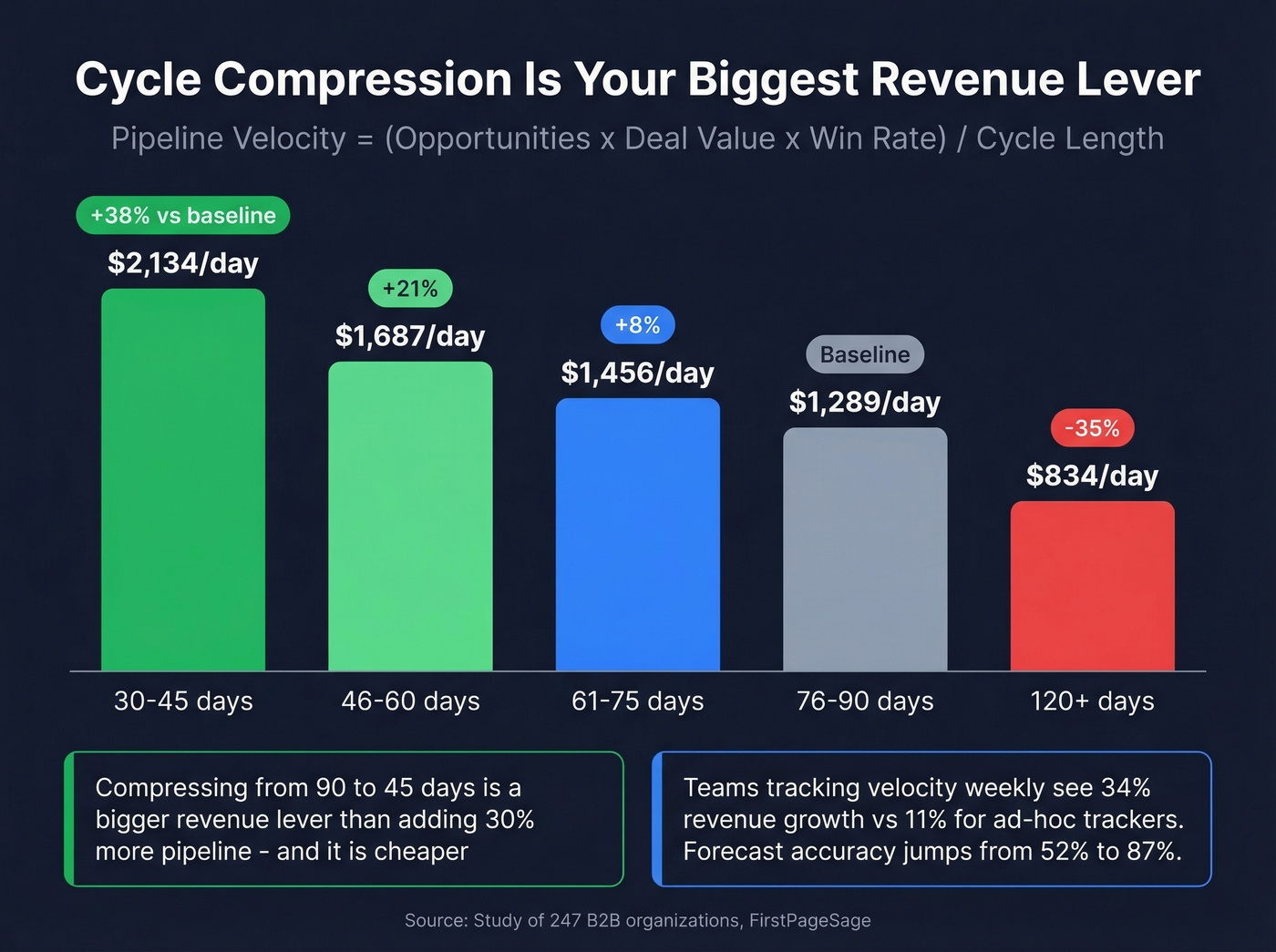
Pipeline Velocity = (Opportunities x Deal Value x Win Rate) / Cycle Length
A study of 247 B2B organizations shows how dramatically cycle length impacts velocity:
| Cycle Length | Velocity/Day | vs. Baseline |
|---|---|---|
| 30-45 days | $2,134 | +38% |
| 46-60 days | $1,687 | +21% |
| 61-75 days | $1,456 | +8% |
| 76-90 days | $1,289 | Baseline |
| 120+ days | $834 | -35% |
The SaaS & Technology median sits at $1,847/day with a median deal of $12,400, 22% win rate, and 67-day cycle. Compressing your cycle from 90 to 45 days is a bigger revenue lever than adding 30% more pipeline. And it's cheaper.
Let's be honest: most SaaS companies pour money into top-of-funnel when the real ROI is in cycle compression. Adding 50 more opportunities to a 120-day cycle with a 20% win rate is like pouring water into a leaky bucket. Fix the bucket first.
Teams that track pipeline velocity weekly see 34% revenue growth versus 11% for ad-hoc trackers. Forecast accuracy jumps from 52% to 87%. Weekly measurement is the difference between managing your pipeline and guessing at it.
How to Compress Your Sales Cycle
Multi-Thread Every Deal
Use this when: You're selling to accounts with more than one stakeholder - which is every mid-market and enterprise deal in 2026.
Skip this if: You're running pure self-serve with sub-$2K ACV and a single decision-maker.
What happens when you don't? Your champion goes dark for a week because they're on PTO, and the deal stalls. Or they leave the company, and your opportunity dies. Single-threading into a 6.8-person buying committee is a death sentence for deal velocity.
The data backs this up: deals with 3+ contacts engaged close 2.4x faster. But multi-threading requires having verified contact data for the CFO, the VP of Engineering, the security lead - not just your initial champion. Tools like Prospeo let reps map the full buying committee with verified emails and direct dials using 30+ search filters before the first call, so you're never dependent on a single thread.
Send Proposals Within 24 Hours
Proposals sent within 24 hours of the demo close 35% faster. Momentum matters. The prospect just saw your product, they're excited, and every day you wait is a day for competing priorities to creep in.
The fix is simple: templatize 80% of your proposal and customize the remaining 20% - pricing, use case specifics, implementation timeline. If your proposals take three days because legal needs to review custom terms, pre-approve standard language for deals under a certain threshold.
Use Mutual Action Plans on $25K+ Deals
Outreach's data shows deals with Mutual Action Plans have a 26% higher win rate than deals without them. A MAP is a shared document between buyer and seller that aligns on the objective, key milestones with dates, owners on both sides, deliverables at each stage, and a go-live date working backward from close.
Introduce the MAP after confirming shared objectives with your champion and economic buyer - not on the first call. The MAP forces both sides to acknowledge procurement timelines, legal review windows, and budget approval cycles upfront. It turns "we'll get back to you" into a documented commitment with a date.
Fix Your Data Before Your Process
Here's a cycle-killer that never shows up in CRM reports: bad contact data.
When an email bounces, the rep doesn't log "wasted 3 days waiting for a response from an invalid address." When a phone number is disconnected, the follow-up attempt silently fails. These micro-delays compound across every deal in your pipeline. Meritt experienced this firsthand - they went from a 35% bounce rate to under 4% after switching to Prospeo's verified data, and their pipeline tripled from $100K to $300K per week.
If you're seeing bounce issues, start with your email bounce rate and work backward to list sources and verification.
If your reps are spending time chasing dead email addresses and disconnected phone numbers, no amount of process optimization will fix your cycle. Clean, verified data is the foundation everything else sits on.
Every day a deal sits in your pipeline costs you $1,289+ in velocity. Bad contact data is the silent cycle killer - bounced emails, wrong numbers, and ghosted follow-ups add weeks to stages that should take days. Prospeo's 7-day data refresh and 98% email accuracy eliminate the dead ends that stall deals between Demo and Close.
Stop losing deals to stale data. Start at $0.01 per verified email.
Respond to Inbound in Under 5 Minutes
SaaStr's guidance is blunt - call inbound leads back within one to five minutes. After 30 minutes, your odds of qualifying that lead drop by an order of magnitude. Route inbound to available reps instantly, not to a queue that gets checked hourly.
Touchpoints That Move Deals (and Ones That Kill Them)
Not all touchpoints are equal. Some accelerate deals, others silently stall them. In our experience, these are the five most common time-wasters we see in pipeline reviews:
Gating high-intent inbound behind SDR qualification. If a VP fills out a demo request and gets a 15-minute "qualification call" with a junior rep, you've added friction and annoyed your buyer. Route them directly to AEs.
Automating outreach for six-figure deals. A $100K purchase requires personalized discovery. Running enterprise prospects through the same eight-touch cadence as SMB leads signals you don't understand their buying process.
Letting demo requests sit for 24-48 hours. By then, the prospect has booked calls with two competitors. Speed wins.
Single-threading enterprise deals. With 6.8 stakeholders in the average buying group, relying on one champion is gambling your pipeline on one person's internal influence.
Disqualifying instead of nurturing. When a prospect isn't ready, drop them into a long-term sequence - don't delete them. The deal you kill today is the deal your competitor closes next quarter.
Cycle Length by Sales Model
The model you're running fundamentally shapes what "normal" looks like.
Self-serve compresses or eliminates SDR qualification, formal proposals, and procurement entirely. The buyer signs up, swipes a card, and starts using the product. This works for sub-$2K ACV where a single decision-maker can act without approval. One underappreciated variable: trial length. A 14-day trial is standard, but complex products that default to 30-day trials can unintentionally stretch the cycle by giving prospects permission to delay their evaluation.
Transactional (sales-assisted) adds a human touch - typically an AE running a demo and handling objections - but keeps the cycle under 30-60 days. This is the sweet spot for $5K-$50K ACV where the buyer needs confidence but not a six-month evaluation.
Enterprise adds POC, security review, multi-stakeholder alignment, and formal procurement. Cycles of 90-180+ days are structural, not a sign of dysfunction. The goal isn't to make enterprise deals close like SMB deals - it's to eliminate wasted time within each stage.
PLG (product-led growth) is a hybrid that's reshaping how we think about cycles entirely. The "sale" often starts with a free user who expands into a team plan, and the sales team enters mid-cycle rather than at the top. The relevant metric shifts from initial close to activation-to-expansion timeline.
Key Metrics to Track
| Metric | Formula / Definition | Benchmark |
|---|---|---|
| Pipeline Velocity | (Opps x Value x Win%) / Cycle | $1,847/day (SaaS) |
| Win Rate | Won / Total Opps | 20-30% |
| Median Cycle | Days, first contact to close | 84 days (B2B SaaS) |
| Median Deal Size | Closed-won revenue / deals | $26,265 (private SaaS) |
| Lead to MQL | MQLs / Total Leads | 39% |
| MQL to SQL | SQLs / MQLs | 38% |
| SQL to Opp | Opps / SQLs | 42% |
| CAC | Total sales + marketing spend / new customers | Target < 12-month payback |
| LTV | ARPA x gross margin / churn rate | Target LTV:CAC of 3:1+ |
| Monthly Churn | Churned customers / total customers | 2-3% monthly (SMB); <1% (enterprise) |
Track these weekly, not monthly. The correlation between weekly pipeline tracking and revenue growth isn't subtle - it's a 3x difference.
If you want a tighter operating cadence, align these with your pipeline health review.
FAQ
What's the average SaaS sales cycle length in 2026?
The median B2B cycle is 84 days based on the Optifai Pipeline Study (N=939), up 22% since 2022. Duration varies dramatically by deal size: SMB deals under $15K ACV close in 14-30 days, while enterprise deals over $100K typically take 90-180+ days.
How does deal size affect cycle length?
Every 5x increase in ACV roughly doubles the cycle. A $5K deal should close within 30 days, a $25K deal within 90, and a $100K+ deal can take three to nine months. Anything significantly longer signals a process problem worth diagnosing stage by stage.
What's the fastest way to shorten a SaaS sales cycle?
Multi-thread every deal by engaging 3+ contacts at the target account - this closes deals 2.4x faster. Combine that with sending proposals within 24 hours of the demo (35% faster close) and using Mutual Action Plans on deals above $25K (26% higher win rate per Outreach's data).
What tools help compress cycle length?
Verified contact data eliminates the hidden delays caused by bounced emails and disconnected numbers. Prospeo provides 98% email accuracy and 125M+ verified mobile numbers on a 7-day refresh cycle, so reps reach the right stakeholders immediately. Pair that with a CRM that tracks stage timestamps and a deal-room tool for Mutual Action Plans.
What is pipeline velocity and why does it matter?
Pipeline velocity measures revenue generated per day: (Opportunities x Deal Value x Win Rate) / Cycle Length. SaaS companies average $1,847/day. Compressing your cycle from 90 to 45 days increases velocity by 38% - often a bigger revenue lever than adding more pipeline.