

Sales Styles: Find Yours, Adapt to Any Buyer, and Close More Deals
84% of sales reps missed quota last year. Reps spend only a third of their time actually selling. And 96% of prospects research your company before they'll even take a call. The gap between quota-crushers and everyone else isn't talent - it's how deliberately they match their sales style to the buyer across the table.
As one popular r/sales thread put it: "Have conversations, not presentations." That single shift separates reps who hit number from reps who blame their territory.
Quick Framework by Deal Size
There's no single best approach. But there is a best style for your deal size, buyer type, and sales cycle. Here's the quick framework:
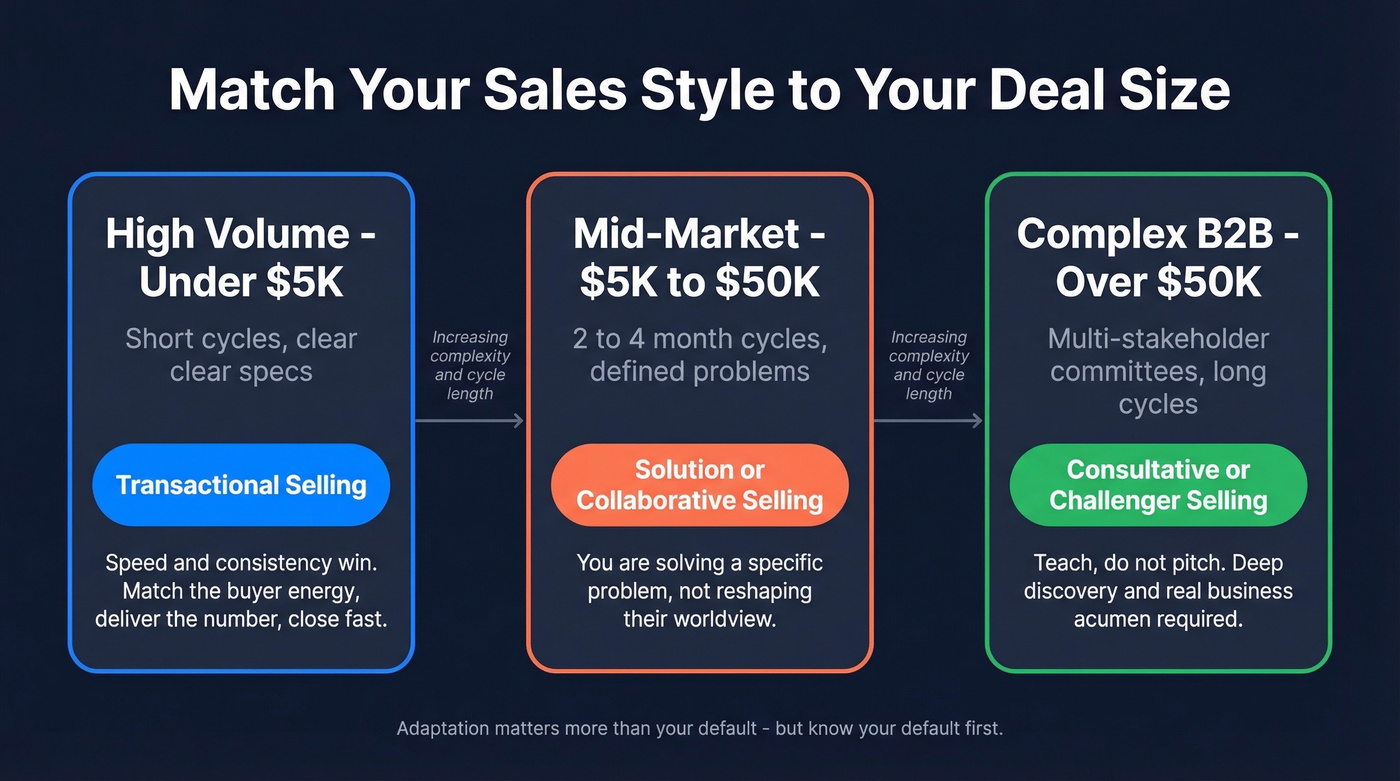
- Complex B2B deals over $50K with multi-stakeholder committees: Consultative or Challenger selling. Teach, don't pitch.
- High-volume, low-ACV products under $5K: Transactional selling with disciplined follow-up. Speed and consistency win.
- Mid-market deals with 2-4 month cycles: Solution or collaborative selling. You're solving a defined problem, not reshaping the buyer's worldview.
Adaptation matters more than your default - but you need to know your default first. Intentional selling starts with understanding which styles exist and when each one applies.
10 Selling Styles Every Rep Should Know
Transactional Selling
Pure speed and efficiency. You match a known need to a product and close fast. This works for commodity products, clear specs, and buyers who already know what they want. The risk: you become interchangeable. If price is the only differentiator, you lose to whoever's cheaper next quarter.
When a prospect keeps cutting you off with "just tell me the price," that's a transactional buyer. Don't fight it. Match their energy, deliver the number, close.
Solution Selling
You diagnose a problem, then prescribe your product as the fix. Solution selling still works when buyers can articulate their pain but don't know the remedy. The trap is assuming the buyer's stated problem is the real one - it often isn't.
Consultative Selling
This is the hardest style to execute well, and we've seen plenty of teams botch it. You act as an advisor, ask deep questions, and co-create the solution with the buyer. It requires genuine business acumen, not discovery call scripts. If your team can't run consultative selling at a high level, solution or transactional will actually outperform it. Bad consultative selling just looks like slow selling.
Here's a scenario every mid-market rep knows: your manager says "be more consultative," but your quota is volume-based and your average deal is $2K. The answer isn't to ignore the advice - it's to run a compressed consultative process. Two sharp diagnostic questions, not twenty.
Relationship Selling
Long-game trust building. You invest in the person, not just the deal.
This shines in industries with repeat purchases and high switching costs - enterprise renewals, financial services, managed services. The downside: it's slow to generate pipeline and can mask weak closing skills behind "I'm building the relationship."
Challenger Selling
Around 40% of top B2B performers fit the Challenger profile. The framework rests on three behaviors: teach the buyer something new, tailor the message to their context, and take control of the commercial conversation. Without real intellectual ammunition, though, Challenger selling just comes across as arrogant. Some teams call this the guru approach - leading with authority and expertise - but it only works when the expertise is genuine.
Insight (Provocative) Selling
Insight selling shares DNA with Challenger, but the emphasis shifts to reframing the buyer's entire understanding of their problem. With 71% of prospects preferring independent research over talking to a rep, the only way to earn a conversation is to offer a perspective they can't find on their own. You're telling a story about the buyer's world that they haven't heard before, and that story creates urgency.
Social Selling
Real social selling means using professional networks and content to warm up prospects before outreach - not posting motivational quotes on your feed. Reps who do this well share industry insights and engage with prospects' content before the first DM. Reps who do it poorly just have a nicer profile and no pipeline.
Collaborative Selling
You and the buyer work as partners to design the solution. Common in enterprise deals where the buyer's team has deep domain expertise and your job is to bring technical capability. It requires checking your ego at the door - you're the facilitator, not the smartest person in the room.
Soft Selling
Soft selling prioritizes low-pressure guidance over aggressive closing. You educate, nurture, and let the buyer arrive at their own decision. It builds trust and reduces churn, but it can stall deals when buyers need a nudge to commit. If this is your default, pair it with clear next-step agreements to keep momentum alive.
High-Pressure Selling
Let's be honest: high-pressure selling isn't just ethically questionable - it's inefficient. Churn costs more than a lost deal. There are narrow contexts where urgency-driven selling works (limited inventory, genuine time constraints), but as a default style, skip it entirely in B2B. If you find yourself relying on pressure tactics, the real problem is usually weak discovery earlier in the cycle.
The Hybrid Approach
Most top performers blend styles: consultative discovery with Challenger insights, a shift to transactional when the buyer signals readiness, relationship building layered throughout. The hybrid approach isn't a cop-out - it's the endgame. But you need to master individual approaches before you can blend them effectively.
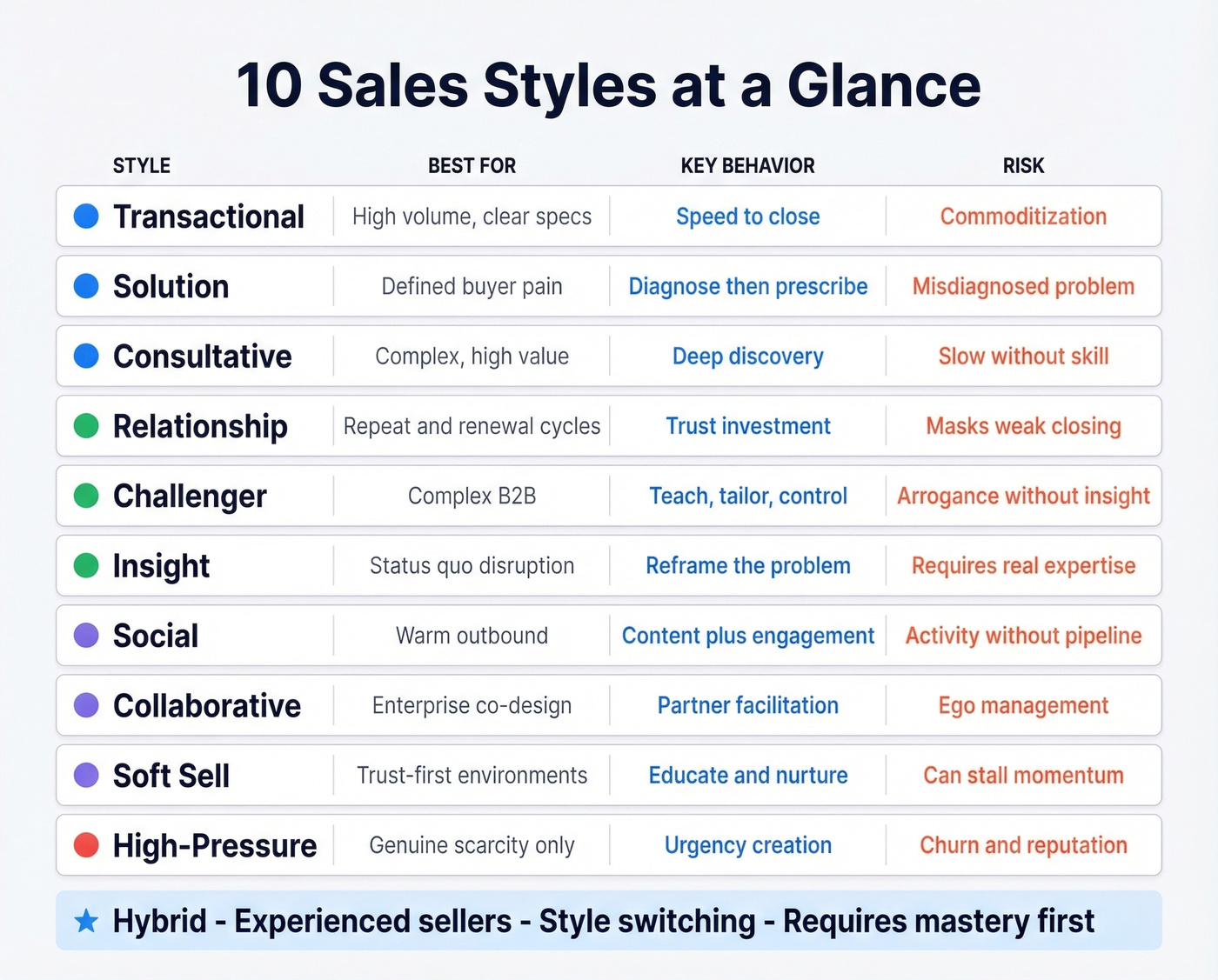
At-a-Glance Comparison
| Style | Best For | Key Behavior | Risk/Pitfall |
|---|---|---|---|
| Transactional | High-volume, clear specs | Speed to close | Commoditization |
| Solution | Defined buyer pain | Diagnose then prescribe | Misdiagnosed problem |
| Consultative | Complex, high-value | Deep discovery | Slow without skill |
| Relationship | Repeat/renewal cycles | Trust investment | Masks weak closing |
| Challenger | Complex B2B | Teach/tailor/control | Arrogance without insight |
| Insight | Status quo disruption | Reframe the problem | Requires real expertise |
| Social | Warm outbound | Content + engagement | Activity without pipeline |
| Collaborative | Enterprise co-design | Partner facilitation | Ego management |
| Soft Sell | Trust-first environments | Educate and nurture | Can stall momentum |
| High-Pressure | Genuine scarcity only | Urgency creation | Churn and reputation |
| Hybrid | Experienced sellers | Style-switching | Requires mastery first |
One framework you'll see elsewhere is the Hunter/Farmer model - a 2x2 matrix mapping proactive vs. reactive reps against new business vs. account growth. It's useful for role design, but it describes what you do, not how you sell. The styles above cover the how.
What's Your Default Selling Style?
Before you can adapt, you need to know your default. The fundraiseinsider diagnostic model maps sellers into five archetypes:
The Hunter thrives in high-activity environments - cold outreach, new logo acquisition, fast pipelines. Growth area: slowing down enough to run real discovery instead of sprinting to the close.
The Consultant excels at deep discovery and complex problem-solving. Ideal for enterprise sales with long cycles. Growth area: moving deals forward with urgency instead of endlessly "adding value."
The Networker builds webs of relationships and referrals - the rep who somehow knows someone at every target account. Growth area: converting relationships into revenue without feeling transactional about it.
The Strategist thinks in systems - territory plans, account maps, competitive positioning. Growth area: connecting with buyers emotionally, not just analytically.
The Educator leads with content, insights, and teaching. They're natural Challengers. Growth area: knowing when to stop teaching and start closing.
Power Pairings for Teams
The best sales teams aren't built from one archetype. Pair a Hunter with a Consultant for full-cycle coverage - the Hunter opens the account, the Consultant runs multi-threaded discovery and expands the deal. Combine a Networker with a Strategist for account-based plays. Put an Educator next to a Hunter and you've got insight-driven outbound that actually converts.
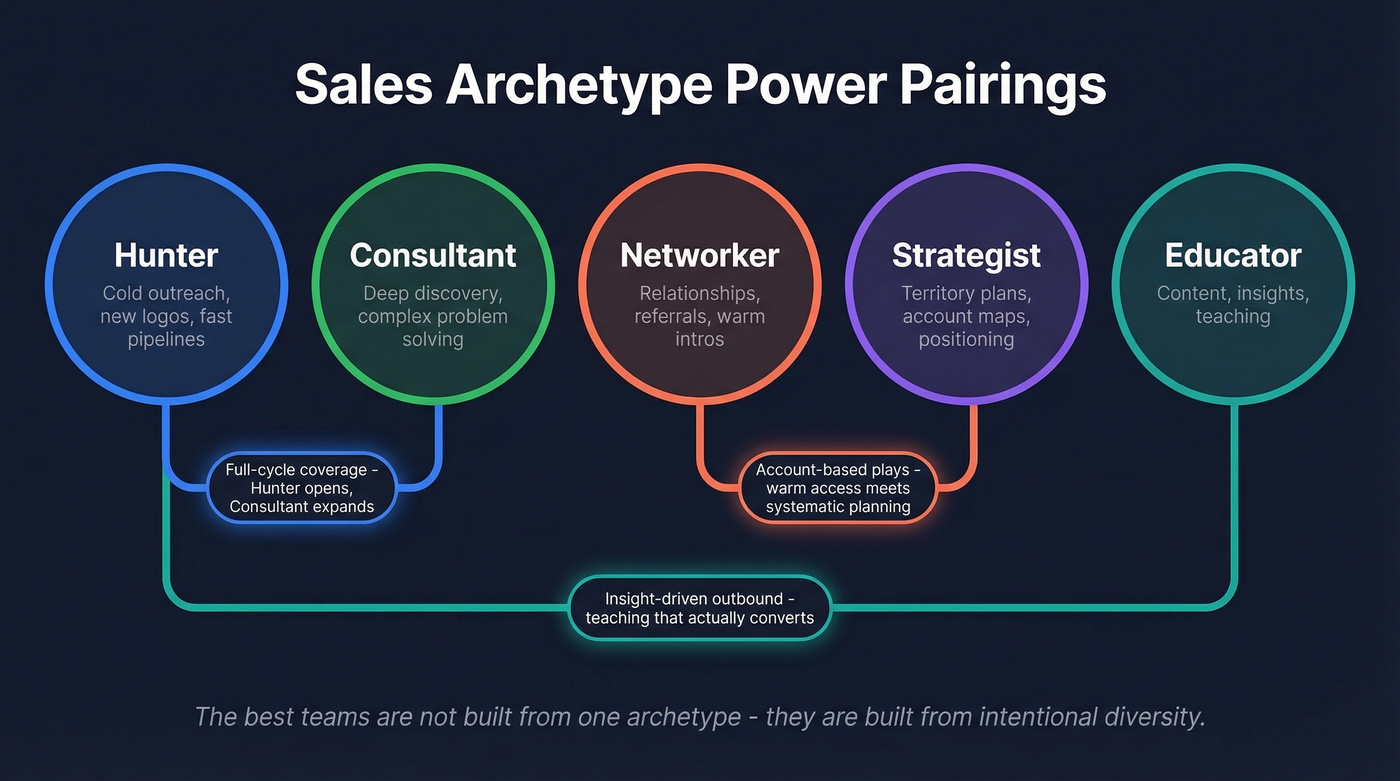
In our experience, the teams that hit plan most consistently aren't the ones with the most talent - they're the ones with the most intentional archetype diversity.

Every sales style in this guide depends on one thing: reaching the actual decision-maker. Prospeo gives you 98% accurate emails and 125M+ verified mobile numbers with a 30% pickup rate - so your consultative discovery calls, Challenger insights, and relationship-building efforts land with real buyers, not dead inboxes.
Stop perfecting your pitch for prospects you'll never reach.
How to Adapt Your Style to Any Buyer
Knowing your own approach is step one. Step two is reading the buyer and flexing accordingly. The DISC framework from Brooks Group gives you a practical system that works in real time.
To tighten your prep, start with a clear ideal customer profile so you're not stretching for the wrong accounts.
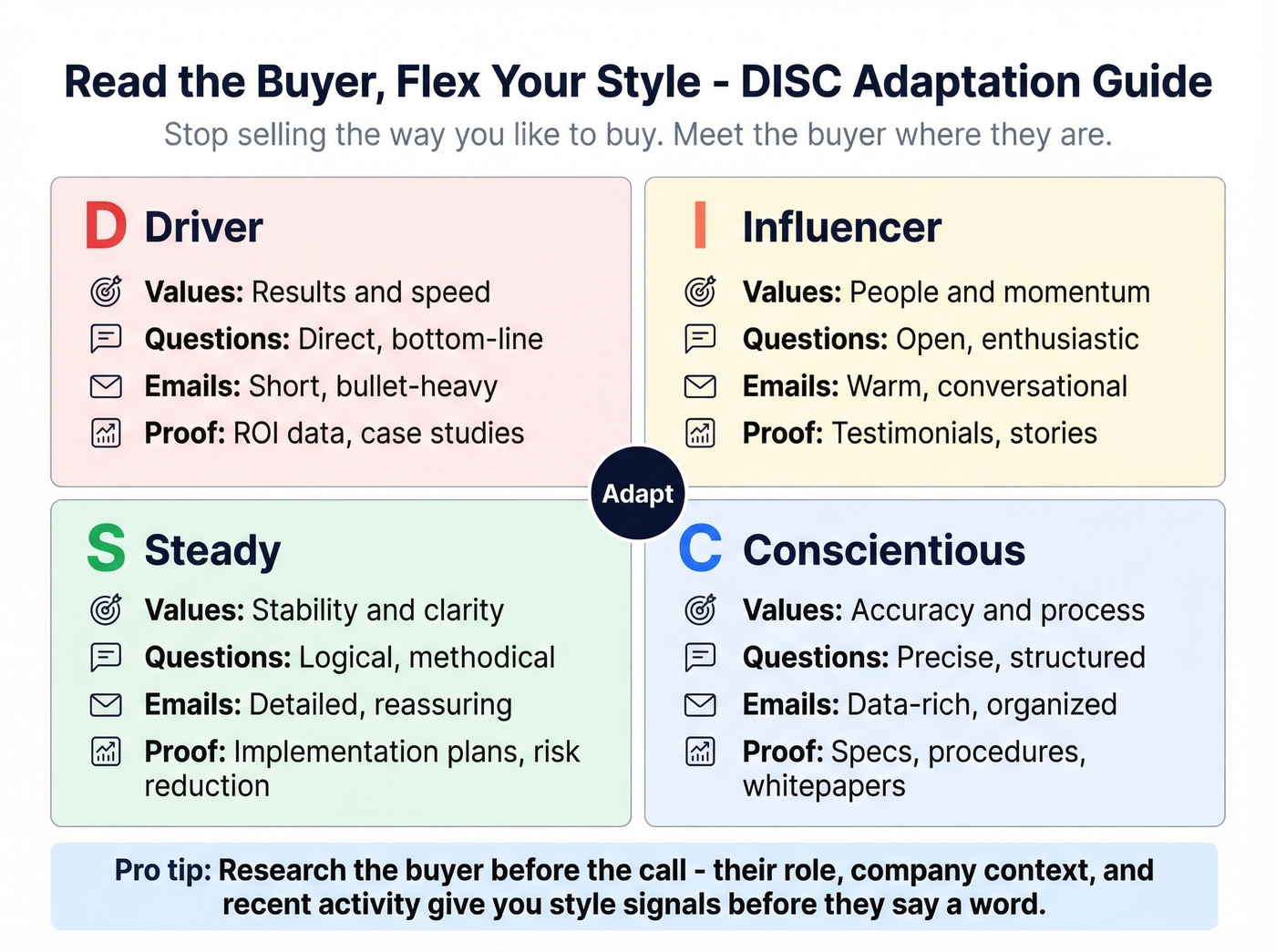
Here's the thing most reps get wrong: they sell the way they like to buy, and it only works on a slice of prospects. The DISC model calls this "stretching" - deliberately moving outside your natural style to meet the buyer where they are.
| Buyer Type | What They Value | Questioning Style | Email Style | Proof Type |
|---|---|---|---|---|
| D (Driver) | Results, speed | Direct, bottom-line | Short, bullet-heavy | ROI data, case studies |
| I (Influencer) | People, momentum | Open, enthusiastic | Warm, conversational | Testimonials, stories |
| S (Steady) | Stability, clarity | Logical, methodical | Detailed, reassuring | Implementation plans, risk reduction |
| C (Conscientious) | Accuracy, process | Precise, structured | Data-rich, organized | Specs, procedures, whitepapers |
The Sandler adaptability framework simplifies mid-call adjustments: detail-oriented buyers need precision and data; big-picture thinkers want strategy and outcomes; expressive buyers respond to energy; reserved buyers need you to slow down and listen more.
What most reps skip is preparation. You can read a buyer's style faster when you've done your homework - walking into a call knowing the prospect's role, company context, and recent activity gives you signals before they say a word. Tools like Prospeo surface verified contact data and intent signals across 15,000 topics, so you're reading the room before you enter it.
If you're building more top-of-funnel volume, use proven sales prospecting techniques so your style has more at-bats.
59% of business buyers say they aren't satisfied with reps' efforts to understand their goals. That's a style problem, not a product problem.
Choosing the Right Style for Your Deal
Deal size and cycle length should drive your style selection more than personal preference. Outreach's data shows that opportunities closed within 50 days have a 47% win rate, compared to 20% or lower beyond that threshold. How you sell often matters more than what you sell - the same product pitched with the wrong approach to the wrong buyer will lose to a competitor who reads the room better.
For complex B2B deals in the $500K-$3M range with multi-stakeholder buying committees, consultative and Challenger selling are the most reliable approaches. The 2026 Selling Challenges research from Challenger Inc. surveyed nearly 500 B2B sellers and found that 60% cite gaining buyer commitment as their top negotiation concern, while 50% say getting a first meeting is a major challenge. Those numbers demand a style that earns attention through insight, not just persistence.
For sub-$5K deals with short timelines, transactional selling with disciplined follow-up wins. A single follow-up email increases reply rates by 49% compared to a single-touch approach. Don't overthink the style - optimize the cadence with battle-tested sales follow-up templates.
And here's a hot take worth sitting with: if your average contract value is under $10K, you probably don't need consultative selling at all. A tight transactional process with genuine empathy will outperform a bloated discovery framework every time. Save consultative for deals that justify the time investment.
Gartner found that purchase regret for customers who prefer a rep-free experience is 23% higher than for customers who interact with a sales rep. Your style doesn't just close deals - it prevents buyer's remorse. That's long-term revenue protection.
One more alignment point: your selling style should match your company's brand positioning. A premium brand running high-pressure tactics creates cognitive dissonance. A scrappy startup trying to run white-glove consultative selling on $1K deals burns cash. Style and brand need to rhyme - especially if you're refining your B2B brand positioning.
Whether you sell transactional or consultative, bad data kills deals before your style even matters. Prospeo's 7-day data refresh and 5-step verification mean you spend your time selling - not bouncing emails. Teams book 35% more meetings than Apollo users.
Master any sales style when every email actually lands.
The Biggest Mistake Reps Make
Dave Kahle makes an argument that's uncomfortable but worth sitting with: "I have my own style" is the most dangerous sentence in sales. It sounds like confidence. It's actually an excuse to stop improving.
Think about it this way. A surgeon doesn't say "I have my own style of removing an appendix." There are identifiable best practices, and the best practitioners study and adopt them. Sales is the same - a profession with learnable, repeatable behaviors that separate top performers from everyone else.
Remember that 84% quota miss rate? A big chunk of that gap comes from reps who've decided their approach is "good enough" and stopped iterating. The best sellers treat their sales style as a living system - constantly adjusting based on what the data and the buyer tell them. Your default is your starting point, not your ceiling. Sometimes the underdog strategy - leaning into your smaller size, faster responsiveness, or scrappier approach - beats the polished enterprise pitch because it feels more authentic to the buyer.
If you want a more measurable approach, lean into data-driven selling and track what actually moves deals.
FAQ
What's the most effective sales style?
Consultative and Challenger selling consistently outperform in complex B2B deals with $50K+ contract values and multi-stakeholder committees. For high-volume deals under $5K, transactional selling with disciplined follow-up delivers the best win rates. Match your approach to deal complexity, not personal preference.
Can you use multiple sales styles at once?
Yes - top performers typically blend two to three styles and adapt based on the buyer's personality, deal stage, and urgency. Master individual approaches first so you switch deliberately, not reactively. The hybrid approach is the endgame for experienced sellers.
How do I identify a buyer's communication style quickly?
Listen for pace, detail preference, and decision drivers in the first 90 seconds of any call. Fast talkers who ask about ROI are Drivers; methodical questioners who want specs are Conscientious types. The DISC framework maps these signals to four buyer types with specific adaptation strategies.
What tools help me adapt my selling style faster?
A CRM for pipeline management, conversation intelligence for coaching, and a verified data platform for pre-call research. Prospeo's 30+ search filters and intent data across 15,000 topics let you identify buyer context before the first call - so your chosen style lands with the right person from the start.
What is negative reverse selling?
Negative reverse selling involves gently discouraging the prospect from buying, which paradoxically increases their desire to move forward. Saying "this might not be the right fit" reduces pressure and lets the buyer sell themselves. It's rooted in the Sandler methodology and works best with skeptical or highly analytical buyers.