

Sales Account Management: The 2026 Operational Playbook
Finance just asked why expansion revenue is flat when you added 15 new logos last quarter. The answer is almost always the same: your sales account management program runs on relationship instincts instead of operational discipline. This is the playbook that closes the gap - with real benchmarks, tiering frameworks, and the tech stack to back it up.
The Short Version
Account management is a revenue function, not customer service. Three things separate high-performing AM programs from the rest: tiered portfolios with five or fewer key accounts per AM, data-backed QBRs with usage metrics and ROI proof, and multi-threaded relationships so one champion's departure doesn't kill the account. Median NRR for private SaaS is 102% - top quartile hits 111%. The gap isn't relationship skills. It's systems.
What Is Sales Account Management?
Sales account management is the practice of growing revenue from existing customers through strategic planning, relationship development, and expansion execution. It's a revenue function - not a support role, not a help desk with a quota.
The distinction that matters is between reactive account management and strategic key account management (KAM). Reactive AMs juggle 20-50 accounts, responding to inbound requests and hoping renewals close themselves. Strategic KAMs manage roughly five accounts with hyper-focused attention - mapping stakeholders, identifying whitespace, and co-creating value with the customer's leadership team. You've seen the perennial "hunter vs. farmer" debate. The real answer is that farming, done strategically, is the higher-leverage motion for most mature SaaS orgs.
The Business Case
It costs $2.00 in S&M spend to acquire $1.00 of new customer ARR. Expansion from existing accounts costs a fraction of that. This math alone should make account management your highest-ROI investment.
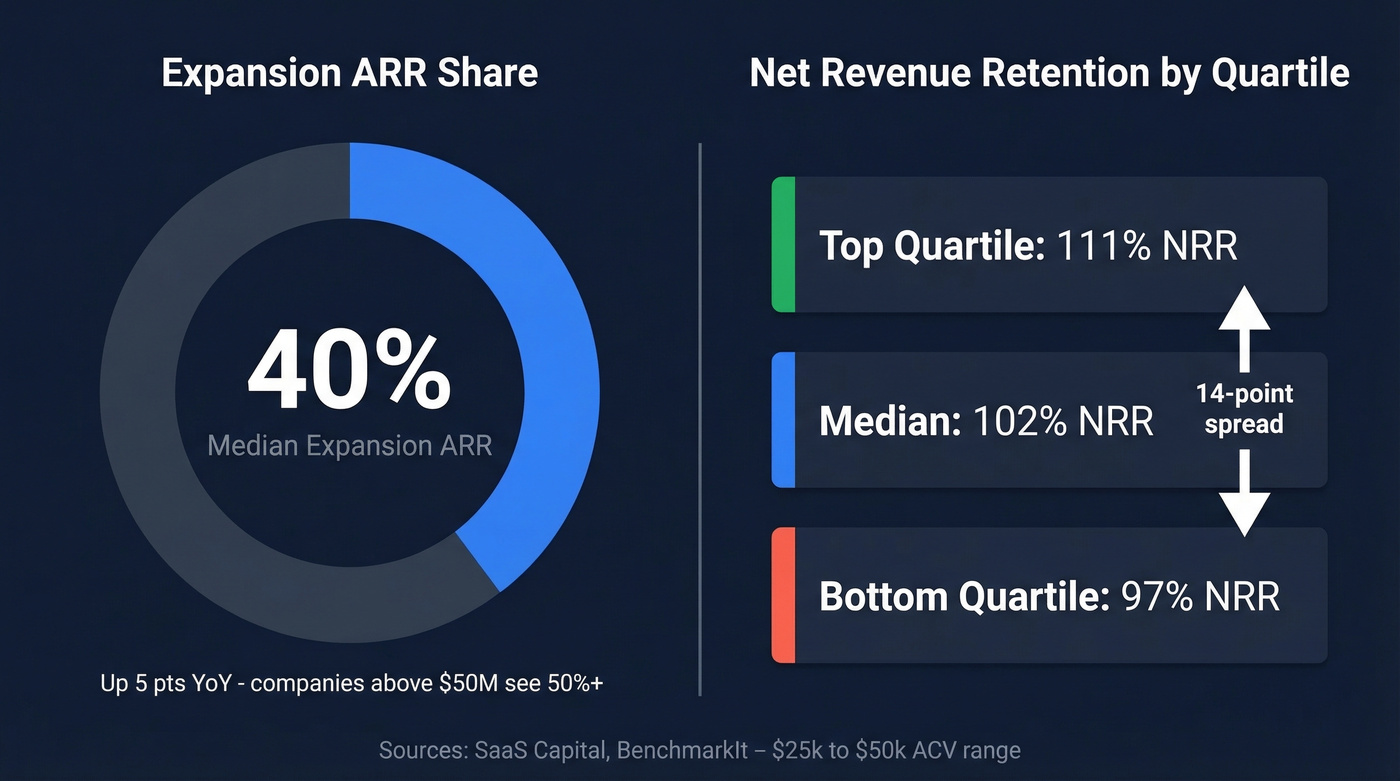
Expansion ARR now represents 40% of total new ARR at the median, up five percentage points year-over-year. At companies above $50M, expansion contributes more than half of new ARR. This isn't a nice-to-have growth lever - it's the primary engine.
Retention benchmarks tell the same story. For SaaS companies in the $25k-$50k ACV range, median NRR sits at 102%, top quartile at 111%, and bottom quartile at 97%. That 14-point spread between top and bottom quartile is the difference between compounding growth and a leaky bucket.
Let's be honest: if your average deal size is under $10k annually, you probably don't need a dedicated KAM program. You need better onboarding and a scaled CS motion. KAM only pays off when individual accounts are worth the dedicated headcount.
AM vs Sales Rep vs CSM
These three roles get conflated constantly. Here's the clean split.
| Sales Rep | Account Manager | CSM | |
|---|---|---|---|
| Focus | New pipeline | Select high-value clients | Entire customer base |
| Primary KPIs | New ARR, pipeline | NRR, expansion, renewals | Retention, adoption, CLV |
| Engagement | Outbound, demos, close | Strategic, high-touch | Proactive, scaled |
| Account load | Territory-based | 5-25 accounts | 50-200+ accounts |
| Comp structure | Heavy variable | Variable + retention | Mostly base salary |
AMs own revenue outcomes. CSMs own adoption and health. Sales reps own new logos. When you blur these lines - asking AEs to manage renewals, or expecting CSMs to close upsells - everyone underperforms. CSM median base salary runs about $75,000; AMs typically earn more because their comp includes expansion-tied variable.

Single-threaded accounts kill expansion revenue. Multi-threading requires verified contact data across every buying committee - and that data goes stale fast. Prospeo refreshes 300M+ profiles every 7 days with 98% email accuracy, so your stakeholder maps never have dead ends.
Stop losing accounts when one champion leaves.
Account Tiering and Team Structure
Here's the thing - if your AMs are managing 40+ accounts, you don't have account management. You have reactive firefighting.
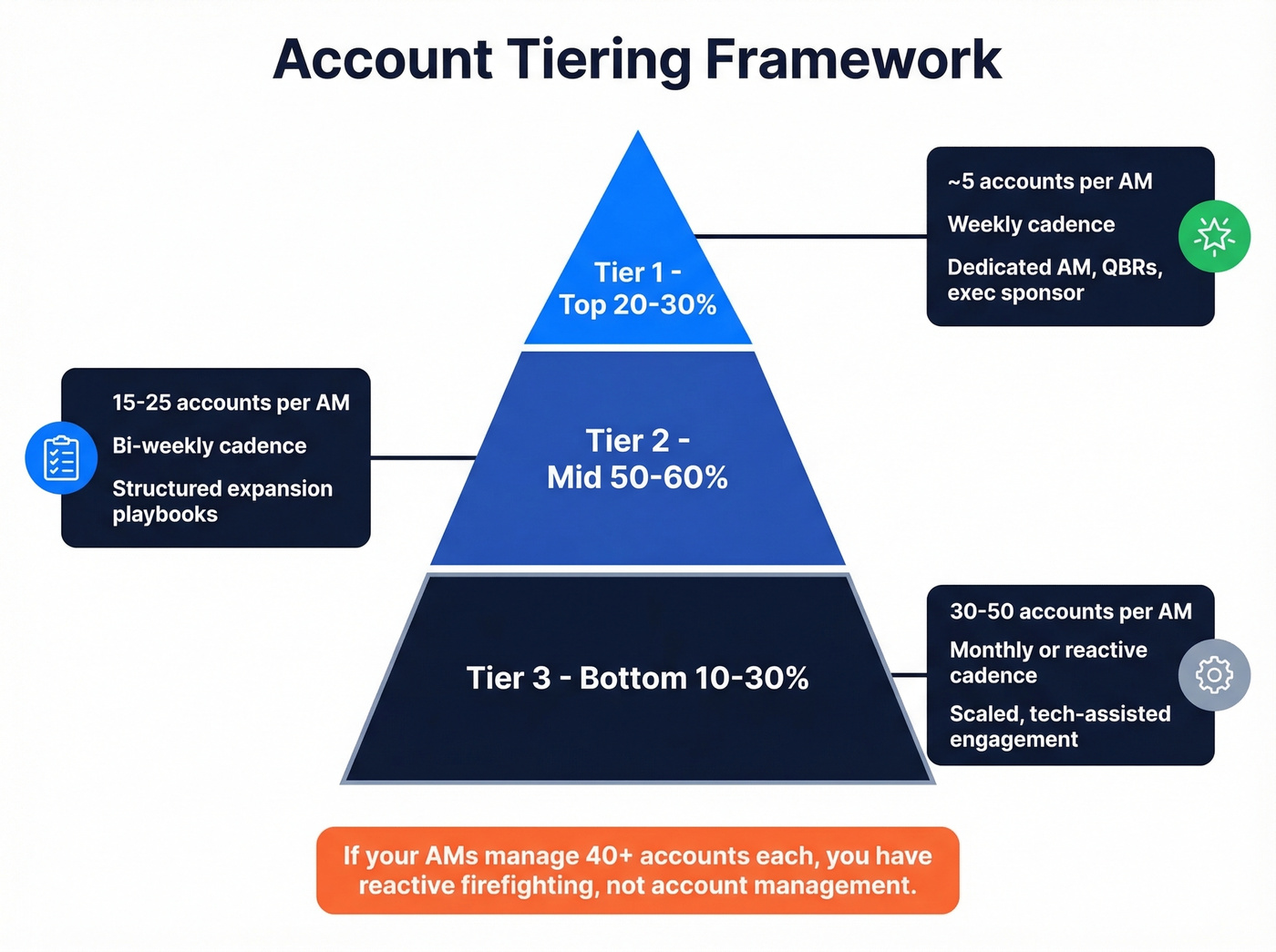
| Tier | % of Book | Accounts per AM | Cadence | Engagement |
|---|---|---|---|---|
| Tier 1 | Top 20-30% | ~5 | Weekly | Dedicated AM, QBRs |
| Tier 2 | Mid 50-60% | 15-25 | Bi-weekly | Structured touchpoints |
| Tier 3 | Bottom 10-30% | 30-50 | Monthly/reactive | Scaled, tech-assisted |
A small percentage of accounts drive the majority of revenue. They deserve disproportionate attention, dedicated resources, and executive sponsorship. Tier 2 gets structured expansion playbooks. Tier 3 gets automated health monitoring and reactive support.
We've watched teams try to treat every account as Tier 1. It doesn't work - your most valuable customers end up getting the same attention as a $5k/year contract, and the AM burns out inside six months trying to maintain weekly cadence across 30 accounts that each think they're the priority. Prioritize ruthlessly.
The Account Management Process
Your best customer's champion just left the company. You find out three weeks later when the renewal conversation goes cold. The operational framework below prevents that.
Identify Key Accounts
Not every large account is a key account. Use a scoring framework across three dimensions: growth potential (expansion headroom, budget trajectory), harmony (cultural fit, strategic alignment), and value creation (co-innovation potential, reference value). Score each factor 1-10 across a 15-factor framework to rank strategic accounts. This surfaces accounts gut instinct misses - the mid-size customer with massive expansion headroom often outranks the big logo that's already fully deployed.
Build the Account Plan
Every Tier 1 account needs a documented plan with four components:
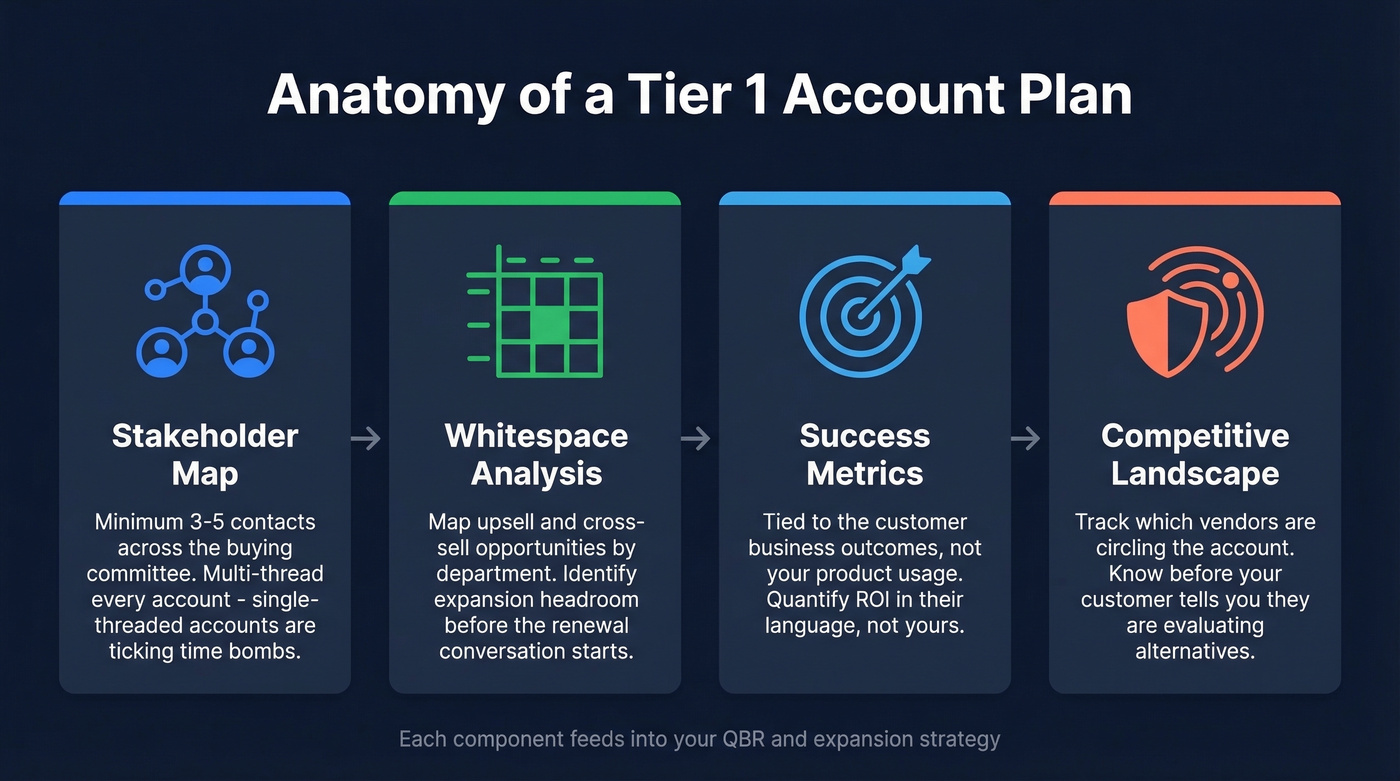
- A stakeholder map with a minimum of 3-5 contacts across the buying committee
- A whitespace analysis showing upsell and cross-sell opportunities by department
- Success metrics tied to the customer's business outcomes, not your product usage
- A competitive landscape assessment tracking which vendors are circling the account
Multi-threading is the most critical element. Single-threaded accounts are ticking time bombs. When that champion changes roles or leaves, you need verified contact data for their VP, their peer, and their replacement. Prospeo's 7-day data refresh cycle and 98% email accuracy keep those stakeholder maps current so you're never rebuilding relationships from scratch after a departure catches you off guard.
Run QBRs That Drive Revenue
QBRs without usage data and ROI metrics are just status meetings. Stop doing them. Every QBR should include usage analytics showing adoption trends, ROI quantified in the customer's terms, a competitive landscape update, and joint roadmap planning tied to their strategic priorities. For key accounts, target NRR above 120%.
Monitor and Expand
Track three churn warning signs obsessively: declining product engagement, stakeholder turnover, and competitive evaluation signals. Any one of these should trigger an escalation workflow - not a "let's check in next quarter" response.
The land-and-expand motion works when you've already identified whitespace and built relationships across departments before the upsell conversation starts. If you're scrambling to find the right contact in a new department the week before a renewal, you've already lost the expansion opportunity.
Why AM Programs Fail
KAM is a different business model, not a new way of selling. Cranfield's research identifies six failure modes we see repeatedly:
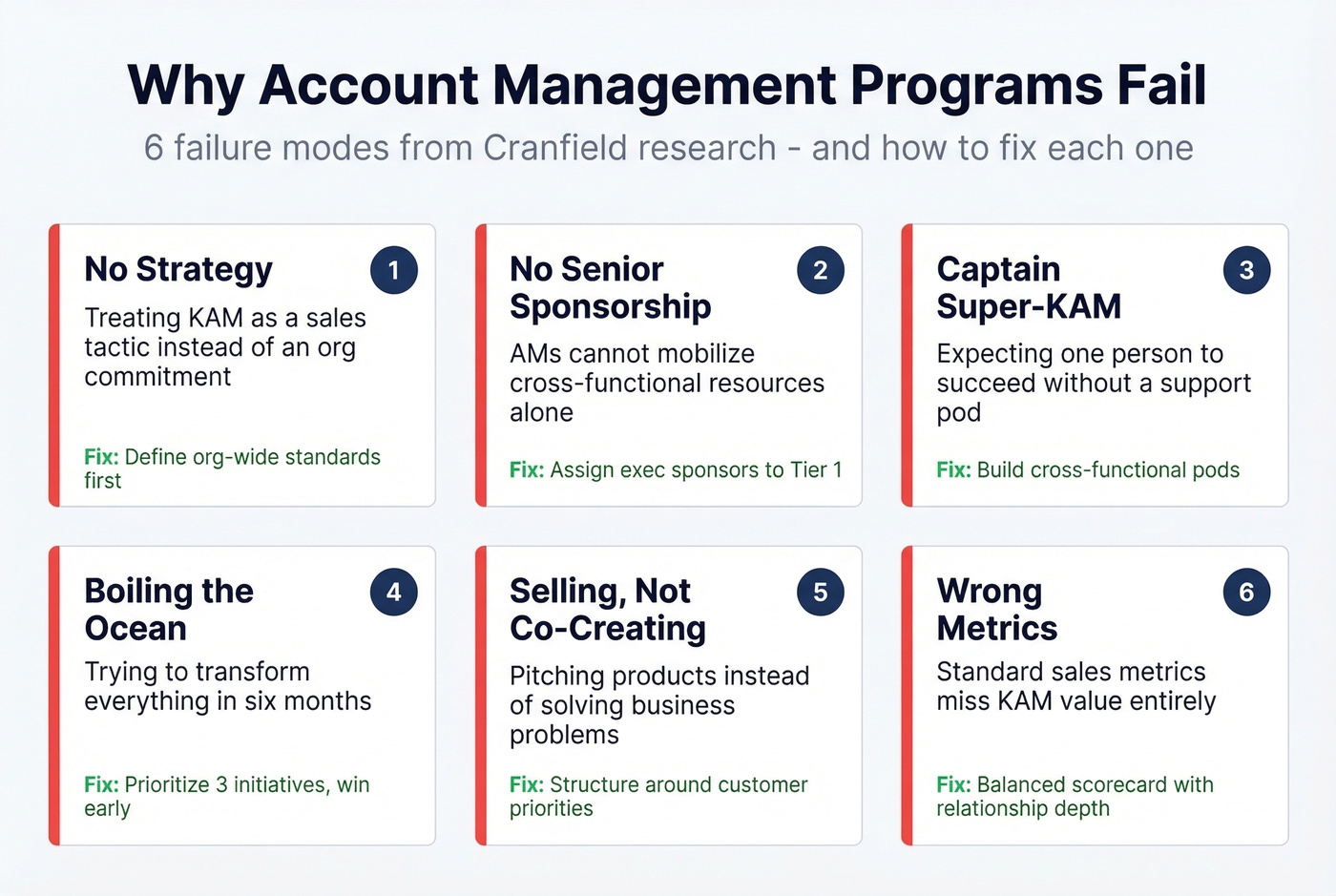
No strategy. Treating KAM as a sales tactic instead of an organizational commitment. Fix: define org-wide standards for people, process, and measurement before assigning a single account.
No senior sponsorship. AMs can't mobilize cross-functional resources without executive air cover. Fix: assign an executive sponsor to each Tier 1 account with quarterly involvement requirements.
"Captain Super-KAM." Expecting one person to succeed without support. Fix: build a cross-functional pod for each Tier 1 account - solutions engineer, product liaison, executive sponsor.
Boiling the ocean. Trying to transform everything in six months. Fix: prioritize three initiatives. Plan for short-term wins that build internal credibility before scaling.
Selling instead of co-creating. AMs who pitch products instead of solving business problems lose strategic accounts. Fix: structure every Tier 1 engagement around the customer's strategic priorities, not your product roadmap.
Measuring the wrong things. Standard sales metrics don't capture KAM value. Fix: build a balanced scorecard - relationship depth, strategic initiative participation, and expansion pipeline alongside revenue.
Account Management Tech Stack
If you've ever inherited an account book with 200 contacts and half the emails bounce, you know the real cost of bad data. Here's what you actually need.
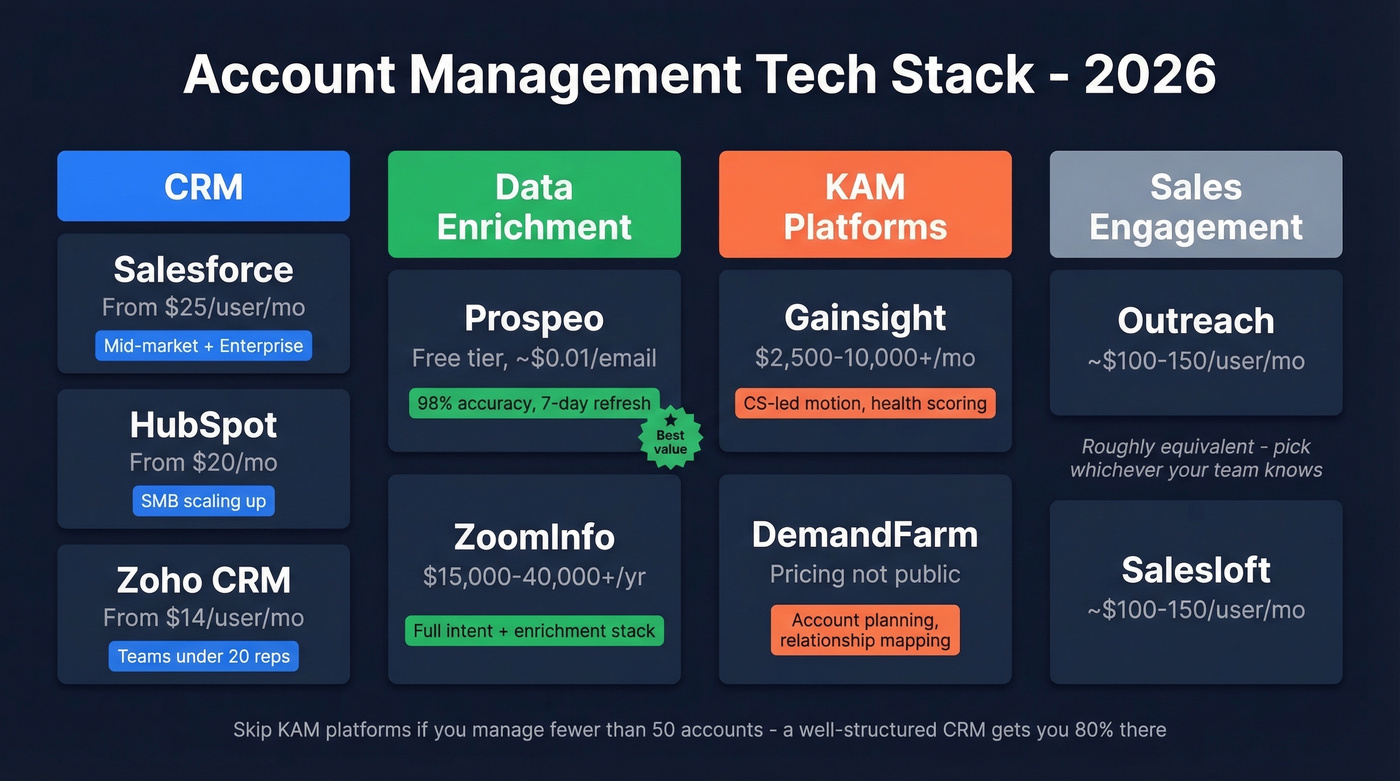
| Tool | Category | Starting Price |
|---|---|---|
| Salesforce | CRM | From $25/user/mo |
| HubSpot | CRM | From $20/mo |
| Zoho CRM | CRM | From $14/user/mo |
| Prospeo | Data Enrichment | Free tier, ~$0.01/email |
| ZoomInfo | Data + Intent | $15,000-40,000+/yr |
| DemandFarm | KAM Platform | Not public |
| Gainsight | KAM / CS Platform | Custom (typically $2,500-10,000+/mo) |
| Outreach | Sales Engagement | ~$100-150/user/mo |
| Salesloft | Sales Engagement | ~$100-150/user/mo |
CRM: Salesforce for mid-market and enterprise. HubSpot for SMBs scaling into account management. Zoho for teams under 20 reps - surprisingly capable for the price. If you're evaluating options, start with these examples of a CRM to sanity-check fit and pricing.
Data Enrichment: This is the operational foundation of multi-threading. Prospeo delivers 98% email accuracy on a 7-day refresh cycle, with native Salesforce and HubSpot integrations that keep account contact data current without manual effort. If you're comparing vendors, see our roundup of data enrichment services and the deeper guide to lead enrichment. At roughly $0.01 per email with a free tier, it's a fraction of enterprise data platform pricing. ZoomInfo makes sense if you need the full intent-plus-enrichment stack and have $15k+ in annual budget.
KAM Platforms: Gainsight for SaaS companies with a CS-led motion - the health scoring and risk alerts are genuinely useful. DemandFarm for dedicated account planning and relationship mapping. Skip these if you're under 50 accounts; a well-structured CRM with custom fields will get you 80% of the way there.
Sales Engagement: Outreach and Salesloft are roughly equivalent. Pick whichever your team already knows. The switching cost isn't worth the marginal feature differences. If you're rolling out a platform, use a proven checklist for implementing a sales engagement platform.
If you're building the measurement layer, pair this stack with a tight set of sales operations metrics and a simple churn analysis workflow so risk signals actually trigger action.
Your AMs shouldn't spend hours hunting for a new VP's email after an org change. Prospeo's CRM enrichment returns 50+ data points per contact at a 92% match rate - keeping Tier 1 account plans current automatically at $0.01 per email.
Give your account managers data that matches their discipline.
FAQ
What does a sales account manager do?
A sales account manager owns post-sale relationships with assigned accounts, focused on retention, renewals, upsell, and cross-sell. Unlike reps who hunt new logos, AMs grow revenue from existing customers through strategic planning, regular QBRs, and multi-threaded stakeholder relationships across the buying committee.
When should you hire dedicated account managers?
Hire dedicated AMs when expansion revenue stalls despite a growing customer base, or when AEs spend more than 30% of their time on existing accounts. Most SaaS companies benefit from dedicated AMs once they pass 50-100 customers with average deal sizes above $25k annually. For smaller deal sizes, a scaled CS motion with automated touchpoints is more cost-effective.
What's a good NRR target?
Median NRR for private SaaS is 102%, and top-quartile teams hit 111%. For key accounts specifically, aim above 120%. Anything below 100% means your install base is shrinking - that's a structural problem, not a performance issue.
How do you keep account contact data accurate?
Run quarterly audits, automate enrichment through CRM integrations, and flag any account where your stakeholder map drops below three active contacts. A 7-day data refresh cycle with automated CRM enrichment keeps records current - critical when a single champion departure can put a six-figure renewal at risk.