

The 8 Best Sales Activity Management Software for 2026
Your reps are dialing disconnected numbers on a $180/user/month platform. They're logging calls into a CRM nobody reads. Meanwhile, nearly 65% of their time goes to non-selling tasks. Sales activity management software exists to fix this - but most teams pick the wrong tool or skip the data quality layer entirely.
We've spent months testing these platforms, talking to sales leaders running them, and digging into the numbers. Here's what actually holds up.
What Is Activity Management Software?
It's not your CRM. Your CRM stores data. Activity management is the tracking, measuring, and optimizing layer that answers the question every sales leader actually cares about: what are reps doing, and is it working?
The category hit $2.3B in revenue last year and it's growing fast. The average B2B buyer now needs 8+ touchpoints before responding, which means the gap between teams that track activities well and teams that don't is widening every quarter.
Our Picks (TL;DR)
- Prospeo - Best for contact data accuracy (the layer every other tool depends on)
- Salesloft - Best for enterprise activity tracking and coaching
- Apollo.io - Best value for teams under 25 reps
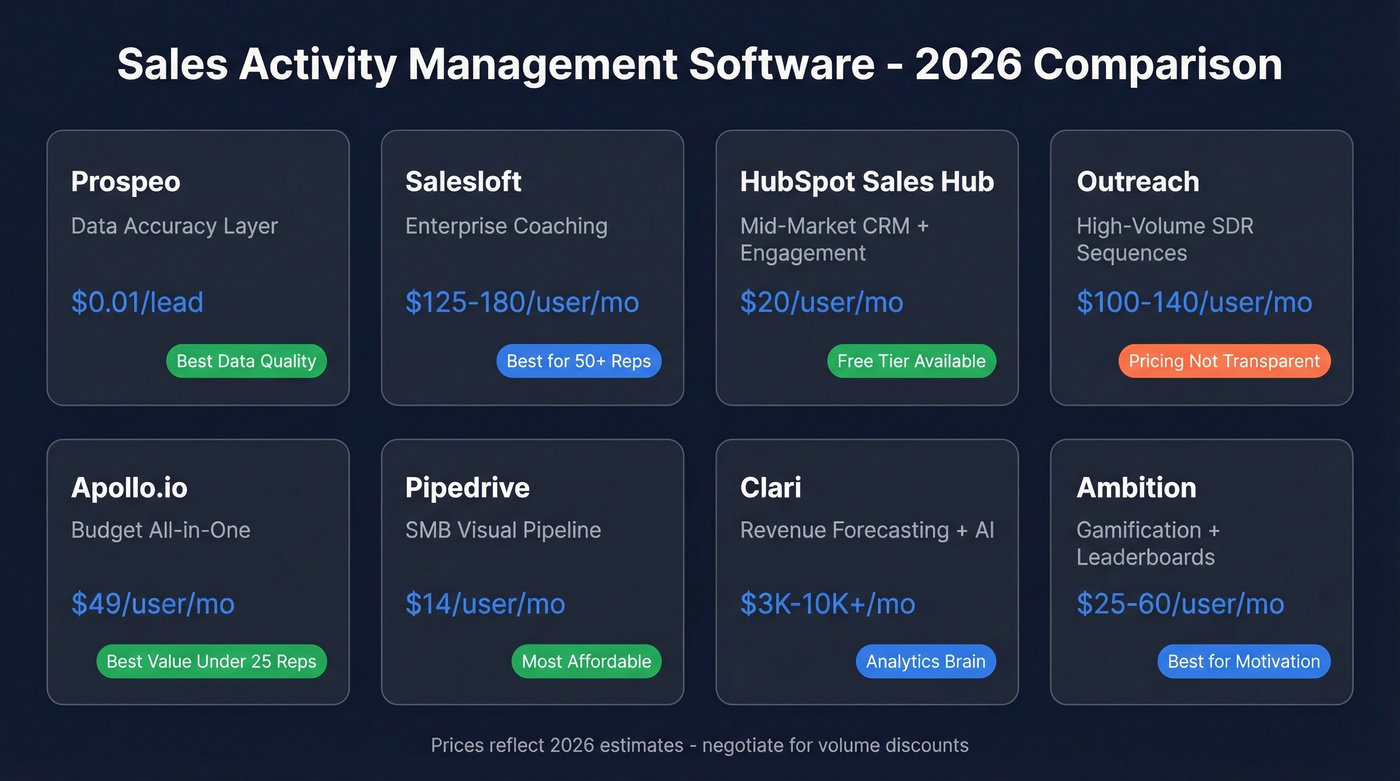
The 8 Best Tools for 2026
| Tool | Best For | Starting Price | Free Tier? | Key Differentiator |
|---|---|---|---|---|
| Salesloft | Enterprise coaching | ~$125-$180/user/mo | No | 3.3x ROI (Forrester) |
| HubSpot Sales Hub | Mid-market teams | $20/user/mo | Yes | Unified CRM + engagement |
| Outreach | High-volume SDRs | ~$100-$140/user/mo | No | Multi-channel depth |
| Apollo.io | Budget all-in-one | $49/user/mo | Yes | Data + sequences combined |
| Pipedrive | SMB pipeline | $14/user/mo | No (14-day trial) | Drag-and-drop simplicity |
| Clari | Revenue forecasting | ~$3,000-$10,000+/mo | No | AI activity capture |
| Ambition | Gamification | ~$25-$60/user/mo | No | Real-time leaderboards |
Prospeo
Use this if: your sequences bounce, reps dial dead lines, or you've been burned by stale data. Skip this if: you already have a verified, fresh contact database (you probably don't).
Every other tool on this list depends on accurate contact data. Prospeo is the upstream layer that makes them work. Its database covers 300M+ professional profiles with 98% email accuracy, 143M+ verified emails, and 125M+ verified mobile numbers hitting a 30% pickup rate across all regions. Data refreshes every 7 days - the industry average is 6 weeks. The database includes 30+ search filters covering buyer intent, technographics, job changes, and funding, powered by Bombora intent data across 15,000 topics.

We've seen teams running Salesloft or Outreach with 35% bounce rates and wondering why their domain reputation is tanking. Snyk's team of 50 AEs dropped bounce rates from 35-40% to under 5% with Prospeo, and AE-sourced pipeline jumped 180%. At ~$0.01/lead versus ZoomInfo's ~$1/lead, teams book 26% more meetings at a fraction of the cost.
The Chrome extension has 40K+ users. Pricing starts at roughly $0.01 per email with a free tier of 75 verified emails per month plus 100 Chrome extension credits. No contracts, no sales calls required.
If you're building outbound from scratch, pair this with proven sales prospecting techniques so the activity volume actually turns into pipeline.
SalesLoft
Use this if: you have 50+ reps and need coaching analytics alongside activity tracking. Skip this if: your annual budget for sales tools is under $50K.
Salesloft is the enterprise activity management standard. A Forrester TEI study found 3.3x ROI, a 40% increase in selling activity without adding headcount, and 12% improved close rates. For large teams with the budget, the coaching layer is genuinely useful - managers can see exactly where reps lose deals in the sequence and intervene with specific, data-backed feedback rather than gut feelings.

The catch is pricing. List price runs ~$180/user/month, though negotiated rates typically land around $125-$127/user/month for 50+ seats. The dialer is an add-on at roughly $7,500/year for 25 users. That "dialer tax" surprises a lot of buyers. For a 25-person team on the Advanced plan with calling, you're looking at ~$45K-$60K/year all in.
If you're planning a rollout, follow a structured implementing a sales engagement platform approach to avoid adoption drop-off.
HubSpot Sales Hub
Use this if: you're already in HubSpot's ecosystem and want activity tracking without another vendor. Skip this if: you need deep sequencing for a 100+ SDR team.
HubSpot Sales Hub starts at $20/user/month for Starter, with a free tier that's genuinely usable. The unified data model means activity data lives alongside marketing and service data - no sync headaches. For mid-market teams that don't need Salesloft-level coaching analytics, it's the simplest option if you're already paying HubSpot.
The tradeoff: HubSpot's sequences work fine for AEs running a modest book of accounts, but high-volume SDR motions will feel constrained quickly.
If you're still evaluating CRMs, compare against other examples of a CRM to make sure you're not forcing a fit.
Outreach
Here's the thing about Outreach: a tool this mature still requiring a sales call for basic pricing information is the single most frustrating thing in this category. The consensus on r/sales isn't about the product itself - it's about the pricing opacity and add-on creep.
Expect $100-$140/user/month for the base Engage module, with add-ons running $30-$50 each for Meet and Deal. Common complaints include HubSpot sync issues and unpredictable AI credit consumption. G2 gives it 4.3/5 across 3,488 reviews. It's powerful, but budget for a 2-4 week onboarding ramp and $5K-$25K in implementation costs.
To keep sequences from turning into noise, use a clear sequence management process and enforce it.
Apollo.io
Apollo combines a 275M+ contact database with built-in sequencing for $49/user/month. There's a free plan that's surprisingly functional. For early-stage teams under 25 reps, it's the obvious starting point - you get prospecting and activity tracking in one platform without a $50K budget.
Apollo's email accuracy sits around 79% vs Prospeo's 98%, so you'll want a verification layer on top if deliverability matters to you (and it should). But for the price, the value is hard to beat.
If you're trying to keep spend low, stack it with other free lead generation tools before you add more paid seats.
Pipedrive
Pipedrive is the SMB visual pipeline tool. $14/user/month, intuitive drag-and-drop interface, and enough activity tracking for teams under 10 reps. It won't replace a dedicated sequencing platform, but for small teams that need to see their pipeline at a glance without complexity, it does the job well.
If you're choosing between CRMs, this Copper vs Pipedrive breakdown can help clarify fit.
Clari
Clari sits in the revenue intelligence layer rather than the sequencing layer. Its AI automatically captures sales activities from emails, calls, and CRM data, then feeds that into forecasting models. G2 rates it 4.6/5 across 5,587 reviews. Expect ~$3,000-$10,000+/month and roughly 2 months for implementation. Best paired with a sequencing tool like Salesloft or Outreach - it's the analytics brain, not the execution engine.
If forecasting is the real pain, start with dedicated sales forecasting solutions before you overbuy engagement features.
Ambition
Ambition adds gamification and real-time leaderboards on top of your existing CRM data. At ~$25-$60/user/month, it's a complement to your sequencing tool, not a replacement. If rep motivation and visibility into daily activity volume are your gaps, Ambition fills them. Skip it if your team is under 15 reps - the leaderboard effect doesn't kick in until there's real competition.
If you're building a coaching culture, align this with a broader sales performance management system so incentives match outcomes.

Every sales activity management tool on this list depends on one thing: reaching real people. Snyk's 50 AEs dropped bounce rates from 35-40% to under 5% with Prospeo, and AE-sourced pipeline jumped 180%. At $0.01/email with 98% accuracy, your sequences actually connect.
Stop logging activities against dead contacts. Start with verified data.
What to Actually Track
Most teams track too many metrics or the wrong ones. We use a five-category framework that keeps things focused:
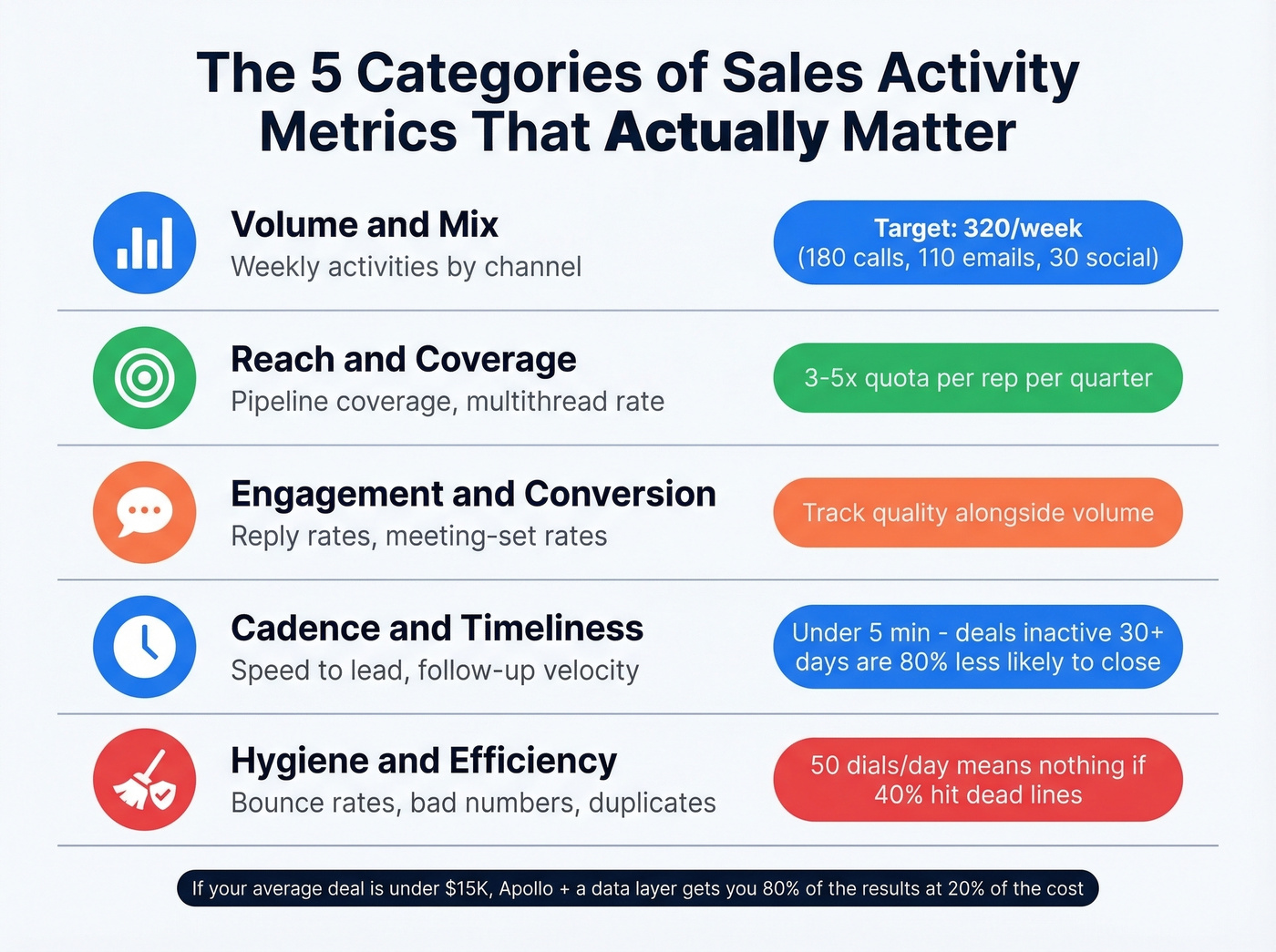
| Category | What to Measure | Benchmark |
|---|---|---|
| Volume & mix | Weekly activities by channel | SDR target: 320/week (180 calls + 110 emails + 30 social) |
| Reach & coverage | Pipeline coverage, multithread rate | 3-5x quota per rep per quarter |
| Engagement & conversion | Reply rates, meeting-set rates | Track quality alongside volume |
| Cadence & timeliness | Speed to lead, follow-up velocity | Under 5 min; deals inactive 30+ days are 80% less likely to close |
| Hygiene & efficiency | Bounce rates, bad numbers, duplicates | 50 dials/day means nothing if 40% hit dead lines |
If you need a clearer definition of what counts as “activity,” these sales activities examples help standardize reporting across teams.
Let's be honest: if your average deal size is under $15K, you probably don't need Salesloft or Outreach. Apollo plus a dedicated data layer will get you 80% of the results at 20% of the cost. Save the enterprise tooling for when you actually have enterprise complexity.
The Data Quality Layer Everyone Ignores
Here's the uncomfortable truth: only 54% of sales teams hit quota, and bad data is a bigger contributor than most leaders admit. Your sequencing tool is only as good as the contacts you feed it. If 35% of your emails bounce, you're not just wasting rep time - you're burning your sender domain and tanking deliverability for every future campaign.

In our experience, this is where the real ROI lives. Meritt cut bounce rates from 35% to under 4%, tripled their connect rate to 20-25%, and tripled pipeline from $100K to $300K/week after fixing their data layer. That's the difference between a pipeline that grows and one that stalls. Pair verified data with whatever activity management tool you choose - the data enrichment layer is what makes the activity layer productive.
If you want to compare vendors, start with the broader landscape of data enrichment services and then narrow by your stack.
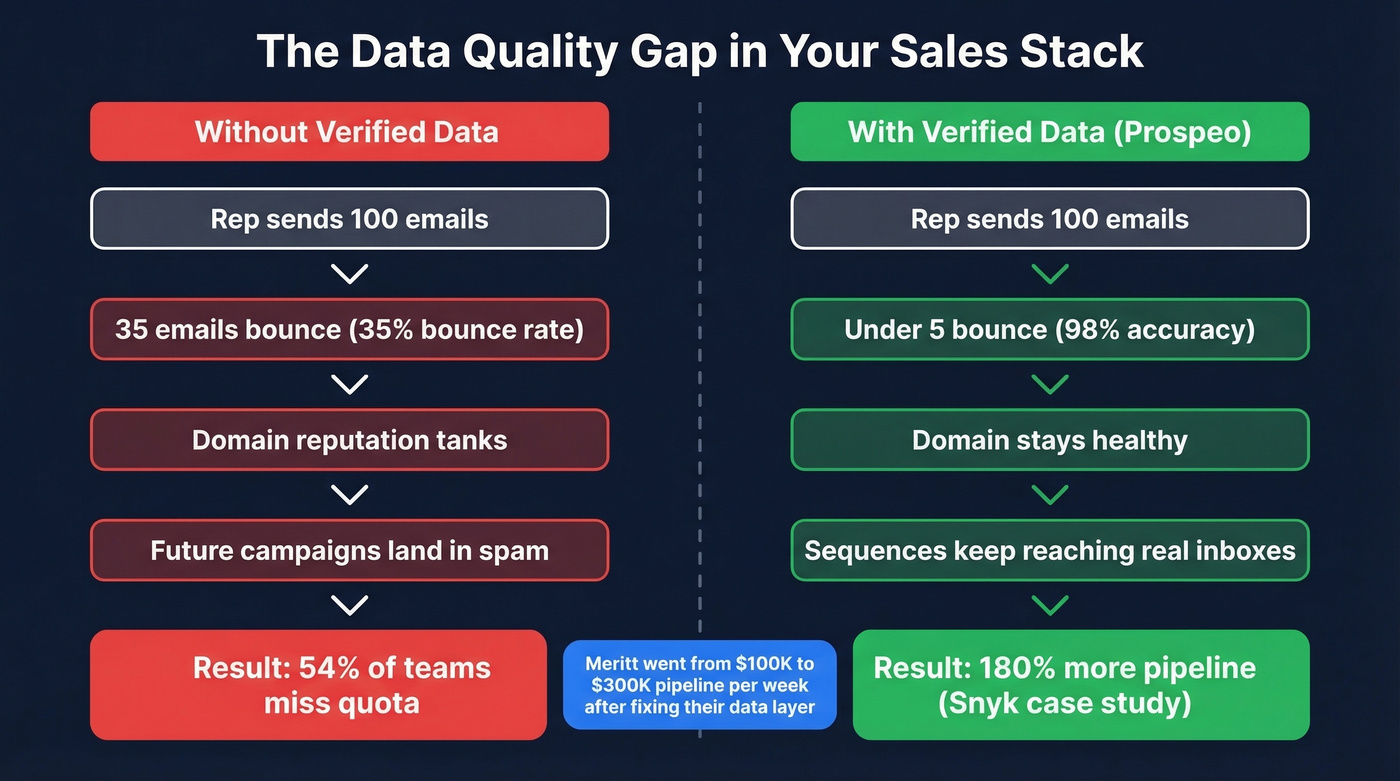
You're paying $125-$180/user/month for activity tracking - but 35% of those activities hit disconnected numbers and bounced inboxes. Prospeo's 125M+ verified mobiles hit a 30% pickup rate, and data refreshes every 7 days, not 6 weeks. That's the upstream fix your stack is missing.
Make every rep activity count with contacts that actually pick up.
3 Mistakes That Kill Rollouts
No clear KPIs before launch. If you can't define "good" before you buy the tool, you won't know if it's working after. We've watched teams spend six months on a platform and then realize they never agreed on what success looked like.
If you’re setting targets, use a consistent sales operations metrics framework so reps aren’t optimizing for the wrong number.
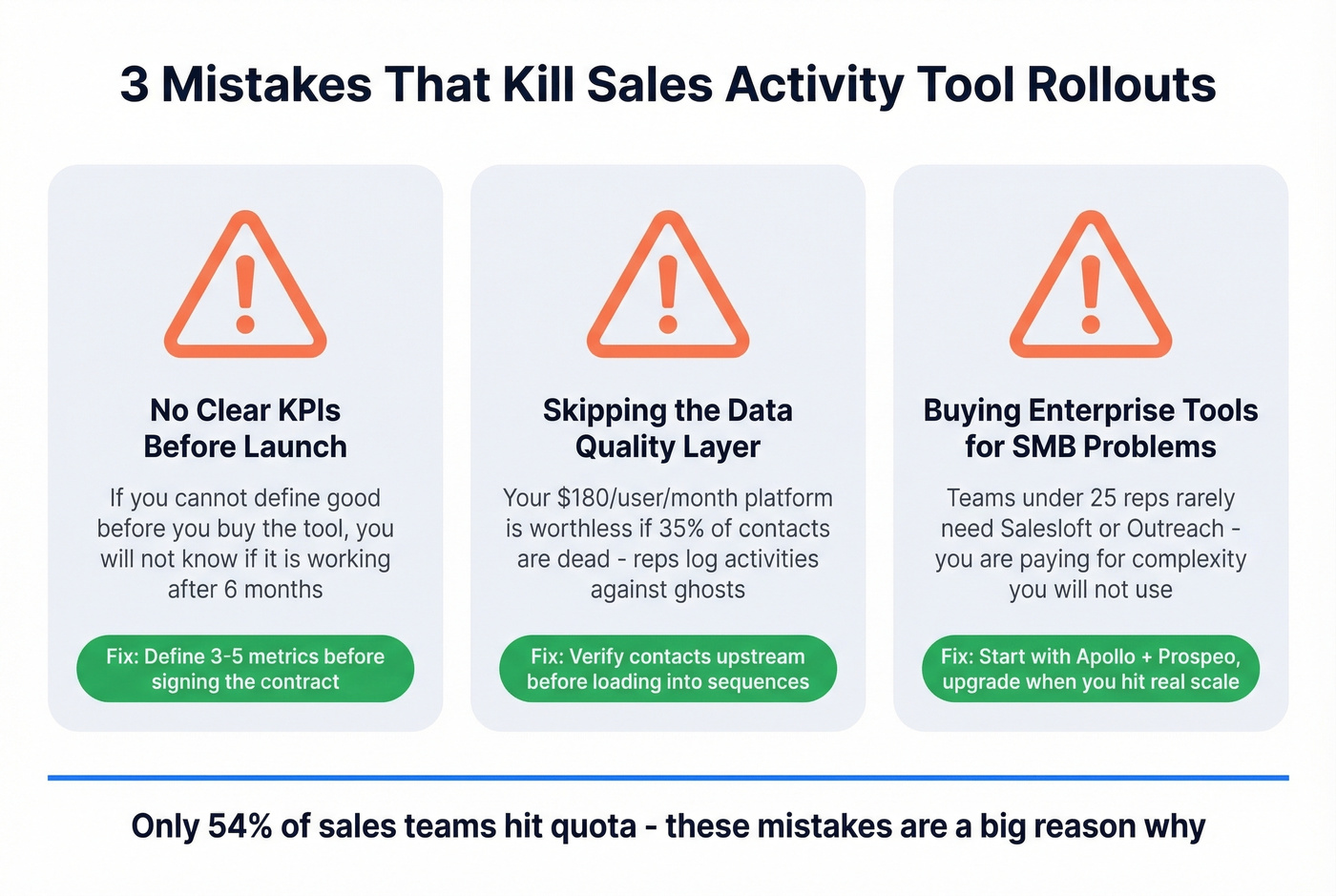
Ignoring data quality. The best activity management platform in the world can't fix a list full of dead emails and disconnected numbers. This one keeps coming up because teams keep making it.
Over-monitoring reps. Activity tracking should enable coaching, not surveillance. Teams that feel watched game the metrics instead of improving outcomes. Track patterns, not keystrokes.
FAQ
How much does sales activity management software cost?
Expect $14/user/month (Pipedrive) to $180+/user/month (Salesloft). A mid-market stack combining data verification and sequencing typically runs $50-$120/user/month. Budget separately for the data layer - skipping it is the most expensive mistake teams make.
What's the difference between a CRM and activity management?
A CRM stores customer records. Activity management tools track and optimize what reps actually do - calls, emails, follow-up cadence, and engagement signals. One's a database; the other's an operating system for rep behavior and coaching.
Can my CRM handle prospect tracking on its own?
Most CRMs log basic activity but lack sequencing, automation, and coaching analytics. If your team runs multi-touch outbound campaigns, a purpose-built platform gives far better visibility into what's working and where prospects drop off.
What's a good free option for small teams?
Prospeo's free tier (75 verified emails + 100 Chrome extension credits/month) covers the data layer, while Apollo.io's free plan handles basic sequencing. Together they give small teams a functional outbound stack at zero cost - enough to validate your process before committing budget.