

Sales and Marketing Integration: The Playbook That Replaces Alignment Meetings With Revenue
Marketing says they delivered 2,000 MQLs last quarter. Sales says the leads are garbage. There's a black hole between "MQL" and "closed-won" where nobody knows what happened, attribution is a mess, and both teams are pointing fingers. If you've spent any time on r/marketing, you've seen this exact complaint play out weekly.
Revenue growth is 70% more common in B2B orgs with well-integrated sales and marketing. That's not a marginal improvement - it's the difference between hitting plan and missing it by a mile. The problem isn't that teams don't want to align. It's that they're aligning around the wrong things, with the wrong data, using the wrong process.
What You Actually Need
- Stop measuring marketing on MQLs and sales on revenue. Shared KPIs or nothing. Among companies with growing revenue, 40% use shared KPIs - compared to just 30% in companies with declining revenue.
- Build a written SLA with lead definitions, response times, and escalation rules. Not a handshake. A document.
- Fix your data layer first. Bad contact data is the silent alignment killer. Sales calls dead numbers, emails bounce, and suddenly "marketing's leads are garbage" again.
Why Most Companies Get This Wrong
The numbers are brutal. An Influ2 analysis of 105 companies found that 53% have a broken hand-off - sales follows up with fewer than 35% of marketing-engaged prospects. Only 11% of companies show both effective hand-offs and high audience overlap. Nine out of ten companies are leaking pipeline somewhere between the two teams.
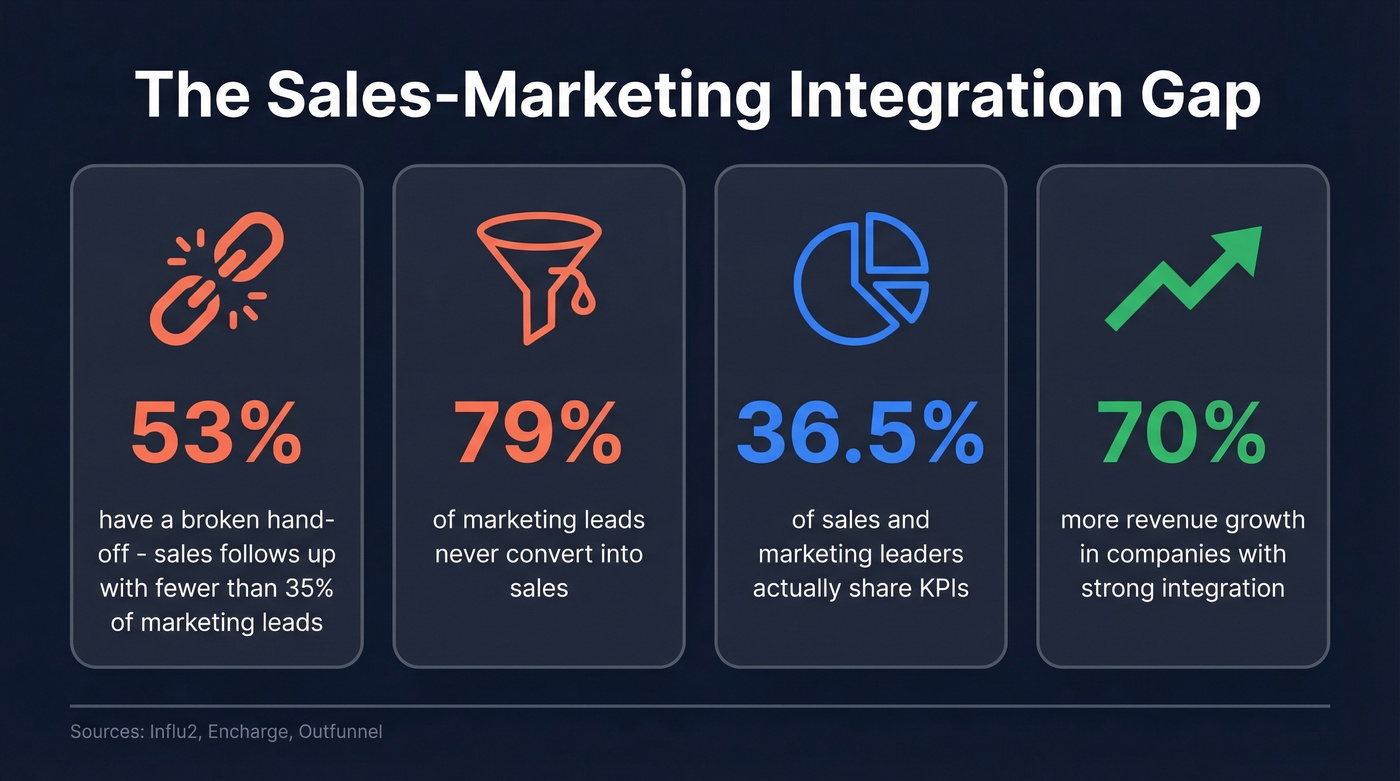
And even when marketing generates a ton of leads, a huge chunk never turns into revenue. 79% of marketing leads never convert into sales - a classic symptom of weak nurturing and broken follow-up.
Here's the thing: a typical B2B buyer interacts with your company dozens of times before purchasing - benchmarks put it in the 5-to-50 touchpoint range, with 62 touchpoints over six months commonly cited in attribution discussions. Sales cycles can run 211 days up to 379 days depending on your market and motion. There are 6.8 decision-makers involved on average, and 83% of the buying process happens through independent research - your reps aren't even in the room. Trying to attribute revenue to a single campaign in that environment is like trying to credit one player for a basketball game.
Only 36.5% of B2B sales and marketing leaders share KPIs. Barely a third. That explains why the hand-off breaks so consistently.
Six Alignment Mistakes That Kill Revenue
We've seen these anti-patterns destroy pipeline at companies of every size.
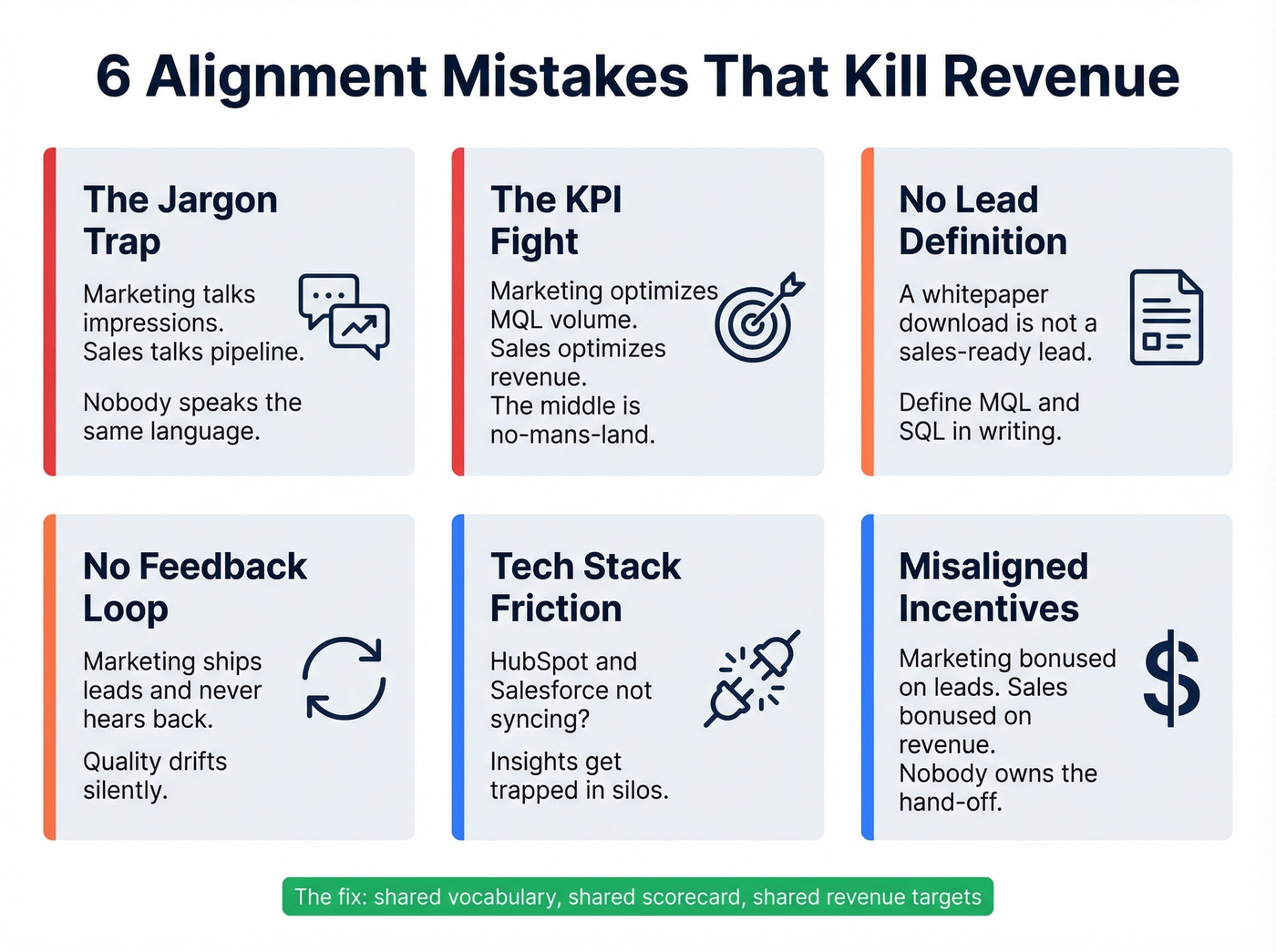
The jargon trap. Marketing talks about impressions, CTR, and brand lift. Sales talks about pipeline and close rates. The fix: build a shared vocabulary around revenue metrics - SQL acceptance rate, pipeline value, win rate.
The KPI fight. Marketing optimizes for MQL volume. Sales optimizes for revenue. Neither owns the middle. The move is a shared scorecard with metrics both teams influence - opportunity creation, sales cycle time, win rate.
No lead definition. A whitepaper download isn't a sales-ready lead, but without a written definition, marketing counts it as one. Define MQL and SQL criteria together, in writing, with concrete examples.
No feedback loop. Marketing ships leads and never hears back. Quality drifts. Fix it with weekly closed/lost analysis and a standing Slack channel for real-time lead feedback.
Tech stack friction. When HubSpot and Salesforce aren't syncing properly, insights get trapped in one system. Audit your integrations quarterly. If data doesn't flow both ways, it's not integrated.
Misaligned incentives. Marketing gets bonused on leads generated. Sales gets bonused on revenue closed. Nobody owns the hand-off. Tie a portion of both teams' comp to shared revenue targets.

53% of companies have a broken sales-marketing hand-off. The #1 silent killer? Stale contact data. Prospeo enriches every lead with 98% accurate emails and verified mobiles on a 7-day refresh cycle - so sales never blames marketing for bad leads again.
Clean data turns your SLA from a document into a revenue engine.
The Playbook for Integrating Sales and Marketing
Agree on Lead Definitions
This is where most integration efforts should start and where most actually skip. Sit both teams down and define what makes an MQL and what makes an SQL - with concrete criteria, not vibes. "Downloaded a pricing guide and matches ICP" is a definition. "Filled out a form" isn't.
The best approach: analyze your last 50 closed/won and 50 closed/lost deals together. What did the winners have in common? That's what "qualified" actually looks like in your business. Marketing ops owns routing logic, sales ops owns follow-up compliance, and RevOps owns the dashboard that keeps everyone honest.
Build a Shared SLA
A handshake agreement isn't an SLA. Write it down:
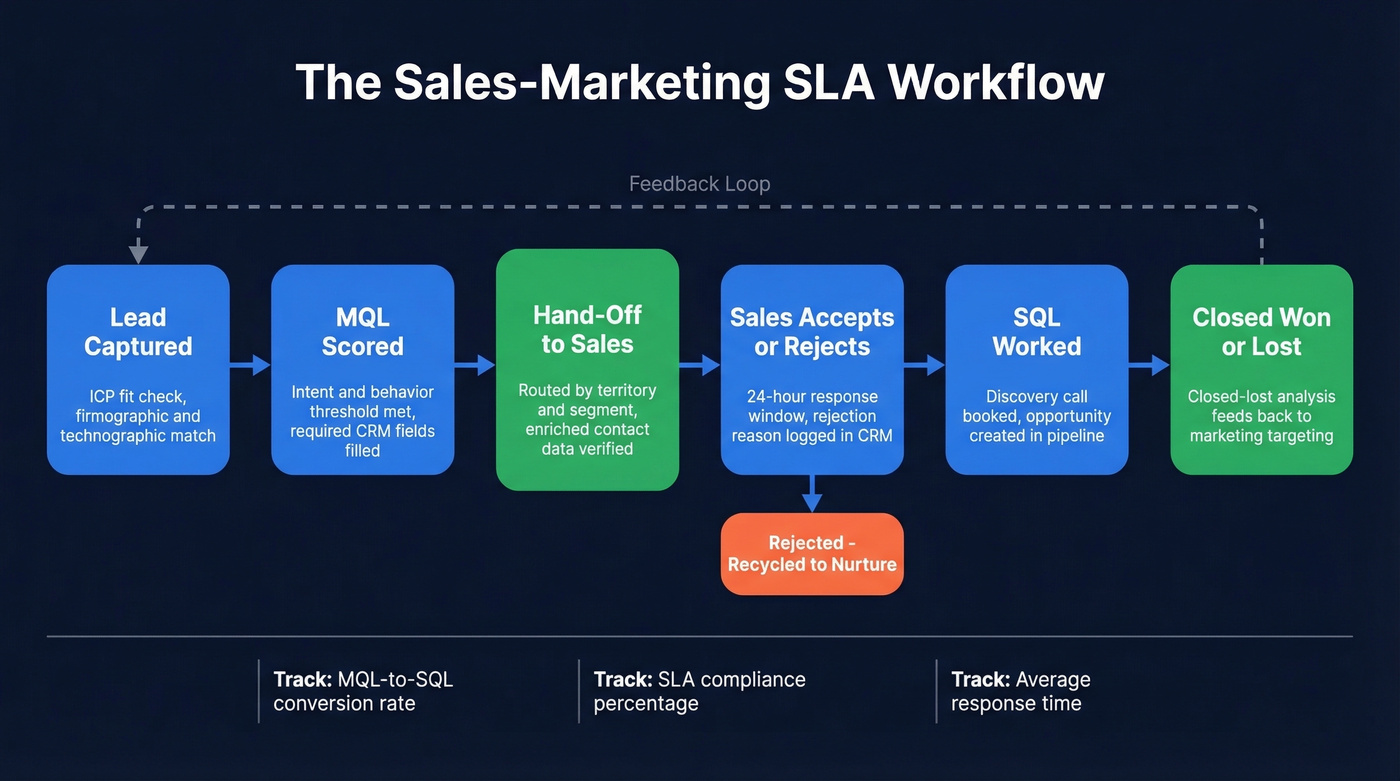
- ICP fit criteria - firmographic and technographic thresholds (use an Ideal Customer Profile scoring rubric)
- Intent/behavior threshold - what actions qualify a lead
- Routing rules - who gets which leads, and how fast
- Required CRM fields - what must be filled before hand-off
- Response-time commitment - 24 hours max for accepted MQLs
- Acceptance/rejection reasons - sales must log why they reject
- Recycle/nurture rules - what happens to rejected leads
- Reporting cadence - weekly review, monthly deep-dive
For a simple "before/after" test, measure just two things for 60 days: MQL-to-SQL conversion rate and SLA compliance. Did reps follow up within the agreed window? Most teams see lead quality debates disappear when definitions and response times are enforced.
Unify Your Data Layer
Here's where alignment strategies quietly die. Marketing sends over a batch of leads. An SDR picks up the phone and gets a disconnected number. They send an email - it bounces. Three more dead contacts later, the SDR tells their manager "marketing's leads are garbage." The leads were perfectly qualified. The data was just stale.
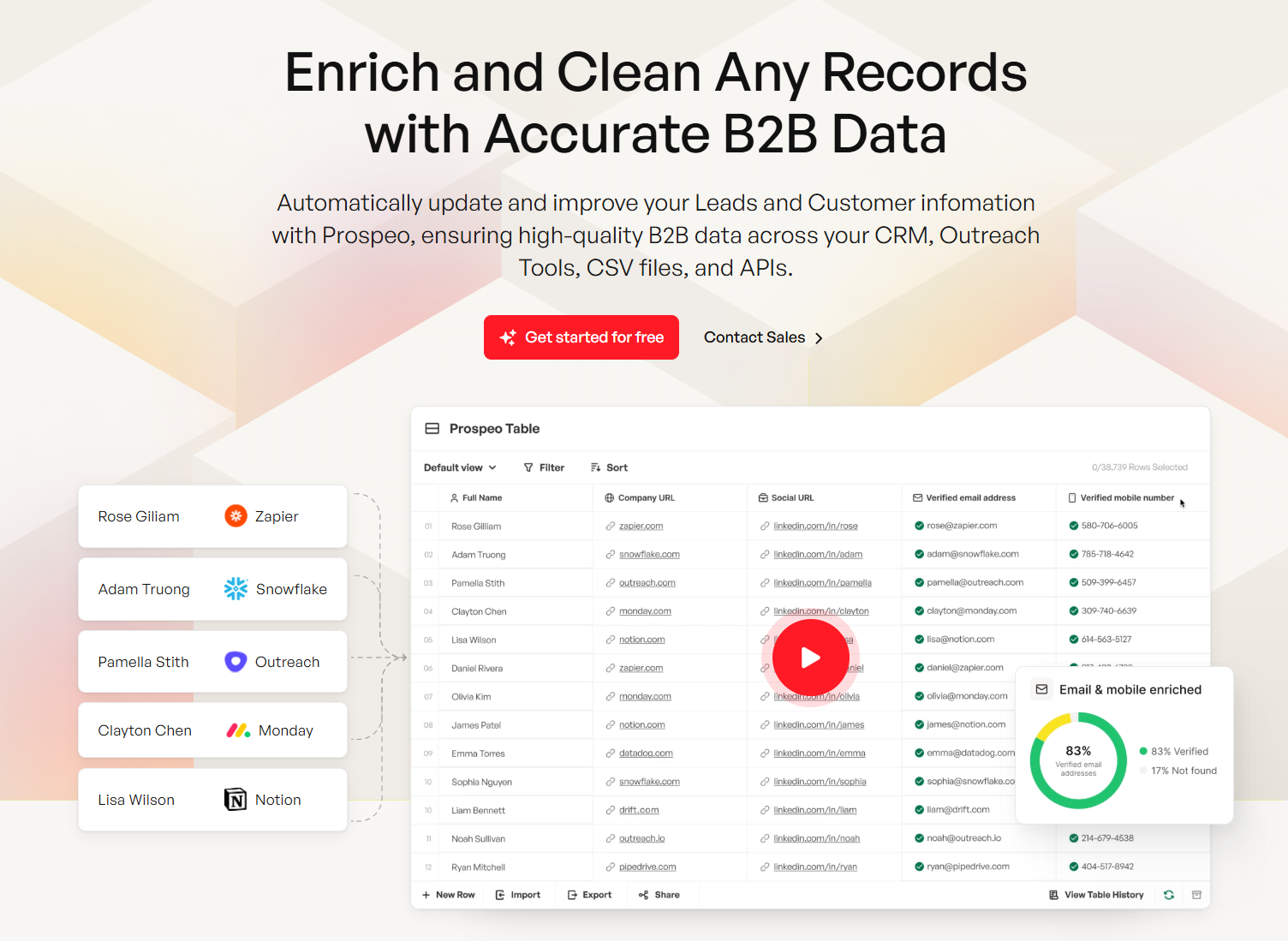
We've watched this cycle play out at dozens of companies, and it almost always traces back to the same root cause: contact data that hasn't been refreshed in weeks or months. Prospeo addresses this with 98% email accuracy and a 7-day data refresh cycle, compared to the six-week industry average. Pair CRM enrichment with your marketing automation platform, and every lead that crosses the hand-off comes with verified contact info. Everything else in this playbook breaks without clean data.
If you’re evaluating vendors, start with a quick scan of data enrichment services and how they handle refresh cycles.
Establish Feedback Loops
Set up a weekly 30-minute meeting where sales and marketing review lead quality together. Create a shared Slack channel where reps can flag bad leads in real time - not at the end of the quarter.
The most valuable ritual we've found: monthly closed/lost analysis. Pull every deal that died and ask why. Was it a bad fit? Wrong timing? Unqualified? That feedback flows directly back into marketing's targeting and content strategy. Skip this if you're comfortable flying blind.
Align Incentives Around Revenue
There has to be a revenue plan, not a sales plan and a marketing plan. If marketing's bonus is tied to MQL volume and sales' bonus is tied to closed revenue, you've built a system that rewards misalignment.
Tie a meaningful portion of both teams' variable comp to shared revenue outcomes - pipeline generated, revenue closed, expansion revenue. Pick metrics both teams influence and make them matter financially. Integration only works when both sides have skin in the same game.
From Alignment to RevOps
Let's be honest: if your average deal size is above $15k and you're still running "alignment meetings" between separate sales and marketing orgs, you're solving the wrong problem. The modern approach is Revenue Operations - a framework that unifies marketing, sales, customer success, and finance under shared processes, tech, and KPIs across the entire revenue lifecycle.
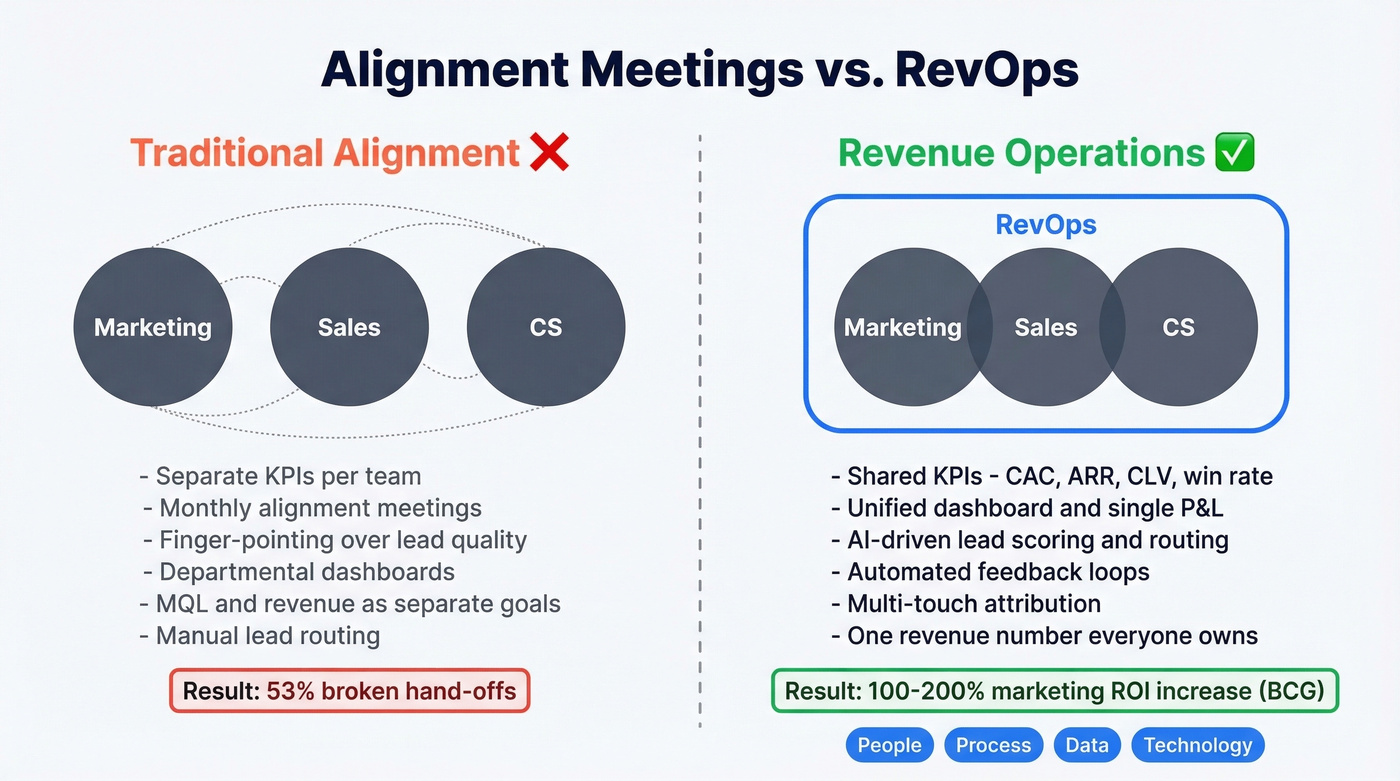
RevOps rests on four pillars: people, process, data, and technology. The KPIs shift from departmental metrics to business outcomes - CAC, ARR, CLV, TCV, churn rate, CSAT, renewal rate, ARPU, and DSO. Everyone looks at the same dashboard. Everyone owns the same number.
The ROI data backs this up. BCG attributes 100-200% increases in marketing ROI to RevOps adoption. HubSpot reports a 59% win rate boost. And Gartner projected that 75% of high-growth companies would be using a RevOps framework by 2026.
AI is accelerating this shift. AI-driven lead scoring now handles what used to require weekly calibration meetings. Automated routing assigns leads based on real-time fit and intent signals instead of round-robin. Multi-touch attribution is finally making it possible to untangle those buyer touchpoints without a data science team.
Stop having alignment meetings. Start sharing a P&L.
Tech Stack for Integrated Teams
You don't need fifteen tools. You need the right ones in each category, and they need to actually talk to each other.
| Category | Tools | Starting Price |
|---|---|---|
| CRM | Salesforce, HubSpot | Free - ~$300/user/mo |
| Marketing Automation | HubSpot, Marketo | ~$800/mo+ |
| Lead Routing | LeanData, Chili Piper | ~$30-80/user/mo |
| Attribution | HockeyStack, Dreamdata | ~$1,000-5,000/mo |
| Intent Data | 6sense, Demandbase, Bombora | ~$30-100K+/yr |
| Integration/iPaaS | Zapier, Make, Segment | Free - ~$100/mo |
If you’re building an SDR motion, a curated list of SDR tools can help you avoid stack bloat.
Your shared KPIs and SLAs mean nothing if reps call dead numbers and emails bounce. Prospeo's CRM enrichment returns 50+ verified data points per contact at a 92% match rate - for roughly $0.01 per email. Integration starts with data you can trust.
Stop debating lead quality. Verify it automatically.
Measuring Integration Success
The standard marketing ROI formula is straightforward: (Revenue - Marketing Investment) / Marketing Investment x 100. A 5:1 ratio - $5 in revenue for every $1 in marketing spend - is the widely cited benchmark for "good."
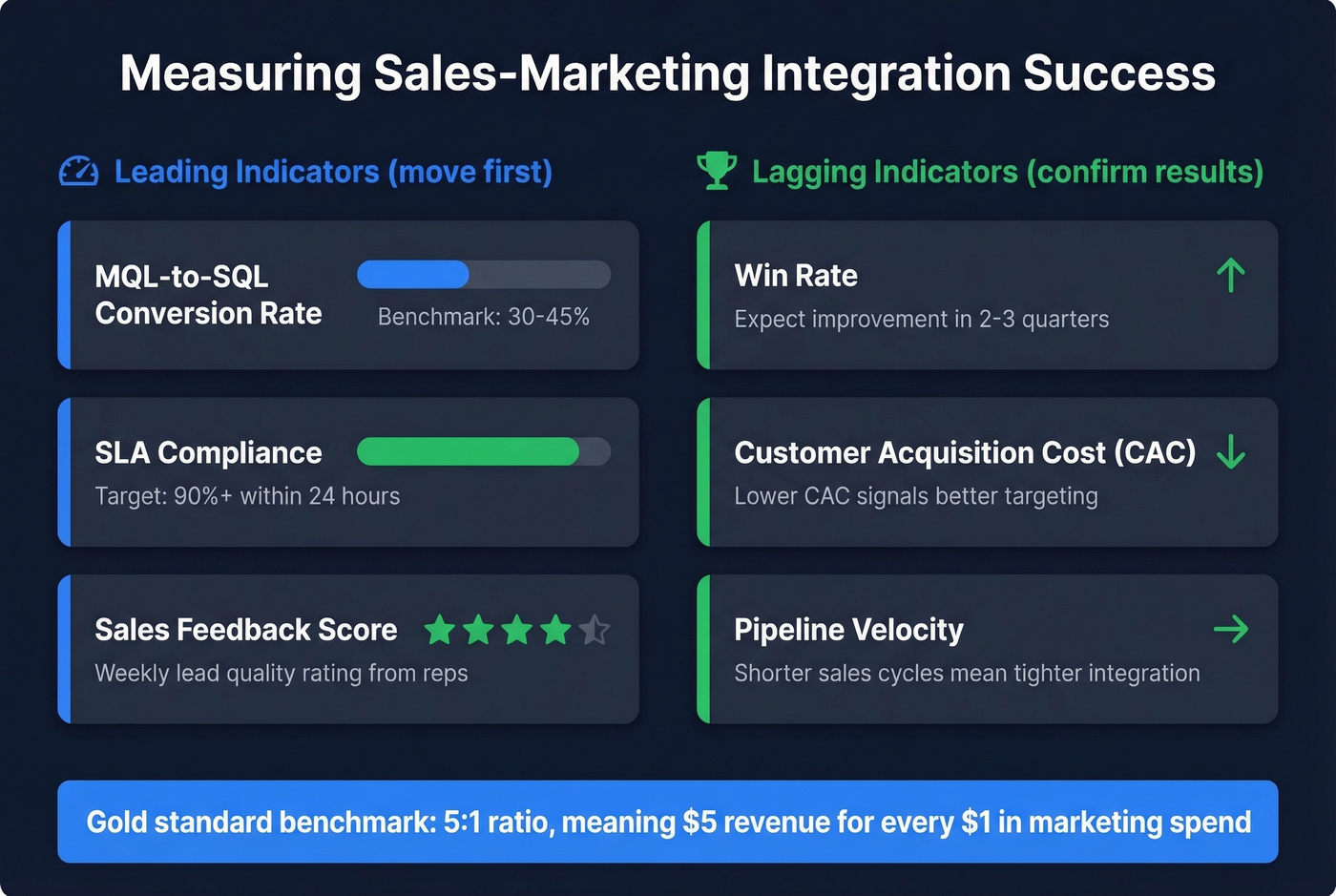
Don't wait for lagging indicators to tell you if integration is working. Track leading indicators first: MQL-to-SQL conversion rate, SLA compliance, and a sales feedback score on lead quality. These move weeks before revenue does.
For lagging indicators, focus on win rate, CAC, and pipeline velocity. If integration is working, you'll see win rates climb and sales cycles shorten within two to three quarters. Multi-touch attribution is the gold standard - single-touch models will mislead you in a world where buyers interact dozens of times before purchasing.
FAQ
What's the difference between alignment and RevOps?
Alignment is a cultural goal - get the teams talking and agreeing on definitions. RevOps is an operational structure that unifies marketing, sales, CS, and finance under shared processes, technology, and KPIs. Alignment is the aspiration; RevOps is the system that makes it stick.
How long does integration take?
Expect 2-3 months for SLA and shared definitions, 6 months for tech stack unification, and 9-12 months before revenue impact shows clearly. Start with lead definitions and a written SLA - those cost nothing and change behavior immediately.
What's the fastest way to fix a broken lead hand-off?
Three things this week: agree on one MQL definition with sales, set a 24-hour follow-up SLA, and verify your contact data so reps aren't calling dead numbers. Prospeo's free tier handles 75 verified emails per month - enough to test whether clean data resolves the blame cycle.
Which shared KPIs matter most?
Focus on MQL-to-SQL conversion rate, pipeline velocity, and win rate. These three metrics sit at the intersection of marketing and sales performance. Companies with shared KPIs are 40% more likely to report growing revenue than those without them.
Sales and marketing integration isn't a project with a finish line - it's an operating rhythm. Get the definitions right, fix the data, share the scorecard, and the revenue follows.