

Sales Automation Specialists: Tools, Agencies, and How to Choose in 2026
Sales reps spend only 28% of their time actually selling. The rest vanishes into data entry, CRM updates, list building, and chasing bad contact info - and the sales force automation market is on track to hit $19.5 billion by 2030 because everyone's tired of watching revenue disappear into admin work.
Whether you need software, a full-time hire, or an agency, this breakdown covers all three paths with real pricing, salary data, and the opinionated stack recommendations you won't get from a vendor's feature page. Sales automation specialists - the people, the platforms, and the services - exist to give reps their selling time back. Here's what's worth your money.
Our Top Picks
| Tool | Best For | Starting Price | Free Tier? |
|---|---|---|---|
| Prospeo | Verified contact data | ~$0.01/email | Yes (75/mo) |
| Clay | Workflow orchestration | $134/mo | - |
| HubSpot Sales Hub | All-in-one CRM + automation | $20/user/mo | Yes |
| AiSDR | AI-driven outbound | $900/mo | No |
| Outreach | Enterprise sequencing | ~$100/user/mo | No |
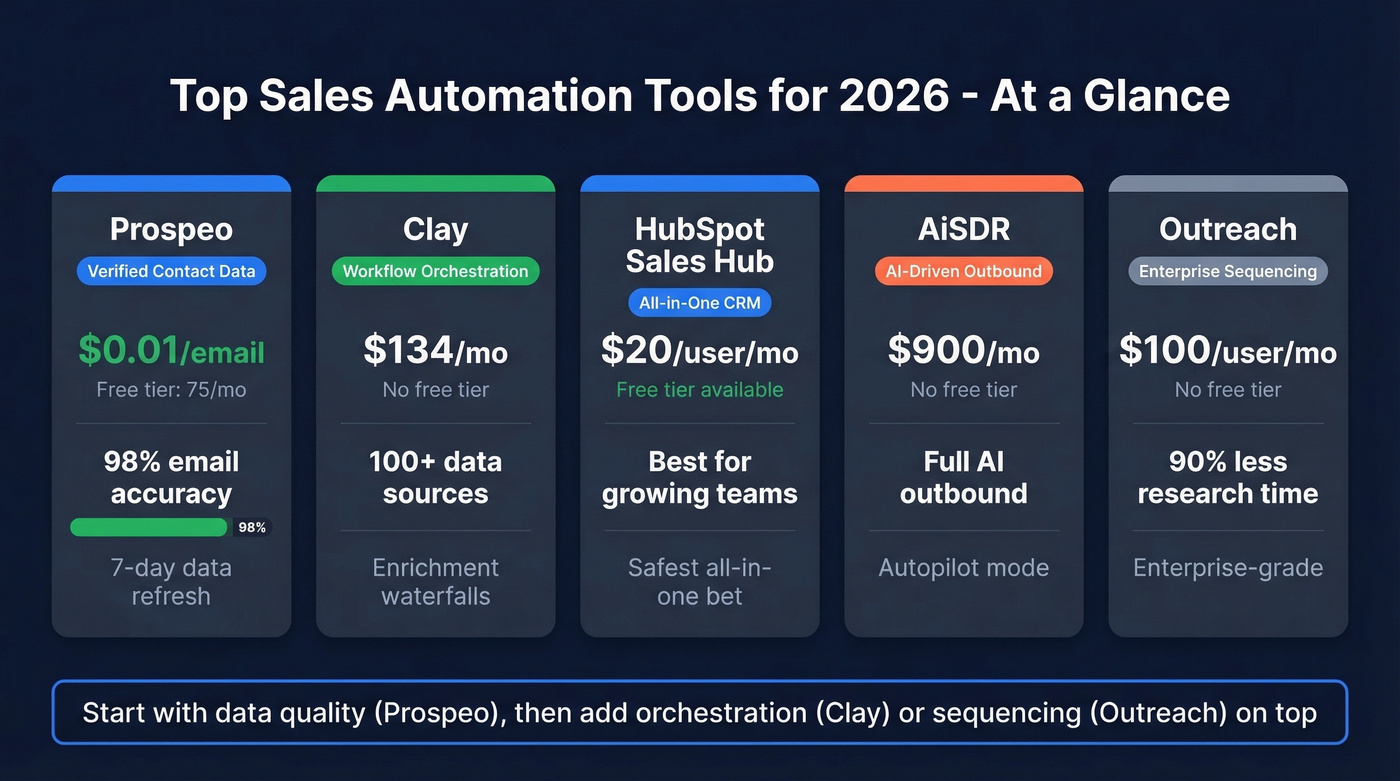
Prospeo wins on data accuracy - 98% verified emails, a 7-day refresh cycle, and pricing that doesn't require a finance committee. Clay is the orchestration layer agencies and RevOps teams swear by. HubSpot is the safest all-in-one bet for growing teams. The rest depends on your team size, budget, and how much you trust AI to write your cold emails.
What These Specialists Actually Do
A sales automation specialist designs, implements, and maintains the automated workflows that keep a sales org running: CRM configuration, sequence building, lead routing, data hygiene, and the integrations that make tools actually talk to each other instead of creating duplicate records and broken handoffs.

Here's the thing - this role is being absorbed. Five years ago, "sales automation specialist" was a distinct job title. Today, it's increasingly a subset of RevOps. The best experts in this space don't just configure HubSpot sequences; they own the entire revenue operations stack, from lead scoring logic to closed-won attribution. If you're hiring, look for someone who thinks in systems, not just tools.
Core responsibilities span CRM architecture and workflow design, sequence building and optimization, lead routing and scoring logic, data hygiene and enrichment management, tool evaluation, cross-department collaboration, and performance reporting. Beyond platform expertise across at least two automation tools, you want data analytics chops, process mapping ability, integration experience with Zapier, Make, n8n, or native APIs - and change management skills. The best automation in the world fails if nobody adopts it.
Salary Benchmarks
| Source | Average / Median | Range | Notes |
|---|---|---|---|
| Glassdoor | $109K median | $87K-$138K | Small sample |
| ZipRecruiter | $92,788 avg | $71,500-$123,500 | 90th %ile: $123,500 |
Top markets pay more - San Mateo hits $154,111. Hiring a full-time specialist makes sense when you're generating $100K+ in outbound pipeline monthly. Below that threshold, you're better off with self-serve tools or a short-term agency engagement.
Why Most Sales Automation Fails
Automation doesn't fail because the software is bad. It fails because teams skip the foundation. We've seen this pattern dozens of times, and it almost always comes down to three things.
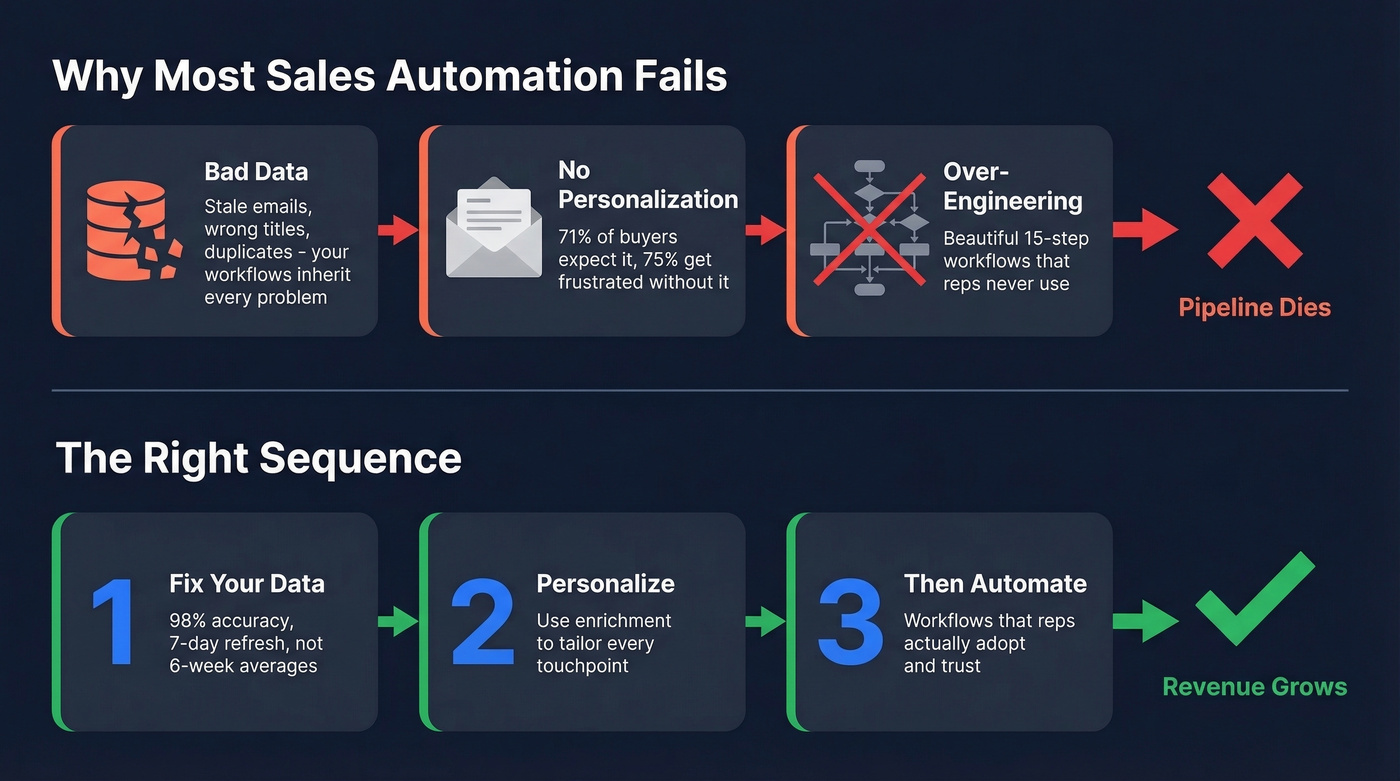
Bad data is the silent killer. If your contact database is full of stale emails, wrong titles, and duplicate records, every automated workflow inherits those problems. Segmentation breaks. Lead scoring becomes meaningless. Your sender reputation takes a hit when you're blasting invalid addresses. Data quality isn't a nice-to-have - it's step zero. Prospeo's 7-day refresh cycle versus the 6-week industry average exists precisely because of this problem, and the accuracy gap between 98% and competitors in the 79-87% range is where pipelines quietly die. (If you need options beyond a single vendor, start with these data enrichment services.)
No personalization despite having the tools for it. 71% of buyers expect personalized outreach, and 75% get frustrated when they don't receive it. Yet most teams use automation to send the same generic sequence to every prospect. Spray-and-pray with automation is just spray-and-pray at scale - faster, but not better. Sellers using Outreach's AI tools cut research and personalization time by 90%. The tools exist. Most teams just don't use them properly. If you want a practical framework, use this personalized outreach playbook.
Over-engineering without adoption. A Reddit thread on CRM rollout failures nailed the three culprits: lack of buy-in, trying to do too much too fast, and skipping training because "it's intuitive enough." The most common pattern we see is a RevOps team building a beautiful 15-step workflow that reps never use because nobody explained why it matters.
Fix your data first. Personalize second. Automate third. That sequence matters.
Workflows That Move Numbers
Most "sales automation" content stays abstract. These three workflows are concrete, high-impact, and running inside real sales orgs right now.
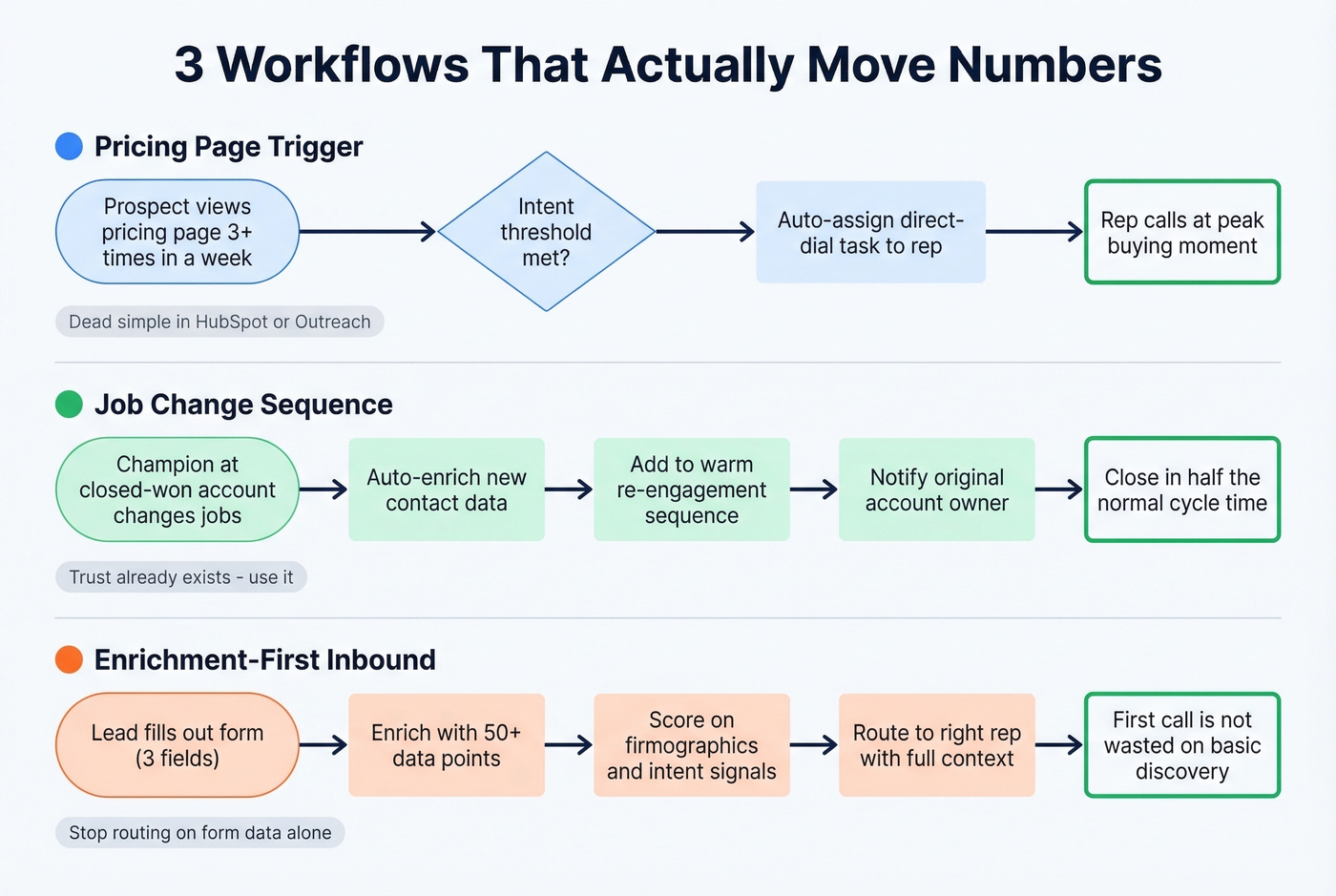
The pricing page trigger. When a prospect views your pricing page three or more times within a week, trigger a direct-dial task for the assigned rep. This catches high-intent buyers at the exact moment they're evaluating - and it's dead simple to set up in HubSpot or Outreach with a basic webhook.
The job-change sequence. When a champion at a closed-won account changes companies, automatically enrich their new contact data, add them to a warm re-engagement sequence, and notify the original account owner. Former champions are easier to re-engage than cold prospects because trust already exists. We've watched teams close these deals in half the normal cycle time.
The enrichment-first inbound flow. When a lead fills out a form, enrich the record with 50+ data points before routing. Score based on enriched firmographics and intent signals, not just the three fields they gave you. Route to the right rep with full context so the first call isn't wasted on discovery questions the data already answered.
Software, Specialist, or Agency?
You've got three ways to solve the sales automation problem, and the right one depends on your budget, timeline, and how much you want to own the process.
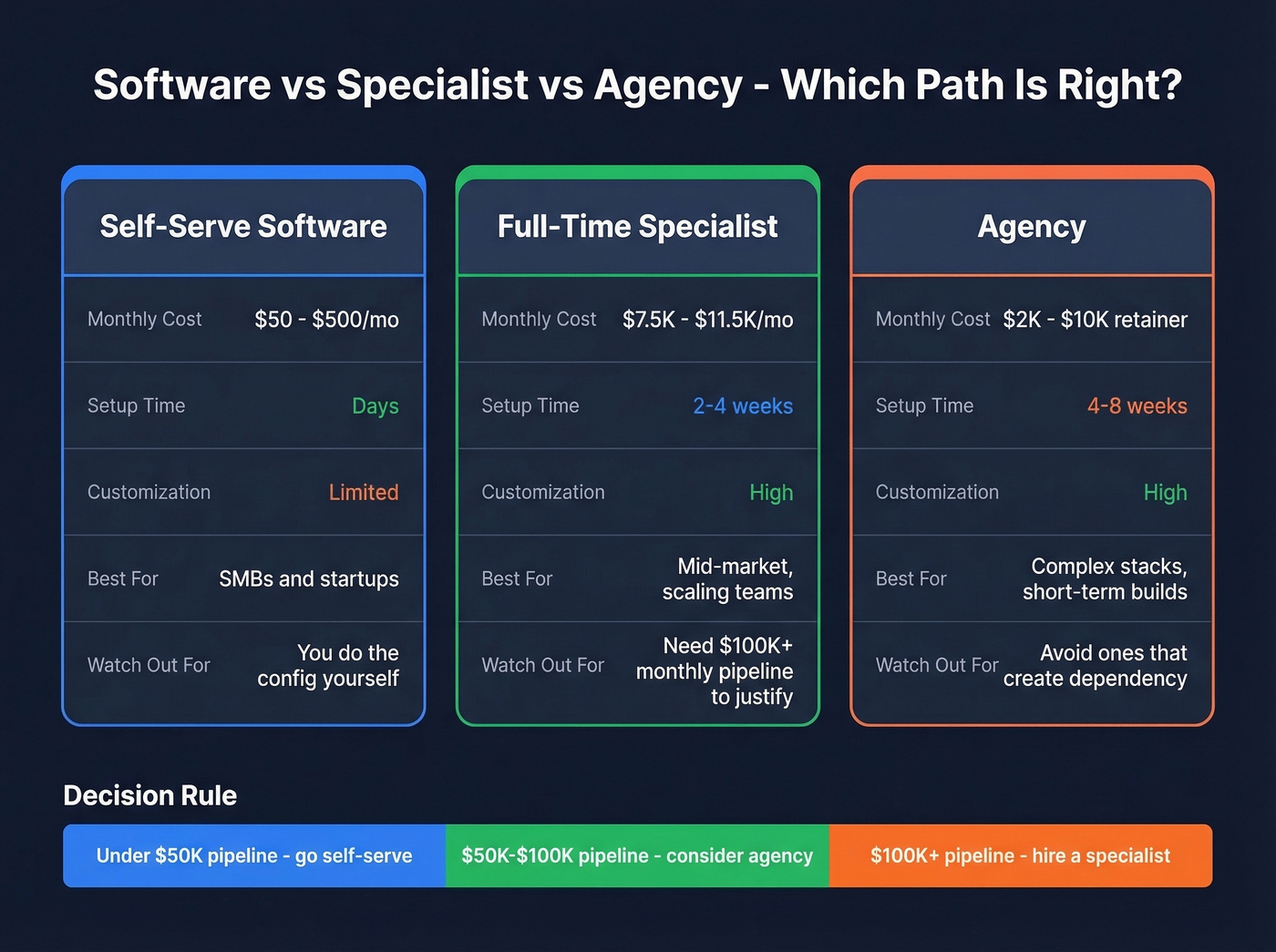
| Factor | Self-Serve Software | Full-Time Specialist | Agency |
|---|---|---|---|
| Monthly cost | $50-$500 | $7.5K-$11.5K (salary) | $2K-$10K retainer |
| Setup time | Days | 2-4 weeks | 4-8 weeks |
| Customization | Limited | High | High |
| Best for | SMBs, startups | Mid-market, scaling | Complex stacks |
Self-serve software is the fastest path. You can have verified contacts flowing into sequences within a day. The tradeoff is you're doing the configuration yourself, and you're limited to what platforms offer out of the box.
A full-time specialist gives you ongoing optimization and deep customization. They'll own your CRM architecture, build integrations, and iterate on workflows monthly. This makes sense when outbound is a core revenue channel and you need someone thinking about it full-time.
An agency gets you expertise fast without a headcount commitment. The best ones build your stack, train your team, and hand it off. The worst ones create dependency and charge you monthly for work that should've been a one-time project. Look, if an agency won't tell you their pricing before a discovery call, that tells you everything about their sales process.
The Autonomy Spectrum
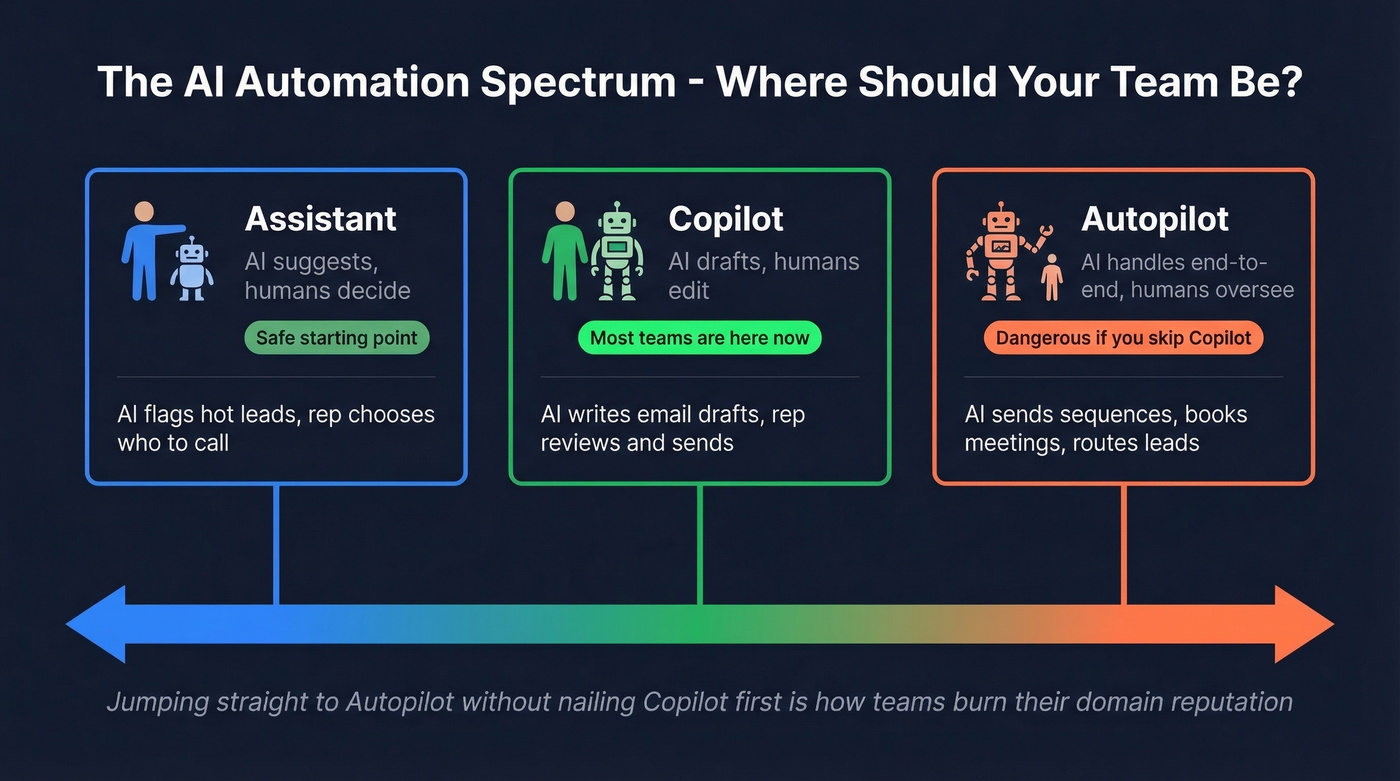
Think about AI automation on a spectrum: Assistant where AI suggests and humans decide, Copilot where AI drafts and humans edit, and Autopilot where AI handles end-to-end with human oversight. Most teams operate in Copilot mode right now. The teams jumping straight to Autopilot without nailing Copilot first are the ones burning their domain reputation. (If you're building this out, follow a structured sales process optimization approach.)

You just read it: bad data is the silent killer of sales automation. Prospeo's 98% email accuracy and 7-day refresh cycle mean your sequences, lead scoring, and routing workflows actually work. At ~$0.01/email, fixing step zero costs less than one bad meeting.
Stop automating on top of broken data. Start with Prospeo.
Best Sales Automation Tools in 2026
Here's where opinions matter more than feature lists. We've evaluated these tools across data quality, ease of use, integration depth, and whether they actually deliver on their promises.
Prospeo
Best for: Verified B2B contact data - the foundation layer
Every automation stack starts with data. The database covers 300M+ professional profiles with 143M+ verified emails and 125M+ verified mobile numbers. Email accuracy hits 98%, mobile pickup rate is 30%, and the 7-day data refresh cycle makes the industry's six-week average look negligent.

The search interface gives you 30+ filters - buyer intent powered by Bombora across 15,000 topics, technographics, job changes, funding events, headcount growth. The Chrome extension, used by 40K+ people, lets you prospect from any website and pull verified contact data in one click. Native integrations push directly into Salesforce, HubSpot, Clay, Smartlead, Instantly, and Lemlist.
Snyk's 50 AEs were dealing with 35-40% bounce rates before switching. After, bounces dropped under 5%, AE-sourced pipeline jumped 180%, and they're generating 200+ new opportunities per month.
Pricing is credit-based and transparent - roughly $0.01 per email, free tier with 75 emails/month, no contracts. That's 90% cheaper than ZoomInfo on a per-lead basis.
Use this if: you need verified data as the foundation of your automation stack. Skip this if: you need a full sequencing platform - pair it with Outreach, Reply.io, or Smartlead for that.
Clay
Best for: Workflow orchestration and enrichment waterfalls
I watched an outbound agency rebuild their entire prospecting workflow in Clay over a weekend. They went from five disconnected tools to one orchestration layer that enriches, scores, and routes leads automatically. That's what Clay does best - serving as the central command center for complex prospecting workflows. (If you're building lists inside Clay, this Clay list building guide will save you time.)
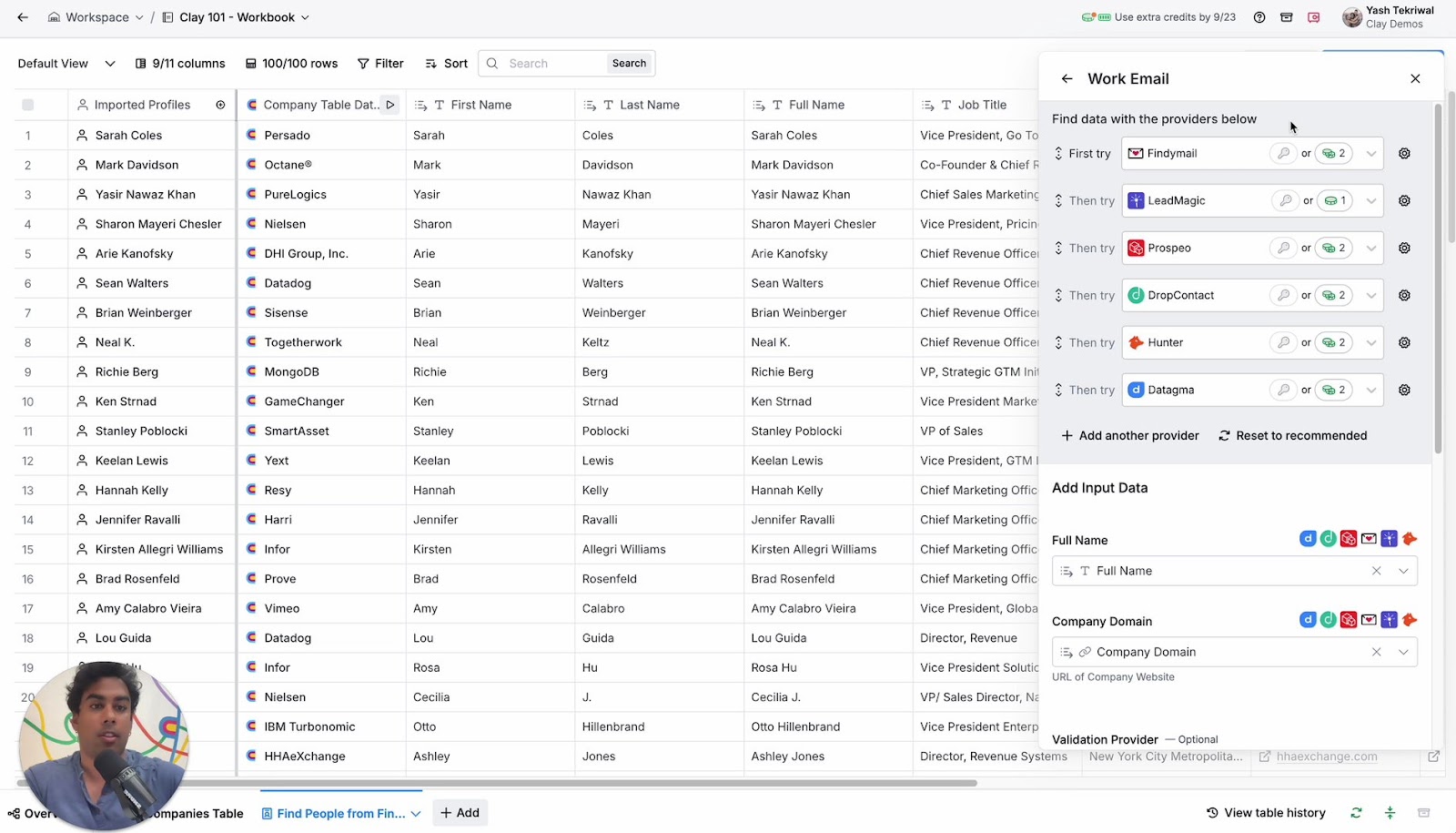
Clay connects to 100+ data sources and lets you build enrichment waterfalls - if Source A doesn't have an email, try Source B, then Source C. The Claygent AI agent handles custom research tasks that would take a human hours. Agencies love it because it replaces manual prospecting with repeatable, scalable workflows.
Starts at $134/month for 2,000 credits on annual billing. Enterprise plans go higher. The learning curve is real - budget a week to build your first workflow properly.
Use this if: you're building multi-step prospecting workflows or running an agency. Skip this if: you just need a CRM with basic automation. Clay is overkill for that.
HubSpot Sales Hub
HubSpot is the obvious starting point for teams that want CRM, automation, and reporting in one platform. The free plan is genuinely useful - a real CRM with contact management and basic pipeline tracking, not a bait-and-switch trial. Starter plans run $20/user/month.
The ecosystem is massive. Almost every agency supports HubSpot, almost every tool integrates with it, and almost every sales hire has used it before. That last point matters more than any feature comparison - adoption is the #1 predictor of whether your automation actually works. If you outgrow HubSpot's built-in sequencing, pair it with a dedicated tool like Outreach or Salesloft. (If you're still evaluating CRMs, here are more examples of a CRM with real pricing.)
Outreach vs. SalesLoft
These two overlap so heavily that evaluating them separately wastes your time. Both offer cadence management, coaching, deal intelligence, and AI-assisted personalization. The real differences are subtle.
Outreach edges ahead on AI benchmarks. 45% of teams now run a hybrid AI-SDR model, and Outreach's data shows deals closed within 50 days hit a 47% win rate versus 20% after that threshold - their coaching tools shave 11 days off the average cycle. Pricing runs around $100/user/month.
Salesloft runs $125-$165/user/month and has a slightly more intuitive UI for reps who aren't power users. The deciding factor is usually which one your team has used before. If you're evaluating both, run a two-week pilot with each - the UX differences matter more than the feature sheets suggest.
Hot take: if your average deal size sits below $10K, neither is worth the spend. Use HubSpot or Reply.io at $49/seat/month and invest the savings in better data.
Apollo.io
The best free-tier option in sales automation, full stop. The free plan gives you access to 210M+ contacts with basic sequencing built in - data and outreach in one tool, no credit card required. Paid plans start at $49/user/month. For startups that need to start prospecting today without budget approval, Apollo is the move. Email accuracy runs around 79%, so verify your critical contacts through a dedicated verification tool before sending to senior executives where every email counts. (If you're building a broader stack, compare more SDR tools before committing.)
The Rest of the Field
Gong is conversation intelligence, not prospecting. It records calls, analyzes deal health, and gives sales leaders coaching insights they can't get from CRM data alone. Expect $30K-$80K/year based on typical enterprise deployments. Best for understanding why deals are won or lost.
AiSDR is the most production-ready AI SDR we've tested. It handles intent-based outreach autonomously - research, personalization, and initial sequences - starting at $900/month for 1,200 emails. HubSpot and Salesforce integrations are native, and deliverability setup comes included. Not a replacement for human reps on complex deals, but a solid way to test AI-driven outbound without hiring a junior SDR.
Pipedrive ($16/seat/month) is a visual pipeline CRM for small teams - simple triggers, clean UI, minimal learning curve. Reply.io ($49/seat/month) handles multichannel sequencing without the Outreach/Salesloft price tag. monday CRM ($12/seat/month) is best for teams already on monday.com who want CRM without another vendor.
Pricing at a Glance
| Tool | Starting Price | Free Tier | Model |
|---|---|---|---|
| Prospeo | ~$0.01/email | Yes (75/mo) | Credit-based |
| Clay | $134/mo | - | Credit-based |
| HubSpot Sales Hub | $20/user/mo | Yes | Per-user |
| Apollo.io | $49/user/mo | Yes | Per-user |
| Outreach | ~$100/user/mo | No | Custom per-user |
| Salesloft | $125-$165/user/mo | No | Custom per-user |
| Gong | ~$30K-$80K/yr | No | Per-user + platform |
| AiSDR | $900/mo | No | Flat (email volume) |
| Pipedrive | $16/seat/mo | Trial only | Per-seat |
| Reply.io | $49/seat/mo | No | Per-seat |
| monday CRM | $12/seat/mo | Trial only | Per-seat |
You don't need 30 tools. You need three or four that actually talk to each other.
Recommended Stacks
The tools above are ingredients. Here's how to combine them.
Startup / SMB (1-5 reps): Prospeo for verified data, Pipedrive for pipeline management, Reply.io for sequences. Total cost: under $200/month. This gets you prospecting, sequencing, and deal tracking without enterprise complexity.
Mid-market (5-20 reps): Your data layer feeds Clay for enrichment and orchestration, which connects to HubSpot Sales Hub for CRM. Native integrations or Zapier tie them together. This is the sweet spot for teams scaling outbound without a dedicated RevOps hire.
Enterprise (20+ reps): Verified data flows into Outreach or Salesloft for sequencing, Gong for conversation intelligence, and Salesforce for CRM. The data layer matters even more at scale - a 5% bounce rate across 50 reps sending 100 emails/day adds up fast. (If bounce is creeping up, start with these email bounce rate benchmarks and fixes.)
Outbound agency: Verified contacts feed Clay for workflow orchestration, then Smartlead or Instantly for sending infrastructure. Clean data powers Clay's enrichment waterfalls, and the sending tools handle deliverability and inbox rotation.
That enrichment-first inbound flow? Prospeo returns 50+ data points per contact with a 92% match rate. Layer in intent data across 15,000 topics and route leads with full context - no specialist hire required. Self-serve, no contracts, free tier included.
Build the workflow. Prospeo handles the data layer.
Finding the Right Agencies
If you'd rather hire experts than build it yourself, here are five agencies worth evaluating. Expect $5K-$25K for initial setup and $2K-$10K/month ongoing.
Utmost Agency - Clay-based outbound automation. They build the prospecting workflow and handle tooling in-house. Strong on deliverability with aged domains, warmup protocols, and inbox rotation.
Directive Consulting - RevOps and revenue orchestration for B2B teams. They think in systems, not campaigns. Good fit for mid-market companies with messy tech stacks.
SmartBug Media - HubSpot ecosystem specialist. Lifecycle automation, lead scoring, and marketing-to-sales handoffs.
New Breed - HubSpot-focused RevOps and lifecycle automation with an emphasis on the full buyer journey from first touch to renewal.
Belkins - Outbound appointment setting plus deliverability management. Best for teams that need meetings booked, not workflows designed.
The consensus on r/sales is blunt: prospects don't care about your tech stack - they care about saving time and money. Pick an agency that leads with outcomes, not jargon.
How to Roll Out Automation
1. Clean your data first. Before you automate a single sequence, run your CRM through an enrichment pass. You can't segment, score, or personalize against dirty data.
2. Start with one workflow, not ten. Pick your highest-impact sequence - usually the initial outbound cadence or inbound lead routing - and automate that first. Measure, then expand.
3. Get buy-in before building. Present the "before and after" in terms reps care about: fewer manual tasks, more time selling, better data in their pipeline. Let's be honest - if reps don't see the value in the first week, they'll revert to their old process and your automation investment collects dust.
4. Train the team. Schedule a 30-minute walkthrough, record it, and make it available on-demand. The teams that skip training are the ones filing support tickets three months later.
5. Measure before and after. Baseline your bounce rate, reply rate, meetings booked, and time spent on admin before launch. Check again at 30, 60, and 90 days. If the numbers aren't moving, the problem is usually data quality or adoption, not the tool.
FAQ
What does a sales automation specialist do?
They design, implement, and maintain automated sales workflows - CRM configuration, sequence building, lead routing, data hygiene, and tool integrations. This operational layer lets reps focus on selling instead of admin. Increasingly, the role is merging with RevOps as companies consolidate operational functions.
How much do they earn?
Total compensation ranges from $87K to $138K per Glassdoor, with a national average around $92,788 on ZipRecruiter. Top earners in markets like San Mateo reach $154,111. Expect to pay more for candidates with Salesforce and HubSpot certifications.
What's the best tool for small teams?
Prospeo for verified contact data (free tier: 75 emails/month) paired with Pipedrive or HubSpot's free CRM covers data, outreach, and deal tracking under $100/month. Apollo.io is another strong free-tier option, though its 79% email accuracy means you'll want to verify high-value contacts separately.
Should I hire a specialist or use an agency?
Hire when you need ongoing optimization and your outbound pipeline exceeds $100K monthly. Use an agency for one-time stack builds or when you need results fast without committing to headcount. Agencies also handle complex platform migrations more efficiently than a single new hire.
Are AI SDRs replacing human reps?
Not yet - 45% of teams use a hybrid model where AI handles research and initial outreach while humans manage relationship-building and closing. Sales teams using AI to automate workloads see a 3-15% revenue uplift and 10-20% growth in ROI. The smart play is augmentation: AI SDRs excel at high-volume top-of-funnel activity but can't navigate complex, multi-stakeholder deals.