

Sales Call Follow Up Emails That Actually Get Replies
You just hung up a discovery call that went great. The prospect was engaged, asked sharp questions, even laughed at your joke about their legacy CRM. Now you're staring at a blank compose window, and the anxiety kicks in - how do you capture that momentum without sounding like every other rep who sends "just following up, any thoughts?"
That gap between a good call and a good sales call follow up email is where deals quietly die. Your first email does roughly 80% of the heavy lifting. The templates and cadence matter far less than most people think - and far more than most people execute.
The Short Version
Nail the recap and next step within 2 hours of the call. That first follow-up does most of the work. Delay kills momentum.
The sweet spot is 4-7 touchpoints spaced 3-4 days apart. After 4+ emails in a sequence, you're driving up unsubscribes and spam complaints fast.
Each follow-up must add something new. "Just checking in" is dead. Every touch needs fresh value - a resource, a case study, a new angle on their problem.
What the Data Actually Says
Here's the contrarian take you won't hear in most sales training: the "80% of sales require 5 follow-ups" stat that gets recycled everywhere is misleading. The highest reply rate comes from a single, well-crafted email. After four or more emails, you're not persisting - you're annoying.
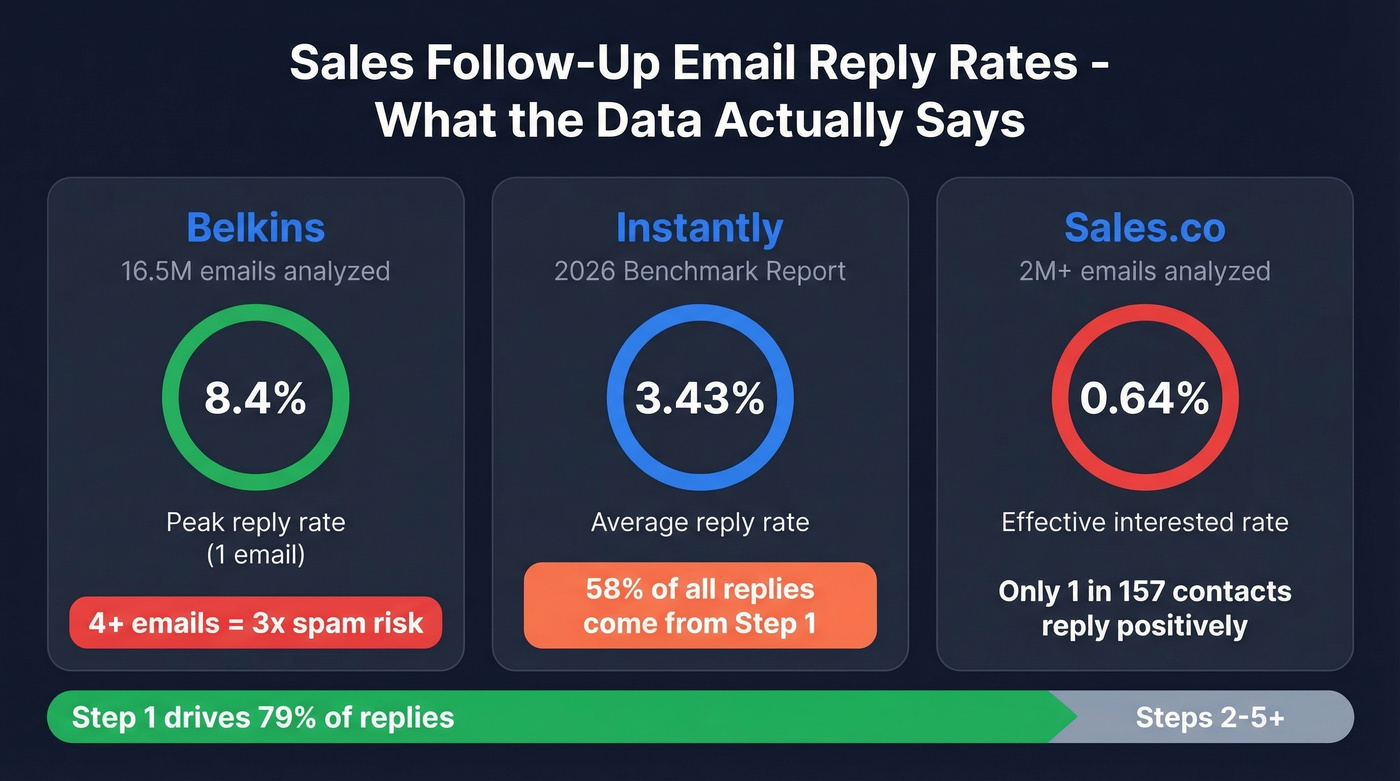
Belkins analyzed 16.5 million cold emails across 93 business domains and found the peak reply rate - 8.4% - came from just one email. Four-plus emails in a sequence tripled unsubscribe rates and more than tripled spam complaint risk. These benchmarks come from cold email datasets, and post-call follow-ups typically perform better, but the pattern holds: front-loaded effort wins.
Instantly's 2026 benchmark report tells a similar story: 58% of all replies come from step one. The overall average reply rate sits at 3.43%, with elite performers pushing past 10%.
And here's the number that should recalibrate your expectations entirely: Sales.co's dataset of 2M+ emails found an average reply rate of 2.09%, but only 14.1% of those replies were positive. That's an effective "interested" rate of roughly 0.64% - about 1 in 157 contacts. Initial outreach drove 79.4% of all replies.
The lesson isn't "follow up more." It's "follow up better."
| Source | Dataset Size | Avg Reply Rate | Key Finding |
|---|---|---|---|
| Belkins | 16.5M emails | 8.4% (1 email) | 4+ emails triples unsubscribes and spam risk |
| Instantly | Not disclosed | 3.43% overall | 58% of replies from step 1 |
| Sales.co | 2M+ emails | 2.09% overall | Only 0.64% interested |
When to Send After a Sales Call
Timing matters more than most reps realize, but not in the way you think. The old advice about "send on Tuesday at 10 AM" is less important than timing to a trigger. A follow-up sent two hours after a great discovery call beats a perfectly timed Tuesday morning email sent three days late.
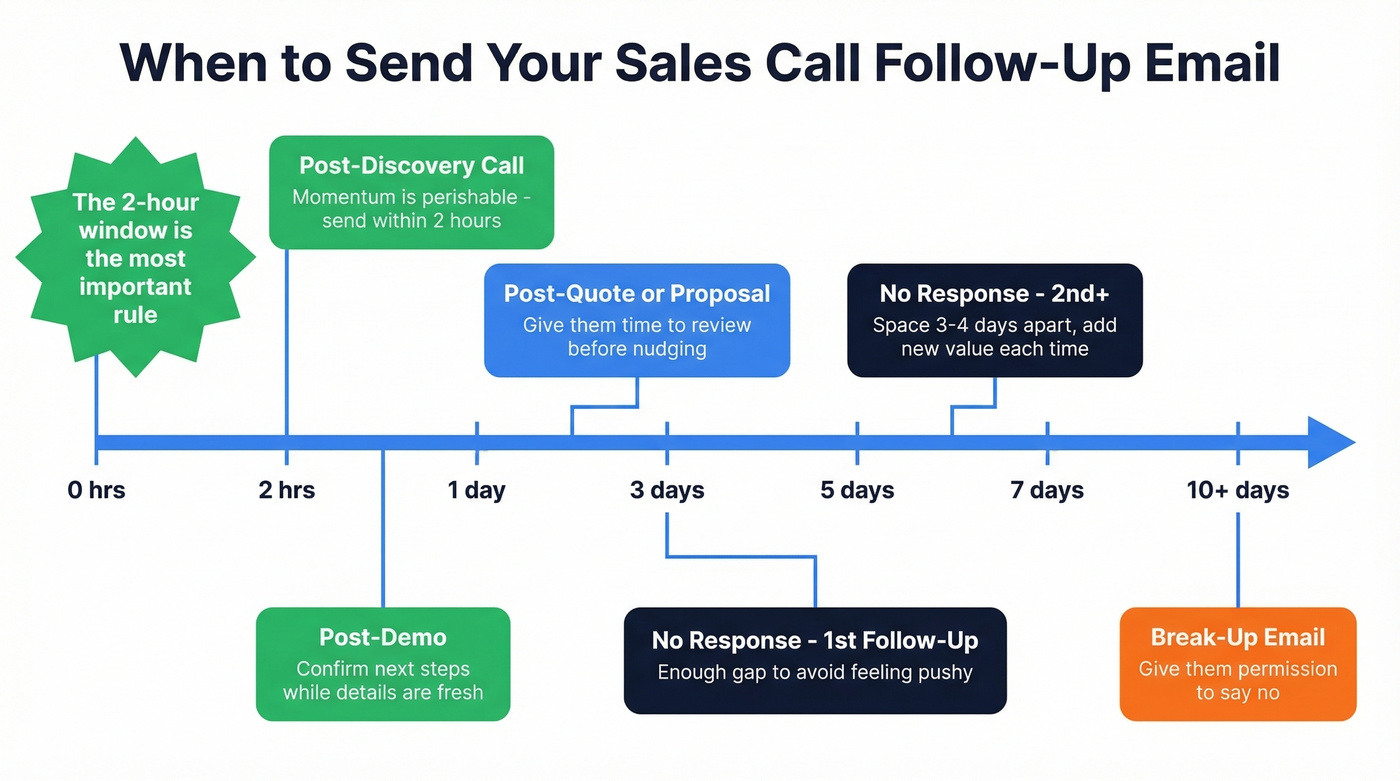
When you don't have a trigger to anchor to, 9-11 AM in the prospect's local time zone typically performs best. Tuesday through Wednesday tends to peak for open rates. But the real rule is simpler: match your timing to the scenario.
| Scenario | Timing | Why |
|---|---|---|
| Post-discovery call | Within 2 hours | Momentum is perishable |
| Post-demo | Same day, within 2 hrs | Confirm next steps while fresh |
| Post-quote/proposal | 2-3 days later | Give them time to review |
| No response (1st) | 3-5 days after send | Enough gap to not feel pushy |
| No response (2nd+) | 3-4 days apart | Consistent without crowding |
| Break-up email | After 7-10 touches | Give permission to say no |
Within two hours after a sales call is the most important timing rule. We've watched reps agonize over Tuesday vs. Wednesday send times while letting 48 hours pass after a great discovery call. Everything beyond that first window is optimization. The two-hour window is the difference between a deal that moves and one that stalls.
Subject Lines That Get Opened
Personalized subject lines are 26% more likely to be opened. Keep them short - under seven words.
Don't overthink this. Your post-call follow-up subject line isn't a cold email hook. The prospect already knows you. Your job is to be recognizable and specific, not clever.
Recap-style:
- Quick recap: [topic discussed]
- Following up on our [day] call
- [Their company] + [your company] next steps
Value-add:
- The [resource] I mentioned
- [Case study company] did exactly this
- Data on [their specific challenge]
Urgency / question:
- Before your [deadline/board meeting/launch]
- Still evaluating [solution type]?
The best subject line makes the prospect think "oh right, that call" - not "who is this?"

Your follow-up templates won't matter if 35% of your emails bounce. Prospeo delivers 98% email accuracy with a 7-day refresh cycle, so the contact you spoke with on a discovery call gets your recap - not a mailer daemon.
Stop losing deals to bad data between the call and the inbox.
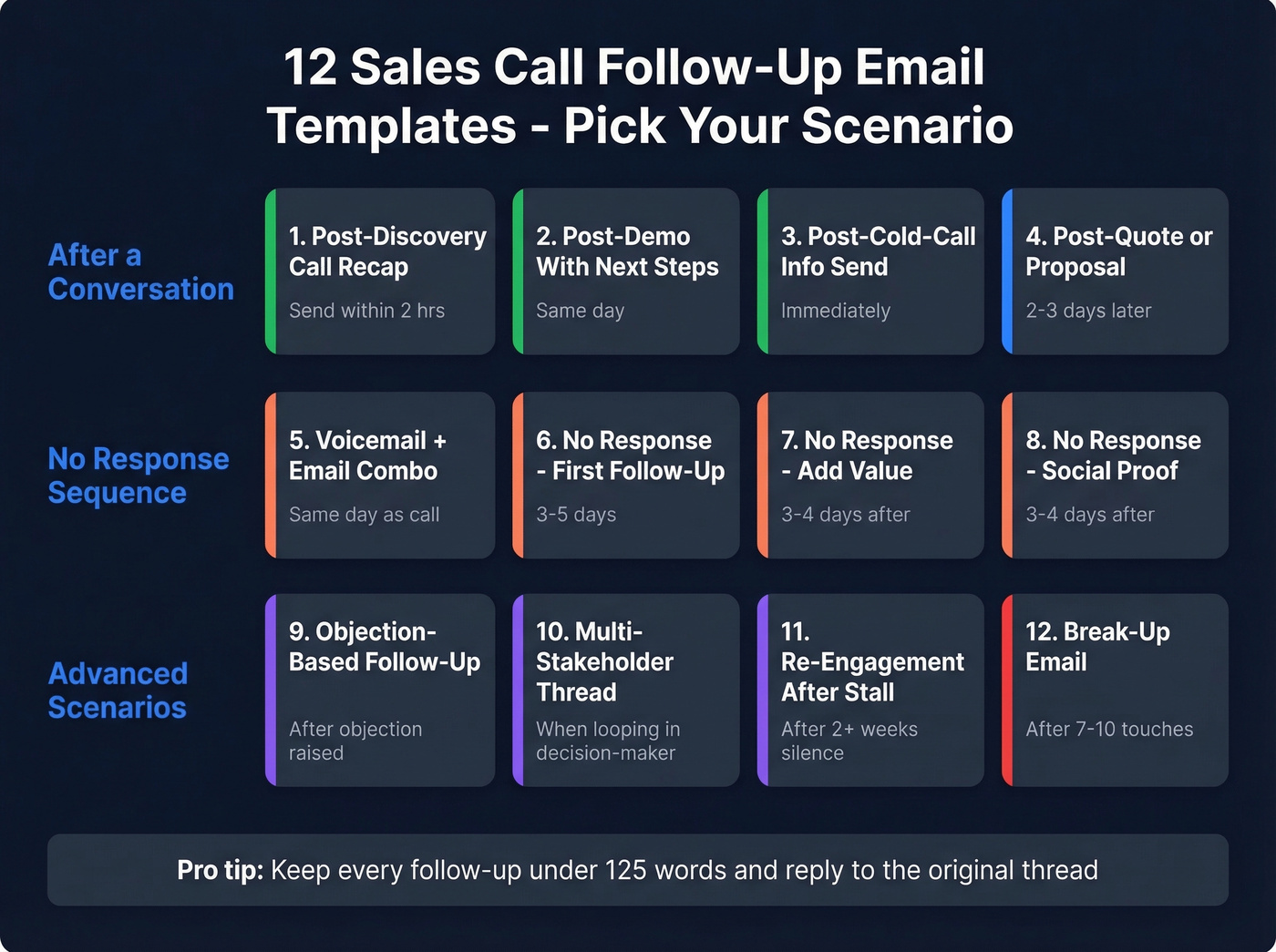
12 Post-Call Follow-Up Templates
These aren't generic fill-in-the-blank shells. Each template maps to a specific post-call scenario. Keep every follow-up under 125 words - if it scrolls on mobile, it's too long. And send follow-ups as replies to your original thread, not new emails. It preserves context and feels like a conversation, not a campaign. If you want more variations, start with these sales follow-up templates.
Post-Discovery Call Recap
Use this within two hours of a discovery call where you identified clear pain points and agreed on next steps. The goal is to confirm what you heard, demonstrate you were listening, and lock in the next meeting.
Hi Sarah,
Thanks for walking me through Meridian Corp's onboarding challenges today - especially the part about new hires taking 6+ weeks to ramp because your current system doesn't integrate with Workday. That's a solvable problem.
Here's what I took away:
- Onboarding time is 2x your target (6 weeks vs. 3)
- The integration gap is costing your ops team ~10 hours/week in manual data entry
- You need a solution live before Q3 hiring push
I'm putting together a custom walkthrough showing how we've solved this for companies similar to yours. Does Thursday at 2 PM work for a 30-minute demo?
Best, [Your name]
Post-Demo With Next Steps
Use this after a demo where the prospect expressed interest but hasn't committed. Recap what resonated, address any hesitation, and propose a concrete next step.
Hi [first name],
Great demo today. Based on your questions, it sounds like [specific feature, like the automated reporting dashboard] is the piece that would save your team the most time - especially with [their context, like quarterly board prep eating up 15+ hours].
A few things I want to send over:
- The ROI calculator we mentioned (attached)
- A 2-minute case study from [similar company in their industry]
Next step: I'd love to get [decision-maker name] on a 20-minute call to walk through implementation. Would next Tuesday or Wednesday work?
[Your name]
Post-Cold-Call (Promised to Send Info)
They gave you 90 seconds on the phone. Don't repay that with a novel.
Hi [first name],
Good speaking with you just now. As promised, here's [what you discussed, like the quick overview of how we help teams in your industry cut ramp time by 40%].
[Link to resource or one-pager]
Takes about 2 minutes to review. Happy to answer any questions - just hit reply.
[Your name]
Post-Quote or Proposal
Use this 2-3 days after sending a proposal when you haven't heard back. The instinct is to write "did you get the quote?" Don't. Add context that makes the proposal easier to evaluate.
Hi David,
Wanted to circle back on the proposal I sent over Monday for Apex Financial's data migration project. I know pricing conversations usually involve a few stakeholders, so I put together a one-page summary comparing our approach to the in-house alternative your team was considering.
Quick math: based on the 14-week timeline we discussed, the in-house route would tie up 3 FTEs at roughly $180K in loaded cost. Our proposal comes in at $95K with a 10-week delivery.
Happy to jump on a quick call to walk through the numbers with anyone on your side. Does Friday work?
Best, [Your name]
Voicemail + Email Combo
When you've left a voicemail, the email should be shorter than the voicemail - it's a nudge, not a repeat.
Hi [first name],
Just left you a quick voicemail. The short version: I have [specific value, like the benchmark data on conversion rates in your industry] we talked about pulling together.
[Link or attachment]
Worth a 5-minute look. Let me know if [proposed next step, like Thursday still works for a follow-up call].
[Your name]
No Response - First Follow-Up
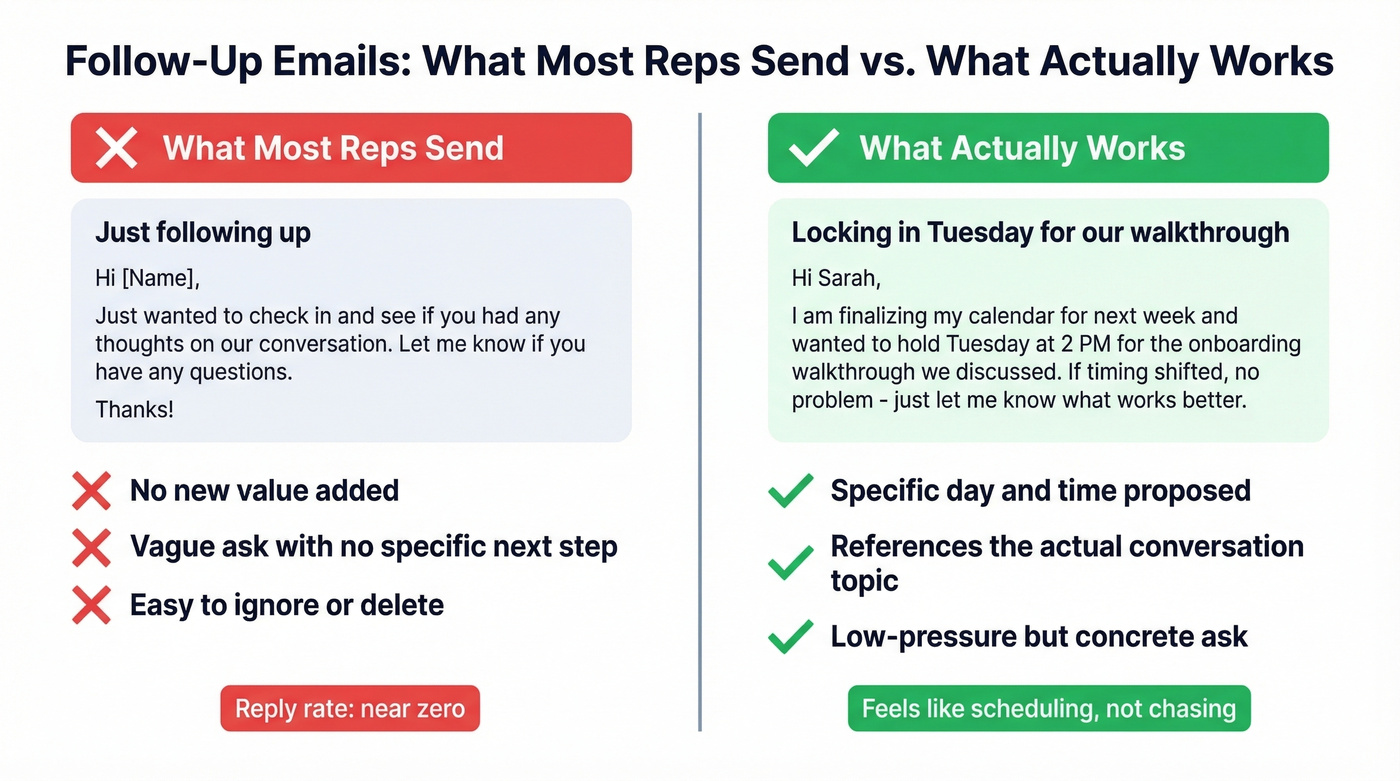
Here's what actually works: frame it as a scheduling question, not a "checking in" nudge. The consensus on r/sales is that "I'm trying to finalize my schedule for next week" works because it's concrete and logistical, not desperate. Use this 3-5 days after your initial follow-up got no reply.
Hi [first name],
I'm locking in my calendar for next week and wanted to see if [specific day, like Tuesday afternoon] works for the [meeting type] we discussed.
If timing's shifted, no problem - just let me know what works better on your end.
[Your name]
Pro tip: If your email tool shows they opened the original message but didn't reply, that's a signal - not that they're ignoring you, but that the ask wasn't clear enough. Sharpen the next step in this follow-up.
No Response - Add Value
When the first follow-up got nothing, stop asking and start giving. A resource, a data point, an insight about their industry.
Hi [first name],
Came across [specific resource, like this report on how companies in your industry are cutting onboarding costs by 30%] and thought of our conversation about [their pain point].
[Link]
Page 12 is the most relevant section for what you're dealing with. Happy to walk through it if useful.
[Your name]
No Response - Social Proof
Use this as your third or fourth touch. Specificity is everything - "companies like yours" is weak; a named company in their industry with a similar challenge is strong.
Hi [first name],
Quick share: [customer company, like a Series C fintech] was dealing with the same [specific problem] you mentioned. They cut it from [before metric] to [after metric] in [timeframe].
[Link to case study or 2-sentence summary]
Thought it might be relevant as you're evaluating options. Worth a conversation?
[Your name]
Objection-Based Follow-Up
What most reps send: "Wanted to see if you had a chance to review the proposal. Let me know!"
What actually works: Address the specific objection they raised - price, timing, internal buy-in - head on.
Hi [first name],
You mentioned [specific objection, like the budget cycle doesn't reset until Q1] during our call. Totally understand.
A few clients in a similar spot have [specific workaround, like started with a pilot in Q4 to build the internal case, then expanded in Q1 with budget already earmarked].
Would it help to see how [similar company] structured that? I can send over the details.
[Your name]
Loop in a Stakeholder
Your champion needs to bring in a decision-maker. Make it effortless for them to forward or introduce you.
Hi [first name],
Based on our conversation, it sounds like [stakeholder name/title] would want to weigh in before moving forward. Totally makes sense.
I put together a [one-pager/executive summary] specifically for [their role] that covers the ROI case in under 2 minutes.
Would it be helpful if I sent that directly, or would you prefer to forward it? Either way works.
[Your name]
Re-Engagement After Going Cold
Use this 30-60 days after a deal went silent. You need a new trigger - a product update, company news, a fresh resource. Don't reference the old thread like nothing happened.
Hi [first name],
It's been a while since we last connected - wanted to reach out because [new trigger, like I saw Apex just closed a Series B, or we just launched a feature that directly addresses the problem you mentioned].
Given where things stood, I thought this might be worth a fresh look. Open to a 15-minute call next week?
[Your name]
Some reps are embedding short Loom videos in re-engagement emails - a 60-second screen recording of a relevant feature or a personalized walkthrough. In our experience, these outperform text-only re-engagements by a wide margin when the prospect has gone cold. If you want a tighter playbook, see this Loom video cold email strategy.
Break-Up Email
Use this after 7-10 touches with no response. The goal isn't to guilt them - it's to give them permission to say no, which paradoxically often gets a reply. This is your last scheduled touch before moving them to long-term nurture.
Hi Sarah,
I've reached out a few times about the onboarding automation project at Meridian Corp and haven't heard back - which is totally fine. Priorities shift.
I don't want to keep cluttering your inbox, so I'll pause here. If this becomes relevant again down the road, I'm easy to find.
One last thought: if the timing just isn't right, a quick "not now" is genuinely helpful on my end. No hard feelings either way.
Best, [Your name]
Five Objections Your Follow-Up Should Address
Every non-response is an unspoken objection. They break into five categories, and your sequence should address each one systematically rather than repeating the same ask in different words. If you want a more systematic way to handle this, use a sales qualification framework to map objections to stakeholders and next steps.
"I don't need this." Surface a pain they haven't fully quantified. "Most teams we talk to don't realize [specific problem] is costing them [dollar amount or hours] until they see the data."
"It's not worth the cost." Reframe from price to ROI. "The pilot with [similar company] paid for itself in 6 weeks. Happy to share the math."
"There's no urgency." Create a time anchor. "Your Q3 hiring push starts in 8 weeks. Implementation takes 4. The window to be live in time is closing."
"I don't want it." This usually means they don't see the fit. Shift the angle. "I may have focused on the wrong use case. [Different feature] might actually be more relevant given your [specific context]."
"I don't trust you (yet)." Lead with proof. "Here's a 90-second video from [customer name] at [company] - they were in the exact same spot 6 months ago."
Each follow-up in your sequence should target a different objection. If you're sending five emails that all say "just checking in," you're addressing zero of these.
Follow-Up Cadence: Day by Day
The difference between a warm post-call follow-up and a cold outbound sequence matters. Warm leads - people who took a call with you - should get 4-7 touches within about two weeks. Cold prospects need 7-10 touches spread over 10-14 days.
Here's an 8-touch cadence adapted from Sybill's framework for post-call follow-up when the prospect goes quiet after an initial good conversation.
| Day | Channel | Action | Goal |
|---|---|---|---|
| 1 | Recap + next steps | Lock in momentum | |
| 2 | Phone | Quick call | Reinforce urgency |
| 3 | Value-add resource | Address "no need" | |
| 5 | Social | Engage their content | Stay visible |
| 7 | Case study/social proof | Address trust | |
| 9 | Phone | Second call attempt | Direct conversation |
| 11 | Objection-targeted | Address cost/timing | |
| 12 | Break-up | Permission to close |
The Instantly sweet spot - 4-7 touchpoints spaced 3-4 days apart - aligns with this. Beyond seven touches, you're in diminishing-returns territory unless each touch genuinely adds something new. Use engagement signals like email opens and link clicks to time your follow-ups; sending when the prospect is active beats sending on a fixed schedule. If you need a deeper system, use this sequence management guide.
One important distinction: some sources cite 12-13 touches to convert a lead into a qualified opportunity. That's a lifecycle number across months of nurture, not a single follow-up thread. Don't confuse the two. Your post-call sequence should resolve within 2-3 weeks, then shift to long-term nurture if needed.
Mistakes That Kill Reply Rates
The Empty Bump
Bad: "Hi Sarah, just bumping this to the top of your inbox. Any thoughts on the proposal?"
Good: "Hi Sarah, since we last spoke, I pulled the implementation timeline for a company your size - looks like 4 weeks to full deployment, not the 8 weeks you were budgeting for. Attached the breakdown. Worth a quick look before your planning meeting Friday?"
Every follow-up without new information is a wasted touch. The r/sales consensus is clear: "just following up, did you receive our quote?" sounds desperate. Drip value instead. If you need better language, here’s how to say just checking in professionally.
Writing Like a Press Release
Bad: "Dear Mr. Thompson, I hope this message finds you well. I am writing to follow up on our recent discussion regarding the enterprise solution we presented..."
Good: "Hey James - quick follow-up on our call. The integration piece you asked about? Turns out we already have a native connector for your stack. Demo takes 10 minutes. Want to see it?"
Sales.co's data shows informal tone drives a 78% higher positive reply rate than formal. Write like a human, not a template. For a deeper breakdown, see this email copywriting guide.
Following Up on Bad Data
Here's the thing nobody talks about: following up on an email address that doesn't exist. Teams run high bounce rates and wonder why their sequences aren't converting - the emails never arrived. Great copy can't fix an email that never lands. Before any follow-up sequence, run your list through a verification tool like Prospeo to catch invalid addresses, spam traps, and catch-all domains. The free tier covers 75 verifications a month - enough to validate your highest-priority prospects before you hit send. If you’re troubleshooting deliverability, start with email bounce rate benchmarks and fixes.
AI-Assisted Follow-Ups in 2026
The biggest shift in follow-up emails right now isn't a template - it's AI personalization. Early adopters are seeing 15-20% reply rate increases from AI-generated follow-ups that pull from conversation intelligence and account signals. If you’re evaluating tools, start with the best AI tools for automating sales follow-ups.
The baseline tells the story: generic cold email templates land at 0.5-2% reply rates. AI-personalized sequences push that to 6-20%+ by referencing specific call details, company news, and buying signals automatically. AI agents now pull from account signals - funding rounds, executive changes, tech stack shifts - to generate follow-ups that reference real-world triggers instead of generic value props. For a full workflow, see AI sales follow-up.
Conversation intelligence tools auto-generate call recaps, extract action items, and draft follow-ups within minutes of hanging up. But let's be honest: if your average deal size is under five figures, you probably don't need a $200/seat AI tool for follow-ups. A well-written template with accurate contact data will outperform a mediocre AI sequence built on stale information every time.
The data is clear: 58% of replies come from your first follow-up. Make it count by sending to verified emails that actually reach the prospect. Prospeo's 143M+ verified emails at $0.01 each mean your post-call momentum never dies in a bounce folder.
One verified email costs a penny. One lost deal costs a quarter.
FAQ
How many follow-up emails should I send after a sales call?
Four to seven touchpoints is the sweet spot. Belkins' research on 16.5M emails shows that 4+ emails in a sequence triple unsubscribe rates and more than triple spam complaint risk. Each touch must add new value - a resource, a case study, or a fresh angle on their problem.
How do I write a follow-up email after a sales call?
Open with a specific reference to something discussed on the call - a pain point, a metric, or a question they asked. Recap key takeaways in bullet points, then close with one clear next step and a proposed time. Keep it under 125 words and send within two hours.
What's the best time to send a follow-up email?
Send your post-call recap within two hours - this is the single most important timing rule. For subsequent touches, 9-11 AM in the prospect's local time zone on Tuesday or Wednesday performs best.
Should I call or email first after a meeting?
Email first, within two hours, to confirm next steps in writing. Follow up with a call 24-48 hours later if you haven't gotten a reply - the email gives your call a natural opening and ensures nothing discussed gets lost.
How do I make sure my follow-up emails actually arrive?
Verify every email address before it enters your sequence. Bounce rates above 3-4% tank your sender reputation fast, which means even your good emails start landing in spam. A quick verification pass before you launch a sequence saves you from burning your domain over bad data.