

Sales Coaching ROI: A Practical Framework You Can Defend
Only 28% of reps hit quota in 2023, down from 44% the year before. Leadership wants to know the sales coaching ROI - and they want the answer in dollars. Here's a framework that converts your coaching investment into a figure finance will accept.
Quick Version
Prepping for a budget meeting in 20 minutes? Take these:
- Formula: ROI (%) = (Net Benefits / Coaching Cost) x 100
- Benchmark range: published studies show 5.7x to 31x returns, with a commonly cited mean of 7x
- Quota context: average attainment sat at roughly 43% in late 2024 - coaching is one of the few levers that moves it
- Impact: coached teams see 16.7% higher revenue growth and 28% better win rates
- Attribution tip: use "contributed to" framing - it's more credible than claiming coaching caused the entire lift

Why Coaching Returns Matter Now
Every enablement leader we've talked to describes the same quarterly ritual: leadership asks for the return on coaching, and nobody has a clean answer. One Reddit thread in r/sales captures the pressure perfectly - an enablement leader scrambling to quantify something that resists clean quantification.
With quota attainment hovering around 43% and buying committees ballooning to 6-10 stakeholders - sometimes 15+ - the cost of an underperforming rep is higher than it's ever been. Finance doesn't care that coaching "feels right." They want a number.
Coaching Isn't Training
Training is a group event: standardized content, delivered once. Coaching is 1:1, continuous, and tailored to how a specific rep applies skills in live deals.
Up to 90% of training is forgotten within 120 days without reinforcement. Coaching is that reinforcement, and the common mistake is blurring the two when calculating returns. Training builds the baseline. Coaching compounds it. If you're lumping both into one ROI calculation, you're muddying the number before you even start.
What the Benchmarks Show
| Study | ROI | Context | Use This When |
|---|---|---|---|
| MetrixGlobal | 529% (788% w/ retention) | Fortune 500 telecom | Defending exec coaching spend |
| PwC Global | Mean 7x; 25% report 10-49x | Global survey | Global benchmarking |
| Manchester Review | 5.7x | 100 execs, Fortune 1000 | Conservative floor estimate |
| Factor 8 | 31x ($3.1M on $100K) | Sales training case | Sales-specific business case |
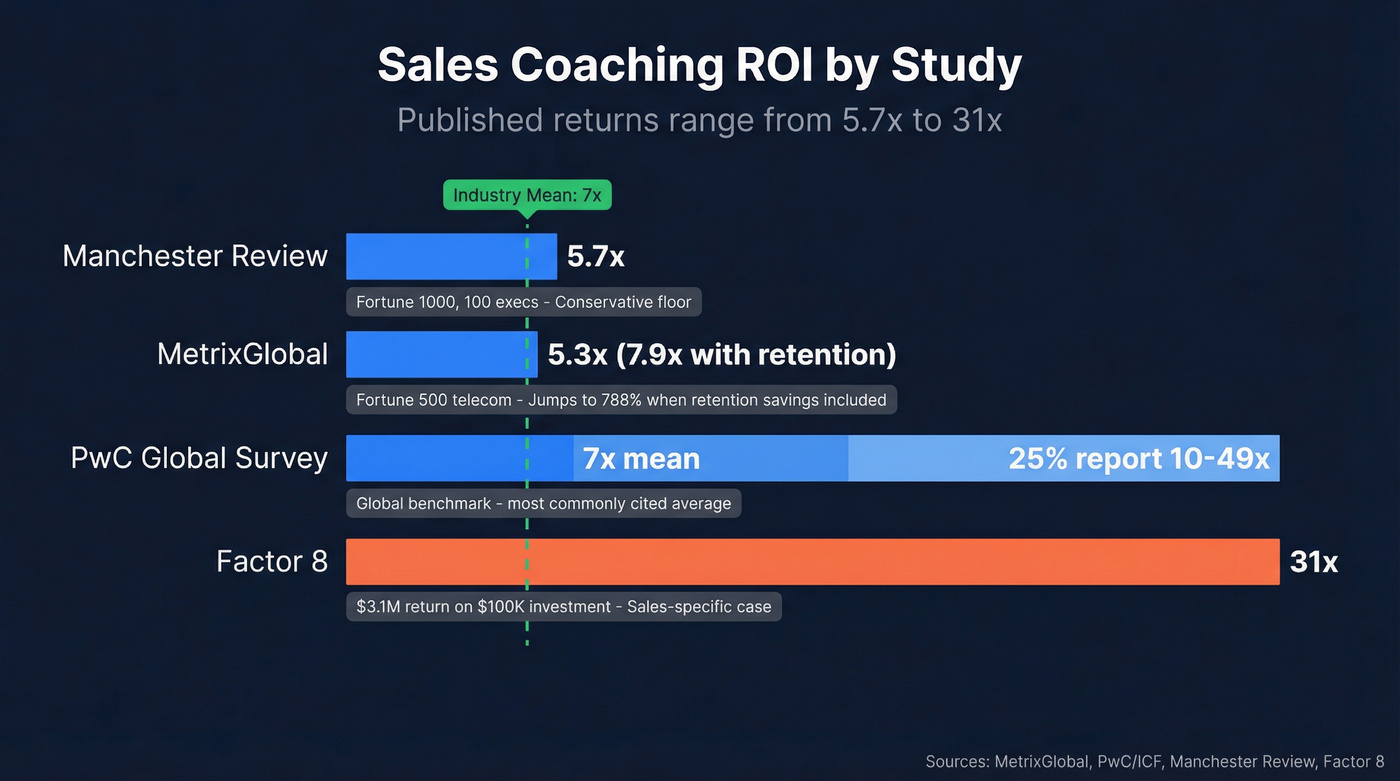
Notice the MetrixGlobal jump from 529% to 788% when retention benefits are included. We've seen teams overlook this entirely - reduced rep turnover is one of coaching's biggest ROI amplifiers, and most calculations ignore it. The revenue impact extends well beyond closed deals when you factor in avoided rehiring costs, which can run $100K-$200K per departed rep once you count recruiting, onboarding, and lost pipeline.
How to Calculate the Return
Step 1: Define Benefits. Pick 2-3 metrics coaching directly influences - win rate, deal size, cycle length, ramp time. Convert improvements to dollars. If you need a broader KPI menu, start with these sales productivity metrics that predict revenue.
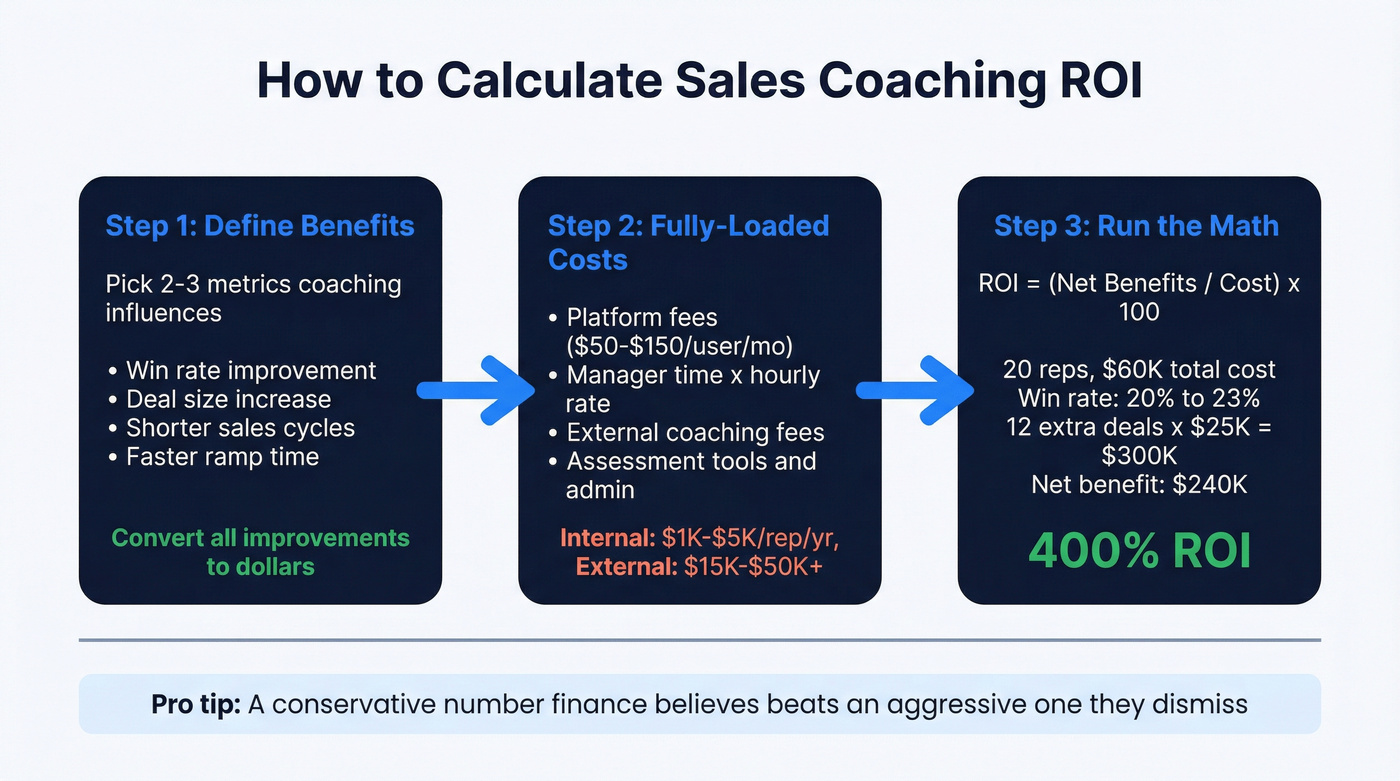
Step 2: Fully-Loaded Costs. Don't just count the platform fee. Include manager time at their hourly rate multiplied by coaching hours, external coaching fees, assessment tools, and admin overhead. Internal programs typically run $1K-$5K per rep per year. External 1:1 coaching runs $15K-$50K+. Platforms cost $50-$150/user/month. If you're comparing vendors, it helps to benchmark against sales coaching software options and typical pricing models.
Step 3: Run the Math. Say you coach 20 reps. Total cost: $60K. Win rate lifts from 20% to 23% across 400 opportunities at $25K ACV. That's 12 extra deals - $300K in revenue. Net benefit: $240K. ROI: ($240K / $60K) x 100 = 400%.
Conservative? Absolutely. But in our experience, a conservative number finance believes beats an aggressive one they dismiss every time.

That 400% ROI calculation above? It assumes coached reps actually reach their prospects. With 98% email accuracy and a 7-day data refresh cycle, Prospeo eliminates the bad-data tax that silently destroys coaching returns.
Stop coaching reps into bounced emails. Start at $0.01 per verified lead.
Sales Coaching Calculator Template
| Input | Your Number | Benchmark |
|---|---|---|
| Reps coached | - | - |
| Baseline win rate | - | 17-21% avg |
| Average deal value | - | - |
| Opps per rep/quarter | - | - |
| Ramp time (current) | - | 3-6 months |
| Total coaching cost | - | $1K-$5K/rep/yr internal |
Plug in your numbers, estimate a realistic lift of even 2-3 percentage points on win rate, and multiply by deal value and opportunity volume. That gives you the benefits side of the equation. A simple calculator like this is often all you need - and if you want a dedicated spreadsheet-style approach, use a sales ROI calculator framework.
Why ROI Feels Impossible
Coaching never happens in isolation. You changed the comp plan, launched a new product, and hired a better SDR team - all in the same quarter. Attributing revenue lift to coaching alone is intellectually dishonest, and finance knows it. The r/LearningDevelopment community puts it bluntly: everyone wants training ROI, no one agrees how to measure it.
The fix is language. Factor 8 uses "contributed to" framing - coaching contributed to a 25% increase in close rates, not "caused" it. Kirkpatrick Partners call this contributive ROI. It's more credible than single-cause attribution, and it's what sophisticated finance teams actually expect. (If you’re aligning this with broader enablement reporting, sales enablement analytics can help you pick defensible measures.)
What Kills Coaching Returns
Coaching Everyone Equally
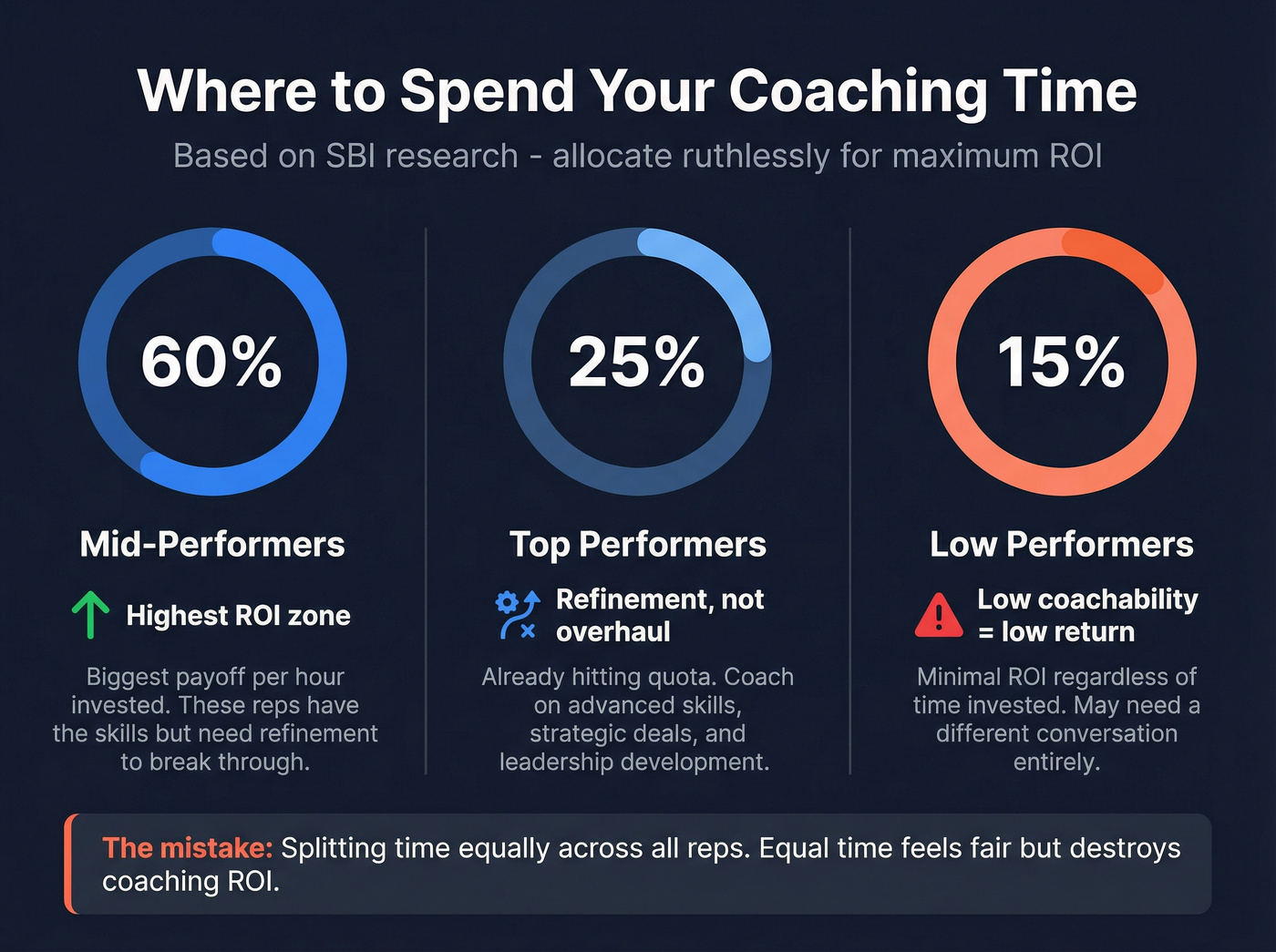
Here's the thing: blanket coaching - same cadence, same depth for everyone - is the fastest way to dilute impact. SBI's research shows that spending 60% of coaching time on mid-performers, 25% on top performers, and 15% on low performers maximizes returns. Low-coachability reps yield almost nothing regardless of time invested. Skip the equal-time approach and allocate ruthlessly. For practical ways to run those sessions, borrow from these sales coaching examples.
Coaching Too Late
Reps getting 30 minutes or less of coaching per week: 43% win rates. Reps getting 2+ hours per week: 56%. That delta isn't subtle. Call coaching effectiveness depends heavily on timing - coaching within 24 hours of a call makes reps 2.5x more likely to improve. Waiting a week to debrief a lost deal isn't coaching. It's a post-mortem. If you need a repeatable structure, use a 1:1 meeting template to standardize debriefs.
The Bad-Data Tax
The ROI killer nobody discusses: coached reps reaching bounced emails and dead numbers. You can't tell if the rep failed or the data did, which makes coaching impact unmeasurable. If 20% of emails bounce and half of phone numbers are disconnected, even perfect execution produces zero pipeline. Prospeo eliminates this upstream with 98% email accuracy and a 7-day data refresh cycle versus the 6-week industry average, so coached outreach actually lands where it's supposed to. If you’re auditing your stack, compare email lookup tools and validation workflows before you scale coaching.
Maximize Returns Fast
Allocate by potential. Most coaching time goes to mid-performers where the payoff is highest. Top performers need refinement, not overhaul. Low performers need a different conversation entirely - often tied to sales management styles and expectations.
Coach the same day. Debrief calls within 24 hours, not next week. The details are still fresh, the emotional context is intact, and the rep can apply the feedback on their next call instead of three weeks later. Pair this with call shadowing so feedback is grounded in real calls.
Verify contacts before coaching plays. When GreyScout paired coaching with clean contact data, they cut ramp time from 8-10 weeks to 4 weeks. That's not a coincidence - coaching on outreach only works when the outreach reaches someone.
Measure leading indicators. Track talk time, conversations over 2 minutes, show rates, and close rates. These move first and prove coaching is working before pipeline catches up. If you wait for revenue to validate coaching, you'll wait a full sales cycle and lose your budget in the meantime. (For a clean definition and examples, see leading vs lagging indicators.)
Let's be honest: most teams don't have a coaching problem - they have a coaching measurement problem. The framework above isn't complicated. The hard part is committing to a number, defending it with "contributed to" language, and running the same measurement every quarter so you build a trend line. One quarter of data is an anecdote. Four quarters is a pattern finance can't ignore.
You just read that coaching within 24 hours makes reps 2.5x more likely to improve. But improvement means nothing if half their outreach hits dead contacts. Prospeo gives coached reps 143M+ verified emails and 125M+ mobile numbers so every rep activity is measurable.
Make every coached dial and email count - with data refreshed weekly.
Measurement That Survives Finance
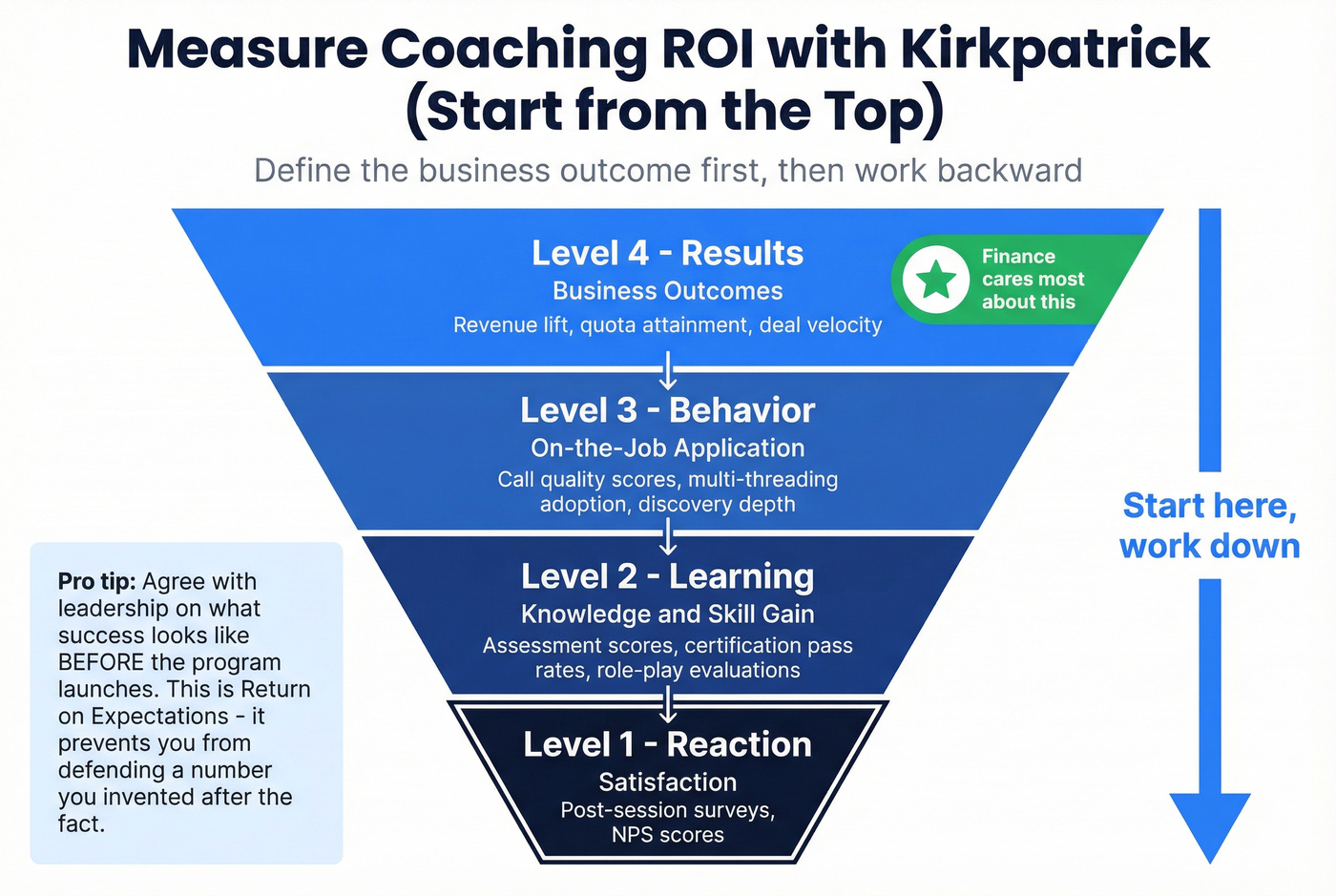
Use Kirkpatrick's four levels, starting from the top:
| Level | What It Measures | Example |
|---|---|---|
| 4 - Results | Business outcomes | Revenue lift, quota attainment |
| 3 - Behavior | On-the-job application | Call quality, multi-threading |
| 2 - Learning | Knowledge/skill gain | Assessment scores |
| 1 - Reaction | Satisfaction | Post-session surveys |
Start with Level 4 - define the business outcome you want, then work backward. Pair this with Return on Expectations: agree with leadership upfront on what "success" looks like so you're measuring against a shared target, not defending a number you invented after the fact. That alignment conversation before the program launches is worth more than any spreadsheet after it ends.
FAQ
What Metrics Best Prove Sales Coaching ROI?
Win rate, quota attainment, deal velocity, and ramp time are the strongest indicators. Lead with whichever your program most directly influences, then show the dollar conversion using the formula: (Net Benefits / Coaching Cost) x 100.
What's a Realistic ROI Range for Coaching Programs?
Published studies range from 5.7x to 31x, with PwC's global mean at 7x. For internal programs in year one, 3-8x is realistic. Factor in retention savings to push toward the higher end.
How Do You Show ROI Without Perfect Attribution?
Use contributive ROI - frame coaching as one of several factors that drove improvement, then isolate its share through cohort comparisons or pre/post analysis. Finance respects honest attribution more than inflated single-cause claims.
How Does Data Quality Affect Coaching Effectiveness?
Coaching returns collapse when reps can't reach the contacts they're coached to engage. If 20% of emails bounce and half of phone numbers are dead, even perfect execution produces zero pipeline. Verifying contact data before coaching plays ensures the investment is measurable - you're testing the rep's skills, not the data's accuracy.