

How to Run a Sales Content Audit That Actually Fixes Your Pipeline
Your best AE lost a deal last quarter - not because the product was wrong, but because she couldn't find the battlecard. It existed. Marketing built it. It was buried three folders deep in a shared drive nobody checks.
That story plays out everywhere. 65% of sales content goes unused because reps can't find it, and reps burn 26% of their time searching for or recreating materials that already exist somewhere in the org. A sales content audit fixes this - but only if you treat it as a pipeline exercise, not a filing project.
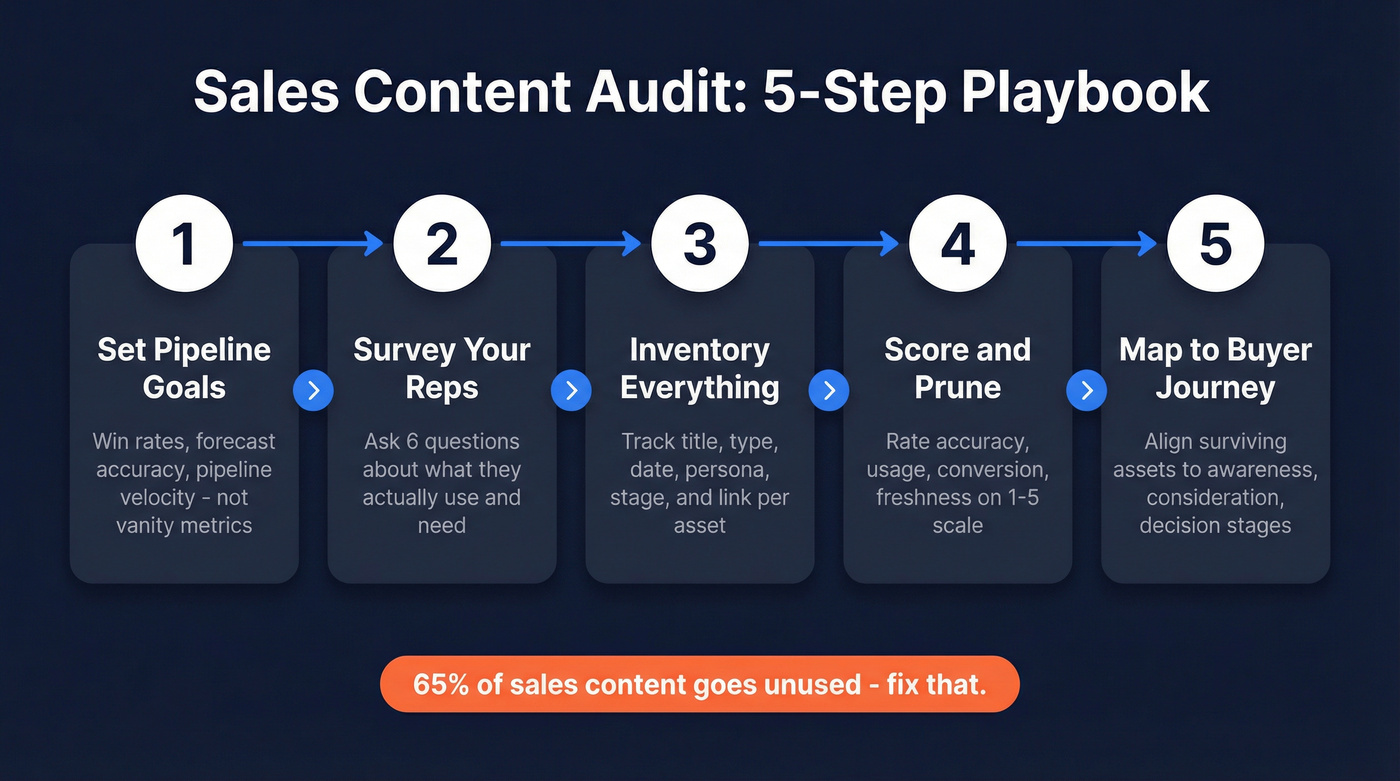
Run Your Audit in 5 Steps
Step 1 - Set Goals That Aren't Vanity Metrics
Skip downloads and views. Think pipeline velocity, win rates, and forecast accuracy - not page opens.
CSO Insights found that companies aligning content with the sales process see 27% higher win rates, and organizations with a defined enablement strategy close 49% more forecasted deals. Those are the numbers your VP of Sales will care about. DocSend recommends audit targets like a 35% lift in deck completion rate, 95% content usage across reps, or a 5% bump in opportunity creation after refreshing messaging. Steal those.
Step 2 - Survey Your Sales Team First
Before you inventory a single asset, ask your reps six questions:
- Are sales materials easy to find and well organized?
- What documents do you use most frequently?
- Which materials lead to conversions?
- Which documents are outdated or incorrect?
- What materials do you typically send together?
- Where would new content fill a gap?
Reps waste up to 43 hours per month searching for content across systems. Let's be honest - if sellers have to click through multiple folders, the content effectively doesn't exist. Getting their input first means you're building a library around how they actually sell, not how marketing thinks they sell.
Step 3 - Inventory Everything
Open a spreadsheet and track seven fields per asset: title, type, created date, last updated date, persona, deal stage, and link. That's it.
The hard part is finding everything. Reps hoard old assets in personal drives and build their own deck versions marketing doesn't know about. We've seen this on nearly every audit we've been involved with - if a rep built their own one-pager, the official version wasn't working. Treat that as discovery, not a problem.
Step 4 - Score and Prune Ruthlessly
Rate every piece on a 1-5 scale across four dimensions:
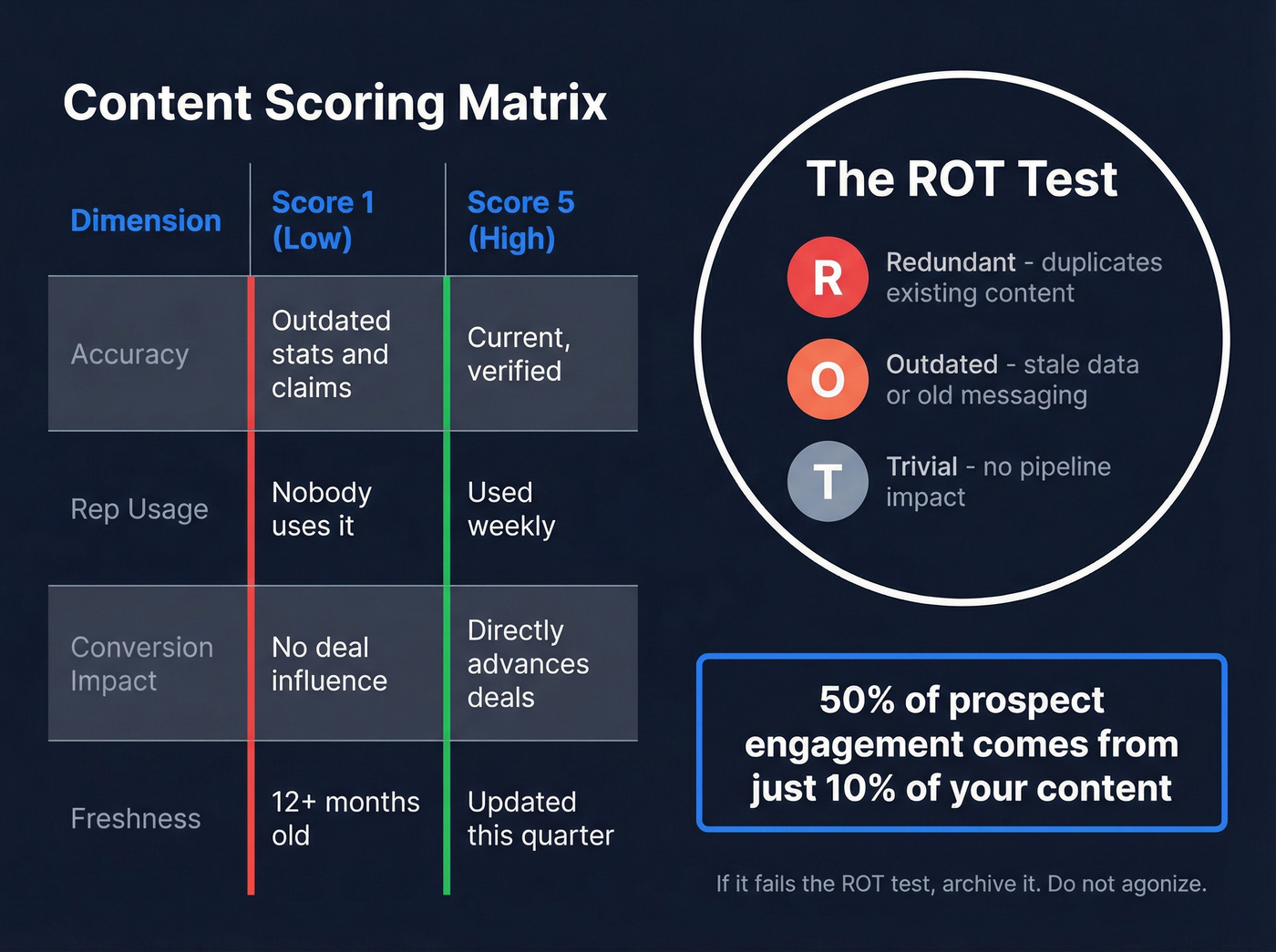
| Dimension | 1 (Low) | 5 (High) |
|---|---|---|
| Accuracy | Outdated stats/claims | Current, verified |
| Rep usage | Nobody uses it | Used weekly |
| Conversion impact | No deal influence | Directly advances deals |
| Freshness | 12+ months old | Updated this quarter |
Here's the stat that justifies being ruthless: 50% of all prospect engagement comes from just 10% of enablement content. Most of your library is dead weight.
Apply the ROT test - is this content redundant, outdated, or trivial? If yes, archive it. Don't agonize over it. A lean library that reps actually use beats a bloated one that makes everyone feel productive at the annual kickoff and then collects dust for eleven months.
Step 5 - Map Content to the Buyer Journey
Map surviving assets to buying stages. A typical B2B deal involves 6-10 stakeholders, and 75% of buyers prefer a rep-free experience for most of their research. Your content has to sell when reps aren't in the room.
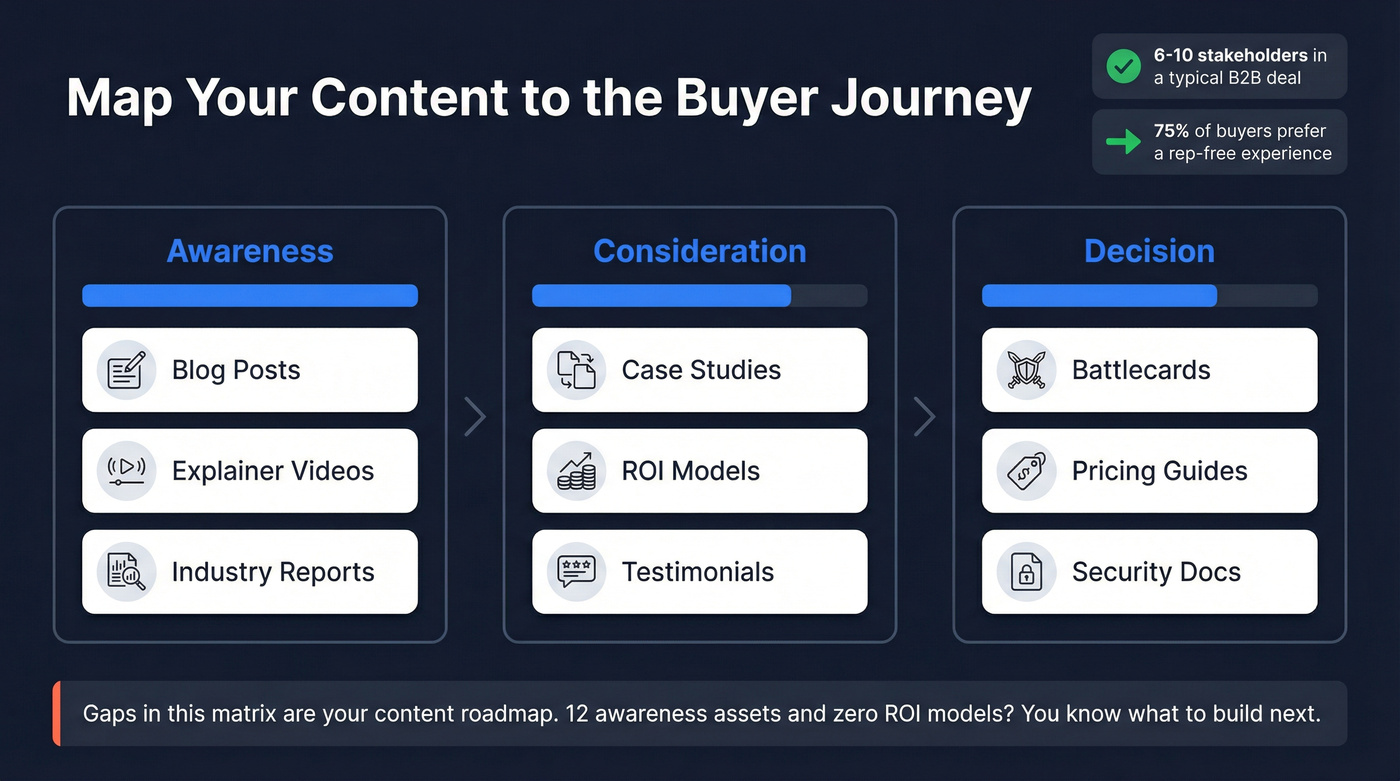
| Stage | Asset Types |
|---|---|
| Awareness | Blog posts, explainer videos, industry reports |
| Consideration | Case studies, ROI models, testimonials |
| Decision | Battlecards, pricing guides, security docs |
Gaps in this matrix are your content roadmap. Twelve awareness assets and zero ROI models? You know exactly what marketing builds next.
Mistakes That Kill Your Pipeline
Organizing by file type instead of selling situation. Nobody searches for "PDFs." They search for "objection handling when the prospect mentions Competitor X." Structure your library around scenarios, not formats.
No talk tracks for reps. A battlecard without a two-sentence "when to use this" note collects dust. In our experience, the single biggest reason audits fail is that nobody tells reps when and how to deploy each asset. (If you need examples, steal a few talk tracks.)
Vanity metrics instead of pipeline influence. Track content-influenced revenue or don't track anything. "This deck was viewed 200 times" tells you nothing if none of those views moved a deal forward.
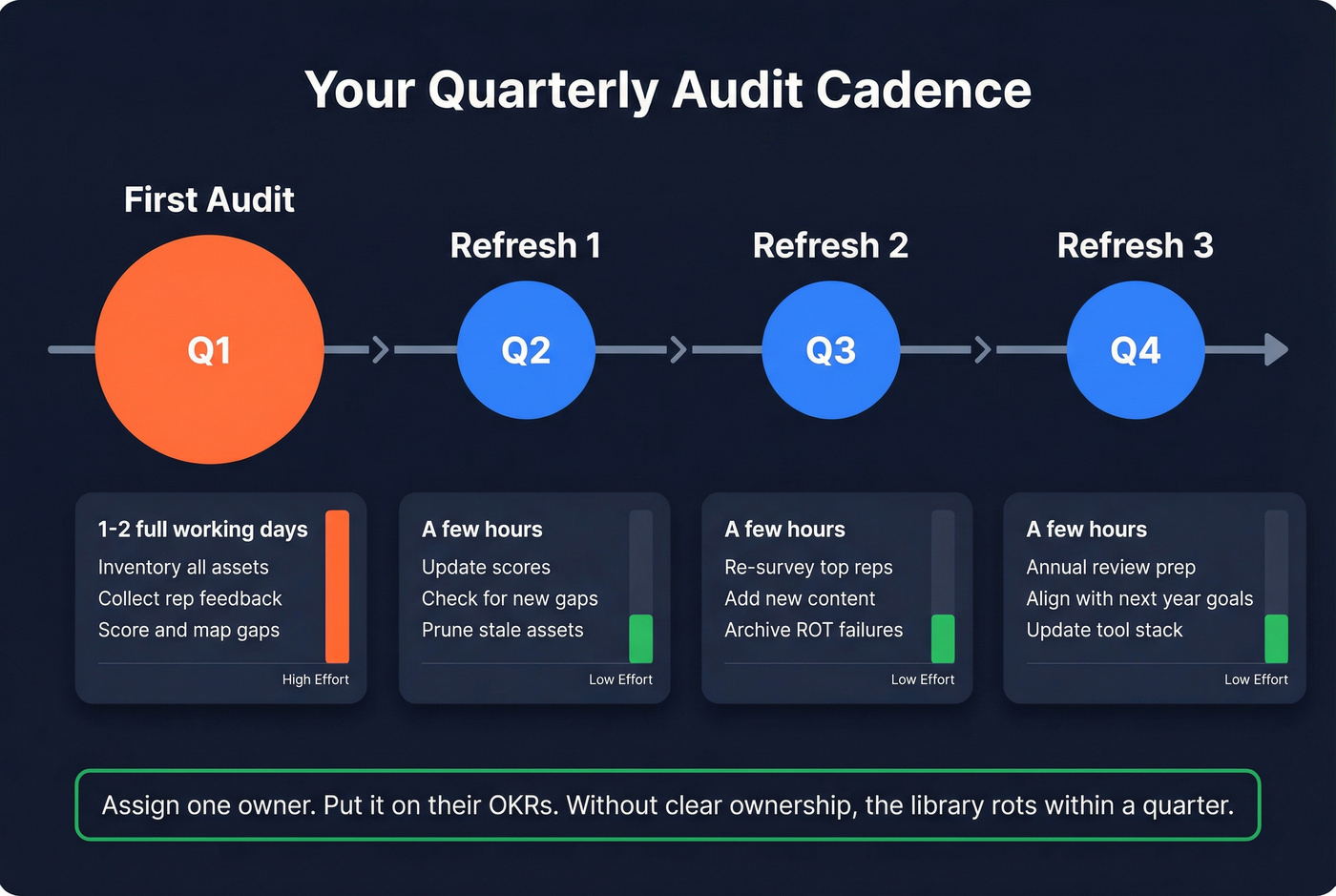
One-time audit with no quarterly cadence. Competitor pricing changes, your product ships features, and case studies go stale. Quarterly reviews keep the library current.
No clear ownership post-audit. 65% of sales and marketing professionals report misalignment between their teams. Without a single owner - a RevOps lead, an enablement manager, someone with it on their OKRs - the library rots within a quarter. (If you're assigning ownership, start with what a RevOps Manager typically owns.)

Your reps already waste 43 hours a month searching for content. Don't let them waste more hours sending that perfect battlecard to emails that bounce. Prospeo's 98% email accuracy and 7-day data refresh mean every asset you just audited actually reaches a real inbox.
Start with 75 free email verifications - no credit card, no sales call.
Tools for Your Enablement Stack
The sales enablement market is projected to hit $8.79B by 2029, and tools are consolidating fast. Seismic and Highspot announced a merger in February 2026. Showpad merged with Bigtincan in October 2025. The enterprise tier is getting bigger and pricier, while 48% of high-performing GTM teams are investing in digital sales rooms.
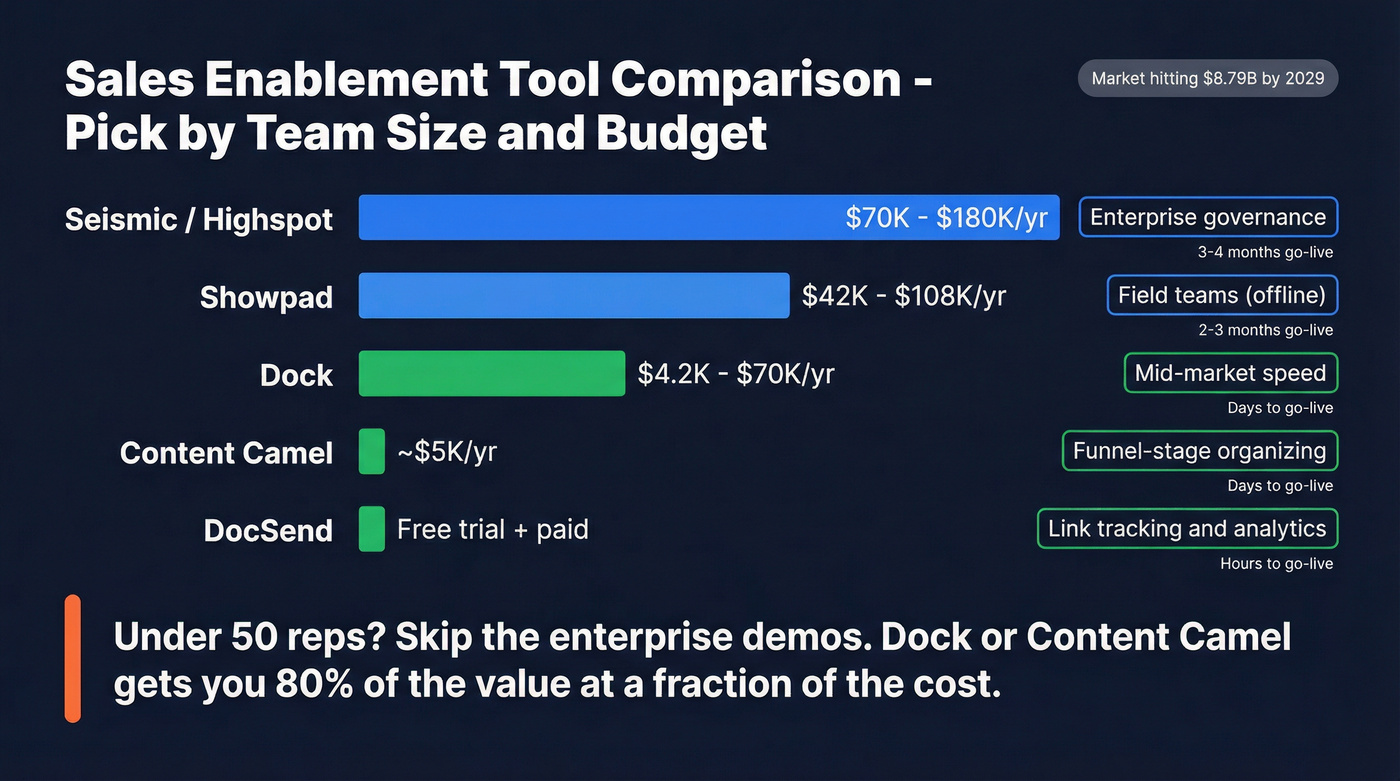
| Tool | Annual Cost | Best For | Go-Live |
|---|---|---|---|
| Seismic/Highspot | $70K-$180K | Enterprise governance | 3-4 months |
| Showpad | $42K-$108K | Field teams (offline) | 2-3 months |
| Dock | $4.2K-$70K | Mid-market speed | Days |
| Content Camel | ~$5K/yr (free trial) | Funnel-stage organizing | Days |
| DocSend | Free trial + paid plans | Link tracking & analytics | Hours |
For teams under 50 reps, we've found that a $70K platform is almost always overkill. Dock or Content Camel gets you 80% of the value at a fraction of the cost. Skip the enterprise demos until you've outgrown the mid-market tools - you'll know when that happens because your enablement owner will tell you.
Don't Forget Your Data
Here's the thing: the audit nobody runs after their sales content audit is the data audit. You can build the perfect battlecard, map it to the right stage, and send it to an email that bounces. The consensus on r/sales is pretty clear - bad data wastes more rep time than bad content does.
Prospeo handles that layer with 98% email accuracy and a 7-day data refresh cycle. There's a free tier with 75 email verifications per month, and at roughly $0.01 per email, it's a rounding error next to a $70K enablement platform. (If you're comparing vendors, start with a quick scan of data enrichment services.)

You mapped content to every deal stage. Now make sure the contacts behind those deals are real. Prospeo verifies 143M+ emails through a 5-step process and refreshes every 7 days - so your newly organized library doesn't get wasted on bounced sends at $0.01 per email.
The fastest way to undo a great content audit is bad data. Fix it now.
How Often Should You Audit?
Quarterly. Assign one owner and block time every quarter for a refresh. The first audit is the heavy lift - expect one to two full working days to inventory assets, collect rep feedback, and score gaps. Every audit after that is updating, not rebuilding. A few hours, tops. (This cadence fits cleanly into most QBR rhythms.)
FAQ
What's the difference between a sales content audit and a website content audit?
A website content audit evaluates pages for SEO and organic traffic. A sales content audit reviews collateral - battlecards, case studies, pitch decks - that reps use to advance deals through the pipeline. Different audience, different metrics, different process entirely.
How long does a first audit take?
Plan one to two working days for the initial pass: inventorying assets, collecting rep feedback, and scoring gaps. After that, quarterly refreshes take a few hours because you're updating rather than rebuilding from scratch.
What if our sales team ignores the content we create?
That's the most common finding - and exactly why this exercise matters. Start by asking reps what they actually need using the six survey questions above. Build around their answers, not your assumptions. Then verify your prospect data is accurate so refreshed collateral reaches real inboxes instead of bouncing into the void.