

Sales Cycle Length by Industry: 2026 Benchmarks That Are Actually Sourced
Most sales cycle benchmark tables floating around B2B blogs cite zero sources. They're one company's unsourced data copy-pasted across the internet until it looks like consensus. You've probably seen the same recycled numbers everywhere - the same table, the same ranges, no methodology in sight.
Here's what the actual research says, with sample sizes and the numbers that matter.
The short version: Most B2B sales cycles run 3-9 months depending on industry, deal size, and buyer committee complexity. Cycles have lengthened roughly 32% since 2021. The highest-impact levers to shorten yours: verified contact data that ensures outreach actually lands, multi-threading from day one, and ruthless early qualification.
Average Sales Cycle by Industry
No single study publishes a transparent, methodologically clear industry-by-industry benchmark. So instead of inventing ranges, here's a sourced table pulled from a widely-circulated benchmark dataset (Focus Digital / Trembi), including the stage breakdowns they publish.
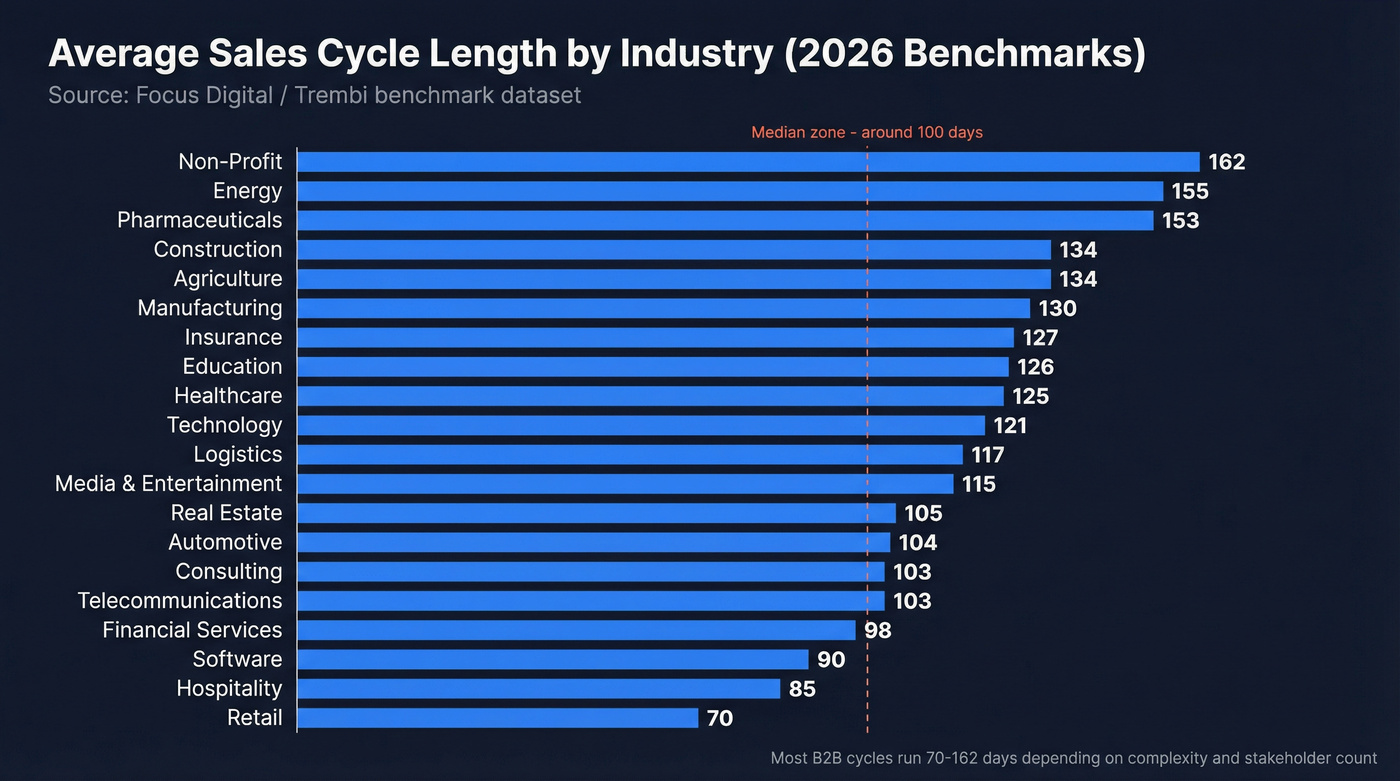
| Industry | Average Sales Cycle (Days) |
|---|---|
| Software | 90 |
| Manufacturing | 130 |
| Healthcare | 125 |
| Financial Services | 98 |
| Retail | 70 |
| Technology | 121 |
| Consulting | 103 |
| Education | 126 |
| Real Estate | 105 |
| Telecommunications | 103 |
| Hospitality | 85 |
| Logistics | 117 |
| Energy | 155 |
| Pharmaceuticals | 153 |
| Automotive | 104 |
| Construction | 134 |
| Media & Entertainment | 115 |
| Agriculture | 134 |
| Non-Profit | 162 |
| Insurance | 127 |
One Reddit practitioner running an advertising agency reported roughly 4 months from qualified lead to first invoice. Another selling expensive machinery into FMCG and pharma cited 9-12 months due to bespoke planning and multi-layer sign-offs. Those numbers track with the broader pattern: cycle length is driven by complexity, risk, and the number of stakeholders involved.
At the funnel level, Implisit's pipeline analysis (summarized by Geckoboard) shows lead-to-opportunity averages 84 days, with opportunity-to-close averaging just 18 days. Most of the cycle is spent qualifying, not closing.
Sales Cycle by Deal Size
Industry matters, but deal size is often the stronger predictor. When teams look up average cycle benchmarks, they're usually trying to set internal targets - but ACV-based data from SaaStr gives a more actionable ladder:
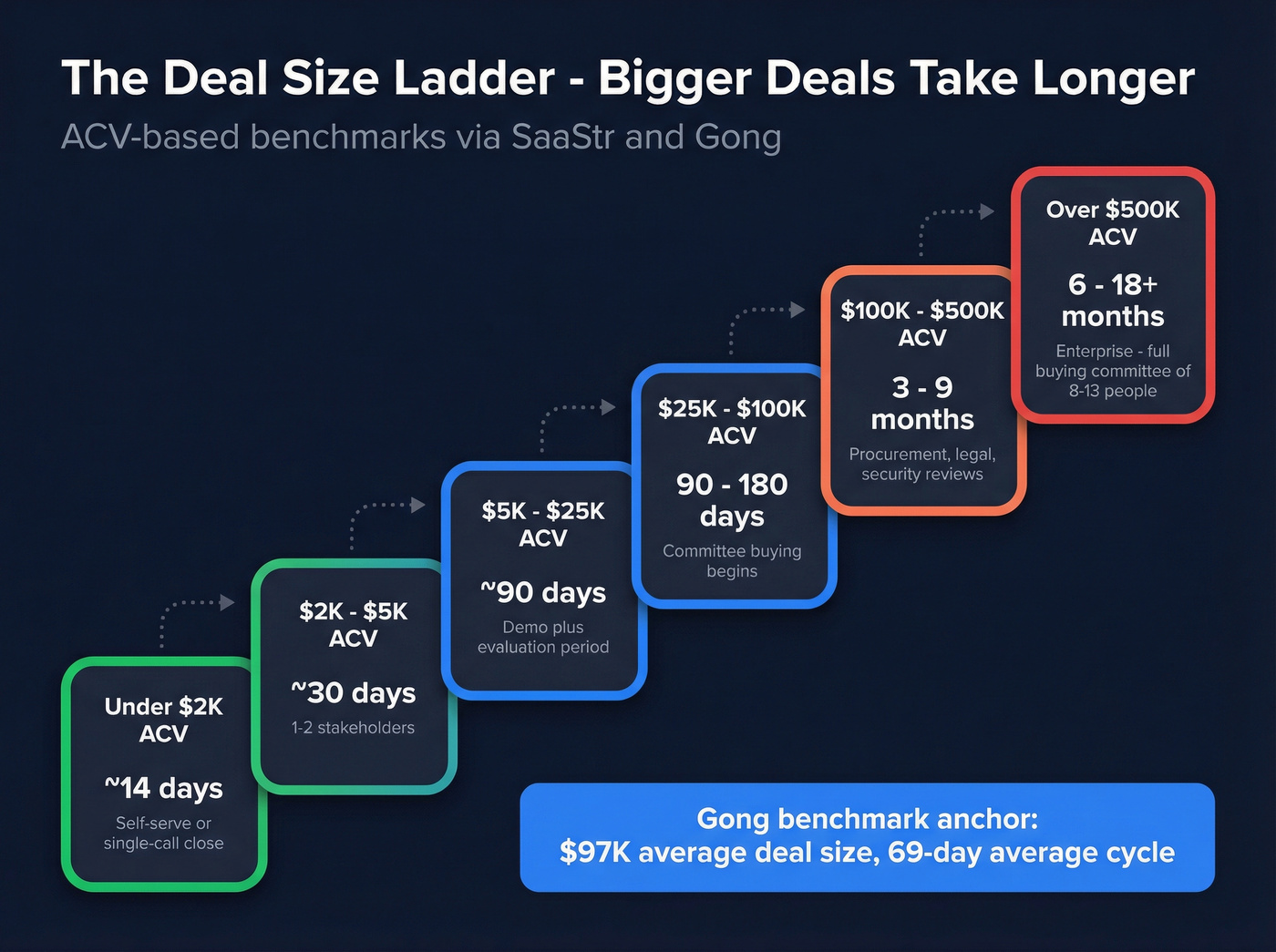
| ACV Range | Typical Cycle |
|---|---|
| < $2K | ~14 days |
| $2K-$5K | ~30 days |
| $5K-$25K | ~90 days |
| $25K-$100K | 90-180 days |
| $100K-$500K | 3-9 months |
| > $500K | 6-18+ months |
SaaStr also cites Gong benchmarks that put the average deal size at $97K with a 69-day sales cycle. It's a useful anchor, but the number shifts dramatically by vertical, deal risk, and buyer maturity. If your average contract value sits below $10K, you probably don't need to obsess over cycle length at all - focus on volume and conversion rate instead.

Every day your outreach bounces is a day added to your sales cycle. Prospeo's 98% email accuracy and 125M+ verified mobile numbers cut the invisible weeks wasted on bad data - the same reason Snyk's 50 AEs saw bounce rates drop from 35% to under 5% and pipeline jump 180%.
Stop inflating your cycle length with emails that never land.
Why Cycles Keep Getting Longer
More people in the room, tighter budgets, and longer procurement processes. That's the whole story.
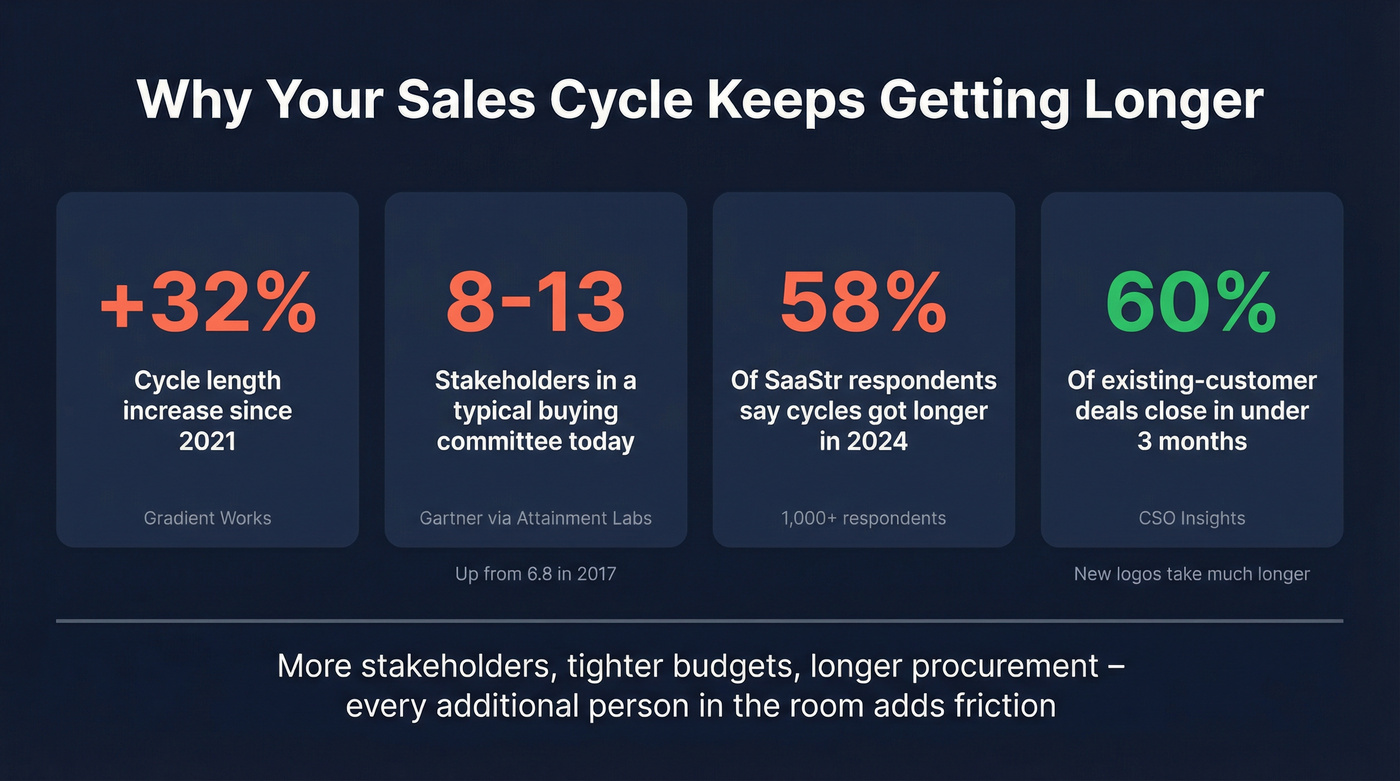
Gong Labs analyzed 1.8 million opportunities and found 77% of deals involve multiple contacts, with strategic enterprise deals averaging 17 contacts. Buying committees now run 8-13 stakeholders (per Gartner, compiled by Attainment Labs), up from 6.8 in 2017 according to HBR. Every additional stakeholder adds friction, review cycles, and calendar coordination that compounds fast.
58% of 1,000+ SaaStr respondents said cycles got longer in 2024. A RAIN Group study found 43% of sales leaders report increased cycle times, with only 16% saying they've shortened. And Gradient Works' benchmarks put the increase at 32% since 2021 - with enterprise deals up 36%.
For existing customers, the picture changes dramatically. CSO Insights found 60% of existing-customer deals close in 3 months or less, and 22% close in under a month. If your "average cycle" metric blends new and existing customers, you're lying to yourself about how long new logos actually take.
The Win-Rate Cliff
This is the stat that should change how you think about stalled deals.
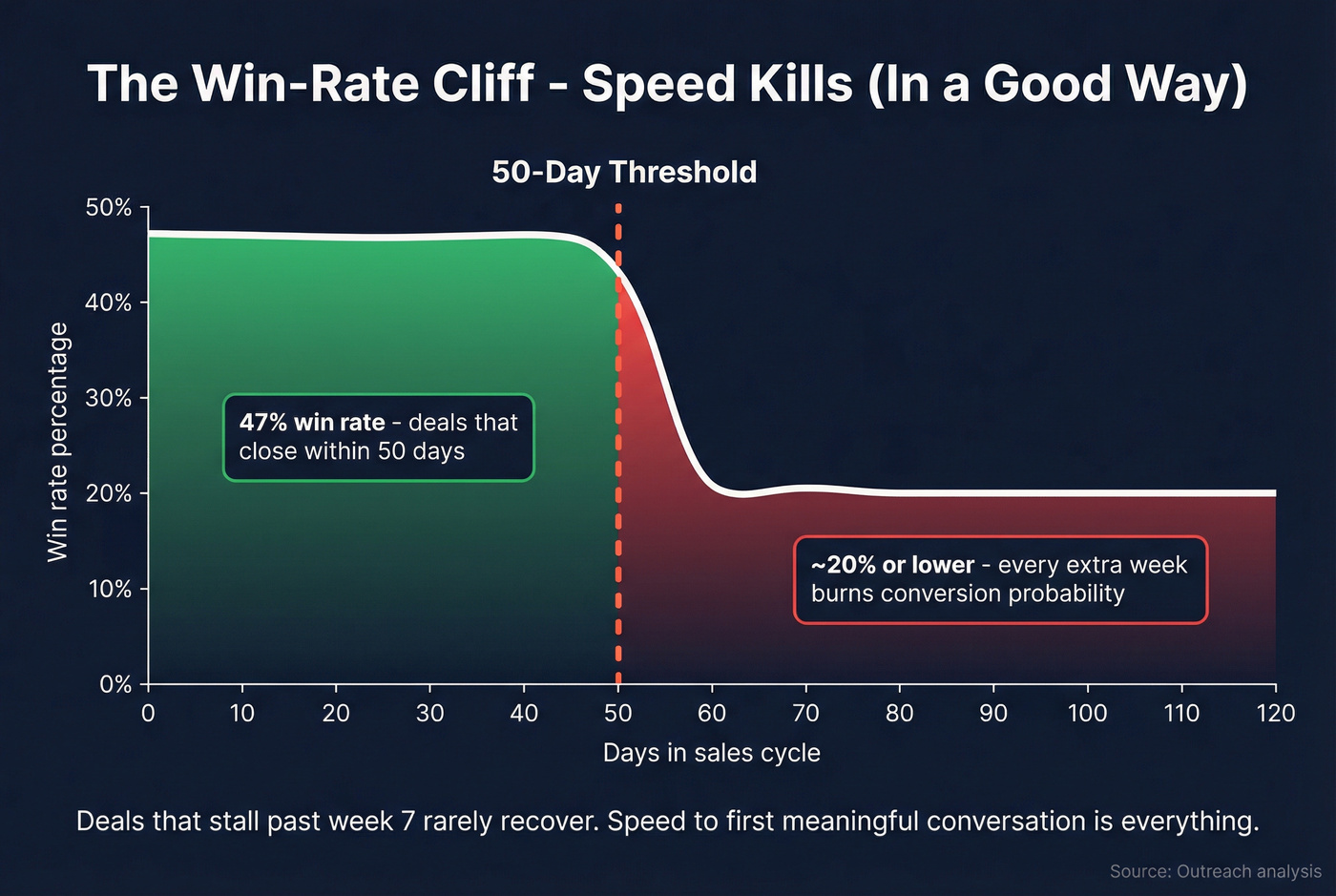
Outreach's analysis shows opportunities closed within 50 days carry a 47% win rate. Past that threshold, win rates drop to roughly 20% or lower. Every week a deal sits past the inflection point, you're burning conversion probability.
In our experience, the 50-day threshold tracks closely with what we see across outbound teams - deals that stall past week 7 rarely recover. Speed to first meaningful conversation matters more than most teams realize. And that starts with whether your outreach actually reaches someone.
How to Shorten Your Sales Cycle
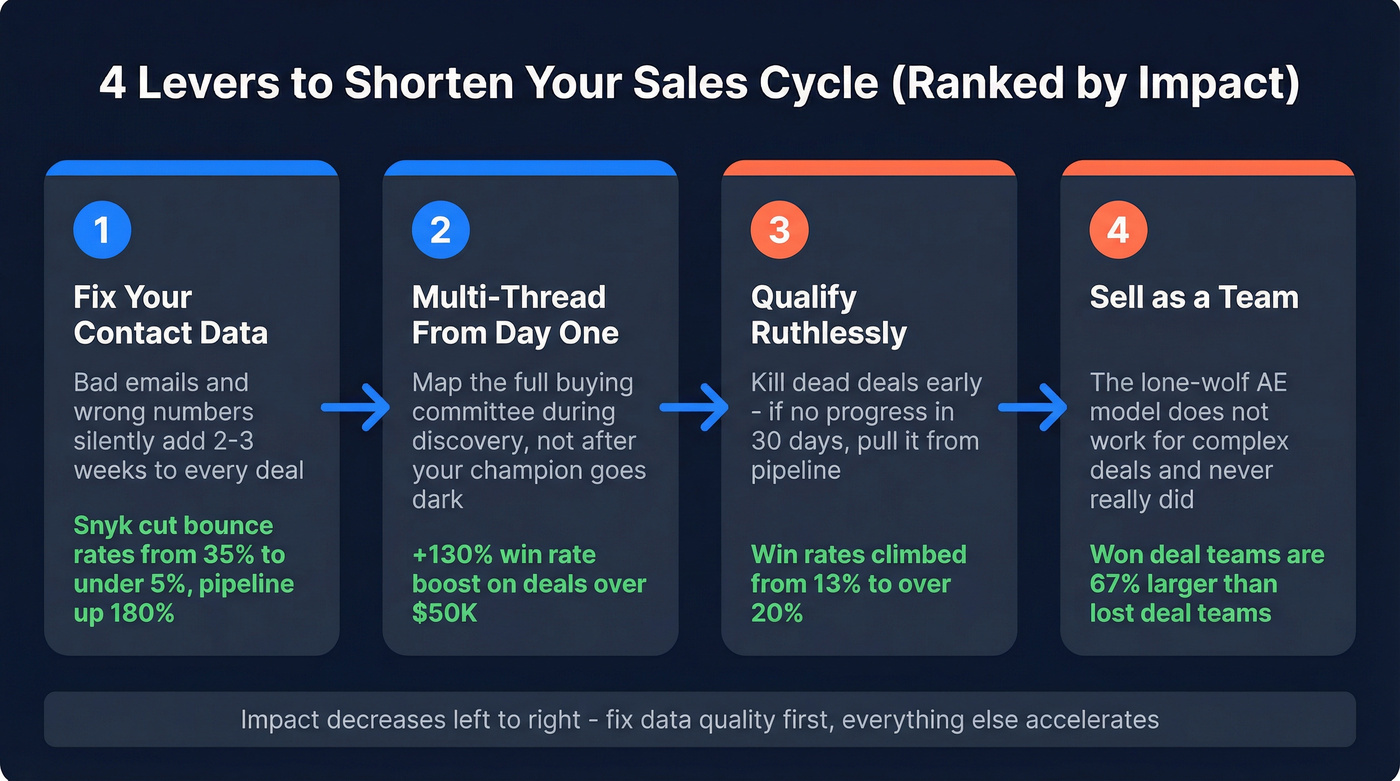
Four levers, ranked by impact.
Fix Your Contact Data First
Bad emails and wrong numbers add 2-3 weeks before first meaningful touch - an invisible cycle-length tax that doesn't show up in your CRM reports. When Snyk deployed Prospeo's real-time verification across 50 AEs, bounce rates dropped from 35-40% to under 5% and AE-sourced pipeline jumped 180%. That's not a marginal improvement; it's the difference between pipeline that moves and pipeline that sits.
If you’re cleaning lists or filling gaps, pair verification with data enrichment so reps aren’t prospecting blind.

Multi-Thread From Day One
Don't wait until a deal stalls to find the other stakeholders. Multi-threading boosts win rates by 130% in deals over $50K. Closed-won deals have 2x as many buyer contacts as closed-lost. Start mapping the buying committee during discovery, not after your champion goes dark.
This is also where account-based selling and firmographic filters make multi-threading faster and less random.
Qualify Ruthlessly
Kill dead deals early. One team that refreshed rep account books every 30-60 days and enforced stage-exit criteria saw win rates climb from 13% to over 20%. If a deal hasn't progressed in 30 days, pull it. Your pipeline will look smaller and your forecast will get more honest.
If you need a tighter framework for stage exits, use a formal sales qualification approach and keep your pipeline health metrics visible.
Sell as a Team
Selling teams for won deals are 67% larger than for lost deals. Bringing in a sales engineer lifts enterprise win rates by up to 30%. Let's be honest - the lone-wolf AE model doesn't work for complex deals. It never really did.
For complex, multi-stakeholder deals, team selling is usually the default, not the exception.
Multi-threading from day one means finding every stakeholder's verified contact before the deal stalls. Prospeo's 300M+ profiles with 30+ filters - including department headcount and job changes - let you map the full buying committee in minutes, not weeks.
Reach all 8-13 stakeholders before your champion goes dark.
FAQ
What's a good sales cycle length?
Under $5K ACV, aim for 14-30 days. For $25K-$100K deals, 90-180 days is normal across most industries. Compare against your own historical trend and the ACV ladder above rather than generic averages - deal size predicts cycle duration more reliably than vertical alone.
How do you calculate average sales cycle length?
Sum the days from first contact to close for all won deals in a period, then divide by the number of deals. Exclude open or lost opportunities. Klipfolio publishes a clear walkthrough with the formula and common pitfalls.
Are B2B sales cycles getting longer in 2026?
Yes, and the trend shows no sign of reversing. Gradient Works reports cycles are up 32% since 2021, and 58% of SaaStr respondents confirmed longer timelines. Larger buying committees and tighter budgets are the primary drivers.
How does contact data quality affect sales cycle length?
Bad data silently adds 2-3 weeks to every deal by delaying first contact. We've seen teams cut bounce rates below 5% with real-time email verification, which accelerates pipeline entry and shortens the overall cycle in ways that are immediately visible in reporting.