

Sales Data: The Practitioner's Guide to Making It Actually Useful
A RevOps lead we know ran a 10,000-contact outbound campaign last quarter. The list came straight from their CRM - "clean" data, supposedly verified six months prior. The bounce rate hit 35%.
That's not a data problem. That's a pipeline fire. And it's shockingly common: only 42% of sales professionals are completely confident in their data accuracy, while reps spend 60% of their time on non-selling tasks - much of it wrestling with bad records, duplicates, and missing fields.
Fix These Three Things First
If your data foundation is broken, fix three things before you touch anything else. Standardize definitions across your CRM: what counts as an MQL, when does a deal move stages, who owns each transition. Clean your contact data - bounced emails and dead phone numbers corrupt everything downstream (see email bounce rate benchmarks and fixes). Then establish a monthly audit cadence. Not quarterly. Monthly.
The tools that matter: your CRM, a BI layer, and a data enrichment/verification platform (compare data enrichment services). Everything else is optional until those three work together.
What Is Sales Data?
Sales data is every piece of information your revenue team generates, collects, or depends on to close deals - contact details, deal values, activity logs, pipeline stages, win/loss reasons, and the behavioral signals that tell you whether a prospect is warming up or going cold. Teams that can't define it consistently can't govern it.
Most people blur three distinct concepts:
| Data | Reporting | Analytics | |
|---|---|---|---|
| Question | What do we have? | What happened? | Why, and what's next? |
| Example | Deal values, contact records, timestamps | "We closed $420K last month" | "Deals with 3+ stakeholder touches close 2.3x faster" |
| Output | Raw material in your CRM | Dashboards, weekly recaps | Predictions, prescriptions |
96% of sales pros agree real-time data is essential to their workflow. Yet most teams over-index on internal records like deal attributes and rep performance while ignoring the external signals - intent, technographics, trigger events - that actually predict outcomes.
Types of Sales Data
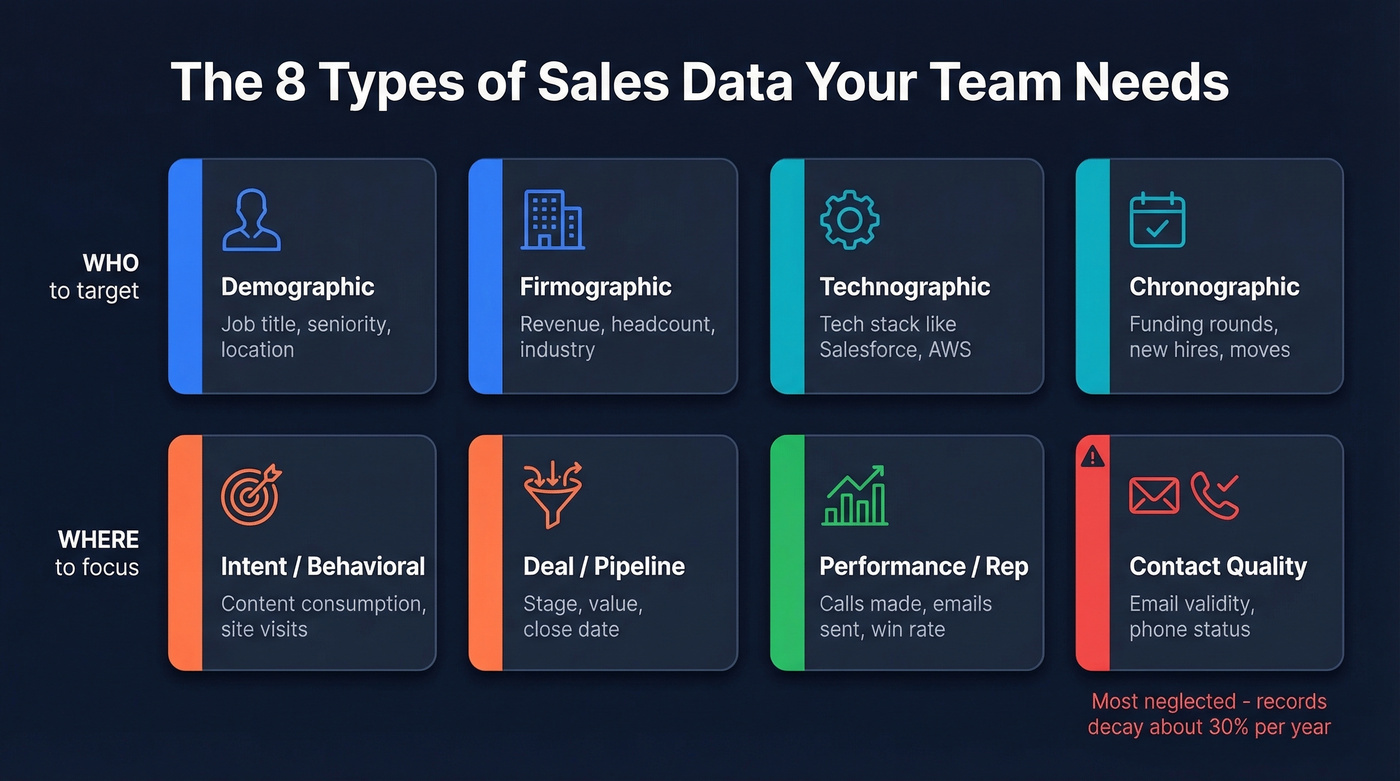
The average sales org uses 10 tools and counting, per Korn Ferry research published via HBR. Each generates a different flavor of information. Knowing the distinct types helps you spot which categories are well-covered and which have dangerous gaps.
| Type | What It Covers | Example | Why It Matters |
|---|---|---|---|
| Demographic | Individual traits | Job title, seniority, location | Targeting the right person |
| Firmographic | Company attributes | Revenue, headcount, industry | Targeting the right account |
| Technographic | Tech stack signals | Uses Salesforce, runs AWS | Product-market fit scoring |
| Chronographic | Trigger events | Funding round, new hire, move | Timing your outreach |
| Intent / Behavioral | Buying signals | Content consumption, site visits | Prioritizing hot accounts |
| Deal / Pipeline | Opportunity data | Stage, value, close date | Forecasting and coaching |
| Performance / Rep | Activity metrics | Calls made, emails sent, win rate | Coaching and capacity |
| Contact Quality | Data accuracy | Email validity, phone status | Everything downstream |
The category most teams neglect is contact quality. Contact records degrade around 30% per year - people change jobs, companies rebrand, phone numbers rotate. Intent data is the other underrated category. Knowing which accounts are actively researching your category changes how you prioritize pipeline entirely. It's the difference between cold outreach and warm timing.
Why Data Quality Matters
Bad data doesn't just create annoying bounces. It systematically degrades every metric your leadership team relies on.
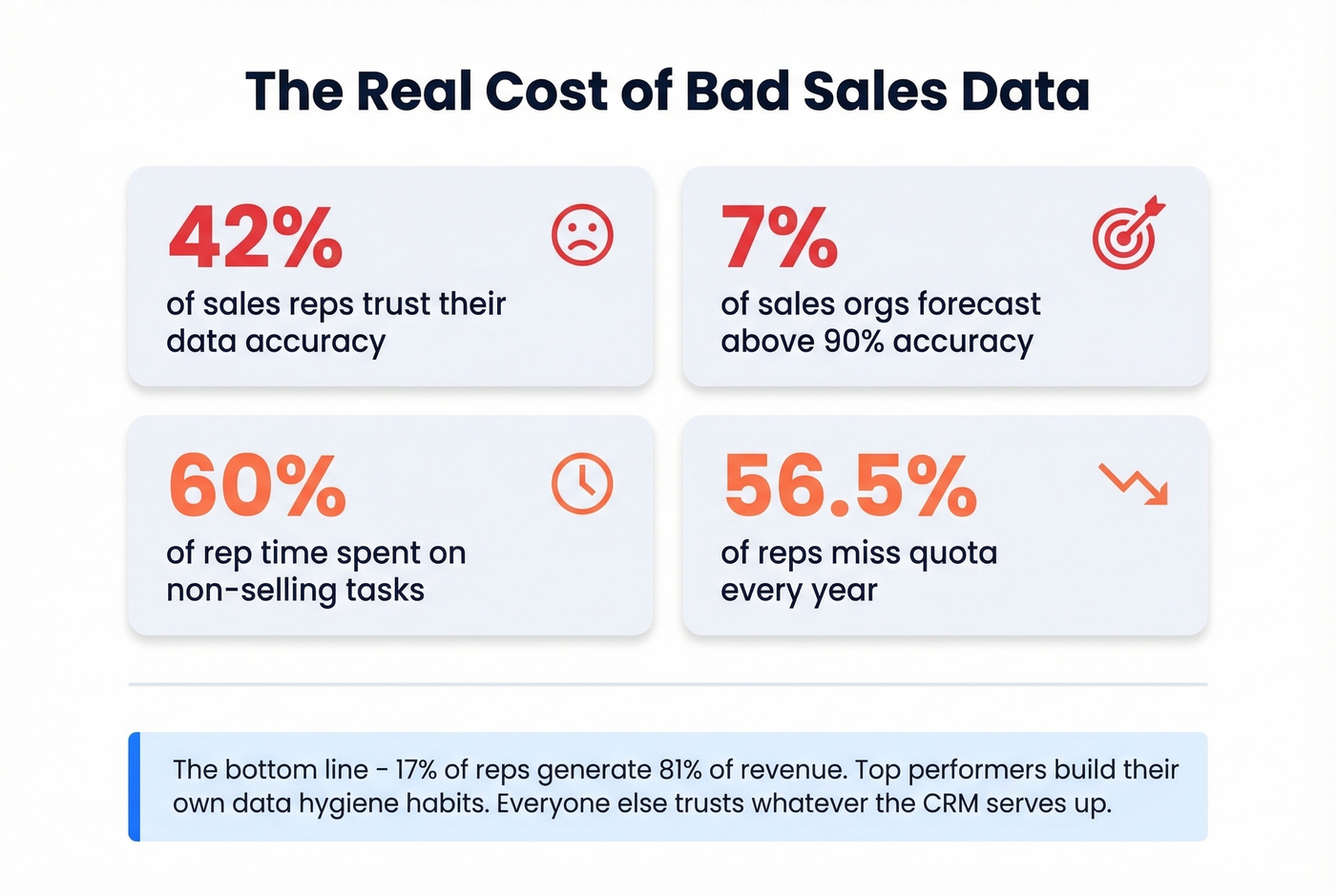
Only 7% of sales orgs achieve forecast accuracy above 90%, and 69% of sales leaders say forecasting is getting harder, not easier. When your contact records are stale, your pipeline stages are inconsistent, and your activity logs have gaps, forecasting becomes guesswork dressed up in a spreadsheet. We've seen teams spend entire QBRs debating numbers instead of strategy because nobody trusts the underlying records.
The downstream effects compound quickly. 43.5% of sales reps hit quota - meaning more than half don't. Revenue concentration is brutal: 17% of reps generate 81% of revenue. Part of this is talent distribution, sure. But part of it is that top performers build their own data hygiene habits while everyone else trusts whatever the CRM serves up.
You can't coach reps on pipeline management if your pipeline records are unreliable. You can't optimize conversion rates if your lead source attribution is missing (see lead generation metrics). When sales and marketing operate from different databases, attribution breaks down entirely. Every analytics initiative starts with data quality. Skip that step, and you're building dashboards on sand.

That 35% bounce rate from the intro? Prospeo users cut theirs to under 4%. Our 5-step verification, 7-day refresh cycle, and 98% email accuracy mean your sales data stays clean without monthly audit marathons. 300M+ profiles, verified in real time - not six months ago.
Stop building dashboards on stale data. Start with records you can trust.
How to Analyze Sales Data
The Analytics Maturity Model
Four levels exist. Most teams are stuck at level one.
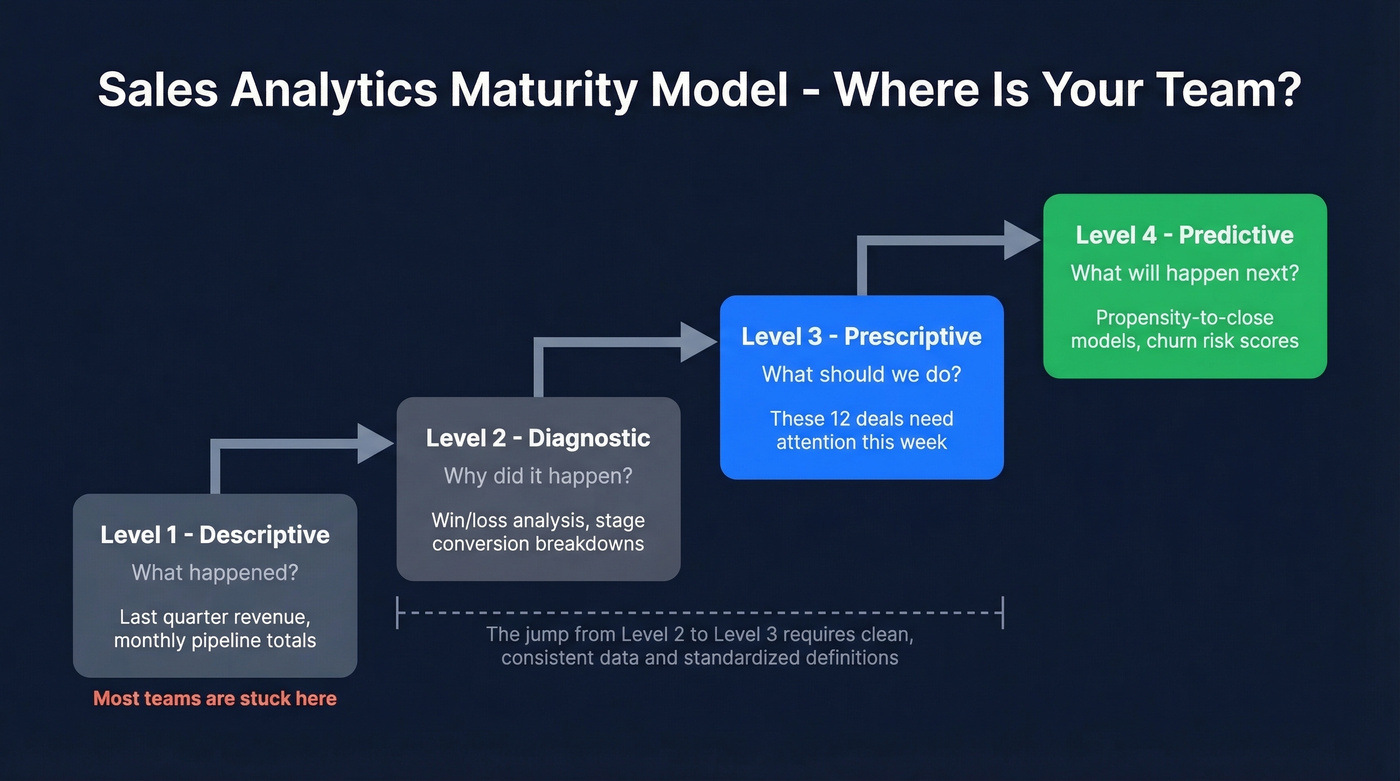
Descriptive answers "what happened" - last quarter's revenue, this month's pipeline. Diagnostic answers "why" - win/loss analysis, stage conversion breakdowns. Prescriptive tells you what to do - "these 12 deals need attention this week." Predictive forecasts what's coming - propensity-to-close models, churn risk scores (see predictive analytics in sales).
The jump to prescriptive and predictive requires clean, consistent records, which circles back to the governance problem.
What to Build First
Practitioners on r/salesoperations consistently recommend the same build sequence, and it matches what we've seen work across dozens of implementations:
- Sales scorecards - rep-level snapshots combining activity, pipeline, and outcome metrics. Start here because it forces you to standardize definitions.
- Weekly pipeline dashboard - deal count by stage, velocity trends, and staleness flags. Flag any deal with no activity in 7+ days or no defined next step in 14 days.
- Lead priority scoring - tag leads as high/medium/low based on firmographic fit, engagement signals, and intent data (see lead scoring). Even a simple model beats treating every lead equally.
- Churn analysis - once pipeline data is stable, look backward at lost deals to identify patterns (use a churn analysis framework).
The key formulas: conversion rate (opportunities / leads), pipeline velocity (deals x win rate x avg deal size / cycle length), customer lifetime value, and deal velocity by segment. Those four metrics tell you more about pipeline health than any 40-slide QBR deck.
Governance That Actually Works
Governance sounds bureaucratic. In practice, it's the difference between a CRM that works and one that's a graveyard.
Do this:
- Standardize definitions for every stage transition. What makes an MQL? When does a deal move from discovery to proposal? Write it down and enforce exit criteria.
- Set SLAs with teeth. Sales must accept or reject a lead within 24 hours and log rejection reasons. No exceptions.
- Track operational quality metrics monthly: contact-to-account match rate, opportunity-campaign association coverage, and stage timestamp accuracy.
- Audit monthly. Track duplicate records, missing fields, and stale contacts.
Skip this:
- Don't build a governance framework in a vacuum. Start with the three metrics that matter most to your VP of Sales.
- Don't layer AI tools on a weak foundation. If your definitions aren't standardized, predictive models will just give you confident wrong answers faster.
- Don't create a 30-page data dictionary nobody reads. A one-page cheat sheet pinned in Slack does more.
Collection Mistakes That Kill Quality
Here's the thing: most data quality problems aren't analytics problems. They're collection problems. These are the anti-patterns we see repeatedly:
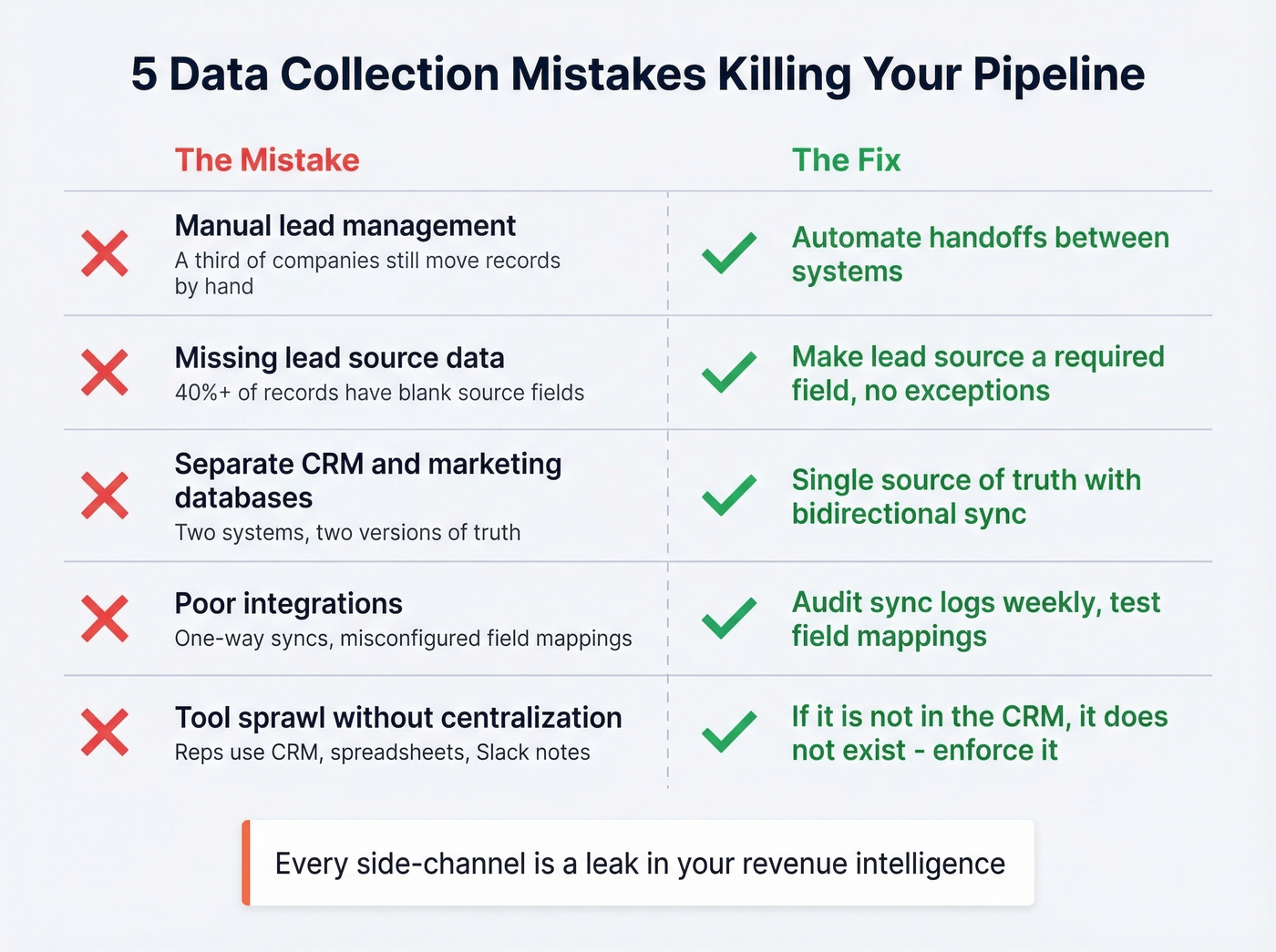
Manual lead management. A third of companies still move records manually between systems. Every handoff introduces typos, delays, and dropped contacts.
Missing lead source data. Most CRMs have "lead source" fields that are blank on 40%+ of records. If you can't attribute pipeline to channels, you can't allocate budget.
Separate CRM and marketing databases. Two systems, two versions of truth, duplicated outreach. This is the #1 alignment killer between sales and marketing.
Poor integrations. One-way syncs, misconfigured field mappings - qualified leads get stuck in sync failures and nobody notices for weeks.
Tool sprawl without centralization. As one SalesOps practitioner put it in a popular r/SalesOperations thread: some reps use the CRM, others use spreadsheets, others keep notes in Slack. No consistent source of truth means no optimization.
Let's be honest - if your records don't live in the CRM, they don't exist. Every side-channel is a leak in your revenue intelligence.
AI and Revenue Data in 2026
88% of organizations report regular AI use in at least one business function. Sellers who partner effectively with AI tools are 3.7x more likely to meet quota, and Bain found that early AI deployments boosted win rates by 30%+ (see best generative AI sales tools).
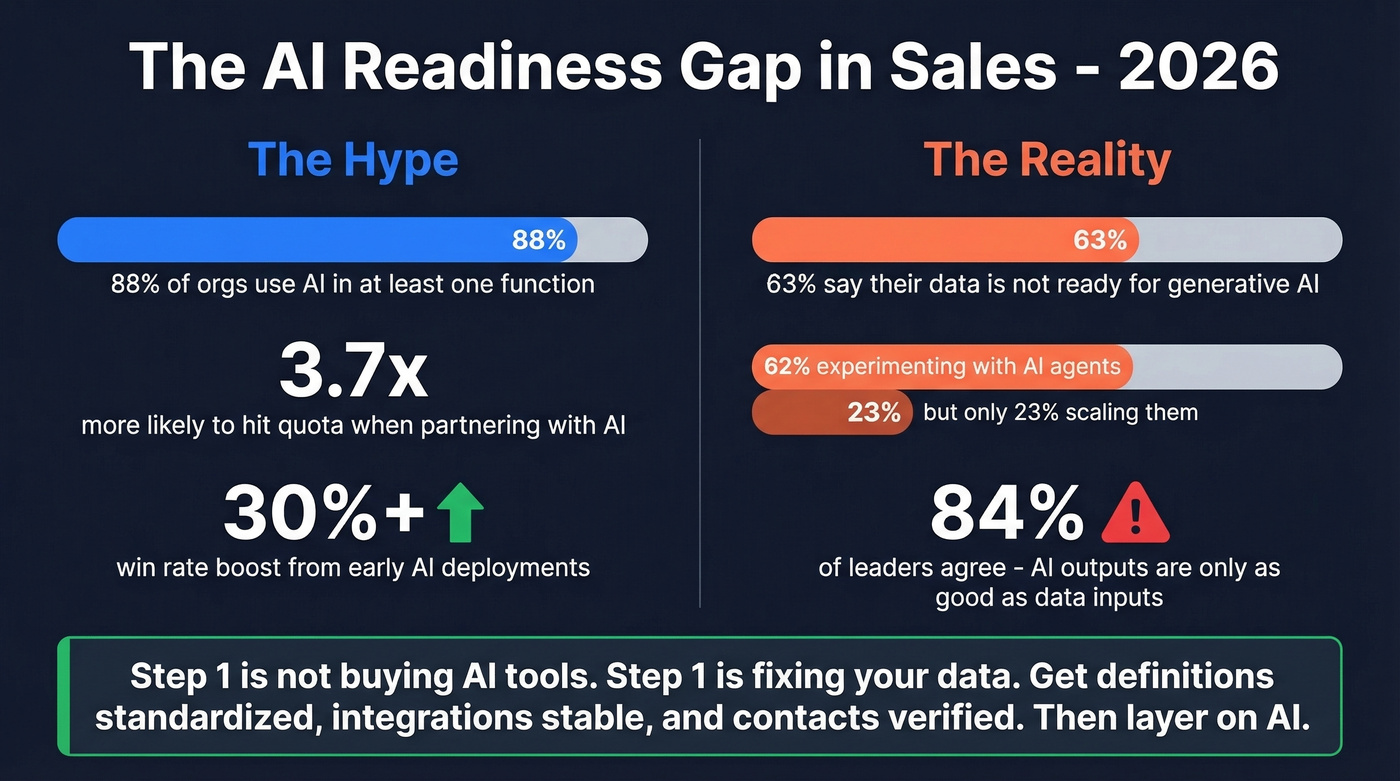
The reality on the ground is different. 63% of companies say their data isn't properly set up for generative AI. 84% of data and analytics leaders agree that AI outputs are only as good as data inputs. And while 62% are experimenting with AI agents, only 23% are actually scaling them.
Stop buying AI tools and start fixing your data. If your average deal size is under $50K and your CRM has more than 10% stale contacts, an AI layer will just give you faster wrong answers. 74% of sales teams already using AI are prioritizing data hygiene to support it - they learned the hard way that AI amplifies whatever you feed it. Get your definitions standardized, your integrations stable, and your contact records verified. Then layer on the AI. Not before.
Tools for Sales Data
CRM: Pick Based on Team Size
| CRM | Price | Best For |
|---|---|---|
| Salesforce Sales Cloud | $25-$500+/user/mo | Enterprise complexity |
| HubSpot Sales Hub | Free-~$150/user/mo | Marketing-sales alignment |
| Close | ~$29-$149/user/mo | SMB outbound teams |
| Pipedrive | ~$14-$99/user/mo | Visual pipeline management |
Analytics and BI
Power BI (free-$20/user/mo) is the budget pick and the obvious choice for Microsoft shops. Tableau (~$15-$75/user/mo) remains the visualization standard. Looker (often ~$5K-$10K+/mo) fits mid-market Google Cloud deployments. Pick based on your existing stack - fighting your ecosystem here wastes months.
Revenue Intelligence
Skip Gong (~$100-$150+/user/mo) and Clari (~$30K-$100K+/yr) until your CRM records are reliable. Both are powerful - Gong owns conversation intelligence, Clari dominates pipeline inspection - but they amplify whatever quality you already have. If your foundation is solid, they're worth the investment. If it's not, you're paying enterprise prices for unreliable insights.
Choosing the Right Data Source
This is where most teams have the biggest gap. Your analytics are only as good as your contact records, and every source degrades constantly - so the refresh cycle matters as much as the initial accuracy.
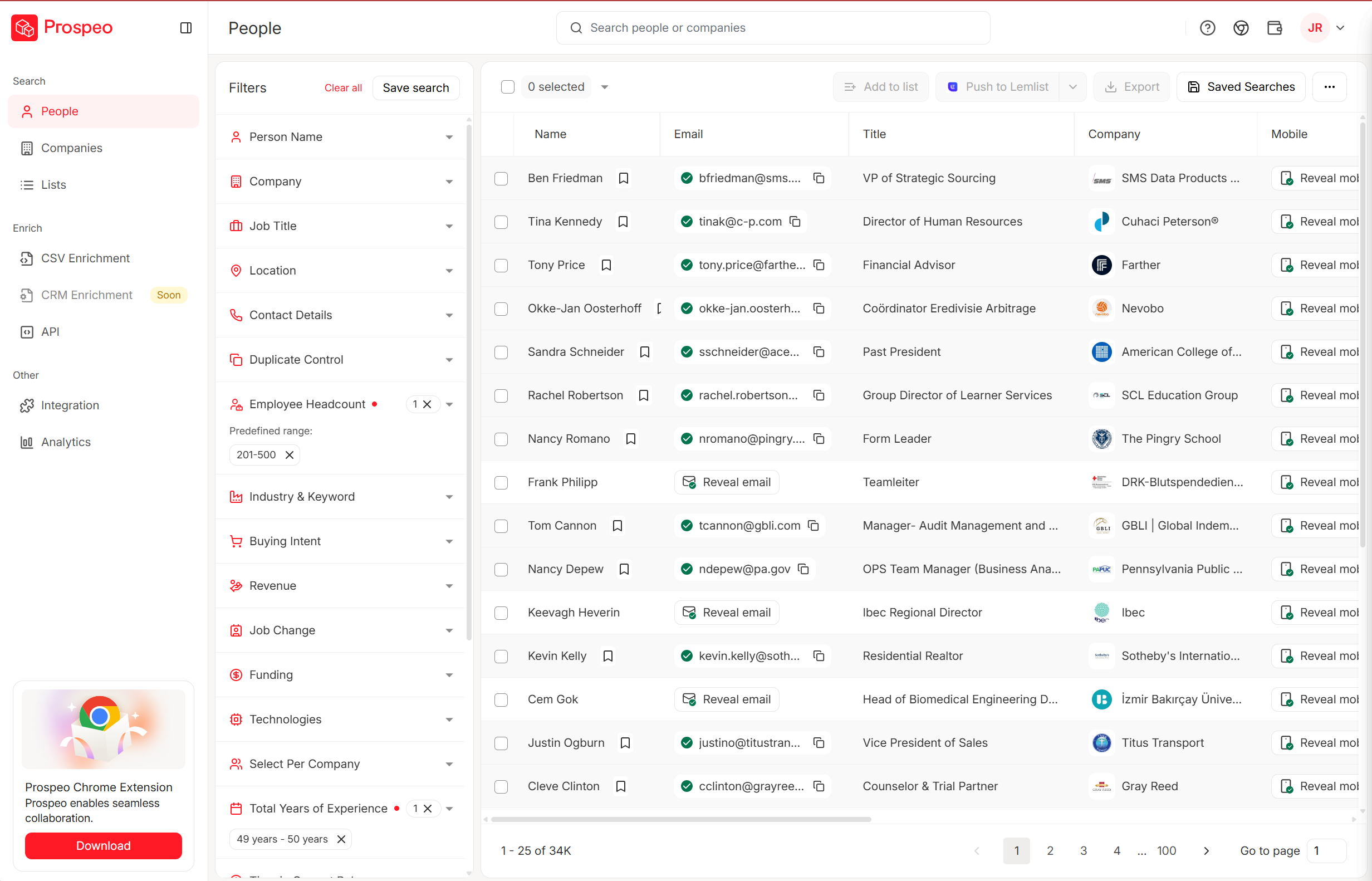
In our testing across 10K+ records, Prospeo's 98% email accuracy held up consistently. The platform covers 300M+ professional profiles, 143M+ verified emails, and 125M+ verified mobile numbers with a 30% pickup rate, all refreshed on a 7-day cycle versus the roughly 6-week industry average. Pricing is credit-based at ~$0.01/email, with a free tier and no contracts. For teams that need a reliable data source without enterprise-level budgets, it's the strongest accuracy-to-cost ratio we've tested.
ZoomInfo ($15K-$40K/yr) is one of the deepest US-focused databases but comes with enterprise pricing and complexity. Apollo (free-$99/user/mo) is the budget prospecting tool with a solid free tier, though email accuracy runs lower.
| Feature | Prospeo | ZoomInfo | Apollo |
|---|---|---|---|
| Email accuracy | 98% | ~87% | ~79% |
| Data refresh | 7 days | 4-6 weeks | 4-6 weeks |
| Starting price | ~$0.01/email | ~$15K/yr | $49/user/mo |
| Free tier | Yes | No | Yes |
| Verified mobiles | 125M+ | Yes | Yes |
| Best for | Accuracy + budget teams | Enterprise US coverage | Free-tier prospecting |
Intent Data
Bombora (~$25K-$50K/yr for mid-market) and 6sense (~$30K-$100K+/yr depending on modules) are the primary standalone intent players. For teams that want intent combined with contact verification in one workflow, look for platforms that integrate a 15,000-topic intent taxonomy natively rather than bolting on a separate vendor.
You can't score leads or forecast pipeline on data that's 30% decayed. Prospeo enriches your CRM with 50+ data points per contact at a 92% match rate - plus intent signals across 15,000 topics so you know which accounts are actually in-market. All for ~$0.01 per email.
Clean contacts, intent signals, and enrichment - one platform, no contracts.
FAQ
What's the difference between sales data and sales analytics?
Sales data is the raw information - deal values, contact details, activity logs. Analytics is what you do with it: identifying patterns, diagnosing problems, predicting outcomes. You can't have useful analytics without clean underlying records, and thorough analysis of those records is the bridge between the two.
How often should you audit your CRM records?
Monthly at minimum. Track contact-to-account match rates, duplicate counts, and field completeness. Automated refresh cycles reduce the manual burden, but you still need human eyes on definition consistency and stage accuracy.
What's the most important sales metric to track first?
Pipeline velocity. It combines deal count, win rate, average deal size, and cycle length into one metric that reveals whether your pipeline is healthy or stalling. Start here because it exposes data gaps fast - if you can't calculate it cleanly, your underlying records need work.
How do you centralize sales data across tools?
Make your CRM the single source of truth. Integrate every tool via native connectors or middleware like Zapier. Eliminate spreadsheet side-channels ruthlessly. If records don't live in the CRM, they don't exist - scattered information across disconnected tools is the fastest way to erode trust in your numbers.