

How to Build a Sales Department Structure Chart (With Benchmarks and Real Examples)
You've just been told to double the sales team by Q3. You're staring at a blank org chart with no idea whether to hire SDRs, AEs, or a manager first. The wrong structure wastes six months and a quarter-million dollars in comp.
Here's how to get it right.
What You Need (Quick Version)
- Pick your org model. Assembly line works for most B2B SaaS teams.
- Match your structure to your ARR stage - specific roles and ratios below.
- Use Lucidchart or Miro to build the chart, then layer in verified contact data for account mapping.
Why Your Sales Org Chart Matters
Only 52% of CEOs believe in their own growth plans. That's a confidence problem rooted in structure - when nobody can articulate who does what, forecasts are fiction. Companies that nail their GTM structure are 2x more likely to meet or exceed revenue targets, with 74% hitting their goals.
Your org chart isn't an HR formality. It's the blueprint that tells every rep, manager, and ops person where they fit and who they serve.
Three Sales Org Models
Most guides list eight or ten models. You don't need that many. Three matter, and one is the default for B2B SaaS.
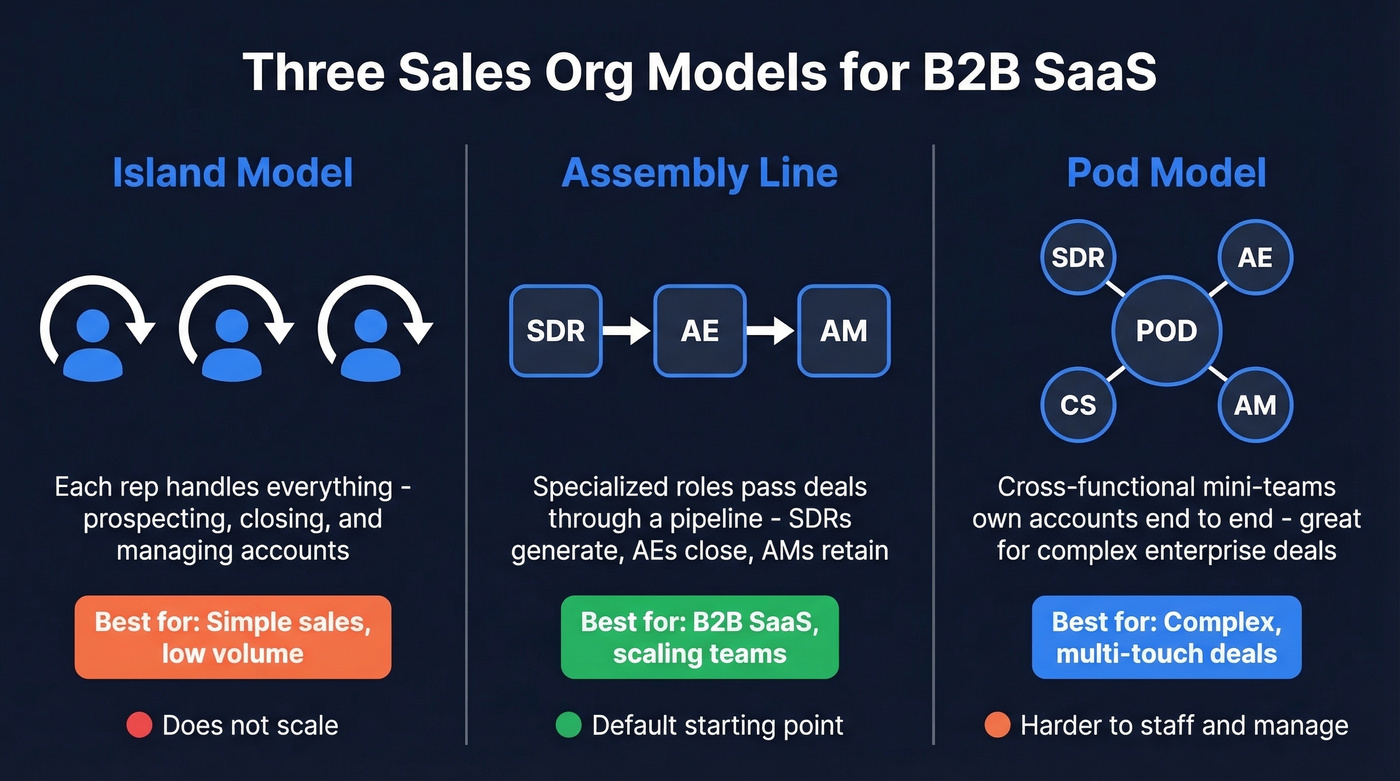
| Model | How It Works | Best For |
|---|---|---|
| Island | Reps handle everything end-to-end | Simple sales, low volume |
| Assembly Line | Specialized roles (SDR → AE → AM) | B2B SaaS, scaling teams |
| Pod | Cross-functional mini-teams | Complex, multi-touch deals |
The assembly line is the default starting point for B2B SaaS - start there. Specialization lets SDRs focus on pipeline generation while AEs close, and that division of labor is what makes the model scale so well once you've nailed your ICP and messaging. Pods make sense once you're running complex enterprise deals with long cycles, but they're harder to staff and manage. The island model? It doesn't scale past a handful of reps. For industries like pharma or manufacturing with regional distribution, the assembly line still works - just segment by geography instead of deal size.

Your org chart maps the structure. Prospeo fills it with real contacts. Pull verified emails (98% accuracy) and direct dials for every decision-maker on your account map - from SDR targets to the C-suite. 300M+ profiles, updated every 7 days.
Turn every box on your org chart into a reachable buyer.
Structure by Company Stage
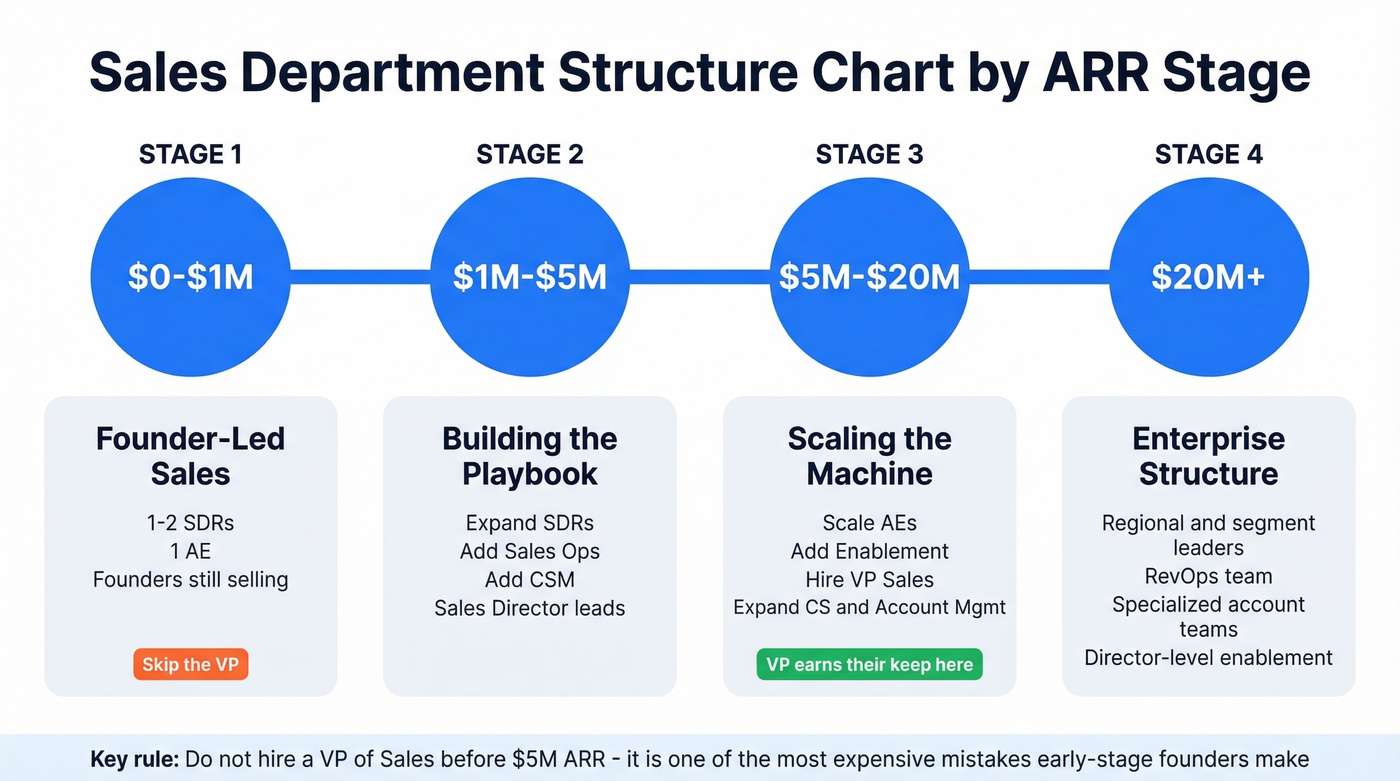
Your sales team hierarchy should look completely different at $500K ARR than at $20M. Hiring a VP of Sales before you've hit $1M is one of the most expensive mistakes early-stage founders make.
| ARR Stage | Roles to Hire | Notes |
|---|---|---|
| $0-$1M | 1-2 SDRs, 1 AE | Founders still selling; skip the VP |
| $1M-$5M | Expand SDRs, add Sales Ops, add CSM | Sales Director builds playbook |
| $5M-$20M | Scale AEs, add Enablement, hire VP Sales | Expand CS + Account Mgmt |
| $20M+ | Regional/segment leaders, RevOps, specialized account teams | Director-level enablement |
At the early stage, founders should be on every deal. The SDRs feed pipeline, the AE closes, and nobody needs a manager yet.
Once you cross $1M, add Sales Ops - someone has to own the CRM, reporting, and lead routing before it becomes a mess. We've seen too many $2M ARR companies where the "CRM" is a shared Google Sheet and territory assignments live in someone's head. The VP of Sales earns their keep at $5M+, when you need someone building a repeatable machine across multiple AEs and the founder can't be in every pipeline review.
Key Benchmarks
These numbers come from a study of 939 B2B companies and they're the benchmarks we use when advising on headcount planning:
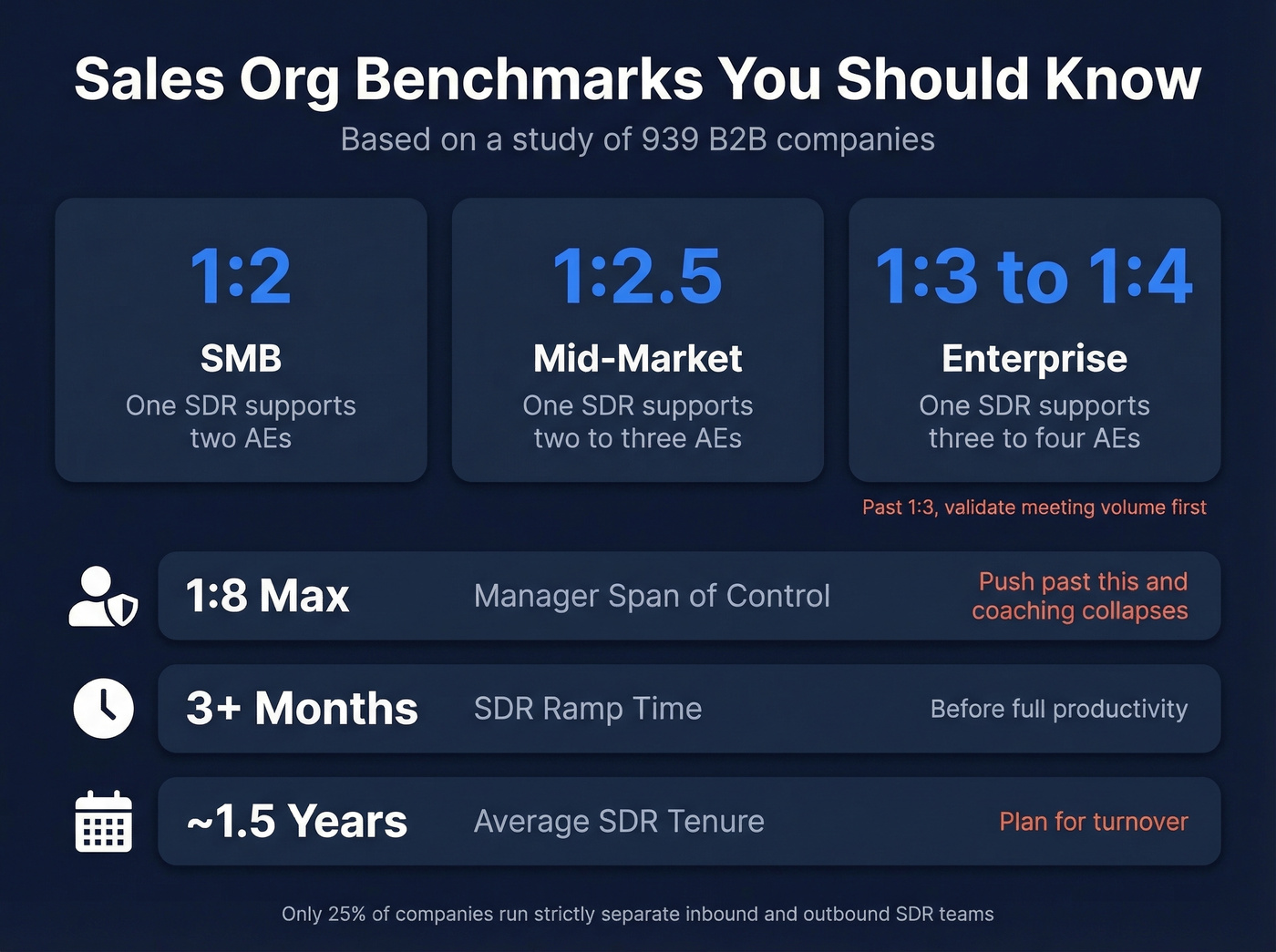
- SDR:AE ratios - SMB: 1:2, Mid-market: 1:2.5, Enterprise: 1:3 to 1:4
- Span of control - 1 manager per 8 reps (push past this and coaching collapses)
- SDR ramp time - 3+ months before full productivity
- SDR average tenure - ~1.5 years (plan for turnover)
Only about 25% of companies run strictly separate inbound/outbound SDR teams - most blend the roles. Don't push past a 1:3 SDR:AE ratio without validating that your SDRs can handle the meeting volume. At 1:4, most SDRs are stretched thin and lead quality drops fast.
Real Example: SaaS Sales Org at $50M ARR
iContact at ~$50M ARR ran 250 employees with roughly 70 in the sales org. The breakdown: 30 SDRs, 25 AEs, and 15 Account Managers.
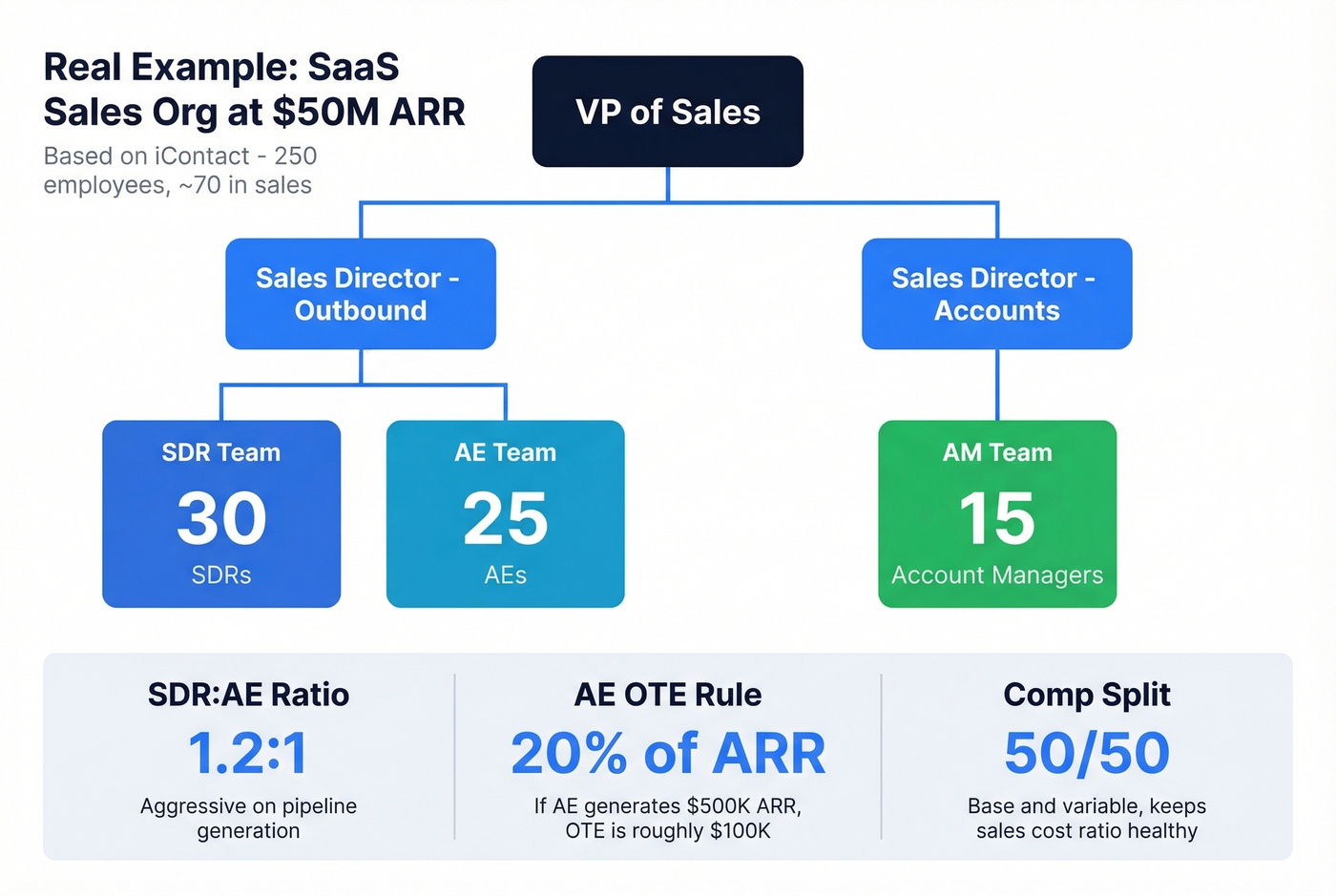
That's an SDR:AE ratio of about 1.2:1 - aggressive on pipeline generation. We've seen this ratio work well at similar-stage companies where outbound is the primary growth lever. Their comp rule of thumb: AE OTE at roughly 20% of ARR generated per year, split 50/50 base and variable. So if an AE generates $500K in new ARR, 20% implies ~$100K OTE. That math keeps your sales cost ratio healthy as you scale.
Best Tools for Building Your Chart
Here's the thing: enterprise reps on Reddit flag the same frustration over and over. Miro is solid for visualizing but painfully manual, PowerPoint can't handle multi-threaded buyer maps, and Sales Navigator's built-in org chart is too rigid. You need a dedicated tool.
| Tool | Starting Price | Best For |
|---|---|---|
| Lucidchart | $9/user/mo | All-around flexibility + data imports |
| Miro | $8/user/mo | Collaborative account mapping |
| Canva | Free | Quick polished visuals |
| Microsoft Visio | $5/user/mo | Microsoft ecosystem |
| Workleap Pingboard | $5/user/mo | Real-time people directory |
| SmartDraw | $7.95/user/mo | Spreadsheet-to-chart |
| Organimi | $20/mo (3 users) | Drag-and-drop simplicity |
| OrgChart | $1.05/user/mo | Budget pick for large orgs |
Lucidchart is the best all-around pick. It imports from spreadsheets, supports AI-generated layouts, integrates with Salesforce, and can even show a person twice if they hold multiple roles - a small feature that matters a lot when mapping matrixed enterprise accounts. Miro wins for collaborative whiteboarding when you're mapping a buying committee in real time. Organimi's free version is limited to one org chart, and accessing all features requires an annual paid subscription - fine for a quick start, but you'll outgrow it. Functionly offers a free template that splits a midsized B2B SaaS sales org into three divisions (Sales, Customer Success, and Operations), which is a useful skeleton if you're starting from scratch.
Let's be honest though: most teams overthink the charting tool and underthink the data inside it. The chart is the skeleton; the contacts are the muscle. Once you've mapped an enterprise account's org, you need verified contact data for every box on that chart. Prospeo's Chrome extension pulls verified emails and direct dials from any website or CRM in one click - 300M+ profiles, 98% email accuracy, free to start with 75 emails and 100 Chrome extension credits per month. For enterprise reps doing account mapping with multiple executive buyers, that's the difference between a pretty diagram and a prospecting tool you can actually execute against.
If you want to operationalize the chart, pair it with a simple lead generation workflow and a repeatable sales prospecting motion so the org map turns into meetings booked.
Enterprise account mapping is useless without verified contact data behind it. Prospeo's Chrome extension lets reps pull emails and mobile numbers from any org chart, CRM, or company page in one click - 75 free emails/month, no contract required.
Stop mapping accounts you can't actually reach.
Mistakes When Structuring Your Sales Org
In our experience, manager overload past 1:8 is the structural failure we see most often. But it's not the only one.
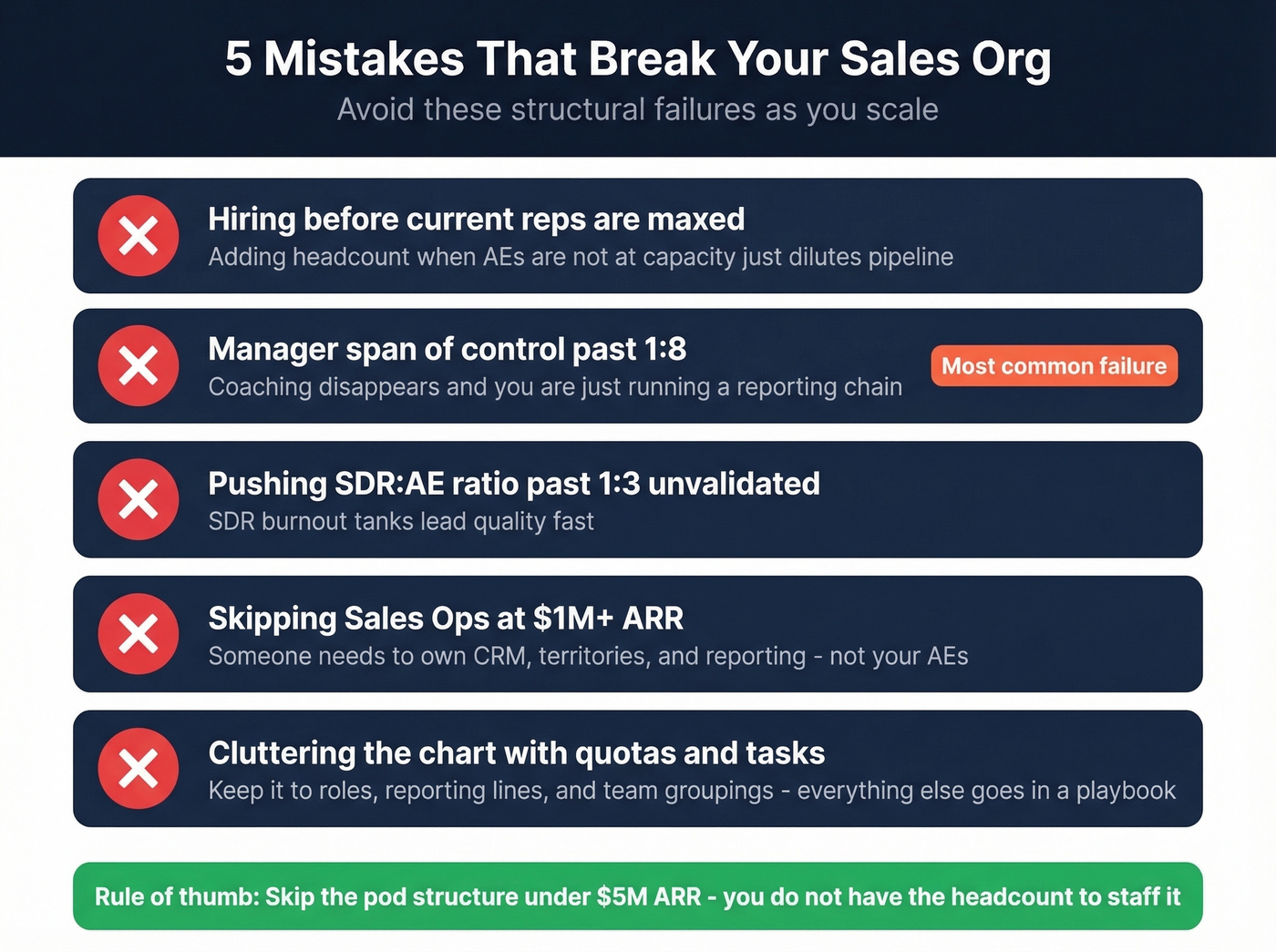
- Don't expand until current reps are maxed. If your AEs aren't at capacity, adding headcount just dilutes pipeline.
- Don't overload managers past 1:8. Beyond that ratio, coaching disappears and you're just running a reporting chain.
- Don't push SDR:AE past 1:3 without validating capacity. SDR burnout tanks lead quality fast.
- Don't skip Sales Ops at $1M+ ARR. Someone needs to own the CRM, territories, and reporting. That someone isn't your AEs.
- Don't clutter the chart with quotas or daily tasks. Keep it to roles, reporting lines, and team groupings. Everything else belongs in a playbook.
Skip the fancy pod structure if you're under $5M ARR. You don't have the headcount to staff cross-functional teams, and you'll end up with pods of two people who are really just doing the assembly line with extra meetings.
FAQ
What is a sales department structure chart?
A visual diagram showing every role in your sales org, reporting lines, and team groupings. It's the foundation for headcount planning, territory design, and onboarding - not just an HR artifact. Most B2B teams use the assembly line model (SDR → AE → AM) as their starting framework.
How often should you update your org chart?
Every time you hire, promote, or restructure - quarterly reviews at minimum. Companies scaling past $5M ARR typically revisit structure each quarter to rebalance SDR:AE ratios and manager span of control.
How do you find contact data for account org charts?
Use a B2B data platform like Prospeo to pull verified emails and phone numbers for every stakeholder on the chart. With 98% email accuracy and 125M+ verified mobiles, it turns a static diagram into a prospecting map you can act on immediately.
What's the ideal SDR-to-AE ratio?
For SMB deals, target 1 SDR per 2 AEs. Mid-market teams run closer to 1:2.5, and enterprise orgs stretch to 1:3 or 1:4. Pushing beyond 1:3 without validating meeting volume usually leads to SDR burnout and declining lead quality.