

The Best Sales Effectiveness Tools for 2026
Twelve hours. That's how much actual selling the average rep squeezes out of a 40-hour week, per Salesforce's State of Sales data. The other 28 hours vanish into CRM updates, internal meetings, and chasing contacts that bounce. The right sales effectiveness tools fix the foundation so the work actually converts - and in 2026, that foundation is shakier than ever.
Our Picks (TL;DR)
| Category | Tool | Starting Price | Best For |
|---|---|---|---|
| Data & Enrichment | Prospeo | Free (75 emails/mo) | Accuracy-first outbound |
| CRM | HubSpot Sales Hub | Free | SMB to mid-market |
| Engagement | Apollo | Free | Data + sequences combined |
| Conv. Intelligence | Gong | Custom (enterprise) | Enterprise deal intelligence |
| Conv. Intelligence | Avoma | $19/user/mo | SMB call coaching |
| Enablement | Highspot | Custom | Content + coaching at scale |
What "Sales Effectiveness" Actually Means
Effectiveness isn't efficiency. Efficiency is doing things faster. Effectiveness is doing the right things - targeting the right accounts, reaching the right stakeholders, running the right deal strategy. One gets you activity metrics. The other gets you revenue.
A [HubSpot survey of 1,000 sales pros](https://blog.hubspot.com/sales/sales-performance-metrics) makes this concrete: 42% rank ARR as their top success metric, with win rate at 28% and quota attainment at 26%. Pipeline coverage and lead scoring? Under 5%. Teams care about outcomes, not activity volume.
The 2026 Selling Environment
The environment has gotten objectively harder. Quota attainment averages roughly 43%, with up to 70% of reps missing quota entirely. Win rates sit at 20-21% while sales cycles have stretched 38% longer than they were in 2021.
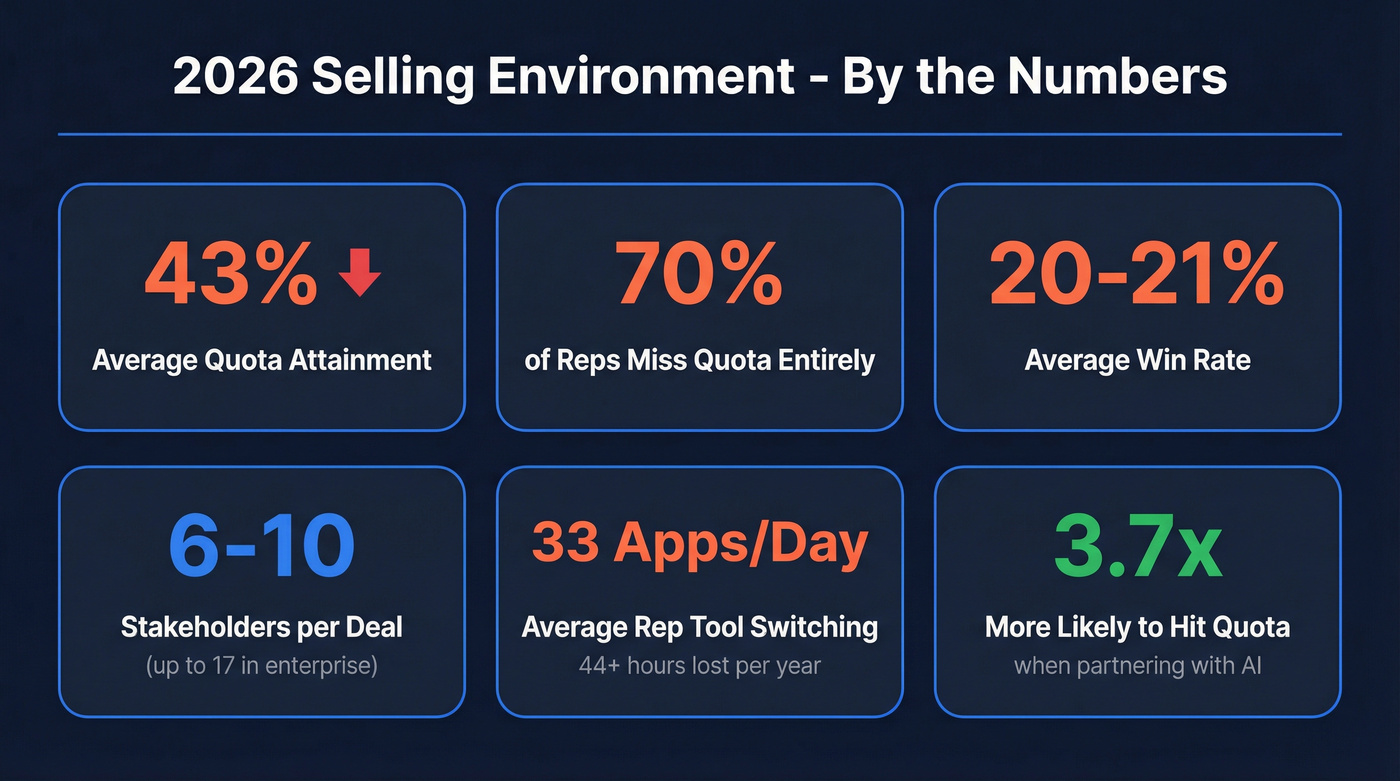
Buying committees now involve 6-10 stakeholders - sometimes up to 17 in enterprise deals - and multi-threaded deals close at 130% higher win rates for opportunities above $50k. Meanwhile, reps switch between 33 apps per day, losing 44+ hours per year just to context switching. And reps who partner effectively with AI are [3.7x more likely to hit quota](https://www.gartner.com/en/newsroom/press-releases/2024-09-16-gartner-sales-survey-reveals-sellers-who-partner-with-ai-re-three-point-seven-times-more-likely-to-meet-quota).
Here's the thing: most teams don't have a tools problem. They have a data problem wearing a tools disguise. Fix the contacts feeding your stack and half your "engagement issues" disappear overnight.


When 57% of the week is lost to admin and bounced contacts, the most effective tool you can buy is better data. Prospeo gives you 300M+ profiles with 98% email accuracy, 125M+ verified mobiles, and a 7-day refresh cycle - so every tool downstream actually works.
Snyk's 50 AEs cut bounce rates from 40% to under 5%. Your stack deserves the same foundation.
The 5 Categories Worth Buying
B2B Data & Enrichment
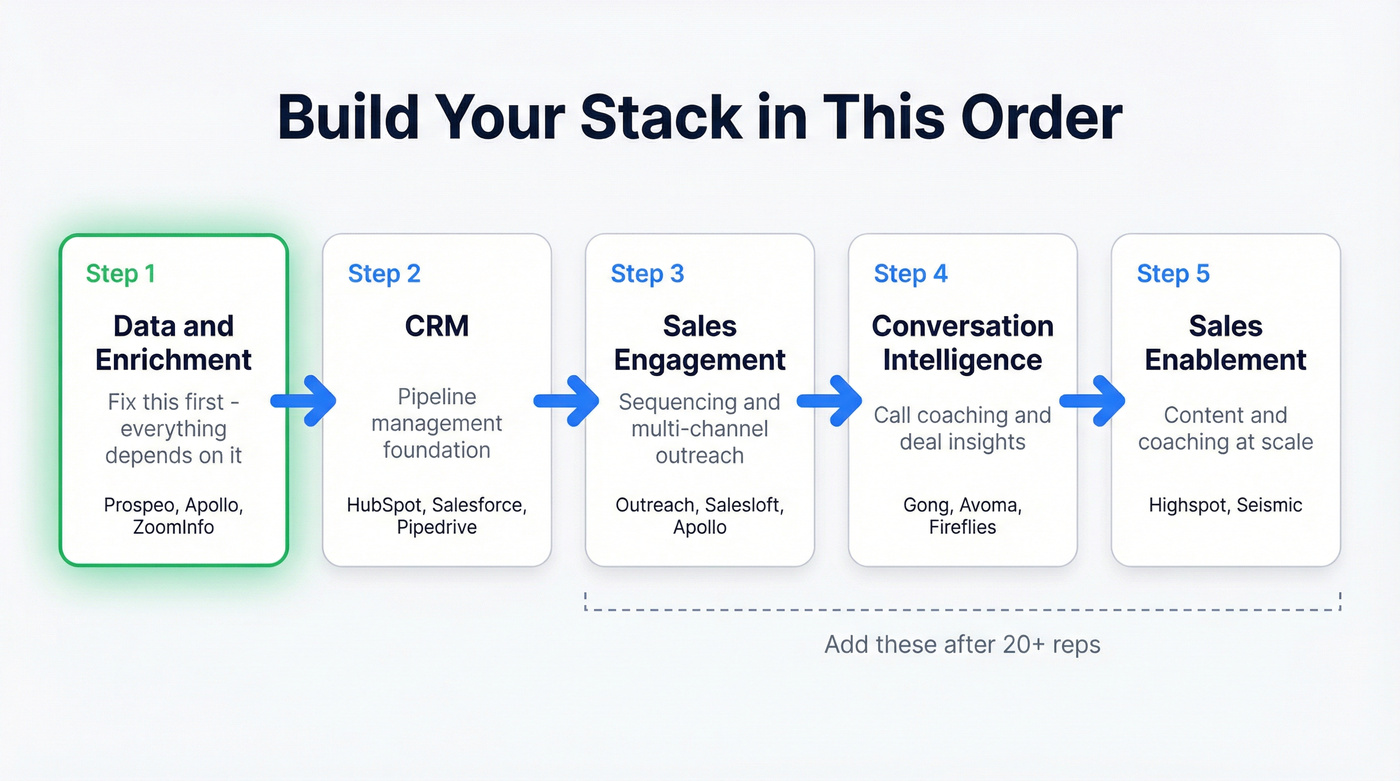
Every tool in your stack inherits the quality of your contact data. Your sequences, your CRM hygiene, your call connect rates - all of it traces back to whether the contacts are real and current. Get this category right first.
Prospeo is the strongest option for teams that prioritize accuracy. The database covers 300M+ professional profiles with 143M+ verified emails at 98% accuracy - compared to 87% at ZoomInfo and 79% at Apollo. The 125M+ verified mobile numbers deliver a 30% pickup rate. But the differentiator that matters most in practice is the 7-day data refresh cycle versus the 6-week industry average.
We've seen the results firsthand. Snyk's 50-person AE team was running bounce rates of 35-40% before switching their data provider. After moving to Prospeo, bounces dropped under 5%, and AE-sourced pipeline jumped 180%. At roughly $0.01 per email with a free tier of 75 emails/month, the math against a $15-40k/year ZoomInfo contract is straightforward.

Apollo pulls double duty as a data platform and engagement tool, which makes it appealing for lean teams at free to $79/user/month. The tradeoff: G2 reviewers consistently flag data accuracy issues with outdated emails and phone numbers. Apollo works best when you verify its data through a separate layer (see email verification).
ZoomInfo remains the enterprise default at $15-40k/year. If you're running fewer than 50 reps, though, you're paying for modules you'll never activate.
CRM
HubSpot Sales Hub is the obvious starting point for SMB and mid-market teams. The free tier is genuinely usable - not a trial - with paid plans from $15/user/month scaling to $150/user/month. Salesforce Sales Cloud runs $25-500/user/month and does everything, but don't buy it unless you have someone dedicated to running it. That's not a joke. We've watched teams burn six figures on Salesforce implementations that nobody maintains (useful context: Salesforce pricing). Pipedrive fills the budget niche at $14-99/user/month for teams under 15 reps who want simplicity over configurability.
Sales Engagement
Skip this category if you have fewer than 20 reps. The ROI math on a $100+/user/month engagement platform doesn't work until you have enough sequence volume to justify the implementation cost, and you should budget an extra $1,000-$8,000 for year-one deployment on the enterprise options.
Outreach runs ~$100-160/user/month with a 5-seat minimum and 4-8 week deployment. Salesloft is the cleaner alternative at ~$125-165/user/month with better UX. For teams that aren't ready for a dedicated platform, Apollo handles 80% of the sequencing use case at a fraction of the cost (more on sequence management).
Conversation Intelligence
Gong is the gold standard - 4.7/5 on G2 with 6,517 reviews. Unmatched deal intelligence and pipeline analytics. But if you're a 10-person team, you're buying a Ferrari to drive to the grocery store.
Avoma starts at $19/user/month and Fireflies.ai offers a free tier with paid plans from $10/user/month. Either handles the core job for SMB teams without the five-figure commitment (pair with a tighter discovery questions process).
Sales Enablement
Gartner defines Revenue Enablement Platforms as tools that unite enablement across sales, CS, and marketing - content management, learning, coaching analytics, and seller engagement tracking. Highspot and Seismic both carry 4.7/5 on Gartner Peer Insights on custom contracts.
Let's be honest: these platforms earn their keep past 20 reps with enough content and playbooks to justify the investment. Before that, a well-organized Google Drive and a weekly coaching cadence get you surprisingly far (a lightweight starting point: sales battle cards).
Full Comparison
| Tool | Category | G2 Rating | Starting Price | Best For |
|---|---|---|---|---|
| Prospeo | Data & Enrichment | 4.8/5 | Free (75 emails/mo) | Accuracy-first outbound teams |
| Apollo | Data + Engagement | 4.8/5 | Free | Lean teams wanting one platform |
| ZoomInfo | Data & Enrichment | 4.4/5 | ~$15-40K/year | Enterprise orgs with RevOps staff |
| HubSpot Sales Hub | CRM | 4.4/5 | Free | SMB to mid-market |
| Salesforce Sales Cloud | CRM | 4.3/5 | $25/user/mo | Enterprise with dedicated admin |
| Pipedrive | CRM | 4.2/5 | $14/user/mo | Teams under 15 reps |
| Outreach | Engagement | 4.3/5 | ~$100/user/mo | High-volume outbound at scale |
| Salesloft | Engagement | 4.5/5 | ~$125/user/mo | Engagement with cleaner UX |
| Gong | Conv. Intelligence | 4.7/5 | Custom | Enterprise deal intelligence |
| Avoma | Conv. Intelligence | 4.4/5 | $19/user/mo | SMB call coaching |
| Fireflies.ai | Conv. Intelligence | 4.5/5 | Free | Budget meeting transcription |
| Highspot | Enablement | 4.7/5 | Custom | Content + coaching at scale |
| Seismic | Enablement | 4.7/5 | Custom | Enterprise enablement |
How to Build Your Stack
You need 3-5 tools, not 10. The practitioner debate on r/sales between best-of-breed point solutions and fewer, more opinionated platforms keeps resurfacing - and the consensus is clear: consolidation wins unless a point solution is dramatically better at a critical function. Gartner's RevTech framing points the same direction: fewer vendors, shared data, cross-functional alignment (see sales process optimization).
Start with your data layer. A tool running on a 7-day refresh cycle means your engagement platform isn't automating failure. Build outward from there: CRM for pipeline management, engagement for sequencing, then CI and enablement as you scale past 20 reps. In our experience, the teams that get the most from their sales effectiveness tools audit their stack quarterly and kill anything reps aren't actively using. If nobody's logged in for 30 days, cancel it (tie the audit to sales operations metrics).
Sales effectiveness starts before the sequence, the call, or the demo. It starts with contacts that are real and current. At $0.01 per email - 90% cheaper than ZoomInfo - Prospeo delivers 98% accuracy with data refreshed every 7 days, not every 6 weeks.
Teams using Prospeo book 26% more meetings than ZoomInfo users. See why.
FAQ
What's the difference between sales effectiveness and sales productivity tools?
Effectiveness tools help you do the right work - better targeting, sharper messaging, smarter deal strategy. Productivity tools help you do work faster through automation and templates. The best stacks address both, but start with effectiveness. Automating the wrong activities just scales failure.
How many tools does a team actually need?
Three to five integrated tools cover most teams. CRM plus data enrichment plus engagement is the minimum viable stack. Add conversation intelligence and enablement as you scale past 20 reps. More than that, and you're creating the context-switching problem that kills the productivity you're trying to gain.
What's the most important category to invest in first?
Data quality. Every other tool depends on accurate, current contacts. A 98% email accuracy rate and weekly refresh cycle is the benchmark to aim for - because a strong data foundation means your sequences, calls, and CRM records start clean, so the tools built on top actually perform as designed.
Is there a free option worth starting with?
Prospeo offers 75 free emails/month with full verification - no trial expiration or feature gates. Apollo also has a free tier combining data and sequences, though its email accuracy sits at 79%, so you'll want a verification layer on top. HubSpot's free CRM rounds out a zero-cost starter stack for teams testing outbound before committing budget.