

Sales Email Copywriting: Data-Backed Tactics That Get Replies in 2026
A practitioner on r/coldemail posted their progression last month: 3.44% reply rate on campaign one, 8.18% on campaign two, 24.36% on campaign three. Same ICP. Same product. The only thing that changed was the copy. When the average cold email reply rate sits at 3.43%, that kind of leap isn't luck - it's sales email copywriting done right.
The Quick Version
- Keep emails under 60 words. Lead with the prospect's pain, not your product. Use a soft CTA.
- Personalize differently by seniority - company context for directors and above, individual context for ICs. Gong's data on 30,000+ emails backs this up.
- None of this matters if your emails bounce. Verify every address before sending.
What "Good" Looks Like in 2026
Most teams celebrate a 2% reply rate because they don't know the benchmark. Here's where the bar actually sits, per Instantly's 2026 benchmark report analyzing billions of cold email interactions:
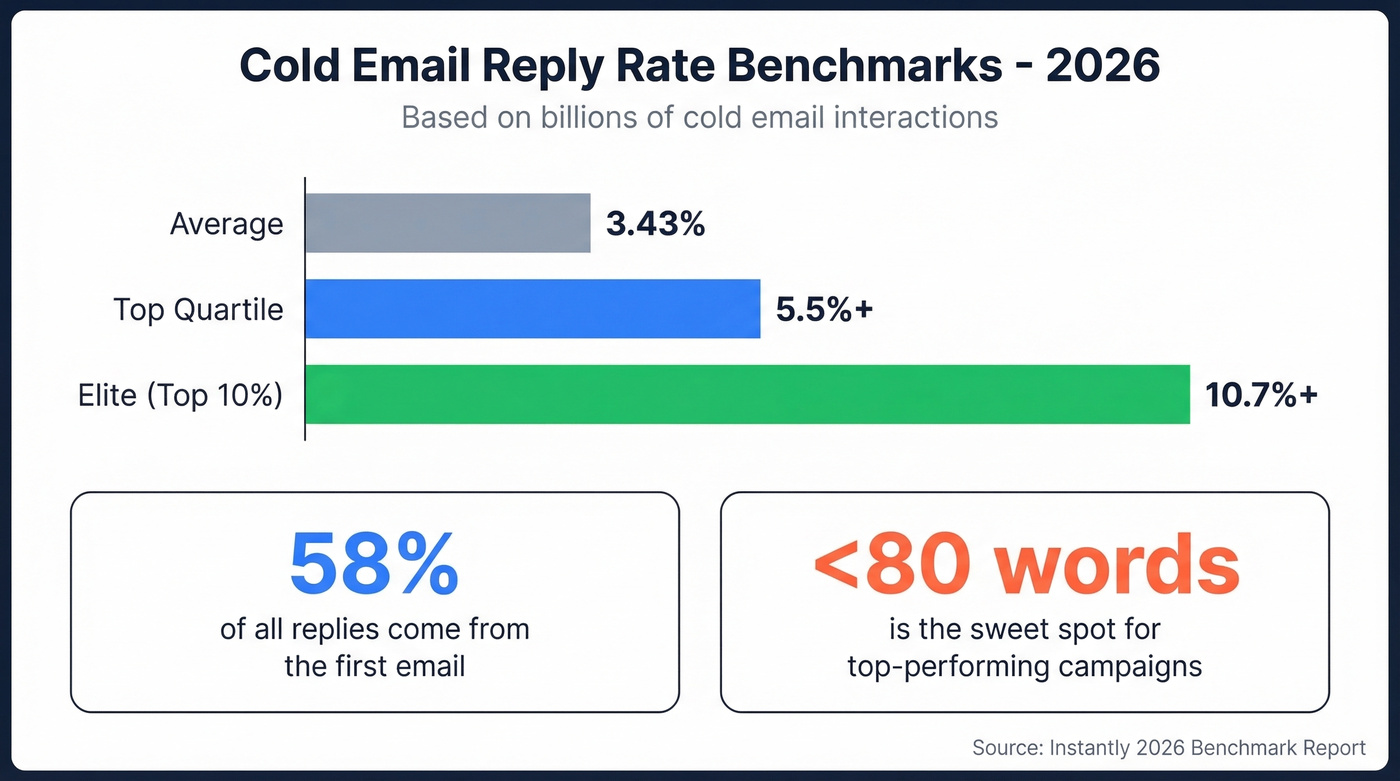
| Tier | Reply Rate |
|---|---|
| Average | 3.43% |
| Top quartile | 5.5%+ |
| Elite (top 10%) | 10.7%+ |
Two numbers worth internalizing: 58% of all replies come from the first email, and the best-performing campaigns keep emails under 80 words. Your first touch carries most of the weight. Brevity is the vehicle.
How to Write Outbound Emails That Get Replies
The 60-Word Rule
The consensus on r/copywriting is blunt: 40-60 words max. Not 125. Not "a few short paragraphs." Shorter emails force you to lead with value instead of burying it under context nobody asked for. The r/coldemail practitioner's first two campaigns failed with generic value props and passive CTAs - the breakthrough came from leading with pain and assuming relevance.
Here's what a 47-word cold email actually looks like:
Hi {{firstName}},
Most {{industry}} teams lose 10-15 hours/week on manual list building. We built an automation that cuts that to under 2 hours - already running for [similar company].
I'll record a 3-min Loom showing how it'd work for {{company}}. Worth a look?
No company pitch. No three-paragraph backstory. Pain, proof, offer, soft CTA. That's the entire body doing all the heavy lifting in under 50 words.
If you want a full sequence (not just the first touch), borrow from these sales follow-up templates and adapt the same pain-first structure.
Personalize by Seniority, Not Template
Gong analyzed 30,000+ prospecting emails across 250+ companies and found something most teams get backwards. For directors and above, company-based personalization - referencing their company's situation, growth, or challenges - triples reply rates. For individual contributors, one-to-one personalization more than doubles replies.
This is also why modern personalized outreach works best when it’s driven by real signals, not token swaps.
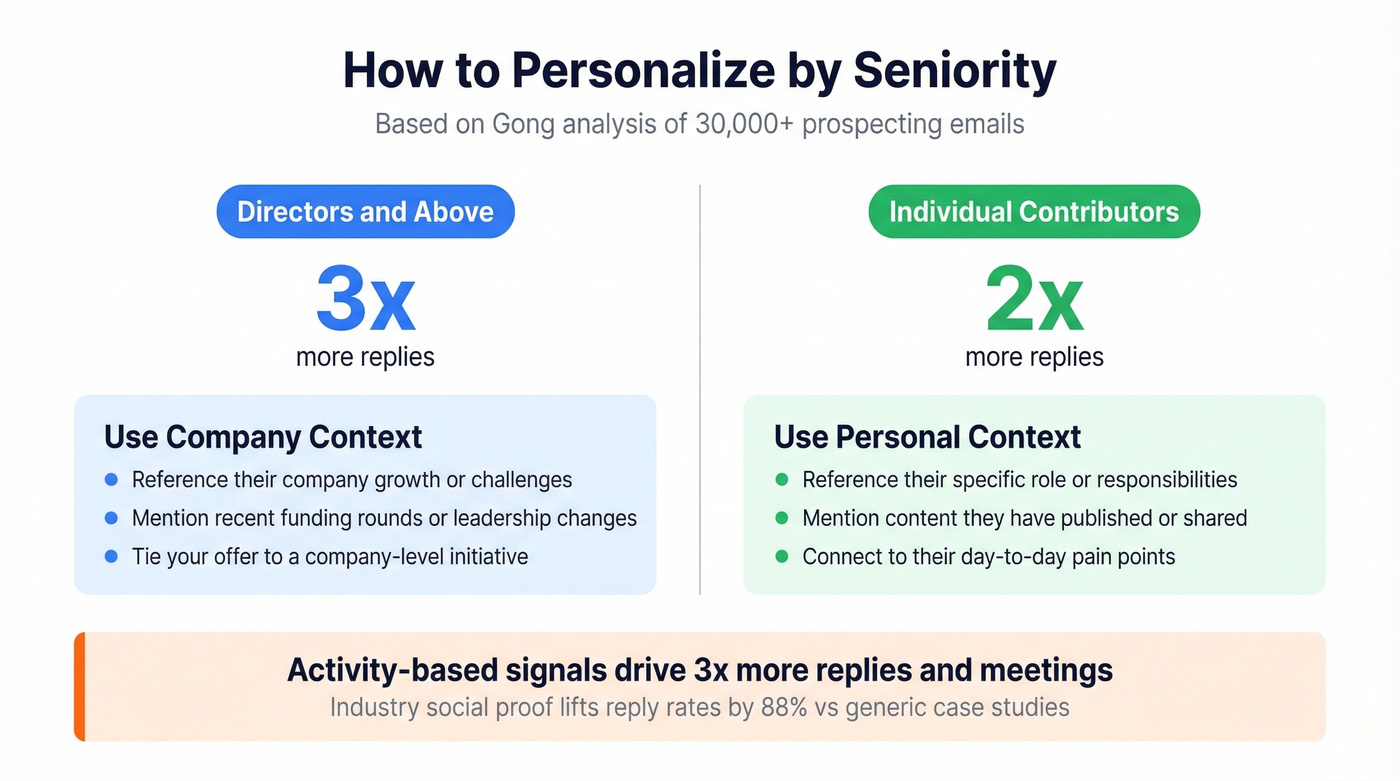
Activity-based signals are even stronger. Referencing a prospect's recent behavior - a funding round, a leadership change, a job posting that signals a new initiative - drives 3x more replies and scheduled meetings than static personalization. Industry-based social proof lifts reply rates by 88%, so mentioning results with companies in the prospect's vertical beats generic case studies every time.
Here's the thing: 87% of buyers say the sales emails they receive don't address a relevant challenge. And with 64% of marketers now using AI in email marketing, your prospects are drowning in AI-generated "I noticed your company..." openers. Generic mail-merge tokens are dead. The bar for outbound copy that actually resonates is higher than it's ever been.
Subject Lines: Stop Overthinking
Keep them 25-45 characters, lowercase, and casual - most mobile clients truncate around 33-43 characters, so front-load the important words. "Quick question about {{company}}" beats "Revolutionize Your Sales Pipeline Today" almost every time. The r/sales consensus is clear: vague and casual beats salesy and specific.
For more ideas you can test quickly, pull from these cold email subject line examples (and keep the same “casual + relevant” vibe).
My hot take - the subject line matters about 5x less than the offer. Measure positive reply rate, not opens. Opens are vanity. Replies are pipeline.
If you’re building a full outbound motion, these sales prospecting techniques help you pair better targeting with better copy.

You just learned how to write cold emails that earn replies. Now make sure they actually land. Prospeo's 5-step email verification delivers 98% accuracy on a 7-day refresh cycle - so your 47-word masterpiece hits real inboxes, not bounce logs.
Great copy deserves verified contacts. Start with 75 free emails.
Copy Doesn't Matter If It Hits Spam
Nearly half of all global email traffic is spam. Roughly 1 in 6 emails never reach the inbox. Authenticated senders are up to 2.7x more likely to land in the inbox, and since 2025, bulk sender rules require SPF, DKIM, and DMARC authentication, bounce rates under 2%, and spam complaints under 0.3%.
If you need the full technical checklist, start with this email deliverability guide and then tighten your email velocity before you scale.
Your beautifully crafted 47-word email is worthless if it bounces. We've seen this pattern over and over - a team invests weeks writing sharp cold emails, launches, and watches 15-20% bounce because their list was stale. Meritt, an outbound agency, cut their bounce rate from 35% to under 4% using Prospeo's verification before sending. Their connect rate tripled to 20-25%.
Upload a CSV or run contacts through Prospeo's Email Finder, and every email goes through a 5-step verification process - catch-all handling, spam-trap removal, honeypot filtering. The result is 98% email accuracy on a 7-day data refresh cycle. There's a free tier (75 emails + 100 Chrome extension credits/month) if you want to test it before committing.
To go deeper on list hygiene, use these email bounce rate benchmarks and fixes (especially if you’re hovering above 2%).
Personalizing by seniority, referencing funding rounds, and layering industry proof requires real data. Prospeo gives you 30+ search filters - buyer intent, job changes, headcount growth - across 300M+ profiles so every email you write is backed by signals that drive 3x more replies.
Stop guessing. Prospect with intent data and verified contacts.
Test, Iterate, Repeat
The 3.44% to 24.36% progression took three campaign iterations, not one lucky send. Here's the testing framework that gets you there:
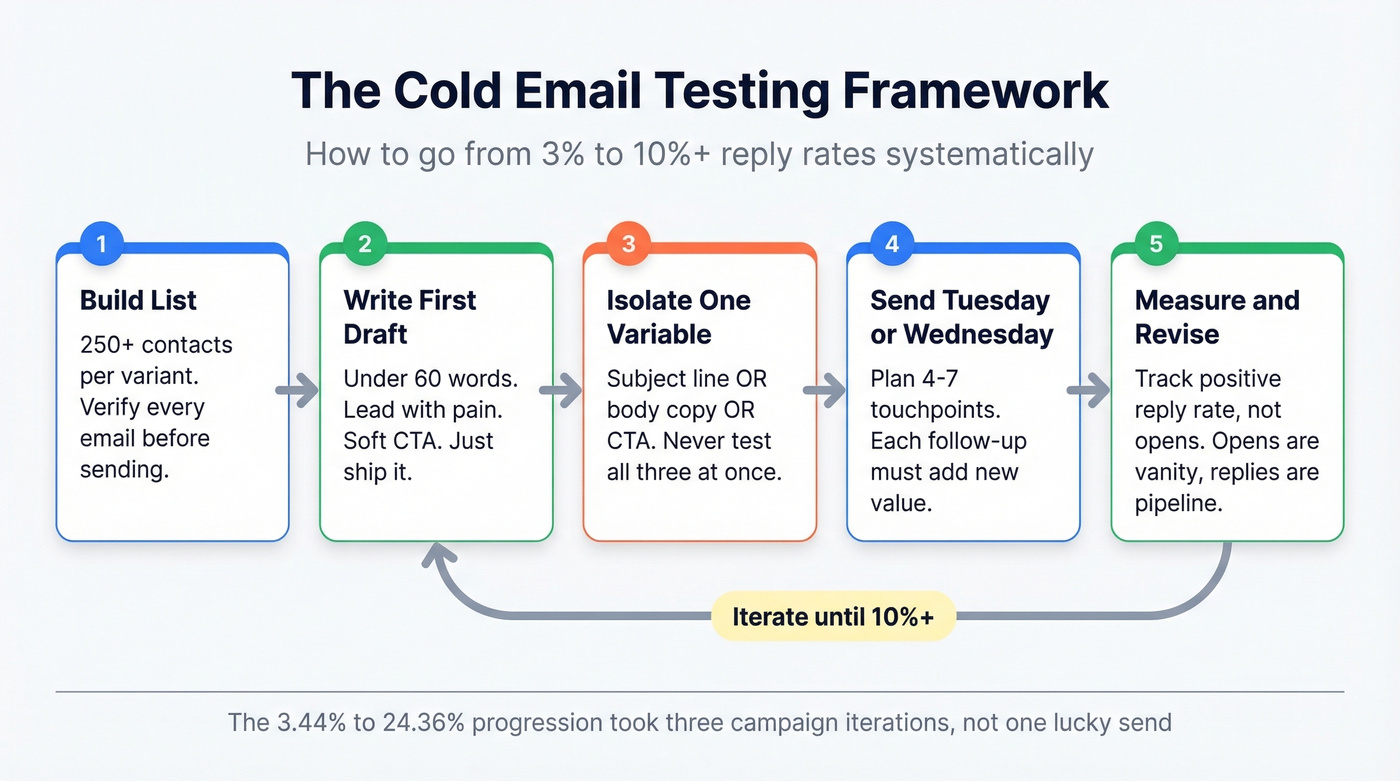
- Sample size: at least 250 contacts per variant. Anything less and you're reading noise.
- Isolate one variable: subject line OR body copy OR CTA. Never all three at once.
- Measure positive reply rate, not opens. Replies tell you which messaging actually resonates.
- Send Tuesday-Wednesday. Wednesday pulls the highest reply rates in Instantly's dataset.
- Plan 4-7 touchpoints. Beyond 7, diminishing returns kick in hard unless each follow-up adds genuinely new value.
If you’re mapping the whole sequence, this B2B cold email sequence guide pairs well with the testing approach above.
Skip this section if you're still writing your first campaign - get one version out the door, then come back and optimize. Perfectionism before data is just procrastination.
Sales email copywriting is an iteration game. The teams that write, measure, and revise systematically are the ones that break into double-digit reply rates.
A Cold Email Template You Can Steal
Let's break down a PAS-structured cold email, annotated. Steal it, adapt it, test it.
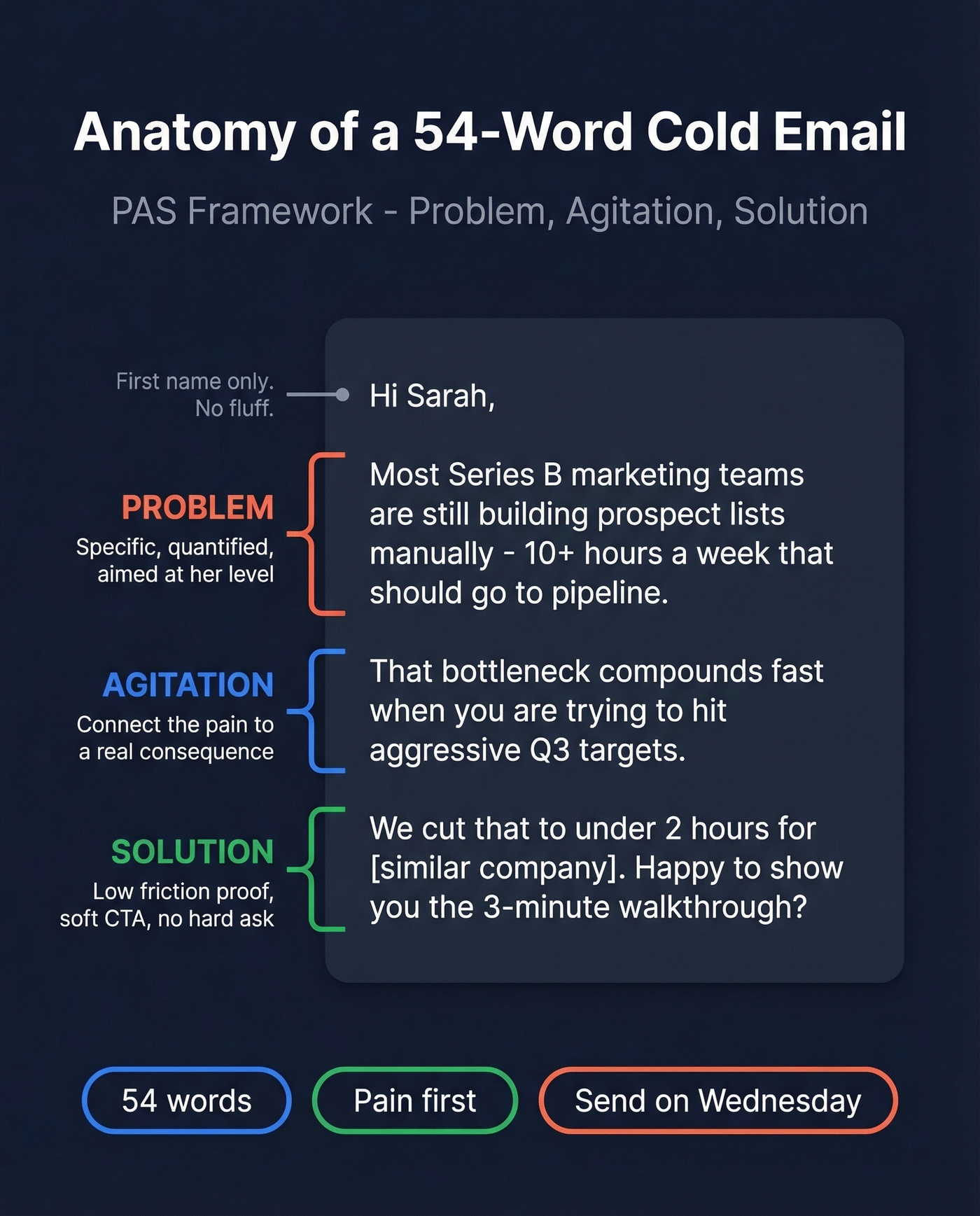
Hi Sarah, - First name only. No "Hope you're well."
Most Series B marketing teams are still building prospect lists manually - 10+ hours a week that should go to pipeline. - Problem: specific, quantified, aimed at her level.
That bottleneck compounds fast when you're trying to hit aggressive Q3 targets. - Agitation: connect the pain to a real consequence.
We cut that to under 2 hours for {{similar company}}. Happy to show you the 3-minute walkthrough? - Solution + soft CTA: low friction, specific proof, no hard calendar ask.
That's 54 words. Pain first, proof in the middle, easy out at the end. If you're learning how to write a B2B sales email, this PAS structure is the most reliable starting point we've found across hundreds of campaigns our users have run. Send it on a Wednesday. Verify the address first. Watch what happens.
The copy is the variable. Everything else is infrastructure.