

Sales Enablement AI: What It Costs, What Works, and What Everyone Gets Wrong
A RevOps leader at a 400-person SaaS company we advise signed a $92K enablement platform contract last year. Twelve months later, 60% of reps hadn't logged in past onboarding week. The content library had 4,000 assets and no tagging system. The AI coaching module was recommending call scripts for a product line they'd sunset in Q2.
That's not a technology failure. That's a $92K shelfware problem, and it's shockingly common.
Highspot's 2025 State of Sales Enablement report found that 55% of organizations can't effectively drive GTM initiatives. Up to 70% of reps miss quota, and average attainment hovers around 43%. The tools exist. The AI is real. But something between the purchase order and the pipeline is broken, and it's usually not the software.
What You Need (Quick Version)
Here's the cheat sheet based on team size and budget:
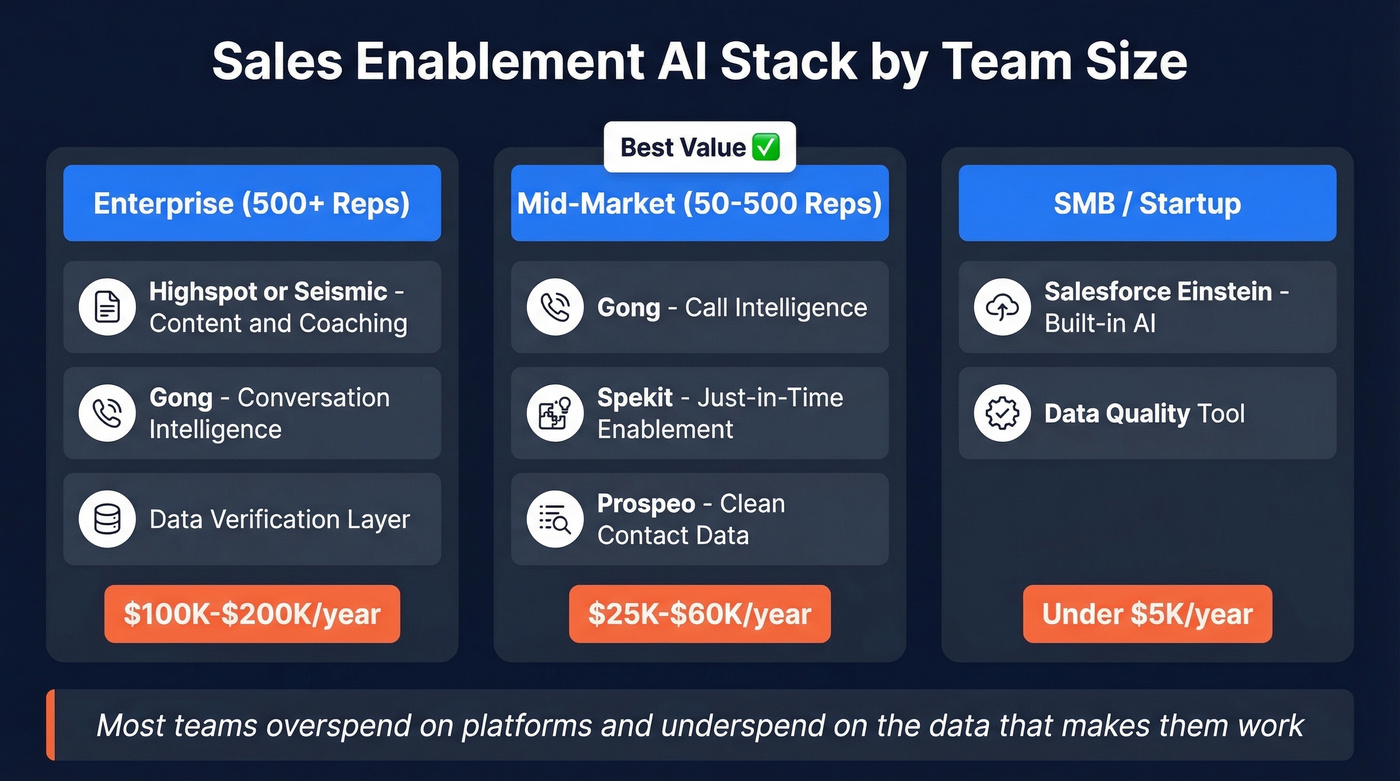
Enterprise (500+ reps): Highspot or Seismic for content and coaching, Gong for conversation intelligence, and a data verification layer underneath everything. Budget $100-200K/year all-in.
Mid-market (50-500 reps): Gong + Spekit + Prospeo for clean contact data. You'll get 80% of the enterprise value at roughly $25-60K/year. Skip the six-figure platform until you've outgrown this stack.
SMB / startup: Salesforce Einstein if you're already on Sales Cloud, paired with a data quality tool. Total cost under $5K/year. Skip the $90K platforms entirely.
Here's the contrarian take most vendors won't tell you: most teams overspend on enablement platforms and underspend on the data that makes them work. A $90K content recommendation engine is useless if 20% of your CRM contacts have bounced emails and disconnected phone numbers.
What Does AI-Powered Enablement Actually Mean?
Traditional sales enablement meant building a content library, running quarterly training, and hoping reps found the right deck before a call. Adding AI replaces that hope with automation.
The core technologies driving this shift are machine learning for pattern recognition across deal data, NLP for analyzing call transcripts and emails, generative AI for drafting personalized content, and predictive analytics for scoring leads and forecasting outcomes. Together, they transform enablement from a "push" model - where someone in marketing decides what reps need - to a "pull" model where AI surfaces the right content, coaching, and insights at the moment a rep actually needs them.
Think of it as the difference between a static training manual and a copilot that watches every deal, reads every call transcript, and nudges reps toward what's working. A rep preparing for a call with a VP of Engineering doesn't dig through a content library - the system already knows the deal stage, the persona, and which case study closed the last three similar deals, and it pushes that asset before the meeting starts.
Gartner predicts that by 2027, 95% of seller research workflows will begin with AI - up from less than 20% in 2024. That's not a gradual shift. That's a wholesale replacement of how reps prepare for conversations.
Why This Matters Now
The math is brutal. Bain's 2025 research found that sellers spend roughly 25% of their time actually selling to customers. The rest goes to admin, internal meetings, CRM updates, and hunting for content. AI could double that selling time by absorbing the surrounding work, and early adopters are already seeing 30%+ improvement in win rates.
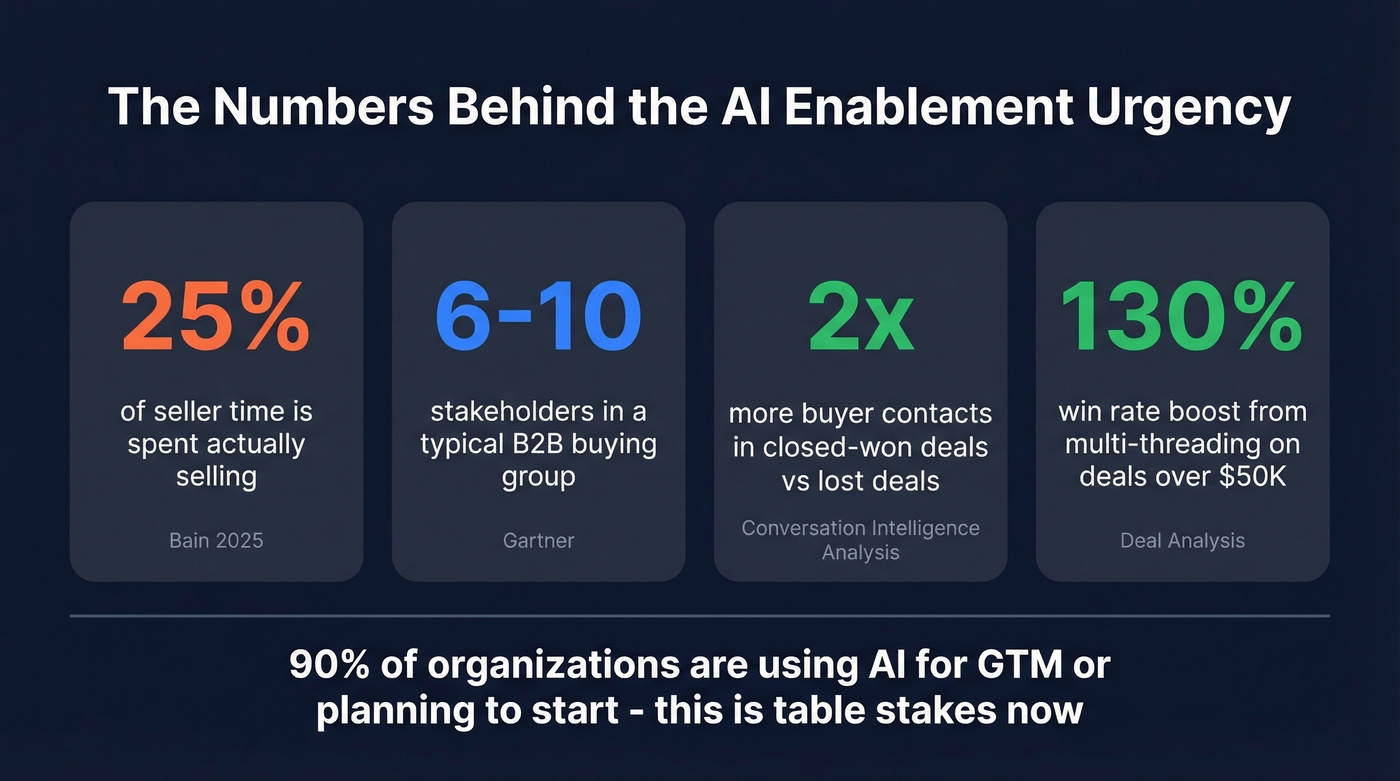
Buying committees have gotten more complex too. Gartner pegs the typical B2B buying group at 6-10 stakeholders, with some enterprise deals involving 15 or more. A conversation-intelligence analysis covering 1.8M opportunities shows that closed-won deals have roughly 2x as many buyer contacts as lost deals. For deals over $50K, multi-threading boosts win rates by 130%. You can't multi-thread effectively if your CRM doesn't even have accurate contact info for the buying committee - which makes data quality not just a hygiene issue, but a direct revenue lever.
90% of organizations are either using AI for GTM or planning to start. The window where AI-driven enablement was a competitive advantage is closing fast. It's table stakes now.
The Agentic AI Shift
Here's where most teams are about to get it wrong.
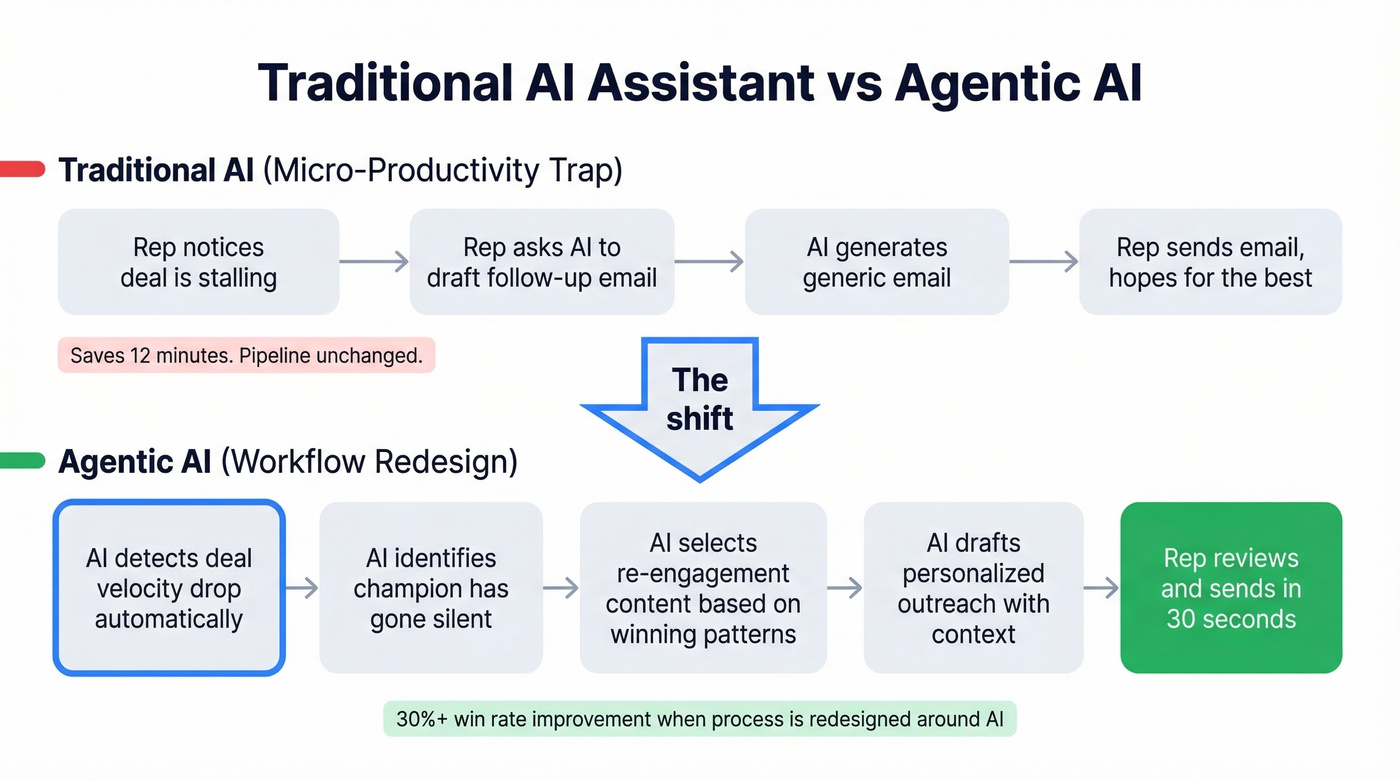
Bain coined a useful term: the "micro-productivity trap." It's what happens when you use AI to automate broken processes slightly faster. You save reps 12 minutes a day on email drafting, declare victory, and wonder why pipeline didn't move. The trap is optimizing individual tasks instead of redesigning workflows.
Agentic AI is the antidote. Gartner defines it as autonomous or semi-autonomous entities that can perceive, decide, and act - integrating with external apps and executing multi-step tasks without constant human input. Instead of an AI that suggests a follow-up email, an agentic system monitors deal velocity, detects when a champion goes silent, identifies the right piece of content for re-engagement, and drafts the outreach - all before a rep notices the deal is stalling.
Highspot's Deal Agent is an early example. It monitors deal activity and buyer engagement to spot slowdowns and prompt specific actions. Highspot reports customers seeing 50% greater efficiency, a 55% boost in seller confidence, and 51% lift in buyer engagement. Those numbers are self-reported, but the direction is clear: platforms that move from "assistant" to "agent" will pull ahead fast.
We've watched three early-adopter teams hit that 30%+ win-rate improvement. Every one of them redesigned their sales process around the AI, not just bolted it onto existing workflows. The teams that treated agentic AI as a plug-in saw marginal gains at best.

You read it above: closed-won deals have 2x more buyer contacts than lost deals. Multi-threading doesn't work when 20% of your CRM has bounced emails. Prospeo's 7-day data refresh and 98% email accuracy give your enablement AI the clean foundation it needs to actually recommend, coach, and close.
Stop feeding your $90K enablement platform dirty data at $1/lead.
7 Use Cases That Move Pipeline
Not all AI enablement use cases deliver equal ROI. Here are the seven that consistently move pipeline, ranked roughly by how quickly they pay back.
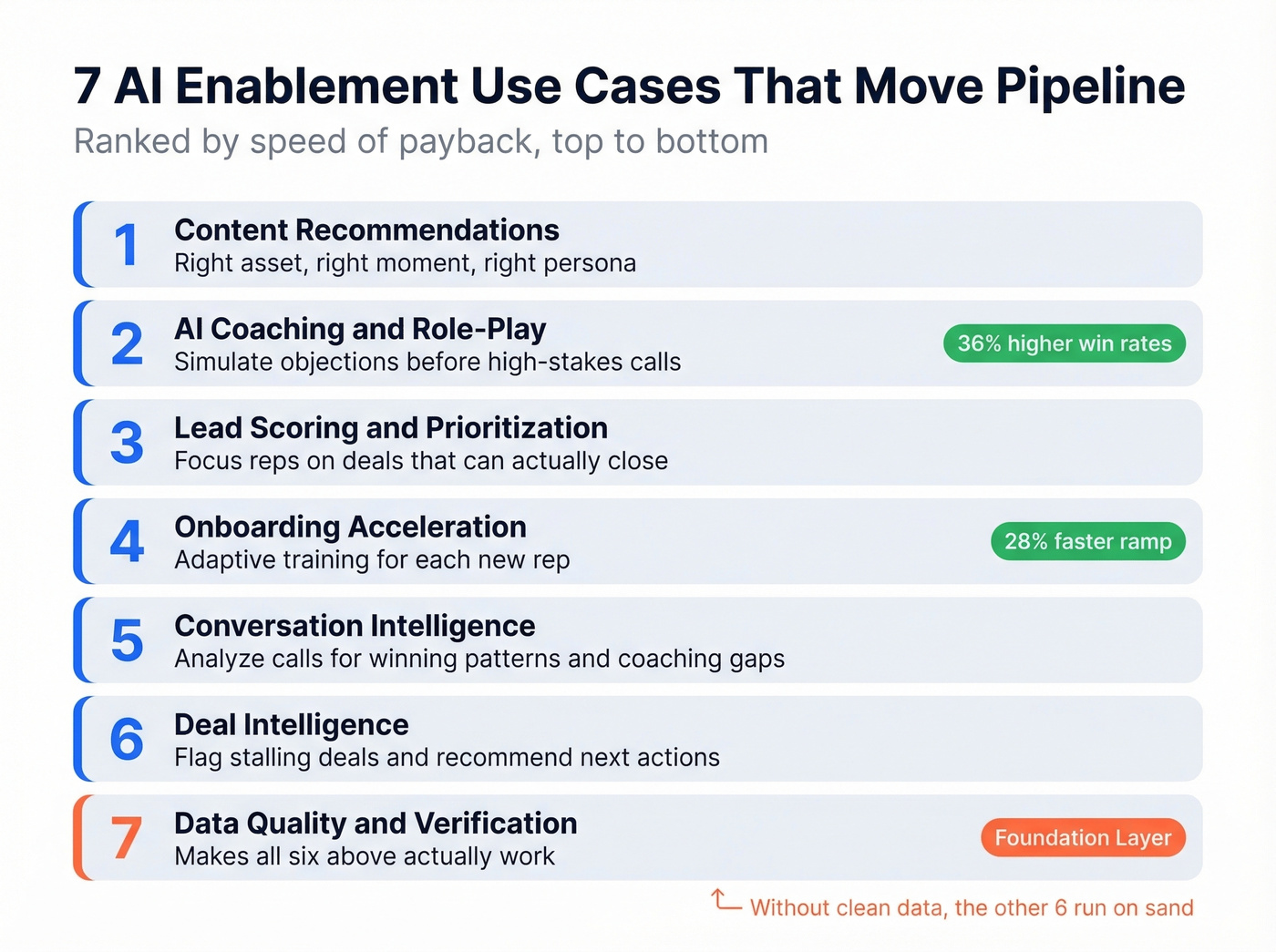
1. Content recommendations. AI analyzes deal stage, buyer persona, and past engagement to surface the right case study, deck, or one-pager at the right moment. This is the core value prop of Highspot and Seismic, and it's where most teams start.
2. AI coaching and role-play. Generative AI simulates buyer objections so reps can practice before high-stakes calls. Teams using AI-powered coaching are 36% more likely to report higher win rates per Highspot's research. Mindtickle leads here.
3. Lead scoring and prioritization. Predictive models rank leads by likelihood to convert, factoring in firmographic data, engagement signals, and intent. This keeps reps focused on deals that can actually close instead of working stale opportunities.
4. Onboarding acceleration. AI-driven onboarding programs adapt to each new rep's knowledge gaps, serving targeted training modules instead of a one-size-fits-all bootcamp. One benchmark study found AI-coached onboarding reduces ramp time by 28%.
5. Conversation intelligence. Tools like Gong record, transcribe, and analyze sales calls to identify winning patterns - talk-to-listen ratios, objection handling, competitor mentions. Managers spend 13 hours per week coaching reps, and conversation intelligence makes those hours dramatically more targeted.
6. Deal intelligence. AI monitors pipeline health in real time, flagging deals that are stalling, missing key stakeholders, or deviating from winning patterns. This is where agentic AI shines - the system doesn't just report problems, it recommends actions.

7. Data quality and verification. This is the use case nobody talks about, and it's the one that makes all the others work. AI enablement tools are only as smart as the data they run on. If 20% of your CRM emails bounce, every recommendation is built on a lie. A verification layer with 98% email accuracy and a weekly refresh cycle ensures your coaching, content recs, and deal intelligence target real, reachable people. Without clean data, you're running a $90K platform on a foundation of sand.
Platforms and Real Pricing
We've included actual cost data instead of the usual "contact sales for a quote" runaround, plus two data points most reviews skip: what the tools actually cost after negotiation, and where they fall short.
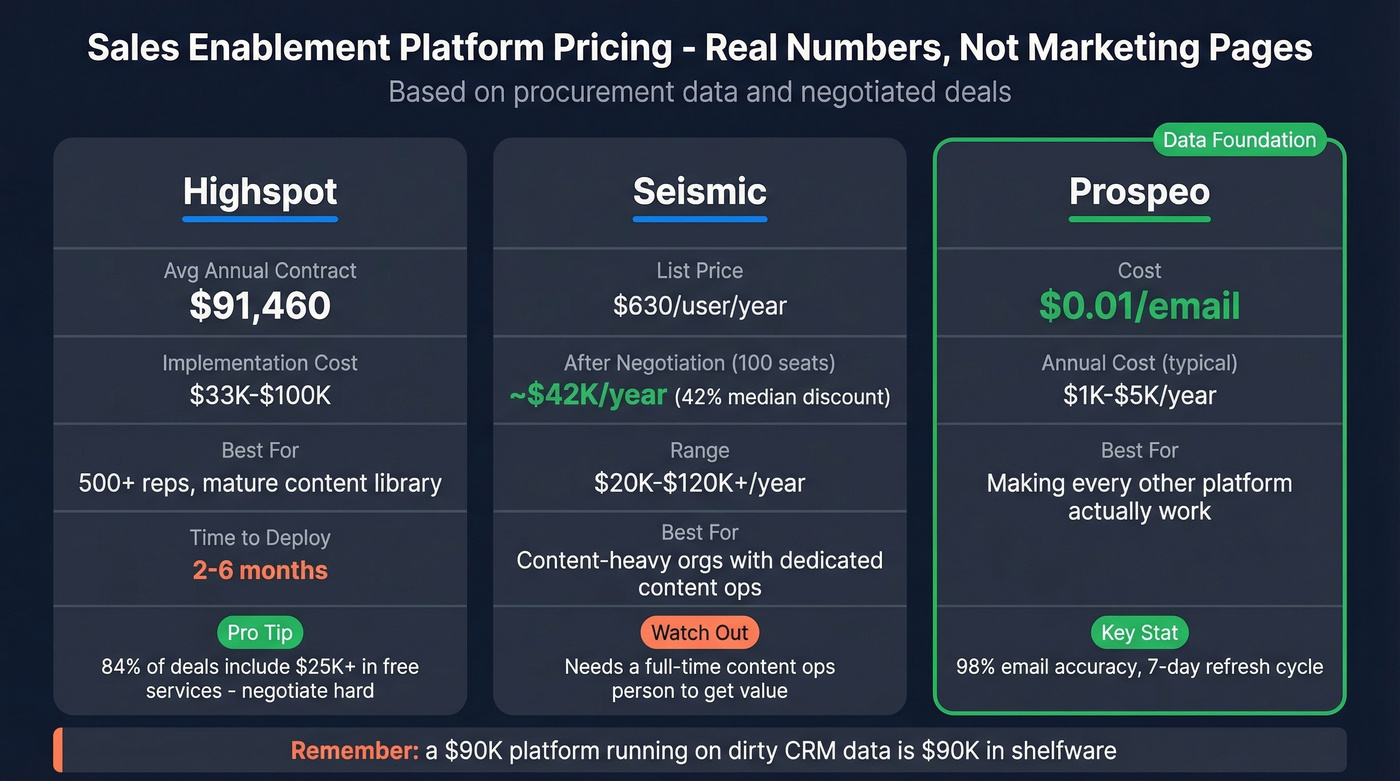
The most common complaint about enterprise enablement platforms on review sites isn't the AI - it's the 2-6 month implementation timeline and the content governance overhead that follows. Keep that in mind as you read.
Highspot
Use this if: You have 500+ reps, a mature content library, and the budget for a full enablement platform. Highspot's Deal Agent and AI-powered content recommendations are best-in-class for enterprise teams.
Skip this if: You're under 200 reps or don't have a dedicated enablement team to manage the platform. The average annual contract runs ~$91,460 across 62 procurement-tracked deals, and that's before implementation.
Implementation adds up fast. Services run $15K-$45K, content migration $8K-$25K, and training and change management $10K-$30K. The smart play is negotiating hybrid licensing - mixing full licenses with Learning-Only seats at ~$67/user/year can cut costs by 31% on average. Procurement benchmark data shows 84% of enterprise deals include at least $25K in professional services at no extra charge, so push for that.

Seismic
Seismic is a content powerhouse for enterprise orgs where reps need AI to find, personalize, and track the right assets across hundreds of buyer scenarios. HubSpot reported $18M in annual efficiency savings. Aerogen cut sales cycles by 56%.
The reality: Seismic is a Ferrari - powerful, but expensive to maintain without a dedicated content operations team. If you don't have at least one person whose job is managing and tagging content, the AI has nothing useful to recommend.
Professional Edition lists at ~$630/user/year, but discounts are aggressive. On a 100-seat deal, the median discount is 42%, bringing effective annual cost to roughly $42K. The typical range lands between $20K-$120K+/year depending on modules and scale. Implementation runs 2-3 months.

Gong
The multi-threading stat I cited earlier - 2x buyer contacts in won deals, 130% win-rate boost on deals over $50K - comes from a conversation-intelligence analysis covering 1.8M opportunities. That's not marketing fluff; it's one of the largest datasets referenced in B2B sales benchmarking.
Gong records, transcribes, and analyzes every sales call, turning them into coaching opportunities. Managers who spend 13 hours per week coaching reps get dramatically more leverage when they can search across hundreds of calls for specific objection-handling patterns or competitor mentions.
For mid-market teams, Gong is the single highest-ROI enablement investment you can make. Typical cost runs $15K-$50K/year depending on seats and modules. It's the most accessible Tier 1 tool for teams that aren't ready for a six-figure platform but want real AI-driven coaching. Skip it only if you need a full content management platform - Gong doesn't replace Highspot or Seismic for content enablement.
Prospeo
Use this if: You need a data quality foundation before or alongside any enablement platform. Prospeo sits underneath your entire stack, ensuring every AI recommendation, coaching prompt, and deal alert targets verified, reachable contacts.
With 300M+ professional profiles, 143M+ verified emails, and 125M+ verified mobile numbers, Prospeo delivers 98% email accuracy and a 30% mobile pickup rate. Its 7-day data refresh cycle means your CRM stays current without manual intervention. CRM enrichment returns 50+ data points per contact at a 92% API match rate, and intent data powered by Bombora tracks 15,000 topics so you can layer buyer signals into your enablement workflows.
Pricing starts with a free tier (75 emails + 100 Chrome extension credits/month) and scales at roughly $0.01/email - no contracts, no sales calls required. For teams spending $50K+ on enablement platforms, adding Prospeo for a few hundred dollars a month is the highest-leverage investment you can make.
Mindtickle
Mindtickle starts at $15/user/month on Capterra, but enterprise contracts tell a different story - the average ACV across 34 deal analyses is ~$92,184/year, with some reaching $430K. The 4.8/5 Capterra rating across 125 reviews is one of the highest in the category. Best for organizations where rep ramp time and ongoing certification are measurable pain points.
Spekit
Spekit takes a different approach: in-workflow enablement that surfaces training and content inside the tools reps already use, rather than requiring them to visit a separate platform. It's more accessible than Highspot or Seismic for mid-market teams that want contextual guidance without the six-figure commitment. Budget roughly $10K-$30K/year for mid-market deployments.
Allego
Allego blends video-based coaching with content management, making it a strong pick for teams that rely on peer learning and asynchronous role-play. Its AI analyzes recorded practice pitches and flags areas for improvement before reps ever get on a live call. Pricing typically falls in the $20K-$60K/year range for mid-market teams, with enterprise contracts scaling higher. If your biggest gap is rep readiness and you want coaching baked into the content workflow, Allego is worth a pilot.
Showpad
Showpad combines content management with guided selling - AI recommends assets based on deal context while also providing interactive training paths. It's a solid middle ground between Seismic's content depth and Spekit's simplicity, particularly for teams with 100-500 reps. Expect pricing in the $20K-$50K/year range for mid-market, scaling with seat count and modules.
Salesforce Einstein
If you're already on Sales Cloud, Einstein is the path of least resistance. It's included with certain Salesforce editions and add-ons, offers a 30-day free trial, and covers lead scoring, opportunity insights, and basic AI recommendations without adding another vendor to your stack.
Comparison Table
| Tool | Best For | Core AI Capability | Typical Annual Cost |
|---|---|---|---|
| Prospeo | Data quality + CRM hygiene | Email/phone verification, enrichment, intent | Free tier; paid ~$0.01/email |
| Highspot | Enterprise 500+ reps | Content recs, Deal Agent | ~$60K-$130K+ |
| Seismic | Content-heavy orgs | Content personalization | ~$20K-$120K+ |
| Gong | Coaching + deal visibility | Conversation intelligence | ~$15K-$50K |
| Mindtickle | Onboarding + readiness | AI role-play, certification | ~$15K-$92K+ |
| Allego | Coaching + peer learning | Video coaching, content mgmt | ~$20K-$60K+ |
| Showpad | Mid-market guided selling | Content recs + training | ~$20K-$50K+ |
| Spekit | Mid-market enablement | In-workflow guidance | ~$10K-$30K |
| Einstein | Salesforce-native teams | Lead scoring, insights | Included with certain editions |
Mistakes That Kill Enablement ROI
1. Treating AI as a silver bullet. AI doesn't fix a broken sales process. It accelerates whatever process you have - including the broken parts. If reps are chasing the wrong accounts, AI will help them chase wrong accounts faster.
2. Ignoring data quality. Gartner estimates poor data quality costs organizations $12.9M annually. Before you spend $90K on an enablement platform, invest a few hundred dollars a month in a data quality layer. Verify emails and phone numbers in real time, enrich CRM records, and refresh data weekly - for a tiny fraction of that platform cost. (If you want a quick shortlist, start with the best email verifier tools.)
3. Falling into the micro-productivity trap. Bain nailed this one. Automating a bad process gives you a slightly faster bad process. The teams seeing 30%+ win-rate improvements redesigned their workflows around AI capabilities - they didn't just plug AI into existing steps.
4. Skipping change management. The fact that most enablement platforms have adoption problems isn't a technology issue - it's a people issue. If you don't budget time and money for training, champion identification, and manager buy-in, you'll join the 55% who can't drive GTM initiatives.
5. No clear KPIs before buying. "We want AI" isn't a business case. Define what success looks like - quota attainment lift, ramp time reduction, content utilization rate - before you sign the contract. Otherwise you can't measure ROI, and the platform becomes shelfware by Q3. (A simple starting point: Account Executive KPIs.)
6. Ignoring compliance. Call recording consent varies by state and country. Data residency requirements affect where AI processes your customer conversations. These aren't edge cases - they're deal-breakers if you get them wrong. (Use a B2B compliance checklist, not vibes.)
7. Overspending on platform, underspending on data. We've seen teams allocate $120K to an enablement platform and $0 to data quality. Then they wonder why the AI keeps recommending outreach to contacts who left the company eight months ago. If your deal sizes are modest, you probably don't need a six-figure enablement platform at all - you need clean data and a solid process.
How to Implement Without Wasting $100K
Gartner's 2026 guidance for CSOs boils down to three imperatives: build a sales-centric AI roadmap, transform GTM motions to match buyer preferences, and redesign the sales manager role. Here's how that translates into a phased rollout.
Phase 1: Audit and define (Weeks 1-4). Audit your CRM data quality - what percentage of emails bounce? How many contacts have changed roles? Define 3-5 KPIs you'll measure against. Clean your data foundation first. We've run this audit for multiple teams, and it's common to find 15%+ of CRM contacts are unreachable. This phase costs almost nothing but saves everything downstream. (If you need a framework, borrow from a RevOps Tech Stack audit.)
Phase 2: Pilot with one team (Weeks 5-12). Pick a single team or use case. If coaching is your biggest gap, start with Gong. If content findability is the problem, pilot Highspot or Seismic with one division. Measure against your KPIs weekly. Managers spend 13 hours per week coaching reps - AI coaching should measurably improve how those hours convert to rep performance.
Phase 3: Scale with process redesign (Months 4-6). This is where most teams fail. Don't just roll out the pilot to more teams - redesign the workflows. If the AI surfaces deal risks, who acts on them? If content recommendations improve, how does marketing's production process change? Scale the process, not just the license count. (This is also where sales enablement planning makes or breaks adoption.)
Let's be honest: sales enablement AI only works when the data underneath it is accurate and current. Clean data is the prerequisite, not the afterthought. If you're rebuilding your prospecting motion at the same time, align it with B2B prospecting strategies so enablement and outbound don't fight each other.
Every agentic AI workflow - deal alerts, content recommendations, automated outreach - breaks down when contact data is stale. Prospeo refreshes 300M+ profiles every 7 days (not 6 weeks), so your enablement stack always targets real people at real companies.
Your AI copilot is only as smart as the contacts it can actually reach.
FAQ
What's the difference between traditional and AI-powered enablement?
Traditional enablement relies on manual content distribution and scheduled training. AI-powered enablement automates content recommendations, coaching, lead scoring, and deal intelligence using machine learning and NLP - shifting from static resources to dynamic, context-aware guidance that adapts to each rep's deals in real time.
How much does an AI enablement platform cost?
Enterprise platforms like Highspot and Seismic run $20K-$130K+/year. Mid-market options like Gong, Spekit, and Showpad range $10K-$50K/year. Budget an additional 15-25% for implementation in year one. SMB teams can start with Salesforce Einstein and a data quality layer for under $5K/year total.
Why does AI enablement fail most often?
Stale CRM data is the top cause. If contacts are outdated and emails bounce, every AI recommendation targets the wrong people. Gartner estimates poor data quality costs organizations $12.9M annually. Fix your data foundation with a tool that refreshes weekly at 98%+ accuracy before investing in any platform.
Do I need a dedicated platform or can I use CRM-native AI?
Salesforce Einstein and HubSpot AI cover the basics - lead scoring, opportunity insights, simple recommendations. Dedicated platforms add content management, AI coaching, and conversation intelligence. For teams with fewer than 50 reps, CRM-native AI is a reasonable starting point. Scale into a dedicated platform once you can measure the pipeline impact.
How do I keep CRM data clean enough for AI enablement?
Use a verification tool that refreshes data on a weekly cycle and verifies emails at 98%+ accuracy. A 5-step verification process - including catch-all handling, spam-trap removal, and honeypot filtering - keeps your CRM current so coaching, content recommendations, and deal intelligence always target real, reachable contacts.