

15 Sales Enablement Examples: What They Actually Look Like Inside
Your new SDR starts Monday. They open the shared drive and find 47 folders, 200+ documents, and zero indication which battlecard is current. That's not a sales enablement program. It's a content graveyard.
Every article about sales enablement examples gives you the same thing: a list of content types you already know exist. Battlecards. Playbooks. Case studies. What none of them show you is what a good battlecard actually contains, how a playbook should be structured stage by stage, or why your perfectly designed templates still aren't moving pipeline.
Reps spend roughly 30% of their time actually selling - the rest disappears into admin, content hunting, and CRM hygiene. Meanwhile, 65% of B2B content created for sales goes completely unused. The problem isn't a lack of enablement assets. It's that most of them are built without structure, buried in shared drives, and disconnected from the buyer's journey.
Start Here If You're Building From Scratch
Five assets first: a sales playbook, 3-5 competitor battlecards, one case study per ICP segment, an email sequence template built on verified data, and a one-pager per product. Everything else is a nice-to-have until these five are solid.
76% of organizations now have a dedicated enablement function, up from 32% five years ago. But having a function doesn't mean having the right assets. We've seen teams with 200+ enablement assets and zero adoption because nothing was organized by deal stage. You don't need 18 types of enablement content. You need 5-6 done well, organized so reps can find them in under a minute, built on clean data.
Which Assets Belong at Each Stage
Not every asset serves every stage. Here's a buyer-journey map that keeps your enablement library organized instead of chaotic.
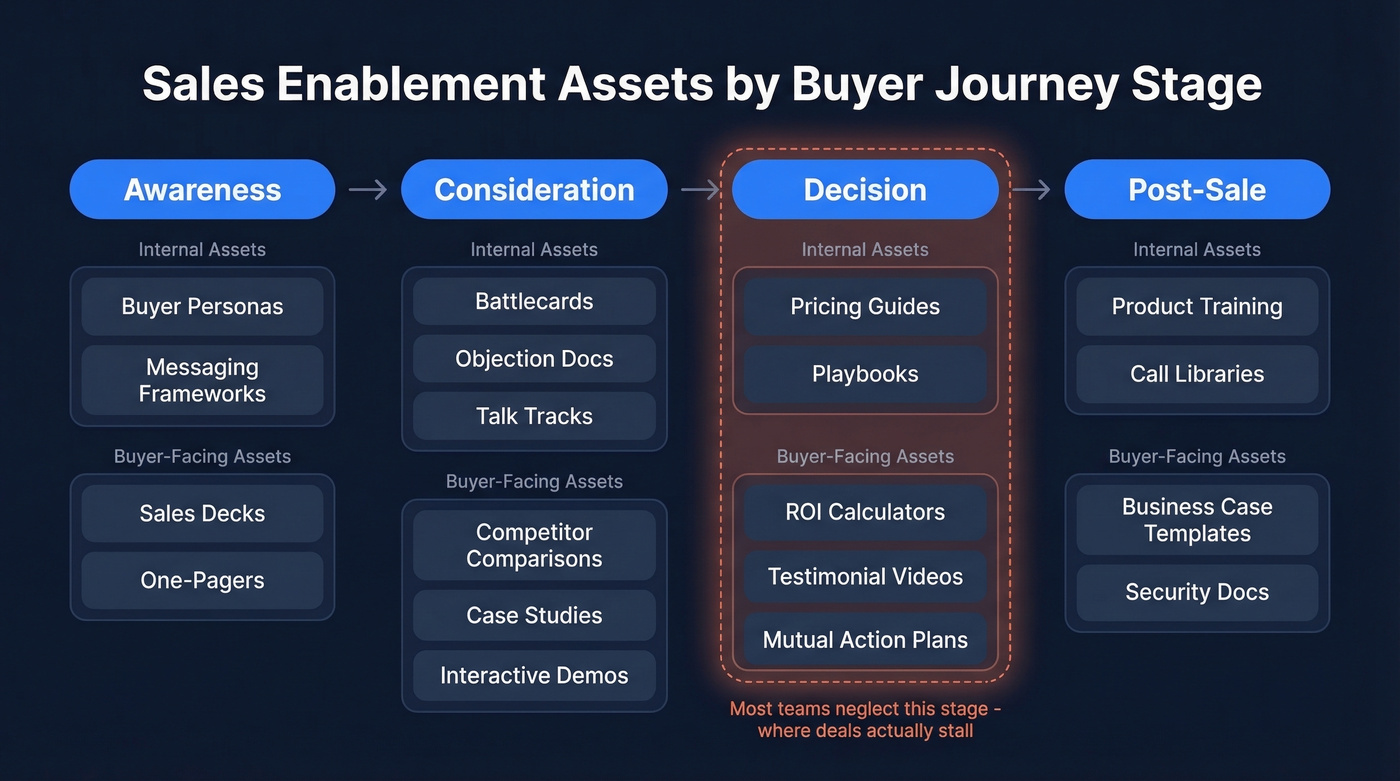
| Stage | Internal Assets | Buyer-Facing Assets |
|---|---|---|
| Awareness | Buyer personas, messaging frameworks | Sales decks, one-pagers |
| Consideration | Battlecards, objection docs, talk tracks | Competitor comparisons, case studies, interactive demos |
| Decision | Pricing guides, playbooks | ROI calculators, testimonial videos, mutual action plans |
| Post-Sale | Product training, call libraries | Business case templates, security docs |
The mistake most teams make is front-loading everything into Awareness and Consideration, then leaving reps empty-handed at Decision - the exact moment deals stall. If your reps are building their own ROI slides in Google Sheets, your enablement program has a gap where it matters most.
Internal Enablement Assets
These are the assets your reps use daily but your buyers never see. They're the scaffolding that makes every customer-facing interaction sharper.
Sales Playbooks
A playbook isn't a PDF that sits in Confluence. A good one is a living operational document with stage-by-stage entry and exit criteria, discovery qualification questions, decision trees by buyer situation, recommended talk tracks, and milestone success metrics.
The payoff is real. Organizations with best-in-class enablement strategies see 84% of reps hitting quota - nearly double the industry average of 43.5%. The playbook is the foundation everything else plugs into, and it doubles as the clearest strategy example you can hand to leadership when justifying investment.
Competitive Battlecards
What separates a useful battlecard from a forgettable one is structure. Build it with five sections: competitor overview covering positioning, target market, and recent moves; a side-by-side feature matrix; pricing comparison with context; trap-setting questions designed to expose competitor limitations; and customer proof points that counter their narrative.
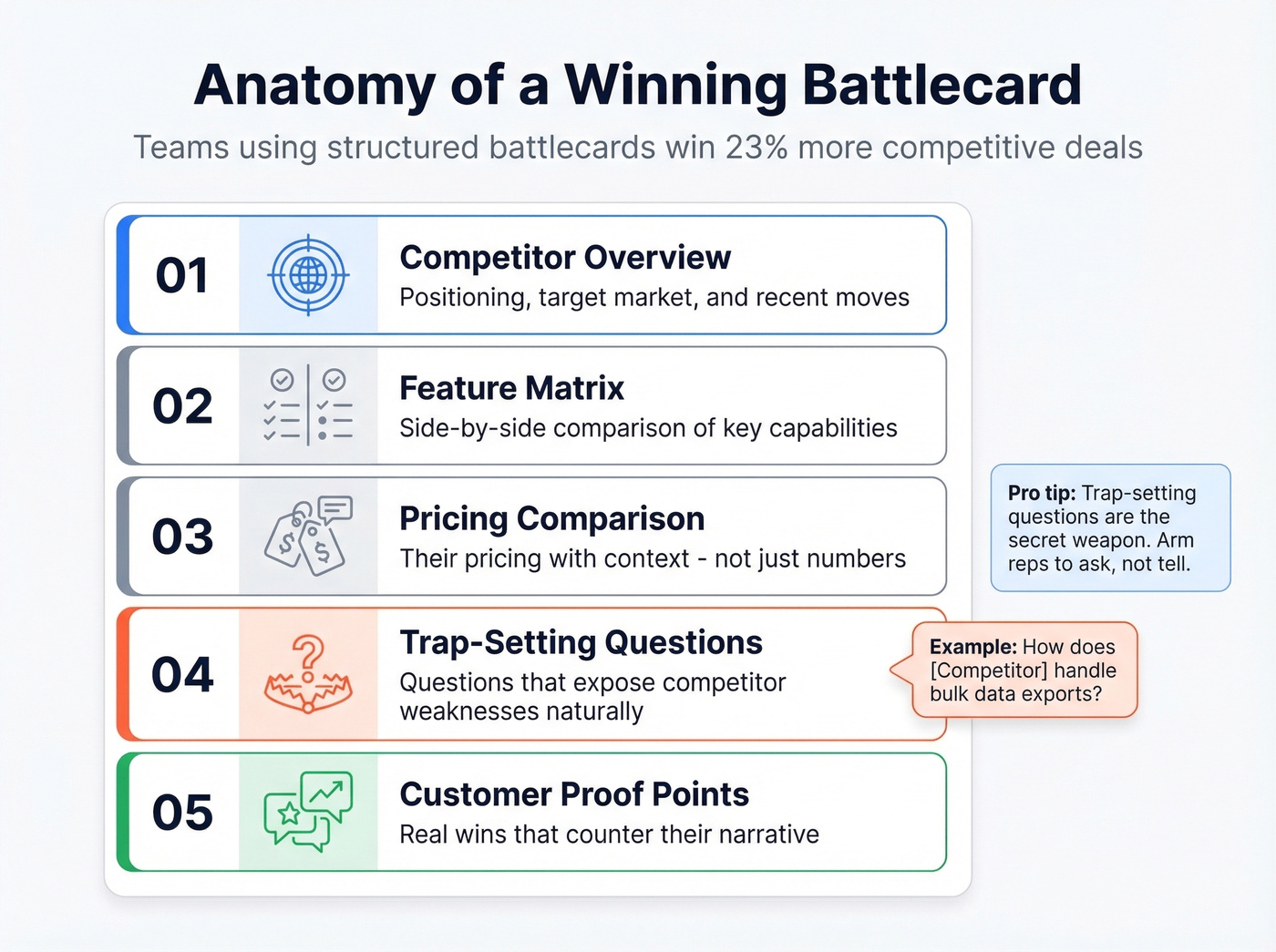
The trap-setting questions are the secret weapon. Instead of "we're better because X," you're arming reps to ask prospects questions like "How does [competitor] handle Y?" - knowing the answer exposes a weakness. Teams using structured battlecards win 23% more competitive deals.
Win/Loss Analysis Stories
Here's the thing: most reps close deals (or lose them) and move on. Lessons evaporate. The fix is a debrief document for every closed deal - deal timeline, decision factors the buyer cited, competitors involved, rep self-assessment, and pattern extraction for the broader team. The goal isn't blame. It's building a library of real decision intelligence that feeds back into playbooks and battlecards.
Buyer Personas
Go beyond demographics. A useful persona captures buying triggers - what event makes this person start looking - along with objection patterns, preferred communication channels, and the distinction between internal champion and economic buyer. Your SDR needs to know that the VP of Engineering cares about integration complexity, not ROI percentages. That's a persona doing its job.
Onboarding & Training Programs
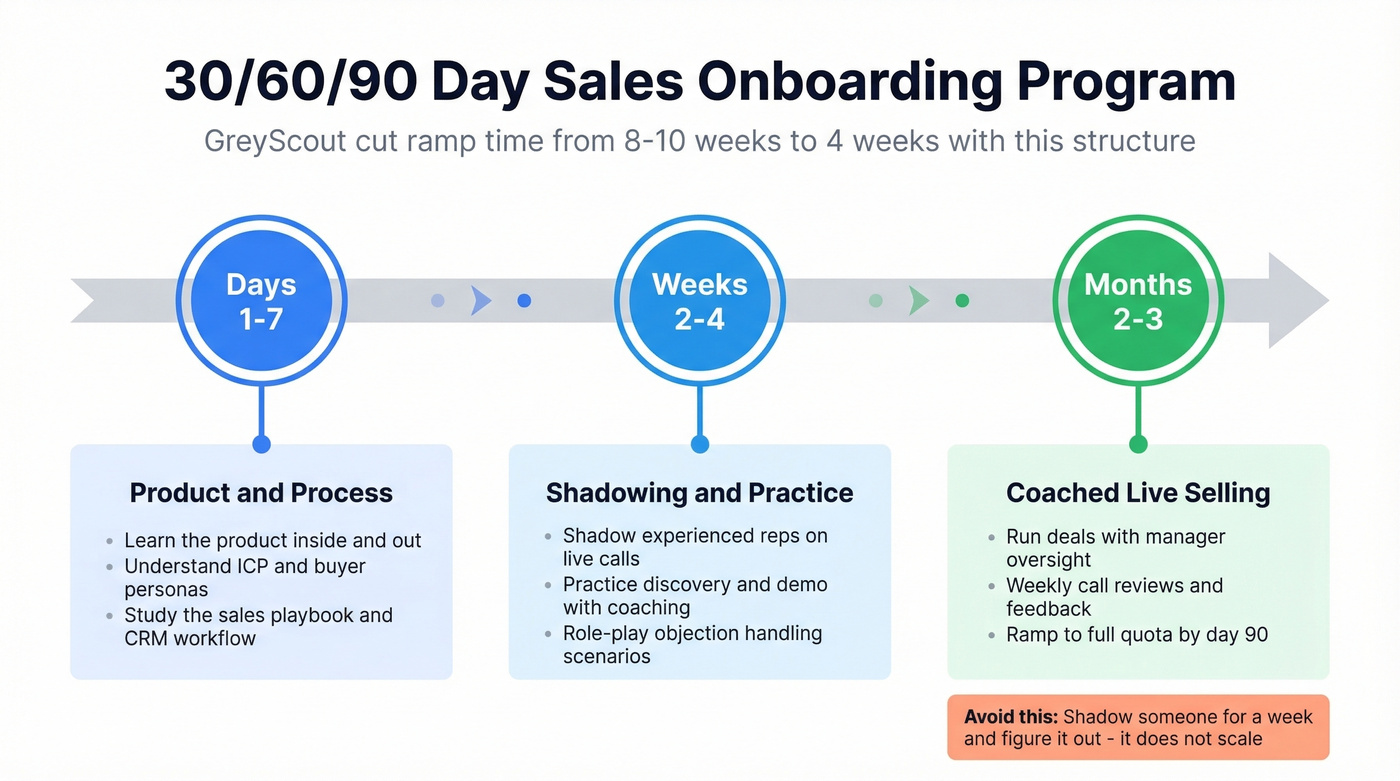
A structured 30/60/90-day onboarding program can dramatically change ramp time. GreyScout cut ramp time from 8-10 weeks to 4 weeks after implementing a structured program and doubled their sales team from 2 to 5 reps. Week one is product and process, weeks two through four are shadowing and practice, months two and three are coached live selling. Skip the "shadow someone for a week and figure it out" approach - it doesn't scale.
Call & Demo Libraries
Record everything. Then organize it. Categorize calls by type - discovery, objection handling, pricing conversations, demos by audience - and add timestamps with annotations explaining why specific moments worked. A new rep watching a tagged "pricing objection at 14:32" clip learns more in two minutes than in an hour-long training session.
Pricing Guides with Discount Authority
Build a decision tree. Deals under $50K can be discounted up to 15% within defined guardrails, larger discounts require VP approval, and enterprise deals follow a custom approval workflow. Without this, reps give away margin to close faster or stall deals chasing internal approvals. Either outcome costs you money.
Talk Tracks & Call Scripts
Rigid scripts kill conversations. Flexible talk tracks with branching logic - "if the prospect says X, pivot to Y" - give reps structure without making them sound robotic. The best talk tracks read like choose-your-own-adventure guides, not teleprompter copy. If you need starting points, steal proven talk track examples and adapt them to your ICP.

Every enablement asset in this article - battlecards, playbooks, email sequences - falls apart when reps reach out and emails bounce. Prospeo's 98% email accuracy and 7-day data refresh mean your reps spend time selling, not chasing dead contacts. At $0.01 per email, clean data costs less than one wasted hour of rep time.
Stop building enablement on bad data. Start with verified contacts.
Buyer-Facing Sales Enablement Examples
These are the assets your prospects actually see. They carry your brand, your proof, and your value proposition into rooms where you aren't present.
Case Studies
BSH Home Appliances - the parent company behind Bosch, Siemens, Neff, and Gaggenau - described their pre-enablement reality bluntly: "Almost every sales rep did their own presentation... we didn't have one song... took a lot of time." That's the problem a good case study library solves, and it's also the structure every case study should follow: challenge, solution, and measurable result. One case study per ICP segment is the minimum. Without them, your reps are telling stories from memory instead of showing proof.
Sales One-Pagers
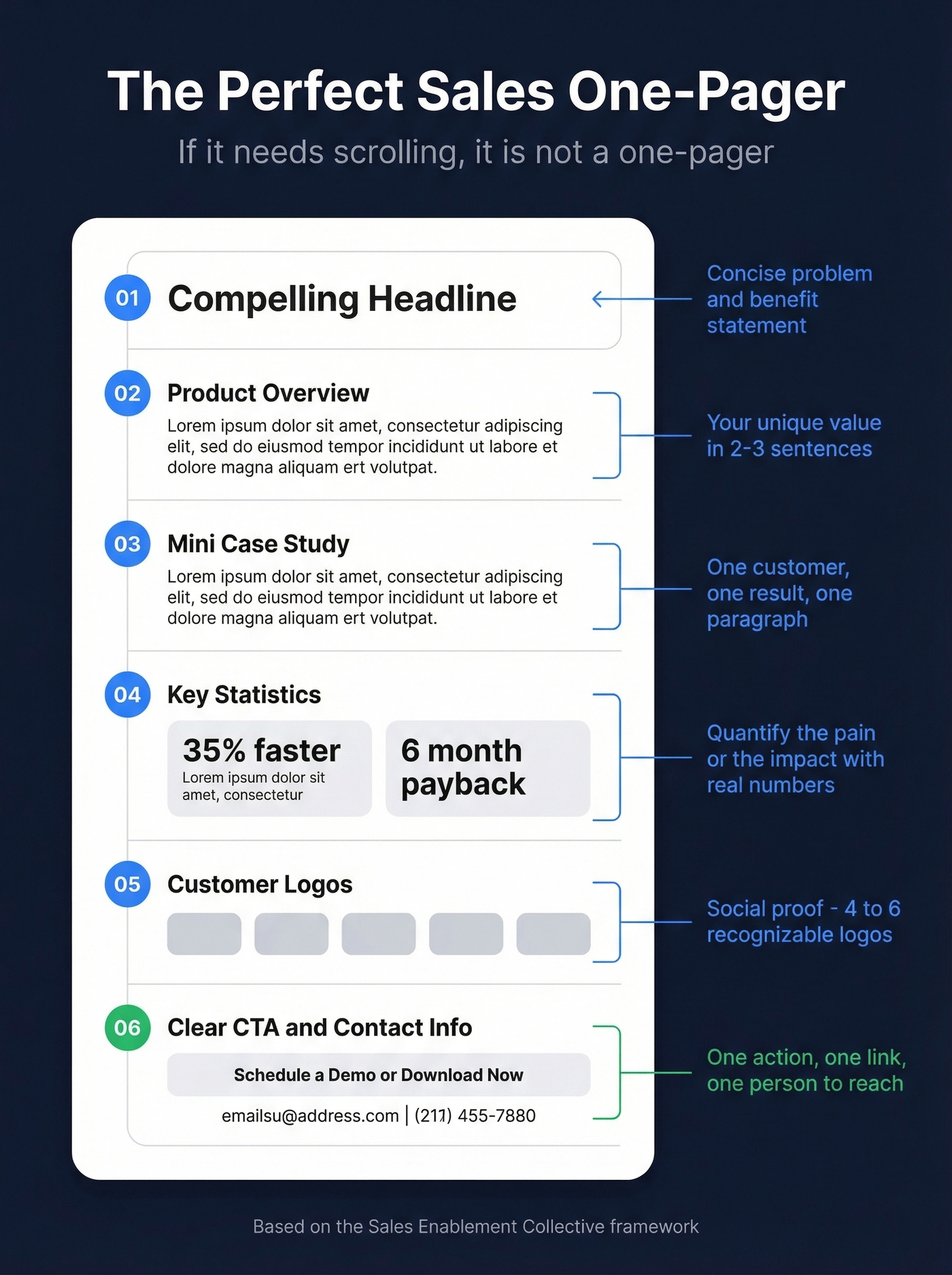
The Sales Enablement Collective's framework nails the structure: compelling headline with a concise problem/benefit statement, product overview with unique value, a mini case study, relevant statistics that quantify the pain or impact, customer logos for credibility, and a clear call-to-action with contact info. Six sections, one page. If your one-pager needs scrolling, it's not a one-pager.
ROI Calculators
A good ROI calculator needs four inputs: current cost of the problem, projected savings with your solution, implementation timeline, and payback period. Don't just give prospects a blank spreadsheet - pre-populate it with industry averages so they can see the math before customizing. A CFO who can see a 6-month payback in a shared calculator is far more likely to approve budget than one reading a generic "save time and money" slide.
Email & Outreach Templates
Template structure matters - subject line, personalized opener, value hook, social proof, clear CTA. But the best outreach template in the world bounces if the email is wrong. Before rolling out new sequences, verify your contact data. Meritt's team saw bounce rates drop from 35% to under 4% and their connect rate tripled to 20-25% after switching to verified contact data through Prospeo. Domain reputation is fragile - one bad sequence can tank deliverability for weeks. If you want plug-and-play options, start with these sales follow-up templates.
Interactive Demos
Self-serve product exploration is now a default expectation in many categories. Prospects want to click through your product before they'll book a call. Interactive demos map to the Consideration stage - they let buyers qualify themselves, which means your reps spend time on prospects who've already seen the value.
Mutual Action Plans
A shared timeline between buyer and seller that maps every step from evaluation to go-live. These reduce deal slippage by making the next action visible to both sides. In enterprise sales, they're table stakes.
Sales Presentations & Decks
Skip this if your team is under 10 reps and selling a single product. For everyone else: build modular decks. Reps should be able to swap sections - industry-specific slides, persona-relevant proof points, product deep-dives - without breaking brand consistency. A locked-down 40-slide deck that nobody customizes is worse than a 15-slide modular kit that every rep makes their own. If decks are a bottleneck, tighten your sales deck storytelling so reps can assemble slides without losing the narrative.
Why Most Enablement Programs Fail
Revenue teams spend 440 hours per year searching for or creating content. Reps recreate existing assets 40% of the time because they can't find what already exists.
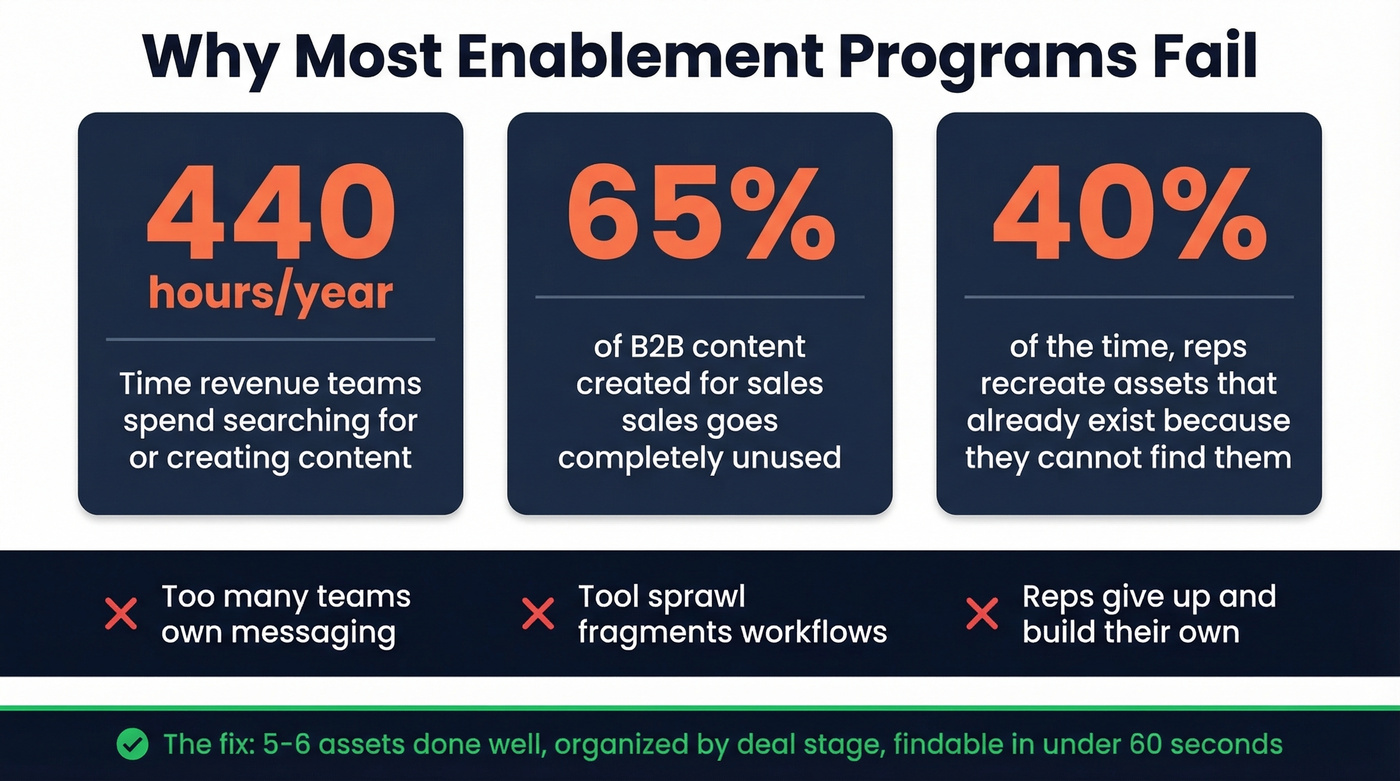
The root causes are predictable. Too many teams influence messaging - marketing, product, enablement, managers, RevOps - and nobody owns the final version. Tool sprawl fragments workflows across CRM, content library, call recording platform, and training tool. Reps give up and build their own materials, which means your carefully crafted battlecard sits untouched while your AE sends a competitor comparison they made in 10 minutes.
The failure mode nobody talks about is data quality. Picture this: your AE just sent a perfectly crafted cold email sequence to 500 prospects. 180 bounced. Domain reputation damaged. Your playbooks are sharp, your templates are polished, and none of it matters because the contact data is months old. Snyk's 50-person AE team went from 35-40% bounce rates to under 5%, generating 200+ new opportunities per month after fixing their data pipeline. Win rates have declined 18% since 2022, and sales cycles grew 16% in the first half of 2023 before stabilizing - making every enablement asset that actually gets used more valuable. If deliverability is hurting you, fix it at the source with an email deliverability guide.

Let's be honest: 50-90% of the B2B buying journey happens before a rep is involved. If your enablement program only optimizes what happens after the first call, you're optimizing the minority of the buyer's experience. Most teams would get more ROI from a single well-built interactive demo than from ten internal training decks.
Building Enablement for Repeatable Wins
Before you build more content, audit what you have. In our experience, the teams that struggle most aren't missing content - they're missing structure. The entire point of enablement is turning what your best reps do instinctively into a system every rep can follow. Use these four categories, adapted from Training Industry's systems framework, to diagnose where your program is actually breaking.
Process - Do reps follow a defined sales process, or does every AE run their own playbook? Is CRM adoption above 80%, or are deals living in spreadsheets and Slack? If your process is inconsistent, start with sales process optimization.
Information - Can a rep find the right battlecard in under 30 seconds? Are reps pulling content on demand, or is marketing pushing assets nobody asked for?
Learning - Is onboarding structured with a 30/60/90-day plan, or is it "shadow someone for a week"? Do managers coach to specific skills, or just review pipeline?
Leadership - Are enablement outcomes tied to revenue metrics, or just content production? Does someone own content freshness - reviewing and retiring assets on a cadence?
You don't need to score perfectly across all four. But if you can't answer "yes" to at least one question per category, you've found your starting point. And if you scored zero on Information, stop building new content immediately - fix discoverability first.
Tools That Manage Enablement Content
Once you have the right assets, you need somewhere to put them that isn't a shared Google Drive with 47 folders.
Highspot takes a seller-first approach - strong AI-powered search, "Spots" collections for organizing content by deal stage or persona, and simpler governance than enterprise alternatives. It's a strong fit for mid-market teams that want adoption without heavy implementation overhead.
Seismic is enterprise-first. Stronger version control, approval workflows, and dynamic document generation via LiveDoc. But it requires real setup and training, and budgets typically start at $100K+/year. For smaller teams, it's often overkill.
Dock is the budget-friendly option. Free for individuals, $350/mo for up to 5 users, $750/mo for 10. It doubles as a deal room and mutual action plan tool, which makes it appealing for startups that need enablement and buyer collaboration in one place.
Showpad sits in the mid-market alongside Highspot, with solid content management and training features. Allego scored #1 in Gartner's Critical Capabilities for onboarding and continuous learning (4.41/5) and earned Leader status in the 2026 Gartner Magic Quadrant for Revenue Enablement Platforms alongside SalesHood, which serves as a more affordable alternative. Gartner's forecast: by 2030, agentic AI will automate 70% of routine enablement tasks. The platforms that survive will be the ones that integrate AI without adding complexity.
| Tool | Best For | Starting Price |
|---|---|---|
| Highspot | Mid-market adoption | ~$40K-60K/yr |
| Seismic | Enterprise governance | $100K+/yr |
| Dock | Startups, small teams | Free / $350/mo |
| Showpad | Mid-market content + training | ~$30K/yr |
| Allego | Learning + coaching | ~$50K/yr |
| SalesHood | Budget alternative | ~$20K/yr |
GreyScout cut rep ramp time from 8-10 weeks to 4 and grew pipeline 140% - not just with better playbooks, but with data that actually connected reps to real buyers. Prospeo gives your team 300M+ verified profiles with 30+ filters so new reps prospect like veterans from week one.
Arm your reps with data that makes every enablement asset hit harder.
FAQ
What is sales enablement?
Sales enablement equips revenue teams with the content, tools, training, and data they need to engage buyers effectively at every stage of the sales cycle. It bridges strategy and execution - covering playbooks, tech stack, coaching, and data quality. Organizations with dedicated enablement functions see 84% quota attainment vs. the 43.5% industry average.
How do you measure enablement ROI?
Track content usage rates, rep ramp time, win rates on deals where enablement assets were used, and quota attainment. The 440 hours/year reps spend hunting for content is a strong baseline - any reduction there translates directly to more selling time and pipeline.
What's the most important asset to build first?
A sales playbook. It defines your process, qualification criteria, and talk tracks - everything else plugs into it. Battlecards, templates, and one-pagers all reference the playbook framework. Think of it as the single document that codifies how your team sells.
How do you keep enablement content from going stale?
Set refresh cadences: battlecards every 60-90 days, pricing guides quarterly, case studies when new results land. Assign content owners with explicit accountability. For underlying contact data, use tools that refresh records on a weekly cycle so outreach templates never run on stale information.
What's the biggest enablement mistake teams make?
Building more content instead of fixing discoverability. If reps recreate existing assets 40% of the time, the problem isn't volume - it's organization. Audit your library, tag assets by deal stage and persona, and retire anything that hasn't been opened in 90 days before creating anything new.