

The Data-Backed Sales Follow Up Schedule That Actually Works
Every sales guide tells you 80% of deals require 5+ follow-ups. What they don't tell you: Belkins' analysis of 16.5M cold emails found reply rates peak on email #1 at 8.4%, and 4+ emails more than triple unsubscribe and spam complaint rates. The goal isn't more touches. It's a sales follow up schedule built on better-timed, multi-channel touches to verified contacts.
What You Need (Quick Version)
- 8-12 touches over 17-21 days across email, phone, and social - not 12 emails to the same inbox.
- Reply rates peak on email #1 (8.4%) and decline after. Quality beats quantity.
- Verify your contact data before launching any sequence. Bounced emails burn your domain and waste every step that follows.
Day-by-Day Follow Up Cadence
Most cadence advice gives you a vague "follow up on Day 3" with no channel assignment. That's useless. Below is a framework drawn from Cognism's multi-channel cadence research and practitioner schedules running in production right now. The pattern is 6-12 touches over 2-3 weeks across email, phone, and social. Use this as a follow up schedule template and adjust timing to match your sales cycle.
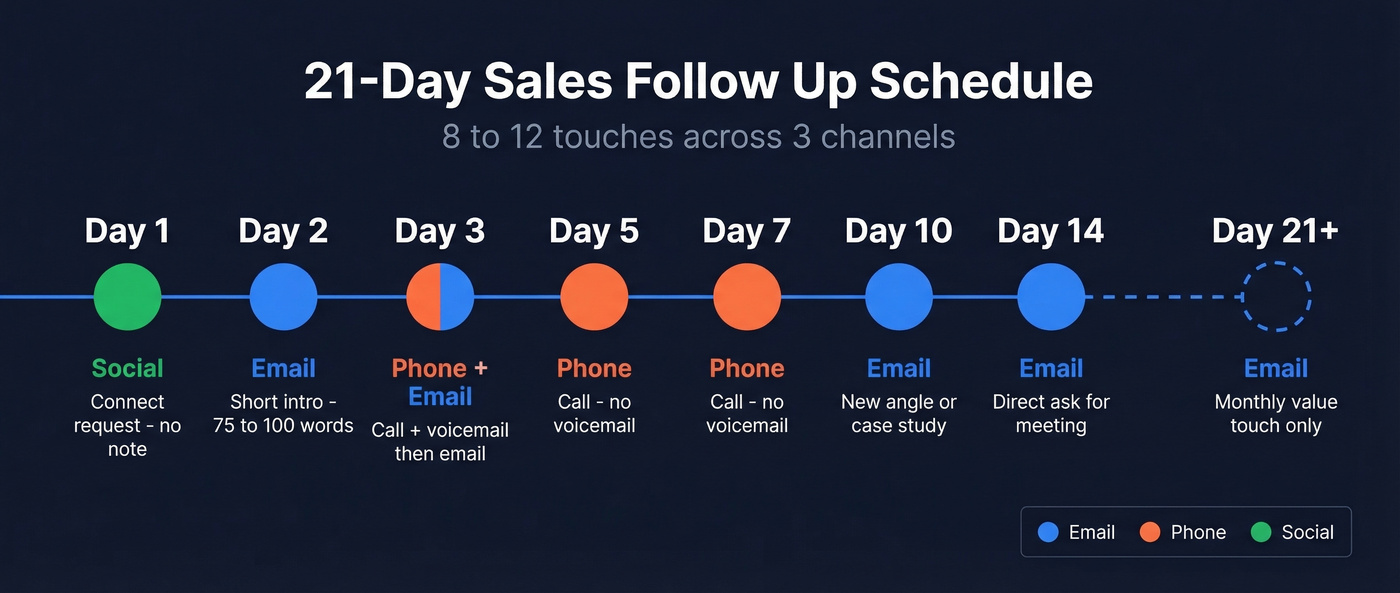
| Day | Channel | Action | Why |
|---|---|---|---|
| 1 | Social | Connection request (no note) | Warms name recognition |
| 2 | Short intro, 75-100 words | Peak reply rate window | |
| 3 | Phone + Email | Call + voicemail, then email | VM primes; email adds context |
| 5 | Phone | Call attempt, no voicemail | Stay visible, not annoying |
| 7 | Phone | Call attempt, no voicemail | Third call shows persistence |
| 10 | Personalized follow-up | Fresh angle or case study | |
| 14 | Direct ask for next step | "Can we get 15 minutes this week?" | |
| 21+ | Monthly value touch | New info only - never "just checking in" |
Leave one voicemail on Day 3, then stop leaving them. Keep emails under 100 words; 75 is the sweet spot. After Day 14 with no engagement, shift to monthly touches with genuinely new information.
The social + email combination isn't optional anymore. A social message paired with a profile visit hits an 11.87% reply rate - higher than typical email-only benchmarks.
Best Days and Times to Follow Up
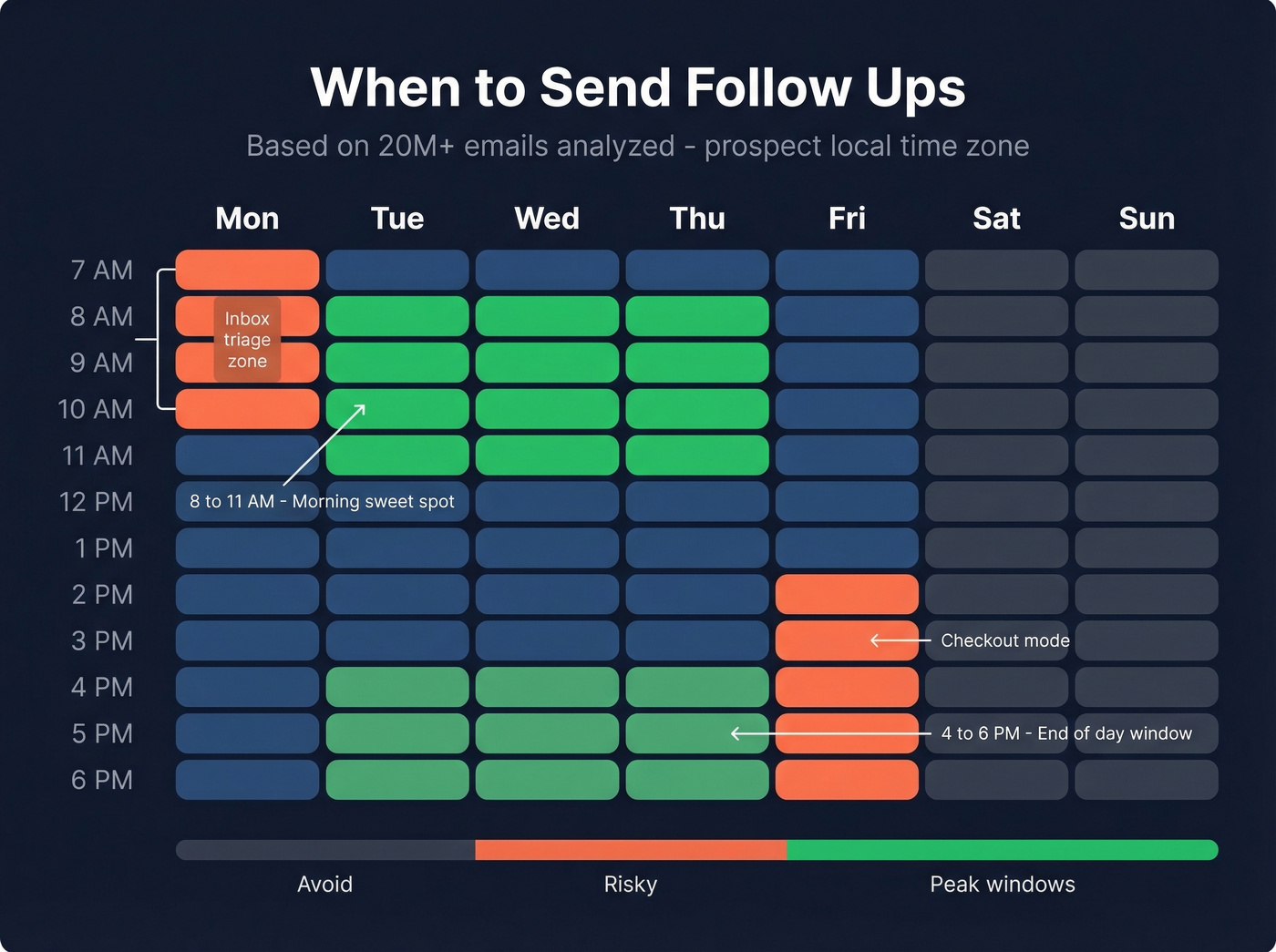
Tuesday through Thursday, during two windows: 8-11 AM and 4-6 PM in the prospect's time zone. This comes from a Mailshake synthesis of multiple large-scale studies, including HubSpot's analysis of 20M+ emails and Moosend's 10B-email dataset. Weekends perform worst. Monday mornings are inbox triage. Friday afternoons are checkout mode.

Your 21-day cadence falls apart if email #1 bounces. Prospeo's 5-step verification delivers 98% email accuracy on a 7-day refresh cycle - so every touch in your sequence reaches a real inbox, not a dead end.
Fix the list before you fix the cadence.
Adjust by Deal Size
SMB deals (1-3 month cycle): Compress the cadence to 10-14 days. Fewer stakeholders, faster decisions. No response by Day 14? It's probably dead or deprioritized.
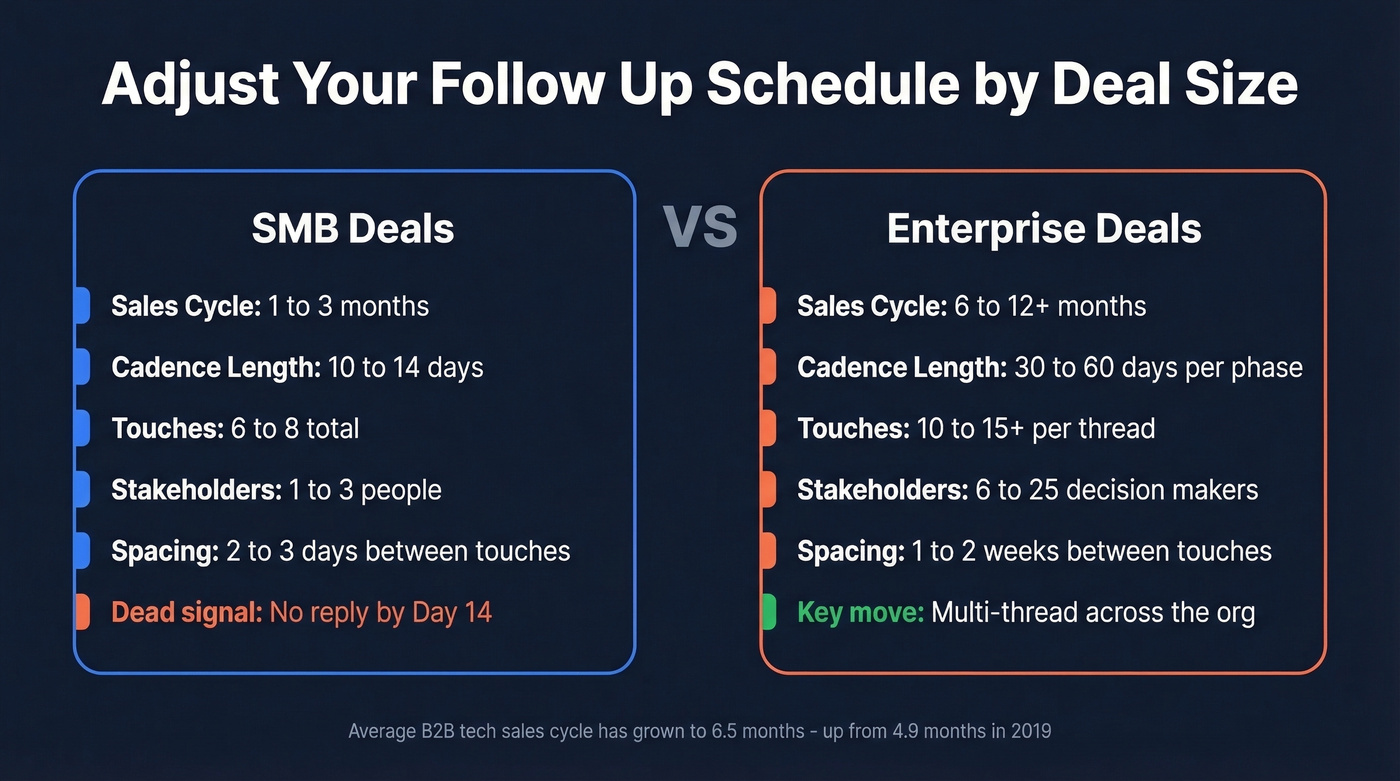
Enterprise deals (6-12+ months): Stretch to 30-60 days between phases. You're threading across 6-25 decision-makers with account-based touches, and the average B2B tech sales cycle has expanded to 6.5 months - up from 4.9 months in 2019. Your cadence needs to match that reality, which means patience and multi-threaded outreach rather than hammering one inbox.
Follow-Up Mistakes That Kill Deals
Address a specific objection with each touch. The five core objections are no need, cost concerns, no urgency, don't want it, and don't trust you. Map one to each follow-up so every email earns its slot in the sequence.
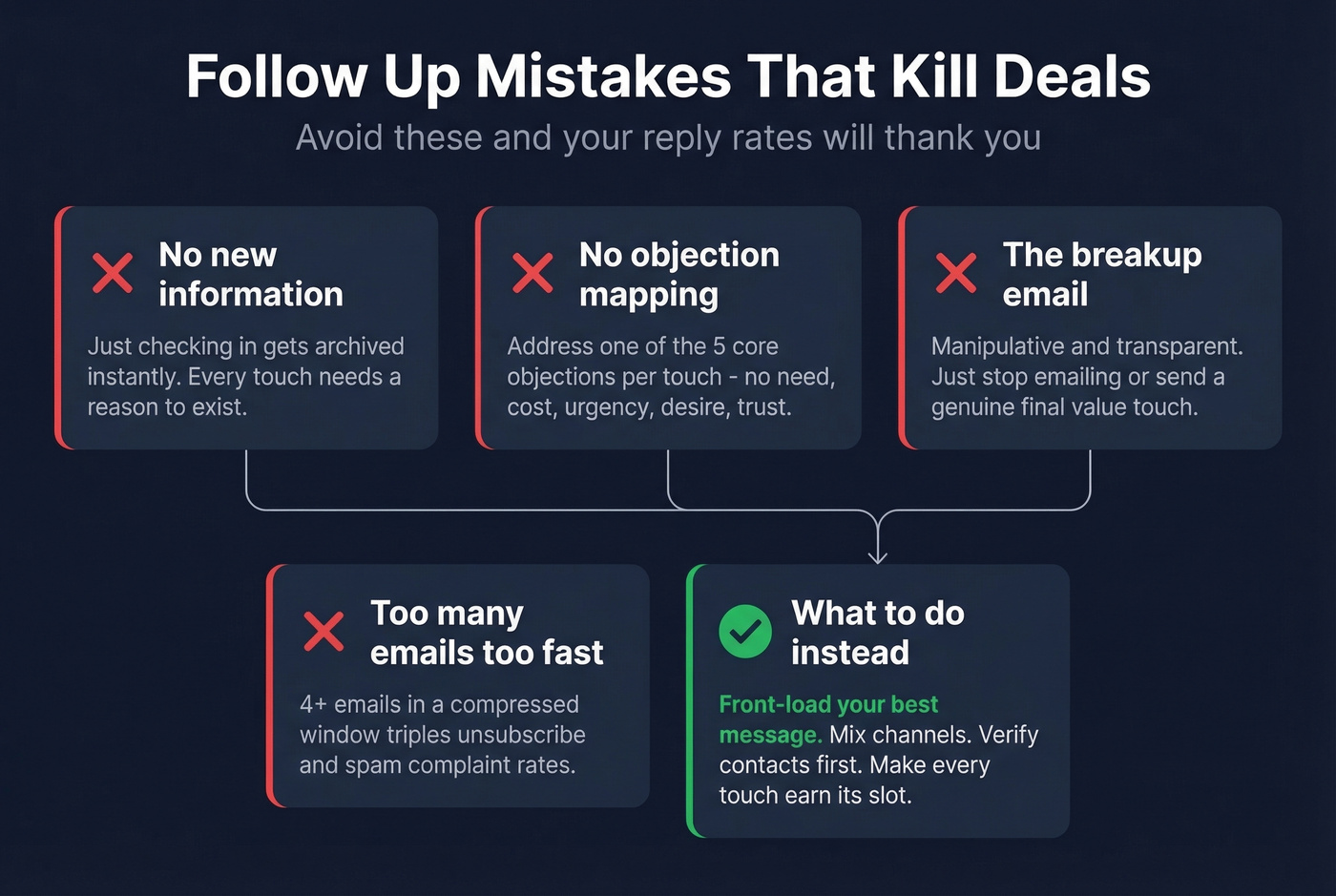
Never bump with no new information. "Just checking in" and "wanted to make sure you saw my last email" get archived instantly. We've seen this kill reply rates faster than anything else - every touch needs a reason to exist, whether that's a case study, a relevant insight, or a new angle on their problem. (If you need better wording, use these sales follow-up templates and learn how to say just checking in professionally.)
Skip the break-up email. The "I guess we're breaking up" framing is cringe and overused. The consensus on r/sales is that it's manipulative and transparent. Just stop emailing, or send a genuine final value touch without the guilt trip.
Here's the thing: if your average deal size is under $10k, you probably don't need a 21-day multi-channel cadence at all. A 3-touch email sequence with verified contacts will outperform a 10-touch sequence to bad data every single time.
The Step Nobody Mentions First
You built a 7-step sequence, launched it Monday, and by Wednesday you've got 15 bounces and 3 spam complaints. The sequence wasn't the problem - the list was.
Before you launch any cadence, verify your list. We've watched teams spend weeks perfecting their cadence copy while sitting on contact lists with 20%+ bounce rates, and it's painful. Prospeo runs a 5-step verification process with 98% email accuracy and refreshes data every 7 days - compared to the 6-week industry average. Teams like Stack Optimize maintain 94%+ deliverability and sub-3% bounce rates across all client campaigns using this approach. (If you're troubleshooting, start with email bounce rate and an email deliverability guide.)

Teams running Prospeo-verified lists maintain sub-3% bounce rates and 94%+ deliverability across every campaign. At ~$0.01/email with no contracts, cleaning your list costs less than a single spam complaint.
Stop burning domain reputation on bad data.
FAQ
How many follow-ups should I send?
Plan 8-12 touches across email, phone, and social over 17-21 days. Reply rates peak on email #1 at 8.4%, so front-load your best messaging and make each subsequent touch introduce a new angle or objection handler.
When should I stop following up?
After 3-4 emails with no engagement, switch to monthly value touches. Sending 4+ emails in a compressed sequence more than triples unsubscribe and spam complaint rates, so spacing matters as much as volume.
What's the best channel for follow-ups?
Social paired with email hits an 11.87% reply rate - higher than email alone. But channel choice only matters if you're reaching verified contacts; bounced emails torpedo your domain reputation before the cadence even runs.
Does a sales follow up schedule differ by industry?
Yes. SaaS and tech deals with sub-$15k ACV respond well to a compressed 10-14 day cadence. Enterprise or regulated industries like healthcare and finance need 30-60 day spacing between phases because procurement cycles involve more stakeholders and compliance reviews.