

The Sales Follow-Up Timeline That Actually Works (Backed by 16.5M Emails)
Most reps blame their cadence when sequences underperform. The data tells a different story. Belkins analyzed 16.5 million cold emails across 93 business domains and found the highest reply rate - 8.4% - comes from the first email. Every follow-up after that pulls the number down. Your timing matters, but it's rarely the thing that's actually broken.
Here's the thing: we've watched teams obsess over whether Day 3 or Day 5 is the "optimal" second touch while sending emails to addresses that bounced on Day 1. Let's fix the whole picture.
The Day-by-Day Follow-Up Cadence
This framework draws from that 16.5M-email dataset, Cognism's 5-8 touch benchmark, and a practitioner cadence shared on r/salestechniques.
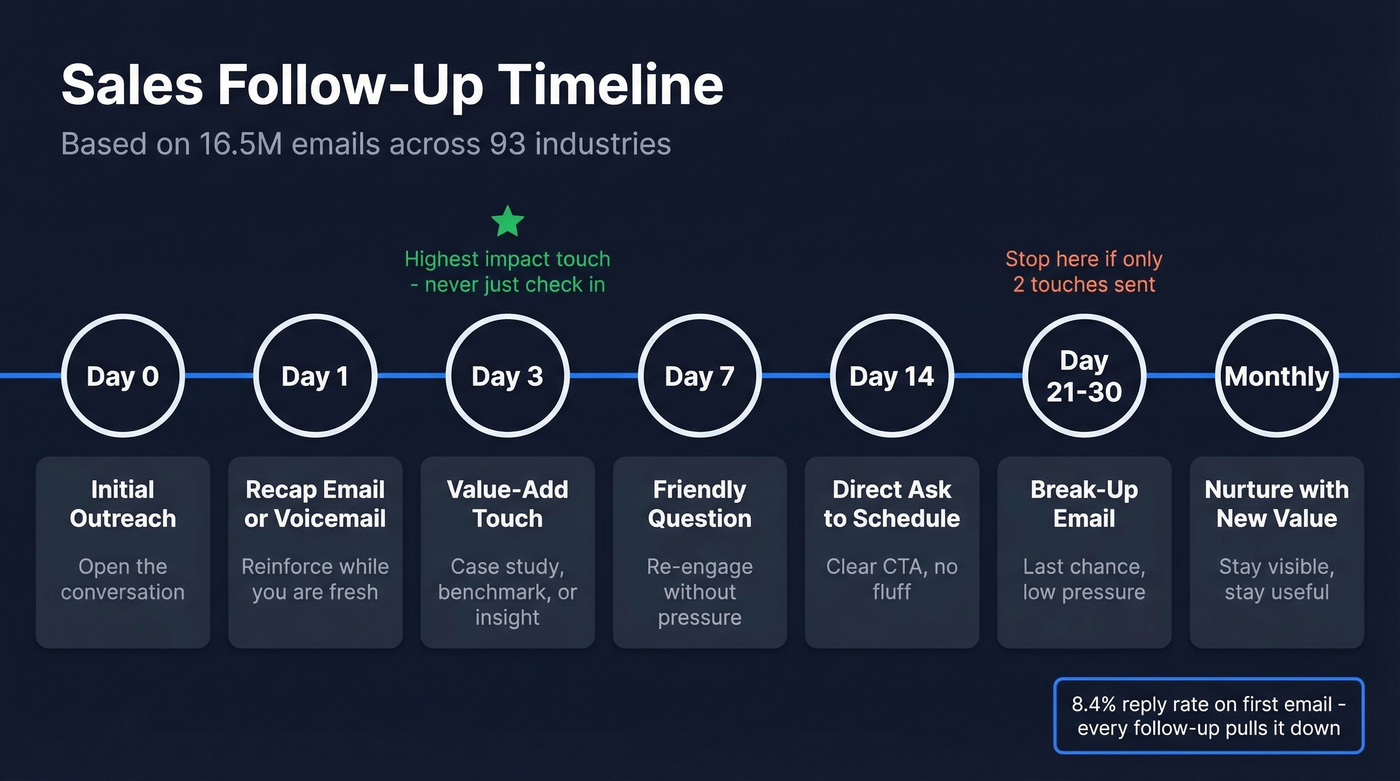
| Day | Action | Purpose |
|---|---|---|
| Day 0 | Initial outreach | Open the conversation |
| Day 1 | Recap email or voicemail | Reinforce while you're fresh |
| Day 3 | Value-add (case study, insight) | Give before you ask |
| Day 7 | Friendly question | Re-engage without pressure |
| Day 14 | Direct ask to schedule | Clear CTA, no fluff |
| Day 21-30 | Break-up email | Last chance, low pressure |
| Monthly | Nurture with new value | Stay visible, stay useful |
The Day 3 value-add is where most reps fall short. "Just checking in" isn't a follow-up - it's noise. Send something the prospect can actually use: a relevant case study, a benchmark for their vertical, a two-sentence insight about their industry. Something like: "Saw [competitor] just launched X - here's how two companies in your space responded." That gives the prospect a reason to reply beyond politeness.
The Day 7 question works best when it's genuinely open-ended. "Is [specific challenge] still a priority this quarter?" beats "Did you see my last email?" every time. One invites a conversation. The other invites the archive button.
For warm inbound leads, throw this schedule out entirely. Speed-to-lead research - including the canonical HBR work on online lead response - shows that contacting a lead within 5 minutes dramatically improves outcomes versus waiting 30+ minutes. If someone fills out your demo form at 2:14 PM, they should hear from a human by 2:19 PM. Set that as an alert or automation in your CRM. Don't rely on reps checking a queue.
Adjust by Deal Stage
Not every scenario gets the same cadence. Where a prospect sits in your pipeline changes everything about timing.
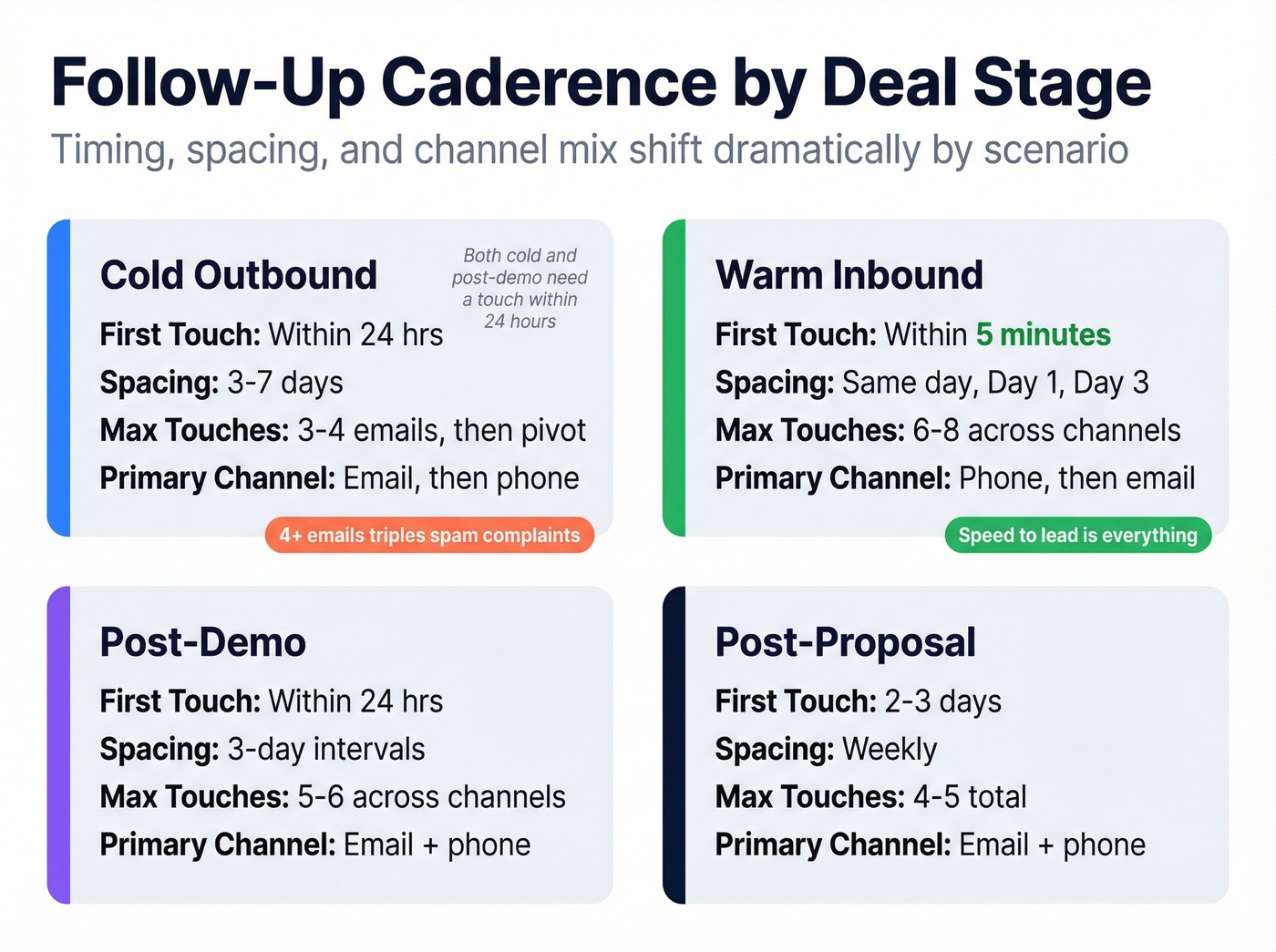
| Scenario | First Touch | Spacing | Max Touches | Primary Channel |
|---|---|---|---|---|
| Cold outbound | Within 24 hrs | 3-7 days | 3-4 emails, then pivot | Email, then phone |
| Post-demo | Within 24 hrs | 3-day intervals | 5-6 across channels | Email + phone |
| Post-proposal | 2-3 days | Weekly | 4-5 total | Email + phone |
| Warm inbound | Within 5 min | Same day, Day 1, Day 3 | 6-8 across channels | Phone, then email |
Notice the pattern: for both cold outbound and post-demo, you should follow up within 24 hours. That first day is when context is freshest and engagement is highest.
The cold outbound cap at 3-4 emails isn't arbitrary. The 16.5M-email dataset shows that sending 4+ emails in a sequence more than triples unsubscribe and spam complaint rates. After three or four unanswered emails, switch to phone or social. Track reply rates by touch number so you know exactly where your sequence loses steam - if Touch 3 gets zero replies, the problem isn't Touch 4.
If you want a swipe file for each touch, pair this cadence with these sales follow-up templates so reps don't default to "checking in."
Adjust by Company Size
The data reveals a clear split. SMB prospects (2-50 employees) start at a 9.2% reply rate and actually tolerate more touches - reply rates bounce back on the second follow-up. You've got room to be persistent here.
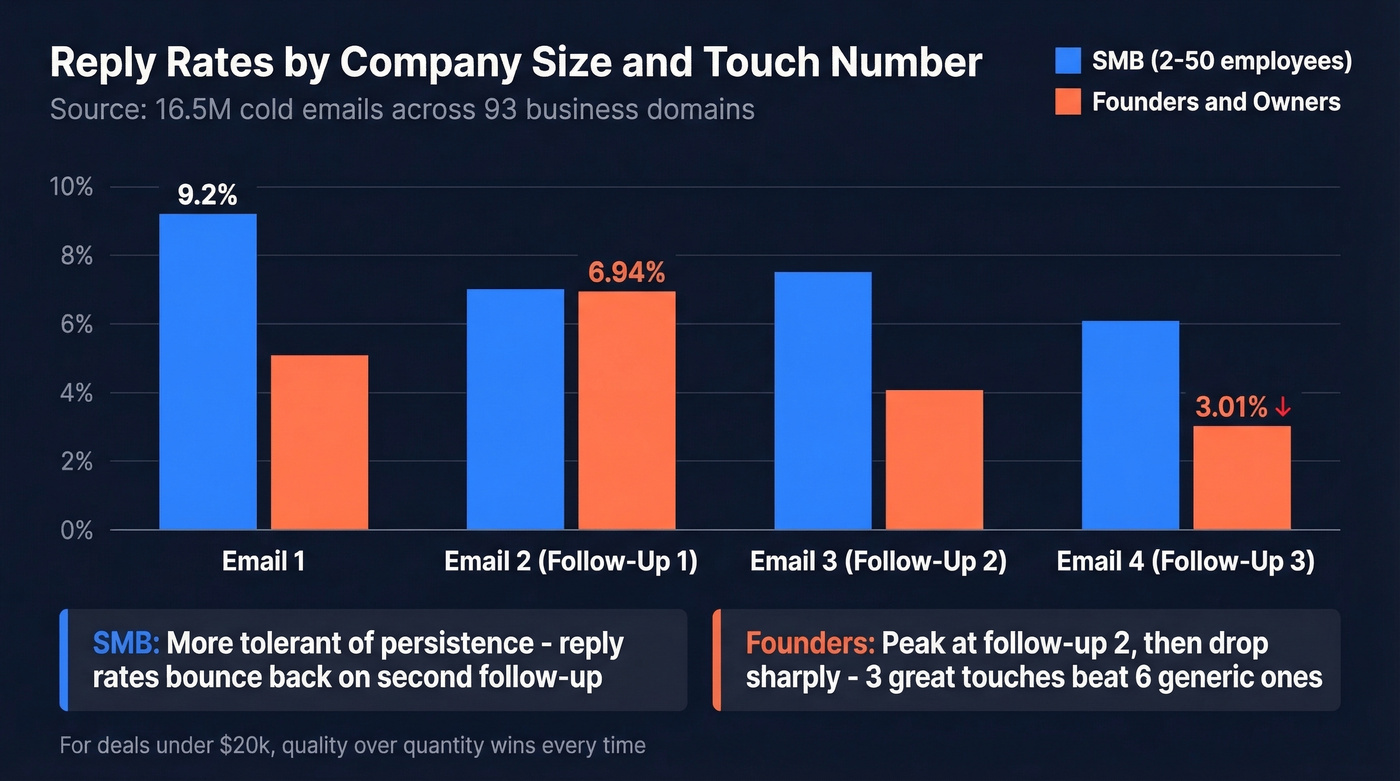
Founders and owners are a different animal. That segment peaks on the second follow-up at 6.94%, then drops to 3.01% by the fourth. For deals under $20k, three well-researched touches beat six generic ones. And some industries buck the trend entirely - solar reply rates increase on the first follow-up - so segment by vertical when you can.
This is also where personalized outreach and a tight ideal customer profile do more than any "perfect" timeline.

You're adjusting cadences by company size - smart. But the 16.5M-email dataset proves reply rates collapse when contacts are wrong. Prospeo's 300M+ profiles are refreshed every 7 days, not every 6 weeks. That's how Snyk cut bounce rates from 35% to under 5% and generated 200+ new opportunities per month.
Stop optimizing sequences built on dead email addresses.
Go Multi-Channel
The fix to underperforming sequences isn't more emails. It's more channels. With 347 billion emails sent per day according to Statista's 2026 projections, your follow-up competes with an absurd volume of noise.
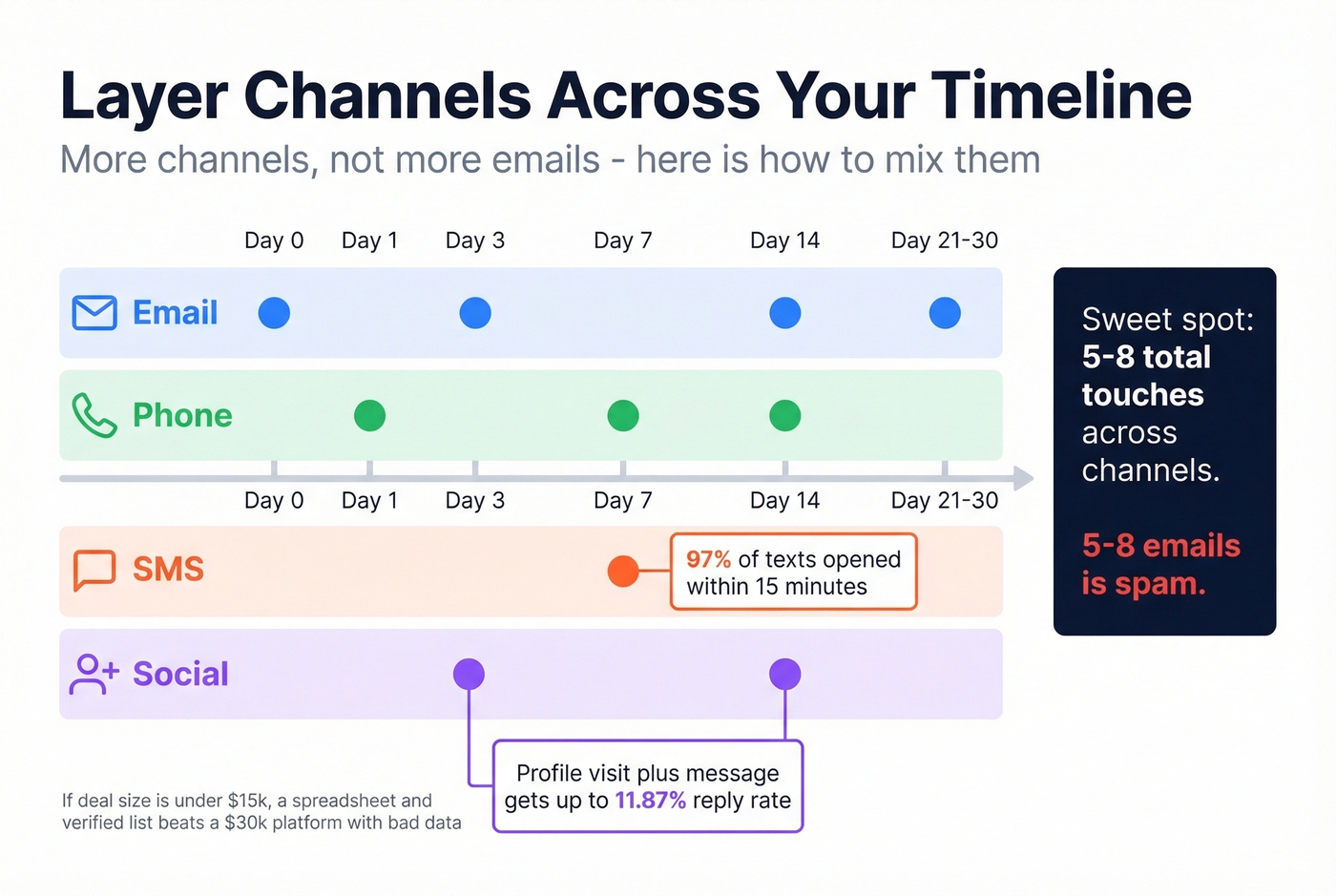
Layer email, phone, SMS, and social across your timeline rather than blasting every channel on Day 1.
97% of text messages are opened within 15 minutes. SMS is criminally underused in B2B. Profile visit + message combos on professional networks drive reply rates up to 11.87% - higher than any email follow-up in the dataset. Phone still converts, but only with real numbers. Verified mobile databases make phone and SMS touches viable at scale; without them, you're dialing switchboards and hoping for the best.
If you're building this into a repeatable motion, treat it like sequence management and track deliverability with the right email reputation tools.
Look - if your average deal size is under $15k, you don't need an eight-touch, four-channel orchestration platform. A spreadsheet, a verified list, and discipline will outperform a $30k-$100k/year sales engagement tool with garbage data underneath it.
When to Stop Following Up
That "80% of sales require 5+ follow-ups" stat recycled in every sales blog? It's misleading. Reply rates crater after 3-4 emails. The nuance is channel mix. Five to eight total touches across email, phone, and social is the sweet spot. Five to eight emails is spam.
Send a break-up email around Day 21-30. Keep it short: "Looks like the timing isn't right - feel free to reach out if anything changes." Then move them to monthly nurture and stop the active sequence. We've found that reps who can't let go of dead sequences end up tanking their sender reputation, which hurts the next campaign too.
If you're still unsure, this guide on when should i follow up on an email helps you decide based on context, not superstition.
Skip the break-up email entirely if you've only sent two touches and gotten zero engagement. Two unanswered emails don't warrant a dramatic goodbye - just move on.
The Hidden Follow-Up Killer
Your SDR ran a 500-contact sequence. 180 emails bounced. That's a 36% bounce rate - and it's not a follow-up problem. It's a data problem.
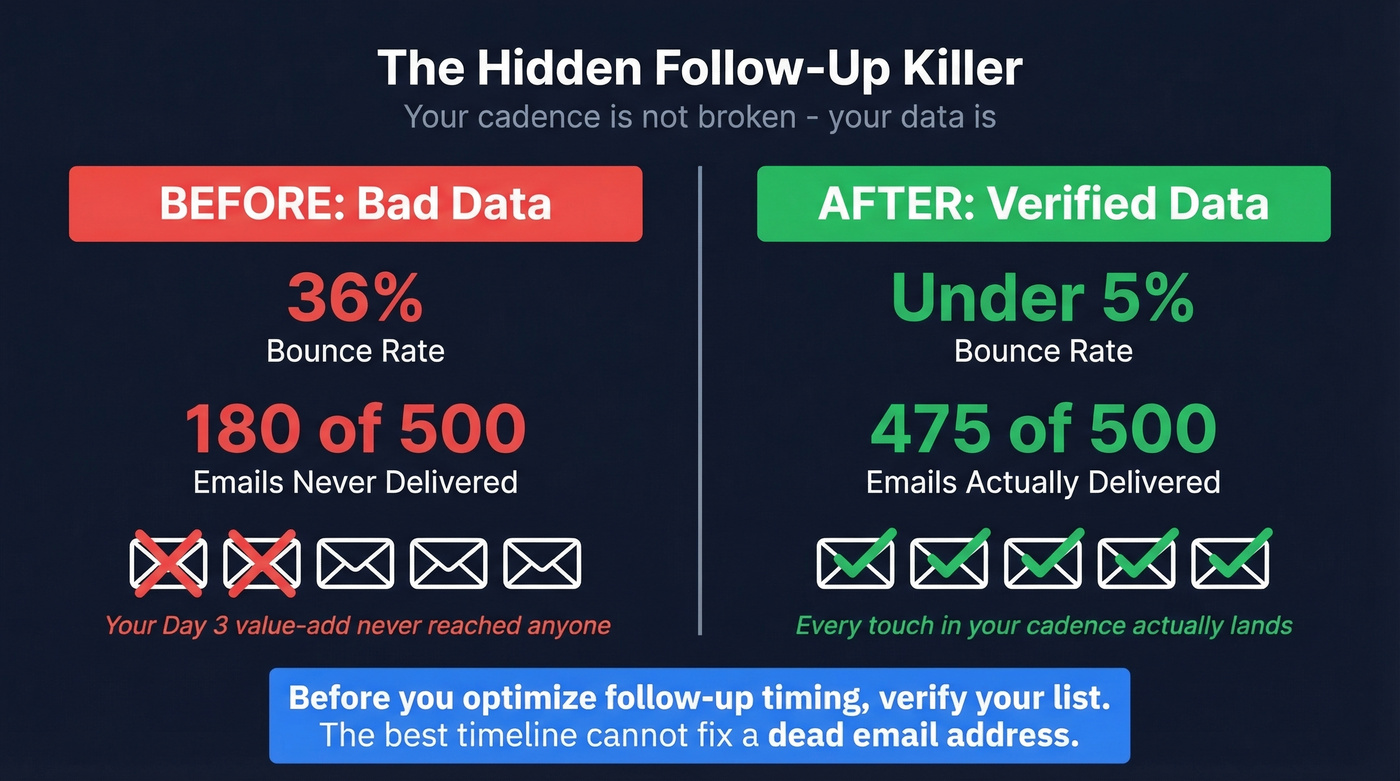
Your carefully crafted Day 3 value-add never reached anyone. Your CRM says "no response," but the message bounced on Day 1. We've seen this pattern over and over: teams like Meritt and Snyk were running solid sequences that silently failed because 35-40% of their emails never landed. After switching to Prospeo's verified data, their bounce rates dropped below 5%. That's the difference between a sequence that works and one that quietly burns your domain reputation.
Before you optimize your follow-up timing, verify your list. The best sales follow-up timeline in the world can't fix a dead email address. Start by understanding your email bounce rate and following a proper email deliverability guide.

Multi-channel follow-ups only work with real phone numbers. Prospeo gives you 125M+ verified mobiles with a 30% pickup rate - so your Day 7 call actually reaches a human. At $0.01 per email and no contracts, it costs less than one bounced sequence.
Make every touch in your cadence land. Start with 75 free verified emails.
FAQ
How many follow-up emails should I send?
Three to four cold emails maximum before switching channels. Across 16.5M emails, 4+ messages more than tripled spam complaints. Across all channels - email, phone, SMS, social - aim for 5-8 total touches. Fewer emails, more channels.
What's the best day and time to follow up?
Thursday between 3:30-5 PM and Tuesday through Thursday 10 AM-2 PM both show strong results, but your audience matters more than any universal rule. Industry, time zone, and seniority level shift the window. What the data does agree on: always follow up within 24 hours of a demo or meaningful interaction. Waiting longer than a day cuts reply rates significantly.
How do I make sure my follow-ups actually get delivered?
Verify your contact data before launching any sequence. Bad emails bounce, tank your sender reputation, and make your entire cadence invisible. Use a verification tool with catch-all handling and spam-trap removal. Check your bounce rate after the first 50 sends and pull any address that soft-bounces twice.