

Sales Funnel Automation: A Practitioner's Guide for 2026
Four out of ten emails bounced. That was the wake-up call for a RevOps team we worked with last year - they'd spent two weeks building a gorgeous 12-step nurture sequence, only to watch it crater because the underlying contact data was garbage. Sales funnel automation promises speed and scale, but the average B2B funnel loses 79% of leads between first contact and closed deal. Most of that leakage isn't a messaging problem. It's a plumbing problem. Responding within five minutes makes you 21x more likely to qualify a lead, but speed means nothing if the data feeding your automations is stale or wrong.
We're starting where most guides don't - with the data layer - then walking through stage-by-stage automation, real benchmarks, tool pricing, and the mistakes that silently kill funnels.
The Quick Stack
Most guides tell you to set up email sequences first. Don't. Start with data quality, then build stage-by-stage automations on top. You need three things: a CRM with workflow logic, a data enrichment layer, and a connector tool.
- CRM + automation: ActiveCampaign for best value, or HubSpot if budget allows
- Connector: Zapier or Make
The rest of this guide shows you exactly how to wire these together - and why the order matters more than the tools themselves.
What Is Sales Funnel Automation?
It's replacing manual, repetitive tasks at each stage of your buyer journey with trigger-based workflows. Instead of a rep remembering to follow up, a system fires the right message at the right moment based on prospect behavior.
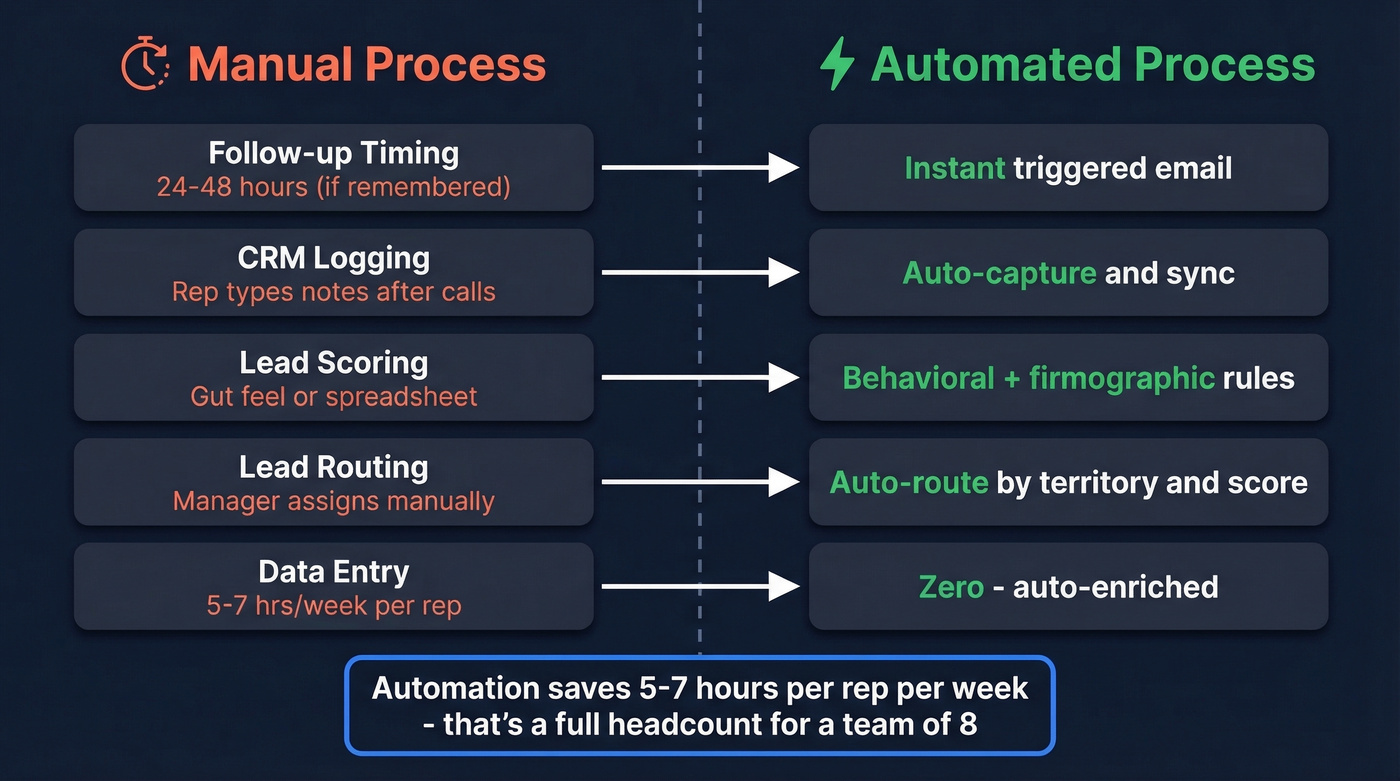
The difference between manual and automated isn't subtle. It's structural.
| Task | Manual Process | Automated Process |
|---|---|---|
| Follow-up timing | 24-48 hours (if remembered) | Instant triggered email |
| CRM logging | Rep types notes after calls | Auto-capture and sync |
| Lead scoring | Gut feel or spreadsheet | Behavioral + firmographic rules |
| Lead routing | Manager assigns manually | Auto-route by territory/score |
| Data entry | 5-7 hrs/week per rep | Zero - auto-enriched |
That last row matters more than people think. Automatic lead capture eliminates 5-7 hours weekly of manual data entry per rep. Across a team of eight, that's 40-56 hours per week - basically a full-time headcount you're paying for but not getting.
Why Automate: The Numbers
Sales reps spend only 33% of their time actually selling. The rest disappears into admin, data entry, and CRM updates. Companies automating their funnel analytics see a 15-25% revenue uplift and an 80% reduction in manual work, with ROI typically landing within 3-12 months.
Here's a quick back-of-napkin calculation: for a 10-person team at $100K average salary, a 20% time savings from automation translates to roughly $200K in recovered annual value. Even against a $150K implementation cost, that's a 33% return in year one - before counting the revenue lift from faster follow-ups and fewer dropped leads.
But aggregate stats only tell part of the story.
Case Study: Seed-Stage B2B SaaS
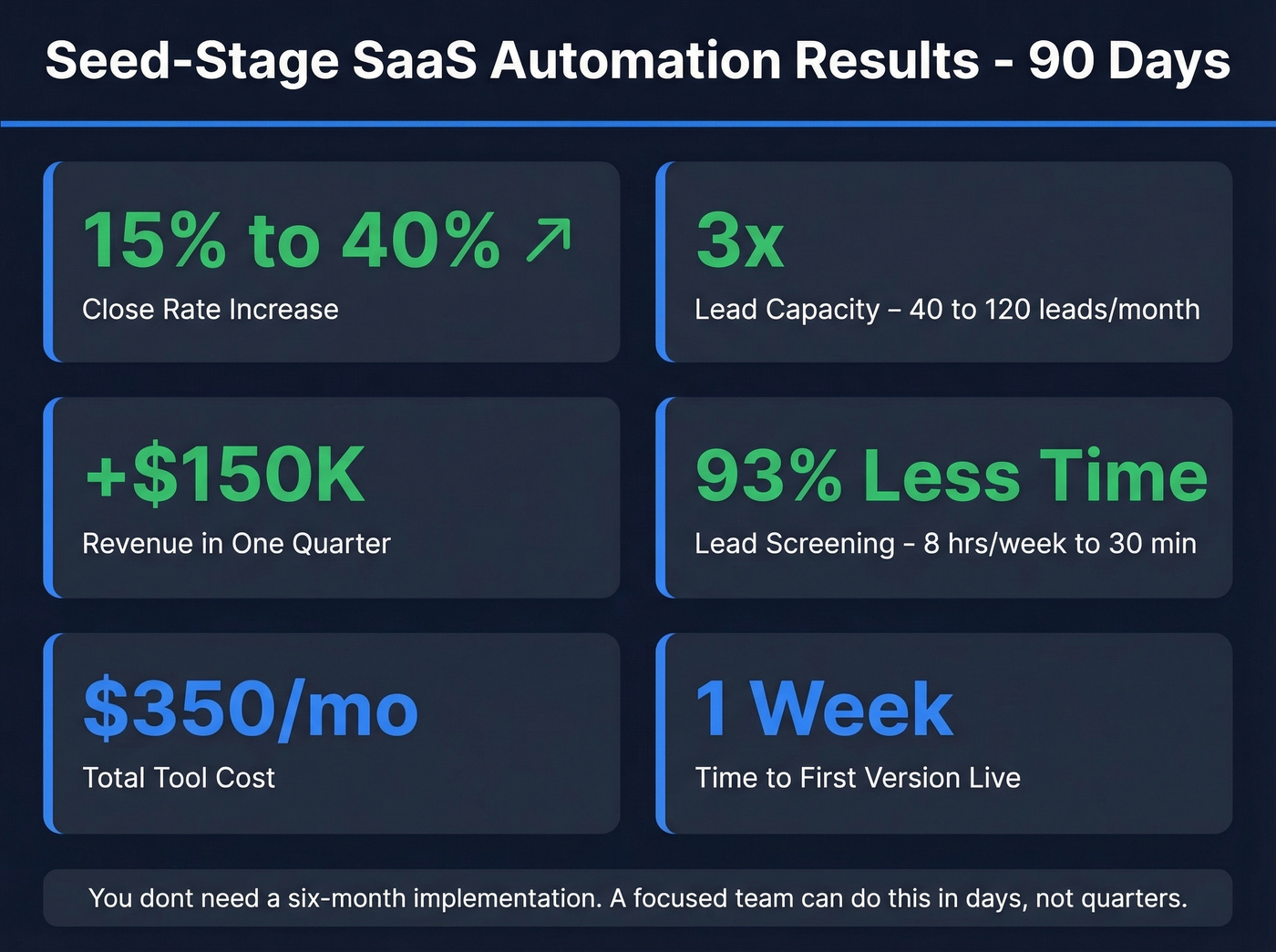
A seed-stage startup discovered that 70% of deals were dying within 48 hours after demos - a bottleneck invisible until they mapped the funnel. After implementing automation with n8n, CRM integrations, and AI lead qualification:
- Close rate: 15% to 40% in 90 days
- Lead capacity: 40 to 120 leads/month (3x)
- Revenue: +$150K in a single quarter
- Lead screening: 8 hours/week to 30 minutes
- Total tool cost: $350/month
First version was live within one week.
You don't need a six-month implementation. A focused team can get a basic automated funnel running in days, not quarters.
What to Automate at Each Stage
Here's the thing - most teams try to automate everything at once and end up with a Rube Goldberg machine nobody can debug. The smarter approach is stage-by-stage, with clear trigger, condition, and action logic at each level. One user on r/smallbusiness shared their full autopilot funnel, from automated social scheduling through to invoicing, and reported it runs with near-zero daily oversight. That's the goal. But you build toward it incrementally.
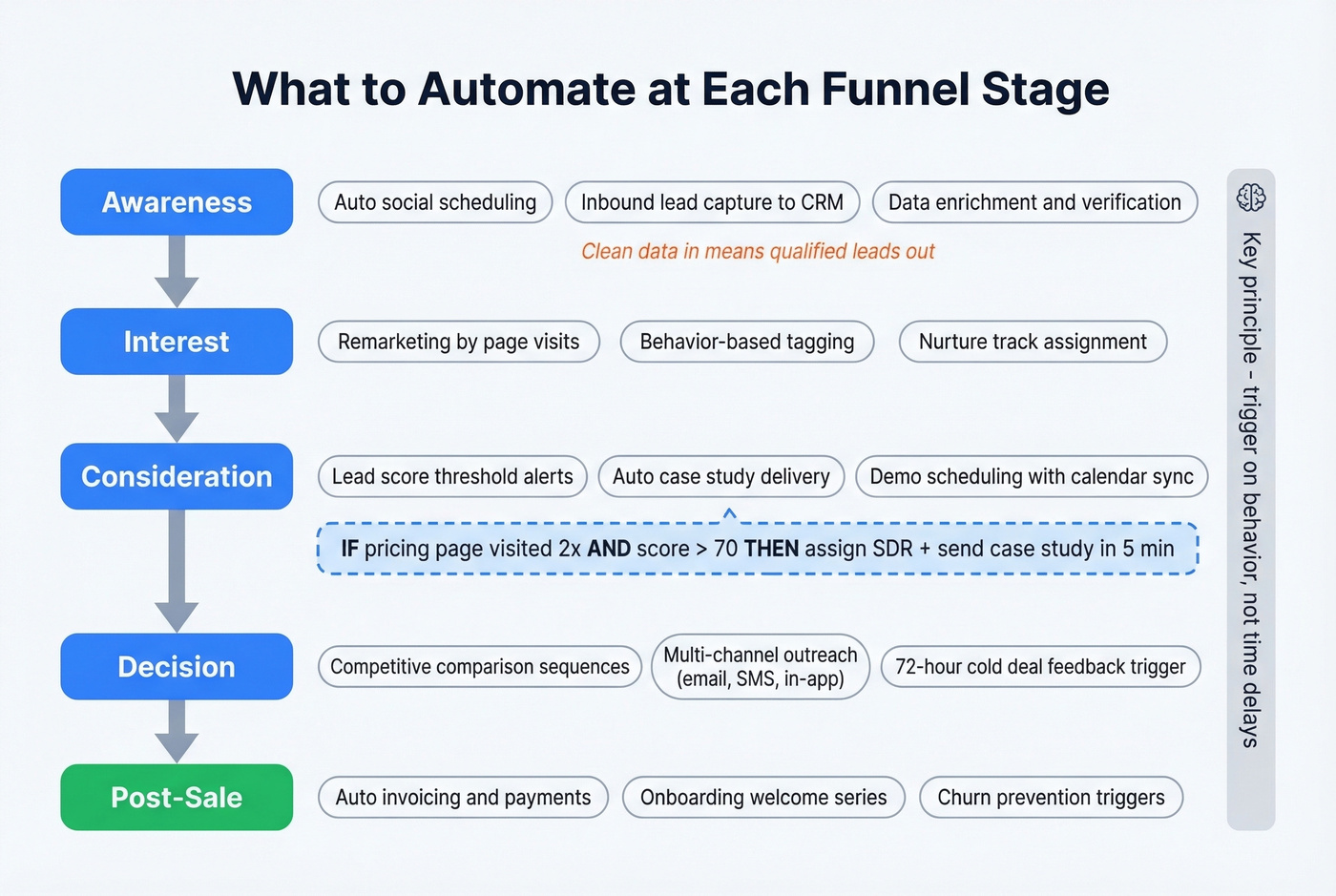
Awareness. Automated social scheduling pushes blog content, SEO pages, and PR mentions on a cadence. Inbound leads from these channels get auto-captured into your CRM. Before they enter any sequence, enrich them with verified contact data - there's no point nurturing an email address that'll bounce. This is where lead generation funnel automation starts paying dividends: clean data in means qualified leads out.
Interest. Remarketing campaigns fire automatically based on page visits. A prospect who reads three blog posts in a week gets tagged and enters a different nurture track than someone who bounced after ten seconds. Behavior-based triggers beat time-based delays every time.
Consideration. This is where automation earns its keep. A workflow like: IF pricing page visited 2x AND lead score > 70 THEN assign to SDR + send case study email within 5 minutes - that's the kind of logic that turns a passive funnel into an active one. Automated demo scheduling with calendar integration eliminates the back-and-forth that kills deal velocity.
Decision. Automated sequences deliver value content, competitive comparisons, and limited-time offers based on where the prospect stalled. Feedback request triggers fire if a deal goes cold for more than 72 hours. Multi-channel matters here - email, SMS, even in-app messages if you have the infrastructure.
Post-Sale. Automated invoicing, payment processing, and onboarding welcome sequences. This stage is criminally under-automated at most companies. A three-email onboarding series triggered by contract signature cuts first-30-day churn, and it takes an afternoon to build.
Across all stages, the key distinction is the same: behavior-based triggers like pricing page visits, email opens, and demo requests dramatically outperform generic time delays. Build your workflows around what the prospect does, not just when they entered the funnel.

Four out of ten emails bouncing kills your funnel before automation even kicks in. Prospeo's 5-step verification delivers 98% email accuracy with a 7-day refresh cycle - so every trigger, sequence, and workflow fires on real, reachable contacts.
Stop automating on top of bad data. Start with contacts that connect.
Funnel Benchmarks
You can't improve what you don't measure. Here are stage-by-stage conversion benchmarks for B2B SaaS - use these as your baseline.
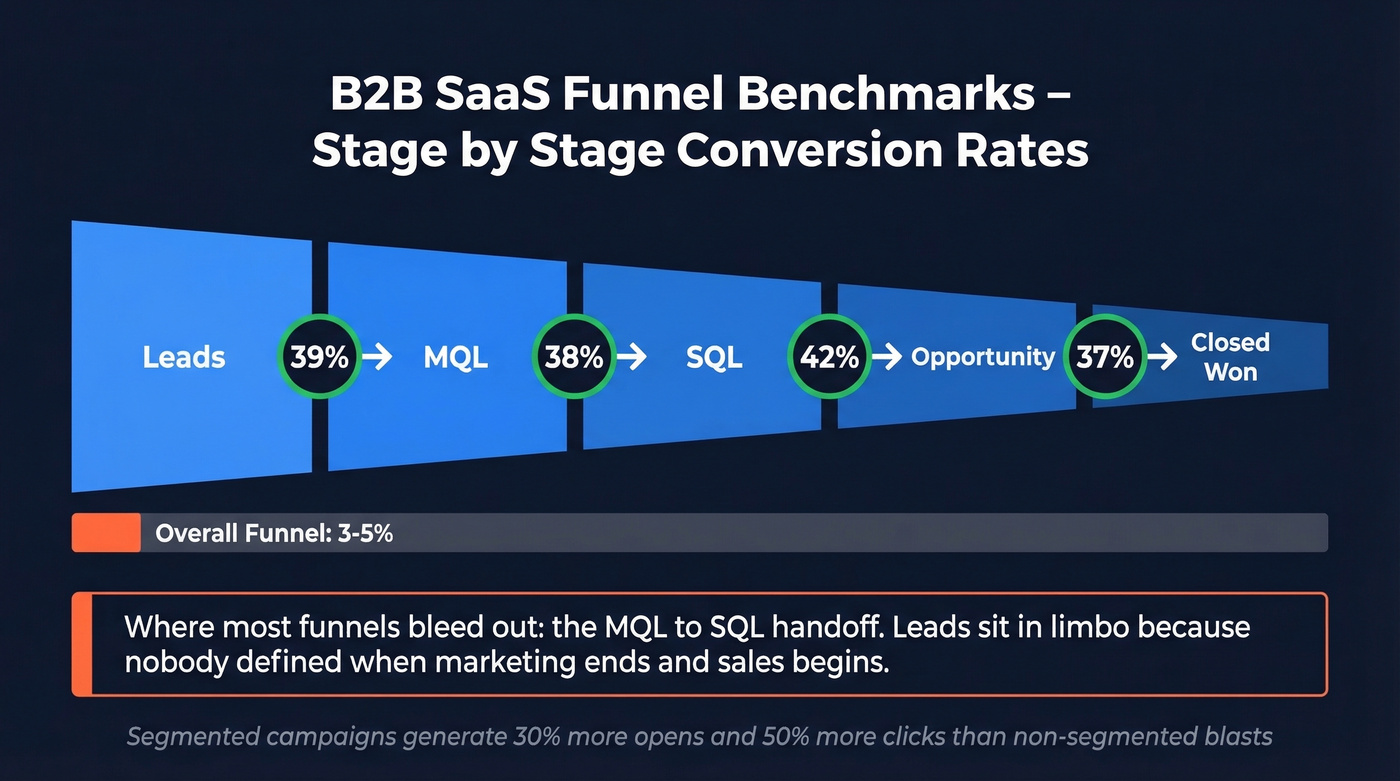
| Stage Transition | Benchmark Rate |
|---|---|
| Lead to MQL | 39% |
| MQL to SQL | 38% |
| SQL to Opportunity | 42% |
| SQL to Closed Won | 37% |
| Overall funnel | 3-5% |
If your numbers fall significantly below these, the problem is usually in one of two places: data quality at the top of funnel, or handoff points between stages. In our experience, the MQL-to-SQL handoff is where most funnels bleed out - leads sit in limbo because nobody defined when marketing's job ends and sales begins. According to HubSpot data, segmented campaigns generate 30% more opens and 50% more clicks than non-segmented blasts, so poor segmentation is often the hidden culprit behind weak pipeline velocity.
Don't obsess over hitting these exact numbers. They're directional. Track your own stage-to-stage rates monthly and spot where the drop-off lives.
How to Build an Automated Sales Funnel
Seven steps, in order. The sequence matters - we've seen teams skip straight to step 4 and spend months debugging problems that step 1 would've prevented.
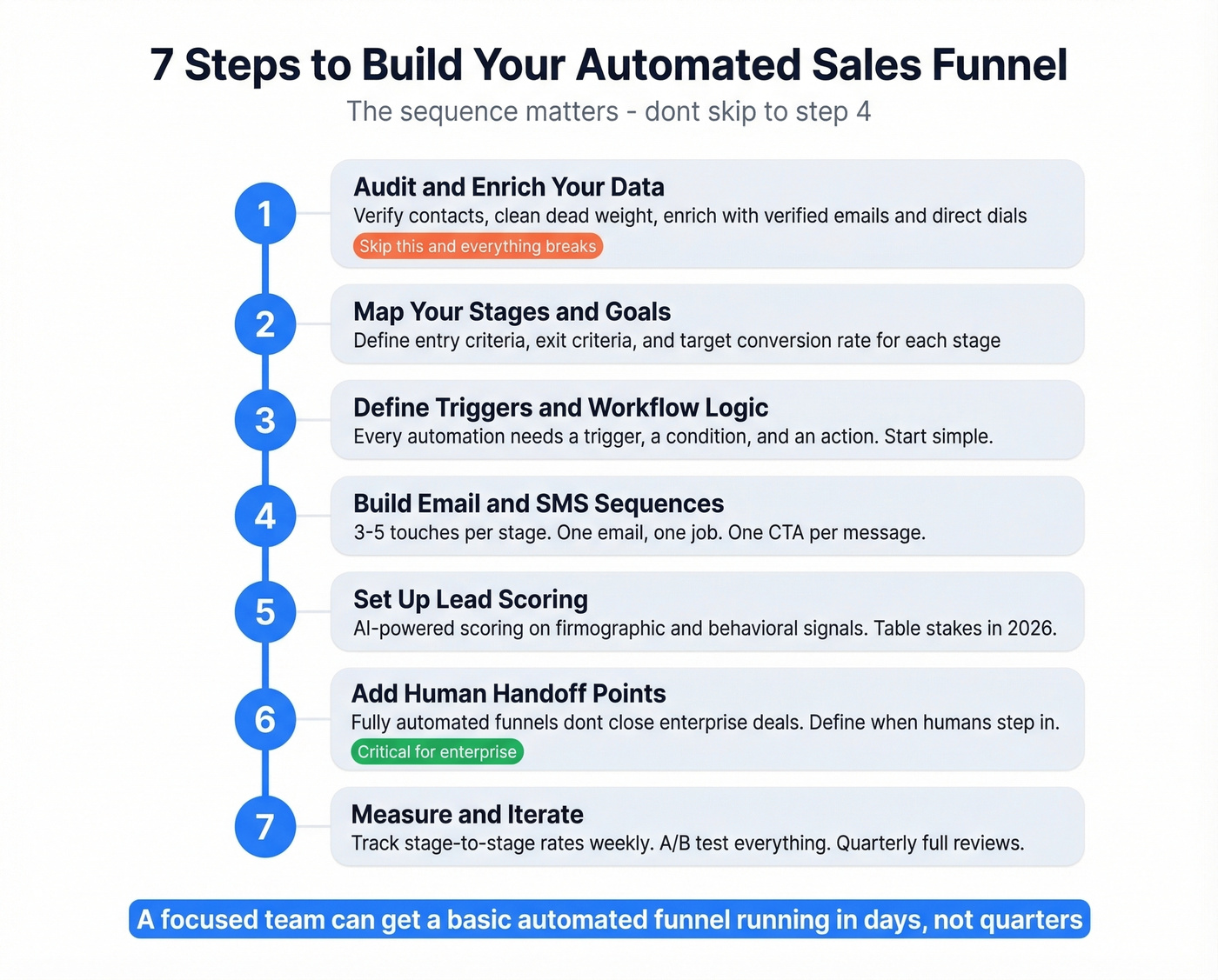
Step 1: Audit and Enrich Your Data
Before you configure a single workflow, verify your contact data. Stale emails and disconnected numbers are the #1 silent killer of automated funnels. Run your existing list through a verification tool, clean out the dead weight, and enrich what remains with verified emails and direct dials. If 15% of your list is bouncing, you're burning sender reputation on every automated sequence you run.
This step alone can transform your funnel economics. Snyk - with 50 AEs prospecting daily - dropped bounce rates from 35-40% to under 5% after switching to Prospeo for enrichment, and AE-sourced pipeline jumped 180%. With a 7-day data refresh cycle versus the 6-week industry average, records stay current long after the initial enrichment pass.
Step 2: Map Your Stages and Goals
Define what each deal stage means for your business. "MQL" means something different for a PLG SaaS company than for an enterprise services firm. Write down the entry criteria, exit criteria, and target conversion rate for each stage. Without this, your automation logic has no foundation.
Step 3: Define Triggers and Workflow Logic
Every automation needs a trigger, a condition, and an action. Map these for each stage transition. Start simple - you can always add complexity later. On r/passive_income, one practitioner described AI agents handling follow-ups, content delivery, and response triage across their entire funnel, replacing 10+ hours of repetitive work per week. That level of sophistication comes later. Start with the basics.
Step 4: Build Email and SMS Sequences
Now you build the actual messages. Keep sequences short - three to five touches per stage is plenty. One email, one job. One CTA per message. Resist the urge to build a 15-step nurture monster on day one. If you need a starting point, keep a swipe file of follow-up copy you can adapt fast.
Step 5: Set Up Lead Scoring
AI-powered lead scoring is table stakes in 2026, not a premium feature. Modern CRMs analyze hundreds of firmographic and behavioral signals - page visits, email engagement, company size, funding stage, technology stack - to generate scores that predict conversion likelihood. Predictive scoring, sentiment detection, and intelligent routing are what separate funnels that convert from funnels that just send emails.
Step 6: Add Human Handoff Points
Let's be honest: fully automated funnels don't close enterprise deals. You need clear handoff points where a human steps in - typically when a lead hits a score threshold, requests a demo, or enters the Decision stage. Set up alerts so reps know exactly when to engage and have full context from the automated interactions. This is the moment automation supports but can't replace.
Step 7: Measure and Iterate
Track stage-to-stage conversion rates weekly. Run A/B tests on subject lines, send times, and trigger conditions. Add fallback logic for disengaged leads - a 60-day re-engagement sequence works well here. Quarterly reviews of your entire automation stack aren't optional; they're how you find the workflows that stopped working three months ago.
Best Tools for Funnel Automation
Here are the tools, organized by function and real cost. The "Full Automation Price" column is the one that matters - it's what you'll actually pay once you outgrow the starter tier.
| Tool | Starting Price | Full Automation Price | Free Tier? |
|---|---|---|---|
| ActiveCampaign | $19/mo (1K contacts) | $99/mo Professional | No (free trial) |
| HubSpot | $20/mo Starter | $890/mo Marketing Pro | Yes (free CRM; pipeline limits) |
| Prospeo | ~$0.01/email | ~$0.01/email (scales flat) | Yes (75 emails/mo) |
| Systeme.io | Free | $97/mo Unlimited | Yes (2,000 contacts) |
| ClickFunnels | $97/mo | $297/mo Pro | No |
| GetResponse | $59/mo | $199/mo Ecommerce | No |
| Zapier / Make | Free / Free | ~$20/mo / ~$9/mo | Yes / Yes |
ActiveCampaign is the best automation-per-dollar tool on the market right now. The $19/mo entry plan gets you solid email automation, and the $99/mo Professional tier unlocks a workflow builder that competes with platforms five times its price. CRM is a paid add-on starting at $50/mo - even with it, you're under $150/mo for a full stack. Skip this if you need built-in content management or customer service tools.
HubSpot is the obvious choice if you want everything in one dashboard - CRM, marketing, sales, service. But the Starter plan at $20/mo is a teaser. Real automation lives at the $890/mo Marketing Hub Professional tier with 2,000 contacts, and sales automation adds another $500/mo. The bundle can hit $1,781/mo. For teams of 50+ that value unified reporting, it's worth it. For everyone else, it's overkill.
Hot take: If your average deal size is under $15K, you almost certainly don't need HubSpot-level spend. A modular stack at $100/month covers 80% of what the $890/month plan does - and the other 20% is reporting dashboards your team won't look at after the first month.
Systeme.io has a genuinely free plan with 2,000 contacts and three funnels - hard to beat for bootstrapped founders. ClickFunnels at $97/mo is purpose-built for landing page funnels, not full sales automation. GetResponse at $59/mo blends email automation with funnel building and includes a basic CRM. Zapier and Make are the glue - they connect tools that don't natively talk to each other, with Make offering better value for most workflows.
Stack vs. Suite: For teams under 10 people, build a modular stack. ActiveCampaign + Prospeo + Zapier runs under $100/month and handles lead enrichment, email automation, scoring, and CRM routing. Go all-in-one only if you genuinely need advanced reporting, content management, and customer service under one roof.
7 Mistakes That Kill Your Funnel
1. Automating without clean data. Garbage in, garbage out - at scale. Run your list through verification before launching any sequence. One enrichment pass can cut bounce rates from 35% to under 4%. If you’re diagnosing issues, start with email bounce rate benchmarks and root causes.
2. Overcomplicated workflows. A 25-step sequence with 14 conditional branches looks impressive in the builder. It performs worse than a focused 5-step flow. When you automate your funnel, simplicity wins.
3. Poor segmentation. Segmented campaigns generate 30% more opens and 50% more clicks. Blasting your entire list with the same message isn't automation - it's spam with extra steps. If you want a cleaner system, build intent based segmentation into your routing rules.
4. Misaligned triggers. Using generic time delays when you should be using behavioral triggers like pricing page visits and demo no-shows. Behavior-based triggers convert at dramatically higher rates.
5. No personalization. Dynamic variables in subject lines and body copy aren't optional. "Hi {first_name}, saw you checked out our pricing" outperforms "Hi there, here's our latest offer" every single time. Keep a library of high-performing email subject lines so you’re not guessing.
6. No clear CTA. Each automated email should have one job and one action. Stuffing three links and two asks into a single message guarantees none of them get clicked.
7. Forgetting human handoffs. Automation nurtures. Humans close. Build alerts for high-intent signals so reps engage at exactly the right moment with full context.
That 5-7 hours of manual data entry per rep? Eliminate it. Prospeo enriches your CRM with 50+ data points per contact at a 92% match rate - buyer intent, direct dials, verified emails - so your funnel automations run on complete, fresh records.
Auto-enrich every lead entering your funnel for $0.01 each.
FAQ
What's the best free tool for building an automated sales funnel?
Systeme.io offers the most generous free plan - 2,000 contacts, three funnels, and email automation included. For data enrichment, Prospeo's free tier covers 75 verified emails per month, enough to validate your initial list quality before scaling.
How long does setup take?
A basic funnel covering lead capture, email sequence, and CRM routing can be live in about a week. The seed-stage case study above went from zero to fully automated in seven days and tripled lead capacity within 90 days.
What's a good conversion rate for an automated funnel?
Overall funnel conversion rates typically fall between 3% and 5% for B2B SaaS. Stage benchmarks run: Lead to MQL 39%, MQL to SQL 38%, SQL to Opportunity 42%, SQL to Closed Won 37%. Track your own rates monthly to spot drop-off points.
Do I need a CRM for this?
Yes - the CRM is the central hub that stores contact data, tracks deal stage progression, and triggers workflows. ActiveCampaign includes automation at $19/mo with CRM as a $50/mo add-on. HubSpot bundles a free CRM but gates real automation behind its $890/mo Professional tier.
How is this different from marketing automation?
Marketing automation focuses on top-of-funnel activities like ads, content distribution, and lead capture. Full sales funnel automation extends through qualification, deal progression, close, and post-sale onboarding - covering the entire revenue lifecycle, not just lead generation.