

Sales Funnel Management: Benchmarks, Math, and the Playbook Nobody Else Gives You
You've read five articles about sales funnel management and none of them told you what conversion rate to actually hit at each stage. They gave you definitions, maybe a diagram, and called it a day. Definitions are 20% of funnel management. The other 80% is knowing what to measure, what benchmarks to aim for, and where to intervene when the numbers go sideways.
What You Need (Quick Version)
- The math is brutal. With 50% stage-to-stage progression, you need 160 pitches to close 10 deals. Drop to 33% progression and that number balloons to 810. Disqualifying early is the highest-leverage activity in your funnel.
- Benchmark your MQL-to-SQL rate. Healthy B2B SaaS teams run 32-40%. Below ~25% is a common sign your lead definition is too loose or your handoff is broken.
- Meeting booking is your canary. The median qualified-to-booked rate is 62%; top 10% hit 78%+. Below median, it's usually a data quality or speed-to-lead problem.
- Data quality is a prerequisite, not a nice-to-have. Verify your contact data before it enters your CRM. Bad data poisons every metric downstream.
- Build role-based dashboards. Teams using CRM dashboards see a 29% average increase in sales. That's not a rounding error.
What Is Sales Funnel Management?
Sales funnel management is the discipline of overseeing how prospects move through each stage of your buying process, measuring conversion rates at every transition, and optimizing the points where they drop off. It's not vocabulary. It's not drawing a triangle on a whiteboard.
Operationally, it means three things. First, defining clear exit criteria for each stage so deals don't linger. Second, tracking stage-to-stage conversion rates so you know where the drop-off is. Third, running a regular cadence of review so problems get caught in weeks, not quarters. Every team that's good at this treats it as an ongoing process, not a one-time CRM setup.
Sales Funnel vs. Sales Pipeline
These terms get used interchangeably, and that causes real confusion. They're different lenses on the same data.
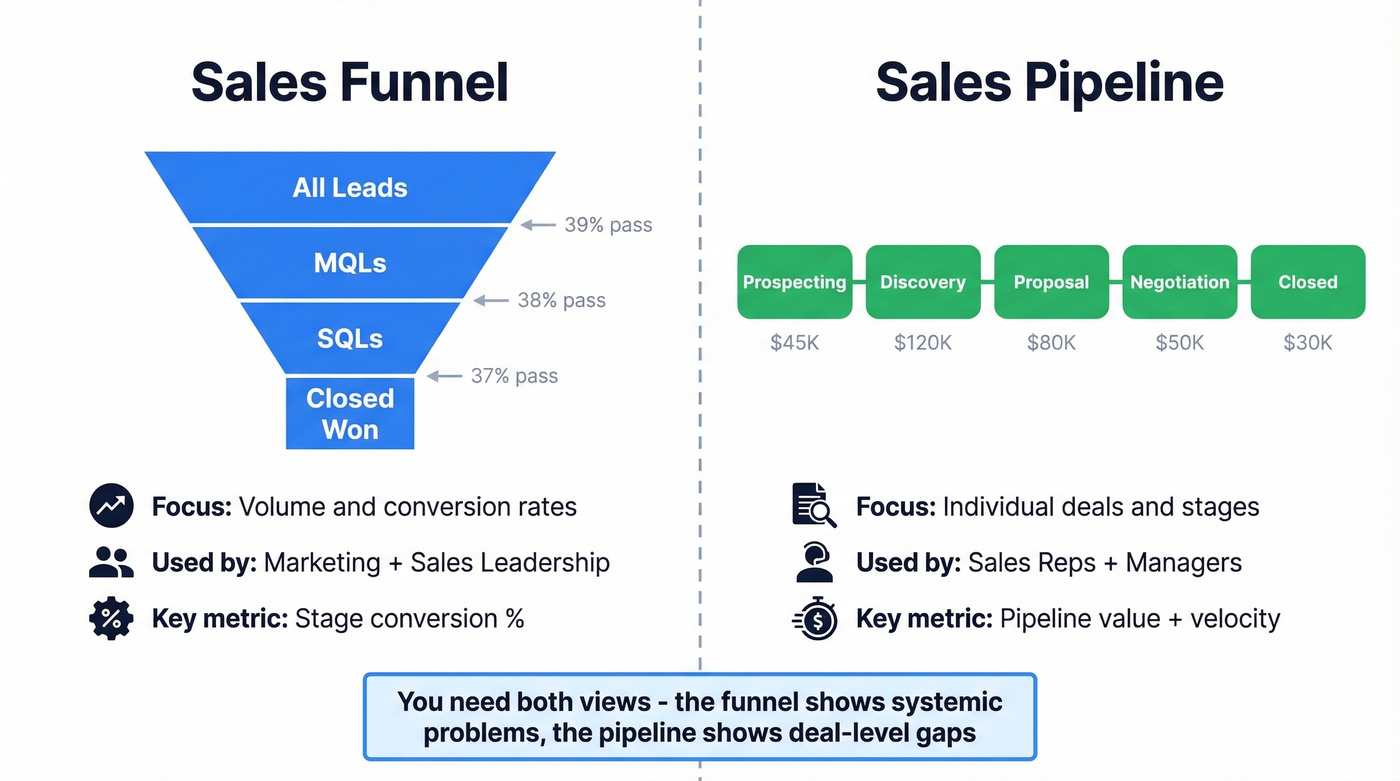
| Sales Funnel | Sales Pipeline | |
|---|---|---|
| Focus | Volume & conversion rates | Individual deals & stages |
| Question it answers | How many prospects drop off? | What's happening with my deals? |
| Used by | Marketing + sales leadership | Sales reps + managers |
| Primary metric | Stage conversion % | Pipeline value + velocity |
You need both views. The funnel tells you what needs to happen to consistently fill the pipeline. The pipeline tells you what's happening right now with your deals. Teams that only look at pipeline miss systemic conversion problems; teams that only look at the funnel miss deal-level execution gaps.
The Five Funnel Stages
Most B2B funnels follow a five-stage model. The labels vary by company, but the logic is consistent. What matters isn't the names - it's the exit criteria you define for each stage.
Lead - Someone enters your system through a form fill, content download, or outbound prospecting. Exit criteria: basic fit confirmed across industry, company size, and geography.
MQL (Marketing Qualified Lead) - The lead has shown enough engagement or fit signals to warrant sales attention. Exit criteria: meets your ICP scoring threshold and has taken a qualifying action like a demo request or pricing page visit.
SQL (Sales Qualified Lead) - A sales rep has had a conversation and confirmed budget, authority, need, and timeline. Exit criteria: the prospect has a real problem you solve and the ability to buy.
Opportunity - There's an active deal with a defined scope, timeline, and decision process. Exit criteria: proposal delivered or commercial terms under discussion.
Closed Won - Contract signed, revenue booked.
Some teams extend the funnel past Closed Won to include retention and expansion stages. If your business depends on net revenue retention - and most SaaS businesses do - tracking post-sale conversion into upsell and renewal is just as important as tracking the initial close.
One thing worth flagging: modern buyer journeys aren't strictly linear. Prospects research across multiple channels, loop back to earlier stages, and sometimes skip stages entirely. Your funnel model should account for this. Don't force prospects into a rigid sequence that doesn't match how they actually buy.

You just saw the math: dropping from 50% to 33% stage progression costs you 5x more effort. The fastest fix? Stop feeding bad data into stage one. Prospeo's 98% verified emails and 7-day refresh cycle mean fewer bounces, faster disqualification, and reps spending time on real buyers - not dead contacts.
Fix your funnel at the source - start with data that's actually verified.
The Math Behind Funnel Conversion
This is where most articles on managing your funnel stop being useful. Let's do the actual math, because it changes how you think about every stage.
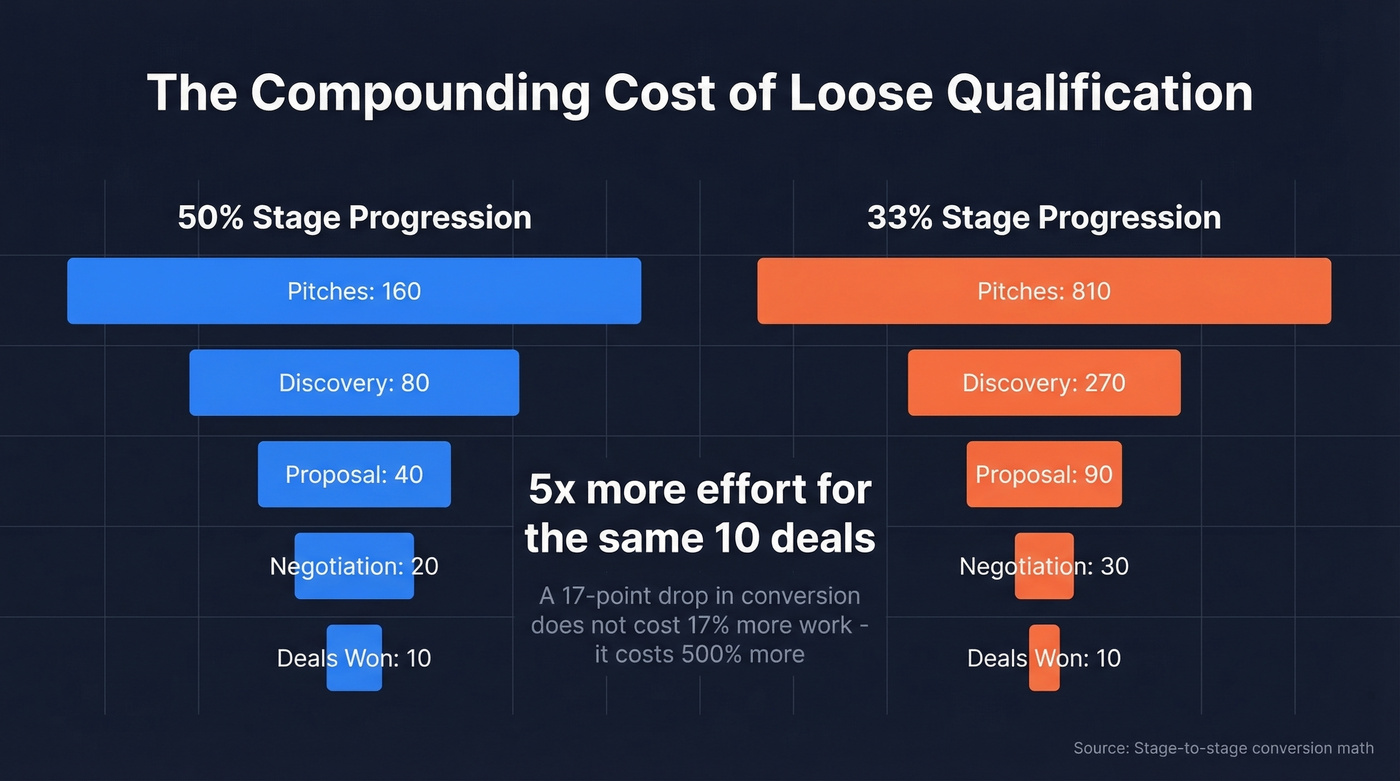
Assume a five-stage funnel: pitch, discovery, proposal, negotiation, deal. With 50% progression at each stage, winning 10 deals requires 160 pitches (10 x 2^4). That's manageable for a small team.
Now drop progression to 33% - which isn't unusual for teams with loose qualification. To win those same 10 deals, you need 810 pitches (10 x 3^4). Five times the top-of-funnel volume for the same outcome.
The compounding effect is what kills teams. A 17-percentage-point drop in stage conversion doesn't cost you 17% more effort - it costs you 5x more effort. This is why disqualifying early is the single highest-leverage activity in funnel management. Every unqualified prospect you let through stage one multiplies the wasted effort at every subsequent stage.
A practitioner on r/GrowthHacking put it well: drastically narrowing the top of your funnel protects rep time and lets you reinvest in higher-probability pipeline. The "skinny funnel" approach sounds counterintuitive, but the math is unambiguous.
Here's the thing: most teams don't have a lead generation problem. They have a disqualification problem. If your average deal size is under $25K and you're running 800+ pitches to close 10 deals, you don't need more leads - you need fewer, better ones. Spend the budget you'd put into top-of-funnel volume on data quality and lead scoring instead.
Stage-by-Stage Conversion Benchmarks
Real numbers for each stage, drawn from aggregated B2B data. Use them as directional targets, not gospel.
Conversion Rates by Industry
| Industry | Lead-to-MQL | MQL-to-SQL | SQL-to-Opp | SQL-to-Closed |
|---|---|---|---|---|
| B2B SaaS | 39% | 38% | 42% | 37% |
| Fintech | 21% | 46% | 49% | 58% |
| Professional Services | ~30% | ~35% | ~45% | ~40% |
| Healthcare IT | ~25% | ~30% | ~40% | ~35% |
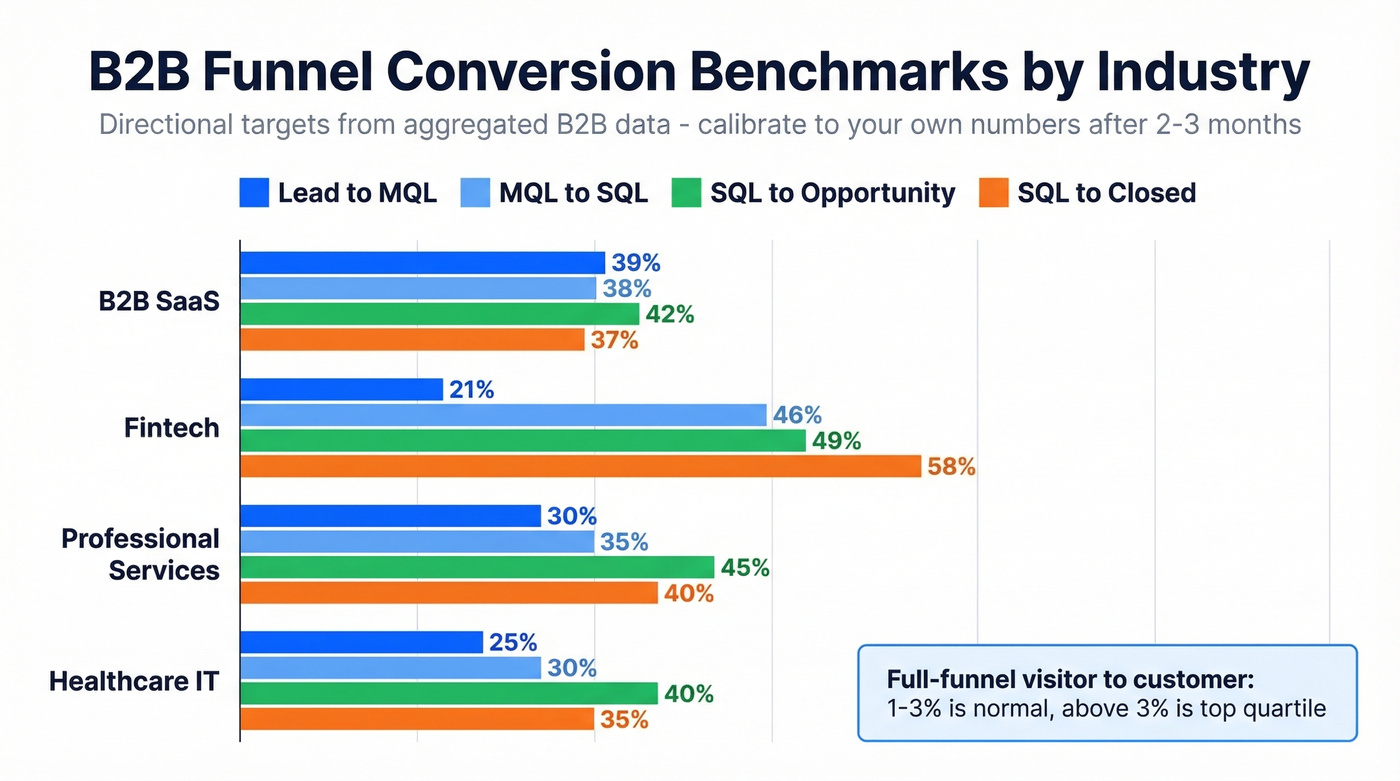
SaaS and Fintech rows come from First Page Sage's latest benchmarks report. Professional Services and Healthcare IT are estimates based on aggregated B2B data. Fintech's low Lead-to-MQL but high SQL-to-Closed pattern is typical of industries with longer education cycles but strong close rates once prospects qualify.
Full-funnel visitor-to-customer conversion typically lands at 1-3% for B2B. Above 3% puts you in the top quartile. Below 1%, something structural is broken.
Meeting booking deserves its own callout: the median qualified-to-booked rate is 62%, top 10% hit 78%+, and the best teams reach 88%. If your number is below 60%, it's usually bad contact data or slow follow-up - two problems that compound each other.
Time-to-Convert Benchmarks
| Transition | Typical Timeframe |
|---|---|
| Visitor to Lead | 1-3 days |
| MQL to SQL | 8-15 days |
| SMB Opp to Close | 30-45 days |
| Enterprise Opp to Close | ~120 days |
If your MQL-to-SQL handoff takes longer than 15 days, you're losing deals to competitors who move faster. 96% of prospects research before engaging sales - by the time they raise their hand, the clock is already ticking.
CAC by Deal Size
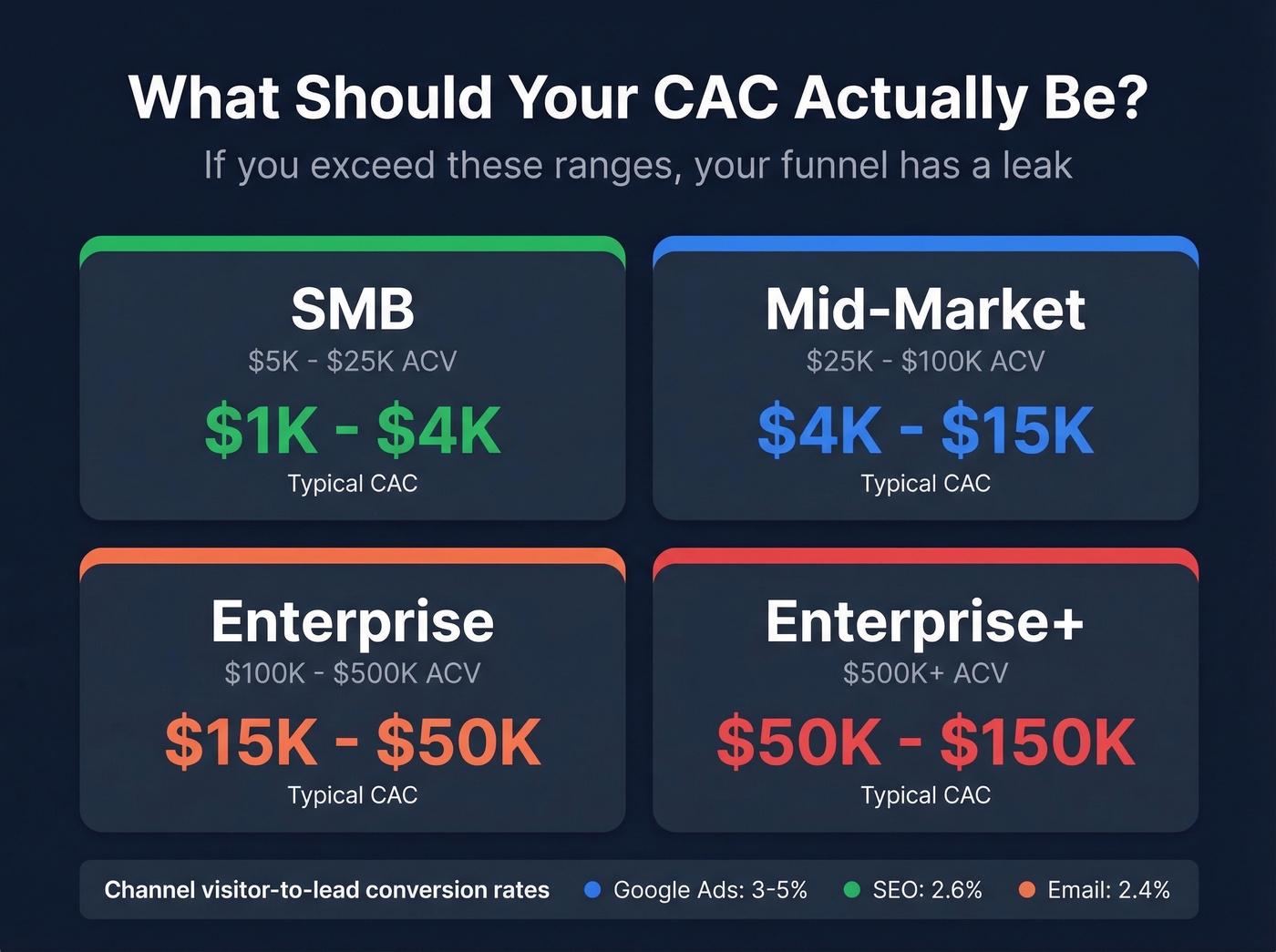
Funnel optimization isn't just conversion rates. It's whether your acquisition cost makes economic sense.
| ACV Band | Typical CAC |
|---|---|
| $5K-$25K (SMB) | $1K-$4K |
| $25K-$100K (Mid-market) | $4K-$15K |
| $100K-$500K (Enterprise) | $15K-$50K |
| $500K+ (Enterprise+) | $50K-$150K |
If your CAC exceeds these ranges, your funnel has a leak - either you're spending too much to generate leads or you're converting too few of them. Channel benchmarks add context: Google Ads converts visitors to leads at 3-5%, SEO at ~2.6%, and email at ~2.4%.
How to Manage Your Funnel Step by Step
We've seen this seven-step process work across teams from 3-person founder-led sales orgs to 50-rep enterprise operations.
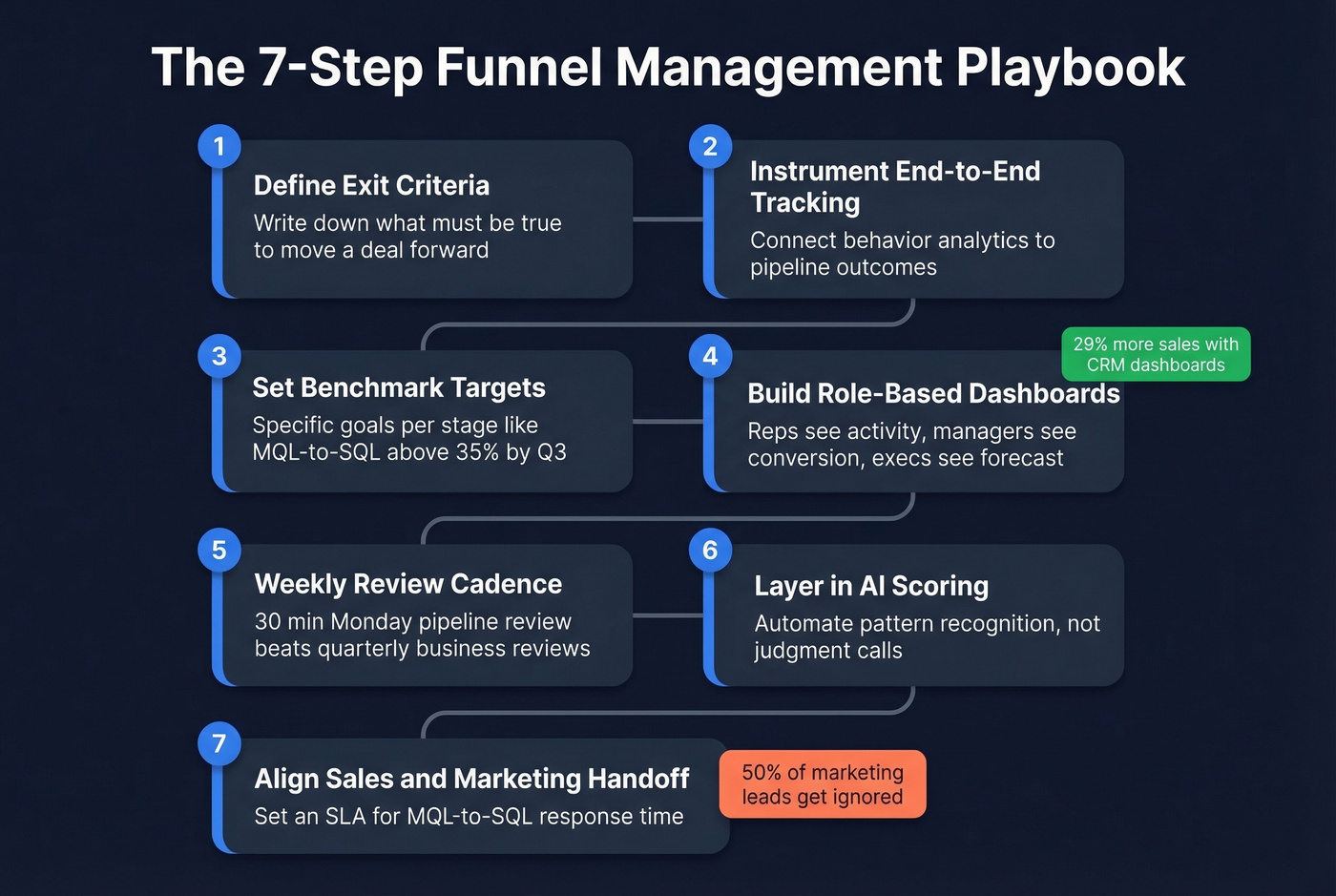
1. Define stages with explicit exit criteria. Don't just label stages - write down what has to be true for a deal to move forward. "MQL" means nothing without criteria. "Visited pricing page + matches ICP + company size 50-500" means something.
2. Instrument tracking end-to-end. Build a measurable chain from landing page view to CTA click to form submit to CRM lead to SQL to opportunity to revenue. Connect behavior analytics to downstream pipeline outcomes, not just form fills. Reliable tracking at every transition is what separates teams that optimize from teams that guess.
3. Set benchmark targets per stage. Use the tables above as starting points, then calibrate to your own data after 2-3 months. Your benchmarks should be specific: "MQL-to-SQL above 35% by Q3" not "improve conversion."
4. Build role-based dashboards. Reps need activity metrics and stage progression. Managers need conversion rates and velocity. Execs need pipeline value and forecast accuracy. One dashboard for everyone means no dashboard works for anyone. A purpose-built funnel tracker inside your CRM - whether it's a HubSpot report or a Salesforce dashboard - lets each role see exactly the metrics they can act on. Teams using CRM dashboards see a 29% average increase in sales, and organizations with mobile CRM access hit sales targets 65% of the time vs. 22% without.
5. Establish a weekly review cadence. In our experience, the teams that review funnel metrics weekly catch problems in days. Teams that review monthly catch them in quarters. A 30-minute pipeline review every Monday morning is worth more than a quarterly business review.
6. Layer in AI where it earns its keep. Predictive lead scoring and AI-driven deal prioritization aren't experimental anymore - they're table stakes for any team running more than a handful of deals. Use AI to flag deals likely to stall, score inbound leads against your ICP automatically, and surface re-engagement opportunities for stalled pipeline. Don't automate judgment calls like disqualification, but do automate the pattern recognition that feeds those calls. (If you're building this out, B2B predictive analytics is a good starting point.)
7. Align sales and marketing at the handoff. Set an SLA for MQL-to-SQL response time. Half of marketing-generated leads get ignored by sales - that's not a marketing problem, it's a handoff problem. Define who owns what, when the handoff happens, and what "worked" means for both sides. And build a re-engagement workflow for lost deals: a prospect who went cold three months ago may have budget now.
For small teams and founders: skip to steps 1, 2, and 5. Start with capture, demo, CRM. Get the basic flow instrumented, then layer in benchmarks and dashboards as you scale. The founder who's trying to minimize time spent on sales while handling inbound leads needs a lightweight version of this, not an enterprise playbook. Build the minimum viable feedback loop first - everything else comes later.
Funnel Management Tools Worth Using
CRM (Your Funnel Backbone)
HubSpot Sales Hub is the default for teams that want marketing and sales in one platform. Free tier gets you started, Professional runs $100/seat/month, Enterprise $150/seat/month. The reporting is solid out of the box, and the marketing integration means your funnel data doesn't live in two systems. If you're already running HubSpot for marketing, adding Sales Hub is the path of least resistance - and the unified reporting across the full funnel is genuinely useful, not just a nice-to-have.
Pipedrive is the best visual pipeline tool for teams that want simplicity over features. Plans run around $15-$100/user/month. If your team is under 20 reps and you don't need marketing automation baked in, Pipedrive's drag-and-drop interface makes funnel oversight intuitive. Skip it if you need deep reporting or marketing attribution - that's not what it's built for.
Salesforce starts at $25/user/month and remains the enterprise standard - steeper learning curve, but unmatched customization. Zoho CRM from $14/user/month is the budget pick for small teams who need CRM basics with solid workflow automation and no sticker shock. (If you're comparing options, see more examples of a CRM.)
Data Quality & Verification
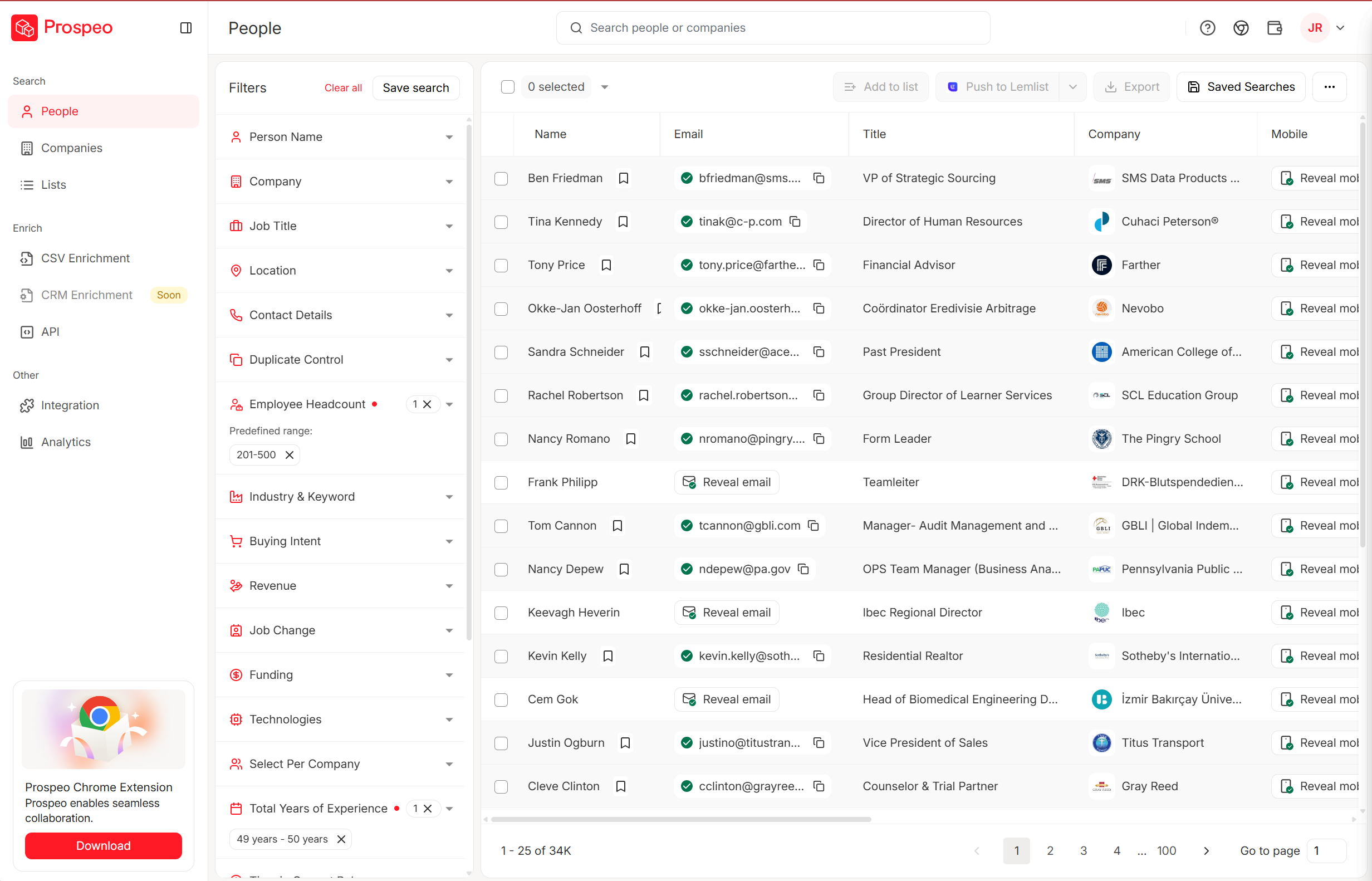
Your CRM is only as useful as the data inside it. Bad contact data is the silent killer of funnel metrics - every bounced email, every wrong number, every outdated record compounds through every stage. We've watched teams spend months optimizing their sales process only to realize the real problem was 30% of their contact records were garbage.
The proof point that matters: Snyk's 50-person AE team went from 35-40% bounce rates to under 5% after switching, and AE-sourced pipeline jumped 180%. That's what clean data does to funnel economics. Free tier gives you 75 emails and 100 Chrome extension credits per month. Paid usage runs at ~$0.01/email. No contracts. (If bounces are hurting you, start with email bounce rate fundamentals.)
ZoomInfo starts at $14,995/year and goes to $40K+ for Elite plans. Broad database coverage, especially in the US, but 87% email accuracy vs. 98% from Prospeo means more bounces and more waste at the top of your funnel. If budget isn't a constraint and you need deep firmographic data alongside intent signals, ZoomInfo is a strong option - just verify the accuracy against your own bounce rates before committing to an annual contract.
| Tool | Starting Price | Best For |
|---|---|---|
| HubSpot Sales Hub | Free / $100/seat/mo | All-in-one CRM + marketing |
| Pipedrive | ~$15/user/mo | Visual pipeline management |
| Salesforce | $25/user/mo | Enterprise customization |
| Zoho CRM | $14/user/mo | Budget-friendly workflow automation |
| Prospeo | Free / ~$0.01/email | Data accuracy & verification |
| ZoomInfo | $14,995/yr | Large database coverage |
Common Funnel Mistakes to Avoid
No early disqualification. Go back to the math: 33% stage progression requires 810 pitches for 10 deals. 50% requires 160. The difference is entirely about how aggressively you disqualify. Set hard criteria at each stage and enforce them. A "maybe" that lingers in your pipeline for 90 days costs more than a "no" on day one.
Bad data poisoning the funnel. If your bounce rate is above 5%, fix your data before you fix your process. We've seen teams cut bounce rates from 35-40% to under 5% just by verifying contact data before it enters the CRM - that's not a marginal improvement, it's the difference between a functional funnel and a broken one. Every bad email wastes a sequence step, hurts your domain reputation, and skews your conversion metrics. (For the deeper mechanics, use an email deliverability guide.)
Skipping nurture for "buy now" pressure. There's a real tension in B2B right now. Teams running incentivized demo ads with $100-$200 gift cards can generate qualified pipeline, but close rates crater because the prospect wasn't ready to buy. Stage-appropriate engagement beats forcing every lead into a demo. Cart abandonment averages 70% across industries for a reason - people need time.
No follow-up speed discipline. Half of marketing-generated leads get ignored by sales. That's not an exaggeration - it's a consistent finding across multiple studies. Establish an SLA for response time. If an MQL sits untouched for 48 hours, it's not an MQL anymore. (If you need copy you can deploy fast, use these sales follow-up templates.)
Never re-engaging lost deals. Most teams treat a closed-lost deal as dead forever. Build a re-engagement workflow that triggers 60-90 days after a deal goes cold. Budget cycles change, champions switch roles, new pain points emerge. A simple "has anything changed?" email sequence recovers more pipeline than most teams expect.
Your MQL-to-SQL rate tanks when reps waste calls on wrong numbers and bounced emails. Prospeo delivers 143M+ verified emails and 125M+ verified mobiles so your qualified-to-booked rate climbs toward that 78% top-decile benchmark - not languishes below median.
Book 26% more meetings with contact data that actually connects.
FAQ
What's a good funnel conversion rate?
B2B SaaS benchmarks run roughly 39% Lead-to-MQL, 38% MQL-to-SQL, and 37% SQL-to-Closed Won. Full-funnel visitor-to-customer conversion typically lands at 1-3%, with anything above 3% placing you in the top quartile. Calibrate against First Page Sage's industry benchmarks, then adjust for your deal size and sales cycle length.
How is a sales funnel different from a sales pipeline?
A funnel tracks volume and conversion rates across the buyer journey - how many prospects drop off at each stage. A pipeline tracks individual deals and their progress toward closing. You need both: the funnel reveals systemic conversion problems, while the pipeline shows deal-level execution gaps in real time.
What tools do I need for sales funnel management?
At minimum: a CRM like HubSpot, Pipedrive, or Salesforce, plus a data verification tool to keep contact records clean before they enter your system. Add basic sequence automation for follow-up. A lightweight stack handles 90% of what teams under 50 reps need - start with CRM and data quality, then layer in automation as you scale.
How do you manage a funnel with a small team?
Start simple: capture leads, book demos, and log everything in your CRM. Instrument tracking across those three steps so you can see where prospects drop off. After a month or two of data, set stage-specific conversion targets and add a weekly 30-minute review. Build the minimum viable feedback loop first - enterprise-grade process comes later. Pipedrive's visual pipeline is a solid starting point if you want something lightweight that doesn't require a CRM admin to configure.