

Sales Funnel vs Sales Cycle: What's Actually Different?
A VP of Sales posted on r/sales asking whether the sales cycle is the seller's perspective and the funnel is the buyer's. That question captures the core confusion perfectly - people mix up cycle, funnel, and pipeline, then optimize the wrong thing entirely.
The sales cycle measures how long it takes to close a deal. The sales funnel measures how many prospects convert at each stage. One is a clock. The other is a filter. Get them confused and you'll spend weeks fixing something that was never the actual problem.
What Is a Sales Cycle?
The sales cycle is the structured process from first contact to closed deal - prospecting, qualifying, engaging, proposing, negotiating, closing. It's measured in days, and it answers one question: how long does this take?
For most B2B companies, the answer is 60 to 120 days. Complex enterprise deals average 10.1 months according to 6sense research. GovTech sellers on Reddit describe 12-18 month cycles dictated by procurement timelines and fiscal year budgets.
Cycles are getting longer for many teams. A RAIN Group study found 43% of sales leaders report their cycles have grown, while only 16% say they've shortened. More stakeholders, more legal review, more consensus-driven buying - all of it adds time. And here's what makes cycle speed existential, not just operational: 6sense research shows the winning vendor is on the buyer's Day One shortlist 95% of the time, and buyers don't even make first contact until they're 61% through their buying journey. If you're not present before that mental shortlist closes, your cycle length is irrelevant. You never had a shot.
What Is a Sales Funnel?
The sales funnel doesn't map a journey - it measures where prospects drop off. The concept traces back to the AIDA model), but modern B2B teams think in TOFU, MOFU, and BOFU stages mapped to Lead, MQL, SQL, Opportunity, and Closed Won.
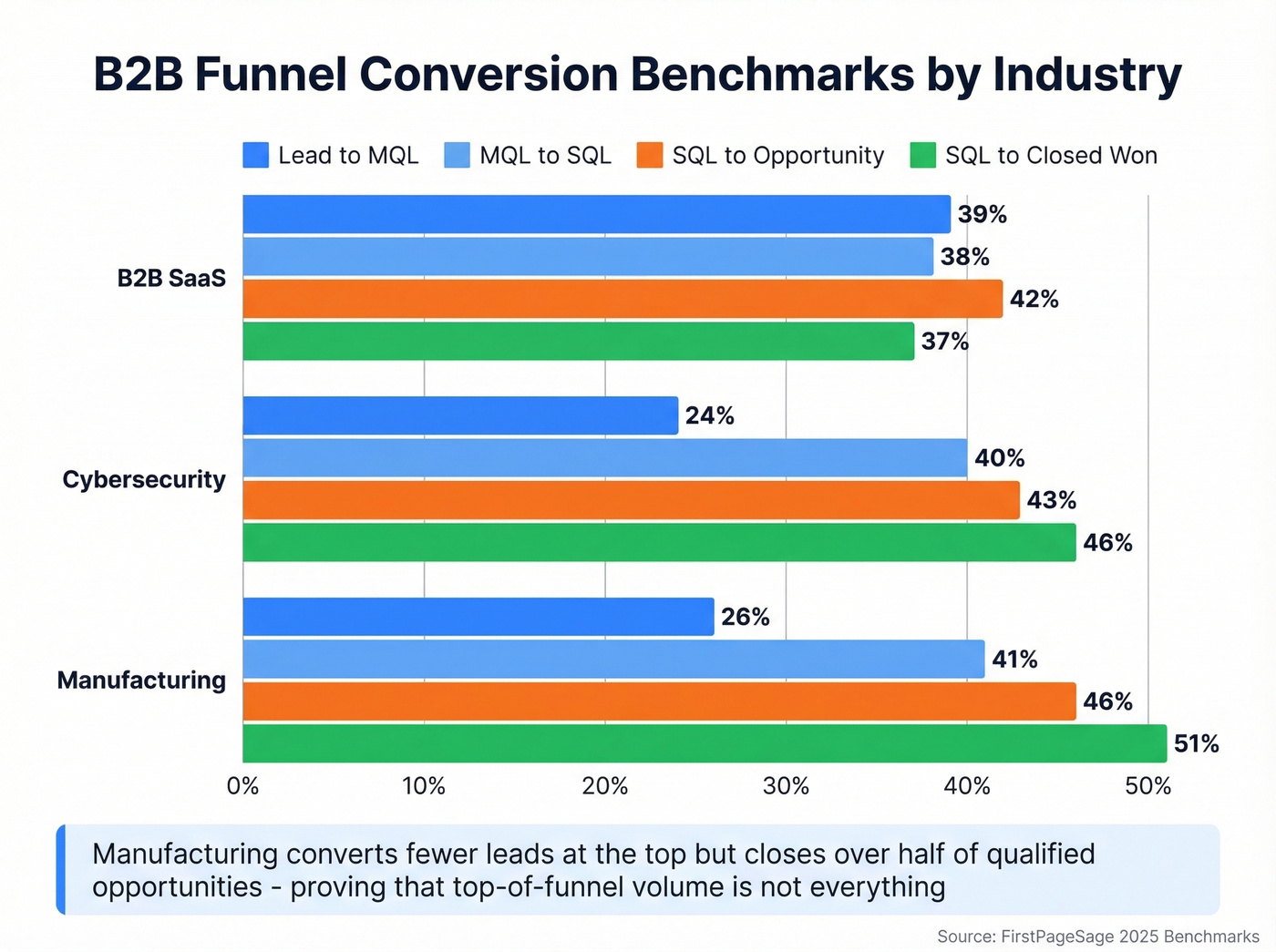
The power of the funnel is in the numbers. The median B2B conversion rate sits at 2.9% end-to-end, but that single number hides where the real problems live. Here's the breakdown by industry using FirstPageSage's benchmark data:
| Industry | Lead to MQL | MQL to SQL | SQL to Opp | SQL to Closed Won |
|---|---|---|---|---|
| B2B SaaS | 39% | 38% | 42% | 37% |
| Cybersecurity | 24% | 40% | 43% | 46% |
| Manufacturing | 26% | 41% | 46% | 51% |
Manufacturing has a lower top-of-funnel conversion but a much higher close rate. In our experience, teams that track both frameworks catch revenue problems two to three stages earlier than those using just one. The funnel surfaces that kind of insight - a time-based cycle measurement never would.
Side-by-Side Comparison
| Dimension | Sales Cycle | Sales Funnel |
|---|---|---|
| Measures | Time (days to close) | Conversion (% drop-off) |
| Perspective | Seller's process | Buyer conversion behavior |
| Key metric | Days-to-close | Stage conversion % |
| Typical stages | Prospect to Close | Lead to MQL to SQL to Won |
| Primary use | Forecasting | Optimization |
| Owned by | Sales leadership | Marketing + sales ops |
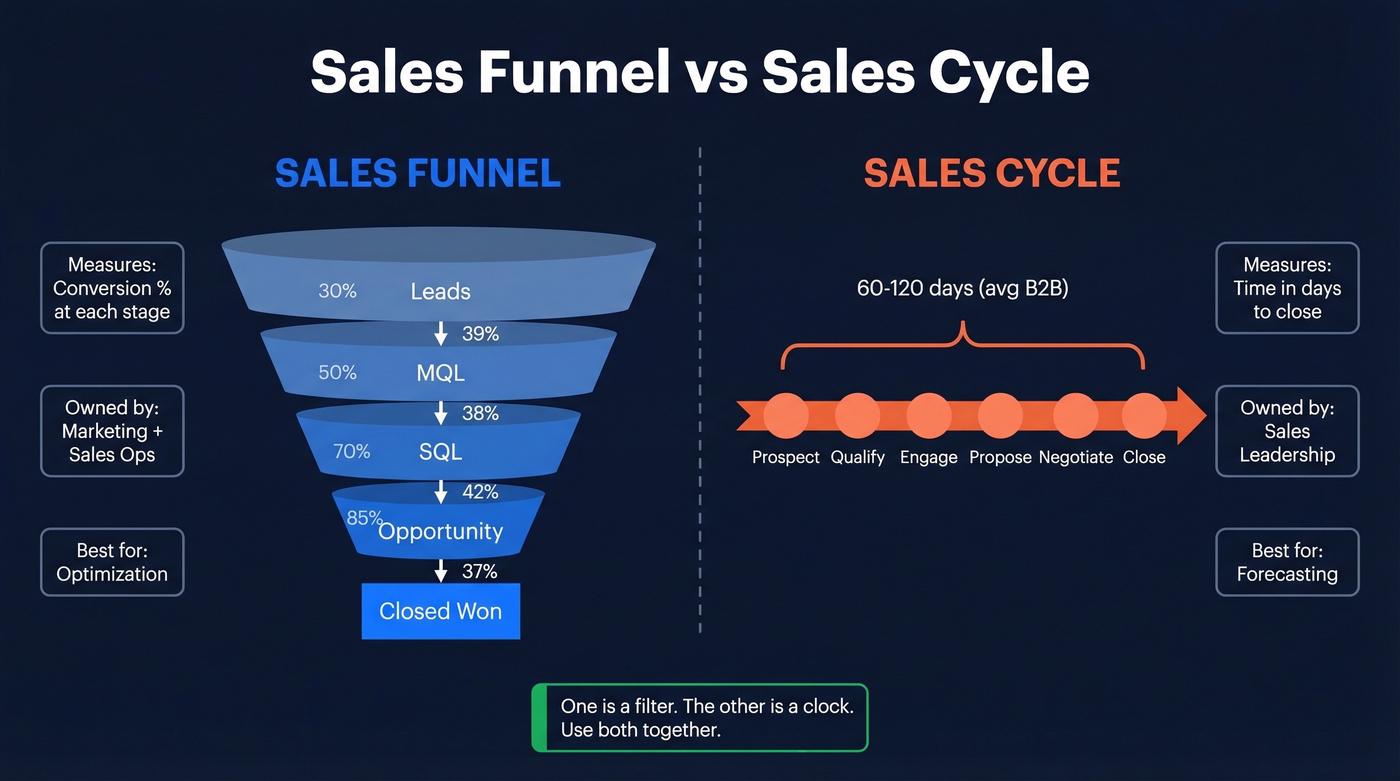
The cycle tells you a deal takes 90 days. The funnel tells you 85% of MQLs never become SQLs. Both are true. Neither is sufficient alone.

Your funnel shows 85% of MQLs never become SQLs. Your cycle shows deals dragging past 90 days. Both problems trace back to the same root cause: reps chasing outdated contacts. Prospeo's 143M+ verified emails refresh every 7 days - not every 6 weeks - so your outreach actually reaches real buyers.
Stop losing deals to bad data. Start with 75 free verified emails.
How Does the Pipeline Fit In?
The pipeline is the operational layer - your CRM's deal tracker, showing which deals are active, their dollar value, and what stage they're in. Think of it this way: the pipeline shows what sellers do, the funnel reveals what buyers do, and the cycle measures how long it all takes.
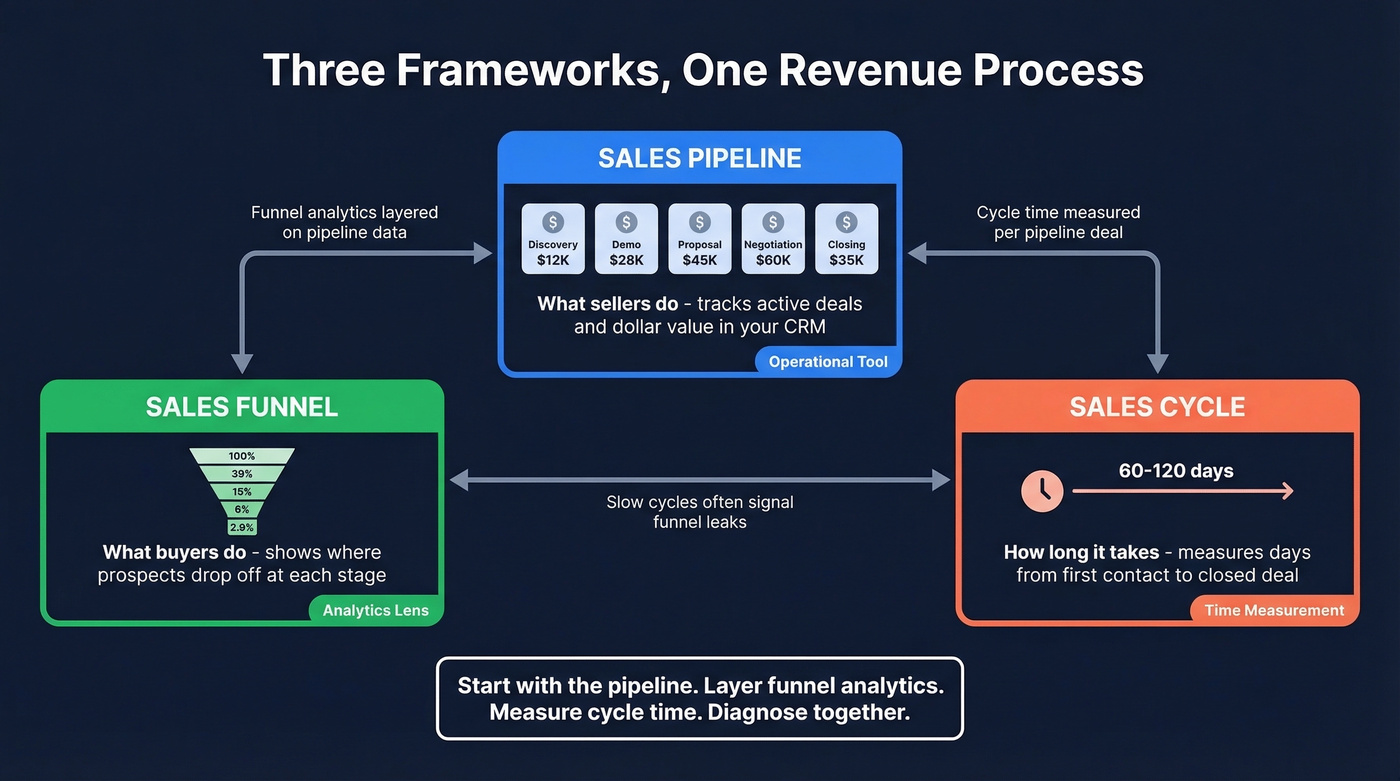
If you're building from scratch, start with the pipeline. It's operational and immediate. Then layer funnel analytics on top to spot conversion bottlenecks.
Where Funnels Leak and Cycles Stall
The biggest funnel leakage point is MQL to SQL - only about 15% of MQLs convert to SQLs, meaning 85% drop off before reaching a real sales conversation. And 79% of leads never convert at all due to insufficient nurturing, a problem that compounds when reps are working from bad data.
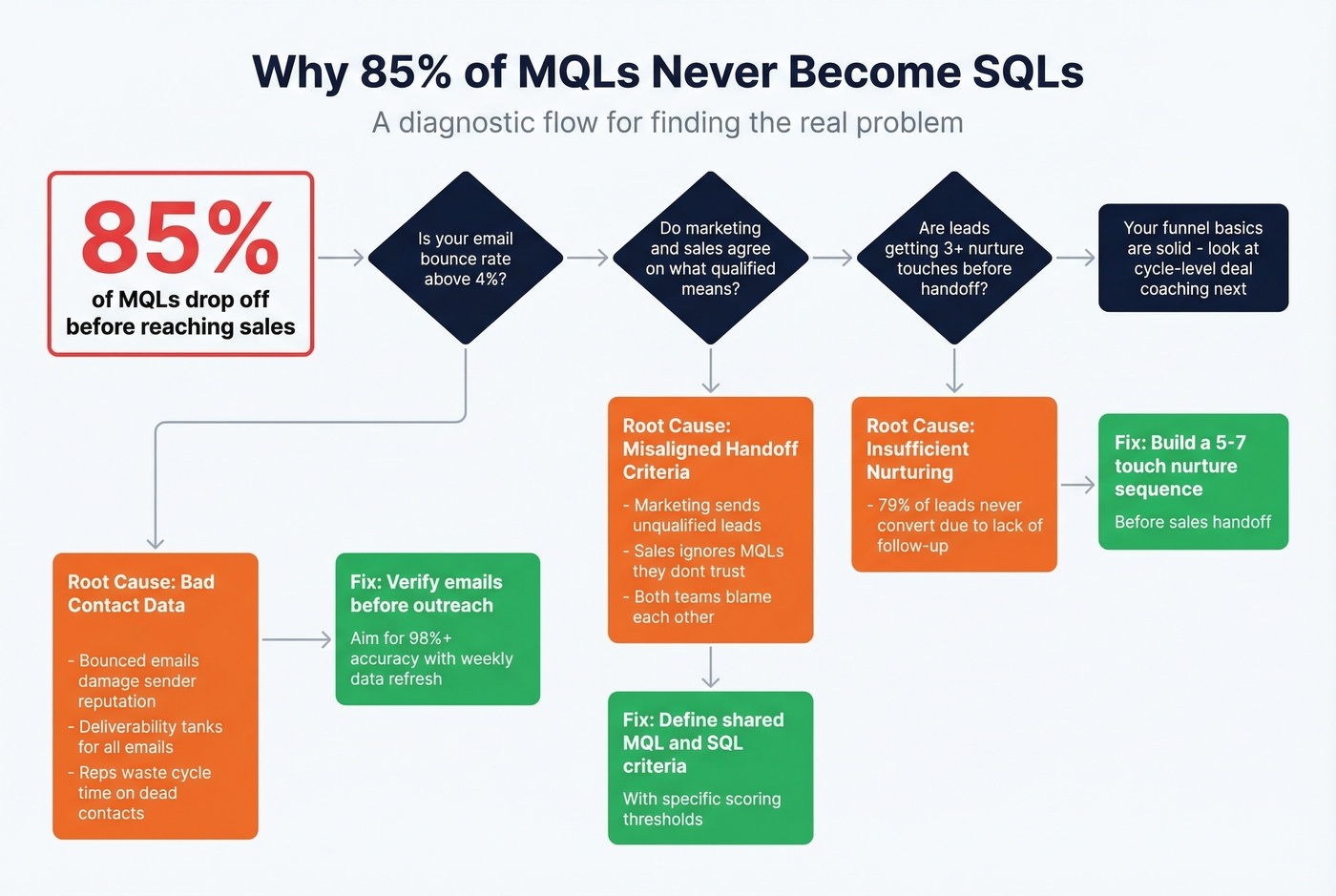
Here's the thing: most teams blame their nurture sequences or lead scoring when conversion tanks. But we've seen the root cause over and over - bad contact data. If a meaningful chunk of your emails bounce, you're not just losing those leads. You're damaging sender reputation, which tanks deliverability for the emails that would have landed. That's funnel leakage and cycle drag compounding each other.

If your MQL-to-SQL drop-off is worse than 15%, check your data before blaming your nurture sequence. Prospeo runs 98% email accuracy with a 7-day data refresh cycle across 143M+ verified emails, so reps aren't burning cycle time chasing contacts who left the company six months ago. Gating friction from forms already causes abandonment - Reddit practitioners complain about this constantly. Adding bounced emails on top creates a compounding problem you can actually fix.
When to Use Which Framework
Use the cycle framework when you need to forecast revenue timing and cash flow, coach reps on deal-level progression, or benchmark how efficiently your enterprise sales motion runs.
Use the funnel framework when you need to identify which stage loses the most prospects, optimize marketing spend and resource allocation, or align marketing and sales on handoff criteria.
Use both when you're scaling outbound, diagnosing pipeline health, or trying to get marketing and sales to stop blaming each other. Let's be honest - that last one is half the reason RevOps exists. Treating the funnel and cycle as a single integrated view, time and conversion layered together, is how high-performing ops teams pinpoint whether deals are dying slow or dropping fast.
Some teams are moving toward flywheel models that loop post-sale retention back into the top of the funnel. It's a useful complement, not a replacement - the funnel still does the best job of showing where conversion breaks.
Skip the flywheel if you haven't nailed your basic funnel metrics yet. You can't optimize a loop when you don't know where the line breaks.
Every bounced email is funnel leakage and cycle drag compounding each other. At ~$0.01 per verified email with 98% accuracy, Prospeo eliminates the data problem so you can diagnose what's actually stalling conversions - not chase ghosts who left the company months ago.
Teams using Prospeo book 35% more meetings than Apollo users. See why.
FAQ
Is the sales funnel the same as the sales pipeline?
No. The funnel measures conversion rates between stages - what percentage of prospects drop off at each step. The pipeline tracks individual deals and their dollar value through your CRM. The funnel is an analytics lens; the pipeline is an operational tool. Most RevOps teams use both simultaneously.
How long is a typical B2B sales cycle?
Most B2B sales cycles run 60-120 days. Complex enterprise deals average 10.1 months, and GovTech sales regularly stretch to 12-18 months due to procurement requirements. With 43% of leaders reporting longer cycles, these numbers are trending up across industries.
How do I fix a leaky sales funnel?
Start with data quality - bad contact data is the top cause of top-of-funnel leakage. Once bounce rates drop below 4%, deliverability improves and MQL-to-SQL conversion follows. Then audit your handoff criteria. If marketing and sales disagree on what "qualified" means, that 15% conversion rate stays stuck.
What's the core difference between a funnel and a cycle?
The sales funnel vs sales cycle distinction comes down to measurement. The cycle tracks time from first contact to closed deal - use it for forecasting. The funnel tracks the percentage of prospects who advance or drop off at each stage - use it for optimization. High-performing teams layer both views together.