

Sales GPT: What It Actually Means, What Works, and What Doesn't
Your VP came back from a conference and dropped "Sales GPT" into a Slack thread like it was a strategy. You tried to research it. You found a 2023 Salesforce press release with branding that's already outdated, a GitHub repo with ~2,500 stars, and two startups you've never heard of. Now you're supposed to "figure out our AI sales strategy" by Friday.
Sales GPT isn't one product. It's three different ideas wearing the same trench coat - and conflating them is how teams waste months evaluating the wrong thing.
What "Sales GPT" Actually Means
The term gets thrown around in three completely different contexts.
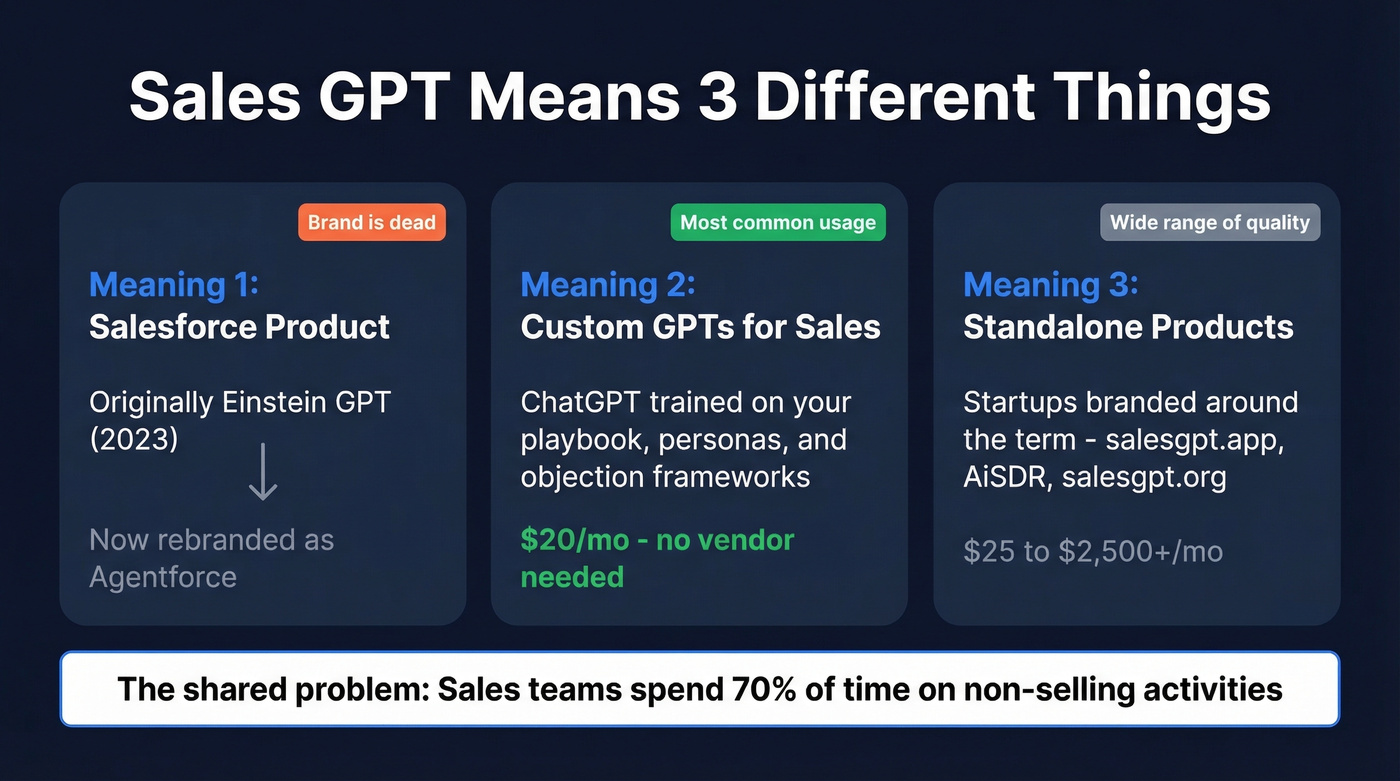
Meaning 1: Salesforce's original product. In 2023, Salesforce launched "Sales GPT" as part of its Einstein GPT suite. It's since evolved into what Salesforce now calls Agentforce - a broader AI layer across Sales Cloud designed to automate repetitive tasks so reps can focus on selling. If someone references "Salesforce Sales GPT," they're talking about a product that's been renamed and rebuilt. The brand is dead; the functionality lives on.
Meaning 2: Custom GPTs built for sales workflows. This is what most practitioners actually mean. You take ChatGPT, train it on your playbook, personas, and objection-handling frameworks, and use it as a sales assistant. No vendor required. Just $20/month for ChatGPT Plus and some thoughtful prompt engineering. There's also an open-source SalesGPT project on GitHub (LangChain-based) that can identify the stage of a sales conversation and act accordingly - interesting for developers, but more framework than production tool for most teams.
Meaning 3: Standalone products. A handful of startups - salesgpt.app, salesgpt.org, and AiSDR's "Sales GPT" - have literally branded around the term. These range from lightweight prompt wrappers to full AI SDR platforms charging $900+/month.
The shared problem all three address: sales teams spend roughly 70% of their time on non-selling activities - admin, data entry, research, scheduling. AI's promise is reclaiming that time. Whether it delivers depends entirely on which path you pick and what data you feed it.
What You Need (Quick Version)
Three paths, based on where you are:
- Mid-market team (10-50 reps): Apollo for prospecting, Gong for call intelligence, ChatGPT for workflow automation. Layer a verification tool on top - Apollo's data is good but not clean enough to protect your domain at scale.
- Enterprise Salesforce shop: Agentforce is the native choice. But verify your data independently. CRM data decays fast, and Agentforce is only as good as what's in your org.
Does AI Actually Work for Sales?
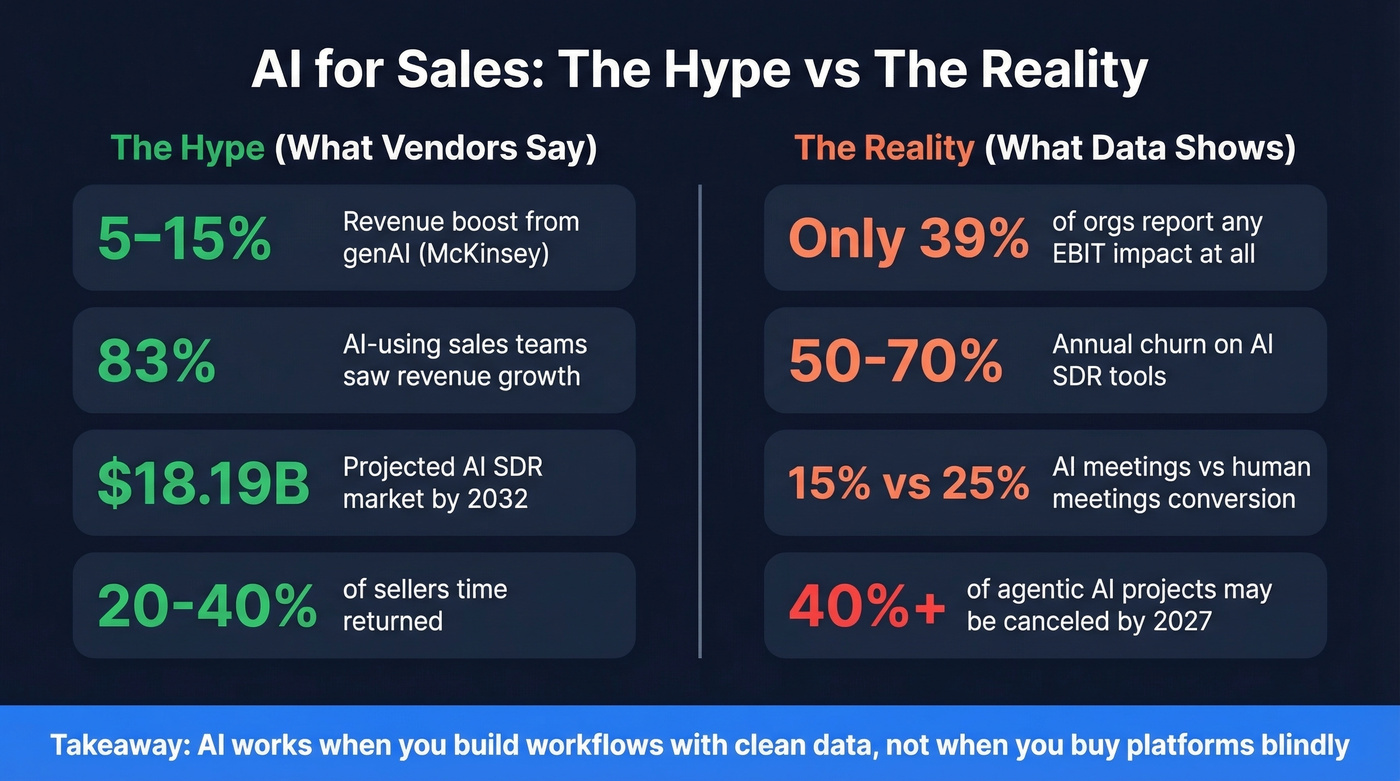
The headline stats look great. McKinsey estimates genAI can boost B2B sales revenues 5-15% and return 20-40% of sellers' time. Salesforce reports 83% of AI-using sales teams saw revenue growth, versus 66% without. The AI SDR market is projected to grow from $4.27B to $18.19B by 2032 at a 23% CAGR.
Now the reality check.
McKinsey's own survey shows 88% of organizations use AI in at least one function, but only 39% report any EBIT impact at all - and for most of those, it's under 5% of EBIT. AI SDR tools see 50-70% annual churn. The conversion gap between AI-generated meetings and human-generated ones sits around 15% vs 25%. Industry predictions suggest 40%+ of agentic AI projects will be canceled by end of 2027.
The risks are real too: hallucinated company details in outreach emails, data leaks from poorly configured LLM integrations, and compliance gaps when AI-generated content crosses regulatory lines. One practitioner on r/AI_Agents reported wasting weeks debugging agentic workflows for tasks that a simple automation trigger could handle. Not every sales task needs AI - sometimes basic automation does the job faster and more reliably.
Here's the thing: if your deal sizes sit below $10K, you almost certainly don't need an AI SDR platform at $900+/month. Build custom GPTs, feed them clean data, and keep your reps in the loop. The teams we've seen getting real ROI aren't buying platforms - they're building workflows.
Best AI Sales Tools in 2026
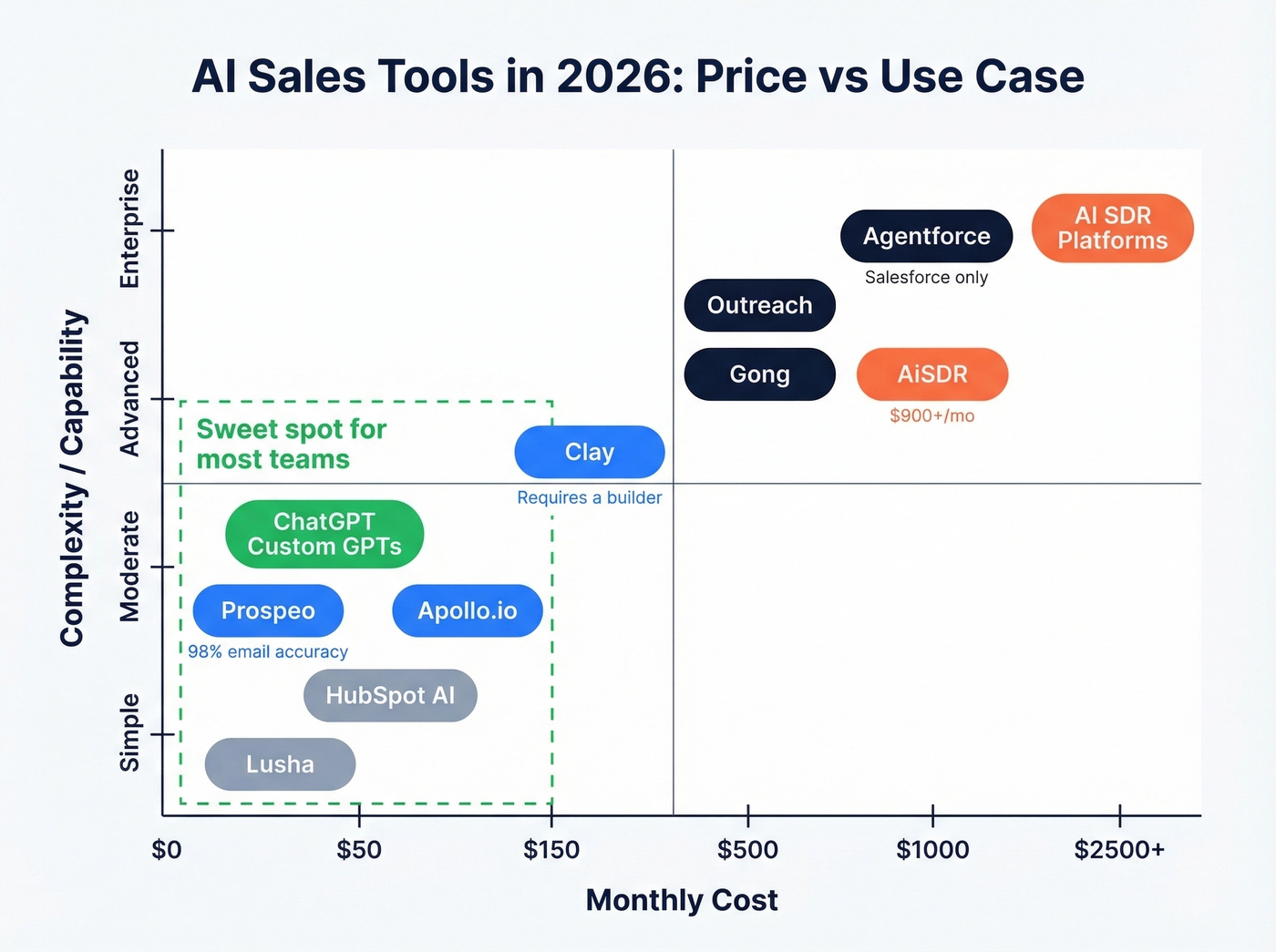
| Tool | Starting Price | Best For |
|---|---|---|
| ChatGPT Custom GPTs | $20/mo (Plus) | DIY sales assistants |
| Prospeo | Free (75 emails/mo) | Verified contact data |
| Apollo.io | Free / $39/user/mo | Mid-market prospecting |
| Clay | $149+/mo | Advanced enrichment |
| HubSpot AI | $20/seat/mo | CRM-native AI |
| Agentforce | $75-$330/user/mo | Enterprise Salesforce shops |
| Outreach | ~$100-$150/user/mo | Enterprise pipeline |
| Gong | ~$100-$150/user/mo | Conversation intelligence |
| AiSDR | $900-$2,500/mo | AI SDR platform |
| AI SDR platforms (avg) | $500-$5,000/mo | Autonomous outbound |
ChatGPT Custom GPTs
This is the most underrated option in the entire conversation. For $20/month, you can build custom GPTs trained on your specific playbook, personas, objection frameworks, and competitive positioning. No vendor lock-in. No six-month implementation. No $50K annual contract.
Custom GPTs win for most teams because you control the training data. Upload your best-performing email sequences, your MEDDIC templates, your competitor battlecards. The GPT learns your voice - not some generic "sales AI" tone that sounds like every other automated email in your prospect's inbox. We've seen teams build five custom GPTs (cold email writer, objection handler, call script generator, battlecard assistant, and call recap tool) in under a day, and the output quality depends entirely on what you feed it.
Prospeo
Every AI sales tool in this list has the same dependency: the data you feed it. If your contact data is stale or unverified, your AI-generated emails bounce, your personalization fields show "[First Name]," and your domain reputation tanks.

Prospeo's database covers 300M+ professional profiles with 98% email accuracy - compared to 87% at ZoomInfo and 79% at Apollo. The 7-day data refresh cycle means you're not working with contacts who changed jobs six weeks ago. At ~$0.01 per email with a free tier of 75 emails/month, it's one of the cheapest ways to keep outbound deliverability intact. Snyk's 50-person AE team went from 35-40% bounce rates to under 5% after switching, with AE-sourced pipeline jumping 180% and generating 200+ new opportunities per month.
Apollo.io
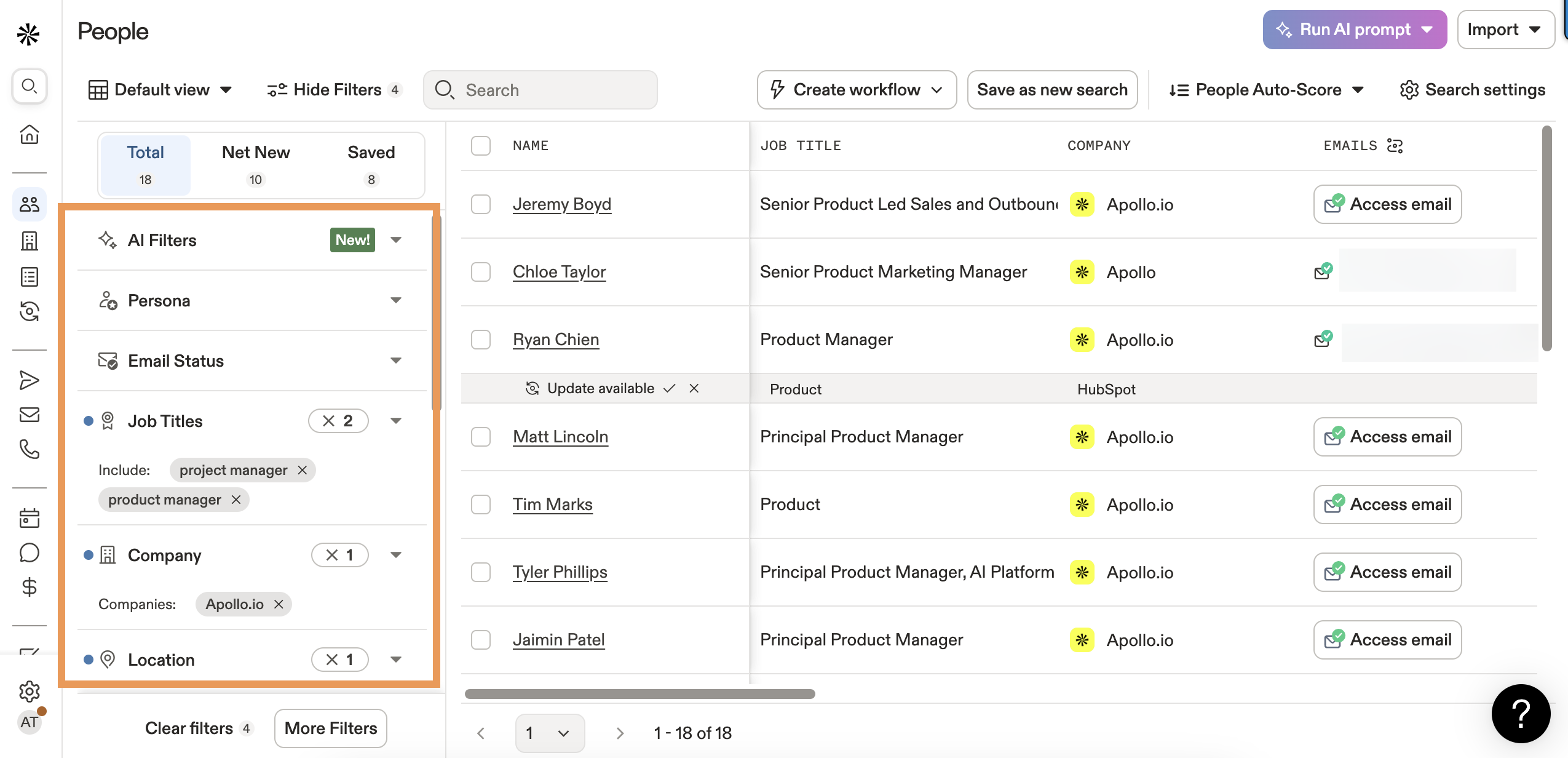
Use this if: You need a single platform for prospecting, basic sequences, and a solid contact database - and you want to be up and running today. Apollo's free tier is genuinely useful, and paid plans start at $39/user/month.
Skip this if: You're selling into niche industries or smaller international markets. Apollo's data quality gets spotty outside mainstream segments, and the AI features are more "helpful copilot" than "autonomous agent."
Clay
Clay is the tool practitioners on Reddit consistently praise - and consistently warn requires a specific type of person to operate. Think of it as LEGO pieces for data: you chain together enrichment sources, AI prompts, and data transformations to build hyper-specific prospect lists that no single database could produce.
Pricing runs $149-$800/month. Clay's ceiling is higher than almost any other tool here, but it demands someone who genuinely enjoys building workflows. If your team doesn't have that person, you'll pay for Clay and use 10% of it.
If you're going down this route, it helps to understand data enrichment and what sources you're chaining together.
Salesforce Agentforce
This is what "Salesforce Sales GPT" became. Agentforce handles prospecting, autonomous qualification across web, email, and voice, pipeline management with automatic field updates, and meeting prep - with a reported 33% faster meeting prep and a 10% increase in win rates. Salesforce's Trust Layer handles data governance, which matters if your legal team has concerns about LLM data retention.
Pricing starts at $75/user/month for Einstein GPT-level features, scaling to $330/user/month for the AI Cloud suite. Agentforce only makes sense if you're already deep in the Salesforce ecosystem. On HubSpot or Pipedrive? Look elsewhere.
Outreach & Gong
Outreach processes 33B+ interaction signals weekly to deliver predictive deal insights and coaching. Expect ~$100-$150/user/month. If you're running a 100+ rep org with complex deal cycles, it's worth evaluating. For smaller teams, it's overkill.
Gong isn't a GPT-powered sales tool by itself, but it's the best workflow partner for one. Record calls in Gong, paste transcripts into ChatGPT, extract MEDDIC fields, and draft follow-up emails. That Gong-to-ChatGPT workflow is one of the most replicated on r/sales. Pricing runs ~$100-$150/user/month.
AiSDR, HubSpot AI & Others
AiSDR offers a custom GPT built on GPT-4, trained for outreach and deliverability guidance. Pricing: $900-$2,500/month. HubSpot AI bakes AI into Sales Hub starting at $20/seat/month - lightweight but improving fast. salesgpt.app ($25-$259/month) and salesgpt.org (free/Pro at $29/month) are niche tools worth a look if you want something purpose-built and cheap. Amplemarket (~$500-$1,000/user/month) combines AI-driven sequencing with enrichment and is popular with mid-market teams. Lusha ($36-$59/user/month) is a solid, affordable contact data option that practitioners frequently recommend alongside Apollo.

Every Sales GPT workflow has the same bottleneck: bad data in, bad outreach out. Prospeo's 300M+ profiles with 98% email accuracy and 7-day refresh give your AI the foundation it needs to actually perform.
Stop debugging AI outputs when the real problem is your contact data.
Build Your Own Sales GPT (Free)
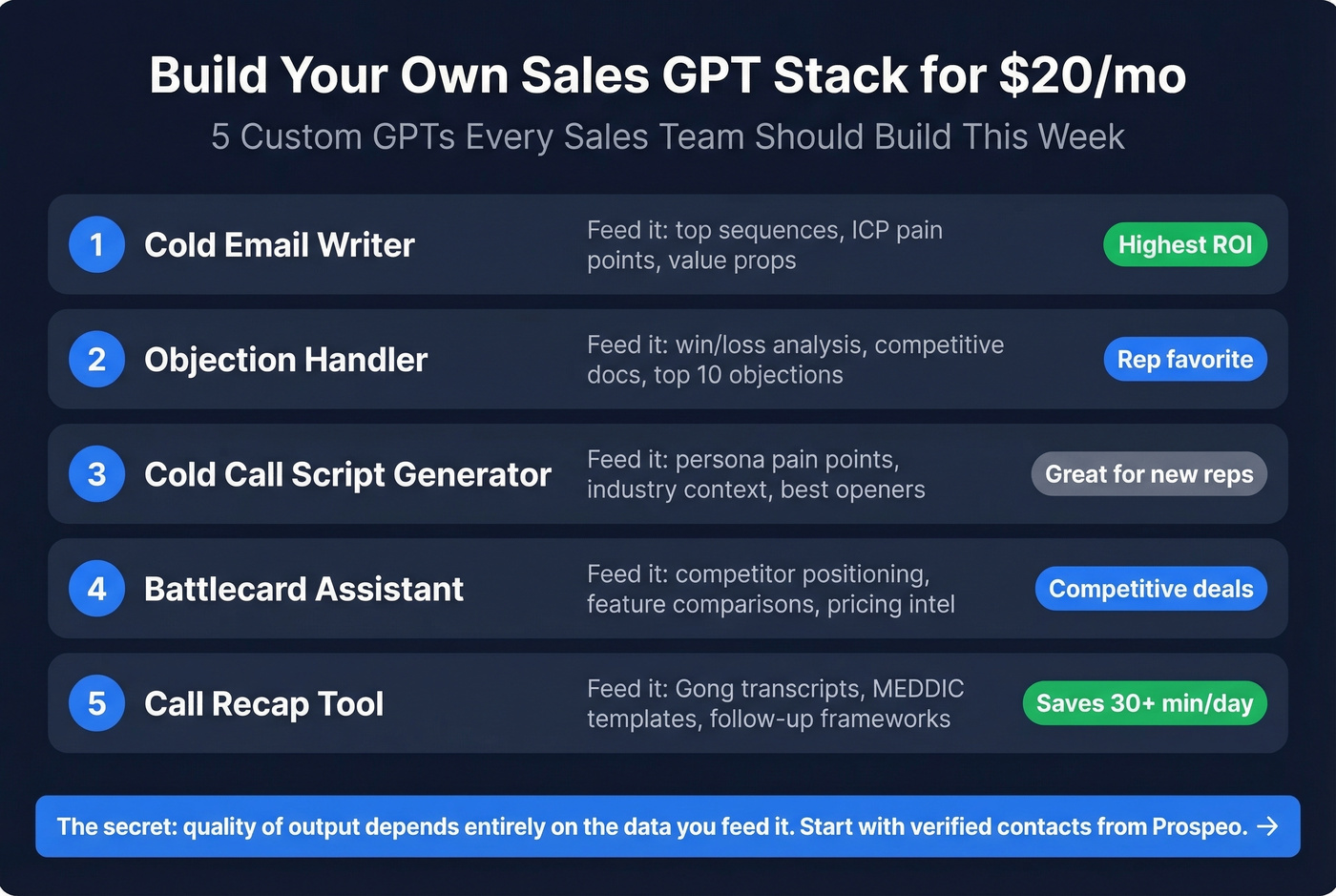
The best AI sales assistant for most teams is the one you build yourself. Here are five custom GPTs worth creating this week.
Cold Email Writer
Train it on your top-performing sequences, your ICP's pain points by persona, and your product's specific value props. Feed it verified contact data so personalization fields are accurate. Example prompt: "Write a 3-sentence cold email to a [title] at a [company size] [industry] company. Pain point: [specific challenge]. Tone: direct, no fluff, one clear CTA."
Objection Handler
Upload your win/loss analysis, competitive positioning docs, and the 10 objections your reps hear most. Prompt pattern: "Prospect said: [objection]. Acknowledge the concern, reframe around [value prop], and ask a question that moves the conversation forward."
If you want to go deeper, map these to proven objection handling techniques so the GPT doesn't just "sound nice."
Cold Call Script Generator
Feed it persona pain points, industry context, and your best openers. Include compliance requirements like GDPR and TCPA as guardrails. This one's especially useful for new reps who haven't internalized your messaging yet - it cuts ramp time dramatically when they can generate scripts tailored to the exact persona they're about to dial.
Competitor Battlecard
Your rep is mid-call and the prospect mentions they're also evaluating a competitor. This GPT becomes their real-time intelligence layer. Upload competitor pricing, feature comparisons, and recent win/loss notes, then ask: "Prospect is evaluating [competitor]. What are our three strongest differentiators and what objection should I expect?"
Call Recap and Follow-Up
This one pairs perfectly with Gong or any call recording tool. Paste a transcript, and the GPT extracts key commitments, next steps, MEDDIC fields, and drafts a follow-up email. Five minutes instead of thirty.
Workflows That Actually Work
Gong to ChatGPT to CRM
This is the workflow that spawned r/chatgptforsales. Here's how it works:
- Record your sales call in Gong or any transcription tool.
- Copy the full transcript into ChatGPT with this prompt: "Extract MEDDIC fields from this call transcript. Format for Salesforce opportunity fields. Flag any gaps where I need follow-up."
- ChatGPT returns structured MEDDIC data - Metrics, Economic Buyer, Decision Criteria, Decision Process, Identify Pain, Champion - formatted for your CRM.
- Draft the follow-up email in the same thread: "Based on this call, write a follow-up email that references [specific pain point discussed], confirms [next steps], and includes one piece of relevant content."
- Paste MEDDIC fields into your opportunity record. Send the email. Total time: 5 minutes instead of 30.
In our experience, this single workflow saves reps more time than any $900/month AI SDR platform. It's not glamorous. It just works.
The Data Quality Problem
Look - if your bounce rate is above 10%, buying an AI email writer is like putting a spoiler on a car with no engine. Every tool in this article - ChatGPT, Apollo, Clay, Agentforce - depends on accurate contact data to function. Most teams don't have it.
The hidden cost nobody budgets for: 40-60 hours of data cleaning, enrichment, and segmentation before you can even launch an AI-powered outbound motion. A human SDR costs $75K-$139K/year fully loaded. An AI SDR platform runs $500-$5,000/month. But the AI only delivers if the data underneath it is solid. Clean data is the prerequisite that makes every other tool in your stack perform - skip this step and your fancy AI workflows bounce, your domain reputation drops, and your reps lose trust in the entire system.
If you're trying to systematize this, start with CRM automation and a repeatable data hygiene process.
Building custom GPTs for sales? Smart move. But even the best prompt engineering can't fix a bounced email. At $0.01 per verified email, Prospeo is the cheapest way to keep your AI-powered outbound from torching your domain reputation.
Snyk cut bounce rates from 40% to under 5% - their AI finally had room to work.
Sales GPT FAQ
Is Salesforce Sales GPT still available?
No. Salesforce retired the Sales GPT branding and replaced it with Agentforce, which now serves as the AI layer across Sales Cloud. If you're evaluating Salesforce's AI capabilities in 2026, look at Agentforce, not the old product name.
Can I build a sales GPT for free?
What's the biggest mistake teams make with AI sales tools?
Launching on bad data. AI amplifies whatever you feed it - if your contact list has 30% invalid emails, your AI-written sequences bounce at 30%. Verify your data first, clean your CRM, then layer AI on top.
How long before I see ROI from AI sales tools?
Expect 3-6 months with clean data and defined workflows. Budget 6-9 months if you're building processes from scratch. The first 40-60 hours go to data prep, segmentation, and prompt engineering - not the glamorous part, but the part that determines whether the investment pays off.