Sales Intelligence AI: The Practitioner's Guide for 2026
Reps spend about 25-30% of their time actually selling. Sales intelligence AI was supposed to fix that. For most teams, it hasn't - because they bought the AI before they fixed the data.
The Short Version
B2B contact records decay roughly 30% per year. Fix your data quality first, then layer AI for signal detection, lead prioritization, and autonomous workflows. Budget anywhere from $0 on free tiers to $60K+/year depending on team size and ambition.
What Sales Intelligence AI Actually Is
It's not a database with a search bar. It's the layer sitting between your data sources and your CRM, making both smarter without replacing either.
That layer covers real-time contact enrichment, buyer intent tracking, autonomous lead qualification, and signal-based outreach sequencing. If your platform isn't using AI for data validation, signal detection, and workflow execution, you're paying for a spreadsheet with a nice UI.
The market is projected to grow from $4.42B in 2025 to $9.15B by 2031 at 12.89% CAGR. A separate Precedence Research forecast puts it at $9.02B by 2034 at 10.54% CAGR - different methodology, same conclusion. The fastest-growing segment is SMEs at 16.93% CAGR, because smaller teams simply can't afford to waste rep time on manual research.
Why AI-Powered Selling Matters Now
56% of sales professionals use AI daily, and those daily users are twice as likely to exceed their targets. AI adoption in sales nearly doubled from 24% to 43% between 2023 and 2024. Early deployments boosted win rates by 30%+, and sellers who effectively partner with AI tools are 3.7x more likely to meet quota.
Here's the thing: reps still spend only about 25% of working hours on direct selling. AI's real value isn't replacing sellers. It's giving them back the other 70-75%.
The Data Quality Problem Nobody Wants to Talk About
We've watched teams deploy powerful AI platforms on top of databases where a third of the contacts had changed jobs. The result: 35%+ bounce rates and a pipeline full of ghosts. The AI worked perfectly - it just sent perfectly personalized emails to people who'd left the company eight months ago.
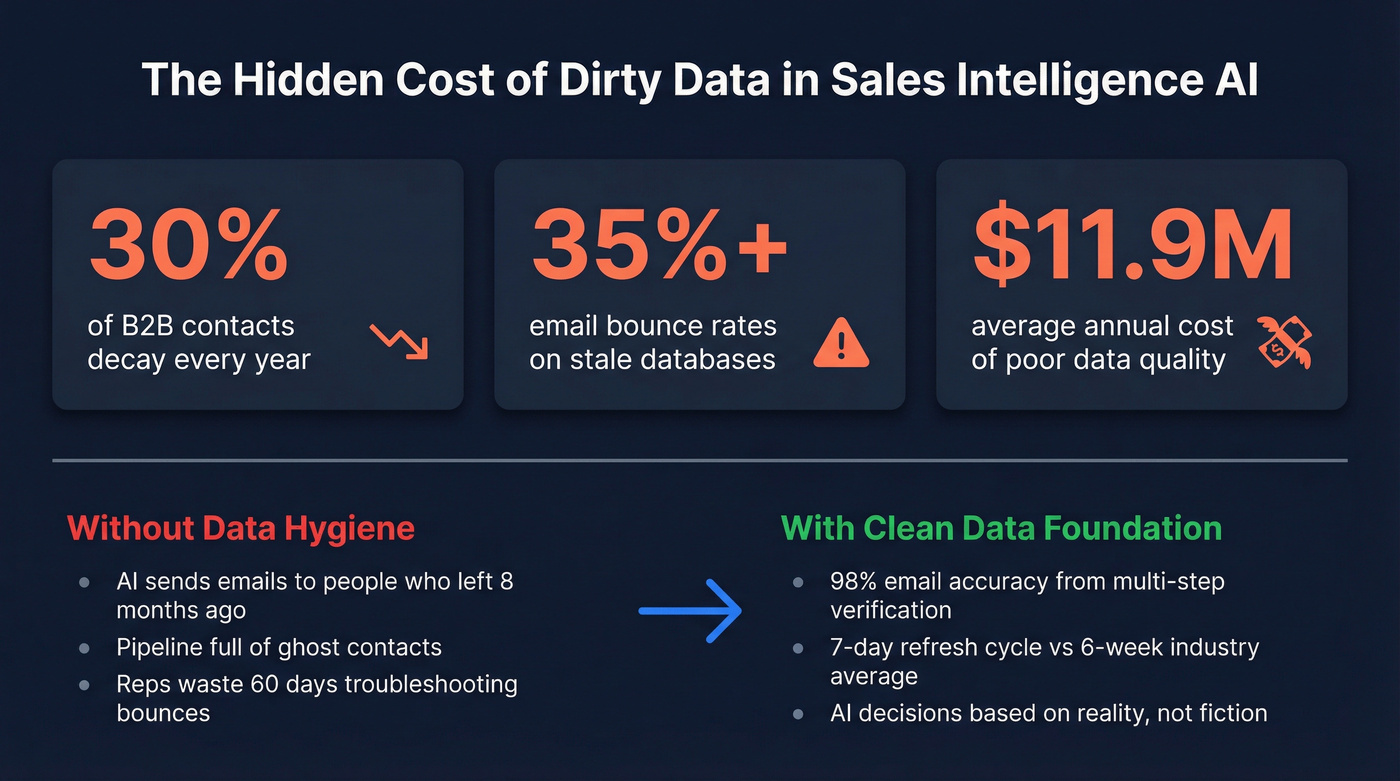
Poor data quality costs organizations roughly £11.91M per year, and 87% of organizations have low confidence in their own data. AI amplifies whatever you feed it. Any team investing in AI-driven sales data needs to treat data hygiene as a prerequisite, not an afterthought.
This is where the foundation matters more than the features. Prospeo refreshes its entire database on a 7-day cycle compared to the 6-week industry average, with 98% email accuracy built on a 5-step verification process including catch-all handling, spam-trap removal, and honeypot filtering. With 300M+ professional profiles and 143M+ verified emails, it gives AI systems a clean substrate to work from - which is the entire point.


AI amplifies whatever you feed it. Prospeo's 7-day data refresh cycle and 98% email accuracy give your sales intelligence stack the clean foundation it needs - not the 6-week-old records that turn AI into an expensive bounce machine.
Stop feeding your AI stale data. Start with 75 free verified emails.
Generative AI vs. Agentic AI
Generative AI creates content - cold emails, call summaries, account briefs, follow-ups. Most teams started here. Most are still stuck here. Only 19% of reps use AI features built into their sales tools; the rest are just copying and pasting from ChatGPT.
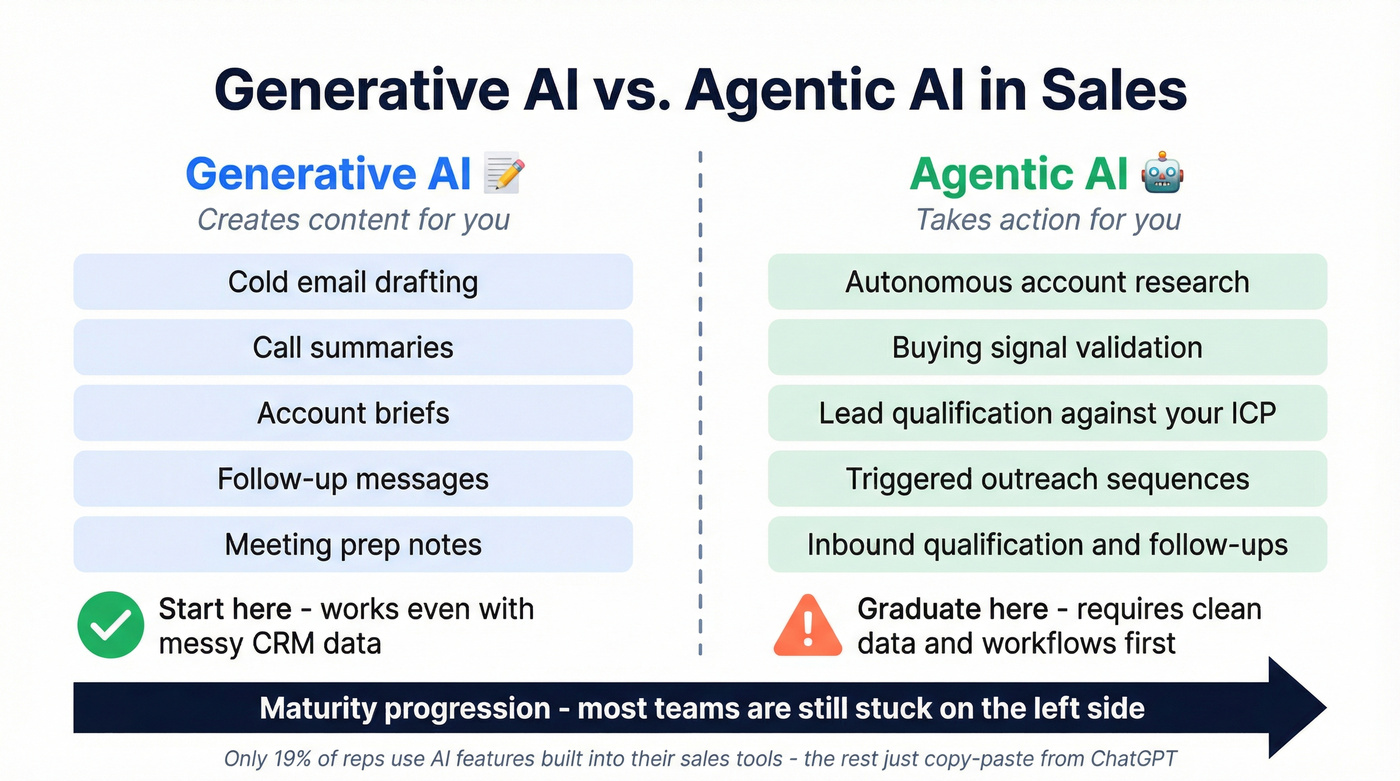
Agentic AI takes action. It researches accounts autonomously, validates buying signals, qualifies leads against your ICP, and triggers outreach without human intervention. monday CRM's AI sales agent is an early example, handling autonomous outreach via phone and SMS while supporting inbound qualification and follow-ups.
Start with generative for meeting follow-ups and onboarding sequences. Graduate to agentic once your data and workflows are clean enough to trust autonomous execution. Skip this if your CRM data is a mess - agentic AI on dirty data doesn't just fail, it fails loudly and at scale.
What AI Does Well in Sales
Signal-Personalized Outreach
Campaigns built on intent signals and job-change triggers hit 15-25% reply rates vs. the 3-5% cold email average. That's not incremental. It's a different category of performance entirely, and one firm, Frontify, reported a 42% increase in sales velocity after consolidating tools and using AI-driven signals.
Research Automation
AI cuts account research time by 50%+ across nine major platforms studied by G2. Analytic Partners cut their research time by 85%, which freed their reps to spend those hours on actual conversations instead of tab-switching between databases and Google.
Continuous Account Prioritization
Real-time re-ranking replaces static lead lists, factoring in technographic changes, headcount growth, and content consumption patterns. Knowing who to contact matters less than knowing when. Intent data tracking thousands of topics, layered with job change and growth signals, gets reps to buyers while they're actively researching solutions - not three months after they've already signed with a competitor.
What It Costs
| Platform | Starting Price | Model |
|---|---|---|
| Prospeo | Free (75/mo); ~$0.01/email | Credit-based, no contracts |
| Apollo.io | Free; $49-$119/user/mo | Per-seat + credits |
| Lusha | Free; from ~$36/mo | Per-seat credits |
| HubSpot Sales Hub | Free; $20-$150/seat/mo | Per-seat tiers |
| Cognism | ~$1,000/user/yr | Per-seat, annual |
| ZoomInfo | ~$15,000-$40,000+/yr | Per-seat, quote-only |
| Demandbase | ~$50,000/yr | Platform + modules |
| 6sense | ~$60,000/yr | Platform + modules |
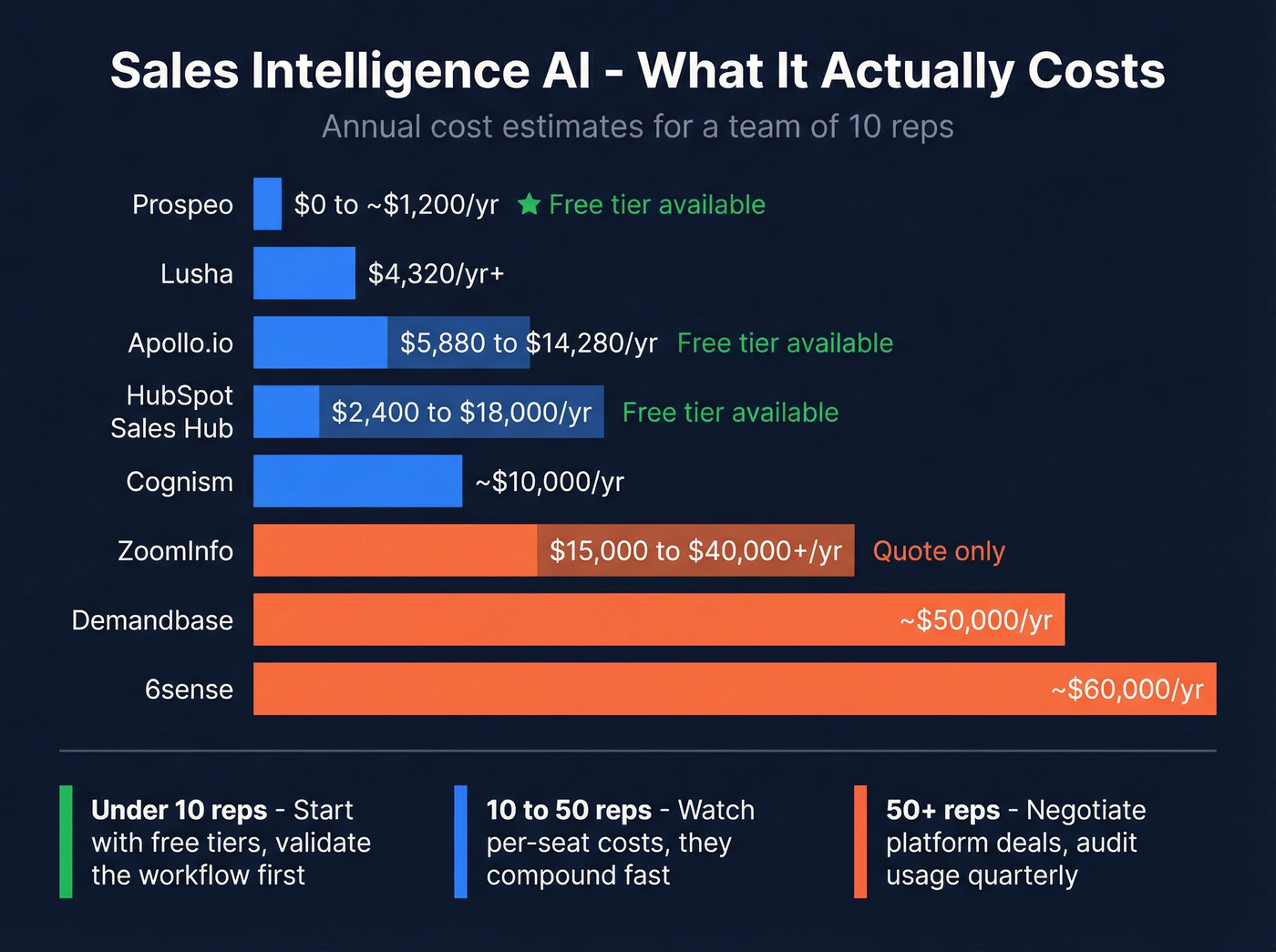
Teams consistently call out two frustrations across Reddit threads and tool roundups: ZoomInfo's pricing is brutal for small companies and credits run out fast, while Apollo can surface incorrect contact details that cause bounces. The consensus on r/sales is that you're overpaying if your average deal size doesn't justify the platform cost.
Let's be honest: if your average deal size is under $10K, you almost certainly don't need a $40K+ platform. Start with self-serve tools, prove the workflow, and upgrade only when you've outgrown the data.
Team-size guidance: Teams under 10 should start with free tiers and scale only after validating the workflow. For teams of 10-50, watch per-seat costs - they compound fast. At 50+ reps, negotiate platform deals but audit module usage quarterly because half those seats are probably underutilized.
How to Implement It
Don't buy the AI before you fix the plumbing. In our experience, teams that skip data cleanup waste their first 60 days troubleshooting bounces instead of closing deals.
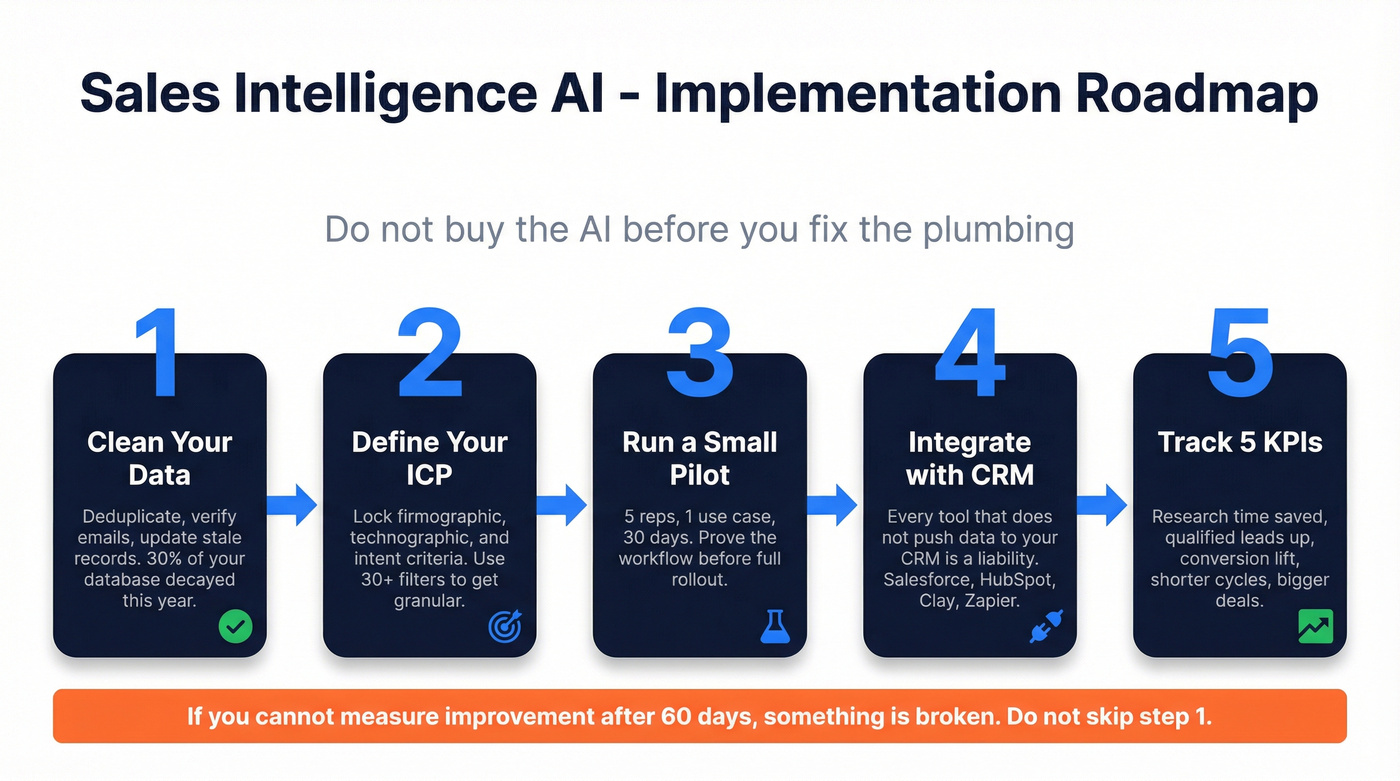
Five steps, in order:
- Clean your data first. Deduplicate, verify emails, update stale records. If 30% of your database decayed this year, your AI is making decisions on fiction. (If you need a system, start with CRM hygiene and a proper CRM verify workflow.)
- Define your ICP. Lock firmographic, technographic, and intent criteria before you run your first search. Platforms with 30+ search filters - including buyer intent powered by Bombora across 15,000 topics - let you get granular from day one.
- Start with a small pilot. Five reps, one use case, 30 days. Don't roll out to the full team until you've proven the workflow works and reps actually adopt it.
- Integrate with your CRM. The average business runs 110 SaaS apps. Every tool that doesn't push data into your CRM is a liability. Native integrations with Salesforce, HubSpot, and tools like Clay or Zapier aren't nice-to-haves - they're table stakes. (If you're automating updates, AI CRM data entry automation helps keep records from drifting.)
- Track five KPIs. Time saved on research, increase in qualified leads, conversion rate lift, sales cycle reduction, and deal size growth. If you can't measure improvement after 60 days, something's broken. (For scoring and routing, use an AI lead qualification framework.)
One compliance note worth flagging: GDPR and CCPA enforcement has real teeth. The Dish Network $280M penalty for Do Not Call violations is the kind of stakes example that gets budget approved for proper data governance. Make sure your AI tools support role-based access control and opt-out enforcement. (For outbound rules, keep a GDPR for Sales and Marketing checklist handy.)
The article makes it clear: teams under 10 don't need a $40K platform. Prospeo gives you 300M+ profiles, intent data across 15,000 topics, and 30+ ICP filters at ~$0.01/email - the same AI-ready data infrastructure, without the enterprise price tag.
Enterprise-grade sales intelligence at 90% less than ZoomInfo. No contracts.
FAQ
What's the difference between sales intelligence and sales engagement?
Sales intelligence identifies who to contact and when based on data signals. Sales engagement executes the outreach - emails, calls, sequences. AI increasingly bridges both, with agentic systems that research accounts and trigger sequences autonomously without rep intervention.
How accurate is AI-powered contact data?
Accuracy varies wildly. With 30% annual contact decay, any unverified database degrades fast. The best platforms maintain 98% email accuracy through multi-step verification on weekly refresh cycles; most competitors refresh every 4-6 weeks. Always test a sample before committing to any platform.
Can small teams afford sales intelligence AI?
Yes. Multiple platforms offer free tiers that let teams under 10 reps start without budget approval. Most self-serve paid plans run $36-$119/month per user - a fraction of the cost of one missed deal from bad data.
What's the fastest way to see ROI from these tools?
Layer intent data on top of verified contacts and run a 30-day outbound pilot with 5 reps. Teams that start with clean data and signal-based targeting typically see 15-25% reply rates within the first month, which is 3-5x the cold email baseline. Track qualified meetings booked, not just emails sent.