

The 12 Best Sales Lead Generators for Every Budget
Your SDR manager just told you 30% of emails from your current database are bouncing. That's not a data problem - it's a pipeline problem disguised as a spreadsheet. The average qualified-lead conversion rate across industries is just 2.9%, and 80% of leads never convert to customers. When a third of your contacts are dead on arrival, those already-brutal numbers get worse fast.
You don't need 23 tools. You need two or three that actually work together. The right pick depends on whether you're doing outbound, inbound, or both - and how much bad data you can afford to tolerate. Here are the 12 tools worth your time, what they actually cost, and which combinations make sense for your team size.
Our Picks (TL;DR)
| Pick | Tool | Best For | Starting Price | G2 Rating |
|---|---|---|---|---|
| Best data accuracy | Prospeo | Verified emails & direct dials, no contracts | Free (75 emails/mo) | - |
| Best all-in-one free start | Apollo | Teams testing outbound for the first time | Free (50 AI credits) | 4.7/5 (9,447) |
| Best inbound ecosystem | HubSpot | Capturing and nurturing website leads | Free CRM | 4.4/5 |
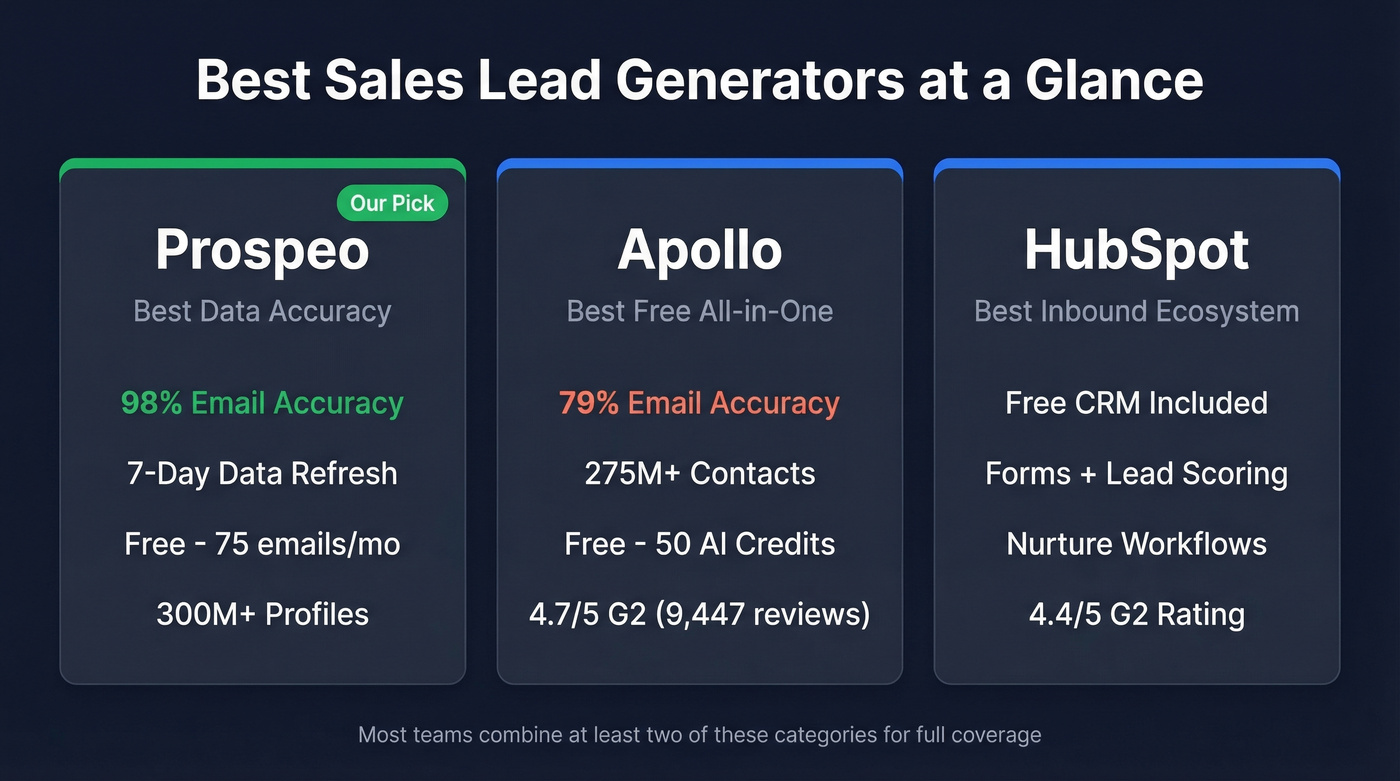
Prospeo wins on raw data quality - 98% email accuracy, a 7-day refresh cycle, and teams booking 26% more meetings compared to ZoomInfo and 35% more compared to Apollo. Apollo gives you the broadest free tier with built-in sequencing. HubSpot owns inbound with forms, lead scoring, and nurture workflows out of the box. Most teams end up combining at least two of these categories.
The 12 Best Sales Lead Generator Tools for 2026
B2B Contact Data Platforms
1. Prospeo
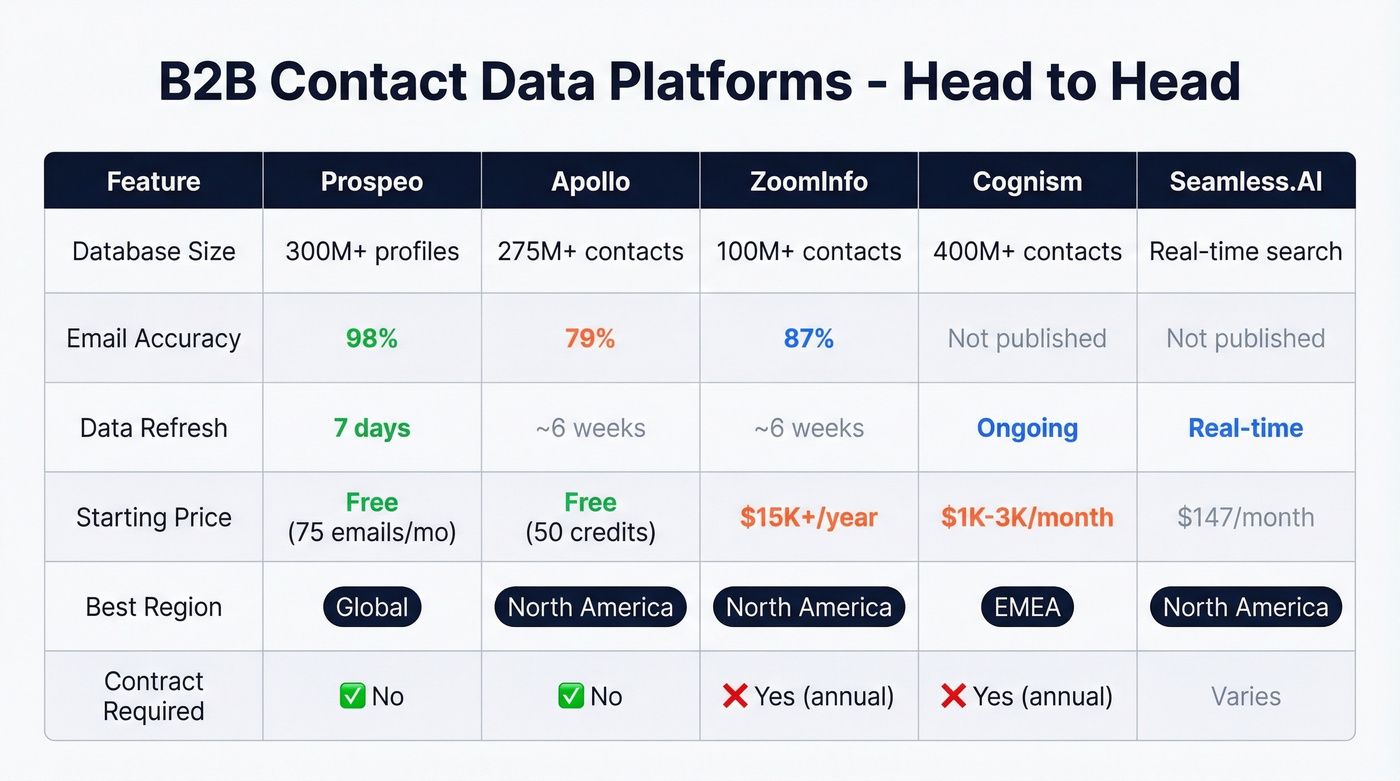
Use this if you've been burned by bounced emails and need data you can actually trust. Prospeo's database covers 300M+ professional profiles, 143M+ verified emails, and 125M+ verified mobile numbers - all refreshed on a 7-day cycle. The industry average for data refresh is six weeks, which means most databases are already stale by the time you export a list.

Here's what matters: 98% email accuracy, 30% mobile pickup rate, and a proprietary email-finding infrastructure that doesn't rely on third-party providers. The database includes 30+ search filters - buyer intent powered by Bombora across 15,000 topics , technographics, job changes, headcount growth, funding, and revenue - so you can build targeted lists without exporting and re-filtering in a spreadsheet. The Chrome extension with 40K+ users lets you pull verified contacts from any website or CRM in one click.
One customer, Meritt, tripled their pipeline from $100K to $300K per week after switching. Their bounce rate dropped from 35% to under 4%. That's not a marginal improvement; that's a different business.
Prospeo integrates natively with Salesforce, HubSpot, Instantly, Lemlist, Smartlead, Clay, Zapier, and Make - so your outreach, dialing, and sequencing tools get fed verified data automatically. Pricing starts free at 75 emails plus 100 Chrome extension credits per month, with paid plans running about $0.01 per email. No contracts, no annual lock-in.

If 30% of your emails are bouncing, your sales lead generator is the problem. Prospeo's 7-day data refresh and 98% email accuracy mean your lists stay clean - Meritt tripled their pipeline to $300K/week and cut bounce rates from 35% to under 4%.
Stop generating leads that bounce. Start generating pipeline.
2. Apollo
Apollo is the obvious starting point for teams testing outbound for the first time. The free tier alone - 50 AI credits, basic contact access, and two active sequences - lets you run a real pilot before spending anything.
Pros:
- 275M+ contacts with solid North American coverage
- Built-in sequencing that's genuinely good, not bolted on as an afterthought
- 4.7/5 on G2 across 9,447 reviews
- Paid plans from $49/month (Basic) to $119/month (Organization, minimum 3 seats)
Cons:
- Email accuracy runs around 79% - workable, but you'll want to verify before sending
- Credits don't roll over, and the hybrid pricing model creates cost surprises at scale
- A single lookup can burn multiple credits depending on data availability
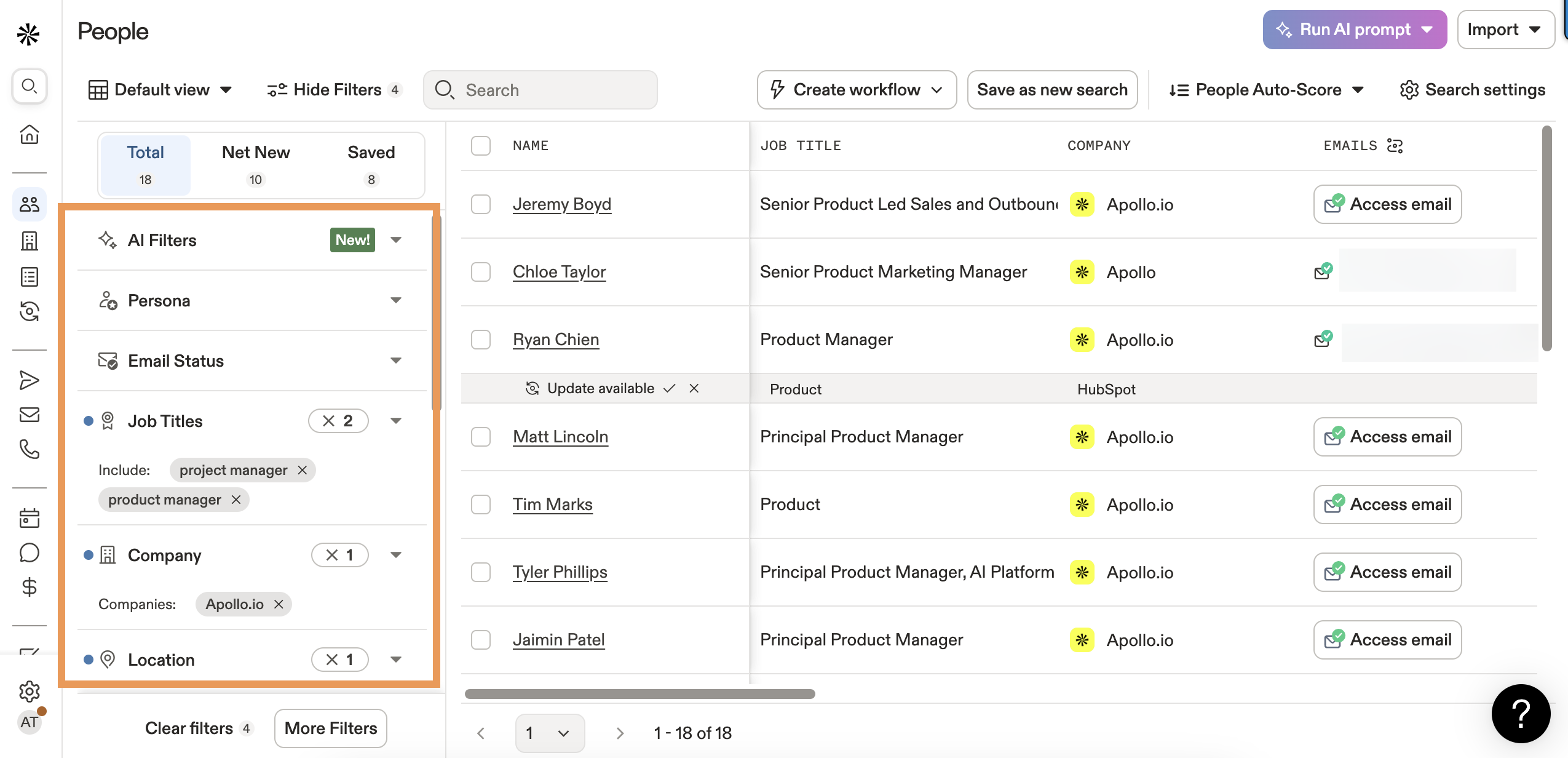
Apollo's database is wide but not always deep. We've seen match rates drop noticeably for director+ roles in EMEA. For US-focused SMB outbound, though, it's hard to beat the value.
3. ZoomInfo
ZoomInfo is the default enterprise sales intelligence platform - 100M+ contacts, 14M+ company profiles, and the deepest org charts and technographics in the market. If you're running ABM at scale with a dedicated RevOps team, ZoomInfo's depth is hard to match.
Pros:
- Best-in-class direct dials, org charts, and technographic data
- 4.5/5 across 9,031 reviews
- Buyer intent data, website chat, and workflow automation all native
Cons:
- Professional starts at $15K+/year, Advanced at $24K+, Elite at $40K+
- Add-ons push real costs toward $50K/year
- Annual contracts with 60-90 day cancellation windows and auto-renewal clauses that include 20% increases
- Email accuracy sits around 87%
- EMEA and APAC coverage has gaps
The #1 complaint in user reviews? Price. A 10-seat ZoomInfo contract with intent data and mobile numbers can run $40-$70K/year. That's real money for a Series A company.
Here's the thing: ZoomInfo is still the best all-in-one platform. But most teams don't need all-in-one. If your average deal size is under $15K, you almost certainly don't need ZoomInfo-level infrastructure - and you'll get better email accuracy from a focused data tool at a fraction of the cost.
4. Cognism
Use this if you're selling into Europe and GDPR compliance isn't optional. Cognism's 400M+ contact database has the strongest European coverage in the market, with phone-verified mobile numbers that actually connect. Where Cognism wins over ZoomInfo: EMEA data quality and compliance infrastructure. Where ZoomInfo still wins: US database depth and workflow breadth.
Skip this if your entire TAM is North America. Custom pricing typically runs $1,000-$3,000/month for small teams on annual contracts - not cheap, but significantly less than ZoomInfo for comparable EMEA coverage.
5. Seamless.AI
Seamless.AI takes a different approach: it's a real-time search engine for B2B contacts rather than a static database. You search, it finds and verifies contacts on the fly. With a 4.4/5 across 5,317 reviews, the model clearly works for a lot of teams.
Best for reps who prospect one account at a time rather than building bulk lists. Skip this if you need to build lists of thousands in a single session. Free tier available for testing, with paid plans starting around $147/month on a credit-based system.
6. Lusha
Lusha covers 45M+ contacts at $29-$99/month with a 4.3/5 rating across 1,617 reviews. Think of it as a quick-draw contact lookup tool - you already know who you're targeting and need a phone number or email mid-conversation. It's not a full prospecting workflow. It's a fast, affordable way to fill in the gaps.
Email Finder Tools
7. Hunter
Use this if you need a clean, focused email finder without the complexity of a full data platform. Hunter indexes 200M+ emails and does one thing well: find and verify email addresses by domain or name.
Pricing is transparent per their pricing page: Free at $0 for 50 credits/month, Starter at $34/mo billed yearly, Growth at $104/mo, Scale at $209/mo. Every plan includes unlimited users, which is unusual and valuable for teams.
Skip this if you need phone numbers, company data, or sequencing. Hunter is email-only by design. Pair it with a CRM and a separate phone data source for the full picture.
If you're comparing options, see our breakdown of Hunter alternatives.
Inbound & CRM Platforms
8. HubSpot
HubSpot isn't a traditional outbound prospecting tool - it's the best inbound lead capture ecosystem on the market. The free CRM gives you forms and contact management. Marketing Hub starts at $15/seat/month and scales into enterprise territory for teams running full inbound operations with landing pages, email nurture, lead scoring, and attribution.
The strength is integration density. Everything talks to everything else natively - your blog captures a lead via form, the workflow enrolls them in a nurture sequence, and the CRM scores them for sales handoff. No duct tape required. Given that 67% of customers prefer self-service over speaking to a rep, HubSpot's self-serve inbound infrastructure is more relevant than ever.
For outbound data, pair HubSpot with a dedicated data platform. HubSpot captures and nurtures the leads; the data platform finds them.
If you're still deciding, here are a few examples of a CRM to benchmark against.
9. Pipedrive
Pipedrive starts at $14/seat/month billed annually with a 14-day trial. The LeadBooster add-on adds web forms and a chatbot for basic lead capture. Best for small sales teams under 10 reps wanting a simple, visual CRM with pipeline management. It doesn't pretend to be a data platform, which is exactly why small teams love it.
10. Intercom
Intercom starts at $29/user/month billed annually, with the Fin AI Agent at $0.99 per resolution. Best for SaaS companies using live chat and AI-powered bots to qualify inbound leads in real time. It's a conversation tool, not a prospecting tool - think support-led growth and product-qualified leads.
Visitor Identification
11. Leadfeeder (Dealfront)
Use this if you have meaningful website traffic and want to convert anonymous visits into outbound targets. Leadfeeder identifies companies visiting your site and shows you which pages they engaged with.
Skip this if your site gets under 1,000 monthly visitors - there won't be enough signal to act on. Free plan covers 100 companies with 7-day history. Paid plans start at $99/month billed annually for full history and CRM integrations.
Outreach Automation
12. Instantly
Instantly has earned a 4.8/5 across 4,039 reviews - the highest rating on this list. Starting around $30/month, it handles email warmup, inbox rotation, and sending infrastructure for teams scaling cold email volume. It's not a data tool. It's the delivery engine.
If you're building your stack, compare more outbound lead generation tools alongside Instantly.
Pair it with a verified data source and you've got a complete outbound stack for under $100/month. The consensus across r/sales and cold email communities backs this up - Instantly plus a solid data source is one of the most recommended stacks for lean outbound teams.
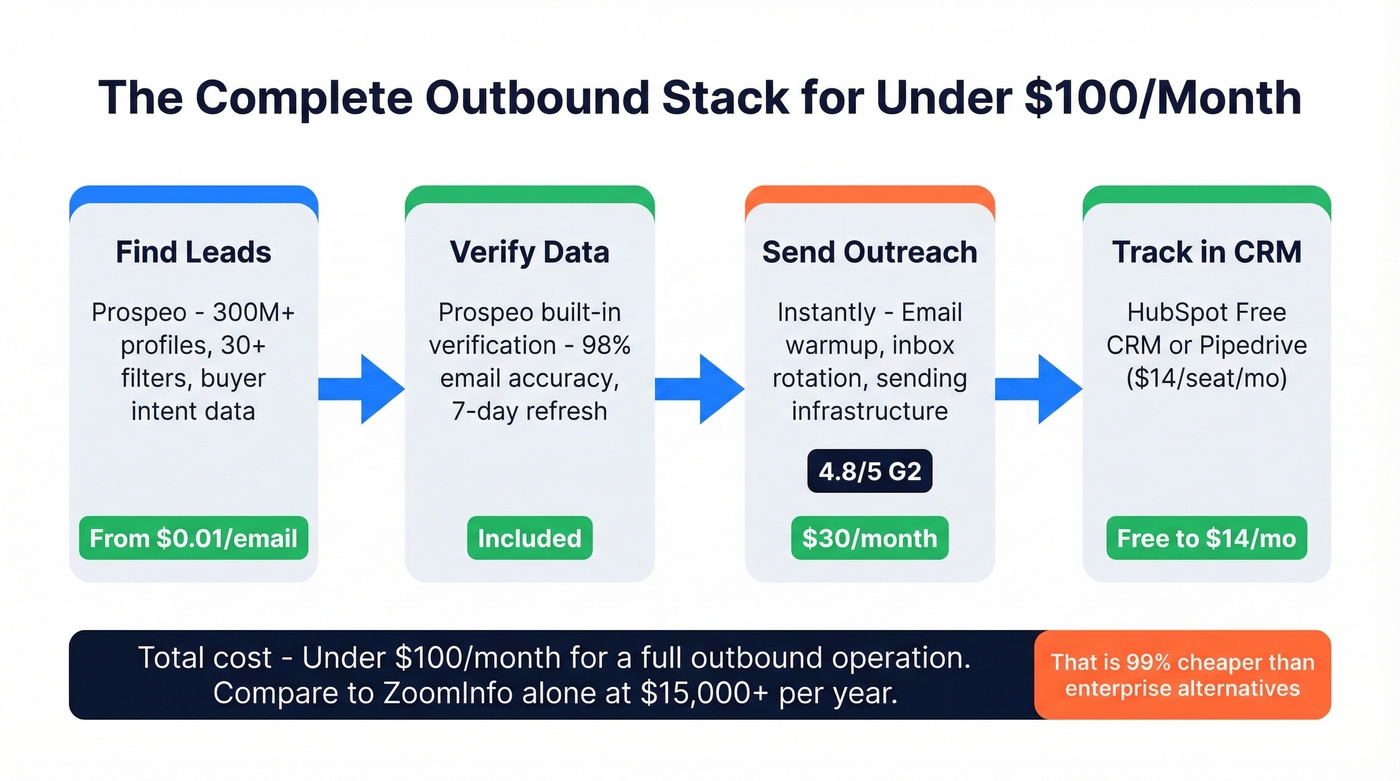
You don't need a $40K/year platform to generate quality sales leads. Prospeo gives you 300M+ profiles, 125M+ verified mobiles, buyer intent across 15,000 topics, and 30+ filters - starting at $0.01 per email with no contracts.
Enterprise-grade lead generation without the enterprise price tag.
Pricing at a Glance
Let's talk about the credit trap. You signed up for a "free trial," got 50 credits, burned through them in an afternoon, and now you're staring at a $15,000/year quote. Credit-based pricing sounds flexible until you realize credits don't roll over, overages are expensive, and the "free" tier was designed to get you hooked - not to be useful long-term. Seat-based pricing from HubSpot and Pipedrive is more predictable. Hybrid models from Apollo and ZoomInfo require careful monitoring.
If you're trying to clean up lists before you send, start with these data enrichment services.
| Tool | Free Tier | Starting Paid | Model | Contract |
|---|---|---|---|---|
| Prospeo | 75 emails/mo | ~$0.01/email | Credit-based | None |
| Apollo | 50 AI credits | $49/mo/user | Hybrid | Monthly |
| ZoomInfo | No | $15K+/yr | Credit + seat | Annual |
| Cognism | No | ~$1K/mo | Custom | Annual |
| Seamless.AI | Yes (limited) | ~$147/mo | Credit-based | Varies |
| Lusha | Yes (limited) | $29/mo | Credit-based | Monthly |
| Hunter | 50 credits/mo | $34/mo (yearly) | Credit-based | Monthly/Annual |
| HubSpot | Full free CRM | $15/seat/mo | Seat-based | Monthly/Annual |
| Pipedrive | No (14-day trial) | $14/seat/mo | Seat-based | Annual |
| Intercom | No | $29/user/mo | Seat + usage | Annual |
| Leadfeeder | 100 companies | $99/mo | Flat + usage | Annual |
| Instantly | No | ~$30/mo | Flat | Monthly |
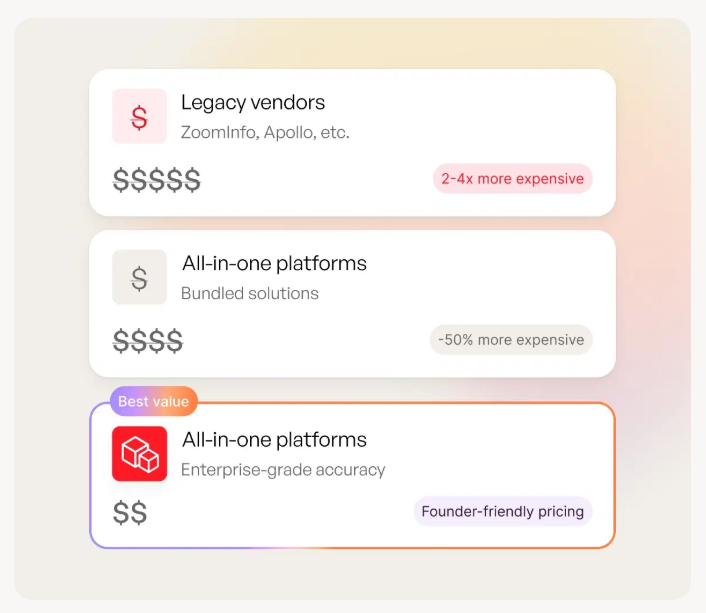
The cost-per-lead difference is stark. A credit-based data tool at $0.01 per lead versus an enterprise platform that lands closer to $1 per lead once you factor in credits, add-ons, and overages - that's a 100x difference that compounds fast when you're building lists of thousands.
How to Choose the Right Sales Lead Generator
The B2B lead generation market is projected to hit $32.85B by 2035 at an 11.33% CAGR, and 91% of B2B marketers say lead generation is their top priority. The tools are proliferating. The question isn't whether to invest - it's where.
The Belkins framework nails the three lenses you should evaluate through: product/industry fit, ACV and sales cycle length, and your market position. Modern B2B buyers need 70+ touchpoints across multiple channels before they're ready to buy. Your tool stack needs to support that reality. Here's what we recommend by team size:
Solo founder or startup (1-3 reps): Prospeo + Instantly. Verified data flowing into automated sequences, total cost under $100/month. In our experience, this stack outperforms setups costing 10x more because the data is clean from the start - no wasted sends, no domain damage.
SMB with 5-20 reps: A dedicated data platform + HubSpot + Instantly. Your data platform handles outbound contacts with verified emails. HubSpot captures inbound leads, manages the pipeline, and handles lead scoring. Instantly scales cold email delivery. Budget: $200-$500/month depending on volume.
Enterprise with 50+ reps: ZoomInfo or Cognism + Salesforce + Outreach. At this scale, you need the workflow depth, org charts, and intent signals that enterprise platforms provide. Budget: $30K-$80K/year for data alone.
The single most important criterion for outbound teams? Data accuracy. A 10% bounce rate doesn't just waste credits - it damages your domain reputation, which tanks deliverability for every future campaign. Look for tools with real-time verification and weekly refresh cycles.
For a deeper dive on list-building and targeting, use these sales prospecting techniques.
Mistakes That Kill Lead Gen ROI
Over-relying on purchased lists. Static lists decay at 2-3% per month. By the time you send, a quarter of the contacts have changed jobs. Use tools with real-time verification and frequent refresh cycles instead.
Ignoring lead qualification. Blasting 10,000 contacts with the same message isn't lead generation - it's spam. Filter by intent signals, job changes, and company growth before you send.
No follow-up system. Cold email benchmarks run 1-5% reply rates and 0.2-2% conversion. That means 95%+ of prospects need multiple touches. Build multi-step sequences with at least 4-5 touchpoints across channels.
If you need copy you can deploy fast, start with these sales follow-up templates.
Weak lead magnets for inbound. Average form conversion rate is 1.7%. Offer something specific and immediately useful - a calculator, a benchmark report, a template. Generic "download our ebook" doesn't cut it anymore.
Not verifying data before sending. This is the most expensive mistake, and we've watched teams make it over and over. A 15% bounce rate triggers spam filters, damages your sender reputation, and can take months to recover from. Verify every list before it hits your sequencer. No tool - no matter how expensive - can fix a ruined domain reputation after the fact.
If you're troubleshooting bounces, see our guide to email bounce rate benchmarks and fixes.
FAQ
What is a sales lead generator?
A sales lead generator is software that finds, captures, or qualifies potential buyers for your pipeline. The category spans B2B contact databases, email finders, website visitor trackers, inbound capture tools, and outreach platforms. Most high-performing teams combine two or three tools from different categories rather than relying on a single solution.
How much do lead generation tools cost?
Costs range from free (HubSpot CRM, Apollo's free tier, Prospeo's 75 emails/month) to $50,000+/year for enterprise ZoomInfo contracts with add-ons. Most mid-market tools run $30-$150/month per user. Average cost per lead varies wildly by industry, from $25 to $800+.
What's the difference between inbound and outbound lead generation?
Inbound attracts leads through content, SEO, forms, and chatbots. Outbound finds and contacts leads directly via cold email, calls, and prospecting databases. Most successful teams run both - inbound builds long-term pipeline while outbound creates immediate conversations.
How do I verify my lead data is accurate?
Check your email bounce rate after every campaign. Under 4% means your data source is solid. Above 10% means your database is stale and actively hurting sender reputation. Tools with real-time verification and weekly refresh cycles set the standard here.
Can I use multiple lead generation tools together?
Yes - and you should. A typical high-performing stack combines a data source for contacts, an outreach tool for delivery, and a CRM for pipeline management. Tools that try to do everything usually do nothing exceptionally well.