

Sales Leadership Strategy: The Data-Driven Playbook for 2026
Your morning starts with 91 unread messages. There's a pipeline review in 20 minutes where someone will say "this one might close soon" without any evidence. A rep is spiraling after losing a deal they never should've been working. And somewhere in Slack, a cross-functional project is dying because nobody owns it.
This is what sales leadership actually looks like - and it's why your sales leadership strategy needs a reset. [69% of reps missed quota](https://www.hyperbound.ai/blog/b2b-sales-performance-benchmark-2025) in 2024, even after targets were cut by 19%. Most leadership advice gives you traits and motivational posters. This gives you benchmarks, frameworks, and a 90-day playbook you can actually execute.
The Quick Version
Three highest-impact moves for any sales leader right now:
- Shift from activity metrics to outcome metrics. Stop counting dials. Start measuring win rate, pipeline velocity, and deal qualification rate.
- Build a weekly coaching cadence focused on development, not deal interrogation. Your 1:1s should make reps better, not just update your forecast.
- Audit your pipeline data quality before your next forecast. If the contact data underneath your pipeline is unverified, your forecast is fiction.
Sales Performance in 2026 - The Numbers
These benchmarks come from aggregated datasets covering millions of B2B opportunities, and they paint a clear picture of a profession under pressure.
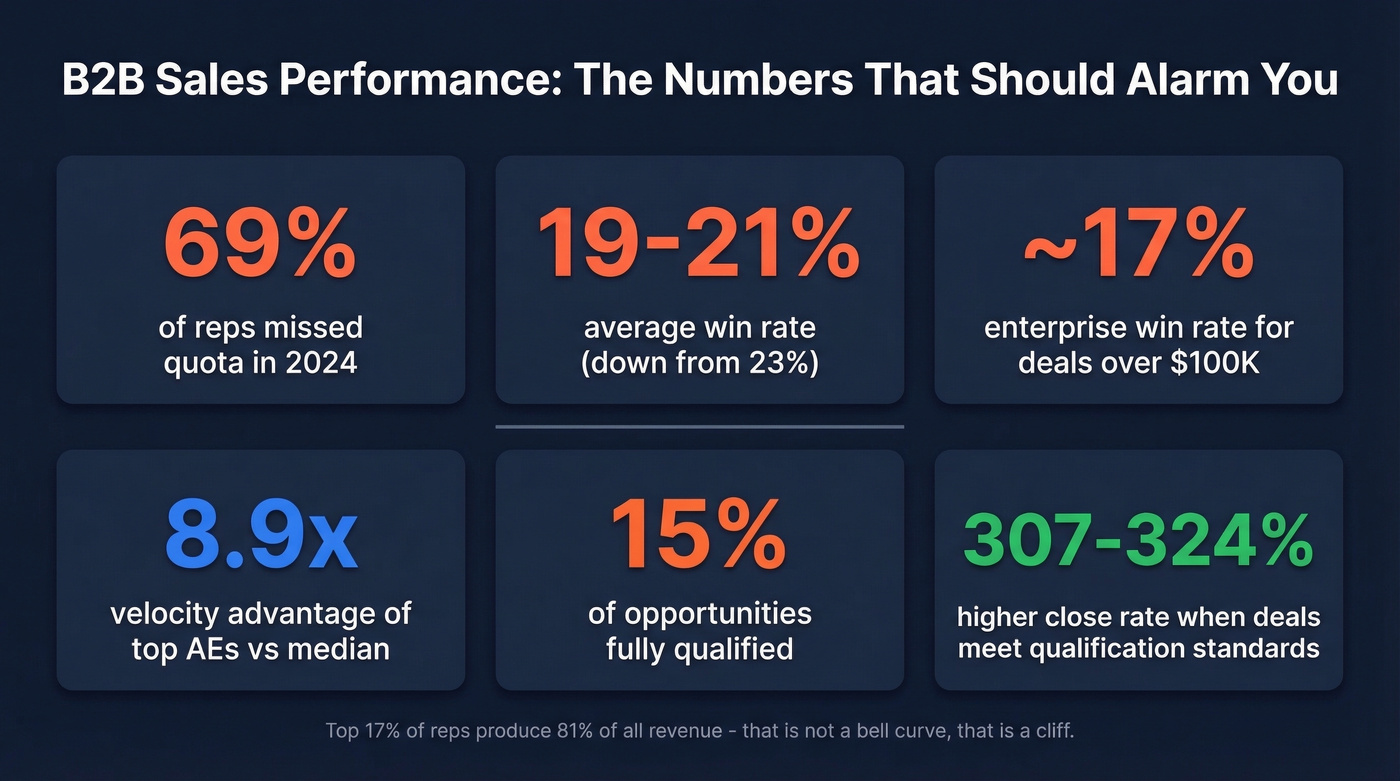
| Metric | 2022 Benchmark | 2024 Reality |
|---|---|---|
| Quota attainment | - | 69% miss (79% adjusted) |
| Avg. win rate | 23% | 19-21% |
| Enterprise win rate (>$100K ACV) | ~22% | ~17% |
| Revenue concentration | - | Top 17% produce 81% |
| Top AE velocity advantage | - | 8.9x vs. median |
| New CAC ratio | - | $2.00 |
| Opps fully qualified | - | 15% |
The win rate decline alone should alarm every VP of Sales reading this. We've gone from roughly one in four deals closing to one in five - and for enterprise, it's closer to one in six. Meanwhile, 17% of reps generate 81% of revenue. That's not a bell curve. That's a cliff.
Top-performing AEs move deals at 8.9x the velocity of the median rep, and mid-market sales cycles have lengthened 24-32% while enterprise cycles stretched 36%. Here's the thing: 61% of closed-lost deals get attributed to "indecision." That's not a buyer problem - it's a qualification problem. Only 15% of opportunities meet framework requirements, and just 5% score confidence on every criterion. Opportunities that do meet qualification standards by the "Solution Presented" stage are 307-324% more likely to close.
This isn't a rep problem. It's a leadership problem.
Leadership vs. Management
Simon Hazeldine frames it cleanly: "Management is about doing things right. Leadership is about doing the right things." Most sales orgs confuse the two, and the confusion is expensive.
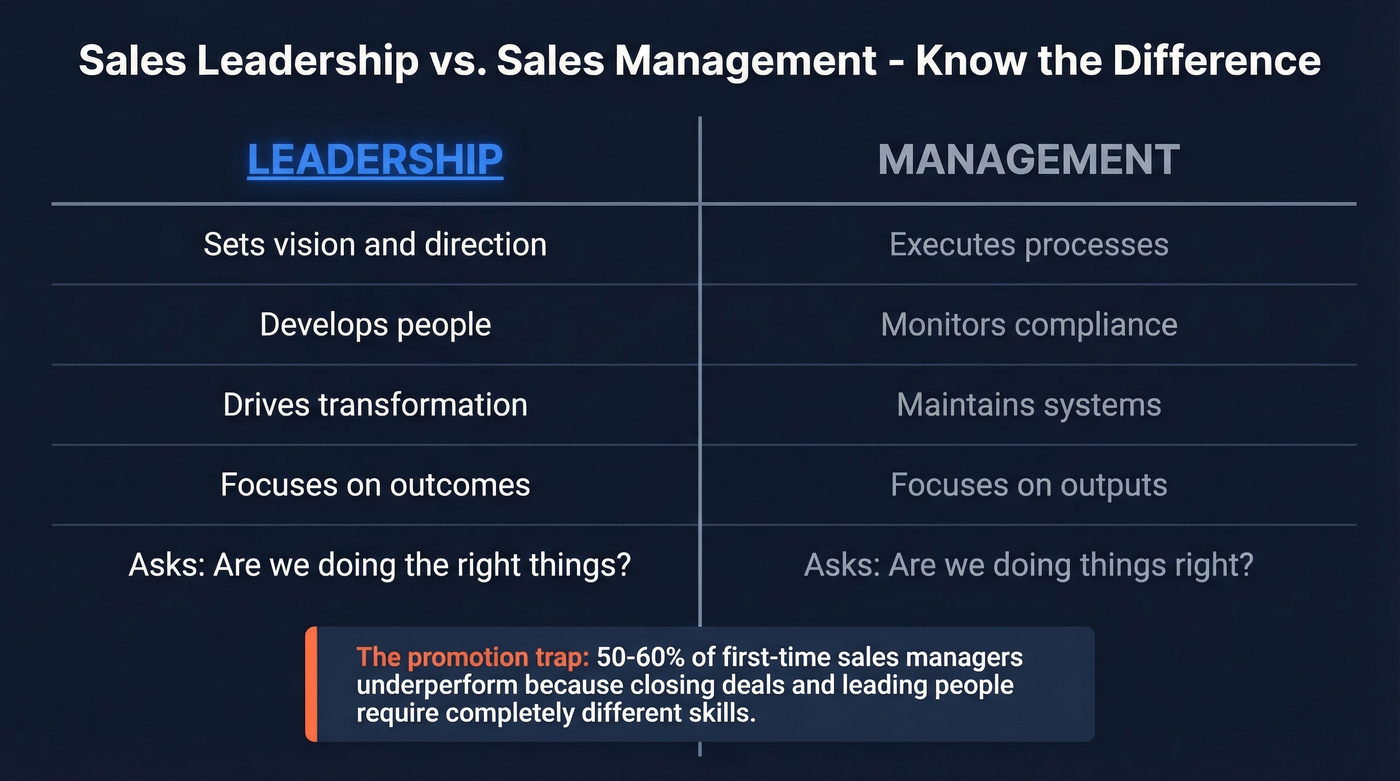
| Sales Leadership | Sales Management |
|---|---|
| Sets vision and direction | Executes processes |
| Develops people | Monitors compliance |
| Drives transformation | Maintains systems |
| Focuses on outcomes | Focuses on outputs |
| Asks "are we doing the right things?" | Asks "are we doing things right?" |
The root cause of the confusion is the promotion trap. Organizations take their best closer, hand them a team, and expect leadership to emerge. It rarely does. What you get instead is a super-seller who takes over deals, interrogates reps on numbers, and wonders why the team isn't performing.
Reddit threads on r/sales capture this tension perfectly - aspiring leaders describe their day-to-day as "forecasting, quotas, deal management" and ask whether the role is supposed to feel this transactional. For anyone wondering how to become a sales leader, the answer starts with understanding that the role demands an entirely different skill set than closing deals. If your 1:1s are number interrogations, you're a spreadsheet with a title, not a leader. Industry estimates put first-time manager underperformance around 50-60% - not because they lack talent, but because the sales manager skills required are fundamentally different from the skills that made them a great rep.

You just read that only 15% of opportunities meet qualification standards - and bad contact data makes it worse. If your reps are reaching the wrong people, no coaching framework will save your pipeline. Prospeo delivers 98% verified emails and 125M+ direct dials on a 7-day refresh cycle, so every rep on your team reaches real decision-makers.
Stop forecasting on fiction. Start with data your team can actually close.
Core Pillars of Effective Strategy
Coaching Is the Job
The single most impactful thing a sales leader can do is coach. Not forecast. Not run pipeline reviews. Coach.
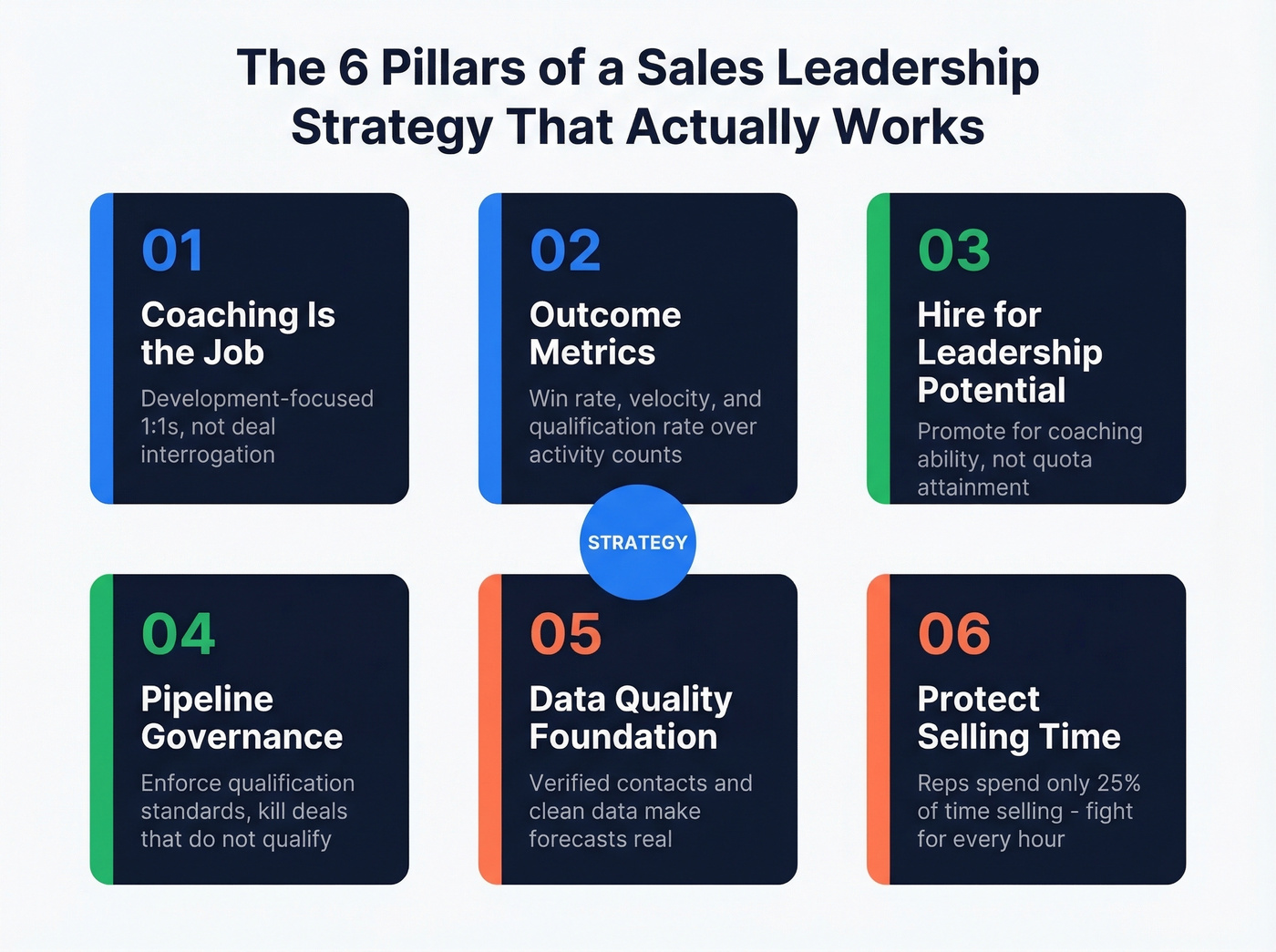
A trust-based coaching framework - where 1:1s focus on development rather than deal interrogation - transforms the manager from a bottleneck into a multiplier. As one Forbes contributor put it, a team of 10 should have 10 potential coaches, not just one manager doing all the developing. The best leaders spend more time building capability than inspecting dashboards, and in our experience, that single shift changes everything about a team's trajectory.
Hot take: If your average deal size is under $50K and your reps are experienced, you probably need less pipeline management and more skill coaching. The deals aren't complex enough to justify weekly deal reviews. Spend that time on discovery call teardowns and objection handling reps instead.
The practical shift: restructure your weekly 1:1s. First 10 minutes on skill development - a specific objection handling scenario, a discovery call review, a negotiation tactic. Last 5 on pipeline. Adapt your approach to each rep's experience level; a 10-year veteran and a new hire don't need the same coaching conversation.
Outcome Metrics Over Activity Metrics
Tracking dials, emails sent, and meetings booked feels productive. It's not. Activity metrics measure effort; outcome metrics measure effectiveness. Teams that enforce qualification rigor see 307-324% higher close rates. That's not a marginal improvement - it's a category shift.
The metrics that matter: win rate by stage, pipeline velocity, deal qualification rate, and quota attainment by cohort. If you can't tell me which stage your deals are dying in and why, you don't have a metrics problem - you have a visibility problem.
Hire for Leadership Potential
Stop promoting your top closer into management by default. Gartner's 2026 CSO priorities call out the need to hire and develop managers for mindsets and competencies - not just quota attainment. The best seller on your team might be a terrible coach. The mid-performer who mentors new hires and thinks systemically about process? That's your next leader.
Investing in sales leadership development early - before someone has direct reports - is the highest-leverage talent bet you can make.
Pipeline Governance
This is where most sales orgs hemorrhage money. 61% of businesses have adopted formal qualification methodologies, but only 15% of their opportunities actually meet the framework's requirements. That gap between "we have MEDDIC" and "we enforce MEDDIC" is where deals go to die.
Leaders who take pipeline governance seriously define clear stage-exit criteria, inspect deals against those criteria weekly, and are willing to kill deals that don't qualify. The discomfort of a smaller pipeline is nothing compared to the cost of forecasting fiction. A strong VP of sales ops can be the forcing function here, building the infrastructure that makes governance repeatable rather than heroic. We've watched teams cut their pipeline by 30% through stricter qualification and still close more revenue the following quarter - because the deals that remained were real.
Data Quality as a Foundation

Your pipeline forecast is only as good as the contact data underneath it. If your reps are working leads with unverified emails and disconnected phone numbers, your pipeline isn't a pipeline - it's a wish list. We've seen teams run entire quarters on pipeline numbers inflated by contacts that bounce, don't pick up, or no longer work at the company. The forecast looks healthy right up until it collapses.
Prospeo addresses this directly: 98% email accuracy and a 7-day data refresh cycle versus the 6-week industry average mean your reps start every conversation with data they can trust. When the data is clean, the forecast is real, and leadership decisions stop being guesswork.
Protect Selling Time
Bain's research found that sellers spend about 25% of their time actually selling. The other 75% goes to CRM updates, internal meetings, admin, and searching for contact information.
As a leader, your job is to fight for that selling time like it's revenue - because it is. Audit your team's calendar for one week. If the ratio of internal meetings to customer-facing activities is worse than 1:1, start cutting.
Trust Over Command and Control
The command-and-control model still dominates sales management. It still doesn't work. Trust-based leadership - where you set clear expectations, give reps autonomy, and hold them accountable to outcomes rather than activities - produces better results and retains better talent. Top performers don't stay to be micromanaged. They stay for leaders who make them better and then get out of the way.
What to Stop Doing
The anti-patterns matter as much as the best practices.
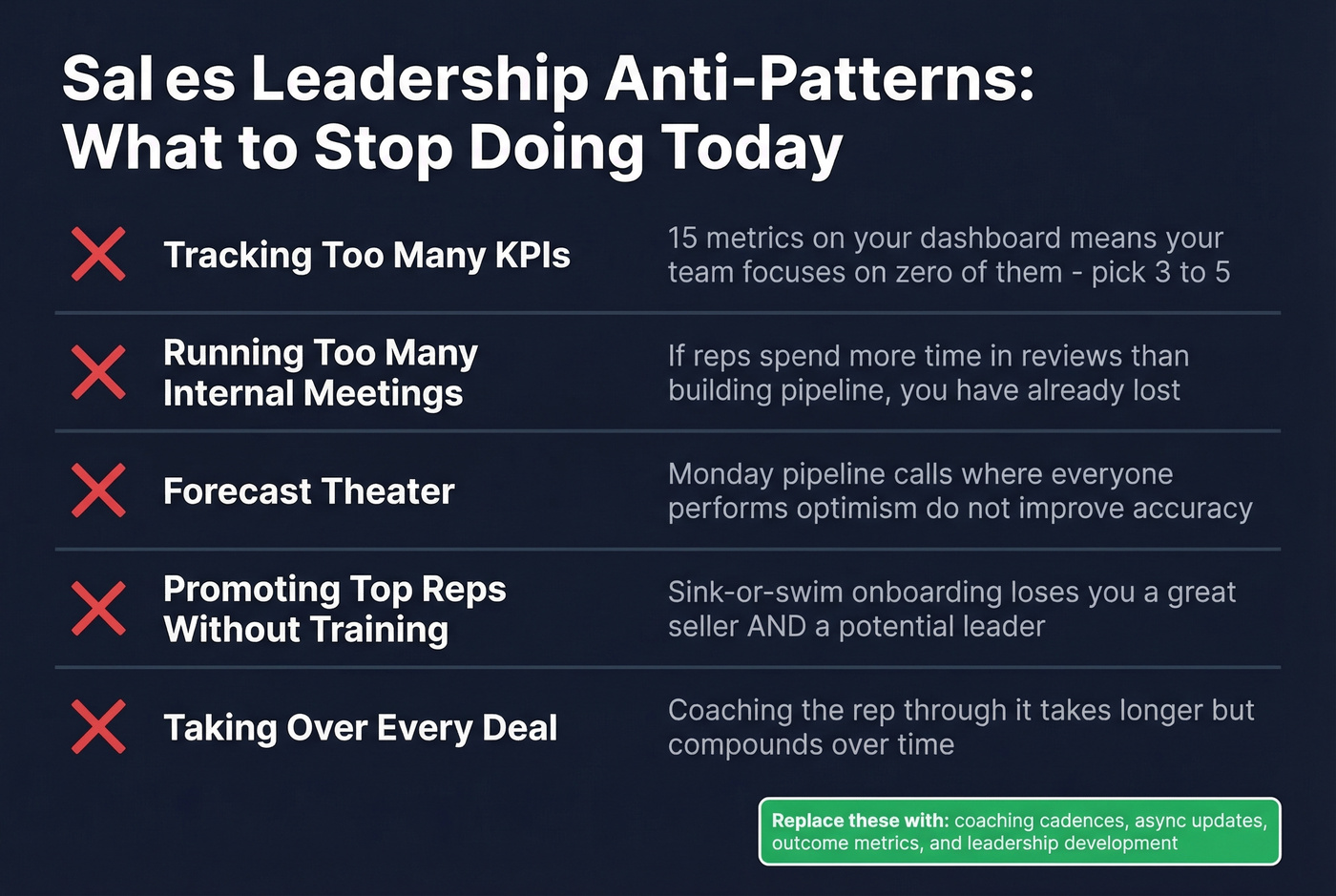
Tracking too many KPIs. The consensus on r/sales is blunt: tracking too many KPIs is one of the biggest leadership mistakes. If your dashboard has 15 metrics, your team focuses on zero of them. Pick 3-5 outcome metrics and obsess over those.
Running too many internal meetings. If your team spends more time in pipeline reviews than on pipeline-building activities, you've already lost. Kill the meetings that exist because they've always existed.
Forecast theater. Those Monday morning pipeline calls where everyone performs optimism? They don't improve forecast accuracy. Replace them with async pipeline updates and use the saved time for coaching.
Promoting top reps without training. Your best closer needs 3-6 months of leadership development before they manage anyone. Sink-or-swim onboarding for new managers is how you lose both a great seller and a potential leader in one move.
Taking over every deal. When a rep struggles, the instinct is to jump in and close it yourself. Resist. Coach the rep through it. The deal takes longer, but the rep gets better - and that compounds.
AI-Era Sales Leadership
Gartner's three critical priorities for CSOs heading into 2026: build a sales-centric AI portfolio roadmap, transform GTM motions to match buyer preferences, and maximize sales manager impact through role clarity. Bain identifies 25 distinct AI use cases across the sales lifecycle - the leadership job is prioritizing which ones to deploy first.
Early AI successes show 30%+ improvement in win rates when AI improves conversion across the funnel - not just task automation. But Bain also warns against the "micro-productivity" trap: automating broken processes just gives you broken processes that run faster.
A 2025 neuroscience study found that AI-coached sellers remembered 50% more information after 48 hours compared to human feedback alone. But human coaching improved motivation and emotional well-being. The practical division of labor is elegant: let AI coach the deal, let managers coach the rep. AI handles call analysis, next-step recommendations, and data enrichment. Managers handle confidence, career development, and the moments when a rep needs someone who's been there.
Most teams adopt AI backwards. They start with AI-generated outreach and wonder why deliverability tanks and replies drop. The right sequence: data quality first, then conversation intelligence, then scaled outreach. Foundation first, automation second.
The majority of B2B buyers now prefer rep-free experiences for much of the buying journey. That doesn't mean reps are obsolete - it means the moments when a rep does engage need to be higher-value, better-informed, and more precisely timed.
Your First 90 Days as a Leader
Whether you're stepping into your first leadership role or taking over a new team, the first 90 days set the trajectory. The biggest mistake? Moving too fast. Forbes research on early-tenure pitfalls consistently flags the same failure mode: new leaders skip the listening phase and implement changes before they understand the culture.
Days 1-30: Listen and Audit
Have 1:1 conversations with every rep - understand their strengths, frustrations, and what they think is broken. Don't pitch your vision yet. Dig into the pipeline data: how many contacts are verified? What's the bounce rate on outbound? What percentage of "qualified" opportunities actually meet your framework's criteria?
Align with your CEO, CRO, and cross-functional partners via weekly check-ins. Establish a coaching cadence by week three, even if it's informal. This signals your priorities from day one.
Don't make structural changes. No territory reorgs, comp plan overhauls, or terminations. You don't have enough context yet.
Days 31-60: Targeted Changes
Pick 2-3 high-impact changes based on your audit - tightening stage-exit criteria, cutting recurring meetings, or implementing a qualification framework. Build your KPI dashboard around outcome metrics: win rate by stage, pipeline velocity, average deal size, qualification rate. Share it with the team so everyone sees the same numbers.
Start inspecting deals against qualification criteria and be willing to downgrade deals that don't meet the bar.
Don't take over deals. Stay in the coaching role even when it's uncomfortable.
Days 61-90: Solidify and Scale
Formalize weekly 1:1s with a consistent structure: skill development first, pipeline second. Document development goals for each rep. Present your 6-month plan to leadership - by now you have data, context, and early results.
Address underperformance directly. You've given people 60 days of support and clarity; if someone still isn't meeting the bar, have the honest conversation. Celebrate early wins publicly and be specific about what someone did well and why it mattered. Learning how to create a compelling sales vision during this phase - one grounded in data rather than aspiration - is what separates leaders who retain top talent from those who watch it walk out the door.
Let's be clear: day 90 is the beginning of execution, not the end of onboarding.
Top AEs move deals at 8.9x the velocity of median reps - and data quality is the hidden multiplier. When your team wastes hours chasing bounced emails and dead numbers, pipeline velocity tanks. Prospeo's 30+ search filters (intent data, job changes, headcount growth) let your reps focus on qualified buyers, not list building. At $0.01 per email, it costs less than one wasted hour of AE time.
Give every rep on your team the data advantage your top performers already have.
FAQ
What is a sales leadership strategy?
It's the operating system a leader uses to drive revenue outcomes through their team - combining vision, coaching cadence, data-driven decisions, and pipeline governance into a repeatable framework. Structure and accountability, not motivational speeches.
How is leadership different from management?
Management focuses on process compliance and forecast accuracy. Leadership focuses on setting direction, developing talent, and making strategic bets on people and markets. Promoting a great manager doesn't automatically create a leader - the skill sets overlap by roughly 40%.
What KPIs matter most for sales leaders?
Win rate by stage, pipeline velocity, quota attainment by cohort, and deal qualification rate. Teams enforcing qualification rigor see 307-324% higher close rates. If you're still counting dials, you're measuring effort, not effectiveness.
What should a new sales leader do first?
Listen before changing anything. Spend 30 days understanding your team, pipeline data quality, and stakeholders. Implement 2-3 targeted changes in days 31-60. Solidify processes and present your 6-month plan by day 90 - not before.
How does data quality affect pipeline forecasting?
Forecasts built on unverified contacts are guesswork. If 20% of your pipeline's emails bounce and half the phone numbers are disconnected, your revenue projections are fiction. Clean, regularly refreshed contact data - like Prospeo's 98% accuracy on a 7-day refresh cycle - turns forecasting from theater into something you can actually trust.