

How to Write a Sales Manager Introduction Email to a Client
It's Monday morning. You just inherited roughly 200 accounts, and leadership wants intro emails out by end of week. Every template you find online is built for cold prospecting - not for the awkward, high-stakes moment of telling an existing client they've got a new point of contact.
Here's the thing: a strong sales manager introduction email to a client sets the tone for the entire relationship. Get it wrong and you're playing catch-up for months. Let's fix that.
Before You Write: The 4-Question Checklist
Don't draft anything until you can answer these about each account:
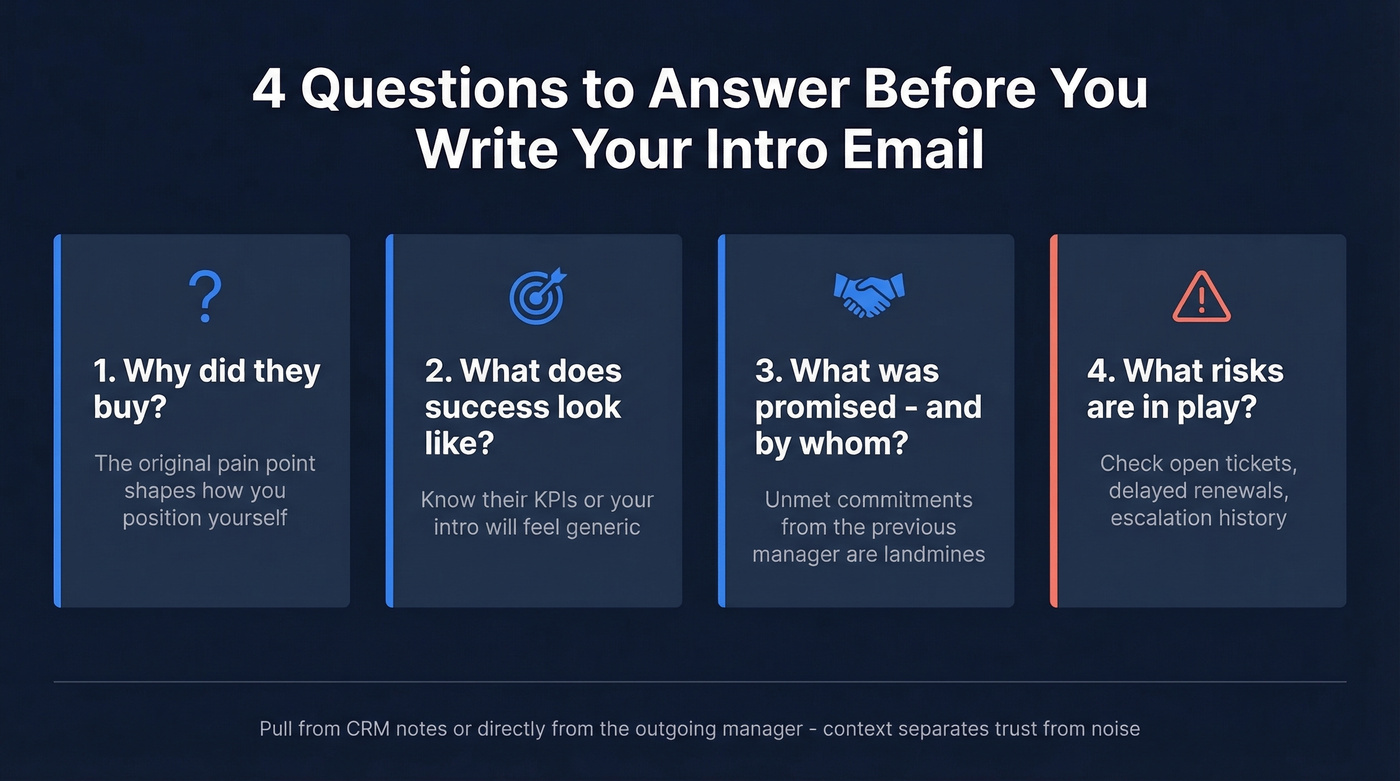
- Why did they buy? The original pain point shapes how you position yourself.
- What does success look like for them? If you don't know their KPIs, your intro will feel generic.
- What was promised - and by whom? Unmet commitments from the previous manager are landmines.
- What risks are already in play? Check for open support tickets, delayed renewals, or escalation history.
Pull these from your CRM notes or directly from the outgoing manager. This context separates a "nice to meet you" email from one that actually builds trust. If you're inheriting a large book of business, it's also worth running your contact list through an email verification tool before you send - we've seen teams bounce 10-15% of inherited contacts because people changed roles since the last CRM update.

5 Client Introduction Email Templates
Account Transition (You're the New Manager)
This is the most common scenario, and the one where specificity matters most. Reference one real account detail early - a goal, a milestone, an integration, a renewal date - so the client instantly knows this isn't a mass blast.
Subject: New point of contact for [Company Name]
Hi [First Name],
I'm [Your Name], your new [Title] at [Company]. I'll be your primary point of contact going forward - my job is to be your advocate on the inside.
I've reviewed your account history and want to make sure we're aligned. Could we grab 15 minutes this week? I'd love to cover what success looks like for you right now, how you're feeling about our services, and your goals for next quarter.
Here's my calendar link: [Link]. Looking forward to connecting.
Best, [Your Name]
Farewell & Handoff (Outgoing Manager Introduces You)
If the outgoing manager is still around, this two-step approach works best: they send the intro, then you follow up within 24 hours. The client hears from someone they already trust first, which lowers the friction on your follow-up dramatically.
Subject: Introducing [New Manager Name], your new [Title]
Hi [First Name],
I'm transitioning out of my role at [Company] and wanted to introduce [New Manager Name], who'll be taking over your account starting [Date]. [He/She/They] is fully briefed on your goals and history with us.
You can reach [New Manager Name] at [email] or [phone]. [He/She/They] will be reaching out shortly. Thank you for the partnership - wishing you continued success.
Warm regards, [Outgoing Manager Name]
Territory Restructuring
Subject: Update on your account team at [Company]
Hi [First Name],
We've restructured our account teams to better serve clients, and I'll now be your dedicated [Title]. This change is purely organizational - your contract, services, and commitments remain exactly the same.
I've been fully briefed on your account and I'm here to make sure nothing falls through the cracks. Would [Day] or [Day] work for a quick intro call?
Best, [Your Name]
New Client Post-Close Handoff
Skip the pleasantries here. The client just went through a sales process and doesn't want to repeat themselves. Prove you already know the context.
Subject: Your dedicated [Title] at [Company]
Hi [First Name],
I'm [Your Name], and I'll be managing your account going forward. [Sales Rep Name] brought me up to speed - including [specific detail: onboarding timeline, key integration, priority goal].
My focus over the next 30 days is making sure you're seeing value fast. Does [Day] at [Time] work for a kickoff call?
Looking forward to it, [Your Name]
Warm Introduction via Mutual Contact
This one's different. You're giving your mutual contact a short, forwardable email so they don't have to figure out what to write:
Subject: Connecting you with [Your Name]
Hi [Client First Name],
I wanted to connect you with [Your Name] from [Company]. [He/She/They] works with companies like yours on [specific value area] and I thought it'd be worth a conversation.
[Your Name] - [Client First Name] leads [role/team] at [Client Company] and has been doing impressive work on [specific detail].
I'll let you two take it from here.
Best, [Mutual Contact Name]
This structure - adapted from David A. Fields' warm intro framework - removes the "what do I write?" barrier for your introducer.

Before you send a single introduction email, make sure those contacts are still valid. Teams inherit CRM lists where 10-15% of contacts have changed roles. Prospeo's email verification catches dead addresses with 98% accuracy - so your first impression isn't a bounce notification.
Don't let a bounced intro email undermine your credibility on day one.
Subject Lines That Get Opened
Keep them under 50 characters. Here are lines mapped to each scenario:
- Account transition: "New point of contact for [Company]"
- Farewell handoff: "Introducing [Name], your new [Title]"
- Restructuring: "Update on your account team"
- Post-close handoff: "Your dedicated [Title] at [Company]"
- Warm intro: "Connecting you with [Your Name]"
Boring? Good. These aren't cold emails competing for attention in a stranger's inbox. Your client already knows your company. Clarity beats cleverness every time in account transition emails. If you want more options, pull from these email subject lines and keep them plain.
5 Mistakes That Kill Your Intro Email
Peacocking. As one customer success manager put it on r/sales, listing your tenure and certifications is "pointless at best and tacky peacocking at worst." The client doesn't care about your 12 years in SaaS. They care whether you'll solve their problems.
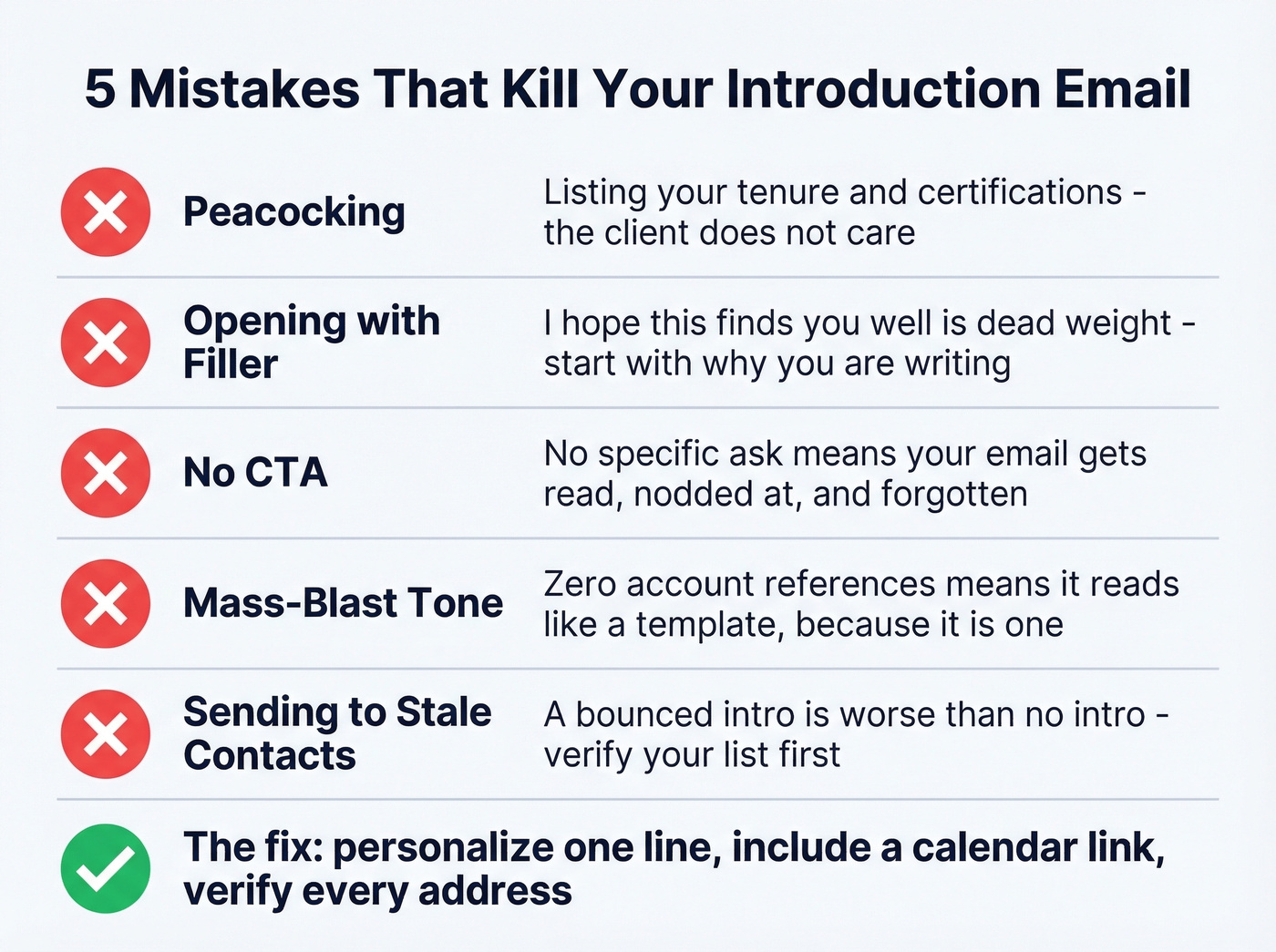
Opening with filler. "I hope this email finds you well" is dead weight. Start with who you are and why you're writing.
No CTA. The client reads your email, nods, and forgets. Always include a specific ask - a 15-minute call, a calendar link, a reply confirming receipt. Without it, you've written a nice note that goes nowhere. (If you need examples, use these email call to action patterns.)
Mass-blast tone. If there's zero reference to their account or goals, it reads like a template. Because it is one. Personalize at least one line per email, even if it takes an extra two minutes per account. This is the same principle behind personalized outreach.
Sending to stale contacts. A bounced intro email is worse than no email. If the contact left the company six months ago, you look unprepared - and your domain reputation takes a hit. We've watched teams tank their sender score in a single afternoon by blasting an unverified inherited list. Run your contacts through Prospeo's email verification first; 98% accuracy means you'll catch the dead addresses before they catch you. If you're seeing issues already, start with email bounce rate basics and then work on improve sender reputation.
Sending 200 account intro emails this week? Run your inherited contacts through Prospeo first. 75 free email verifications per month, $0.01 per email after that. No contracts, no sales calls - just clean data so every intro lands.
Start your new accounts right with contacts that actually exist.
Performance Benchmarks
There isn't a widely cited benchmark specifically for account transition emails, so here's how to triangulate.
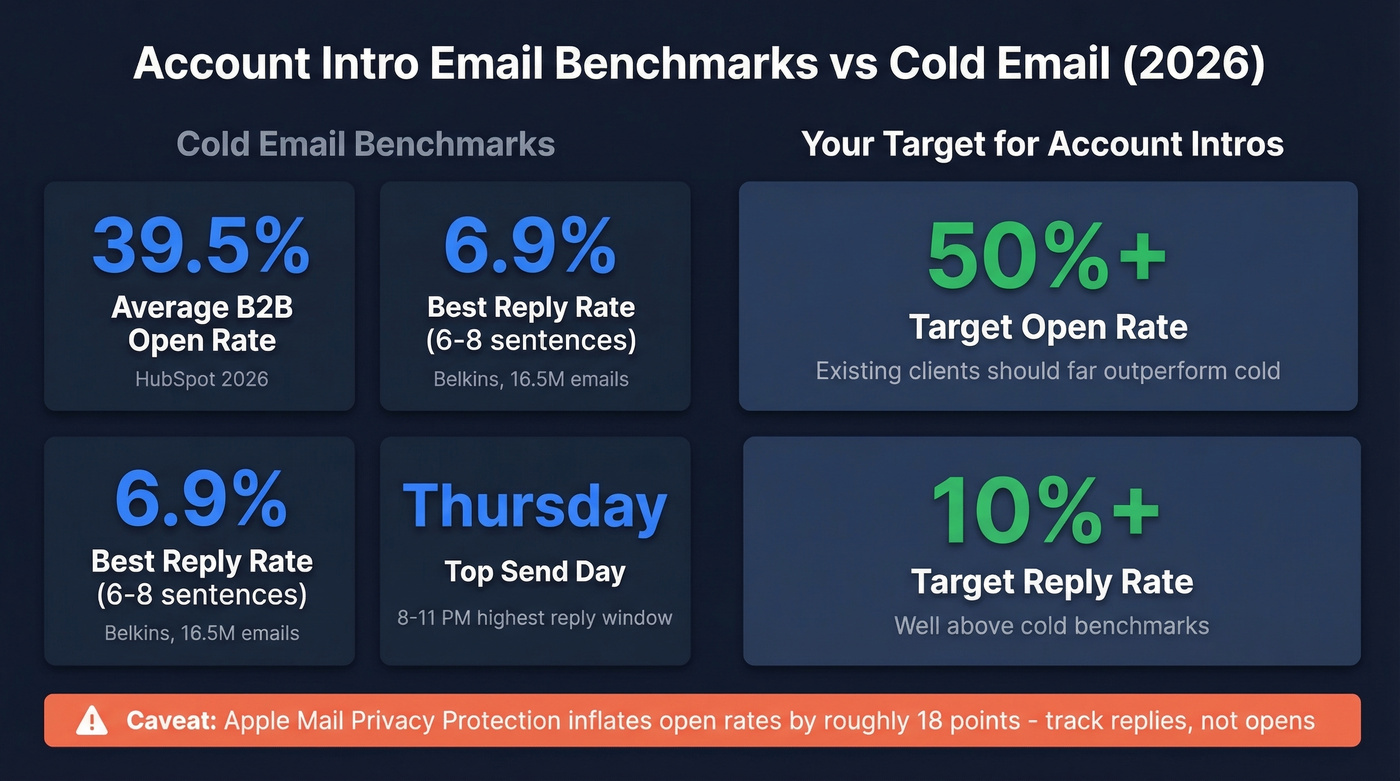
HubSpot's 2026 data puts B2B services open rates at 39.48%. A Belkins study of 16.5 million cold emails found the best-performing length was 6-8 sentences with a 6.9% reply rate, and Thursday was the top send day at 6.87%. Belkins also found evenings between 8-11 PM had the highest reply rates.
Those are cold email numbers. Your introduction to an existing client should outperform cold outreach by a wide margin - a solid target is 50%+ opens and reply rates well above 6-7%. One caveat: Apple Mail Privacy Protection inflates open rates by roughly 18 points. Track replies, not opens. For more on what "good" looks like, compare against standard email open rate benchmarks.
Our honest take: If your average deal size is under five figures, don't overthink these emails. Pick a template, personalize one line, and send. The biggest mistake we see isn't a bad intro - it's waiting three weeks to send one while you craft the "perfect" message. Speed signals competence. Silence signals neglect.
FAQ
How long should a client introduction email be?
Four to six sentences, under 200 words. The email's only job is to book a call - save the detailed account review for the meeting itself.
When should you send the introduction email?
Within the first week of taking over the account. Thursday is the top-performing send day based on Belkins' 16.5M email study, and evenings between 8-11 PM drive the highest reply rates.
What if the client doesn't respond?
Send one follow-up 3-4 business days later with a specific meeting time. After two non-responses, try phone or another channel. Don't send a third email - at that point you're creating noise, not building a relationship.
How do you avoid bounced emails when inheriting accounts?
Run your inherited contact list through a verification tool before sending. Bounced emails don't just waste your time; they actively damage your domain's sender reputation, which hurts deliverability for every email you send after that. Even a 5% bounce rate on a 200-account list means 10 failed first impressions.