

Sales Meeting Agenda: 5 Copy-Paste Templates, Common Mistakes, and the Follow-Through System Nobody Uses
You just sat through another 45-minute pipeline review where six reps narrated CRM data everyone could've read in Slack. That's not a meeting - it's a hostage situation.
The fix isn't a better sales meeting agenda template (though we've got five below). It's rethinking what happens before, during, and especially after the meeting ends.
Half of sales professionals spend more than 5 hours per day in meetings, and 46% attend three or more per day. A huge chunk of those are ad hoc. A solid agenda is where the fix starts, but the follow-through system in Section 8 is the part that actually moves pipeline.
What You Need (Quick Version)
- Weekly standup - 45 min, time-boxed, wins-first format
- Pipeline review - coaching-driven, not status recitation
- 1:1 manager-rep - alternates deal deep-dives and skill development
- Discovery call - the "agenda contract" that reframes every conversation
- QBR - 90 min, data-driven, strategy-forward
One thesis to carry through all of them: most meetings fail after the meeting, not during it.
Should This Meeting Exist?
Before you build an agenda, ask three questions. If you can't answer yes to at least two, cancel the meeting and send an email.
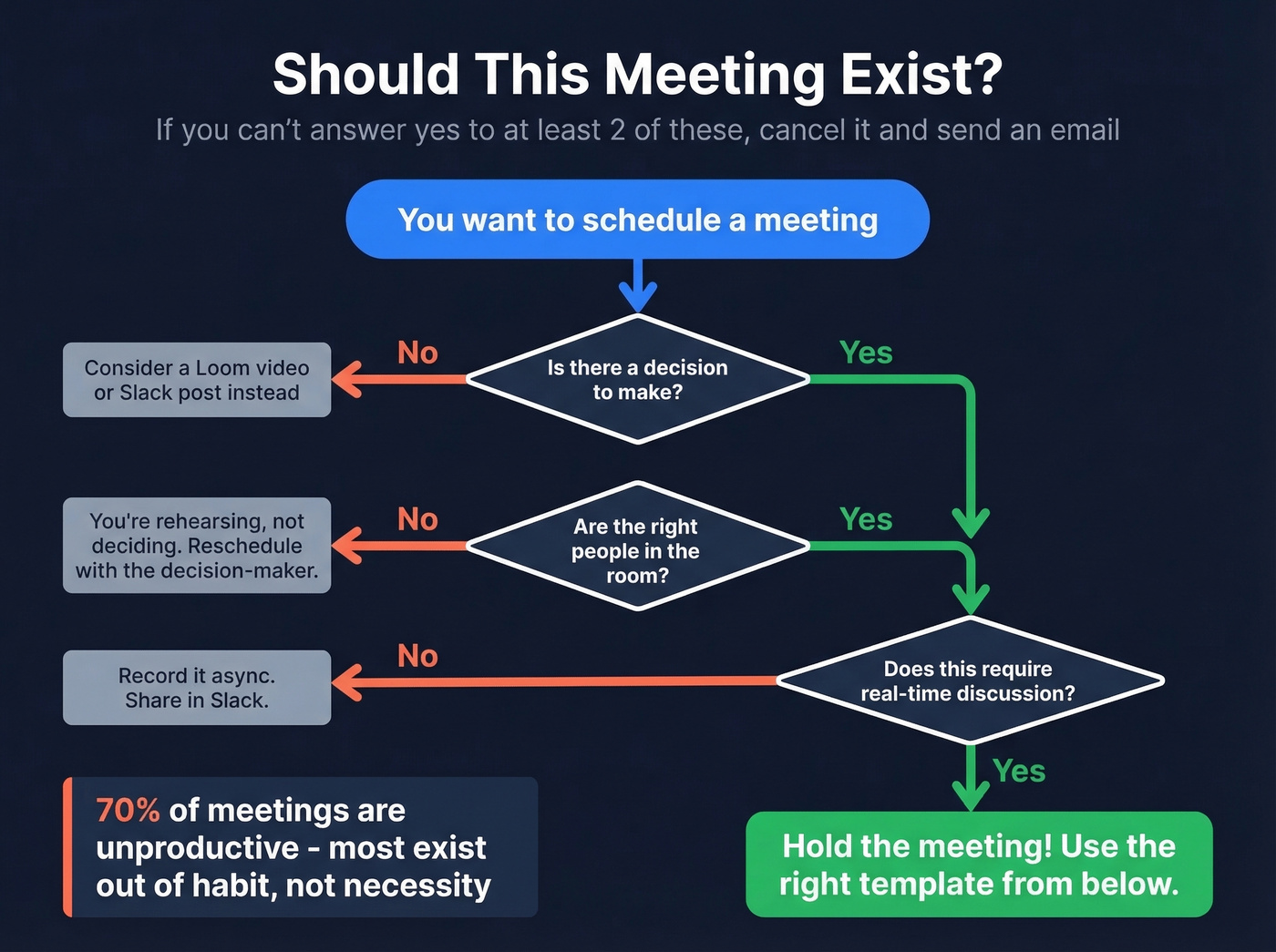
- Is there a decision to make? If the meeting is purely informational, a Loom video or Slack post works better.
- Are the right people in the room? If the decision-maker isn't attending, you're rehearsing, not deciding.
- Does this require real-time discussion? Brainstorming, coaching, and deal strategy benefit from live conversation. Status updates don't.
[70% of meetings are unproductive](https://hbr.org/2022/03/dear-manager-youre-holding-too-many-meetings). That stat holds up - most meetings exist out of habit, not necessity. If your team is distributed across time zones, the bar should be even higher: record anything that doesn't require real-time input and share it async.
Not All Agendas Are the Same
One of the biggest mistakes sales orgs make is running every meeting the same way. A pipeline review and a QBR serve completely different purposes, require different attendees, and need different structures.
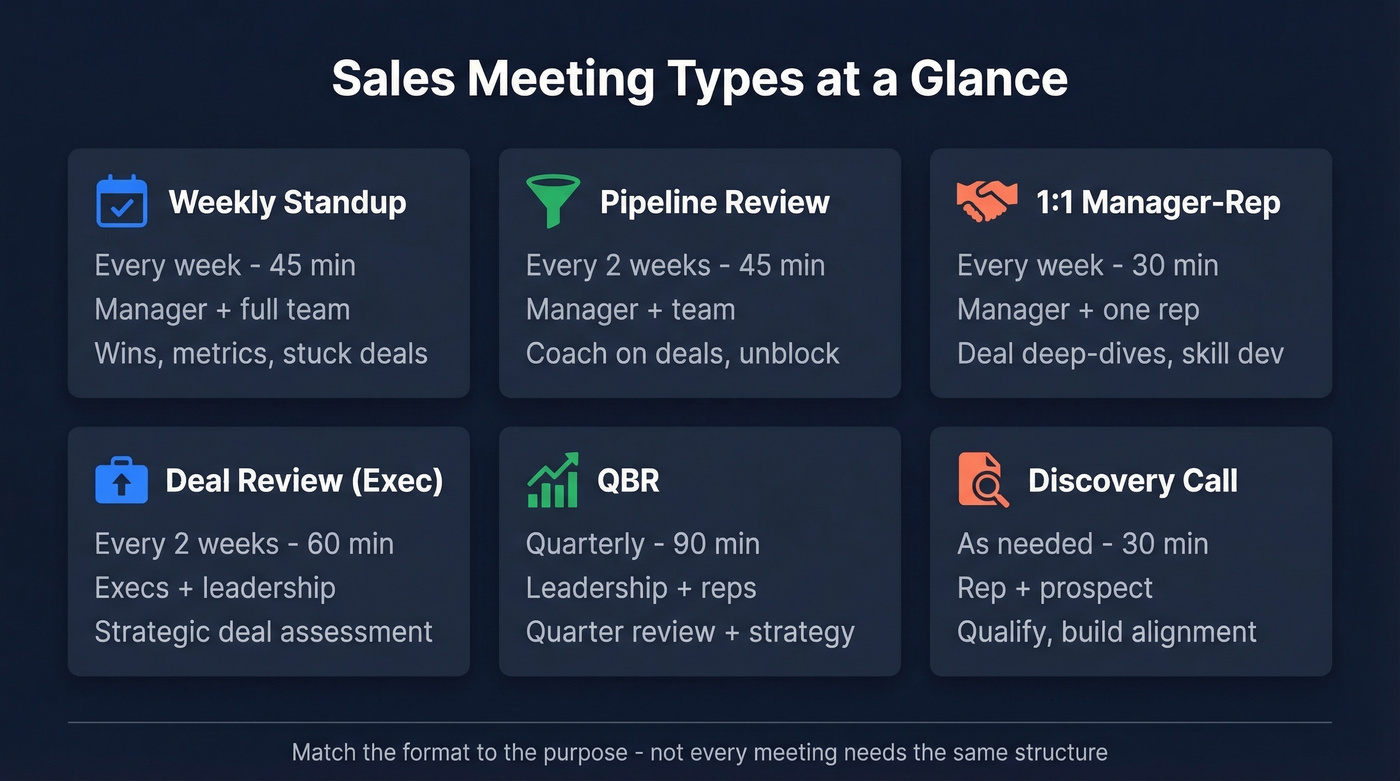
| Meeting Type | Cadence | Duration | Attendees | Primary Purpose |
|---|---|---|---|---|
| Weekly Standup | Weekly | 45 min | Manager + team | Wins, metrics, stuck deals |
| Pipeline Review | Bi-weekly | 45 min | Manager + team | Coach on deals, unblock |
| 1:1 Manager-Rep | Weekly | 30 min | Manager + rep | Deep-dive deals, skill dev |
| Deal Review (Exec) | Bi-weekly | 60 min | Execs + leadership | Strategic deal assessment |
| QBR | Quarterly | 90 min | Leadership + reps | Quarter review + strategy |
| Discovery Call | As needed | 30 min | Rep + prospect | Qualify, build alignment |
Deal reviews come in three flavors - executive, team, and 1:1 - and they're distinct from QBRs. Executive deal reviews assess strategic accounts every two weeks. Team deal reviews happen on the same cadence with the full squad. And 1:1 deal reviews fold into your weekly manager-rep check-ins, alternating between pipeline coaching and skill development.
Don't let deal reviews become performance reviews. If you spot a pattern across multiple reps, handle it in a 1:1 or QBR - not in front of the team.
What Every Agenda Must Include
Regardless of meeting type, every sales meeting agenda needs a clear objective - one sentence, not a paragraph. "Unblock the three deals stalled in negotiation" beats "pipeline discussion." Every section gets a time allocation in minutes, no exceptions. And every meeting starts with wins: it takes two minutes and sets the tone for everything that follows.
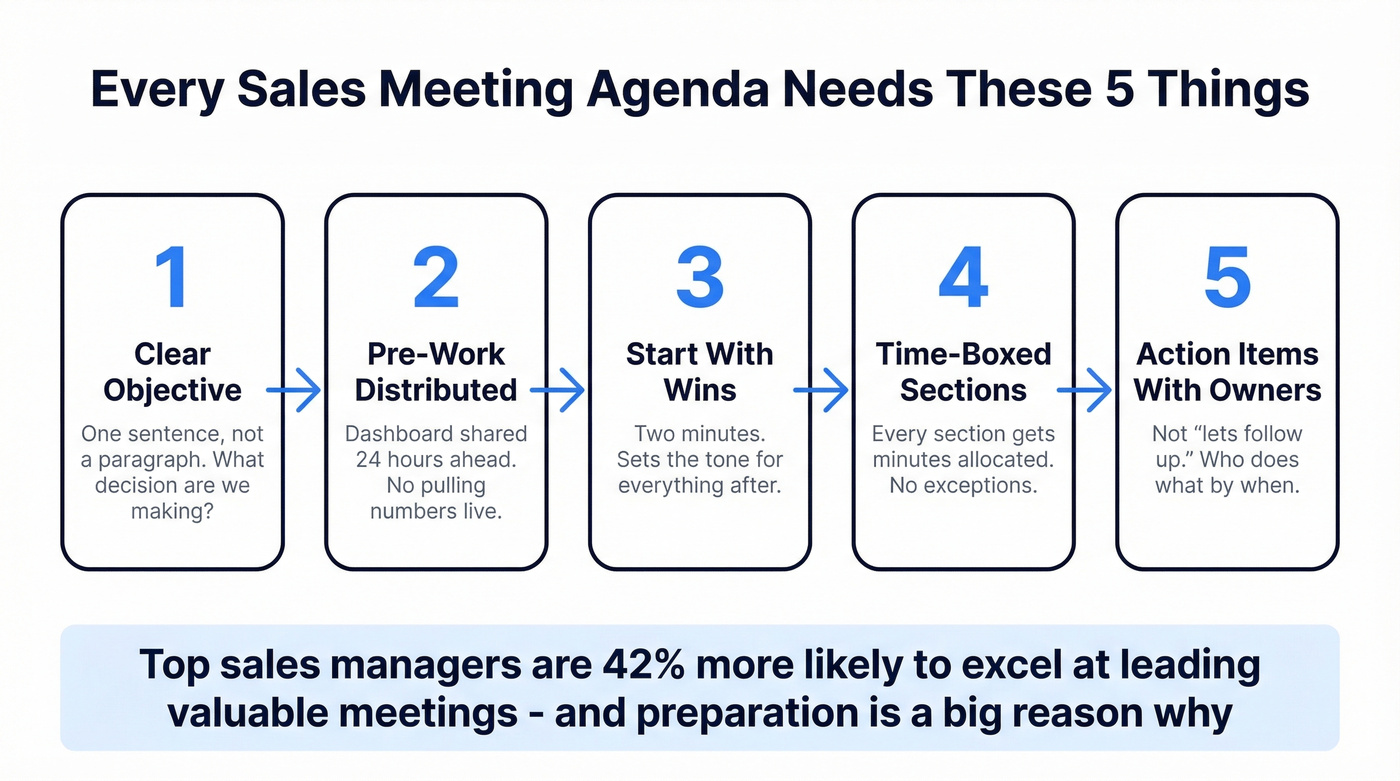
Metrics should come from a shared dashboard distributed 24 hours before the meeting. If reps are pulling numbers live, you've already lost 10 minutes. The core of any meeting is pipeline or deal discussion - coaching, decisions, unblocking - and it ends with action items that have owners and deadlines. Not "let's follow up on that." Instead: "Sarah will send the revised proposal to Acme by Thursday EOD."
We've found that the single biggest time-saver is pre-work: dashboards shared a day ahead, questions or stuck-deal flags submitted before the meeting starts, individual updates in a shared doc so nobody wastes live time reading them aloud. Top-performing sales managers are 42% more likely to excel at leading valuable meetings, and preparation is a big part of why.

Your pipeline reviews are only as good as the pipeline itself. Prospeo gives your team 300M+ verified contacts with 98% email accuracy - so meetings focus on closing deals, not cleaning bad data.
Give your reps a pipeline worth reviewing.
5 Templates You Can Copy-Paste
Copy each template below into your calendar invite or shared doc. Time allocations are built in - just fill in the specifics for your team.
Weekly Team Meeting (45 min)
This is the heartbeat meeting. Keep it tight, keep it wins-forward, and don't let it become a status dump.
- Wins & recognition (5 min) - Celebrate closed deals, booked meetings, creative plays.
- Metrics review from shared dashboard (10 min) - Pipeline velocity, conversion rates, activity numbers. Don't narrate - discuss what's off-trend.
- 2-3 stuck deals (15 min) - Pick the deals with the highest stakes or the most interesting blockers. The team coaches together.
- Training or role-play (10 min) - Objection handling, cold call openers, negotiation tactics. Rotate who leads.
- Action items (5 min) - Who does what by when. Write it down.
If you want a named framework, RAIN Group's WEWIN model (Wins and Recognition, Evaluate Progress, What's New, Issues and Ideas, Needs Action) maps almost directly to this structure.
Pipeline Review (45 min)
Here's the thing about pipeline reviews: if your CRM has the data, don't make reps narrate it. The consensus on r/sales is that pipeline meetings are busywork when they're just status recitation. We've seen this firsthand - meetings that devolve into "move the status to X" help nobody.
- Quick pipeline health check (5 min) - Total pipeline value, stage distribution, deals at risk.
- 3-5 priority deals: coaching and unblocking (30 min) - For each deal: what's the next step, what's blocking it, and what does the rep need from leadership?
- Commit/upside/best-case calibration (5 min) - Quick gut-check on forecast accuracy.
- Action items (5 min) - Specific next steps with owners.
Skip the formal bi-weekly pipeline review if your average deal size is under $25k. A shared Slack channel with deal updates and a monthly coaching session will get you 80% of the value in 20% of the time. Save the formal reviews for enterprise deals where multi-threading and executive alignment actually matter.
1:1 Manager-Rep Check-in (30 min)
Weekly cadence. Alternate between pipeline-focused weeks and coaching-focused weeks so these don't get stale.
- Wins and blockers (5 min) - What went well, what's stuck.
- Top 3 deals deep-dive (15 min) - Walk through the rep's highest-priority accounts. Review the deal plan, assess likelihood, strategize next moves.
- Skill development (5 min) - On coaching weeks, focus on one specific skill: discovery questions, multi-threading, negotiation. On pipeline weeks, use this time for additional deal discussion.
- Action items (5 min) - Commitments reviewed at the start of next week's 1:1.
If you want a ready-made structure, use this 1:1 manager-rep check-in format.
Discovery Call (30 min)
This template comes from a practitioner framework on r/sales. The key move is the "agenda contract" - explicitly asking the prospect for permission to run the agenda, then inviting them to change it.
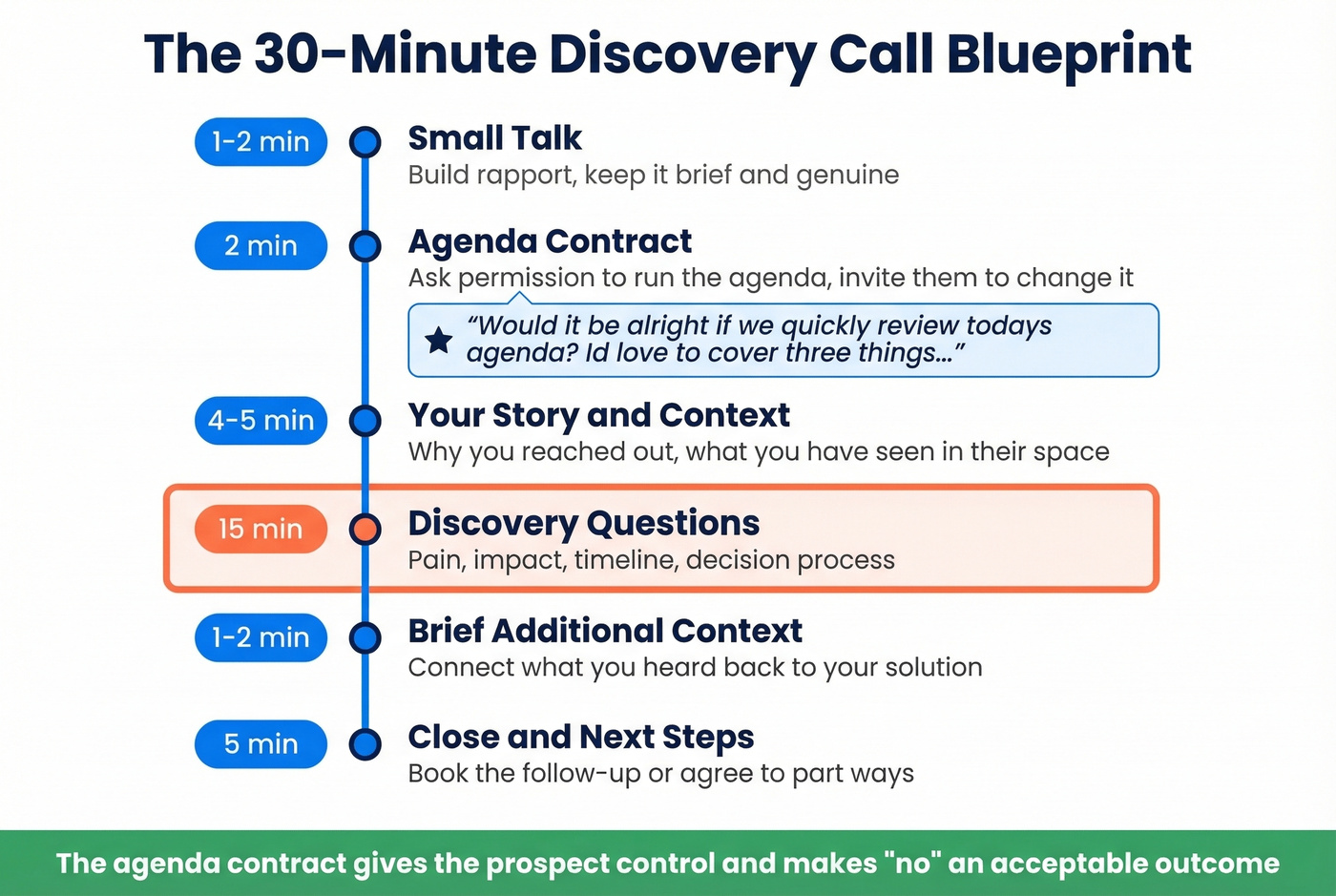
- Small talk (1-2 min)
- Agenda contract (2 min) - See the script below.
- Your story / context setting (4-5 min) - Why you're reaching out, what you've seen in their space.
- Discovery questions (15 min) - Pain, impact, timeline, decision process.
- Brief additional context (1-2 min) - Connect what you heard back to your solution.
- Closing and next steps (5 min) - Book the follow-up or agree to part ways.
The agenda contract script: "Would it be alright with you if we quickly review today's agenda? I'd love to cover three things: first, share a bit of context on why I reached out; second, learn more about [their situation]; and third, figure out if it makes sense to keep talking - or if it doesn't, that's totally fine too. Does that work, or would you like to add anything?"
This framing gives the prospect control and establishes that "no" is an acceptable outcome. Discovery stops feeling like an interrogation.
If you want to go deeper on the flow, use this discovery call playbook.
QBR (90 min)
A QBR evaluates the past quarter's performance and sets strategy for the next one. It's not a weekly meeting on steroids - it's a fundamentally different exercise. Hold it within the first two weeks of the new quarter, after results are finalized.
- Quarter recap (20 min) - Revenue vs. target, win/loss rates, average deal size, cycle time.
- Metric deep-dive (25 min) - Pick 2-3 metrics that tell the quarter's story. Where did the team over- or under-perform?
- Wins and losses analysis (15 min) - 2-3 notable wins, 2-3 notable losses. What's repeatable? What's avoidable?
- Next-quarter strategy (20 min) - Territory adjustments, target accounts, new plays, hiring needs.
- Action items (10 min) - Strategic commitments with owners and deadlines.
Gartner projected that 65% of B2B sales orgs would let data guide decisions rather than intuition by 2026. The QBR is where data-driven decision-making either shows up or doesn't.
If you're building a deck for this, start with a QBR presentation template.
5 Mistakes That Kill Sales Meetings
1. Status theater. If reps are reading CRM updates aloud while everyone else checks email, that's not a meeting - it's a hostage situation. Share dashboards 24 hours ahead and spend live time on coaching and decisions only.
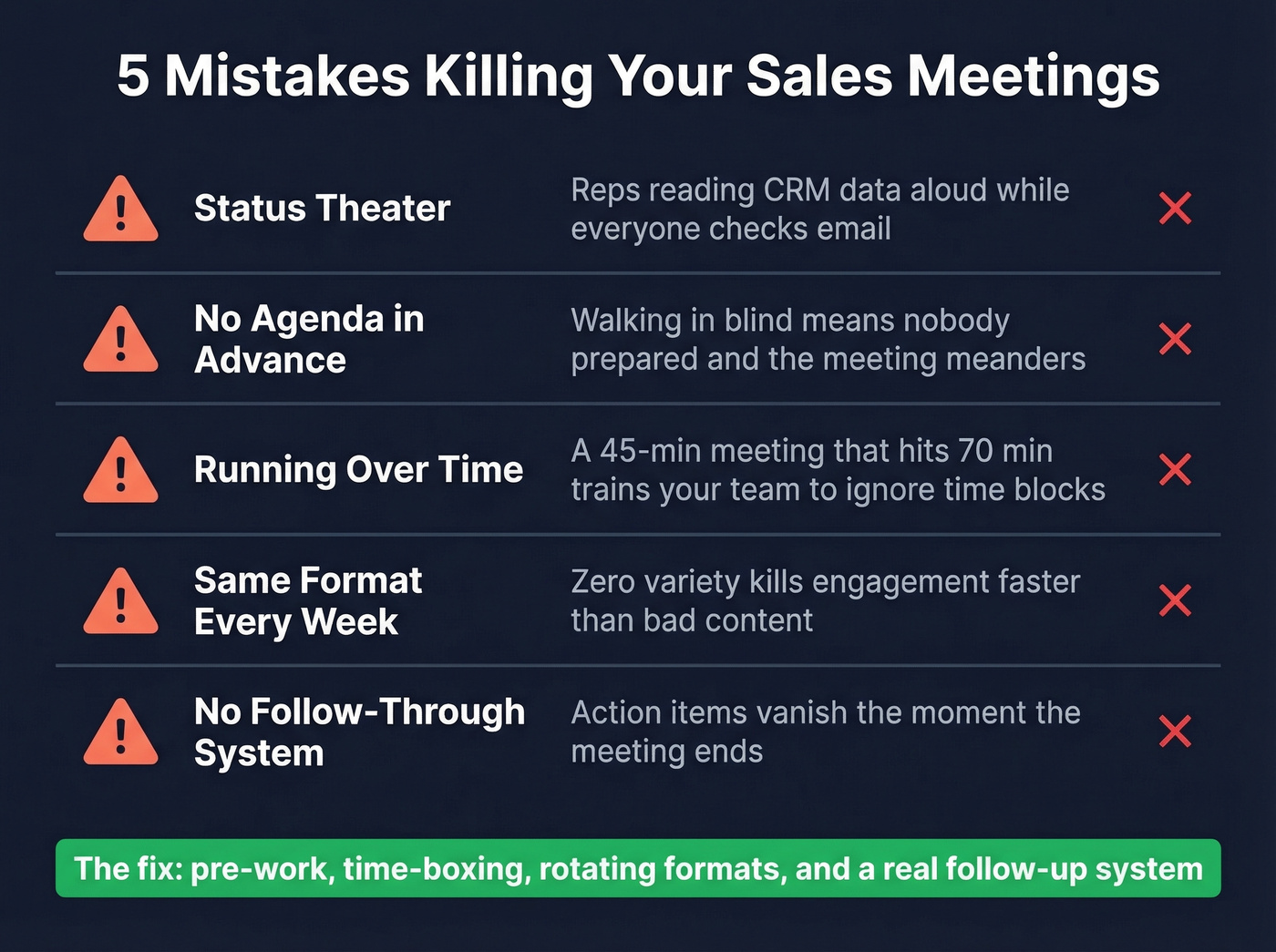
2. No agenda distributed in advance. Walking into a meeting without a shared agenda is like running a discovery call without research. Reps don't know what to prepare, and the meeting meanders. Send the agenda the day before, every time.
3. Running over time. A 45-minute meeting that runs 70 minutes trains your team to ignore time blocks. Assign a timekeeper. When time's up, move on or schedule a follow-up. This is non-negotiable - the moment you let one meeting bleed over, every meeting on the calendar becomes a suggestion.
4. Monotony. Lack of variety kills engagement faster than bad content. If every Monday is the same five agenda items in the same order, reps go through the motions. Rotate who leads, swap in role-plays, bring in a customer story, try live deal teardowns or competitive intel lightning rounds. Small changes keep attention high.
If you need fresh practice material, pull from these role-play scenarios.
5. No post-meeting follow-through. This is the biggest one. A great meeting with no recap email, no tracked action items, and no CRM updates is just a conversation that evaporated. Let's talk about how to fix that.
The Post-Meeting System Nobody Uses
The meeting ends. Everyone goes back to their inbox. Two hours later, nobody remembers who committed to what.
Here's the system that works:
Recap email within 2 hours. Lead with the most important decision or action item, not a summary of what was discussed. The person who needs to act should see their name in the first two sentences.
Action items with owners and deadlines. "Follow up with Acme" isn't an action item. "Jordan sends revised pricing to Acme by Wednesday 5pm" is.
CRM updates by end of day. If a deal's stage changed, a next step was identified, or a contact was flagged as unresponsive - it goes in the CRM today. Not tomorrow. Today.
Next meeting date confirmed. Before anyone leaves, the next meeting is on the calendar with a preliminary agenda.
Data quality check. Are the contacts you discussed actually reachable? This matters more than most teams realize. Pipeline reviews are only as good as the data behind them. I sat in on a pipeline review last quarter where a rep presented a $200k opportunity, and two of the three stakeholders in the CRM had bounced emails. That deal wasn't real - it was a guess.
If you want the deeper why (and the fix), start with sales data quality.
Run your pipeline contacts through Prospeo's bulk verification before each review. With 98% email accuracy and a 7-day data refresh cycle, it takes minutes and turns your pipeline from hopeful to honest.
Every stuck deal on your agenda needs the right contact. Prospeo's 125M+ verified mobiles hit a 30% pickup rate, and intent data across 15,000 topics tells reps exactly which accounts are in-market - before the meeting starts.
Turn pre-work into pipeline with contacts that actually connect.
Tools That Help
You don't need a dozen tools to run good meetings. Here's what actually matters:
CRM dashboards - Salesforce, HubSpot, or Pipedrive, whichever you're already using. The key is having a dashboard shared before the meeting, not built during it. Teamgate has a solid guide on running meetings entirely from CRM data.
If your dashboards are a mess, fix the underlying CRM productivity issues first.
Meeting intelligence - Gong or ZoomInfo Chorus for recording and analyzing external calls. Pull a 60-second clip of a great discovery question instead of lecturing about it.
Async communication - Slack for pre-meeting updates and post-meeting recaps. Loom for anything that "could've been a meeting."
Agenda documentation - Notion or Google Docs. Keep a running template that carries forward action items from the previous meeting.
If you want a more structured cadence, use a sales huddles format for quick weekly alignment.
FAQ
What should a sales meeting agenda include?
Every agenda needs a clear one-sentence objective, time allocations per section, a wins segment, pre-shared metrics, a pipeline or deal discussion block, and action items with owners and deadlines. If you can't state the meeting's purpose in one sentence, you're not ready to hold it.
How long should a weekly sales meeting be?
Thirty to 45 minutes for weekly standups; 90 minutes max for QBRs. A focused 30-minute standup with time-boxed sections beats a meandering hour every time. If you can't fill the slot with decisions and coaching, shorten it.
How often should sales teams meet?
Weekly for team standups and 1:1s. Bi-weekly for pipeline reviews. Quarterly for QBRs. Cancel anything that could be an email - and be honest about how many of your current meetings fall into that category.
What's the difference between a pipeline review and a QBR?
Pipeline reviews focus on current deals and near-term actions, typically bi-weekly in 45-minute sessions. QBRs evaluate the entire quarter's performance and set next-quarter strategy, held within the first two weeks of a new quarter. They serve different purposes and shouldn't be combined.
How do I keep pipeline data accurate between meetings?
Run your CRM contacts through a verification tool before each review. Prospeo's bulk verification catches stale emails and bad numbers in minutes, and the free tier covers 75 verifications per month - enough to audit your top deals.