

Sales Meetings: The 2026 Playbook for Every Type
It's 9:02 AM on Monday. Your pipeline review was supposed to start two minutes ago. Three reps are still joining, nobody updated their deals in the CRM over the weekend, and the VP of Sales is asking for a forecast number you don't have. Sound familiar?
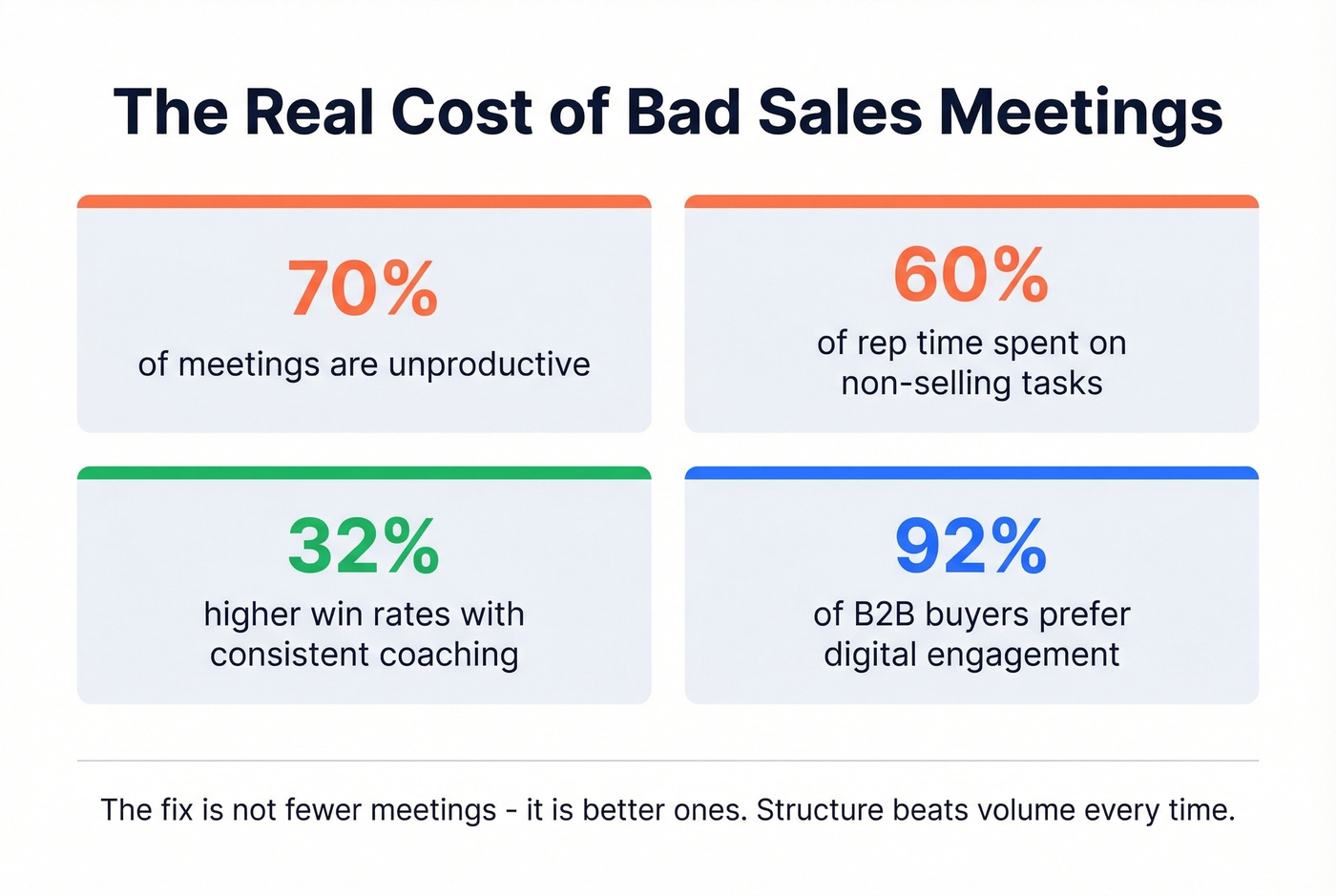
70% of meetings are unproductive, and sales meetings are no exception. Reps already spend 60% of their time on non-selling tasks - poorly run meetings pile onto that waste. The fix isn't fewer meetings. It's better ones. Here's how to run every type, the exact agendas that work, and the tools that make prep effortless.
The Only Three Meetings That Matter
If you only run three meetings well, make them these:
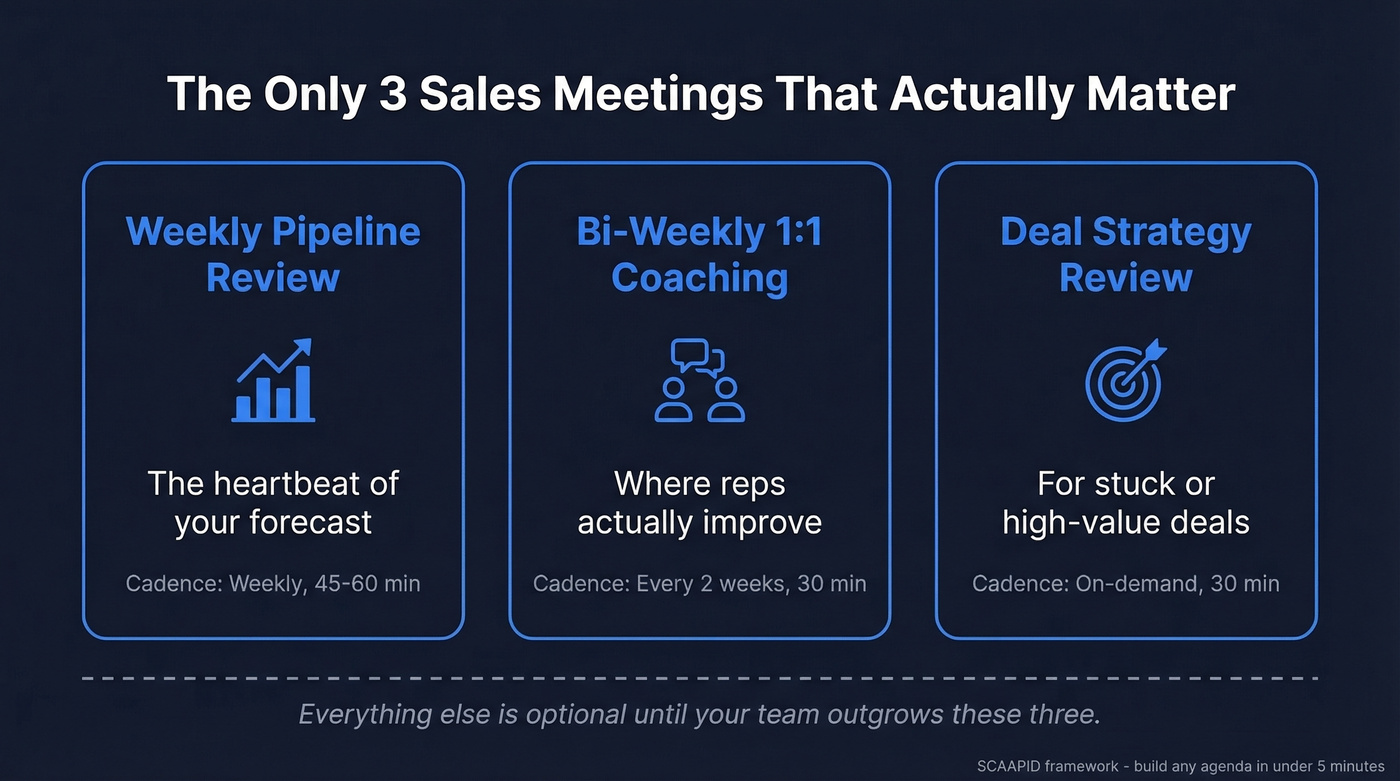
- Weekly pipeline review - the heartbeat of your forecast
- Bi-weekly 1:1 coaching sessions - where reps actually improve
- Deal strategy reviews - on-demand, for stuck or high-value opportunities
Everything else is optional until your team outgrows these three. Use the SCAAPID framework (covered below) to build any agenda in under five minutes. And before any prospect-facing meeting, verify the contact's data is current - stale phone numbers and outdated emails are a top cause of no-shows.
What Counts as a Sales Meeting?
A sales meeting is any structured conversation designed to move revenue forward. That's it. But the term covers two very different animals.
Internal meetings are the ones you run with your team - pipeline reviews, coaching sessions, QBRs. The goal is alignment, accountability, and skill development. External meetings are prospect-facing - discovery calls, demos, negotiations. The goal is advancing a deal. Both qualify, but they require completely different preparation, agendas, and facilitation styles. Treating them the same is how you end up with discovery calls that feel like status updates and pipeline reviews that feel like interrogations.
Types of Sales Meetings
Here's the full taxonomy, mapped to cadence, duration, and who should be in the room.
| Meeting Type | Frequency | Duration | Attendees |
|---|---|---|---|
| Team standup | Daily | 15 min | Full team |
| Pipeline review | Weekly | 45-60 min | Manager + reps |
| Opportunity review | As needed | 30 min | Manager + deal owner |
| 1:1 coaching | Bi-weekly | 30 min | Manager + rep |
| QBR | Quarterly | 60-90 min | Leadership + team |
| Training/enablement | Monthly | 45-60 min | Full team |
| Discovery call | As booked | 30 min | Rep + prospect |
| Product demo | As booked | 45-60 min | Rep/SE + prospect |
| Negotiation/close | As booked | 30-60 min | Rep/Manager + prospect |
Pipeline meetings aren't opportunity reviews. A pipeline review assesses overall health - coverage ratios, stage velocity, where deals are stuck. An opportunity review is a deep dive on one or two specific deals, troubleshooting strategy and next moves. Conflating the two is how a 45-minute pipeline review turns into a 90-minute slog where one rep monopolizes the conversation about a single account.
Run pipeline reviews weekly with the full team, and save opportunity reviews for 1:1s or ad-hoc sessions with the deal owner. Consistent coaching - the kind that happens in structured 1:1s - is linked to 32% higher win rates and 28% higher quota attainment, so don't skip these.

The best pipeline review agenda won't help if your reps are calling dead numbers. Prospeo gives you 125M+ verified mobiles with a 30% pickup rate and 98% email accuracy - so every deal in your pipeline has a real contact behind it.
Stop reviewing deals you can't actually reach. Start with real data.
How to Build a Sales Meeting Agenda
The SCAAPID Framework
SCAAPID gives you a repeatable structure for any agenda in under five minutes:
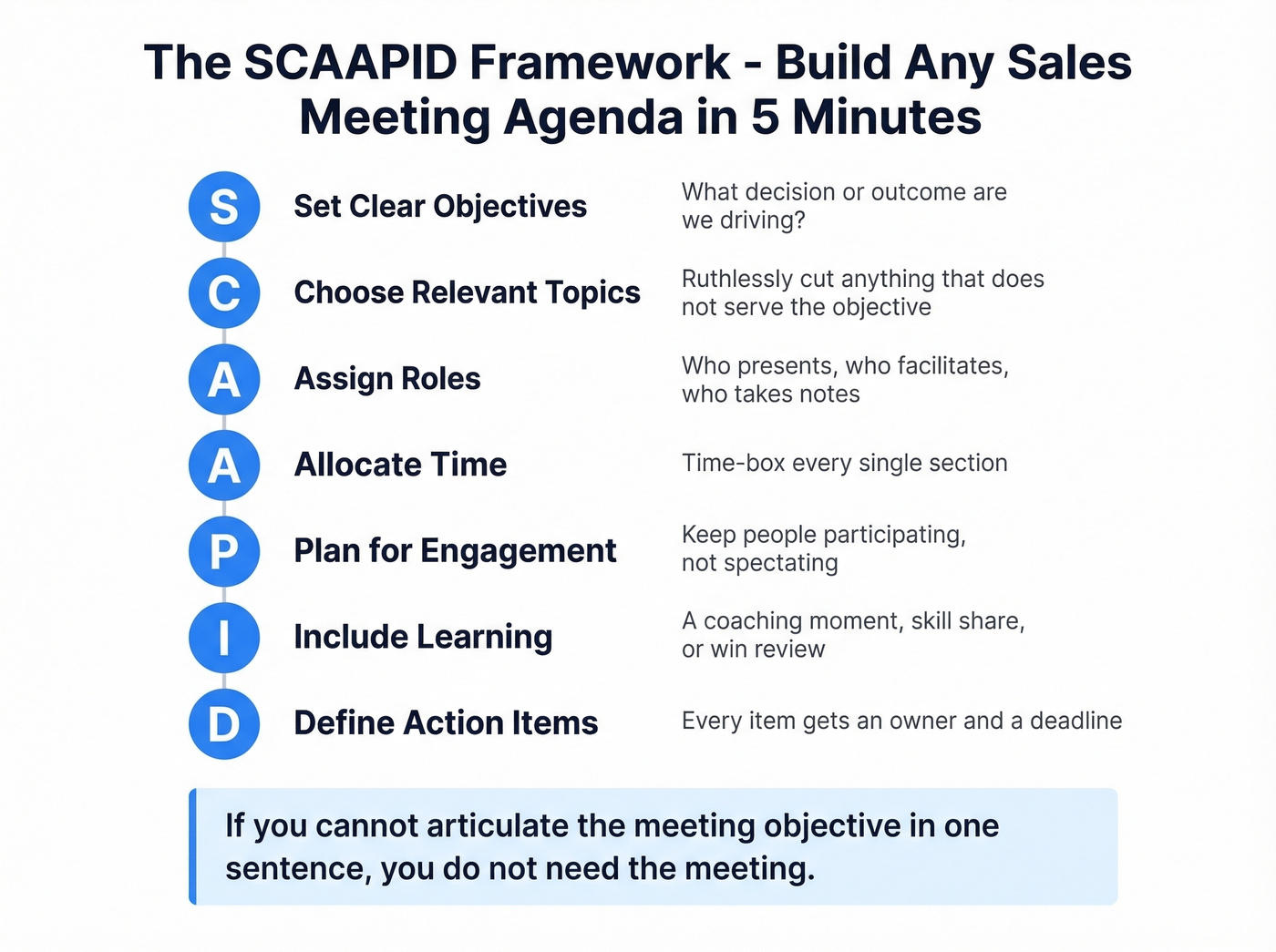
- S - Set clear objectives (what decision or outcome are we driving?)
- C - Choose relevant topics (ruthlessly cut anything that doesn't serve the objective)
- A - Assign roles and responsibilities (who presents, who facilitates, who takes notes)
- A - Allocate time for each section (time-box everything)
- P - Plan for engagement (how will you keep people participating, not spectating?)
- I - Include learning opportunities (a coaching moment, a skill share, a win review)
- D - Define action items and next steps (nothing leaves the room without an owner and a deadline)
The framework works for a 15-minute standup and a 90-minute QBR. The key is that first letter: if you can't articulate the meeting's objective in one sentence, you don't need the meeting.
Weekly Team Meeting Agenda (30 min)
Copy these agendas into your meeting tool of choice - they're designed to work as-is. Every item is time-boxed.
- Wins and celebrations (3 min) - start with energy, not spreadsheets
- Pipeline snapshot from dashboard (5 min) - coverage ratio, stage movement, forecast delta
- Deal blockers - stuck deals only (10 min) - no round-robin updates; only deals that need help
- Coaching moment or skill share (7 min) - one rep shares a tactic, a call recording, or a lesson
- Action items and next steps (5 min) - every action gets an owner and a date
The critical move: send this agenda 24 hours before the meeting. Reps who know what's coming prepare better, and you eliminate the "let me pull that up" dead air.
1:1 Coaching Session Agenda (30 min)
The best 1:1s feel like coaching, not performance reviews. Let the rep talk more than you do. Here's the structure we've seen work best:
- Rep self-assessment (5 min) - let them lead with what's working and what's not
- Deal deep-dive on 1-2 opportunities (15 min) - strategy, blockers, next moves
- Skill development focus (5 min) - one specific skill to work on this cycle
- Action items (5 min) - concrete commitments, not vague "try harder" directives
If you want more templates for manager-rep check-ins, use this 1:1 coaching structure as your baseline.
Discovery Call Agenda (30 min)
Based on Mixmax's time-boxed structure, this external meeting agenda consistently drives the best conversion to next steps:
- Intro and agenda setting (5 min) - confirm the agenda, invite additions, set expectations
- Deep-dive on challenges (10-15 min) - this is where the real selling happens; ask, don't pitch
- Solution alignment (5 min) - connect their pain to your capabilities, briefly
- Next steps and scheduling (5 min) - book the next meeting before you hang up
Sending the agenda before an external meeting isn't just polite - it's strategic. Prospects who've reviewed the agenda arrive ready to engage. Prospects who get ambushed with "so tell me about your challenges" spend the first ten minutes guarded.
Running Virtual and Hybrid Meetings
80% of B2B sales interactions now happen at least partly through digital channels, and 92% of B2B buyers prefer digital engagement. Virtual isn't the exception anymore.
If you're building a distributed org, align meeting cadence with your remote sales team operating rhythm.
Facilitation That Works
Most virtual meetings fail because of passive facilitation, not bad technology. Here's what actually moves the needle:
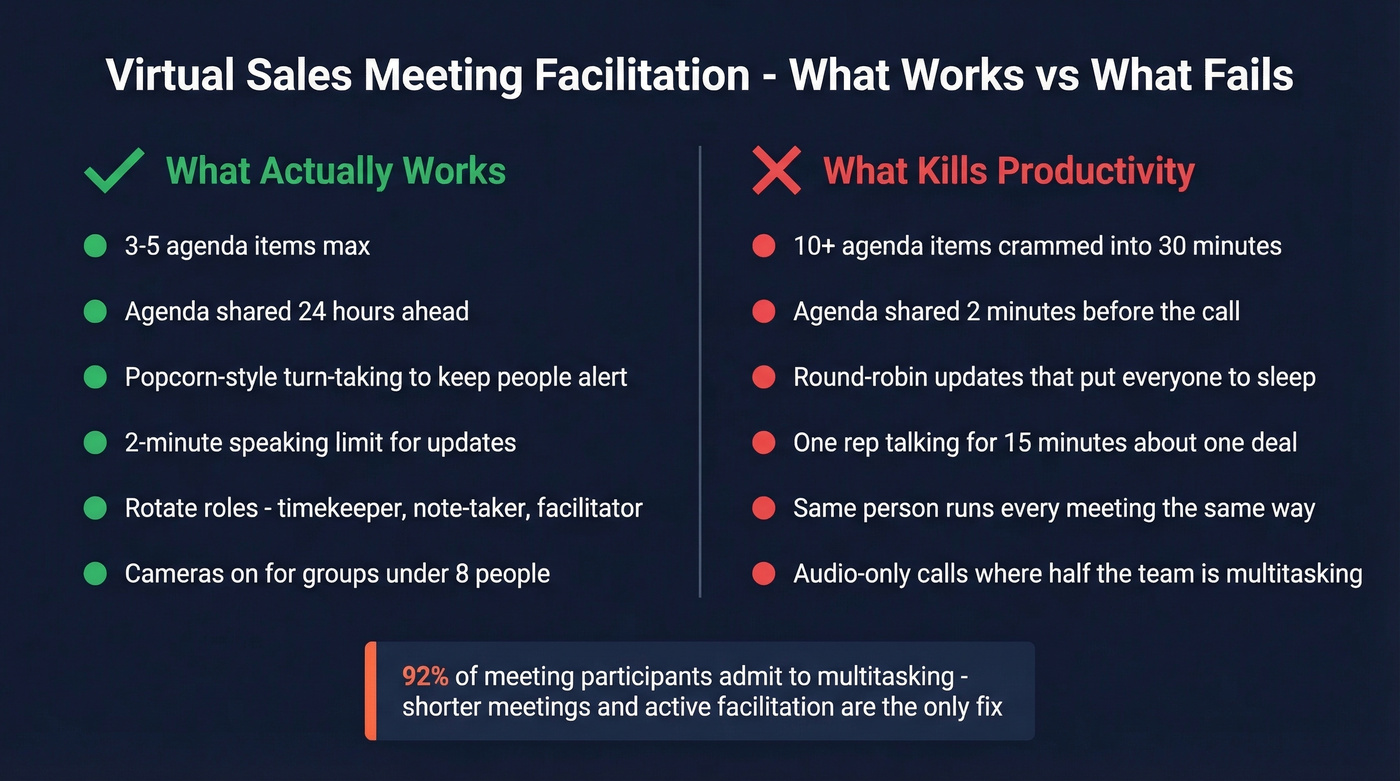
- Cap the agenda at 3-5 items. More than that and you're running a conference, not a meeting.
- Share the agenda 24 hours in advance. No surprises.
- Use popcorn-style turn-taking instead of going around the room in order. "Sarah, what's your read on this? ... Sarah, who should go next?" It keeps people alert.
- Enforce a 2-minute speaking limit for updates. If someone needs more than two minutes, it's a separate conversation.
- Rotate roles - timekeeper, note-taker, facilitator. Shared ownership means shared attention.
- Cameras on for small groups under 8 people. It changes the energy completely.
When to Skip the Meeting Entirely
Here's a heuristic from Salesforce's meeting playbook that we use constantly: if the information can be shared via a spreadsheet or email, it doesn't belong in a live meeting. A sharper version: if the meeting could be resolved in under 10 minutes of async communication, cancel it.
Status updates belong in a Loom video or Slack thread. CRM data pulls belong in a shared dashboard with a 2-line summary. Deal updates that don't need real-time discussion belong in async. Save live time for decisions, coaching, and problem-solving - the things that actually require human interaction.
To make this repeatable, build a lightweight sales operating rhythm so meetings exist for decisions, not habit.
Mistakes That Kill Meeting Productivity
These mistakes destroy more pipeline than bad leads do.
1. Losing sight of purpose. If your team meeting isn't creating more sales, it's not a sales meeting - it's a status update with a calendar invite. Every meeting needs a clear outcome, not just an agenda.
2. Starting late. Five minutes late with eight people in the room is 40 minutes of wasted productivity. Start on time, every time, even if two people haven't joined yet. They'll learn.
3. Being unprepared. Reps who show up without reviewing their pipeline are wasting everyone's time. The fix is simple: send the agenda and expectations 24 hours ahead, and hold people accountable.
4. Allowing absenteeism - mental or physical. Multitasking in meetings is an epidemic - 92% of participants admit to it. Popcorn-style facilitation and shorter meetings are the best countermeasures. And this includes the facilitator: if you're running the meeting while checking Slack, you've given everyone permission to check out.
5. Wasting time on round-robin updates. Going around the room asking "what's in your pipeline?" is the single biggest time sink. We've seen managers waste 20 minutes of a 45-minute pipeline review on a single deal that should've been a 1:1 conversation. Pull the data from your CRM before the meeting and spend live time on blockers and strategy instead.
If you need a tighter format, use a dedicated pipeline review template and keep opportunity deep-dives separate.
6. Lack of variety. Running the identical meeting every week breeds rehearsed answers and checked-out reps. Rotate formats - bring in a call recording review, a competitive intel session, or a win/loss analysis. The consensus on r/sales is that the best managers treat meeting formats like playlists, not repeat tracks.
7. Prepping for meetings that were dead before they started. Your SDR booked a discovery call with a VP of Sales. At 2:05, the Zoom room is empty. The VP left the company three months ago. Your CRM data was stale. Verifying prospect data before booking - emails, phone numbers, job titles - prevents this entirely. Tools like Prospeo's email finder catch these ghosts before they waste your calendar, with 98% email accuracy on a 7-day refresh cycle.
Let's be honest about something: if your average deal size is under $10k and your sales cycle is under 30 days, you probably only need two of these meetings - the weekly pipeline review and bi-weekly 1:1s. Everything else adds overhead that high-velocity teams can't afford. Scale your meeting cadence to your deal complexity, not to what enterprise playbooks tell you.
Tools Worth Paying For in 2026
The right tools don't replace good meeting habits - they remove the friction that makes bad habits easy. Here's what's worth your budget.
Data and Meeting Prep
Before any external meeting, the question isn't "do we have the right deck?" - it's "is this person still at this company, and will they actually pick up?" Prospeo handles this layer with 300M+ professional profiles, 143M+ verified emails, and 125M+ verified mobile numbers on a 7-day data refresh cycle. Snyk's team of 50 AEs dropped their bounce rate from 35-40% to under 5% after switching, generating 200+ new opportunities per month. The free tier gives you 75 emails and 100 Chrome extension credits monthly - enough to verify every prospect meeting on your calendar without spending a dollar.
If you're auditing your stack, compare categories like sales enablement tools and sales readiness tools before you buy.
If email quality is your bottleneck, start with an email verifier to cut bounces before meetings get booked.
For internal meeting prep, your CRM dashboard is the other essential. Salesforce or HubSpot reports should be pulled and shared before every pipeline review - not generated live while eight people watch a loading spinner.
If you want examples of what to share, use these sales report examples as a starting point.
AI Meeting Assistants
85% of sales reps using AI agents say it frees them for higher-value work, and meeting prep is one of the first things they automate.
Fellow is the best option for privacy-conscious teams. It supports botless recording, and CRM sync comes on the Business plan and above. Free tier available, paid plans from $7/user/month.
Fireflies.ai starts free with solid transcription and search across your meeting library. Paid plans from $10/user/month. Skip this if you only need basic summaries - Fathom does that for free. Pick Fireflies when you need a searchable archive across hundreds of calls.
Fathom has a generous free tier that covers most individual rep needs - AI summaries and action items. Great for solo reps or small teams not ready to commit budget.
Avoma sits between the lightweight tools and enterprise platforms at $19/user/month. It combines note-taking, conversation intelligence, and coaching scorecards in one tool - a solid middle ground for mid-market teams who want more than transcription but aren't ready for Gong's price tag.
Conversation Intelligence (Enterprise)
Gong is the gold standard for teams with 50+ reps running complex deal cycles. The analytics, coaching scorecards, and deal intelligence are unmatched. But the price reflects it: roughly $1,600/user/year plus a $5,000-$50,000 annual platform fee. For teams under 20 reps, it's overkill.
Salesloft runs $125-$165/user/month and bundles conversation intelligence into a full sales engagement platform. If you're already using Salesloft for sequences and cadences, the built-in call recording and analytics are a natural extension. If you're not in the Salesloft ecosystem, don't buy it just for meeting intelligence.
| Category | Tool | Starting Price | Best For |
|---|---|---|---|
| Data & Prep | Prospeo | Free (75 emails/mo) | Verifying prospect data |
| AI Assistant | Fellow | Free / $7/user/mo | Privacy-first recording |
| AI Assistant | Fireflies.ai | Free / $10/user/mo | Searchable call archives |
| AI Assistant | Fathom | Free | Individual reps |
| AI Assistant | Avoma | $19/user/mo | Mid-market teams |
| Conv. Intelligence | Gong | ~$1,600/user/yr | Enterprise (50+ reps) |
| Engagement | Salesloft | $125-$165/user/mo | Full-stack engagement |
Discovery calls fall apart when prospects ghost. Stale contact data is the #1 cause of no-shows. Prospeo refreshes every record every 7 days - not the 6-week industry average - so the emails and phones your reps prep with are current when the meeting hits.
Book 26% more meetings with data that's never more than a week old.
FAQ
How often should you hold sales meetings?
Weekly pipeline reviews and bi-weekly 1:1 coaching sessions are the minimum for any team. Daily standups work for high-velocity outbound teams but should be capped at 15 minutes. QBRs happen quarterly. Cancel anything that doesn't have a clear agenda and a defined outcome - a meeting without purpose is just a group email that should've been async.
What should a sales meeting agenda include?
Every agenda needs clear objectives, time-boxed items, assigned presenters, and action items with owners and deadlines. The SCAAPID framework covers this: set objectives, choose topics, assign roles, allocate time, plan engagement, include learning, define next steps. Share the agenda 24 hours in advance so attendees arrive prepared.
How do you run a meeting that drives results?
Define a single outcome - a decision, a plan, or a commitment. Build your agenda with SCAAPID, time-box every section, and assign a facilitator who keeps discussion on track. End with action items that have owners and deadlines. The difference between productive and wasted meetings almost always comes down to preparation and facilitation discipline.
How do you reduce no-shows in prospect meetings?
Verify the prospect's contact data before booking - stale emails, dead phone numbers, and outdated job titles are a top cause. A 7-day data refresh cycle catches job changes and bounced addresses before they waste your calendar. Sending a pre-meeting agenda with a clear value proposition also helps - prospects who know what to expect are far more likely to show up.