

How to Build a Sales Operating Rhythm That Actually Works
A RevOps team we work with hit $1.2M ARR on founder-led sales, then hired two AEs. Win rates dropped fast in the first quarter. The problem wasn't the reps - it was the total absence of any repeatable rhythm for reviewing pipeline, coaching deals, and catching problems before they metastasized. After implementing the three-meeting framework below, they clawed back most of the lost win rate within two quarters.
That ceiling between $800K and $2M ARR is where founder-led sales breaks. The fix isn't more reps. It's a structured cadence.
What Is a Sales Operating Rhythm?
A sales operating rhythm is a recurring, structured set of meetings and reviews that drives pipeline visibility, forecast accuracy, and coaching. Strip away the jargon and it's three meetings done well: a weekly team stand-up, a weekly 1:1 pipeline review, and a monthly business review. Below is the exact template, the KPIs to track at each layer, and the anti-patterns that kill most rhythms before they start.
Core Cadences to Implement
Copy this framework, adapt the durations to your team size, and start this week. Roll it out over four weeks: week one you design the cadences, week two you pilot with leadership, week three you launch stand-ups, week four you start 1:1s.
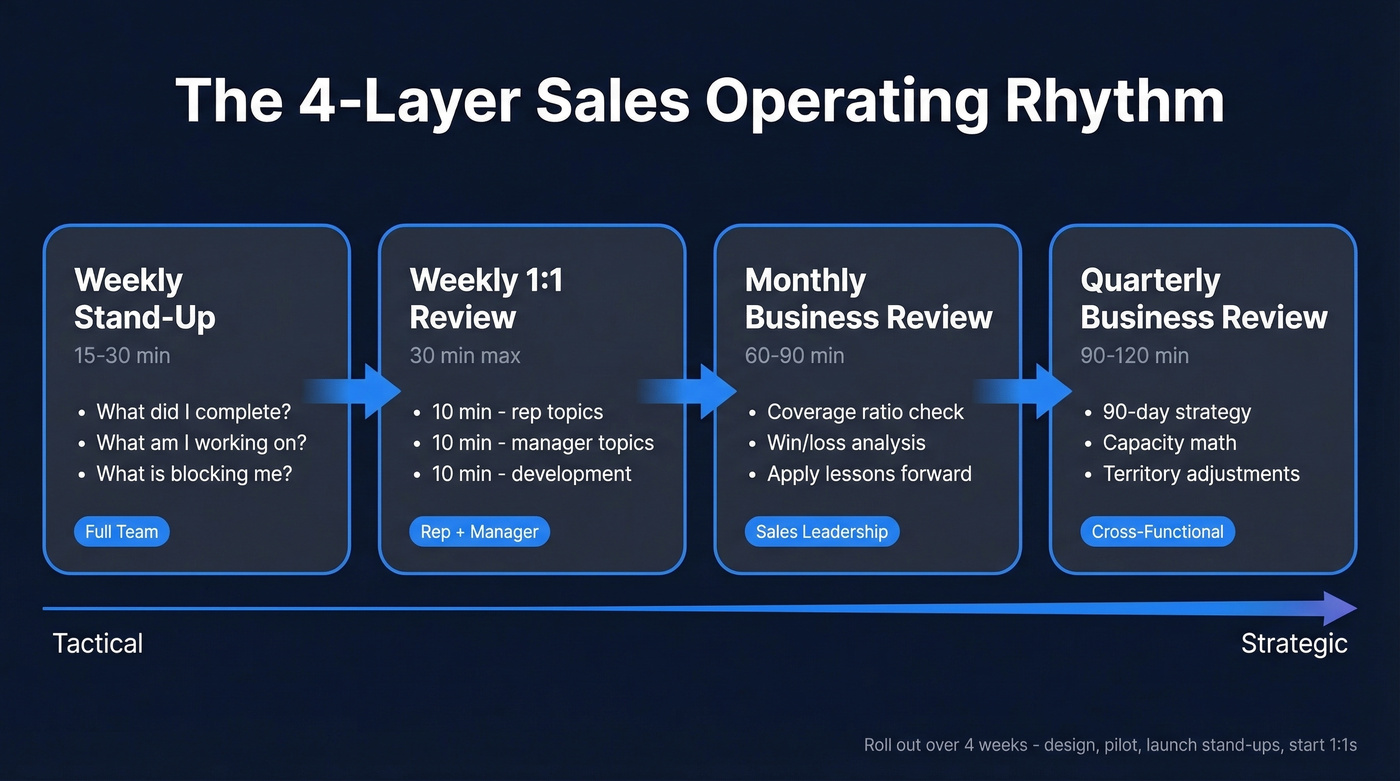
| Meeting | Frequency | Duration | Attendees | Purpose |
|---|---|---|---|---|
| Team stand-up | Weekly | 15-30 min | Full sales team | Surface blockers early |
| 1:1 pipeline review | Weekly | 30 min max | Rep + manager | Coach deals to close |
| Business review | Monthly | 60-90 min | Sales leadership | Outputs, wins, lessons |
| QBR | Quarterly | 90-120 min | Cross-functional | 90-day strategy + capacity |
Weekly Team Stand-Up
Fifteen to thirty minutes, same day and time every week. Each rep answers three questions: what did I complete, what am I working on today, what's blocking me. Cap it at 30 seconds per person. Blockers go to a parking lot for offline resolution - don't let one stalled deal hijack the entire meeting.
This isn't a strategy session. It's a pulse check.
Weekly 1:1 Pipeline Review
This is where coaching happens. Keep it under 30 minutes, 1:1 only, focused on obstacles to closing. Cancel group pipeline reviews - they're almost always a waste of time, and the consensus on r/sales backs this up pretty consistently.
Use a 10/10/10 agenda split: 10 minutes on the rep's topics, 10 on yours, 10 on development. Keep coaching conversations separate from pipeline mechanics. If every 1:1 becomes a deal-by-deal interrogation, you lose the development component entirely, and reps start dreading the meeting instead of using it. Never cancel or reschedule. The rep sets the agenda. You document commitments.
Monthly Business Review
In our experience, the MBR is where most teams first see the rhythm paying off. It covers outputs, wins, learnings, and how you're applying those lessons next month.
Check your coverage ratio. If it's below 3x, you have a generation problem. If it's above 5x but win rates are dropping, you have a quality problem. Pick one metric to focus on each month. Track rhythm health too: decisions made per meeting, issues resolved same week, 1:1 completion rate. Gartner's research on sales management cadences reinforces that the MBR is the single highest-leverage meeting most orgs underinvest in.
Quarterly Business Review
The QBR is your 90-day planning cycle. Strategic direction, capacity math, headcount planning, and territory adjustments all live here. Reconcile bottom-up pipeline data with top-down targets and figure out whether the math actually works. If it doesn't, this is the meeting where you say so - not in a Slack thread three weeks later.
What to Measure at Each Layer
| Cadence | KPIs |
|---|---|
| Weekly (leading) | Dials/day, conversations, emails sent, contact attempts per account |
| Weekly (pipeline) | Coverage ratio (3x-5x quota), stage conversion, deal movement |
| Monthly | Avg deal size, avg cycle length, win rate, pipeline velocity |
| Quarterly | Revenue vs plan, capacity utilization, territory coverage |
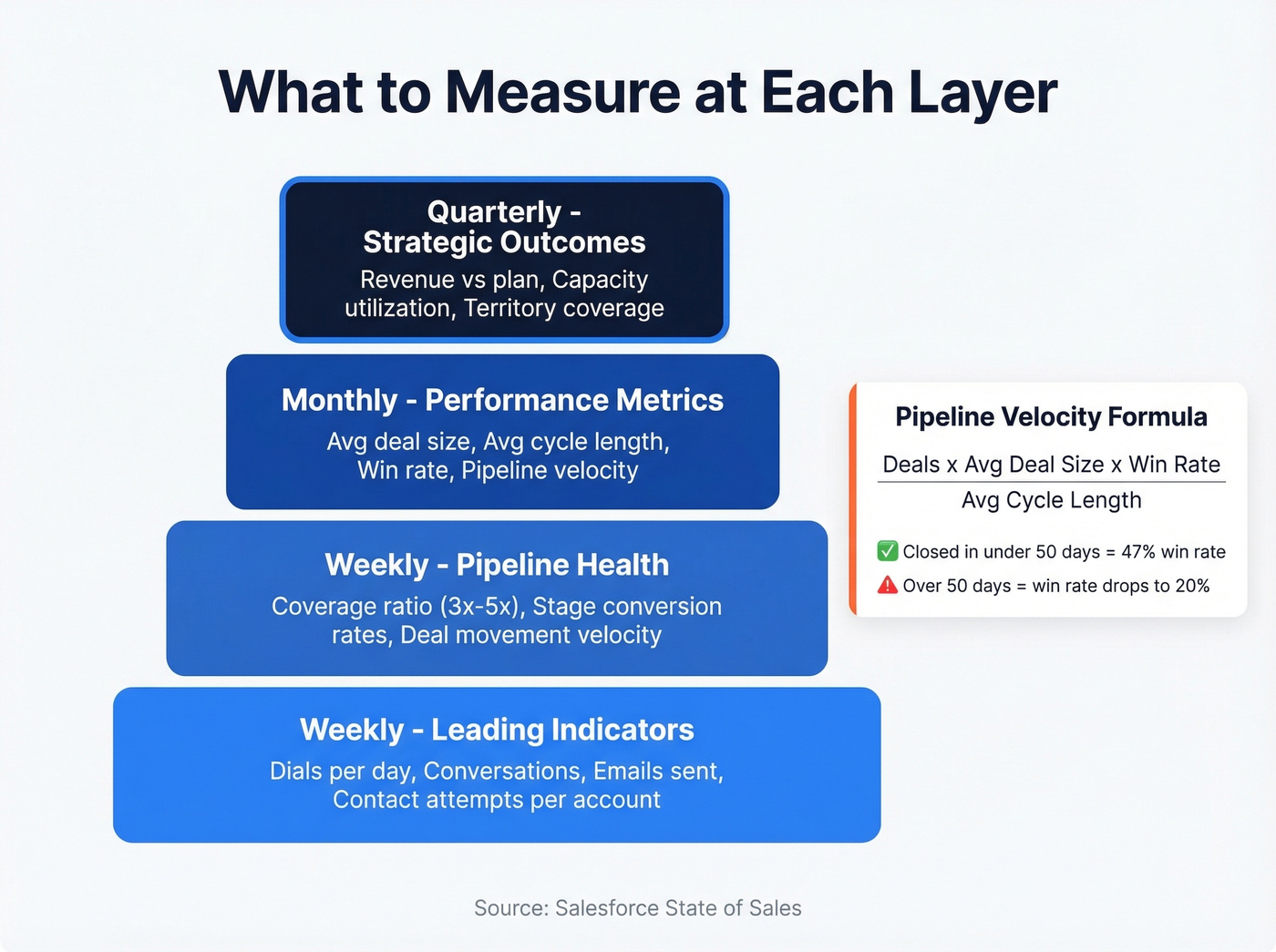
Pipeline velocity ties everything together: deals x average deal size x win rate / average cycle length. Track it monthly. According to Salesforce's State of Sales report, opportunities closed within 50 days carry a 47% win rate; after that threshold, win rates crater to 20% or lower. Sales cycles are running 21% longer than they were in 2020, which means your velocity formula needs recalibrating if you haven't touched it recently.
Here's the thing: most teams obsess over adding pipeline when their real problem is cycle length. Shaving 10 days off your average sales cycle does more for revenue than adding 20% more top-of-funnel. Your cadence should catch stalling deals in week two, not week eight.
A good place to start is tightening your sales process and defining what "progress" actually means in each stage.

Pipeline velocity depends on real conversations with real buyers. When 30% of your emails bounce, your weekly stand-ups and 1:1 reviews are built on fiction. Prospeo delivers 98% email accuracy and 125M+ verified mobile numbers - so every deal in your pipeline review is actually reachable.
Stop coaching deals built on dead contacts. Start with verified data.
Anti-Patterns That Kill Your Rhythm
1. Undefined funnel stages. SQL, opportunity, and commit mean different things to different reps. Fix it with evidence-based stages: decision-maker engaged, mutual action plan agreed, commercial terms confirmed. If a rep can't point to buyer evidence, the deal doesn't advance.
This is also where a simple lead status taxonomy prevents "stage drift" from becoming normal.
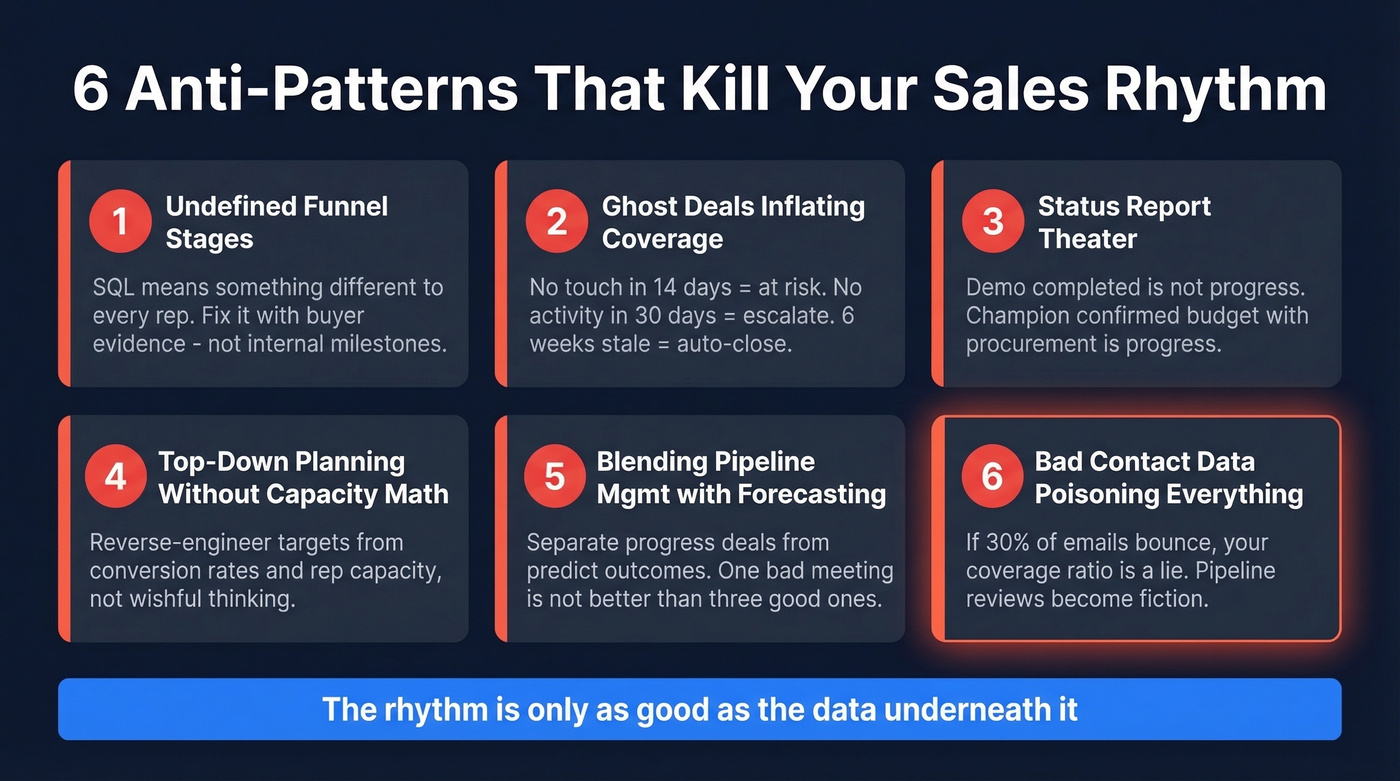
2. Ghost deals inflating coverage. Stalled opportunities that haven't been touched in weeks make your 3x coverage ratio look healthy when it's hollow. No touch in 14 days means at risk. No activity in 30 days means high risk plus escalation. Drift beyond 6 weeks and auto-close it - re-engage later if something changes.
If you want a tighter diagnostic, track pipeline health alongside coverage.
3. Status report theater. Ask any sales manager what meeting they'd kill first. This one tops the list every time. "Demo completed" is an internal milestone. "Champion confirmed budget with procurement" is buyer evidence. Build your stages around the latter.
4. Top-down planning without capacity math. Leadership sets a number, then wonders why the team misses. Reverse-engineer from conversion rates and rep capacity instead. RevOps Co-op's planning frameworks are a good starting point if you've never done this exercise.
5. Blending pipeline management with forecasting. When you try to do both in one meeting, you end up with one bad meeting instead of three good ones. Separate "progress deals" from "predict outcomes." If you need a clean split, align on sales forecast vs sales goal definitions first.
6. Bad contact data undermining every cadence. If 30% of your emails bounce, your coverage ratio is a lie. Reps log activity against contacts who don't exist. Pipeline reviews become fiction. This anti-pattern gets ignored because it feels like plumbing, but it poisons everything upstream. We've seen teams where half the "pipeline" in their Monday review was built on dead email addresses and disconnected numbers - the rhythm was perfect, but the data underneath was rotten.
If you're seeing this, start by benchmarking and fixing your email bounce rate.

Scaling Rhythms by Segment
Shorter sales cycles need more frequent tactical check-ins. Longer cycles need deeper strategic reviews. But the weekly 1:1 stays constant across every segment. We've seen this hold true whether a team runs 15-day SMB cycles or 9-month enterprise deals.
If you're running longer cycles, borrow a few practices from enterprise B2B sales to keep deal reviews strategic, not reactive.
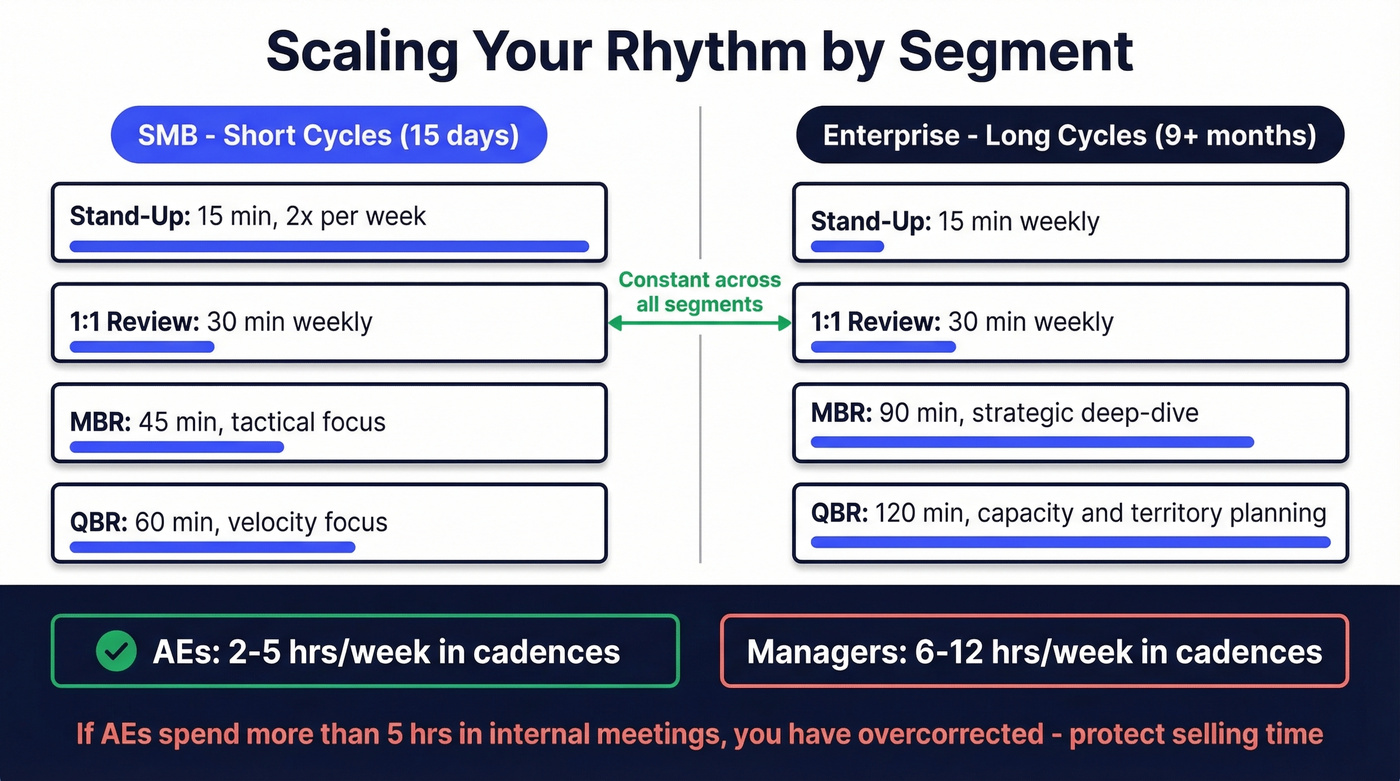
For time budgeting: AEs should spend roughly 2-5 hours per week in cadences. Frontline managers will run 6-12 hours. If your AEs are spending more than 5 hours in internal meetings, you've overcorrected - skip the all-hands pipeline review and protect selling time.
The Data Foundation Under Your Rhythm
Your sales operating rhythm is only as good as the data feeding it. Pipeline reviews built on bounced emails and disconnected phone numbers produce fictional forecasts. Reps waste outbound hours on dead data, then report activity that looks productive but converts to nothing.
A tool like Prospeo that refreshes data every 7 days and verifies emails at 98% accuracy turns your Monday 1:1 from fiction into something actionable. The pipeline you're reviewing reflects reality, not last quarter's imports.
If you're evaluating options, compare categories like data enrichment services and sales prospecting databases before you commit.
The #6 anti-pattern kills more rhythms than bad meetings do. Teams running Monday pipeline reviews on stale data are optimizing a lie. Prospeo refreshes every record on a 7-day cycle - not the 6-week industry average - so your coverage ratios reflect reality, not ghosts.
Clean data at $0.01 per email. No contracts. No sales calls.
FAQ
What's the difference between a sales operating rhythm and a sales cadence?
Same concept, different labels. "Cadence" emphasizes frequency; "rhythm" emphasizes consistency and structure. The four-layer framework - stand-up, 1:1, MBR, QBR - works regardless of which term your org uses.
How do I keep pipeline data clean enough for weekly reviews?
Verify emails before they enter your CRM, enrich records on a weekly refresh cycle, and flag any contact that bounces for immediate replacement. Most teams that take data hygiene seriously see bounce rates drop below 4% within the first month.
How many meetings is too many?
If AEs spend more than 5 hours per week in internal meetings, you've overcorrected. Start with three cadences and add layers only when the weekly rhythm delivers consistent value. Most teams work best with the four-layer structure - stand-up, 1:1, MBR, and QBR - before layering in anything else.