

How to Write a Sales Message That Gets a Reply
You sent 500 cold emails last week. Three replies - one was an out-of-office. The average cold email reply rate sits at 3.43%, which means most reps are writing into a void, burning hours on messages nobody reads. The gap between 3% and 10%+ isn't better subject lines or a fancier email tool. It's a fundamentally different approach to how you construct, deliver, and target your outreach.
The Short Version
If you don't read anything else:
- One framework: PAS (Problem-Agitate-Solve). It works because losses feel roughly 2x as powerful as equivalent gains. Lead with the problem.
- One channel rule: Email-only gets ~3% response. Layer in phone, SMS, and social touches and you're looking at 15%+. Multi-channel isn't optional anymore.
- One writing rule: Keep your first email under 80 words. The data is unambiguous.
- One prerequisite: Verify your contact data before you send anything. A brilliant message sent to a dead inbox is still a bounce, and high bounce rates torch your domain reputation.
The rest of this article is the how.
What Is a Sales Message?
A sales message isn't your company's tagline rewritten for email. It's the talk track a rep uses to show they understand the buyer's business - their processes, their pain, and how things could be better. That's a fundamentally different exercise than brand messaging, which lives at the top of the funnel and speaks to broad audiences with broad language.
There's a great thread on r/sales where a rep admits they actively avoid sending prospects to their own company website because the marketing copy is "convoluted buzzwords" that makes a simple product sound like rocket science. Their approach? "Talk like I'm talking to a 5th grader until they start to use their language, then I use their language."
That's sales messaging in a nutshell - clarity over cleverness.
Kyle Norton, CRO at League and formerly at Shopify, takes this further with what he calls "point of view positioning." The idea is to openly state who your product is for and who it isn't for. Something like: "We're not perfect. If you care more about X, look elsewhere. But if Y is your priority, we're the best choice." It builds trust instantly and helps buyers opt in or opt out faster. That's the job of effective outreach - not to convince everyone, but to resonate with the right people.
Frameworks That Work
You don't need seven frameworks. You need one that fits your motion, used consistently. But knowing what's available helps you pick the right one.
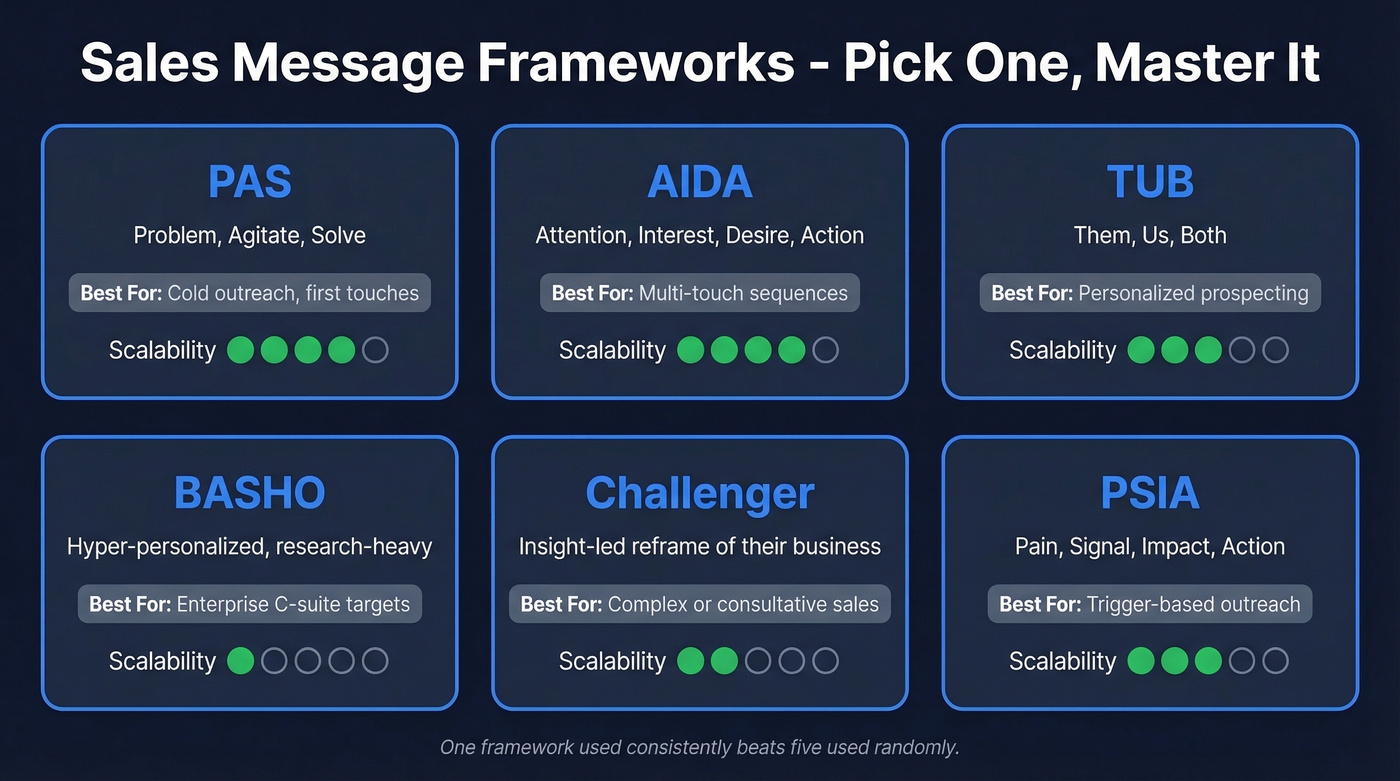
PAS (Problem-Agitate-Solve) is the default starter for cold outreach. Name the problem, twist the knife on why it's costing them, then present your solution. It works because loss aversion is real - people move faster to avoid pain than to chase gains. If you're only going to learn one framework, this is it.
AIDA (Attention-Interest-Desire-Action)) works best for structured sequences where you're building a narrative across multiple touches. Subject line grabs attention, the hook creates interest, proof builds desire, and a simple CTA drives action.
TUB (Them-Us-Both) is the personalization framework. Start with something specific about the prospect ("Them"), show you understand their industry ("Us"), then propose a next step together ("Both"). It pairs well with the Vorsight heuristic: spend 3 minutes finding 3 facts about a prospect before you write. That's the minimum viable personalization.
BASHO is TUB on steroids - hyper-personalized emails for high-value targets. Think C-suite at enterprise accounts. You're referencing their recent earnings call, a specific initiative, a mutual connection. This doesn't scale, and it's not meant to. Reserve it for deals worth the effort.
Value-Based messaging works when you have customer data to quantify outcomes. "Reduce rep ramp time by 30%" hits harder than "improve onboarding." Tie everything to revenue, cost, risk, or efficiency.
Challenger is the insight-led reframe. You're not asking about their pain - you're telling them something they didn't know about their own business. This requires deep industry knowledge and confidence. Powerful when done right, cringe when done poorly.
PSIA (Pain-Signal-Impact-Action) works well for trigger-based outreach. You identify a pain, reference a signal that suggests they're experiencing it right now - a job posting, a funding round, a tech stack change - quantify the impact, and propose an action. It's PAS with a timing layer.
Here's the thing: one framework used consistently beats five used randomly. Pick one, run it for 500 sends, measure, then iterate. We've seen teams obsess over framework selection when the real lever is repetition and refinement.
The 8-Component Checklist
Every sales message should address at least 3-4 of these. A full sequence should cover all 8 across its touchpoints, drawing from Nora Sudduth's messaging framework:
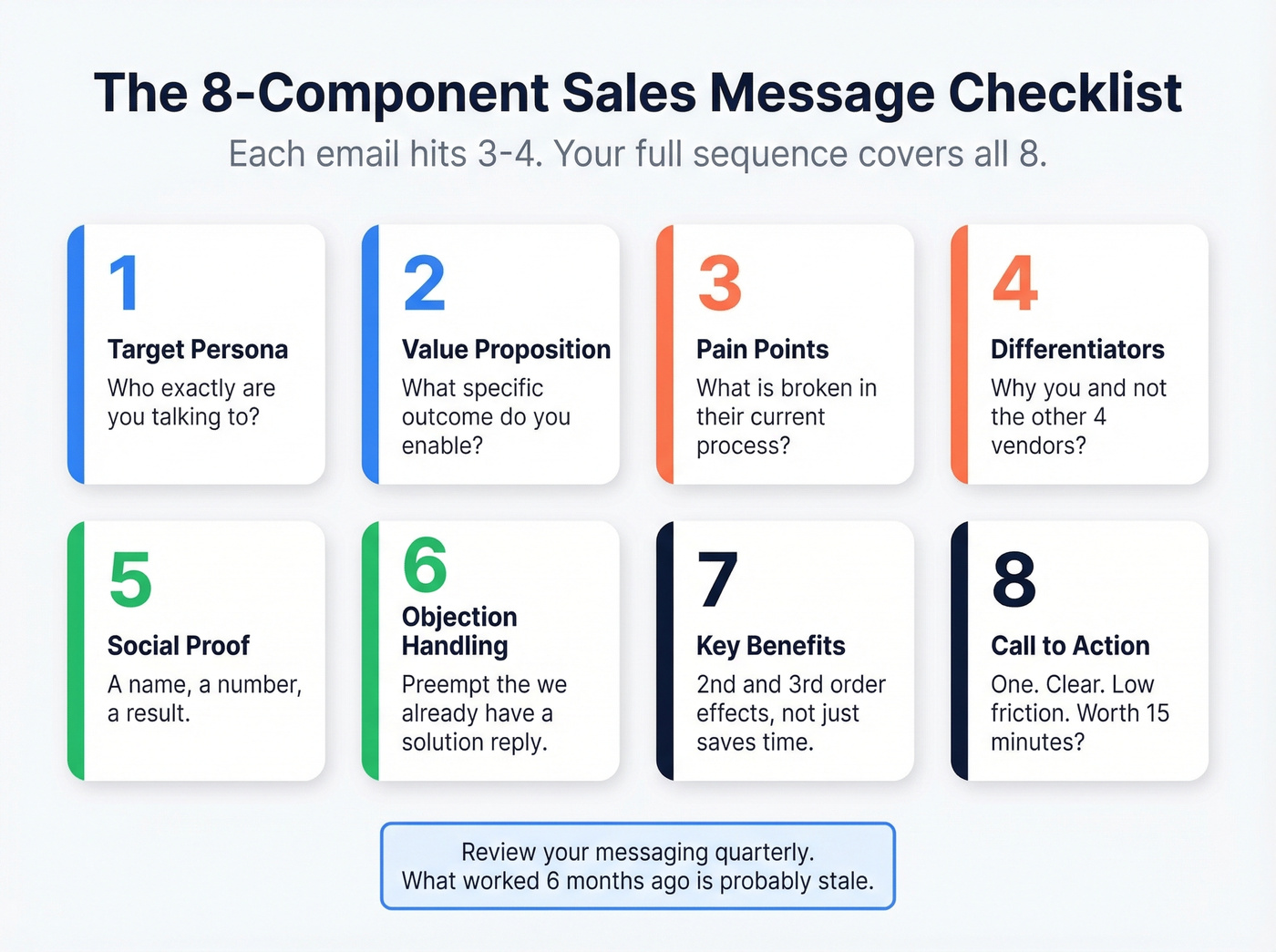
- Target persona - Who exactly are you talking to? Title, function, and seniority matter.
- Value proposition - What specific outcome do you enable? Not features. Outcomes.
- Pain points - What's broken in their current process? Be specific.
- Differentiators - Why you and not the other 4 vendors in their inbox?
- Social proof - A name, a number, a result. "We helped [similar company] do X" beats "trusted by thousands."
- Objection handling - Preempt the "we already have a solution" or "not a priority right now."
- Key benefits - The 2nd and 3rd-order effects. Not "saves time" but "your reps spend 4 fewer hours on manual research per week."
- Call to action - One. Clear. Low-friction. "Worth a 15-minute call?" beats "Let me know if you'd like to schedule a meeting at your earliest convenience."
No single email should cram all 8 in. But if your 5-touch sequence doesn't cover them all, you're leaving gaps your competitor will fill. Treat this as a living document - review your messaging quarterly. Markets shift, buyer language evolves, and what worked 6 months ago is probably stale.

You just spent 20 minutes crafting the perfect PAS email. If it bounces, none of that matters. Prospeo's 98% email accuracy and 7-day data refresh mean your sales messages actually land in real inboxes - not dead ones that torch your domain reputation.
Stop writing into the void. Verify every contact before you hit send.
Templates by Channel
Cold Email
PAS Template:
Subject: [Specific pain] at [Company]
Hi [Name],
Most [role]s at [industry] companies spend [X hours] on [painful task] every week. That's [quantified cost] in lost productivity - and it compounds every quarter you don't fix it.
[Your product] eliminates [specific pain] by [mechanism]. [Similar company] cut their [metric] by [number] in [timeframe].
Worth 15 minutes this week?
TUB Template:
Subject: [Specific observation about their company]
Hi [Name],
Saw [Company] just [trigger event - new hire, funding, expansion]. When [industry] teams hit that stage, [common challenge] usually becomes the bottleneck.
We work with [similar companies] on exactly this - [one-sentence value prop].
Open to a quick call to see if it's relevant?
The writing rules that matter: keep subject lines to 6-7 words (use these cold email subject line examples if you need a starting point). Write at an 8th-grade reading level - 85% of people process information best there. Maintain a 1:2 ratio of "I/my" to "you/your." Keep the first email under 80 words. Personalization lifts open rates by 29%, but only if it's specific. "[First Name]" in the subject line isn't personalization - it's a mail merge.
Here's a stat that should change how you write: 25% of desk workers and 43% of executives say they spend too much time on email. Your message is competing against that fatigue. Brevity isn't optional.
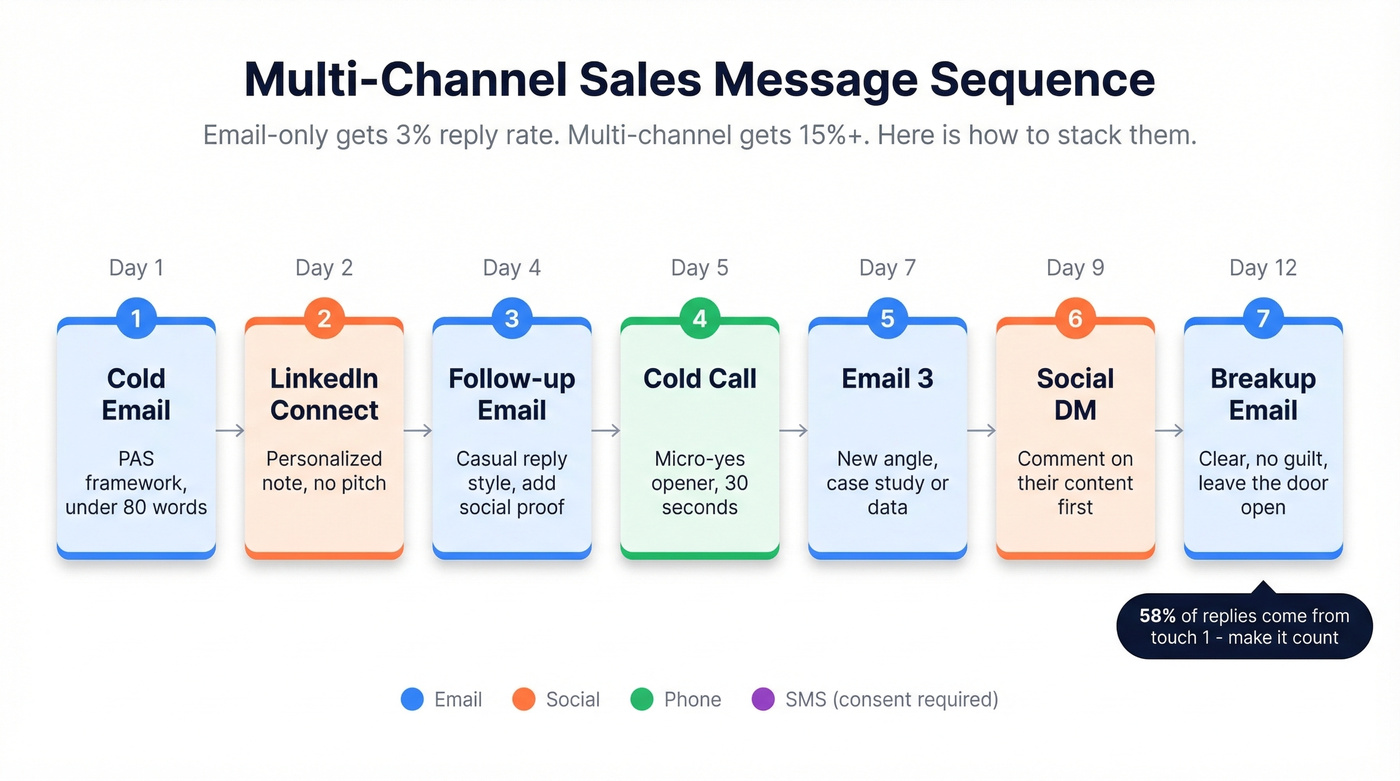
A/B test two versions on 20% of your list, then roll the winner to the remaining 80%. And one more thing: step 2 emails that feel like casual replies outperform formal follow-ups by ~30%. Drop the formatting. Write it like you're bumping a thread with a friend.
Cold Call Scripts
Micro-Yes Opener:
"Hi [Name], this is [You] from [Company]. I know I'm calling out of the blue - do you have 30 seconds so I can tell you why, and you can decide if it's worth continuing?"
This is the "choose your own adventure" pattern from Pipedrive's cold calling playbook. You're earning a micro-yes before you pitch. It gives the prospect control, which paradoxically makes them more likely to listen.
Gatekeeper Reframe:
"Hi, I was wondering if you could help me. I'm trying to reach [Decision Maker] about [specific topic]. What's the best way to get on their calendar?"
Reframe the gatekeeper as a collaborator, not an obstacle. Ask for their help, use their name, and be specific about why you're calling. For voicemails, mirror your cold email structure: short, clear reason for calling, and an explicit callback instruction. "I'll send you an email with the details - look for [subject line]" bridges the voicemail to your sequence.
If you want a full system (not just scripts), build a repeatable cold calling system that matches your sequence.
SMS
SMS has a 98% open rate, and 90% of messages get read within 3 minutes. But there's a hard constraint: cold texting without consent is illegal. You need permission first. Period. (If you need the compliance breakdown, see cold texting.)
SMS is devastating for mid-funnel and post-meeting touchpoints where you already have a relationship:
Follow-up after a meeting:
"Hi [Name], great call today. I'll send the case study we discussed to your email. Quick question - is [date] still good for the next step?"
Quote nudge:
"Hi [Name], did you get a chance to review the proposal? Happy to jump on a 5-min call if anything needs clarifying."
Keep texts short. 23% of consumers will ditch a brand that spams them. SMS is a scalpel, not a shotgun.
Social DMs
Let's be honest: most social DMs are terrible. The inbox is flooded with messages that open with "I noticed you're a VP of Sales at..." - as if reading someone's title constitutes personalization.
The DMs that work are conversation starters, not pitches:
"Saw your post about [specific topic]. We ran into the same issue at [your company] - ended up solving it by [brief insight]. Curious how you're approaching it."
"Your comment on [thread/post] about [topic] was spot-on. We just published some data on this - want me to send it over?"
Keep it under 3 sentences. No ask in the first message. Build the relationship before you pitch.
2026 Benchmarks
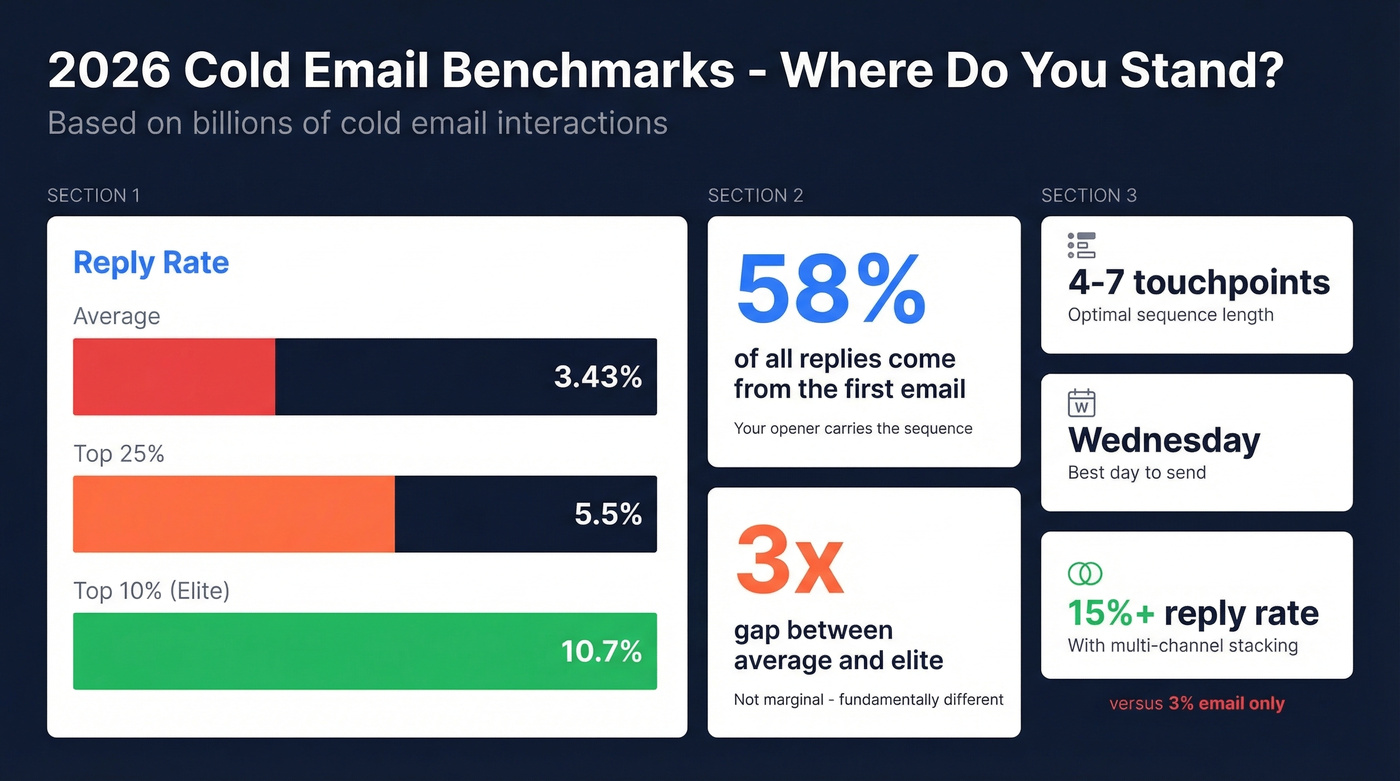
Here's what "good" looks like, based on Instantly's 2026 benchmark report analyzing billions of cold email interactions:
| Metric | Average | Top Quartile | Elite (Top 10%) |
|---|---|---|---|
| Cold email reply rate | 3.43% | 5.5%+ | 10.7%+ |
| Replies from step 1 | 58% | - | - |
| Optimal sequence length | 4-7 touchpoints | - | - |
| Channel stacking lift | 3% (email only) | - | 15%+ (multi-channel) |
| Best send day | Wednesday | - | - |
Two numbers jump out. First, 58% of replies come from the first email - your opener carries the sequence. Second, the gap between average and elite is 3x. That's not marginal improvement. That's a completely different outcome from the same activity.
In our experience, the gap between 3% and 10% reply rates almost always comes down to data quality and message specificity. Teams that fix those two things first see results faster than teams that endlessly A/B test subject lines.
Look - if your deal size is under $10K, you probably don't need a 12-step multi-channel sequence with AI-generated personalization at scale. A tight B2B cold email sequence with verified data will outperform a bloated one built on a shaky contact list every time.
Mistakes That Kill Reply Rates
Leading with jargon your prospect doesn't use. If they wouldn't say it in a meeting with their boss, don't put it in your email. Mirror their language, not your marketing team's.
Talking more than listening. On calls, your talk-to-listen ratio should favor listening. In emails, this translates to the 1:2 I/you ratio. If your message is about you, it's not outreach - it's a press release.
Leading with price instead of value. Price is a conversation you earn after establishing what the problem costs them. Jumping to "only $X/month" before they understand the pain signals desperation.
Zero personalization. "Hi [First Name], I help companies like yours..." is the fastest way to get archived. Spend 3 minutes finding 3 facts. That's the minimum.
Pitching the wrong stakeholder. A perfect message to the wrong person is a wasted message. Verify titles, reporting structures, and buying authority before you sequence anyone.
No clear CTA. "Let me know your thoughts" isn't a CTA. "Worth a 15-minute call Thursday or Friday?" is. One ask. Specific. Low-friction. (More rules and examples in email call to action.)
Sending great messages to bad data. This is the silent killer. Bad data doesn't just waste your messaging - it tanks your domain reputation, which means even your good emails start landing in spam. We've seen teams triple their pipeline just by fixing bounce rates before touching their copy. Meritt cut their bounce rate from 35% to under 4% and went from $100K to $300K/week in pipeline by running their list through Prospeo before sending a single sequence.
Tools for Better Outreach
You don't need a 12-tool stack. You need four categories covered.
Data & verification is the prerequisite layer. If your data is bad, nothing downstream matters - not your framework, not your templates, not your sequencing tool. Prospeo covers this with 300M+ professional profiles, 143M+ verified emails, 98% accuracy, and a free tier with 75 emails per month to start. Paid plans run about $0.01 per email with no contracts. (If you want the broader landscape, compare data enrichment services.)
CRM - HubSpot or Salesforce. Store your templates, run sequences, track engagement. Pick whichever your team already uses. Don't switch CRMs for messaging reasons. If you're evaluating options, start with these examples of a CRM.
Email sequencing - Instantly or Smartlead. Both handle warm-up, rotation, and multi-inbox sending. The sequencer matters less than the message inside it. If you're scaling volume, follow a safe email velocity plan.
SMS - Textline. Free 14-day trial, solid compliance guardrails, and templates organized by funnel stage. Skip this if your motion is purely enterprise and you don't have consent-based phone numbers yet.
Multi-channel outreach only works when you have the right contact data across every channel. Prospeo gives you 143M+ verified emails and 125M+ verified mobile numbers so your sales messages reach decision-makers on email, phone, and social - not gatekeepers.
Emails, direct dials, and intent signals - all in one platform for $0.01/lead.
FAQ
How long should a sales message be?
First cold email: under 80 words. Subject line: 6-7 words. Cold call opener: under 15 seconds before you earn a micro-yes. SMS: 2-3 sentences max. Write at an 8th-grade reading level across every channel - if you're going longer, you're including information the prospect didn't ask for yet.
What's the difference between a sales message and an elevator pitch?
An elevator pitch is a 30-60 second verbal summary of your product - it's about you. A sales message is buyer-specific: it addresses the prospect's pain, not your feature list. The best outreach doesn't mention the product until the second or third touchpoint. Lead with the problem and earn the right to present the solution.
What's the biggest mistake that kills reply rates?
Sending well-crafted outreach to unverified contacts. Bad data tanks deliverability and domain reputation, meaning even good emails land in spam. Meritt dropped their bounce rate from 35% to under 4% and tripled pipeline to $300K/week - before changing a single word of copy.
How many touchpoints should a cold outreach sequence have?
Four to seven touchpoints across multiple channels is the sweet spot. Email-only sequences average 3% reply rates; adding phone, SMS, and social touches pushes top performers above 15%. Front-load your strongest message as touch one - 58% of all replies come from the first email.