

Sales Objections and Answers: What 67,149 Calls Reveal About What Actually Works
A rep on your team just got hit with "we don't have the budget" for the third time today. They rattled off the same ROI pitch they memorized last quarter. The prospect went quiet, then said they'd "circle back next month." They won't.
Here's why mastering sales objections and answers matters more than memorizing scripts: opportunities closed within 50 days hit a 47% win rate, but that number craters to 20% past that threshold. Every fumbled objection stretches the cycle. And with 81% of revenue leaders saying deals are more complex than ever, the objections are getting harder, the buying committees are bigger, and the reps who can't navigate pushback are the ones watching deals die in committee. What separates the closers from the stallers isn't a better script binder - it's a different set of habits.
What You Need (Quick Version)
Three things that move the needle more than memorizing 50 responses:
- Slow down. Top reps pause after objections. Average reps launch into a 21.45 seconds monologue. That pause is one of the highest-leverage behavior changes you can make.
- Diagnose before you respond. Most first objections are smoke screens. Ask one clarifying question before you say anything substantive.
- Learn one framework and one advanced technique. LAER (Listen-Acknowledge-Explore-Respond) covers the majority of situations. Voss-style labels are especially useful for price and stall objections.
What Top Reps Actually Do
Gong Labs analyzed 67,149 demo call recordings using NLP to isolate the behaviors that correlate with closed deals. The findings aren't what most sales trainers teach.
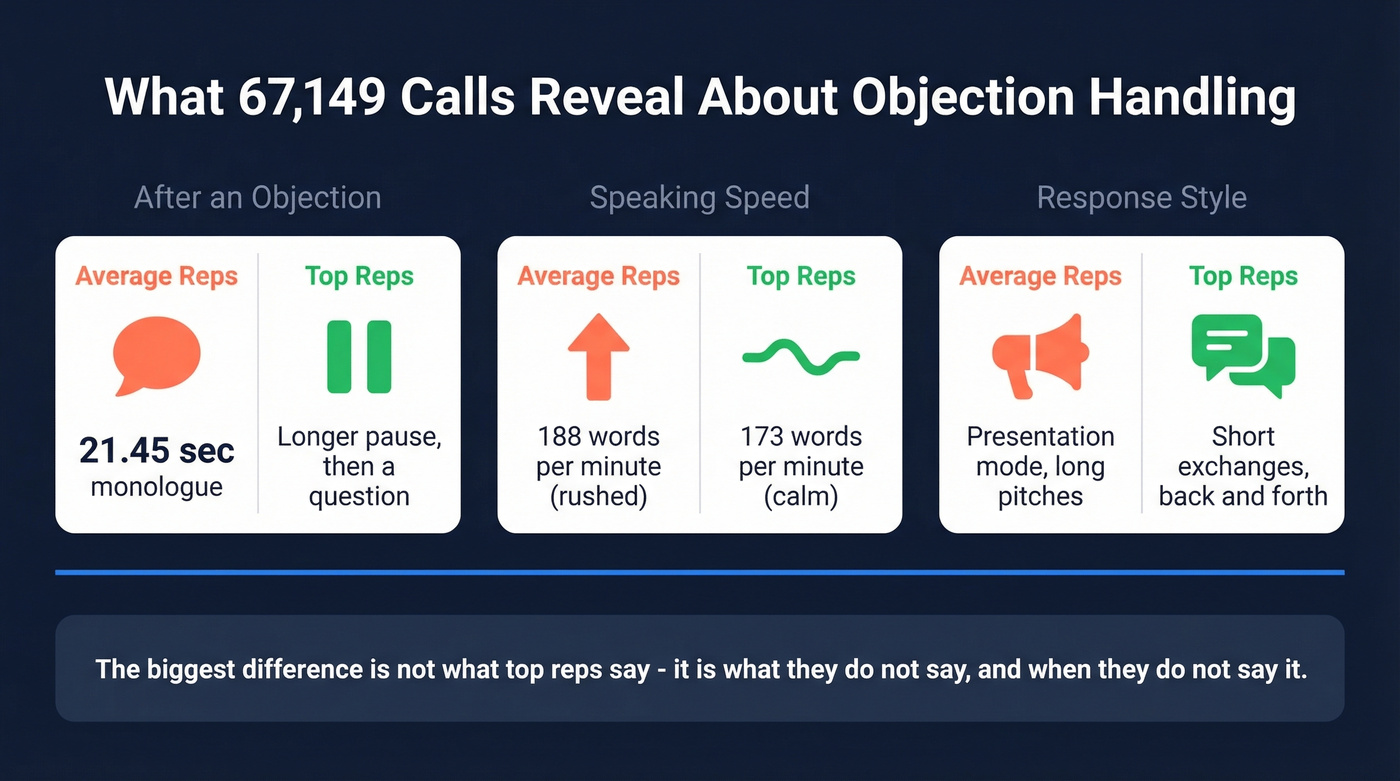
The biggest difference isn't what top reps say. It's what they don't say - and when they don't say it. After an objection lands, successful reps pause longer than they do during normal conversation. Average reps do the opposite: their pause length drops, they pounce, and when they do speak, they monologue for an average of 21.45 seconds before the prospect gets a word in.
That monologue is a deal killer.
There's a speed component too. Normal talking pace runs about 173 words per minute. Under pressure, struggling reps accelerate to 188 wpm. Prospects feel the shift even if they can't name it - it reads as desperation.
Top performers respond to objections with questions, not answers. They maintain conversational flow - short exchanges, back-and-forth - rather than shifting into presentation mode. That question-first shift is one of the strongest patterns in the dataset, and it's the foundation of every effective approach to handling the objections your team faces daily.
Real Objection or Brush-Off?
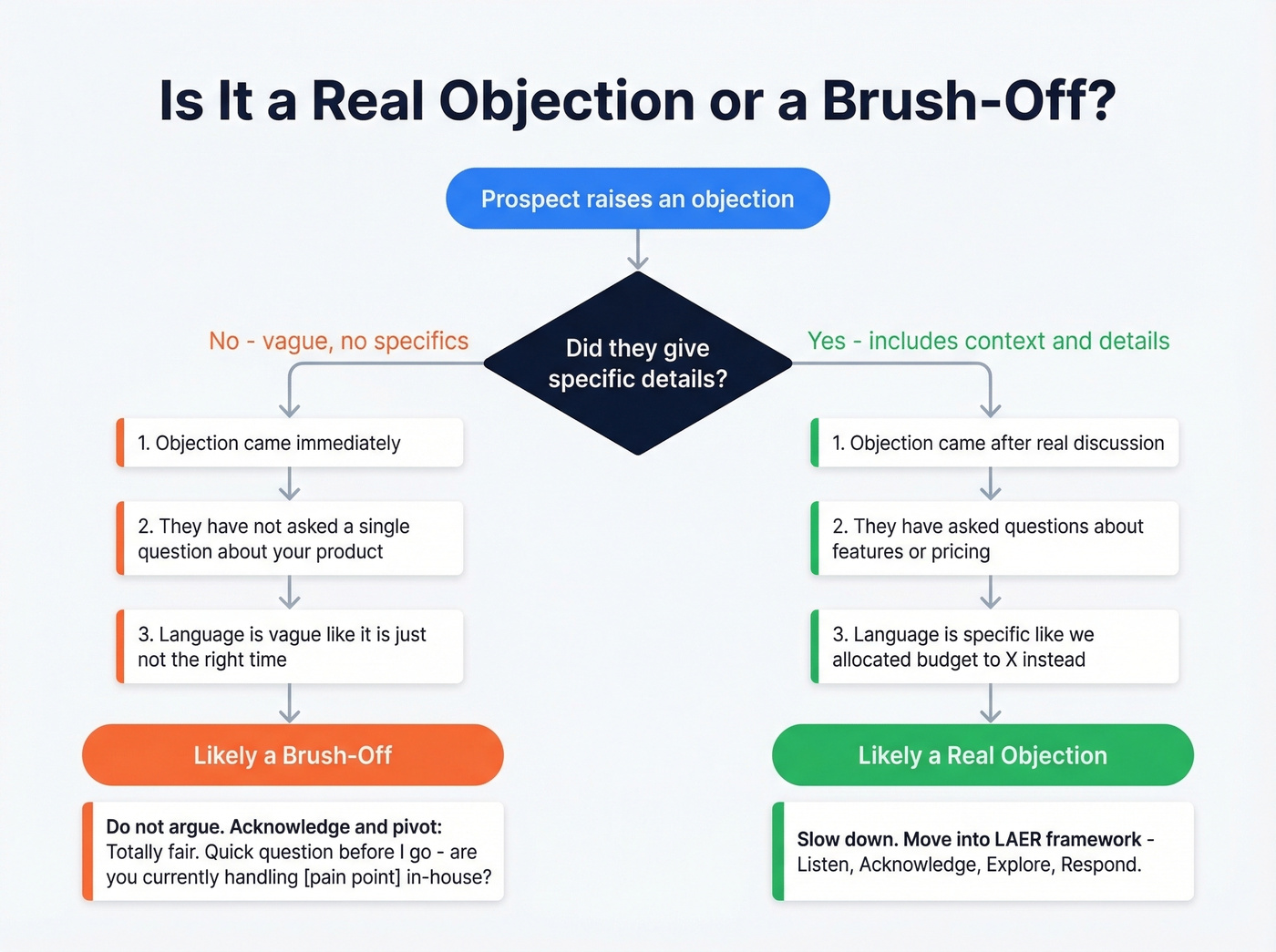
Before you deploy any framework, figure out whether you're dealing with a genuine concern or a polite exit. HubSpot's research puts it bluntly: treating the first objection as the real one is the most common error reps make. Some sales methodologies distinguish between objections (genuine uncertainty) and obstructions (excuses to end the conversation). The distinction matters because the response strategy is completely different.
A diagnostic question that separates real from reflexive: "When you mention budget, are we talking zero flexibility, or is this about where to prioritize spend?" That gives the prospect permission to be honest and reframes budget from a wall into a conversation about priorities.
Signals you're dealing with a brush-off: the objection comes immediately, the prospect hasn't asked a single question about your product, or the objection is vague ("it's just not the right time") with no specifics attached. Real objections come with details. Brush-offs come with exits.
When you identify a brush-off, don't argue. Acknowledge it and pivot to a question that re-engages. When you identify a real objection, slow down and move into a framework.

The #1 objection killer is reaching the right person in the first place. When 35% of your emails bounce, every call starts with a credibility deficit. Prospeo's 98% email accuracy and 125M+ verified mobiles mean your reps spend time handling real objections - not chasing dead leads.
Fewer bounces, more real conversations. Start free today.
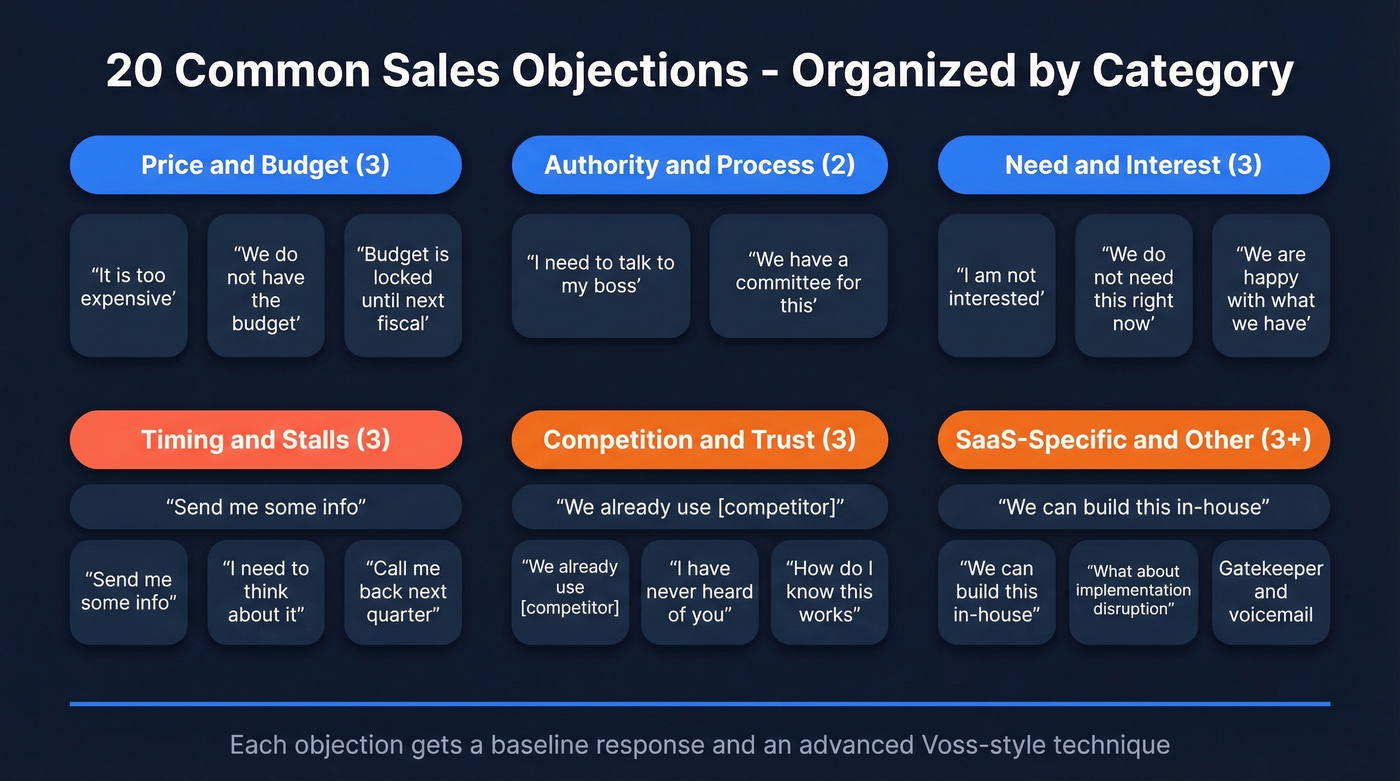
20 Common Objections and Proven Answers
Each objection below gets two responses: a solid baseline and an advanced technique for higher-stakes moments. The advanced versions draw from Voss-style negotiation tactics and practitioner scripts that work in the field.
Price and Budget Objections
"It's too expensive."
Baseline: Shift from price to total cost of ownership. "Let's look at what you're spending now on [manual process / current tool / lost deals] and compare that to the annual cost here." Advanced (Voss label): "It sounds like the value just isn't there for you." The prospect will either confirm - meaning price was never the real issue - or correct you and reveal what they actually need to see. Labels bypass defensiveness and trigger the correction reflex.
"We don't have the budget."
Baseline: "Is this a timing issue or a priority issue? If we could show a clear path to [specific outcome], is there a process to get this funded?"
Advanced: Reframe to cost of inaction. A strong script from r/sales: quantify the operational risk of waiting. "If this backlog compounds like it has, we're talking about 300+ hours lost by next fiscal. Is there a process for surfacing that kind of risk to leadership now?"
"Budget is locked until next fiscal."
Baseline: "Can we map out the business case now so you're ready to move when the cycle opens?"
Advanced: SaaS buying runs on initiatives, and budget can come from multiple places. "Is there a failing tool with embedded budget that could be reallocated? Sometimes the money's already there, just sitting in the wrong line item."
Authority and Process Objections
"I need to talk to my boss."
Baseline: "What would be most helpful for that conversation - a one-pager with the ROI numbers, or should we set up a brief call together?" Advanced (calibrated question): "What specifically are you going to tell them about our conversation?" This Black Swan Group technique forces the prospect to rehearse their internal pitch - and reveals gaps you can fill before they walk in unprepared. It turns the prospect into your internal champion by making them practice the sell.
"We have a committee for this."
Baseline: "Who's on the committee, and what criteria matter most to them?"
Advanced: "What's the one thing that would make the committee say no?" Isolating the kill shot early lets you address it before it becomes a consensus objection.
Need and Interest Objections
"I'm not interested." On a cold call, this is a brush-off, not a real objection. Don't argue. Try: "Totally fair - most people aren't when I call out of the blue. Quick question before I go: are you currently handling [specific pain point] in-house, or is someone else owning that?"
"We don't need this right now."
Baseline: "What would need to change for this to become a priority?" This surfaces the trigger event you can follow up on.
Advanced: "It sounds like the timing just isn't right." (Voss label.) Let them correct you or confirm - either way, you learn something.
"We're happy with what we have." "What made you choose them originally?" This shifts the conversation from defense to reflection. Incumbents drift - the reasons for choosing them erode over time, and this question surfaces that gap without you having to attack anyone's decision.
Look, if a third of your cold calls end in immediate "not interested," audit your data before your scripts. 25% of sales pros say getting direct contact with decision-makers is their biggest challenge. Prospeo verifies emails and direct dials in real time - 98% email accuracy, 30% mobile pickup rate - so every conversation starts with the right person instead of a gatekeeper or a dead number. If you're rebuilding top-of-funnel, start with sales prospecting techniques that match your ICP.
Timing and Stall Objections
SaaStr's research shows that SaaS buying runs on initiative calendars, not fiscal calendars. When a prospect says "not now," they're telling you their initiative hasn't been prioritized - which is a different problem than having no money.
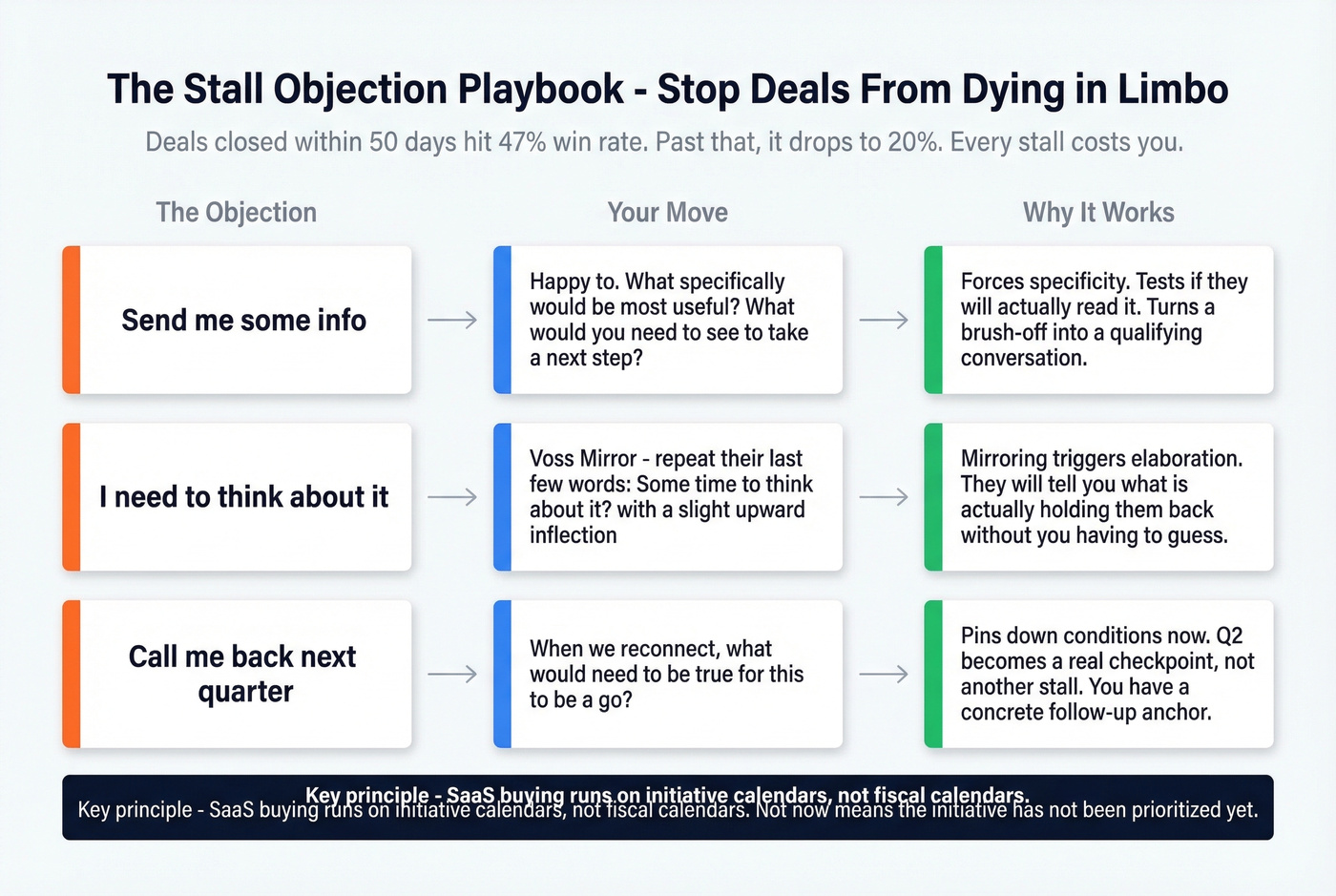
"Send me some info." "Happy to. What specifically would be most useful?" This forces specificity and tests whether they'll actually read it. Follow up with: "What would you need to see in that info to take a next step?" Now you're qualifying, not emailing into a void.
"I need to think about it."
Voss mirror: "Some time to think about it?" Repeat their last few words with a slight upward inflection. They'll elaborate on what's actually holding them back.
"Call me back next quarter." "When we reconnect, what would need to be true for this to be a go?" Pin down the conditions now so Q2 isn't another stall.
Competition and Trust Objections
"We already use [competitor]." "What made you choose them originally?" Followed by: "And how's that working for you now?" Incumbents drift. The reasons for choosing them erode, and this question surfaces the gap. You're not attacking their decision - you're inviting them to re-evaluate it on their own terms.
"I've never heard of you." Social proof, fast: "We work with [2-3 recognizable companies in their space]. Happy to connect you with someone at [reference customer] if that helps."
"How do I know this works?" Offer a pilot. "Let's run a 30-day test with a small segment of your team. If the numbers don't work, you walk away with zero risk." If you need a clean way to structure that pilot, use a simple sales POC plan.
SaaS-Specific Objections
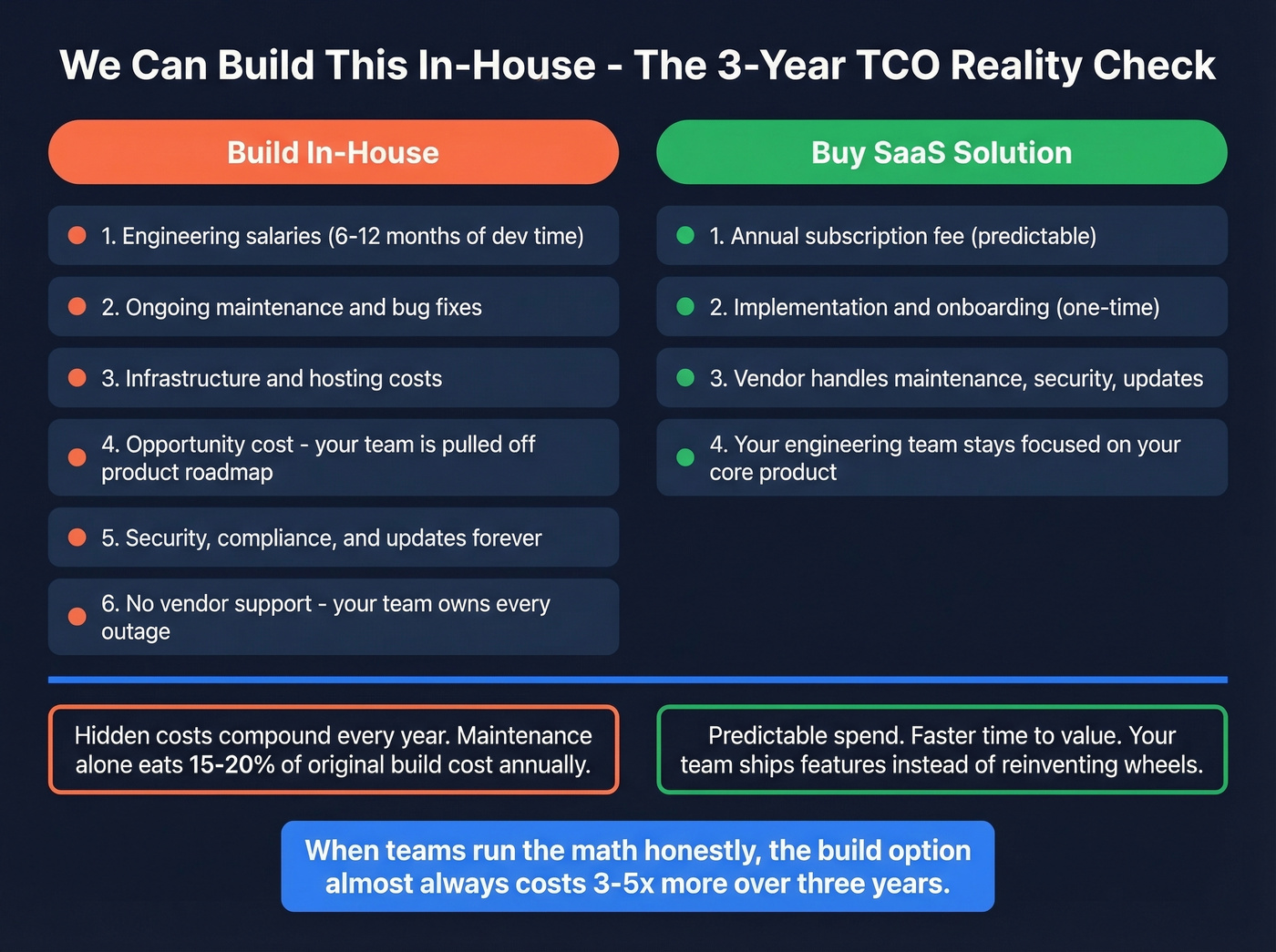
"We can build this in-house." The 3-year TCO comparison kills this objection. Map out the engineering hours, maintenance, and opportunity cost of pulling their team off product work. When teams run the math, the build option almost always ends up far more expensive - especially once you include maintenance and the cost of delaying other roadmap work.
"What about implementation disruption?" Acknowledge it directly, then de-risk: "That's a legitimate concern. Here's what we typically do - a phased rollout starting with one team. You see results before you commit the whole org." If you're running demos remotely, borrow a few remote sales meeting tips to keep momentum.
Bonus: Gatekeeper and Voicemail
Gatekeeper: "What's this regarding?" Don't pitch the gatekeeper. Keep it short and specific: "I'm following up on something I sent [decision-maker's first name] last week about [specific initiative]. Is she available?" Using the first name and referencing a prior touchpoint - even a cold email - signals familiarity.
Voicemail: keep it short. Lead with the pain point, not your name and company. "Hey [name], quick question about [specific problem they likely have]. I'll shoot you an email with details - my number is [number]." That's it. No pitch, no feature dump.
5 Objection Mistakes That Kill Deals
Treating the first objection as the real one - and rushing to answer without diagnosing. These two mistakes are siblings. The initial objection is reflexive, not reflective. Budget objections mask fit concerns. Timing objections mask priority concerns. When a prospect says "it's too expensive," the instinct is to justify pricing. But price can mask concerns about durability, fit, or value. Ask one question before you answer anything. If this is a recurring pattern, it’s often a qualification issue - tighten your discovery questions.
Getting defensive or argumentative. The moment you argue, you've lost rapport. Objections aren't attacks - they're requests for reassurance. Validate first, always.
Discounting too soon. In our experience, this is the hardest habit to break. Dropping price at the first sign of resistance devalues your product and trains the buyer to push harder. Lead with ROI and unique value. Discounts are a last resort, not a first response. If you need a repeatable way to arm reps, build sales battle cards for pricing and competitors.
Speeding up under pressure. Remember the data: reps jump from 173 to 188 wpm when flustered. Prospects read that acceleration as panic. Consciously slow down. A deliberate pace signals confidence more than any script ever will.
Not knowing when to walk away. Not every objection deserves a response. If a prospect has no budget, no authority, no need, and no timeline, they're not a prospect - they're a time sink. Disqualifying gracefully ("It sounds like this isn't the right fit right now - mind if I check back in six months?") preserves the relationship without burning hours you could spend on real opportunities.
4 Frameworks for Handling Objections
If you learn one framework, make it LAER. Want a second weapon? Add Voss labels. The other two are situational.
LAER (Listen-Acknowledge-Explore-Respond)
Developed by Jack Carew, LAER works because it forces you to hold your response until step four:
- Listen - use silence to let the prospect fully articulate their concern.
- Acknowledge - show you heard them without agreeing or combating. "I can certainly understand why you'd have that concern."
- Explore - ask questions to uncover the reasoning behind the objection. You're still not responding.
- Respond - only now, tie your answer back to their specific concern and desired outcome.
You don't respond until step four. Everything before that is diagnosis.
Gong's 7-Step Playbook
Pause, Clarify, Validate, Isolate, Get Permission, Reframe, Confirm. This is the expanded version of what the 67,149-call dataset shows top reps doing naturally. The permission step is the secret weapon: "Can I bounce a few thoughts off of you?" It shifts the dynamic from adversarial to collaborative. Best for discovery and demo calls where you have time to run the full sequence. If you want to operationalize this, treat it like sales process optimization, not a one-off training.
Voss Labels and Mirrors
Labels ("It sounds like...") and mirrors (repeating the last 2-3 words with an upward tone) come from Chris Voss's negotiation methodology. They're precision tools for price objections, executive stalls, and situations where the real concern is hiding behind a polite one. One warning: avoid asking "why" questions. "Why do you feel that way?" puts buyers on the defensive. Labels achieve the same goal without the confrontation. We've seen reps in roleplay sessions where labels consistently outperform scripted rebuttals - the correction reflex is that powerful.
Feel-Felt-Found
The classic. "Some of our customers felt the same way initially. They found that after implementing, they saw a 55% reduction in [specific metric]." It works in mid-funnel, relationship-based selling where trust is already established. The pitfall: if the buyer doesn't believe you genuinely understand their situation, "I understand how you feel" sounds patronizing. Use "some of our customers felt..." instead - it's less presumptuous and more credible.
Build an Objection-Handling System
Individual skill matters, but systems scale. Organizations with a formal sales enablement strategy achieve a 49% higher win rate on forecasted deals. That's not a marginal improvement - it's the difference between hitting quota and missing it. If you're building the system, start with the sales activities you expect reps to execute weekly.
Hot take: if your average deal size is under $10K, you don't need a six-figure conversation intelligence platform. You need a shared Google Doc with your team's five most common objections and the responses that actually moved deals forward last quarter. Start there.
Skip the 2-hour training sessions. Instead, pull the 90-second clip where your best rep handled a budget objection last Tuesday and make everyone watch it. That single clip is worth more than any workshop. Pair it with a weekly drill where reps practice objection handling in live roleplay - the repetition builds muscle memory faster than any slide deck. In our experience working with outbound teams, we've seen cases where the rep with the smoothest talk has the lowest close rate, because smooth talk and deal progression aren't the same thing. Build the feedback loop: record calls, review the objection moments weekly, track which responses advance deals versus which ones just feel good in the moment. Let the data run. To keep deals moving after the call, standardize your sales follow-up templates.
The best collection of sales objections and answers is the one your team builds from its own wins and losses - not a generic list from the internet.
Budget objections hit harder when your pipeline is thin. Teams using Prospeo book 26% more meetings than ZoomInfo users and 35% more than Apollo - because verified data at $0.01/email lets you fill the top of funnel without burning your domain or your budget.
Build the pipeline that makes every objection worth handling.
FAQ
What's the difference between an objection and a rejection?
An objection is a request for more information - the buyer is still engaged and wants reassurance. A rejection is a firm no with no path forward. Many apparent "rejections" in early-stage outreach are actually brush-offs caused by bad timing or wrong contact data, not genuine disinterest. If you're hearing "no" before a real conversation even starts, the problem is usually upstream - your list, your targeting, or your contact data.
How many follow-ups should you send after an objection?
Follow up 3-5 times, each time adding new value - a relevant case study, a data point, or a trigger event. The widely cited "80% of sales require 5+ follow-ups" stat is hard to trace to rigorous research, so don't treat it as gospel. Persistence without new information is spam, and it damages your sender reputation and brand.
What's the best framework for price objections?
Voss-style labels work best because they force the buyer to reveal whether price is actually the issue. "It sounds like the value just isn't there for you" triggers either confirmation or correction - both give you actionable intel. LAER works as a general-purpose fallback. Before deploying either, verify you're reaching the actual budget holder so you're not burning reframe energy on someone who can't say yes.
Can I use these objection scenarios for interview prep?
Yes - the 20 scenarios in this guide double as interview preparation material. Hiring managers frequently use objection-based questions during sales interviews to test how candidates think under pressure. Practice walking through the LAER framework on a price or timing objection. Interviewers care less about the perfect answer and more about your diagnostic process.