

Sales Openers That Actually Work: Scripts, Data, and What to Say Next
It's 10:07 AM on a Tuesday. You've made 14 dials. Two pickups, both "not interested" before you finished your first sentence. The problem isn't your product, your timing, or even your list - it's your opener.
Cold calling success rates dropped to 2.3% in 2025, down from 4.82% the year before. Meanwhile, Gong's analysis of 90,380 cold calls found that the right opener pushes success rates to 10.01% - nearly 7x the baseline. That gap between a good opening line and a bad one has never been wider.
The Short Version
Your default opener should be "The reason for my call is..." It delivered a 2.1x success rate in the 90,380-call dataset.
Best day to call depends on who you ask: Amplemarket's 110,000+ call analysis found Thursday is the most reliable day for meaningful conversations, while Cognism's State of Cold Calling report names Tuesday. We've seen both hold up depending on the vertical.
And before any of this matters, verify your list. Dead numbers kill more deals than bad opening lines ever will.
What 200,000+ Calls Reveal
Three major studies give us enough data to stop guessing:
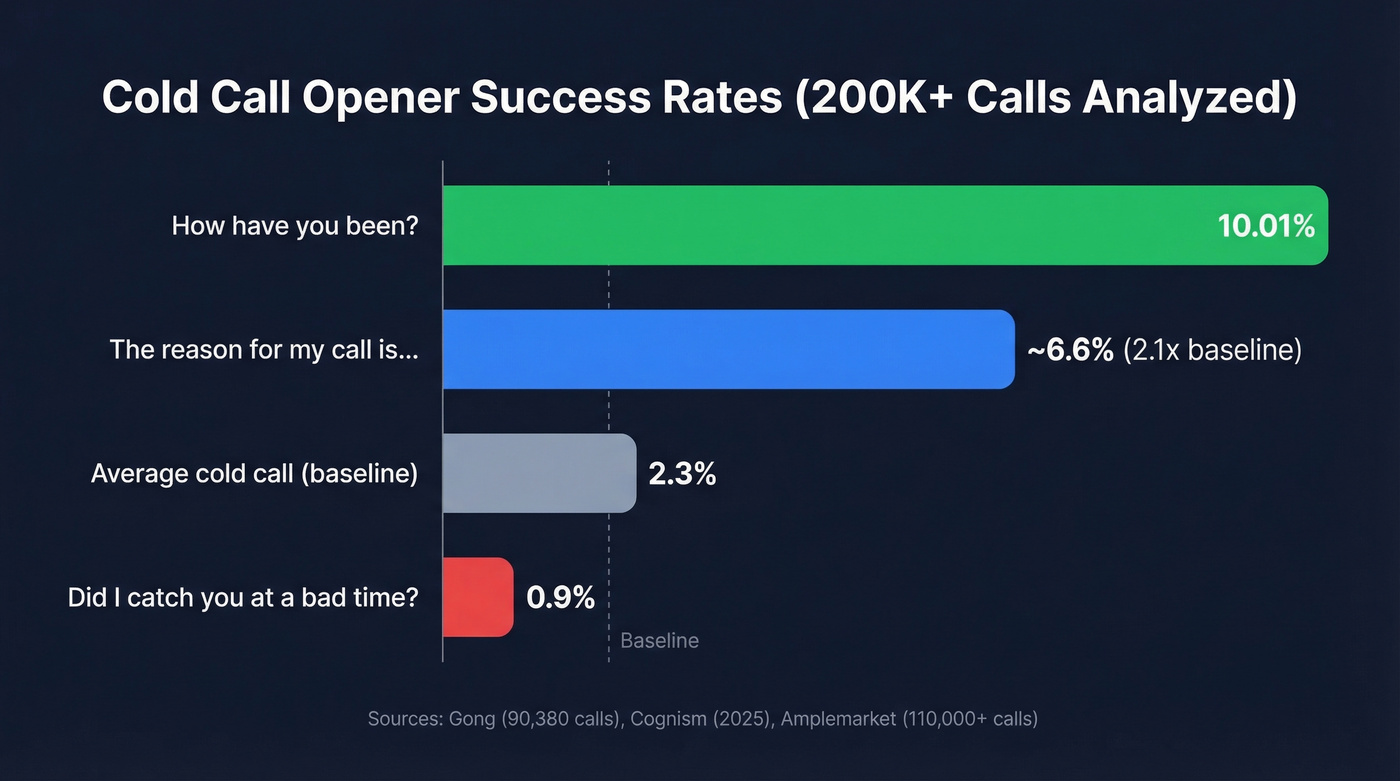
| Study | Sample Size | Key Finding |
|---|---|---|
| Gong - Best opener | 90,380 calls | "How have you been?" hit 10.01% success (vs 1.5% baseline) |
| Gong - Worst opener | 90,380 calls | "Did I catch you at a bad time?" hit 0.9% success |
| Cognism (2025) | Internal study | Avg success rate dropped to 2.3%; 8 attempts avg to reach a prospect |
| Amplemarket (2025) | 110,000+ calls | Thursday = most reliable day; early mornings peak for technical industries |
The pattern is clear: opening lines that build rapport or state purpose outperform openers that hand prospects an easy exit.
Best Cold Call Opening Lines
Not every opener fits every situation. Here are 12 field-tested options organized by strategy. If you want more variations, see these cold calling script examples.
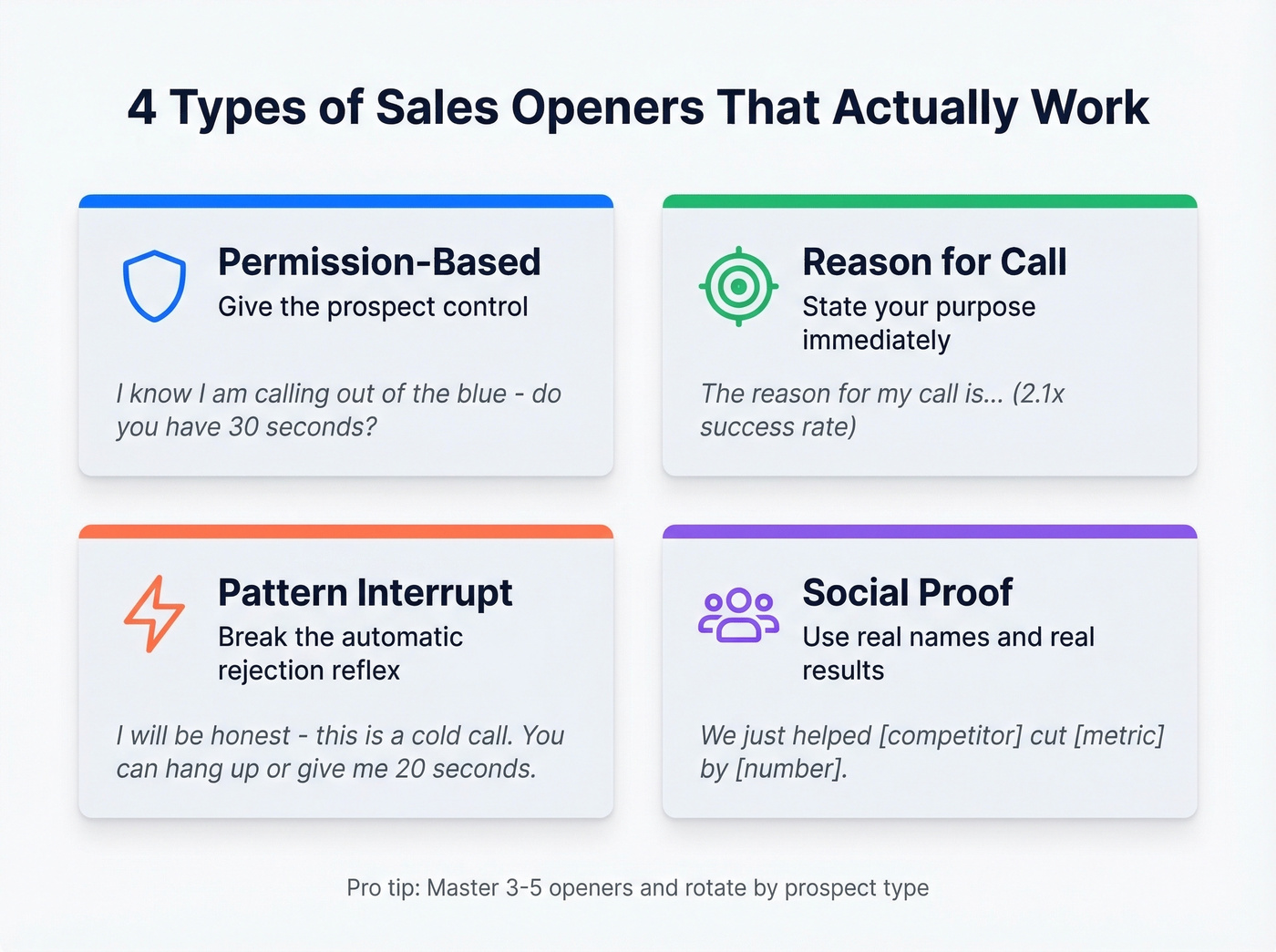
Permission-Based Openers
Permission-based language reduces resistance by giving the prospect a sense of control.
- "I know I'm calling out of the blue - do you have 30 seconds so I can tell you why?" Most people will give you the 30 seconds.
- "Would it be alright if I shared something quick that might be relevant to your team?" Strong for conservative industries like financial services.
- "I'm sure you're busy - is now an okay time, or should I call back at [specific time]?" Binary choice that keeps you in the conversation either way.
Reason-for-Call Openers
This category delivered a 2.1x success rate in the 90,380-call study. The "reason for my call" frame signals you're not wasting their time.
- "The reason for my call is - we help [role] at [company type] solve [specific problem], and I wanted to see if that's on your radar."
- "I'm calling because [Company] just [trigger event], and teams in that situation usually run into [problem]." Trigger-based openers feel researched, not random.
- "The reason I'm reaching out - three companies in [their industry] switched to us this quarter because of [specific pain]."
Pattern Interrupts
Imagine you're the prospect. Your phone rings, you pick up, and your brain is already loading the "not interested" script. Now imagine the caller says:
- "I'll be honest - this is a cold call. You can hang up, or I can take 20 seconds to tell you why I called. Your call." That pause you just felt? That's the pattern interrupt working. The consensus on r/sales is that radical honesty openers like this one outperform slick scripts, and our experience backs that up.
- "I know you weren't expecting this call, and I promise I'm not going to pitch you. I just have one question." The question becomes the hook.
- "Congrats on [recent achievement]. That's actually why I'm calling - companies hitting that milestone usually start dealing with [problem]."
Social Proof and Referral Openers
The key here is specificity. "Companies like yours" falls flat. Real names and real results land.
- "[Mutual connection] suggested I reach out - they thought [specific topic] might be relevant to what you're working on."
- "We just helped [competitor or peer company] cut [metric] by [number]. I wanted to see if that's something your team cares about."
- "I noticed [their company] is hiring for [role]. Companies scaling that function usually run into [problem] - that's exactly what we solve."
Tailoring Openers by Industry
Generic openers get generic results. Here's how to adjust your first sentence across five common verticals.
SaaS: Lead with a quantified outcome. "We helped [Company] cut onboarding time by 37% - is reducing time-to-value a priority for your CS team right now?"
Insurance: Lead with loss aversion. "If you had to file a claim tomorrow, do you feel confident you'd be fully covered? Most business owners I talk to aren't sure." (More industry-specific templates: insurance sales scripts.)
Commercial Real Estate: Lead with timing. "I noticed your lease at [address] is up in [timeframe]. We've got two properties nearby - open to a no-pressure look?"
Recruiting: Use the passive-candidate frame. "I know you're probably not actively looking, but a role just opened that's worth hearing about. Got two minutes?"
Financial Services: Lead with credibility. "I'm not selling anything today. I work with [type of client] on [specific area], and I wanted to see if a quick conversation would be useful."
Skip the industry-specific angle if you don't have at least one real data point about the prospect's company. A generic opener delivered with confidence beats a "personalized" one that's clearly pulled from a template.

Your opener is only as good as the number you're dialing. Prospeo gives you 125M+ verified mobile numbers with a 30% pickup rate - so your pattern interrupts actually reach a human, not a voicemail graveyard.
Stop perfecting scripts for numbers that never connect.
Why These Work
Every effective opener triggers one of four behavioral responses. Reciprocity powers permission-based openers - when you give the prospect control, they feel a subtle obligation to reciprocate with attention. Social proof drives referral openers; we trust what peers have validated. Loss aversion makes risk-based openers effective, especially in insurance and financial services. Pattern interrupts work by disrupting the automatic rejection reflex that kicks in the moment someone realizes they're on a sales call.
If you want to go deeper on delivery, tonality, and pacing, these phone sales skills are the fastest wins.
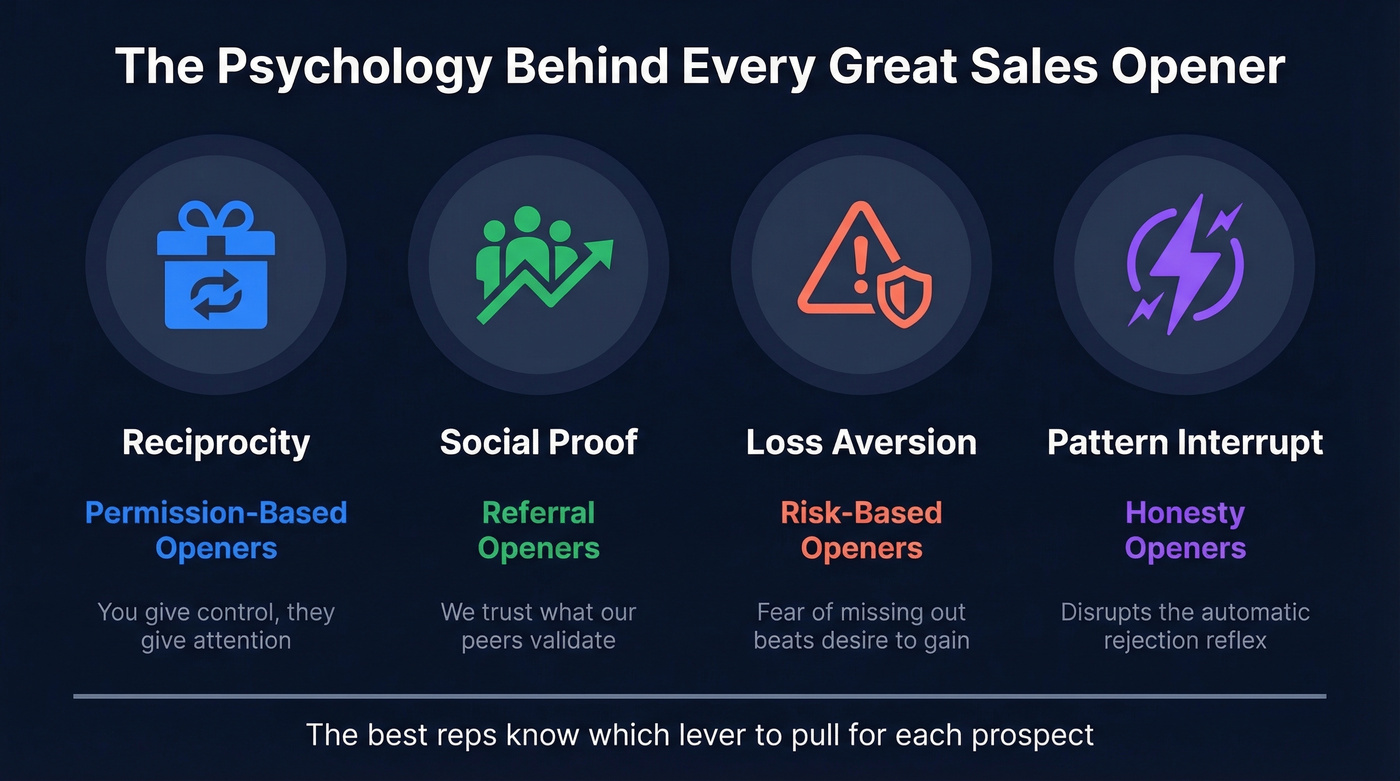
The best reps don't memorize scripts. They understand which psychological lever each opener pulls.
What to Say After the Opening
Here's the thing: the bridge - those 10 seconds after the prospect says "okay, go ahead" - matters more than the opener itself. Most reps fumble it by launching into a pitch. We've listened to hundreds of recorded calls where a perfect opener dies the moment the rep starts monologuing. (A simple way to tighten this is a repeatable cold call framework.)
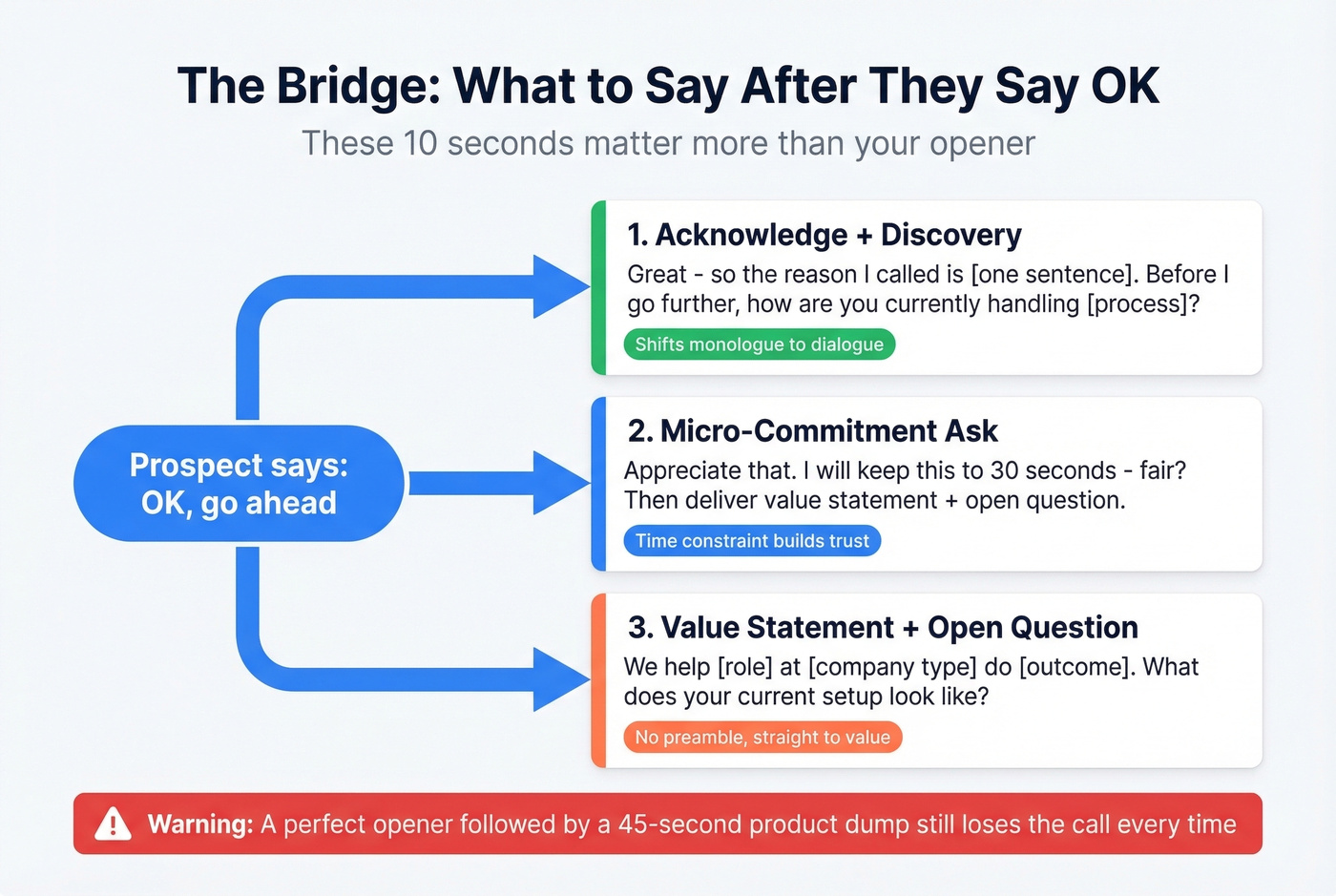
Three frameworks that work:
Acknowledge + Discovery Question. "Great - so the reason I called is [one sentence]. Before I go further, how are you currently handling [specific process]?" This shifts monologue to dialogue immediately.
Micro-Commitment Ask. "Appreciate that. I'll keep this to 30 seconds - fair?" Then deliver a tight value statement and ask an open question. The time constraint creates trust.
Value Statement + Open Question. "We help [role] at [company type] do [outcome]. What does your current setup look like?" No preamble, straight to value, then hand the mic back. A perfect opener followed by a 45-second product dump still loses the call every time.
Openers That Kill Deals
Some opening lines are actively harmful. The data is unambiguous.
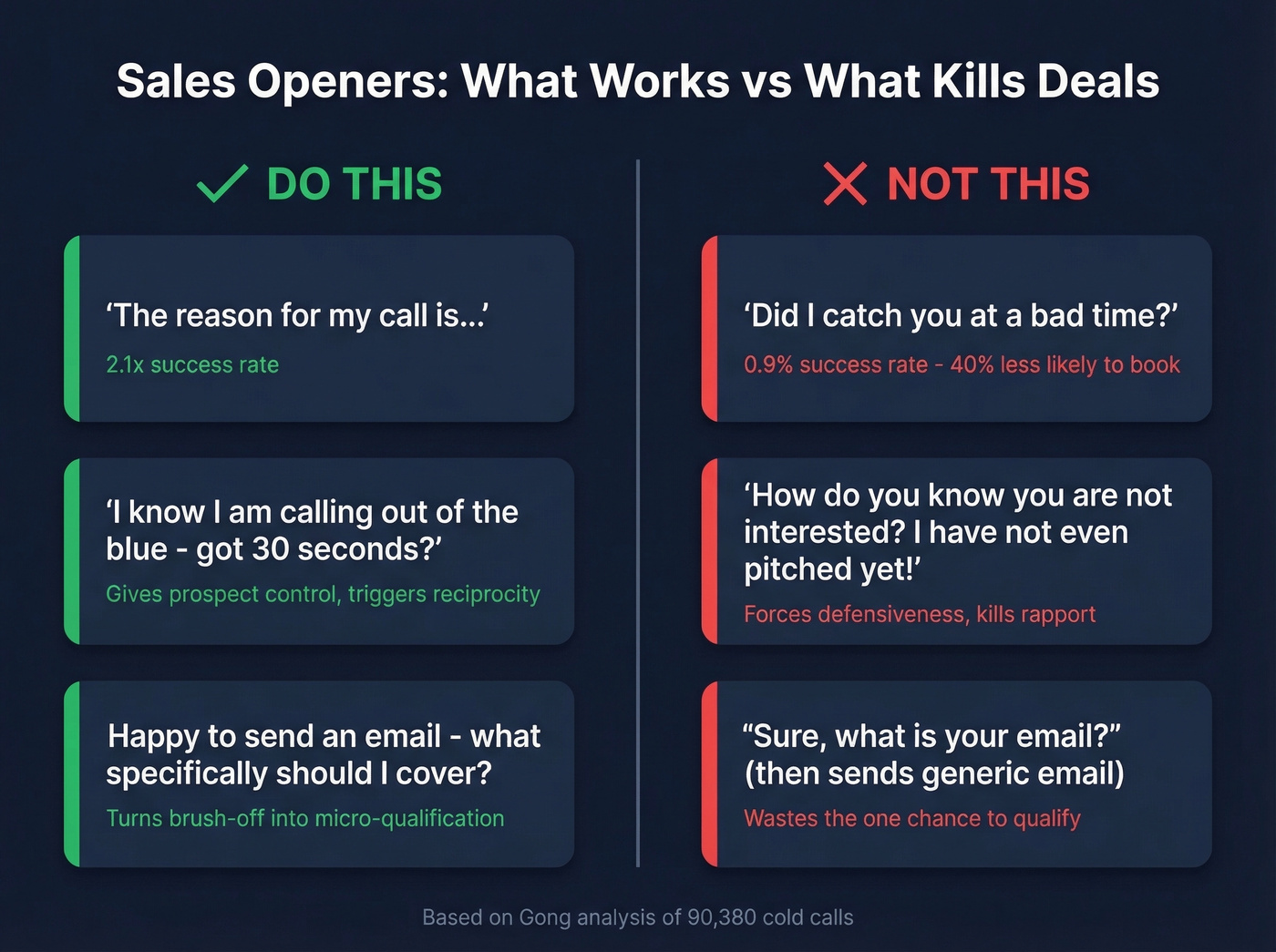
"Did I catch you at a bad time?" - 0.9% success rate. Reps who used it were 40% less likely to book a meeting. It hands the prospect a pre-built exit.
Pushy rebuttals to "Not interested." Lines like "How do you know you're not interested? I haven't even pitched you yet!" force defensiveness. The prospect didn't give you a real objection - they gave you a reflex. Acknowledge it, pivot, or offer to follow up. (More options: not interested objection handling.)
"Send me an email" followed by a generic email. When a prospect says this, don't say "Sure, what's your email?" Instead try: "Happy to - what specifically should I cover so it's actually useful?" That turns a brush-off into a micro-qualification.
Email and Voicemail Openers
Phone openers get all the attention, but most outbound sequences are multi-channel. Only about 20% of cold sales emails get opened, so your first line has to earn the read. Personalized subject lines boost open rates by 26%, and keeping them under 40 characters ensures they render fully on mobile.
Three first lines worth testing:
- "Noticed [Company] just [trigger event] - that usually means [specific challenge] is on the table."
- "Quick question: how's your team currently handling [process]?"
- "[Peer company] cut [metric] by [number] last quarter. Thought it'd be worth sharing how."
Follow-up sequences of 4-7 emails outperform shorter ones, and follow-ups alone can lift reply rates by 50%. If you need copy-paste options, start with a sales email template for new clients.
For voicemail, keep it under 20 seconds with three elements: your name, one sentence of value, and a callback hook. Something like: "Hey [Name], it's [Your Name] from [Company]. We just helped [peer company] with [outcome] - I'll shoot you an email with details." The voicemail isn't meant to close anything. It's meant to warm the email that follows. For more templates, use these sales voicemail scripts.
Before You Dial: Data Quality Decides Everything
Let's be honest - if your connect rate is below 5%, no opener can save you. That's a data-quality problem, not a script problem. If you're diagnosing the issue, start with cold call connect rate benchmarks and fixes.
Meritt's team was stuck at single-digit connect rates before switching to Prospeo's verified mobile database. After the switch, their connect rate tripled to 20-25% and their bounce rate dropped from 35% to under 4%. That's not a script change - that's what happens when you're actually dialing live numbers refreshed every 7 days instead of stale data from six weeks ago.
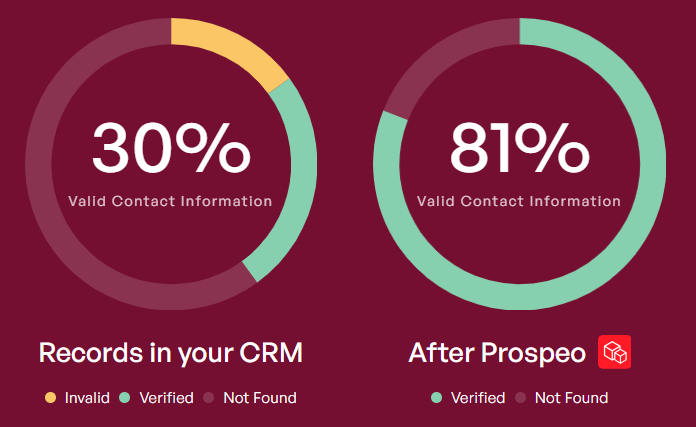
Trigger-based openers like "I'm calling because [Company] just [event]" require real-time data. Prospeo refreshes every 7 days - not 6 weeks - so your job change, funding, and hiring triggers are still relevant when you pick up the phone.
Stale data turns your best opener into a wrong number.
FAQ
What's the best cold call opener right now?
"The reason for my call is..." doubled success rates across 90,380 analyzed calls. It respects the prospect's time and signals specific purpose. Pair it with a trigger event - like a recent funding round or leadership change - for even higher conversion.
How many opening lines should a rep memorize?
Three to five, rotated by prospect type. Master a permission-based opener, a reason-for-call opener, and a pattern interrupt. Then adapt based on the prospect's tone in the first few seconds.
How do I improve my connect rate before optimizing openers?
Start with verified contact data. If 15%+ of your numbers are dead, no script can save those dials. Teams that clean their lists typically see connect rates jump 2-3x before changing a single word in their pitch.