

How to Build a Sales Operations Team That Actually Works
Your CEO just asked you to "stand up a Sales Ops function." No budget guidance, no headcount plan, no clarity on what the team should actually own. Meanwhile, reps spend only 28% of their time actually selling - the rest disappears into CRM updates, forecast calls, and hunting for contact data that's already stale. That gap is exactly what a sales operations team exists to close.
What You Need (Quick Version)
- Your first hire should be an analyst, not a strategist.
- Staff at a 1:30 ratio - one ops pro per 30 reps.
- Track three KPIs first: pipeline coverage (3-5x), forecast accuracy (80-95%), rep selling time (target 40%+).
- Don't rename Sales Ops to RevOps until you have shared metrics, a single data model, and connected systems.
- Fix your data before buying more tools - bad contact data poisons every downstream process.
What Sales Operations Actually Does
A sales operations team owns the infrastructure that lets reps sell instead of administrate. The core responsibilities break into five areas: forecasting and pipeline management, CRM administration, sales process optimization, territory and quota planning, and performance reporting. None of these are glamorous. All of them are load-bearing.
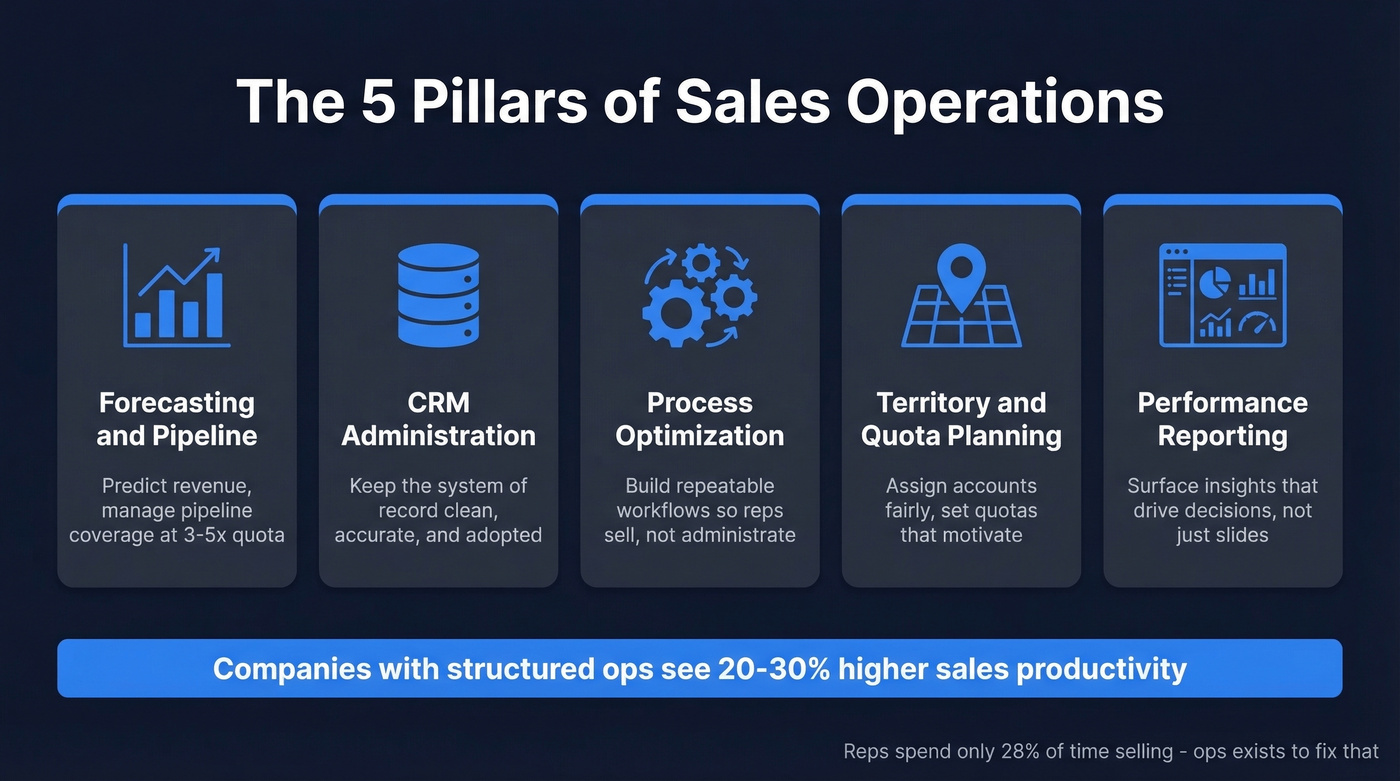
When done well, the impact is hard to ignore. Companies with world-class ops functions see a 20-30% increase in sales productivity, and HBR found that 50% of top-performing sales organizations have highly structured, documented sales processes - the kind that only exist when someone in ops builds and maintains them.
Here's the warning sign to watch for: Gartner found that Sales Ops now spends 73% of its time supporting non-sales functions, up from 39% in 2019. Whether Sales Ops is strategic or just "extra hands" depends entirely on how you scope the mandate. Guard it aggressively.
Structuring Your Sales Ops Team
Start with the 1:30 staffing ratio as your baseline. A 60-person sales team needs at least two dedicated ops hires. Getting the structure right early prevents painful reorganizations later.
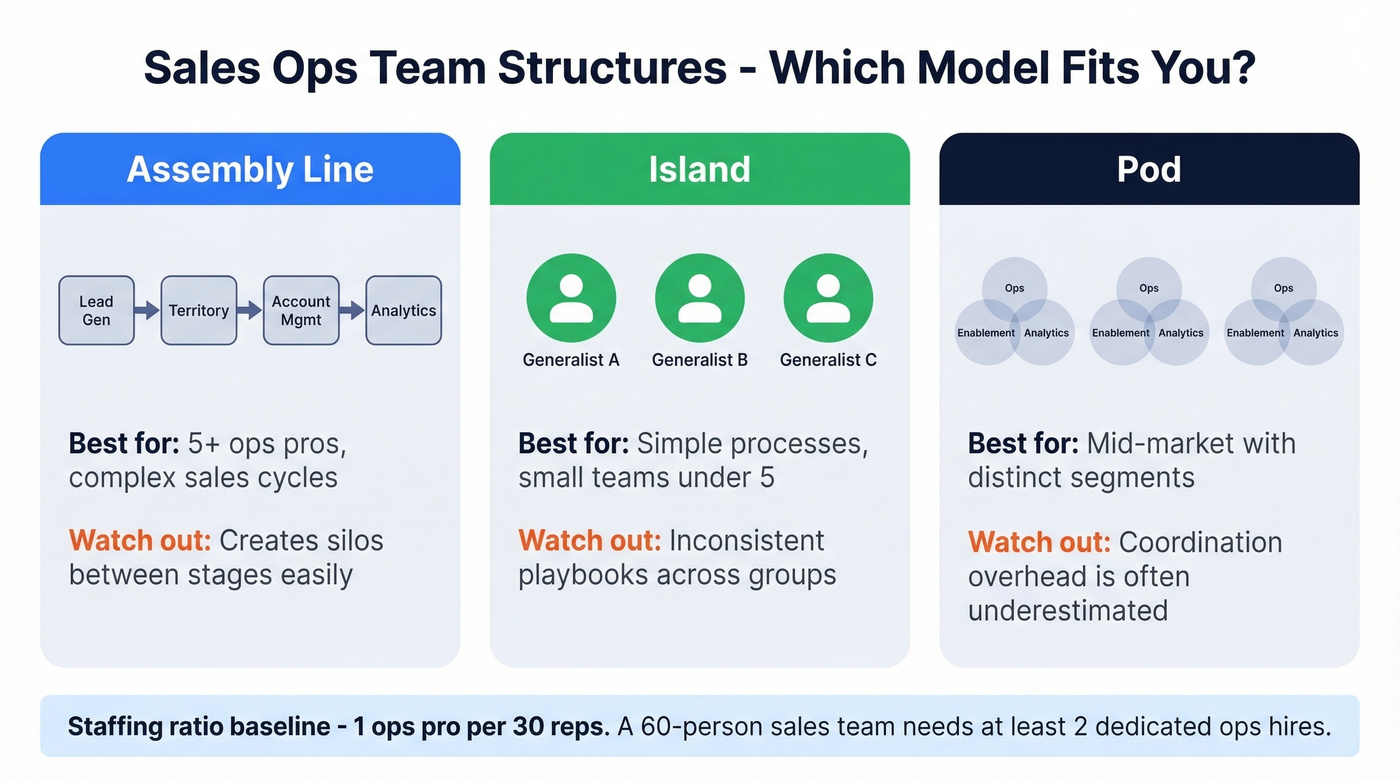
| Model | How It Works | Best For | Watch Out |
|---|---|---|---|
| Assembly line | Specialized roles by stage (lead gen, territory, account mgmt) | 5+ ops pros; complex cycles | Silos easily |
| Island | Generalists cover rep groups | Simple processes; small teams | Inconsistent approaches |
| Pod | Cross-functional mini-teams (ops + enablement + analytics) | Mid-market with segments | Needs strong coordination |
The assembly line model works best when you've got enough people to specialize - below four or five, it falls apart. The island model is simpler but breeds inconsistency across teams, and we've seen orgs struggle to reconcile conflicting processes when each "island" evolves its own playbook over six months.
Pods work well when you have distinct segments and enough volume to justify tighter cross-functional coordination, but they require coordination overhead most teams underestimate.
By level, expect analysts at $70-100K, managers at $110-160K, and directors or VPs at $170-250K+. Your first hire is always the analyst. You need clean data and reliable reporting before you can optimize anything.
Building the Org Chart
Once you move beyond a single analyst, reporting lines matter. A typical org chart places a VP or Director of Sales Operations reporting to the CRO or VP of Sales, with managers overseeing analysts and specialists beneath them. The department structure should mirror the complexity of your go-to-market motion - a single-product company with one segment needs a flat hierarchy, while a multi-segment enterprise seller needs dedicated ops leads per business unit. Resist the urge to over-architect. A clean two-tier hierarchy beats an elaborate five-layer chart with one person per box.
Sales Ops vs RevOps
Stay with Sales Ops if you're under $50M ARR, your marketing and CS ops are still handled by those teams directly, and you don't have shared metrics across the funnel.
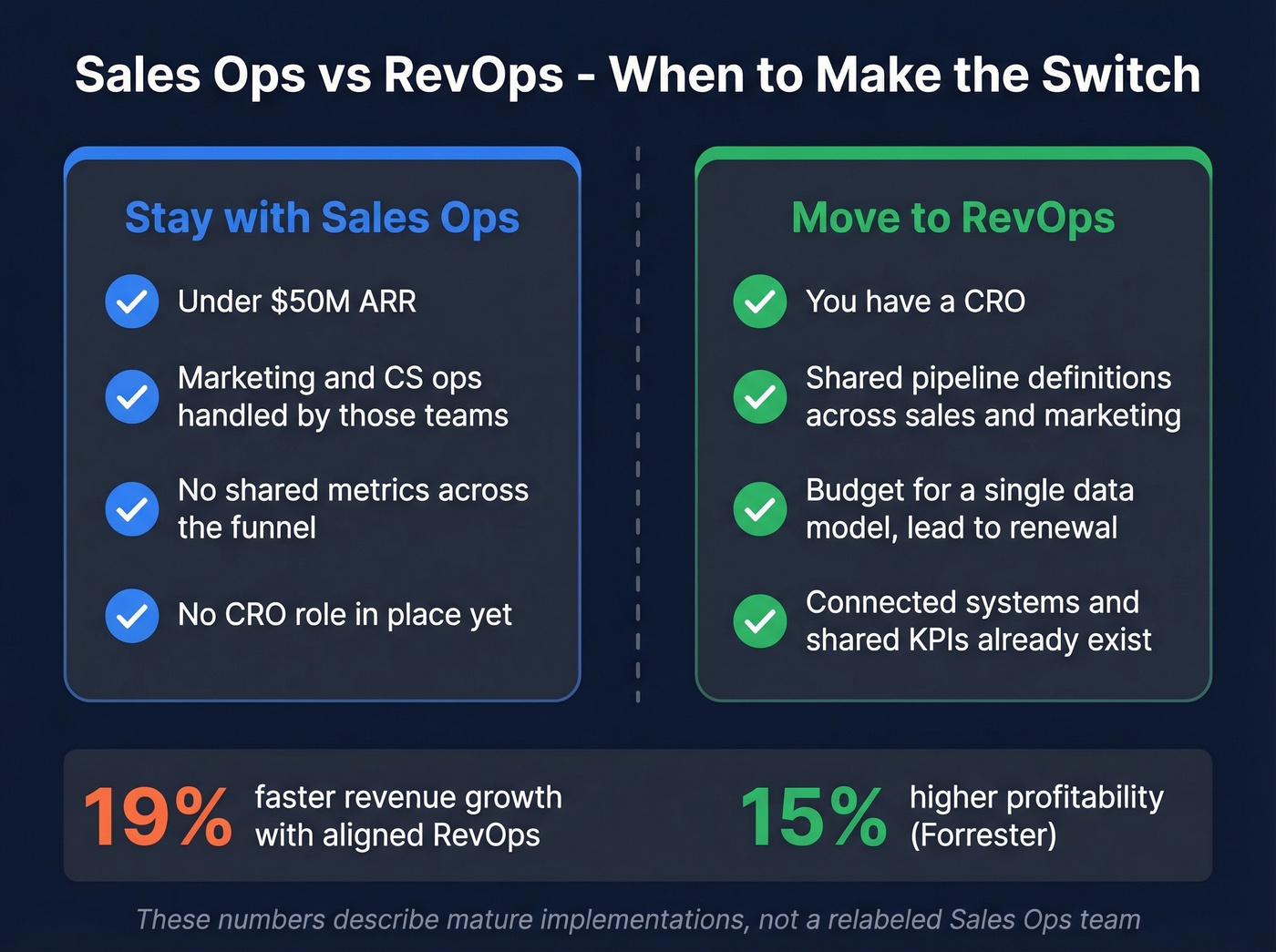
Move to RevOps if you have a CRO, shared pipeline definitions across sales and marketing, and the budget to build a single data model from lead to renewal.
Forrester found that aligned revenue operations drives 19% faster revenue growth and 15% higher profitability. Those numbers are real, but they describe mature implementations - not a team that relabeled Sales Ops as RevOps without changing the work.
Let's be honest: any business can adopt RevOps principles, but not every business needs a dedicated RevOps team. If you don't have connected systems and shared metrics, calling it RevOps is just a title change on a slide deck. The underlying operational structure matters far more than the label.

You just read that reps spend only 28% of their time selling - and bad contact data is a major reason why. Prospeo's 300M+ profiles with 98% email accuracy and 7-day refresh cycles give your Sales Ops team a data layer that actually holds up. No more reps hunting for valid emails. No more inflated pipelines built on stale records.
Give your ops team data that doesn't need babysitting.
KPIs That Matter
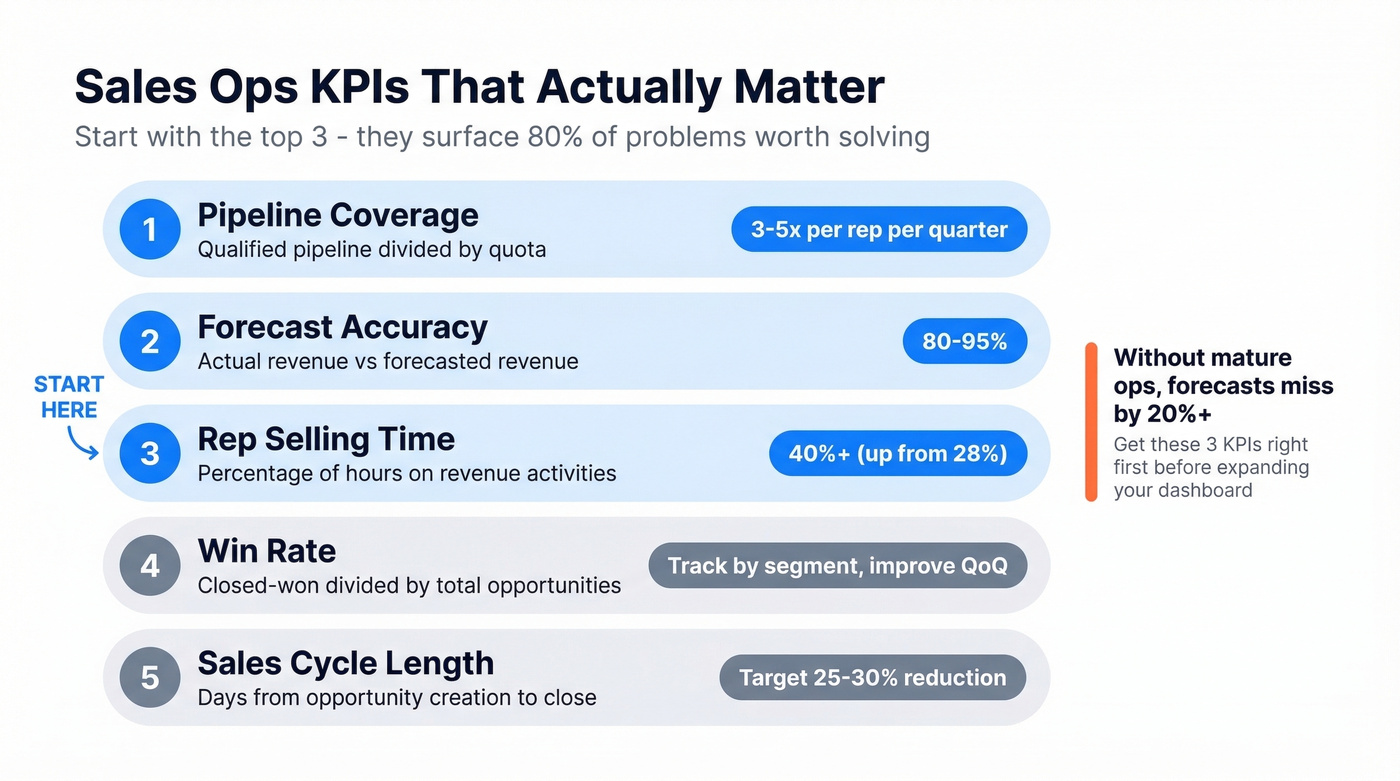
Without mature ops, forecasts miss by 20%+. Here's what to track and where to aim.
| Metric | What It Measures | Target |
|---|---|---|
| Pipeline coverage | Qualified pipeline / quota | 3-5x per rep per quarter |
| Forecast accuracy | Actual / forecasted revenue | 80-95% |
| Rep selling time | % hours on revenue activities | 40%+ (up from 28%) |
| Win rate | Closed-won / total opps | Track by segment; improve QoQ |
| Sales cycle length | Days from opp creation to close | Target 25-30% reduction |
Don't try to track all five on day one. Start with pipeline coverage, forecast accuracy, and rep selling time. Those three will surface 80% of the problems worth solving. If you want a deeper benchmark set, use a dedicated sales operations metrics framework.
Sales Ops Salaries in 2026
The Glassdoor median for "Sales Operations" in the US sits at $120K/year total comp, with a range of $91K-$159K. The most recent compensation cycle showed compression: entry-level ranges climbed 8.44% while senior ranges dropped 10.18%. The market rewards skills over tenure.
SQL proficiency, revenue intelligence platform experience, and AI fluency command premiums that an extra three years of CRM admin work don't. Here's the thing: if your Sales Ops analyst can write SQL and build Gong dashboards, they're worth more than a "Senior Director of Sales Strategy" who lives in PowerPoint. Hire for technical skills first.
The Sales Ops Tech Stack
The average sales org runs 275+ SaaS apps. Most ops teams inherit a mess and spend their first quarter just auditing what's in use.
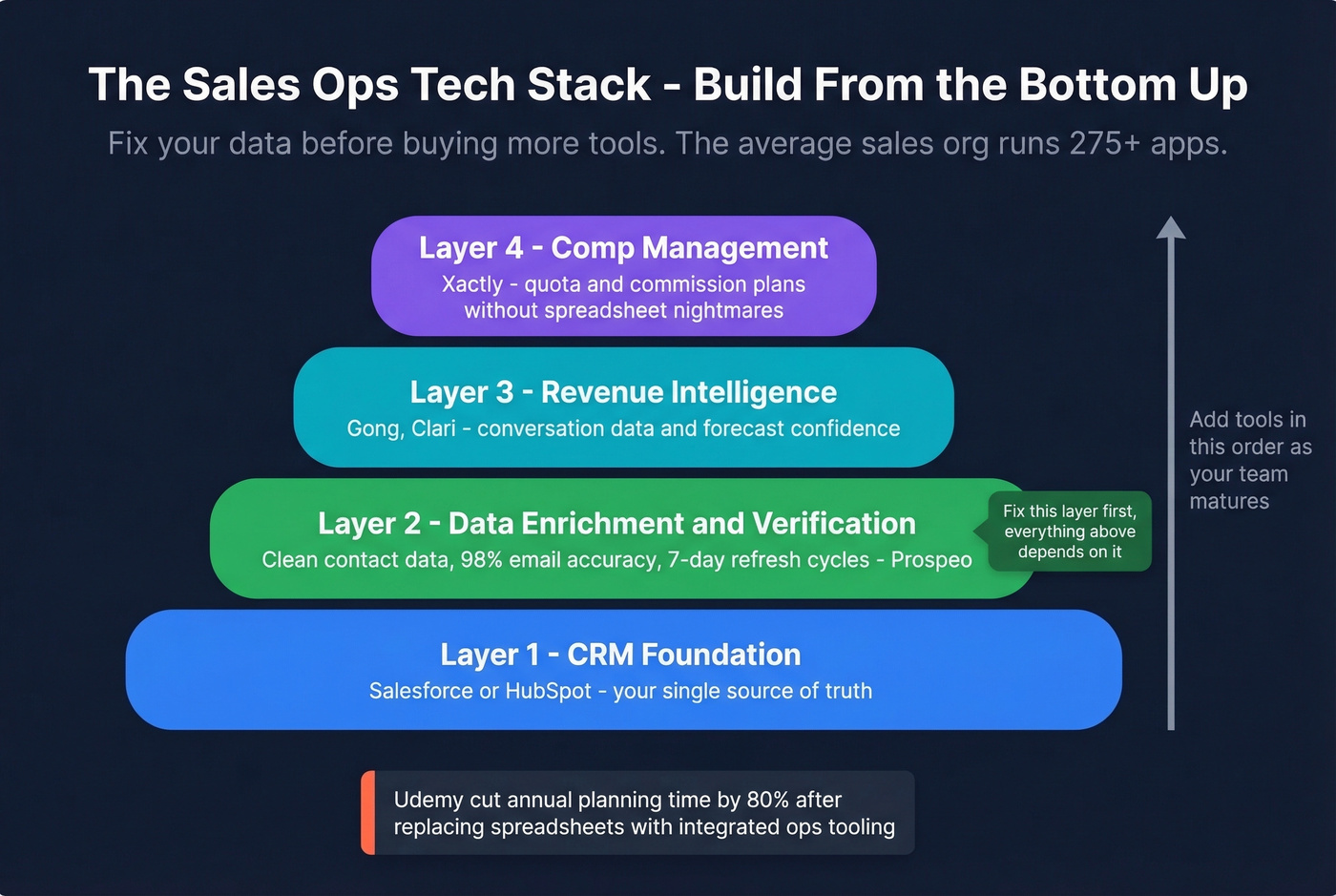
CRM is the foundation - Salesforce or HubSpot. If you're still evaluating options, it helps to review a few examples of a CRM before you commit. Revenue intelligence tools like Gong and Clari give you conversation data and forecast confidence. Comp management platforms like Xactly keep quota and commission plans from becoming spreadsheet nightmares. And data enrichment is where most teams underinvest, even though it's the layer that makes everything else work.

Your forecasting is only as good as the data feeding it. We've tested dozens of enrichment tools across client campaigns, and the pattern is always the same: garbage contact data poisons territory planning, inflates pipeline numbers, and tanks outbound deliverability. If you're comparing vendors, start with a shortlist of data enrichment services and validate match rate + refresh cadence. Prospeo handles the enrichment and verification layer with 98% email accuracy and a 7-day refresh cycle, integrating directly with Salesforce and HubSpot - at roughly $0.01 per email with a free starting tier, it's a data hygiene decision, not a budget conversation.
Udemy cut annual planning time by 80% - from months to weeks - after replacing spreadsheets with an integrated ops platform. That's the kind of result good tooling creates. But skip the intelligence tools entirely if your underlying contact data isn't clean. Fix the data first. If deliverability is already slipping, prioritize an email deliverability guide before scaling outbound volume.
Your Sales Ops tech stack is only as strong as the data feeding it. Prospeo enriches CRM records with 50+ data points at a 92% match rate - for roughly $0.01 per email. That means cleaner forecasts, accurate territory plans, and pipeline coverage numbers you can actually trust. It integrates natively with Salesforce, HubSpot, and every major sequencing tool your team already runs.
Stop auditing bad data and start operating on clean intelligence.
Sales Operations Team FAQ
What's the first role to hire?
An analyst who lives in the CRM, pulls data, and builds reports. Look for SQL skills and CRM fluency over strategic planning experience. Technical chops compound faster than "strategic thinking" at the early stage.
How many ops people do I need?
One per 30 reps is the standard benchmark. A 60-person sales force needs at least two dedicated ops hires; a 150-person org should target five, with specialization by function. The consensus on r/salesoperations largely backs this ratio, though some teams in high-velocity SaaS run closer to 1:20 because the volume of process changes is relentless.
What tools should Sales Ops prioritize first?
Start with your CRM and a data verification tool to ensure reps work from accurate contacts. Add revenue intelligence and comp management as the team matures. Skip anything that doesn't integrate with your CRM - standalone tools that require manual exports create more work than they save.
How should I design the department structure?
Start flat - one manager and a few analysts. Most teams under five people don't need more layers. As you scale past that, specialize roles by function (analytics, CRM admin, territory planning) and add management. Match structure to your sales motion complexity, not another company's org chart.