

Sales Organization Structure: The Benchmark-Driven Guide for Every Stage
Your CRO just came back from the board meeting with a mandate: restructure the sales org after a flat quarter. So you pull up five guides on sales organization structure, and every one gives you the same four boxes - geographic, product, market, functional - as if this is a taxonomy exercise. It's not. That's a framework for a business school exam, not a revenue org.
Let's build something you can actually implement.
The Quick Version
Your sales org structure combines two layers - who you sell to (segmentation) and how you sell (workflow).
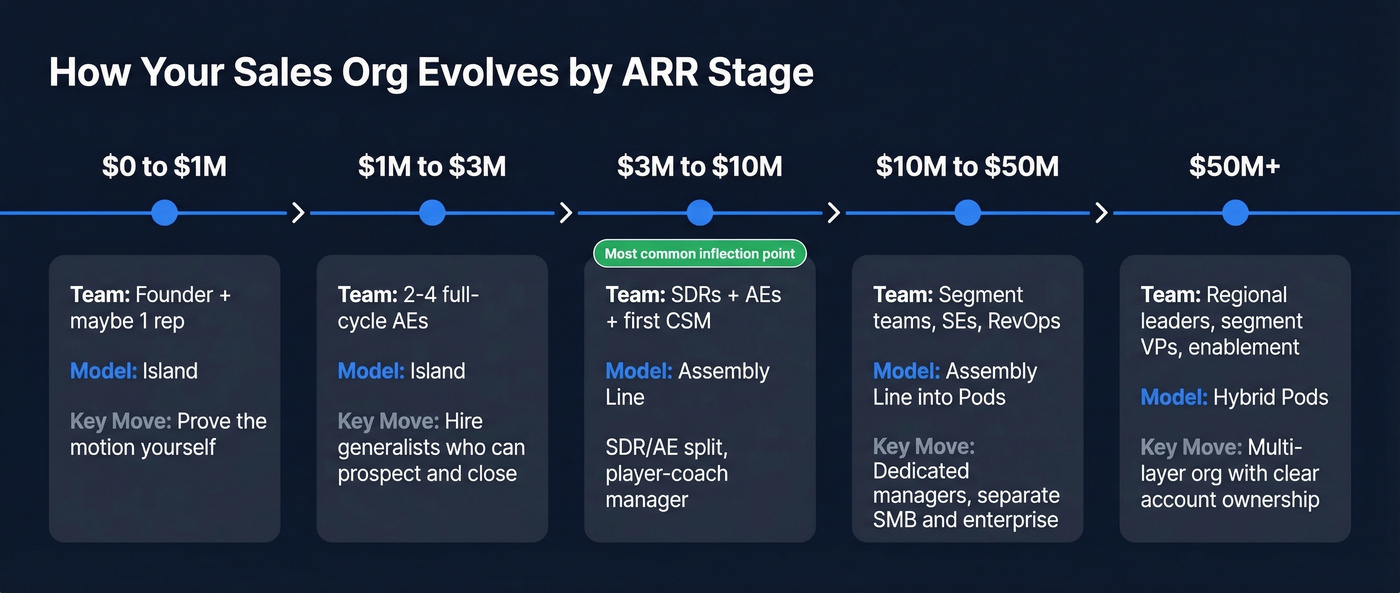
In practice, the structure tends to evolve like this:
- $0-$1M ARR: founder-led, full-cycle
- $1M-$3M ARR: first full-cycle AEs
- $3M-$10M ARR: initial specialization (SDR -> AE -> CSM)
- $10M+ ARR: deeper specialization, and with enough headcount, pods
The rest of this guide gives you the ratios, benchmarks, and stage-by-stage playbook to get there - plus the signals that tell you when your current structure is broken.
What Sales Org Structure Actually Means
Most people think the structure a sales team uses is just an org chart. Boxes and lines. That's only part of it.
RAIN Group's research breaks structure into four components: sales force design, compensation, territory design, and account/lead assignment. All four have to work together. Here's why that matters: 77% of Elite sales organizations say accounts are assigned to the people best suited to work them. Among everyone else? Just 36%. That's a 41-point gap on something most leaders treat as an afterthought.
You don't need a pretty org chart. You need a coverage model. Start with accounts, work backward to roles.
Two Layers: Segmentation + Workflow
Layer one is segmentation - who you sell to. Layer two is workflow - how you sell. Every real org design is a combination of both, and the next two sections break each layer down so you can mix and match for your stage.
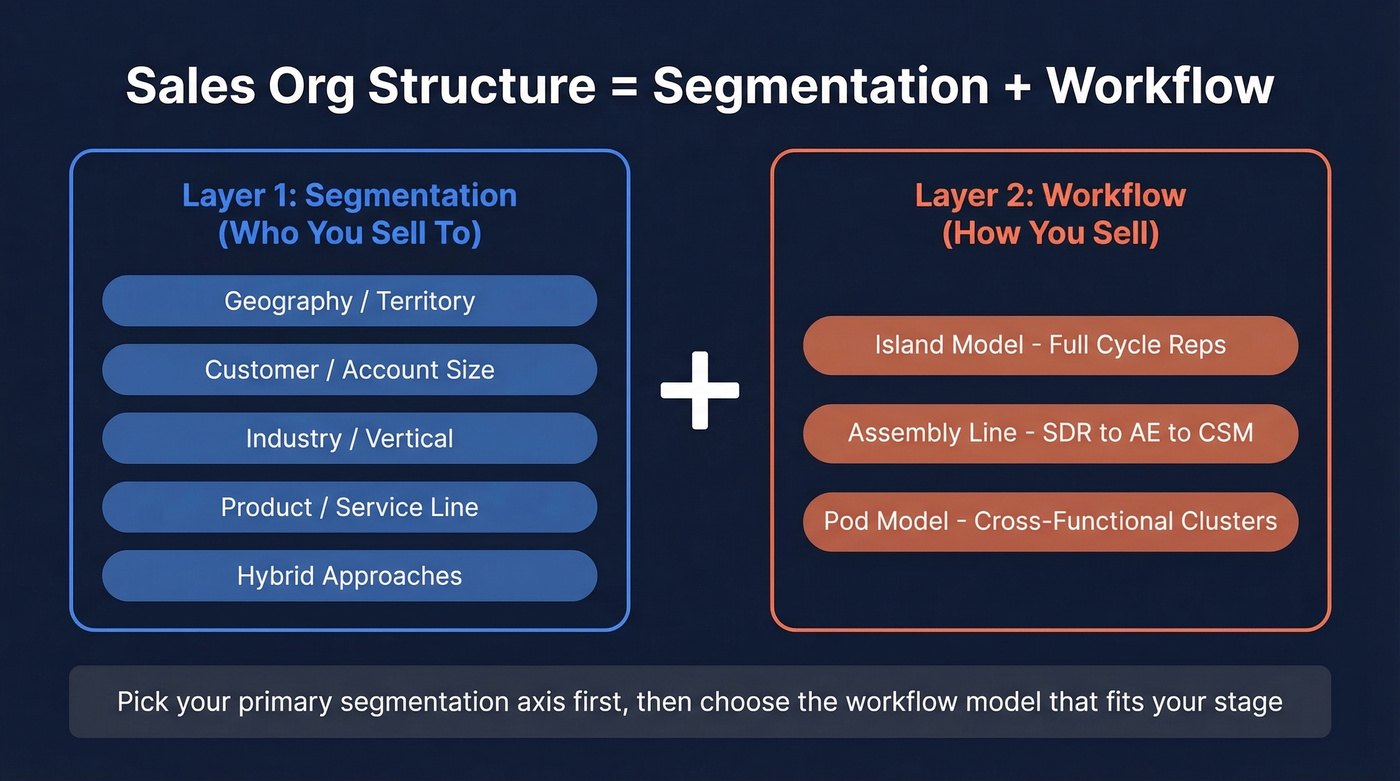
Market Segmentation Models
Geography/Territory
The classic. Assign reps by region, minimize travel, own the local market. It still works for field-heavy enterprise motions where in-person meetings drive deals.
For inside sales, though, geographic territories are often less useful. Close notes that nearly a third of people work from home, which means your "Northeast territory" rep is selling to buyers sitting in Austin. If your motion is primarily digital, segment by account size or intent instead.
Customer/Account Size
SMB, mid-market, enterprise - this is the segmentation model that scales best for most B2B companies. Each segment has different sales cycles, ACVs, and buyer expectations. An AE who crushes $15K mid-market deals will struggle with $200K enterprise procurement processes, and vice versa.
When your customer base spans meaningfully different deal sizes and buying processes, you need segment-based teams. It's the most common type of sales organization in SaaS today for good reason.
Industry/Vertical
Vertical specialization makes sense when domain expertise drives win rates. If your reps need to speak fluent healthcare compliance or financial services regulation, organize by industry. The tradeoff is smaller addressable markets per rep, so vertical orgs work best when each vertical has enough pipeline to sustain dedicated headcount and justify the ramp time for deep domain knowledge.
Product/Service Line
Multi-product companies sometimes organize reps by product. This keeps messaging sharp but creates a terrible buyer experience when two reps from the same company call the same VP in the same week.
Only use product-line segmentation when products serve genuinely different buyer personas - different titles, different budgets, different buying processes. If there's meaningful overlap in your buyer base, a single rep with product training beats two reps tripping over each other.
Hybrid Approaches
Most mature orgs use hybrids. You might segment by account size at the top level, then by vertical within enterprise. The key is picking a primary axis and layering the secondary one on top - not trying to optimize for everything simultaneously.

Your org structure only works if reps can actually reach the right accounts. Prospeo gives every SDR, AE, and pod 300M+ profiles with 98% email accuracy and 125M+ verified mobiles - refreshed every 7 days. Use 30+ filters to segment by account size, industry, or buyer intent so your coverage model matches real demand.
Structure your org around accounts. Let Prospeo fill the pipeline.
Sales Team Models: Island, Assembly Line, Pod
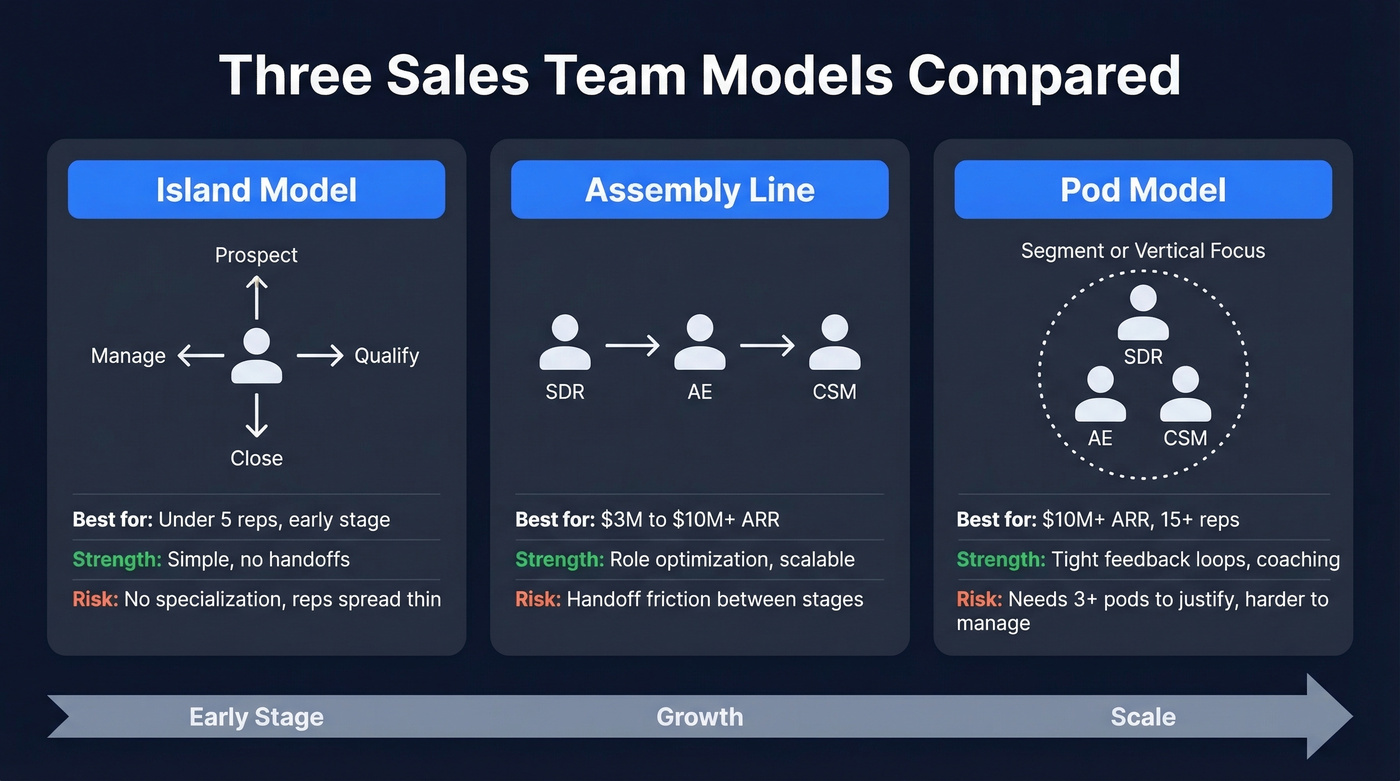
| Model | How It Works | Best For | Key Risk |
|---|---|---|---|
| Island | Each rep owns full cycle | Early stage, <5 reps | No specialization |
| Assembly Line | SDR -> AE -> CSM handoffs | $3M+ ARR | Handoff friction |
| Pod | Cross-functional clusters | $10M+ with 15+ reps | Harder to manage |
The Island Model
Every rep prospects, qualifies, closes, and sometimes even manages the account post-sale. Simple. It's how most startups begin, and it works when you have fewer than five salespeople.
Close runs a version of this - reps handle leads end-to-end until CS handoff, with marketing owning lead gen. The downside is obvious: no specialization means your best closer is spending a huge chunk of their time writing cold emails. (If you need a starting point, use these sales prospecting techniques to systematize outbound without adding headcount.)
The Assembly Line
This is the model that built modern SaaS sales. SDRs generate and qualify pipeline, AEs close, CSMs retain and expand. It works because each role can be optimized independently - you can hire SDRs for hustle and AEs for deal craft. Among the various sales team organizational models, the assembly line remains the most widely adopted for scaling B2B companies, and it's the default "initial specialization" move for teams in the $3M-$10M ARR range.
Here's the thing: we've seen it break down in one specific, predictable way. If your SDRs and AEs don't share a feedback loop, your structure is broken regardless of what the org chart says. SDRs booking meetings that AEs consider garbage isn't a pipeline problem. It's a process failure wearing a pipeline costume. (Tighten the handoff with a simple handoff email template and a shared definition of “qualified.”)
The Pod Model
Popularized by Jacco van der Kooji at Winning By Design, pods group an SDR, one or two AEs, and a CSM into a self-contained unit focused on a specific segment, vertical, or territory. Cognism adopted this approach as they scaled past 3,000+ customers, organizing pods by region and segment.
The benefits are real - tighter feedback loops, faster domain expertise, cleaner customer handoffs. But let's be honest: the pod model is overhyped for teams under 10 reps. You need enough people to form at least three pods, and each pod needs enough pipeline to stay busy. Pods can also create motivation and conflict issues when members don't gel.
Start with the assembly line. Graduate to pods when you have the headcount and the data to segment pods meaningfully.
One stat that makes the case for pods better than any org chart: when sales managers spend 50% of their time coaching, reps score 28% higher in competency measures. Pods make coaching easier because managers oversee a smaller, more focused unit. That's the real argument - not the structure itself, but the coaching it enables.
How Structure Evolves by Stage
| ARR Stage | Team Shape | Key Hire | Structure |
|---|---|---|---|
| $0-$1M | Founder + maybe 1 rep | First AE | Island |
| $1M-$3M | 2-4 full-cycle AEs | Second AE | Island |
| $3M-$10M | SDRs + AEs + first CSM | Player-coach mgr | Assembly line |
| $10M+ | Specialized teams | SEs, ops, managers | Assembly line -> pods |
| $50M+ | Multi-layer org | Regional/segment VPs | Hybrid pods |
$0-$1M: Founder-Led Sales
You are the sales team. Your job is to close enough deals to prove the model works and learn what your ICP actually looks like. Don't hire reps yet - hire when you can articulate the sales motion clearly enough that someone else can replicate it. (A lightweight ideal customer profile doc is usually the fastest unlock here.)
$1M-$3M: First Full-Cycle Reps
Hire one or two generalist AEs who can prospect and close. The practical heuristic from one Series A founder on Reddit: "If we got 10 more opportunities this month, how many would we drop the ball on?" When the answer is consistently more than zero, it's time to add headcount.
Founders on r/sales consistently echo this - the most common regret is specializing too early, not too late.
$3M-$10M: The SDR/AE Split
This is where most teams make the assembly line jump. Add SDRs to generate pipeline so AEs can focus on closing. But don't let AEs go fully inbound - they should still do roughly 30% outbound to keep their prospecting muscle and pipeline awareness.
Add your first CSM when churn starts costing you more than a salary. Handoff mechanics matter here: shared deal decks, call recordings, and Slack channels between AEs and CSMs reduce the "I have to re-explain everything" problem that kills expansion revenue. (If churn is creeping up, run a quick churn analysis before you change roles.)
Your first sales leader should be a player-coach - someone who carries a small book while managing the team. Gallup data shows managers spend a median 40% of their time on individual contributor work, which is exactly why a player-coach makes sense at this stage. Aim for one manager per 8 reps - tight enough for coaching, loose enough to avoid overhead. Skip this if you're considering a full-time non-selling VP. That's premature.
$10M+: Full Specialization
Now you add layers. Dedicated managers (not player-coaches), sales engineers for technical deals, and a RevOps function to keep the machine running. This is where segment-based teams start making sense - separate SMB and enterprise motions with different comp plans, quotas, and tooling.
$50M+: Multi-Layer Organization
Regional leaders, segment VPs, enablement teams, and pod structures within each segment. The org chart gets complex, but the principle stays simple: every rep should know exactly which accounts they own, why those accounts are theirs, and how they're compensated for winning them.
Benchmarks and Ratios Every Leader Needs
| Metric | Benchmark | Source |
|---|---|---|
| SDR:AE ratio | 1:2.6 avg | Bridge Group |
| SE:AE ratio | 1:2-4 (mid-market/ent.) | Industry standard |
| CSM:accounts (SMB) | 1:50-100 | Industry standard |
| CSM:accounts (mid-mkt) | 1:20-40 | Industry standard |
| CSM:accounts (enterprise) | 1:5-15 | Industry standard |
| Mgr span (inside sales) | 8-12 reps | Alexander Group |
| Mgr span (enterprise field) | 5-8 reps | Alexander Group |
| Mgr span (SDR teams) | 10-12 reps | Alexander Group |
| Rep book size (high-vel.) | 100-300 accounts | Gradient Works |
| Book refresh cadence | Every 30-60 days | Gradient Works |
| Ramp time (SDR) | 2-3 months | Industry standard |
| Ramp time (AE) | 4-6 months | Industry standard |
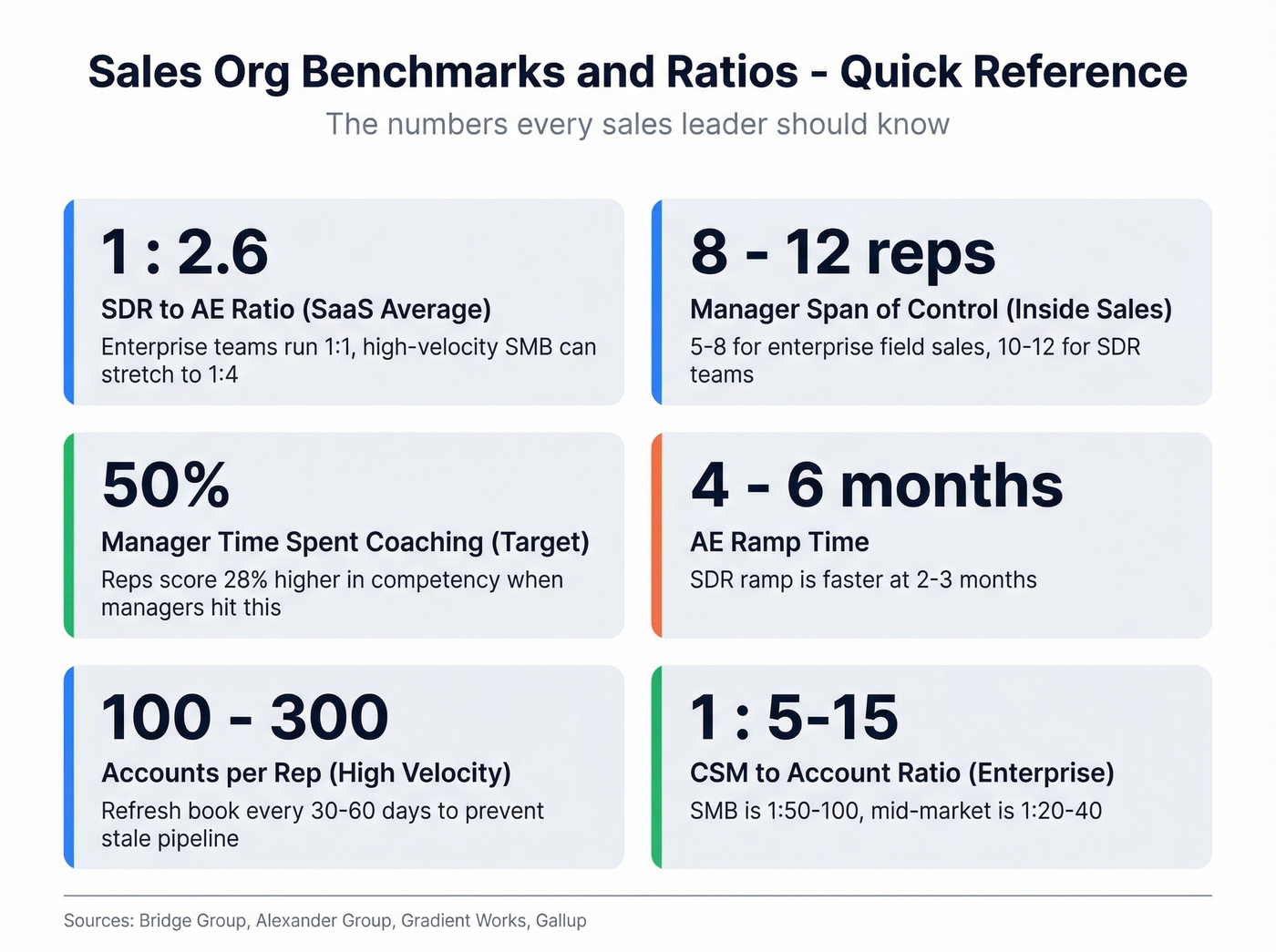
The SDR:AE ratio of 1:2.6 is a SaaS average, but it varies wildly by motion. Enterprise teams with long cycles run 1:1. High-velocity SMB teams can stretch to 1:4 or beyond. Don't copy the benchmark - use it as a starting point and adjust based on your pipeline math. (If you want to pressure-test your funnel assumptions, use these sales pipeline benchmarks as guardrails.)
On span of control, the macro trend is toward wider spans. Gallup data shows average direct reports per manager rose from 10.9 to 12.1 between 2024 and 2025, though the median team is still just 5-6 people. Sales-specific ranges from Alexander Group are tighter - 8-12 for inside sales, 5-8 for complex enterprise - because sales managers need coaching time, not just administrative oversight.
Account book size is the benchmark most leaders ignore, and it's the one that moves the needle fastest. For high-velocity teams, aim for 100-300 active accounts. One Gradient Works customer running a mid-market motion cut from a larger book to 300-400 and saw win rates jump from 13% to 20%+. Box went further, cutting books to 200-250 high-potential accounts. The quote that stuck with our team: "We used to hand reps zip codes. Now, we hand them opportunity." Refresh those books every 30-60 days - stale territory assignments are a silent pipeline killer.
Comp matters more than most leaders admit. RAIN Group found that 71% of Elite sales organizations say compensation drives top performance, versus just 33% of everyone else. If your structure is right but your comp plan incentivizes the wrong behavior, the structure won't save you.
How AI Is Reshaping Sales Orgs in 2026
Here's the hot take most sales leaders aren't ready for: if your average deal size sits below $10K, you probably don't need human SDRs anymore.
AI won't replace your AEs this year. It will replace your email-only SDRs. SaaStr reported going from 10+ humans in sales to 1.2 humans plus 20+ AI agents with the same net productivity - spending $500K on AI agents versus ~$10K on Salesforce. One AI SDR vendor reported a 72% open rate and 10%+ response rate on previously ghosted leads, numbers that would be exceptional for human SDRs.
The role-by-role breakdown is stark:
- Email-based outbound SDRs are 95%+ replaceable by AI today
- Inbound BDR lead screening is 95%+ replaceable
- AEs are about 5% replaceable today
- Customer support sits around 50%+ replaceable with proper training data
Teams running AI SDRs effectively segment contacts into batches of 800-1,000 max per campaign, create persona-specific sub-agents, and orchestrate daily. It's not "set and forget" - it's a different kind of management overhead. (If you’re building this stack, start with a shortlist of AI agents for sales and the right SDR tools.)
Gartner's 2026 priorities for sales leaders reinforce this: build a sales-centric AI roadmap, transform GTM motions for rep-free buying paths, and maximize manager impact. The structural implication is fewer SDR seats, more AI orchestration roles, and a heavier investment in the data layer that feeds everything. AI agents are only as good as the contact data they work from - garbage in, garbage out - which is why a 7-day data refresh cycle matters more now than it did two years ago.
Signs Your Structure Is Broken
Not every performance problem is a structural problem. But these signals tell you what's already broken:
Deals dying between handoffs. If qualified opportunities evaporate when SDRs pass to AEs, or when AEs hand off to CS, you have a workflow gap - not a people gap. Shared deal decks and recorded calls fix this faster than a reorg.
Reps overlapping on accounts. Two reps calling the same prospect in the same week signals broken territory or account assignment. Remember that 41-point gap between Elite orgs and everyone else on account assignment? If your reps are fighting over accounts or ignoring them, you're on the wrong side of it.
Founder is still the top closer at $3M+ ARR. That's a bottleneck, not a badge of honor. The structure hasn't scaled past you.
You hired 3 SDRs and pipeline didn't move. The problem isn't the SDRs. It's that you added a role without building the handoff, coaching, and feedback loop around it.
High bounce rates and stale contact data. Look - reps can't execute any structure if they can't reach prospects. If your team is bouncing 10%+ of emails, the problem isn't org design. It's data decay. Fix the data layer before you touch the org chart. (Use these email bounce rate benchmarks to spot when it’s a data problem vs. a copy problem.)
Before you restructure, diagnose whether the root cause is people, process, or data. Restructuring won't fix bad data, and new tools won't fix a broken handoff.
Whether you're running an assembly line with SDR-to-AE handoffs or self-contained pods, bad data kills the motion. Prospeo delivers under 4% bounce rates - the same result Meritt hit when they tripled pipeline from $100K to $300K per week. At $0.01 per email, scaling headcount doesn't mean scaling data costs.
Stop letting bad contact data bottleneck your new sales org.
FAQ
What's the best sales org structure for a startup?
Under $3M ARR, keep it simple: founder plus one or two full-cycle AEs running the island model. Add SDRs only when AEs are consistently capacity-constrained - use the "10 more opportunities" test. Specializing too early creates overhead without enough pipeline to justify it.
What's the ideal SDR to AE ratio?
The SaaS average is 1 SDR for every 2.6 AEs, per Bridge Group data. Enterprise motions with long cycles may need 1:1, while high-velocity SMB can stretch to 1:4. Let your pipeline math dictate the ratio, not the benchmark.
How do you choose the right structure?
Start by mapping your accounts and buyer segments, then work backward to the model that fits your stage and deal complexity. Island for early stage, assembly line past $3M ARR, pods beyond $10M. The right choice depends on your ARR, headcount, ACV, and how distinct your buyer segments are - not on what a competitor is running.
How do you know when to restructure?
Watch for deals dying between handoffs, reps overlapping on accounts, or pipeline stalling after new hires. If reps can't reach prospects due to stale data, fix the data layer first - a weekly refresh cycle keeps contact records current so reps can actually work the accounts assigned to them. Diagnose whether the root cause is people, process, or data before redrawing the org chart.