

Sales Outreach Email Templates That Get Replies in 2026
Your SDR sends 200 cold emails on Monday. By Wednesday, 70 bounce, 40 hit spam, and the remaining 90 generate two replies - both asking to unsubscribe. No sales outreach email template will save you if your data is rotten. The 2026 benchmark report from Instantly puts the average cold email reply rate at 3.43%, but the top 10% hit 10.7%+. The gap isn't talent. It's process.
What You Need (Quick Version)
- Keep emails under 80 words. Instantly's 2026 benchmark data shows the best-performing campaigns stay under 80 words. Say less.
- Write 2-4 word subject lines. Belkins analyzed 5.5M emails and found this length hits 46% open rates.
- Verify your list before sending. Bounce rates above 5% wreck deliverability, and the best senders keep bounces under 3%.
- Follow up 4-7 times over 3-7 day intervals. Sequences with 4-7 steps generate 3x the reply rate of 1-3 step sequences (27% vs 9%).
2026 Cold Email Benchmarks
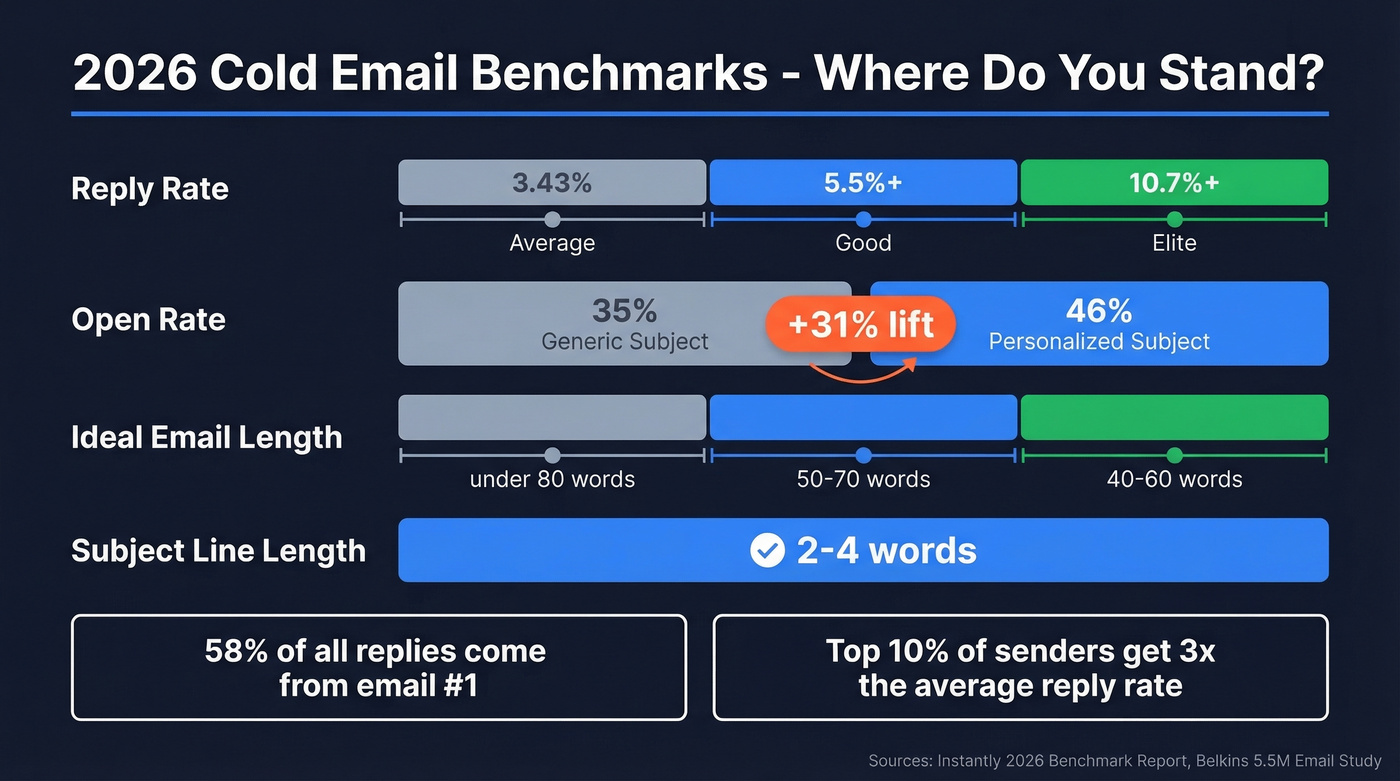
Most template guides skip benchmarks entirely, which means you're guessing whether your numbers are good or terrible. Here's where the bar actually sits:
| Metric | Average | Good | Elite | Source |
|---|---|---|---|---|
| Reply rate | 3.43% | 5.5%+ | 10.7%+ | Instantly 2026 |
| Open rate (personalized subject) | 35% (generic) | 46% (personalized) | - | Belkins 5.5M study |
| Email length | <80 words | 50-70 words | 40-60 words | Instantly 2026 |
| Subject line length | 2-4 words | - | - | Belkins 5.5M study |
Two numbers jump out. First, 58% of all replies come from step one - your initial outreach email carries most of the weight. Second, personalized subject lines drive a 46% open rate versus 35% without. That's a 31% relative lift from something you can implement today.

A thread on r/b2b_sales lines up with this picture: many teams sit around 5-6% reply rates, with "good" starting around 10%. If you're below 3%, the issue is usually deliverability or data quality, not copywriting.
8 Proven Outreach Email Templates
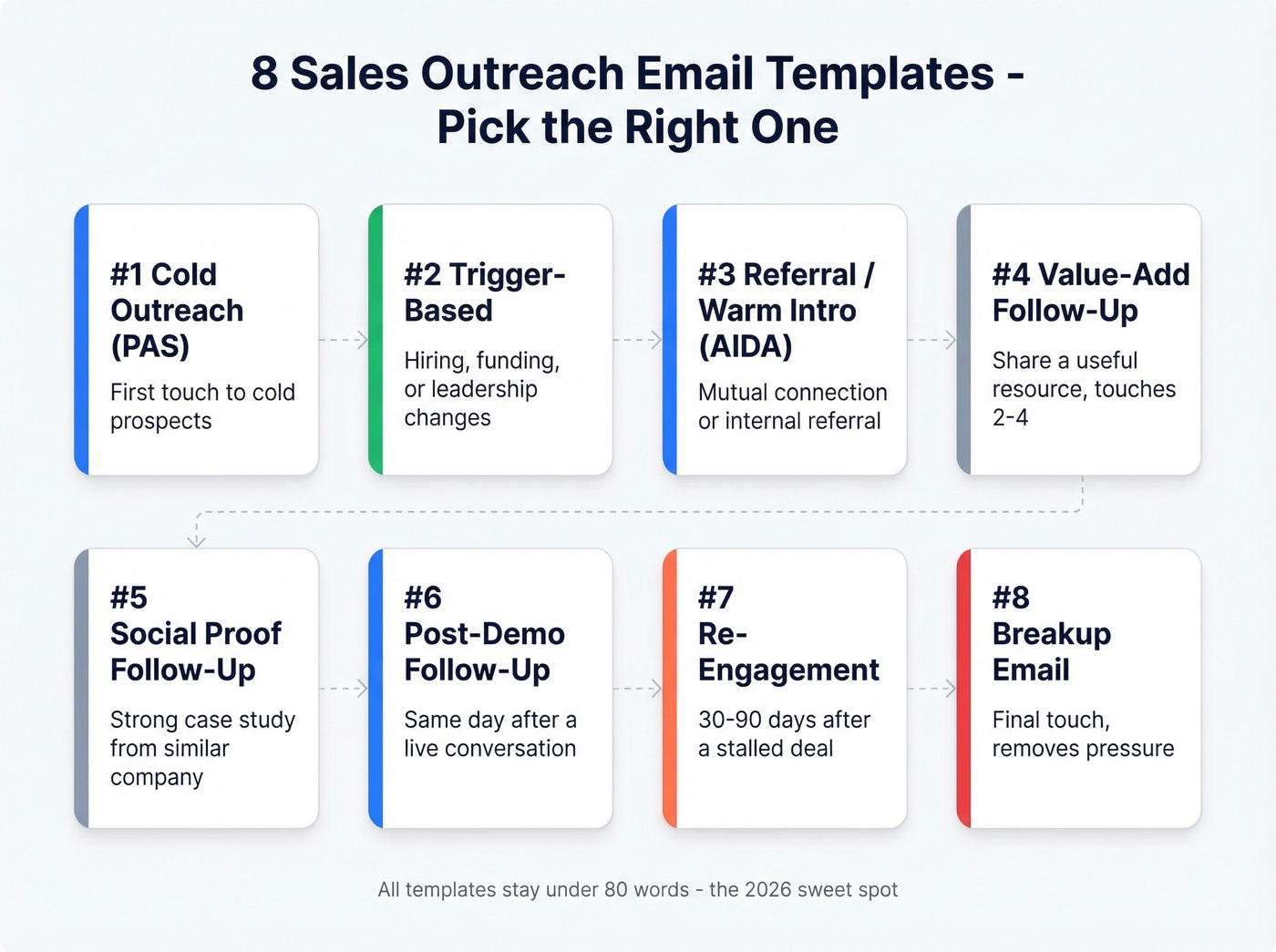
You don't need 55 templates. You need 8 great ones and the discipline to personalize each. Every template below stays under 80 words.
1. Cold Outreach (PAS)
Hi {{first_name}},
Most {{title}}s at {{company_size}} companies lose 10+ hours/week on {{pain_point}} - and the workarounds just create more problems.
We help teams like {{similar_company}} cut that by 60% in the first month.
Worth a quick conversation?
When to use: First touch to a cold prospect. PAS (Problem-Agitate-Solution) names the pain before pitching anything, and the soft CTA outperforms hard meeting asks. This is the most versatile framework because it adapts to any industry or pain point.
2. Trigger-Based (Hiring/Funding)
This is the highest-converting template in our rotation. The trick is timing - you need to reach prospects within days of the trigger, not weeks. Job postings, funding rounds, and leadership changes all have a shelf life.
Hi {{first_name}},
Saw {{company}} just {{trigger - raised Series B / opened 3 AE roles / expanded to EMEA}}. That usually means {{implication}}.
We helped {{similar_company}} handle that transition and {{specific result}}.
Interested in hearing how?
Context triggers prove you're paying attention, not batch-blasting. Pair this with intent data or job posting signals to catch the window. In our experience, this approach consistently outperforms generic cold opens because it ties your message to something the prospect already cares about.
3. Referral / Warm Intro (AIDA)
Hi {{first_name}},
{{mutual_connection}} suggested I reach out. They mentioned you're working on {{initiative}}.
We just helped {{company}} achieve {{result}} with a similar setup. I put together a quick breakdown of what worked.
Want me to send it over?
Use this when you have a mutual connection or internal referral. The referral dissolves the "cold" barrier instantly, and AIDA (Attention-Interest-Desire-Action) builds momentum toward the ask.
4 & 5. Value-Add Follow-Up vs. Social Proof
These two templates serve the same purpose - keeping the thread alive - but take opposite approaches. Use the value-add when you have a relevant resource to share. Use social proof when you have a strong case study from a similar company.
Value-Add:
Hi {{first_name}},
Following up with something useful - {{resource: benchmark, case study, teardown}} relevant to {{their initiative}}.
Still think there's a fit. Happy to walk through it if timing works.
Social Proof:
Hi {{first_name}},
{{Similar_company}} was dealing with {{same problem}} last quarter. After implementing {{your solution}}, they saw {{specific metric - 40% reduction, 3x pipeline}}.
Their setup looks a lot like yours. Worth 15 minutes to compare notes?
Both work for touches 2-4, spaced 3-7 days apart. The BAB framework (Before-After-Bridge) is another strong option here: describe their current state, paint the after, then bridge with your solution.
6. Post-Demo Follow-Up
Hi {{first_name}},
Thanks for the time today. Quick recap: {{key pain point discussed}}, {{proposed solution}}, {{agreed next step}}.
I'll send over {{deliverable}} by {{date}}. Let me know if anything shifts on your end.
Send it the same day while the conversation is fresh. Recapping commitments in writing creates accountability and keeps deals moving. Skip this template if you're running a fully automated sequence - it only works when you've actually had a live conversation.
7. Re-Engagement
Hi {{first_name}},
I know timing wasn't right last time we connected. Since then, we've {{new development - launched feature, published case study, signed competitor}}.
If {{original pain point}} is still on your radar, happy to pick this back up. If not, no worries at all.
Use this 30-90 days after a stalled conversation. Leading with something new respects their time while reopening the door.
8. Breakup Email
Here's the thing about breakup emails: they can outperform your opener. Removing pressure creates it.
Hi {{first_name}},
I've reached out a few times and haven't heard back - totally understand if the timing's off.
I'll close this thread out, but if {{pain point}} comes back up, I'm here. Just reply to this email.
If your breakup email consistently outperforms your first touch, your opener needs work. The breakup succeeds because it's short, honest, and pressure-free - qualities your first email should have too.

Every template above depends on one thing: reaching a real inbox. Prospeo's 98% email accuracy and under-3% bounce rates mean your outreach actually lands. Trigger-based templates? Layer in intent data tracking 15,000 topics to catch prospects the week they're in-market.
Stop writing perfect emails to bad addresses. Start with verified data.
Personalization at Scale
"I noticed you went to Michigan State" isn't personalization. It's biographical flattery, and prospects see through it immediately.
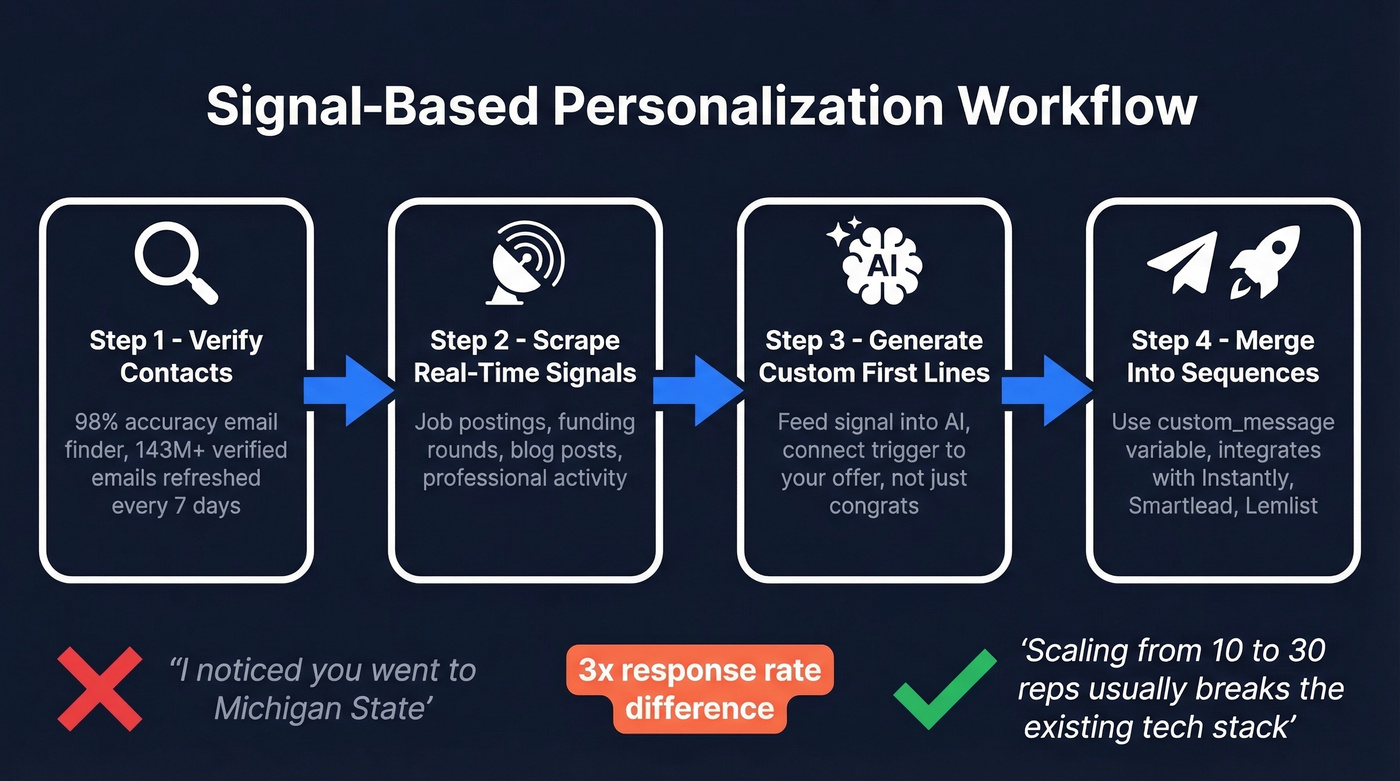
Real personalization connects a prospect's situation to your offer. Practitioners on r/SaaS report roughly 3x response rates with signal-based personalization versus generic templates. Here's the workflow we've seen work best:
- Start with verified contact data. Prospeo's email finder with 98% accuracy means your personalization efforts aren't wasted on dead addresses. With 143M+ verified emails refreshed every 7 days, you're working with current data - not stale records from months ago.
- Scrape real-time signals. Job postings, funding announcements, company blog posts, recent professional activity. These are your context triggers.
- Generate custom first lines with AI. Feed the signal into GPT-4o mini with a prompt that connects the trigger to your offer. Not "Congrats on the funding!" but "Scaling from 10 to 30 reps usually breaks the existing tech stack - here's what we've seen work."
- Merge into your sequences. Use a
{{custom_message}}variable in your cold email tool. This step transforms a generic template into a message that feels one-to-one. Prospeo integrates natively with Instantly, Smartlead, and Lemlist, so verified contacts flow straight into your sequences without manual CSV exports.
Follow-Up Cadence and Timing
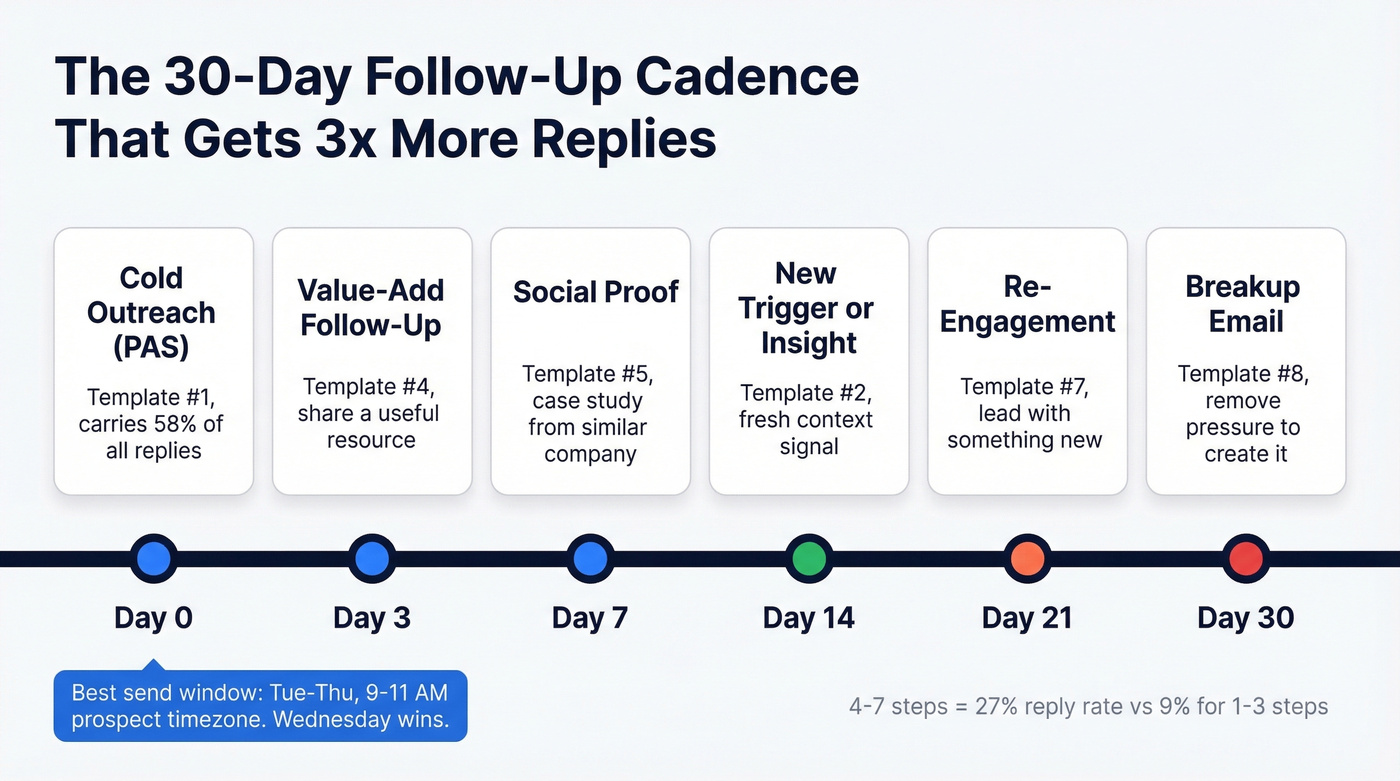
58% of replies come from your first email. But the other 42% comes from follow-ups - and most reps quit after two. The 2026 data shows 4-7 steps is the sweet spot.
| Touch | Day | Purpose |
|---|---|---|
| 1 | 0 | Cold outreach (PAS) |
| 2 | 3 | Value-add follow-up |
| 3 | 7 | Social proof angle |
| 4 | 14 | New trigger or insight |
| 5 | 21 | Re-engagement |
| 6 | 30 | Breakup |
Send Tuesday through Thursday, 9-11 AM in the prospect's timezone. Wednesday performs best. Multi-channel sequences - email plus calls plus social touches - can compress this timeline significantly, but email remains the backbone. If you want a deeper set of follow-up angles, use these follow-up templates as plug-ins for touches 2-6.
Deliverability Checklist
Let's be honest: your templates aren't failing. Your data is. Bounce rates above 3% are a deliverability emergency.
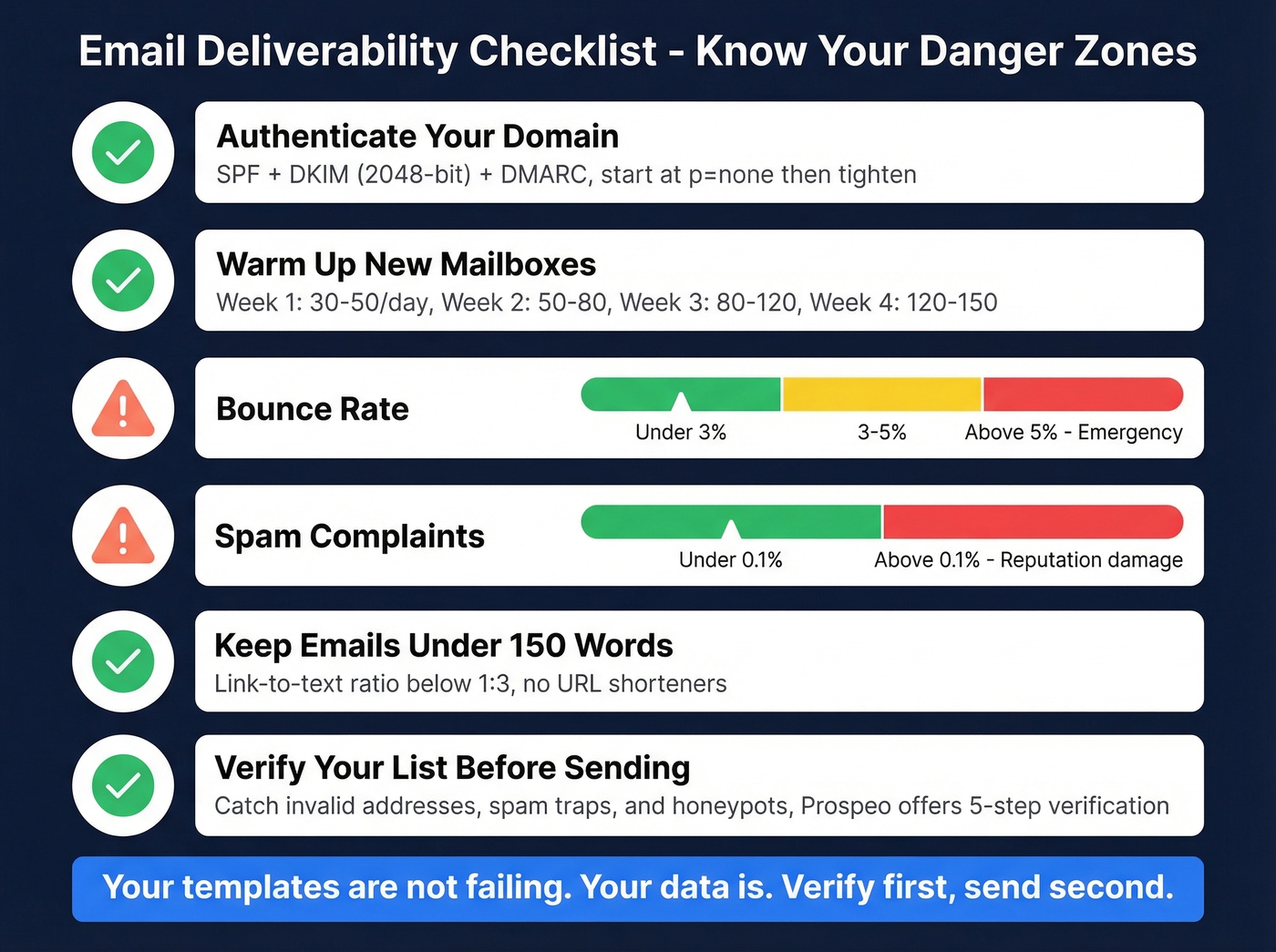
- Authenticate your domain. Set up SPF, DKIM (2048-bit keys), and DMARC. Start DMARC at
p=nonewith reporting, then tighten to quarantine/reject over time. (If you need a deeper walkthrough, start with this email deliverability guide.) - Warm up new mailboxes. Week 1: 30-50/day. Week 2: 50-80. Week 3: 80-120. Week 4: 120-150. Only increase if bounce and complaint rates stay clean. (Also watch your email velocity.)
- Keep bounce rate under 3%. Hard bounces above 2% are a red flag. Spam complaints must stay below 0.1%. (Benchmarks + fixes: email bounce rate.)
- Keep emails under 150 words. Link-to-text ratio below 1:3. No URL shorteners - they're spam triggers.
- Verify your list. This is the single highest-ROI step before launching any sequence. Prospeo's 5-step verification catches invalid addresses, spam traps, and honeypots before they torch your sender reputation - and the free tier gives you 75 verifications per month to test it. (More options: data enrichment services.)
- Add List-Unsubscribe headers. Include one-click unsubscribe where possible, and honor opt-outs within 10 business days.
Personalization at scale requires more than merge tags - it requires real signals. Prospeo gives you 30+ filters including buyer intent, job changes, funding rounds, and headcount growth so every template you send is backed by context that converts.
Build signal-rich prospect lists for $0.01 per verified email.
Compliance Essentials
CAN-SPAM applies to B2B. Full stop. The FTC's compliance guide is clear: every commercial email - including cold outreach - must include a valid physical postal address (a PO box works), a clear opt-out mechanism honored within 10 business days, and non-deceptive subject lines that reflect the email's content. You're also liable for third parties sending on your behalf, including agencies and SDR firms. Penalties run up to $53,088 per email.
For GDPR (EU prospects), you need a legitimate interest basis, clear identification, and easy opt-out. Don't skip this - one complaint to the right regulator can shut down your outbound program entirely. If you're building outbound from scratch, start with an ideal customer profile so you're only emailing the right accounts.
FAQ
How long should a sales outreach email be?
Under 80 words. The 2026 benchmark data shows sub-80-word emails are a common trait of the best-performing campaigns. Practitioners on r/copywriting push even harder - 40-60 words is the sweet spot for maximum replies.
How many follow-ups should I send?
Four to seven touches spaced 3-7 days apart. Sequences with 4-7 steps generate 3x the reply rate of shorter sequences (27% vs 9%). Beyond seven, returns diminish unless each email adds genuinely new value.
How do I keep cold emails out of spam?
Authenticate your domain with SPF, DKIM, and DMARC, then warm up new mailboxes over four weeks. Keep bounce rates under 3% and spam complaints below 0.1%. Verify your prospect list before sending - catching invalid addresses and spam traps before they hit your sender reputation is the single most impactful step.