

Sales Personalization Starts With Your Data, Not Your Copy
Your SDR spent 45 minutes on sales personalization this morning - crafting 10 emails with custom openers and specific references. Three bounced. Two went to people who left the company last quarter. The remaining five landed in inboxes, but two referenced wrong job titles.
That's a 50% hit rate on effort that was supposed to be your competitive advantage. The problem isn't the copy. It's the data underneath it.
Why Most Personalization in Sales Fails
McKinsey research shows 76% of buyers get frustrated when interactions aren't personalized. Salesforce found 65% of customers expect companies to adapt to their changing needs. And yet only about 13% of B2B organizations actually personalize their outreach in any meaningful way.
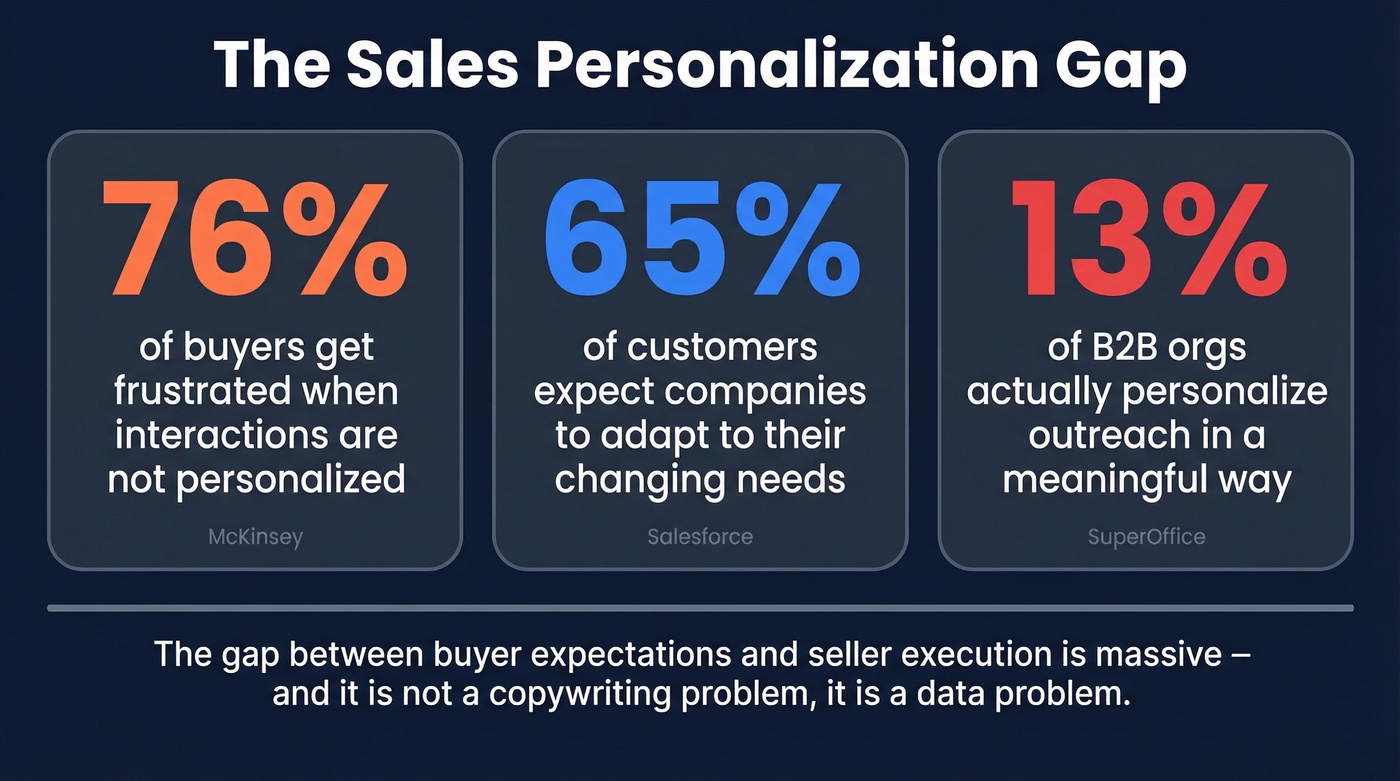
That gap is enormous - and it's not because teams don't want to personalize.
Here's the thing: {{first_name}} isn't personalization. Neither is "I loved your recent post on leadership!" when the SDR clearly didn't read it. Buyers see through the merge-tag-plus-generic-compliment pattern instantly. It's personalization theater - the appearance of relevance without substance.
Every trending approach - digital sales rooms, personalized video, AI-driven next-best-action engines - still depends on knowing who you're talking to, what role they hold today, and whether your message will actually reach them. The real bottleneck is operational: stale CRMs, dead email addresses, and wrong job titles that make personalized communication impossible before you write a single word.
Signals That Actually Move Reply Rates
Not all personalization signals are equal. Let's break down what actually moves the needle.
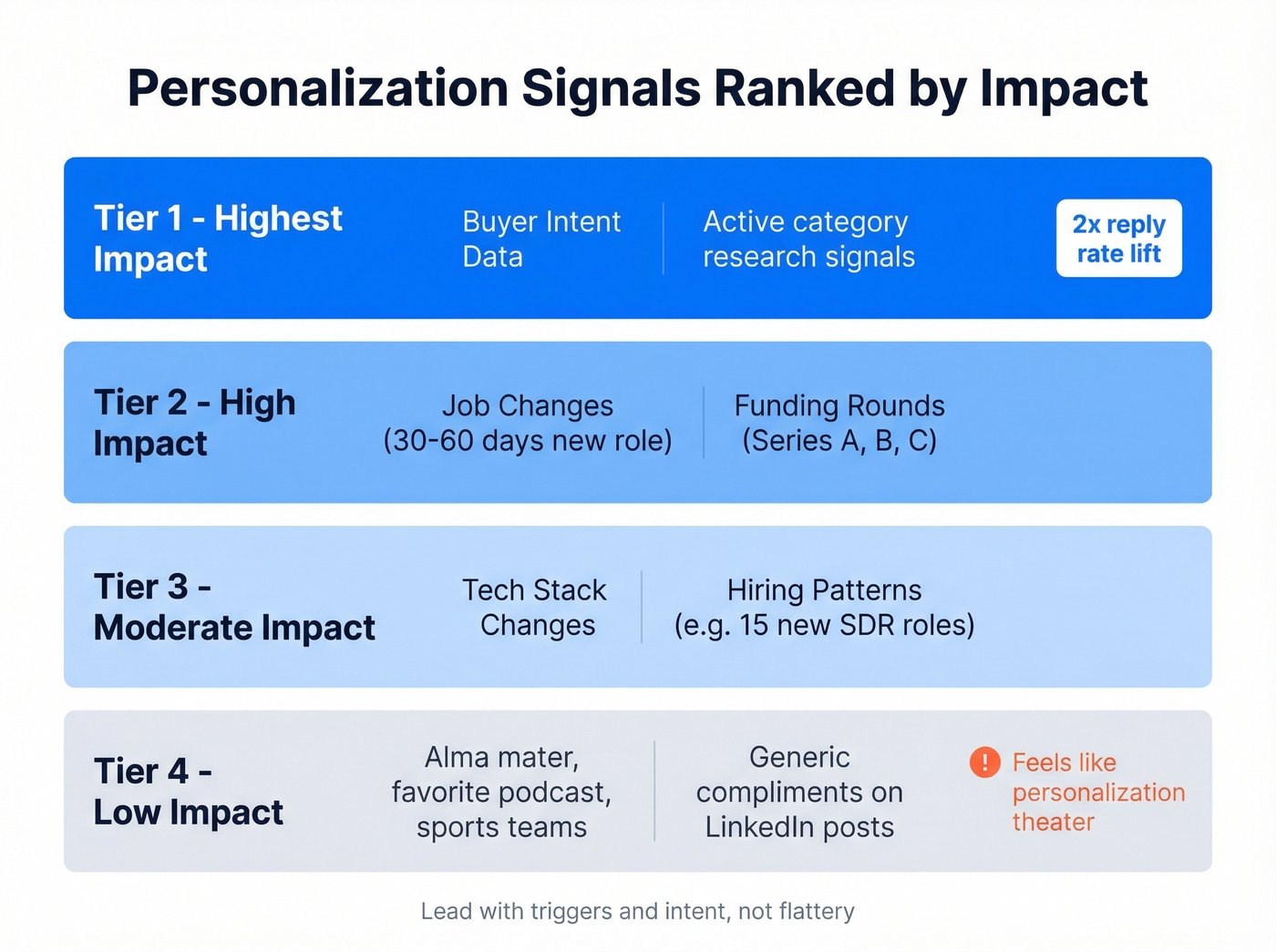
Intent data is the most underused signal in B2B outreach, and it's not close. Knowing an account is actively researching your category is worth more than knowing the prospect's alma mater, their favorite podcast, or what college football team they follow. We've seen teams double their reply rates just by filtering for accounts showing active buying signals before writing any outreach.
After intent, the signals worth your time break down like this:
- Job changes - Someone who started a new VP role 30-60 days ago is building their stack. Open with the transition, not a compliment.
- Funding rounds - A company that just raised a major round is hiring, buying tools, and moving fast. Reference the round and connect it to the problem you solve.
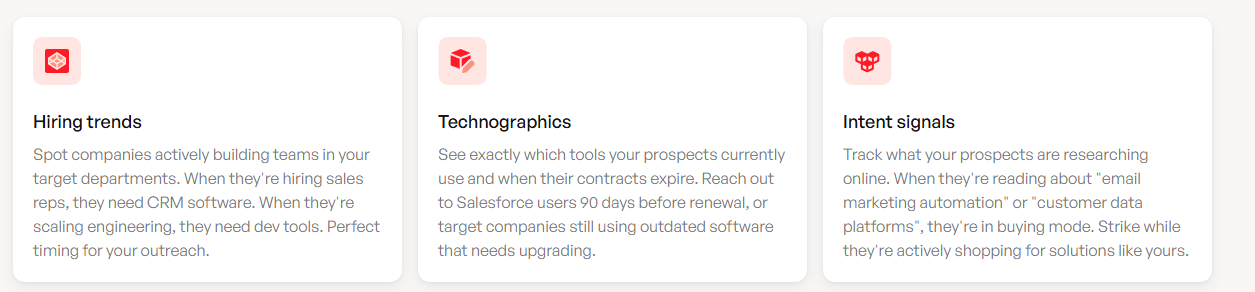
- Tech stack changes - If a company adopts Salesforce or drops a competitor, they're in-market for adjacent tools.
- Hiring patterns - A company hiring 15 SDRs needs data, sequencing tools, and training. That's a signal, not a guess.
For senior executives specifically, reference something they actually said in a podcast or earnings call - not "great episode!" but "Your point about [X] resonated because we see the same pattern with our customers." In practice, this kind of specificity outperforms every template-based approach we've tested.
The Data Foundation for Personalized Sales
Look, most teams should stop investing in email copywriting frameworks and AI writing tools until they fix their data. A perfectly crafted email that bounces is worth exactly zero. A mediocre email that reaches the right person at the right time will outperform it every single day.
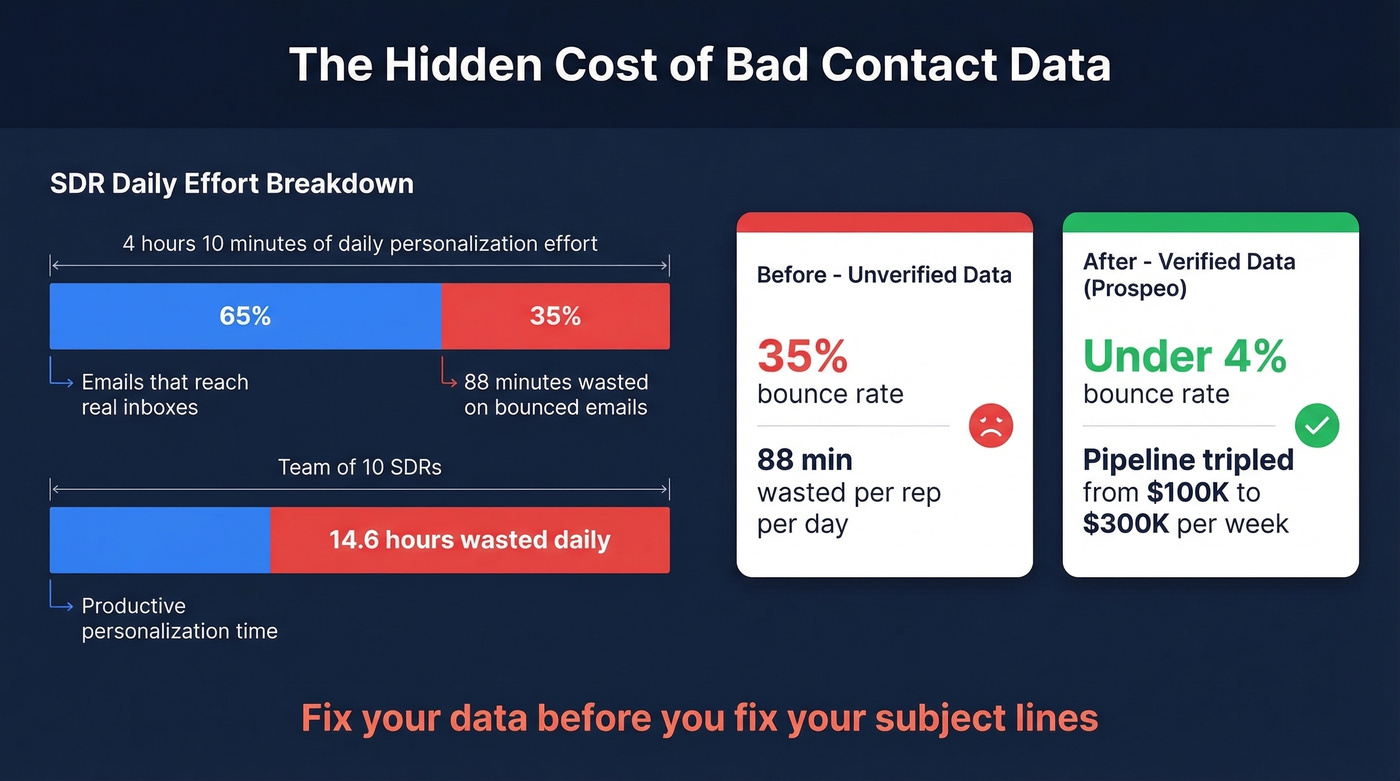
Unverified email lists bounce at 35-40% rates. That means more than a third of your carefully personalized messages never reach anyone. Worse, those bounces damage your domain reputation, which tanks deliverability for the emails that should have landed. It's a compounding problem that gets uglier every week you ignore it.
The math on wasted effort is brutal. If an SDR spends 5 minutes personalizing each email and sends 50 per day, that's about 4 hours and 10 minutes of work. At a 35% bounce rate, roughly 88 minutes of that day is completely wasted - gone, irrecoverable, spent crafting messages for inboxes that don't exist. Scale that across a team of 10 reps and you're burning about 14.6 hours of personalization effort daily on messages nobody will ever see.
Before you personalize a single email, verify your list. Prospeo delivers 98% email accuracy, direct dials with a 30% pickup rate, and contacts refreshed every 7 days - so your personalized message actually reaches a real person at the right company. Meritt saw bounce rates drop from 35% to under 4% after switching, and their pipeline tripled from $100K to $300K per week.
Layering Intent on Top of Clean Data
Clean contact data is the floor. The ceiling is combining verified contacts with buyer intent signals - tracking 15,000 topics via Bombora so you can filter for accounts actively researching your category before your reps spend a minute personalizing. That means every email your team writes goes to someone who's already in-market, not someone who might be interested someday.
The r/sales community talks about this constantly: reps complain about low reply rates while admitting they've never audited their contact data. Skip the subject line A/B tests if your bounce rate is above 5%. Fix the foundation first.

You're burning hours personalizing emails to inboxes that don't exist. Prospeo delivers 98% email accuracy, 30% mobile pickup rates, and a 7-day data refresh cycle - so every minute your reps spend personalizing actually reaches a real buyer.
Stop personalizing emails that bounce. Start with data that connects.
Personalized Outreach by Channel
Email: Reference a specific signal in your opening line - a funding round, a job change, an intent signal. Skip the "I noticed your company does X" opener that every SDR uses. Lead with the trigger, connect it to a problem, and make the ask specific.
Phone: You've got 10 seconds before they decide whether to hang up. Open with a trigger event: "I saw you just joined [Company] as VP of Sales - teams making that transition usually run into [problem]. That's why I'm calling." The trigger event matters more than any personality-matching tool.
Social: Engage with their content before you pitch. Comment on something specific they posted - not "Great post!" but a real reaction to a real point. When you eventually DM or connect, you're not a stranger. You're someone who's been adding value in their feed for two weeks. Across all three channels, the principle is the same: lead with a relevant trigger, not a generic compliment.
Measuring Personalization ROI
Track these metrics to know if your personalized outreach is working:
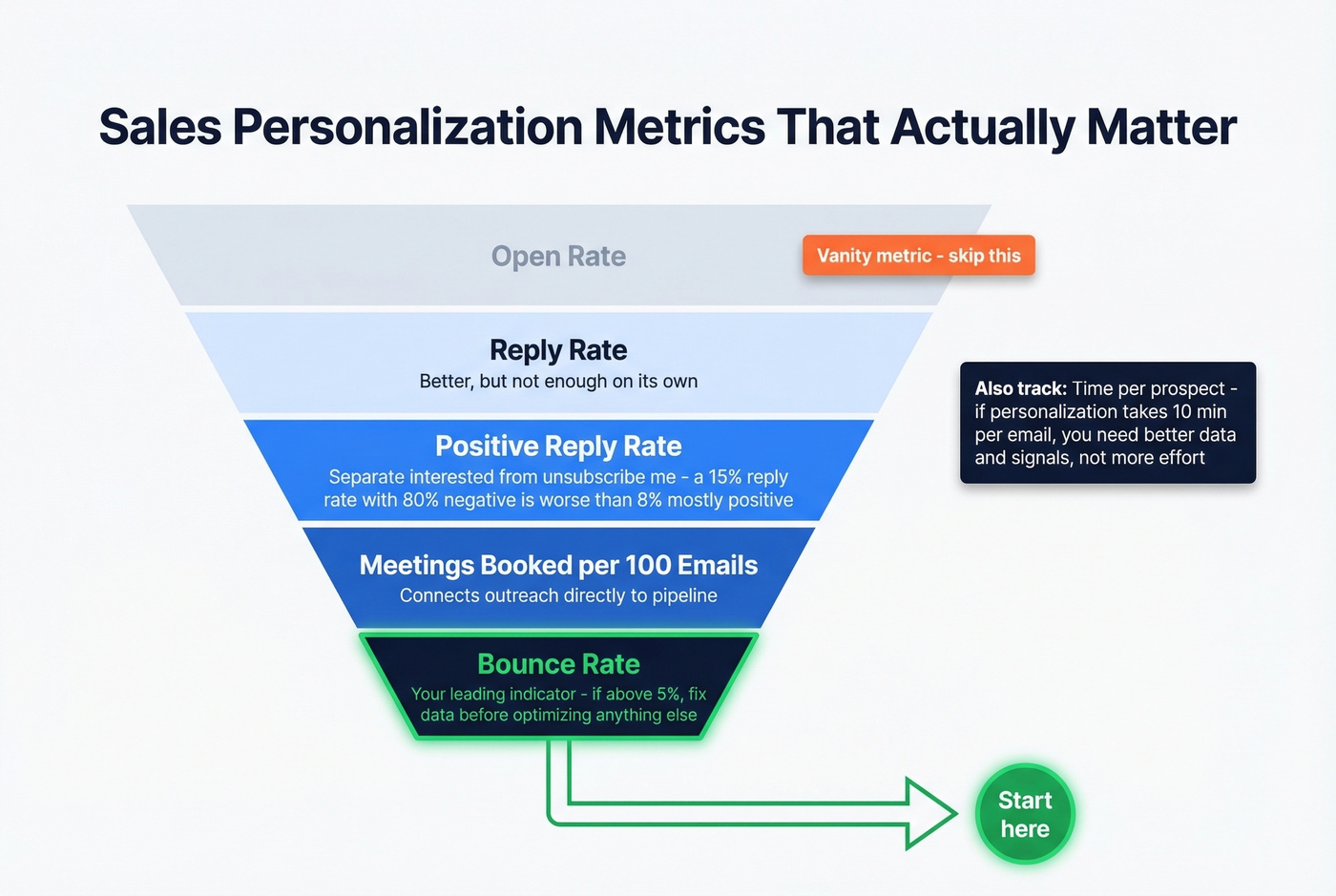
- Reply rate (not open rate) - opens are vanity; replies are pipeline.
- Positive reply rate - separate "interested" from "unsubscribe me." A 15% reply rate with 80% negative replies is worse than 8% with mostly positive.
- Meetings booked per 100 emails - the metric that connects outreach to revenue.
- Bounce rate - your leading indicator. If you're above 5%, fix your data before you optimize subject lines.
- Time per prospect - if personalization takes 10 minutes per email, you need better data and signals, not more effort.
In our experience, the pattern is always the same: teams obsess over subject lines while a third of their emails bounce. Snyk's 50 AEs were spending 4-6 hours per week prospecting with 35-40% bounce rates. After fixing their data foundation, AE-sourced pipeline jumped 180% and they generated 200+ new opportunities per month. The personalized outreach didn't change. The data did.
Fix Your Data First
If you're going to invest in one thing to improve sales personalization in 2026, invest in your data. Verified emails, direct dials, and intent signals will do more for your reply rates than any copywriting framework or AI writing tool. Get the foundation right, and the personalization practically writes itself.
If you want to go deeper on the operational side, start with email deliverability, email bounce rate, and lead enrichment.
Layer intent data on top of verified contacts and your reps only personalize for accounts actively in-market. Prospeo tracks 15,000 buyer intent topics via Bombora, pairs them with 98% accurate emails, and costs roughly $0.01 per lead - 90% less than ZoomInfo.
Personalize for buyers already researching your category, not cold strangers.