

Sales Pipeline Stages Template: Define Your Stages Before You Download Anything
You've downloaded three pipeline templates this month. They're all sitting unused because nobody told you what "Qualification" actually means for your deals. The average B2B deal now involves 13 decision-makers, 80% of buyer interactions happen digitally, and teams are still arguing on Reddit about whether pipeline stages should track verifiable events or abstract buyer phases. A sales pipeline stages template isn't the problem - it's that you skipped the strategy that makes any template useful.
What You Need First
Most templates hand you column headers and call it done. You need three things before touching a spreadsheet:
- Stage definitions with exit criteria. A deal can't advance until a verifiable action happens. If you can't define the exit criteria for a stage, that stage shouldn't exist.
- 5-7 stages. Fewer than 5 hides where deals stall. More than 7 creates friction reps skip.
- Win probability defaults. These power your weighted pipeline forecast - without them, your "pipeline value" is a vanity metric.
Define these, map a qualification framework (BANT or MEDDIC) to your stage gates, set time-in-stage thresholds. Then build or download a template.
The 7-Stage Pipeline Framework
Companies with strong pipeline management grow 28% faster than competitors. That growth doesn't come from having stages. It comes from having the right stages with clear probability assignments.
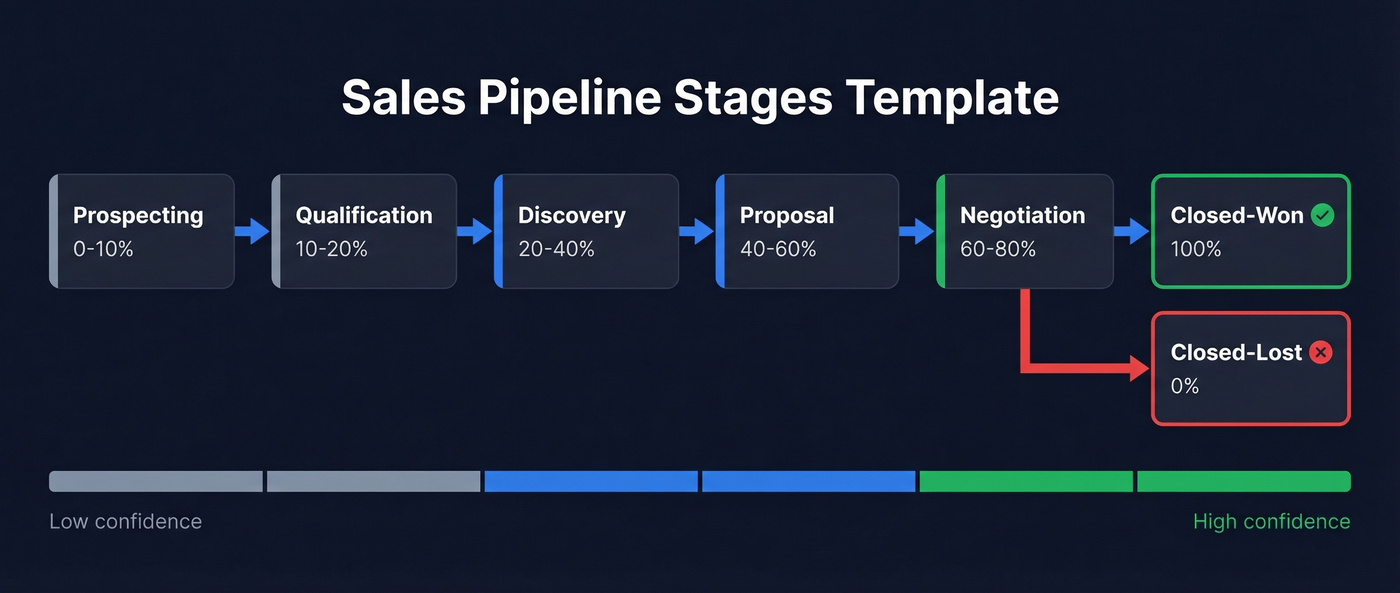
| Stage | What Happens | Win Probability |
|---|---|---|
| Prospecting | Identifying and reaching potential buyers | 0-10% |
| Qualification | Confirming fit: budget, authority, need, timing | 10-20% |
| Discovery | Deep needs analysis, stakeholder mapping | 20-40% |
| Proposal | Solution presentation, pricing shared | 40-60% |
| Negotiation | Terms, objections, contract review | 60-80% |
| Closed-Won | Deal signed | 100% |
| Closed-Lost | Deal dead - log the reason | 0% |
Some teams run leaner. MSPs often start with just four stages (contact, qualify, negotiate, close), and that's fine for transactional motions. But for most B2B teams, seven stages give you enough granularity to diagnose where deals die without creating busywork.
Adapt Stages to Your Industry
The seven-stage framework is a starting point, not gospel. SaaS teams often insert a Demo/Trial stage between Discovery and Proposal to get clearer visibility into evaluation. Real estate pipelines need a Showing/Tour stage. Insurance teams need Underwriting Review before anything closes.
Here's the rule: if your industry has a step where deals routinely die, that step deserves its own stage. The same logic applies to any customer pipeline template - tailor the stages to reflect the actual journey your buyers take, not a generic flowchart someone pulled from a textbook.
Exit Criteria Checklist by Stage
This is the section most pipeline articles skip, and it's the one that actually matters. A common frustration on r/sales is the tension between "event-based" stages (demo complete, trial started) and more conceptual ones (education, discovery). The answer is both: name stages by buyer progress, but define exit criteria around verifiable events so your CRM automation still works.
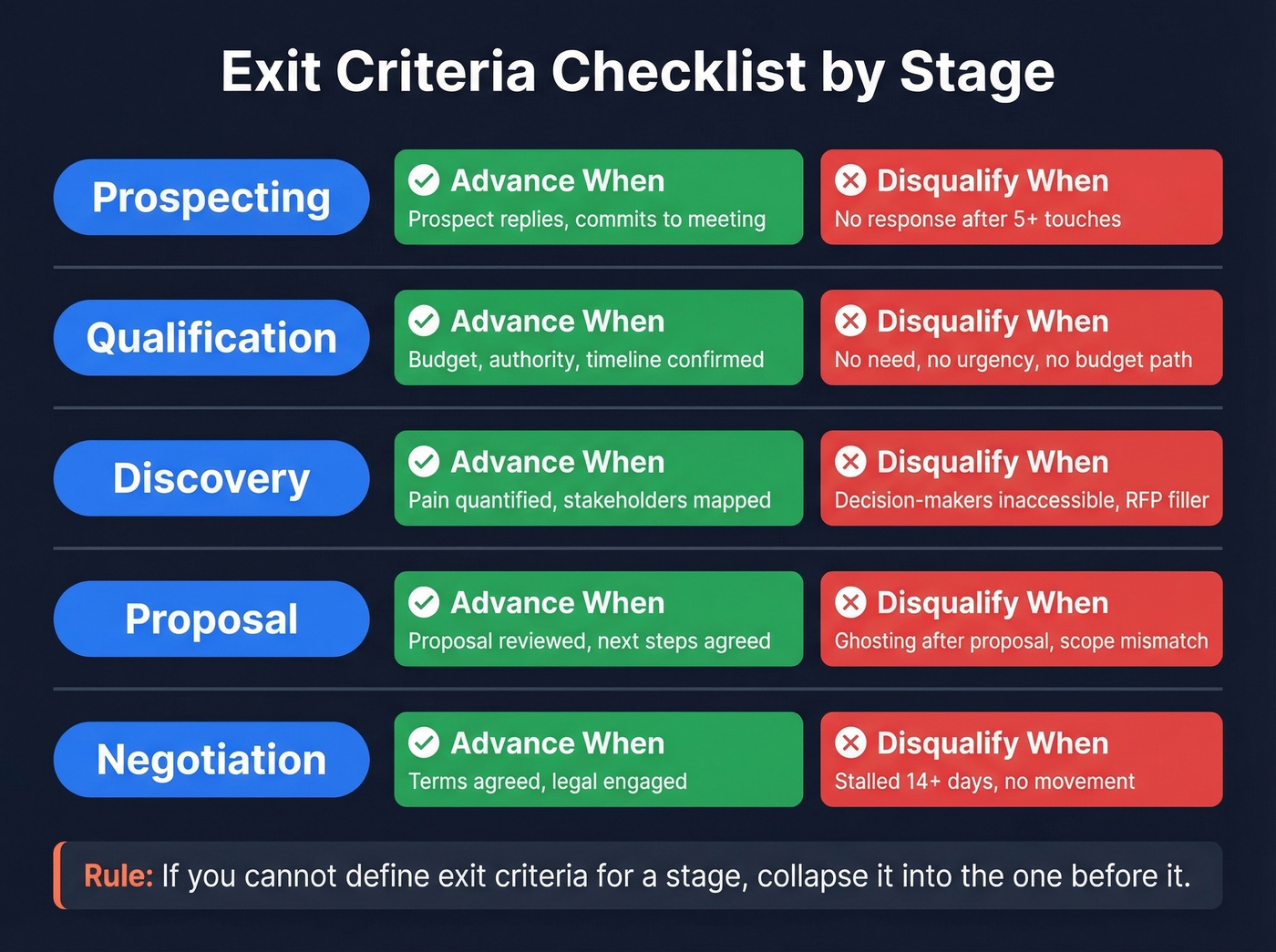
| Stage | Advance When... | Disqualify When... |
|---|---|---|
| Prospecting | Prospect replies, commits to meeting | No response after 5+ touches |
| Qualification | Budget, authority, timeline confirmed | No need, no urgency, no budget path |
| Discovery | Pain quantified, stakeholders mapped, competitors identified | Decision-makers inaccessible, RFP filler |
| Proposal | Proposal reviewed, next steps agreed | Ghosting after proposal, scope mismatch |
| Negotiation | Terms agreed, legal engaged | Stalled 14+ days, no movement |
| Closed-Won | Signature received | - |
| Closed-Lost | - | Lost reason logged in CRM |
If you can't define the exit criteria for a stage, collapse it into the one before it. We've rebuilt pipelines for teams that had 12 stages - half of them were just renamed versions of Discovery. Every stage earns its place by producing a signal your team can act on.
Match Your Framework to Your Stages
Use BANT if you're running SMB or transactional sales. It's fast, it filters, and it keeps reps from wasting time on unqualified leads. Budget, Authority, Need, Timeline - check the boxes, move on.
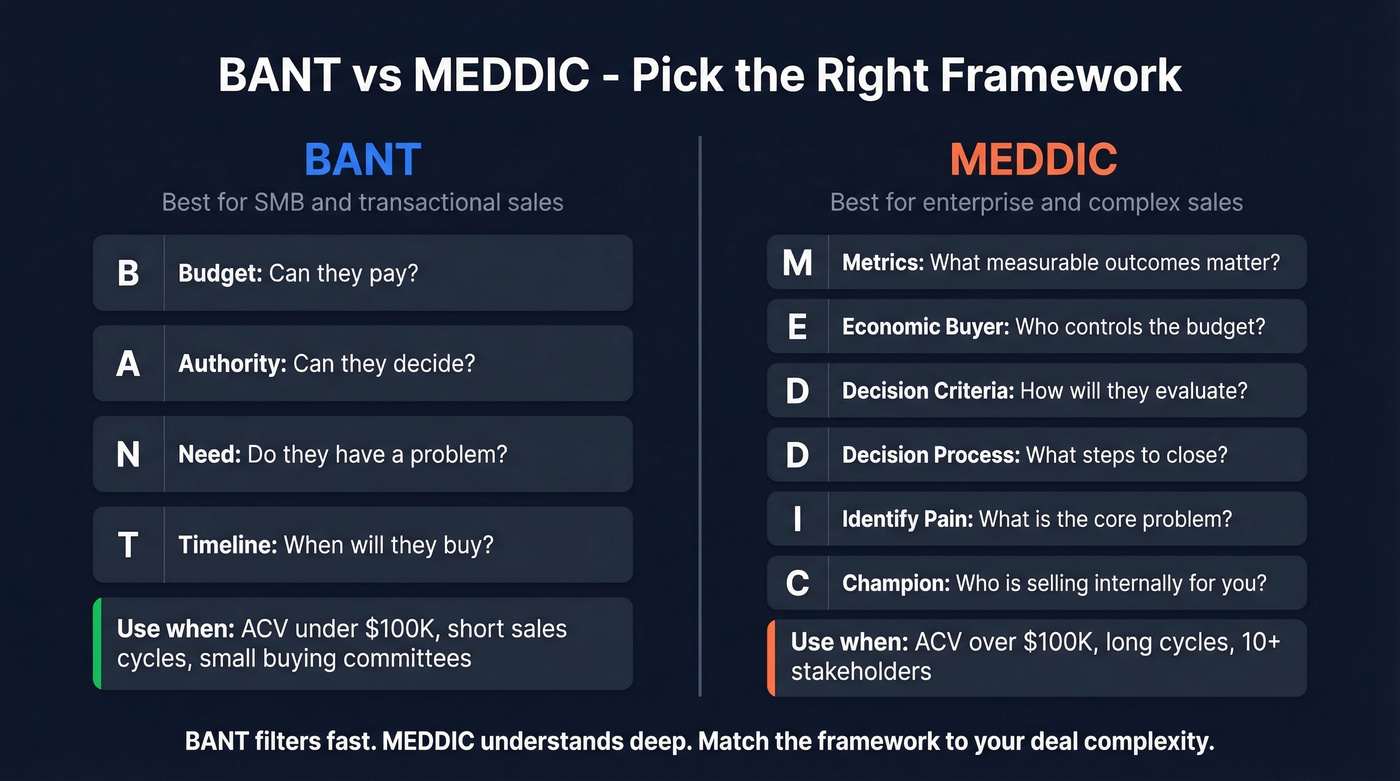
Use MEDDIC if you're selling six-figure enterprise deals. As Sybill frames it, BANT filters while MEDDIC understands. For complex sales, require Metrics + Economic Buyer + Pain + Champion confirmed before a deal advances past Qualification. Skip this gate and you'll burn weeks on deals that were never real.
Let's be honest: using BANT for enterprise is like using a checklist to navigate a maze. If your average contract value clears $100K and your buying committee has double-digit stakeholders, BANT will miss half the dynamics that kill your deals.

Your pipeline stages mean nothing if Prospecting is filled with bad contacts. Prospeo gives you 300M+ profiles with 98% verified email accuracy and 125M+ direct dials - so deals entering Stage 1 actually convert. At $0.01 per email, you stop feeding garbage into a framework you spent weeks building.
Build the pipeline. We'll fill the top of it with contacts that convert.
Conversion and Cycle Time Benchmarks
You need benchmarks to know if your pipeline is healthy or just full. Here's what MarketJoy's aggregated data shows for stage-to-stage conversion:
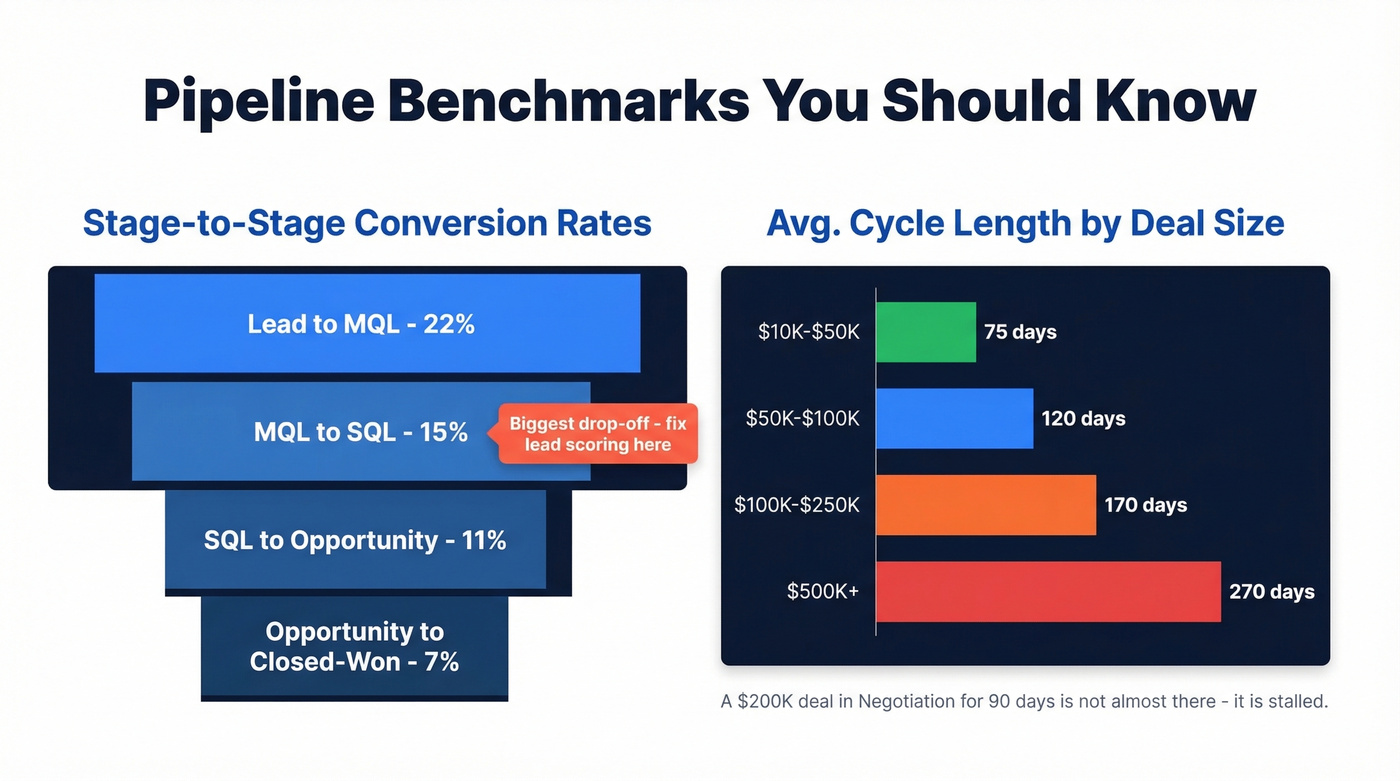
| Stage Transition | Avg. Conversion |
|---|---|
| Lead to MQL | 22% |
| MQL to SQL | 15% |
| SQL to Opportunity | 11% |
| Opportunity to Closed-Won | 7% |
The biggest drop-off is MQL to SQL. That's where marketing's definition of "qualified" collides with sales reality. If your MQL-to-SQL rate is below 10%, your lead scoring model needs surgery - not more leads.
These averages mask significant industry variation, so benchmark against your vertical, not the aggregate. First Page Sage's 2017-2025 dataset shows IT and Managed Services at 19% Lead-to-MQL, 38% MQL-to-SQL, 41% SQL-to-Opportunity, and 46% SQL-to-Closed-Won - wildly different from the averages above.
Now layer in cycle time by deal size, per Focus Digital's benchmarks:
| ACV Range | Avg. Cycle Length |
|---|---|
| $10k-$50k | 75 days |
| $50k-$100k | 120 days |
| $100k-$250k | 170 days |
| $500k+ | 270 days |
Use these to set expected close dates in your template. A $200k deal that's been in Negotiation for 90 days isn't "almost there" - it's stalled.
Weighted Pipeline Forecasting
Your forecast says $500K. Your weighted pipeline says $180K. Which one do you trust?
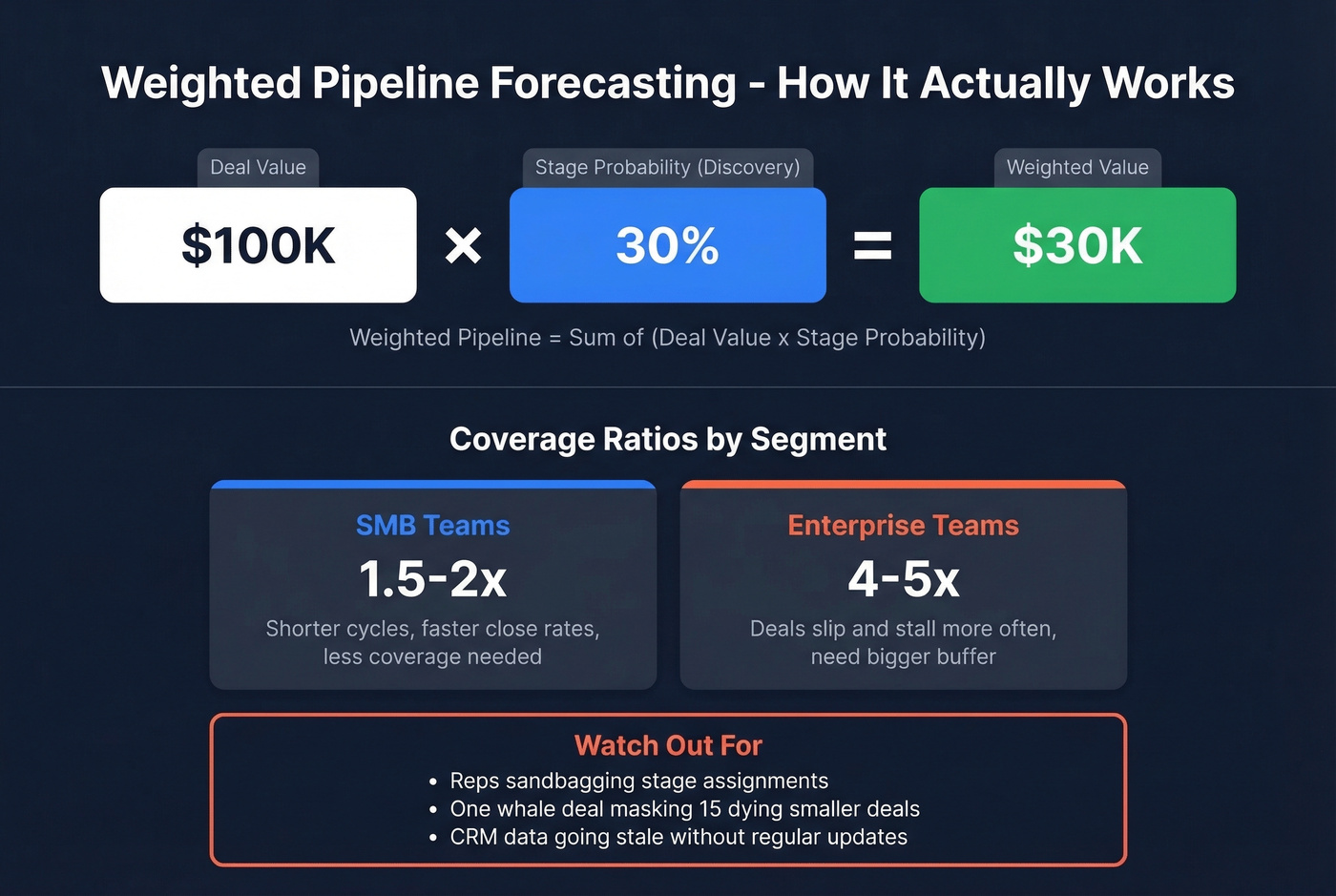
The formula is straightforward: Weighted Pipeline = Sum of (Deal Value x Stage Probability). A $100K deal in Discovery at 30% probability contributes $30K to your weighted forecast. That's the number your CFO should care about.
Coverage ratios matter here. SMB teams with shorter cycles can operate at 1.5-2x coverage (weighted pipeline vs. remaining quota). Enterprise teams need 4-5x because deals slip, stall, and die at higher rates.
Weighted forecasting breaks when reps sandbag stage assignments, CRM data goes stale, or one whale deal skews everything. We've seen teams where a single $500K deal in Negotiation made the forecast look healthy while 15 smaller deals were quietly dying in Discovery. The fix was embarrassingly simple: separate "committed" deals from "best case" deals in the forecast view. Most teams skip this, and it costs them a quarter of accurate planning.
Building Your Template
Start in Google Sheets. Real-time collaboration beats emailing Excel files, and for teams managing fewer than 100 leads, a spreadsheet works fine. Structure it with five tabs: People, Companies, Opportunities, Interactions, and Dashboard. For the Dashboard tab, use INDEX/MATCH formulas to pull stage counts and weighted values from Opportunities - pivot tables work too, but INDEX/MATCH gives you more control over layout. Early-stage companies looking for a sales pipeline template for startups should start here rather than paying for tools they'll outgrow in six months.
Your Opportunities tab needs these columns at minimum: deal name, stage, deal value, probability, weighted value, expected close date, days in stage, next action, and owner. Add a conditional formatting rule that flags any deal sitting in one stage for 14+ days. That single rule will surface more pipeline problems than any weekly review meeting.
When spreadsheet fatigue hits - and it will around deal #80 - upgrade to a lightweight CRM. Pipedrive starts around $15-$30/user/mo depending on plan. HubSpot's free tier handles basic pipeline tracking. Most CRMs let you import a pipeline template directly, so the stage definitions and exit criteria you've already built transfer cleanly. Don't overthink the tool choice; overthink the stage definitions you bring into it (and compare a few examples of a CRM if you're unsure).
One thing we've learned the hard way: your prospecting stage is only as good as the contacts in it. If your emails bounce, every downstream metric is fiction. Tools like Prospeo verify emails before they enter your pipeline (98% accuracy across 143M+ verified addresses), which means your conversion benchmarks actually reflect reality instead of bounced-email noise. If bounce rates are creeping up, use email bounce rate benchmarks to spot the problem early.

Your MQL-to-SQL drop-off isn't a scoring problem - it's a data problem. Prospeo's 30+ filters (buyer intent, technographics, headcount growth, funding) let you qualify before the first touch. Teams using Prospeo book 35% more meetings than Apollo users because every lead enters the pipeline pre-filtered.
Stop qualifying dead leads. Start with prospects who already fit your stages.
Common Pipeline Mistakes
Four mistakes kill more pipelines than bad templates.
Inconsistent prospecting is the silent killer. Reps focus on late-stage deals and let the top of the funnel dry up. By the time they notice, it's a quarter too late. The fix isn't motivation - it's blocking prospecting time on the calendar and treating it like a non-negotiable meeting (use a few proven sales prospecting techniques to keep activity consistent).
Poor qualification is the expensive one. Every deal that shouldn't be in your pipeline distorts your forecast and wastes rep time. Disqualify faster. In our experience, teams that add strict exit criteria to their Qualification stage cut their average cycle time by 20-30% within a quarter - not because deals move faster, but because dead deals stop dragging down the average. If you sell enterprise, tighten this with a proper MEDDIC sales qualification gate.
Letting leads go cold is the most preventable. A prospect who was interested three weeks ago isn't interested anymore. Set follow-up SLAs by stage: 48 hours in Discovery, 72 hours in Proposal, daily during Negotiation. If reps struggle to stay consistent, standardize your outreach with sales follow-up templates.
Keeping dead deals is the most common. Stagnant opportunities inflate your pipeline and make leadership think you're healthier than you are. Run a weekly review and kill anything that hasn't moved in 14 days without a documented reason. If that feels aggressive, good. A lean pipeline that reflects reality beats a bloated one that makes everyone feel comfortable until the quarter ends.
FAQ
How many stages should a sales pipeline have?
Most B2B teams perform best with 5-7 stages. Fewer than 5 hides where deals stall; more than 7 creates friction reps skip. Start with 7, then collapse any stage that doesn't generate actionable data after 90 days of use.
What's the difference between a pipeline and a funnel?
A pipeline tracks individual deals through stages you control - qualification, proposal, negotiation. A funnel measures aggregate conversion rates across marketing and sales. Pipeline is your deal-level view; funnel is your volume-level view. Most teams need both.
How do I fill the top of my pipeline with verified contacts?
Use a B2B data platform to source verified emails and direct dials before adding contacts to your prospecting stage. Bad data at the top corrupts every downstream metric - bounce rates above 5% tank deliverability and skew your stage conversion numbers.
Can I use a spreadsheet instead of a CRM?
Yes - for teams with fewer than 100 active deals, a Google Sheets pipeline template with stage columns, probability defaults, and a weighted forecast formula works well. Once you're managing 100+ opportunities or need automation triggers, migrate to a CRM like HubSpot or Pipedrive.