

Common Sales Pitch Objections (And How to Handle Every One)
Your prospect just heard your pitch and said "we're happy with our current provider" - for the third time today. You're staring at your script sheet wondering which canned response to try next. Here's the thing: you don't need more scripts. You need a framework and better targeting.
Why Objections Hit Harder in 2026
You've probably read a dozen articles that say "acknowledge the concern and pivot to value." Great. What does that actually sound like when a CFO says "we already allocated that budget to Salesforce licenses"?
Generic advice doesn't cut it anymore. There are 7.4 decision-makers involved in a typical B2B purchase. 96% of prospects research your company before they'll take a call. And 81% of revenue leaders say deals are more complex than ever, per Gong's research on deal complexity. The old playbook of "handle the objection, push for the close" doesn't work when seven people all need to say yes.
Objections vs. Obstructions
Before you respond, figure out what you're actually dealing with.
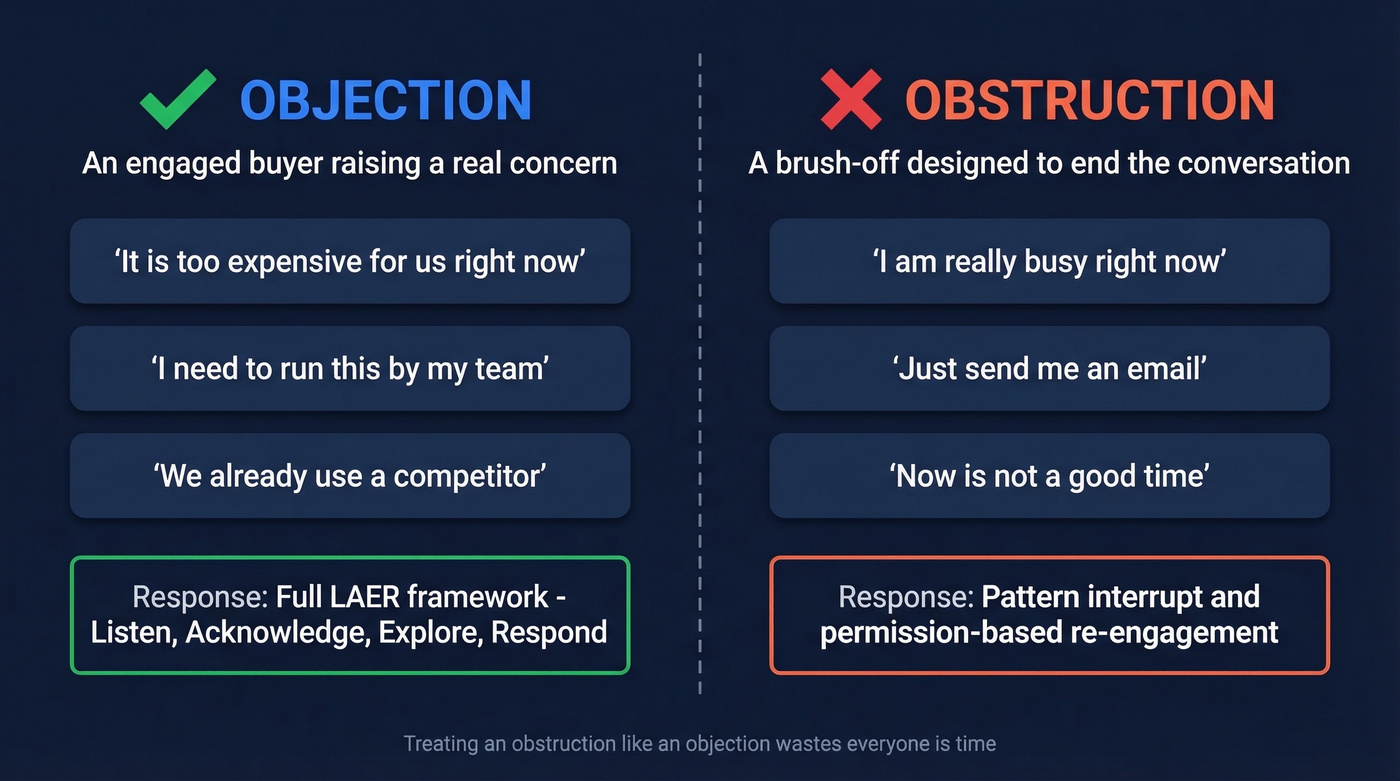
An objection is an engaged buyer raising a real concern - budget, timing, authority. That's a door cracking open. An obstruction is a brush-off designed to end the conversation: "I'm really busy right now," "just send me an email."
Objections deserve the full LAER treatment. Obstructions need pattern interrupts and permission-based re-engagement. Treating an obstruction like an objection wastes everyone's time, and we've watched reps burn 20 minutes trying to "overcome" what was really just a polite hang-up.
5 Mistakes That Make Objections Worse
1. Believing the first objection is real. The stated concern almost always masks something deeper - usually fear of change or internal politics. As sales coach Marcin Pienkowski puts it, the first objection is rarely the real one.
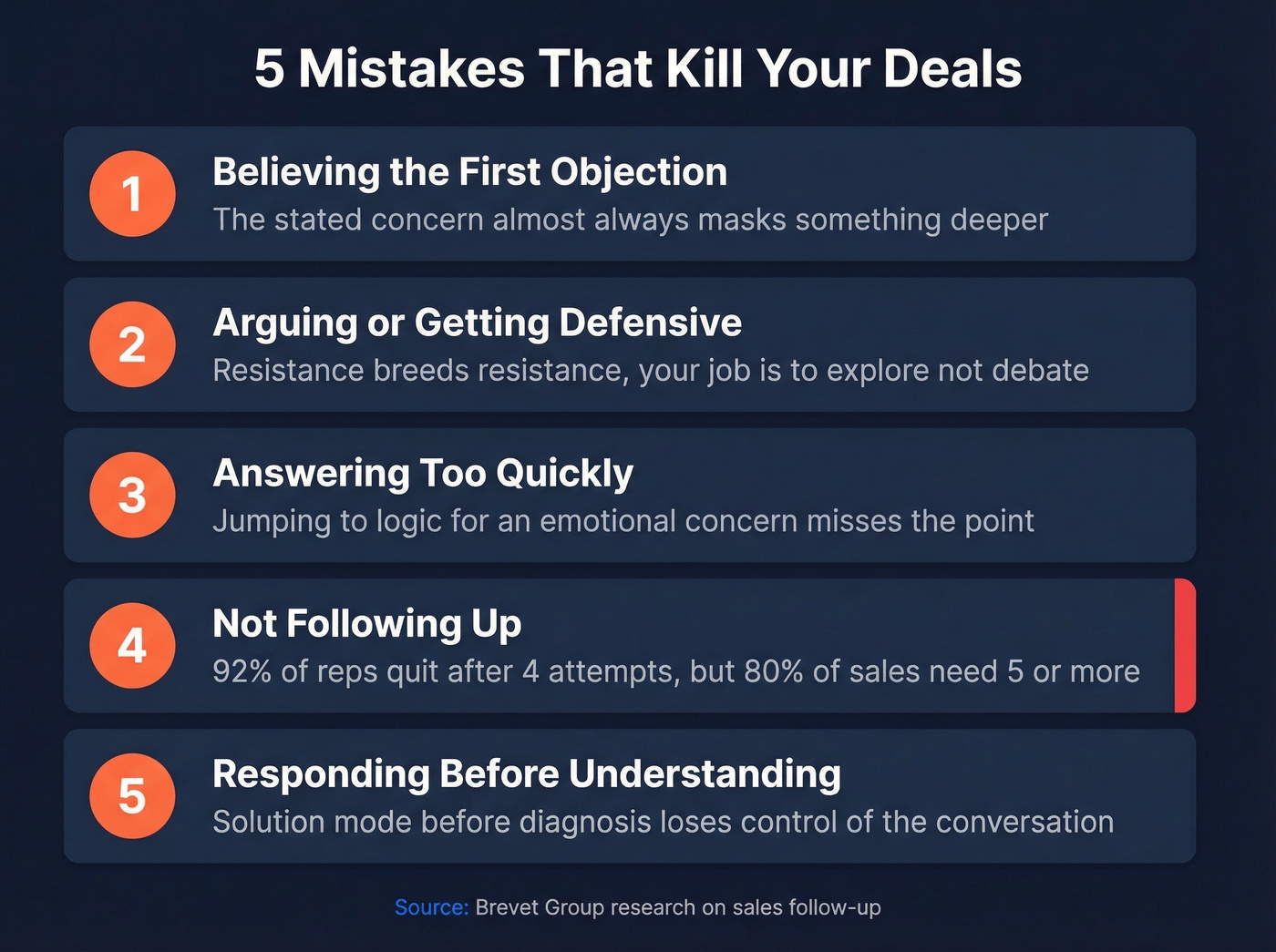
2. Arguing or getting defensive. The moment you push back, the prospect digs in harder. Resistance breeds resistance. Your job is to explore, not debate. This applies to discounting too - offering a price cut too early devalues your product and erodes your margins before you've even understood the real blocker.
3. Answering too quickly. Objections are often emotional - fear of making the wrong decision, fear of change - not logical. Jumping to a logical answer for an emotional concern misses the point entirely.
4. Not following up. 80% of sales require 5+ follow-ups, yet 92% of reps quit after four. We've seen it repeatedly: deals die not because the prospect said no, but because the rep stopped asking. (If you need a system, steal these follow-ups.)
5. Responding before you understand. The fastest way to lose control of a conversation is to jump straight into "solution mode" before you've diagnosed what's actually behind the pushback.

The #1 reason objections kill deals? You're pitching the wrong person. Prospeo's 30+ filters - including job title, seniority, department headcount, and buyer intent signals - put you in front of actual decision-makers, not gatekeepers who "need to run this by their team."
Stop rehearsing rebuttals for people who can't sign the contract.
The LAER Framework
If you learn one framework, make it LAER. It's simple enough to use on a live call and forces you to diagnose before you prescribe. (Full breakdown: The LAER Framework.)
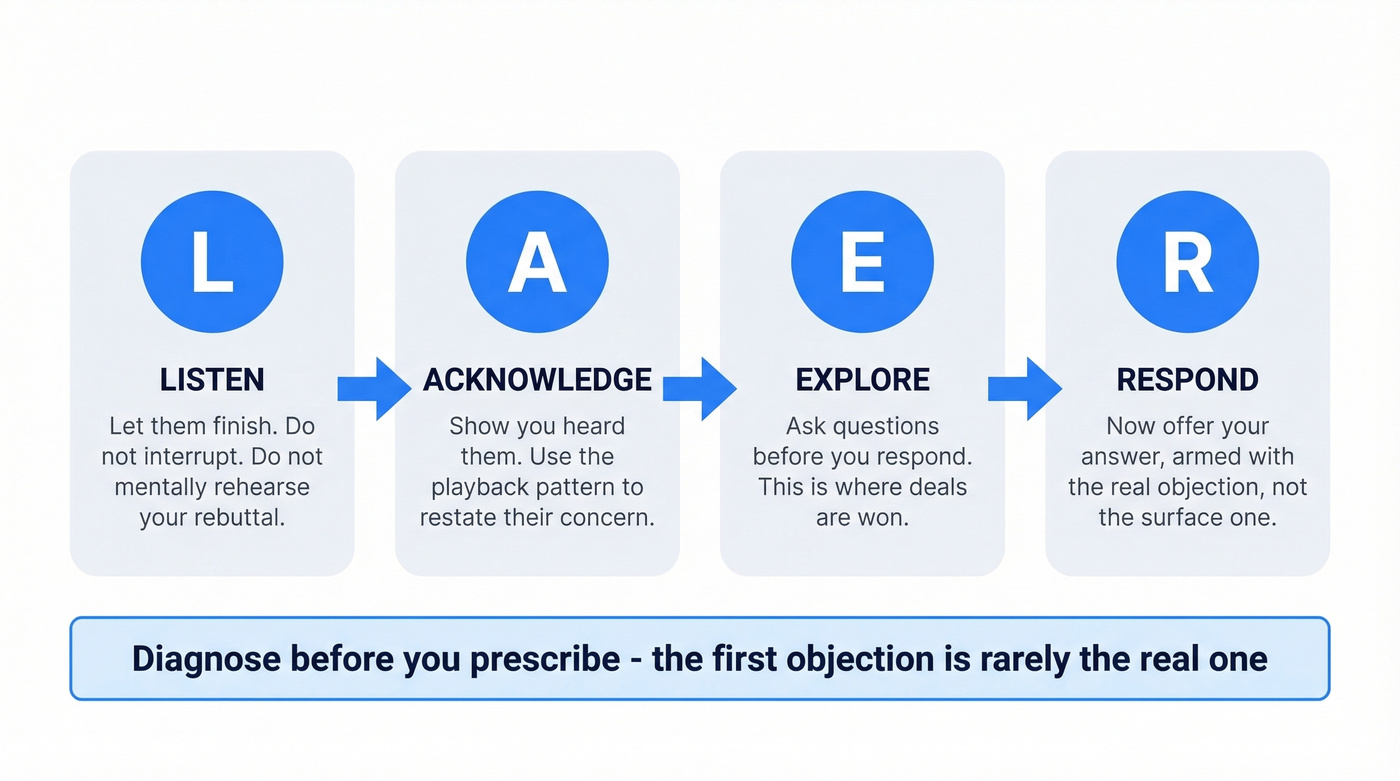
Listen - Let them finish. Don't interrupt. Don't mentally rehearse your rebuttal while they're talking.
Acknowledge - Show you heard them: "I often hear that..." or "That makes sense." Use the playback pattern: "So if I can play that back - [restate their concern]. Did I get that right?"
Explore - Ask questions before you respond: "Which aspect concerns you most?" or "Can you tell me more about that?" This is the hard part, and it's where deals are won. (More prompts: discovery questions.)
Respond - Only now do you offer your answer, armed with the real objection instead of the surface one.
Let's make this concrete. A VC-backed founder I know almost lost a six-figure deal when a CTO said "we can't implement this." Instead of pitching harder, he explored the concern and discovered it was a minor integration issue, not a fundamental objection. Resolved in one follow-up call. The difference between losing $120K and closing it was one question.
12 Rebuttals for Common Sales Pitch Objections
Three objections you'll hear constantly: "not right now," "we already use someone," and "I need to run this by my team." Master these three and you'll close more than the rep who memorizes 50 scripts. (If you want more structure, build a repeatable cold calling system.)
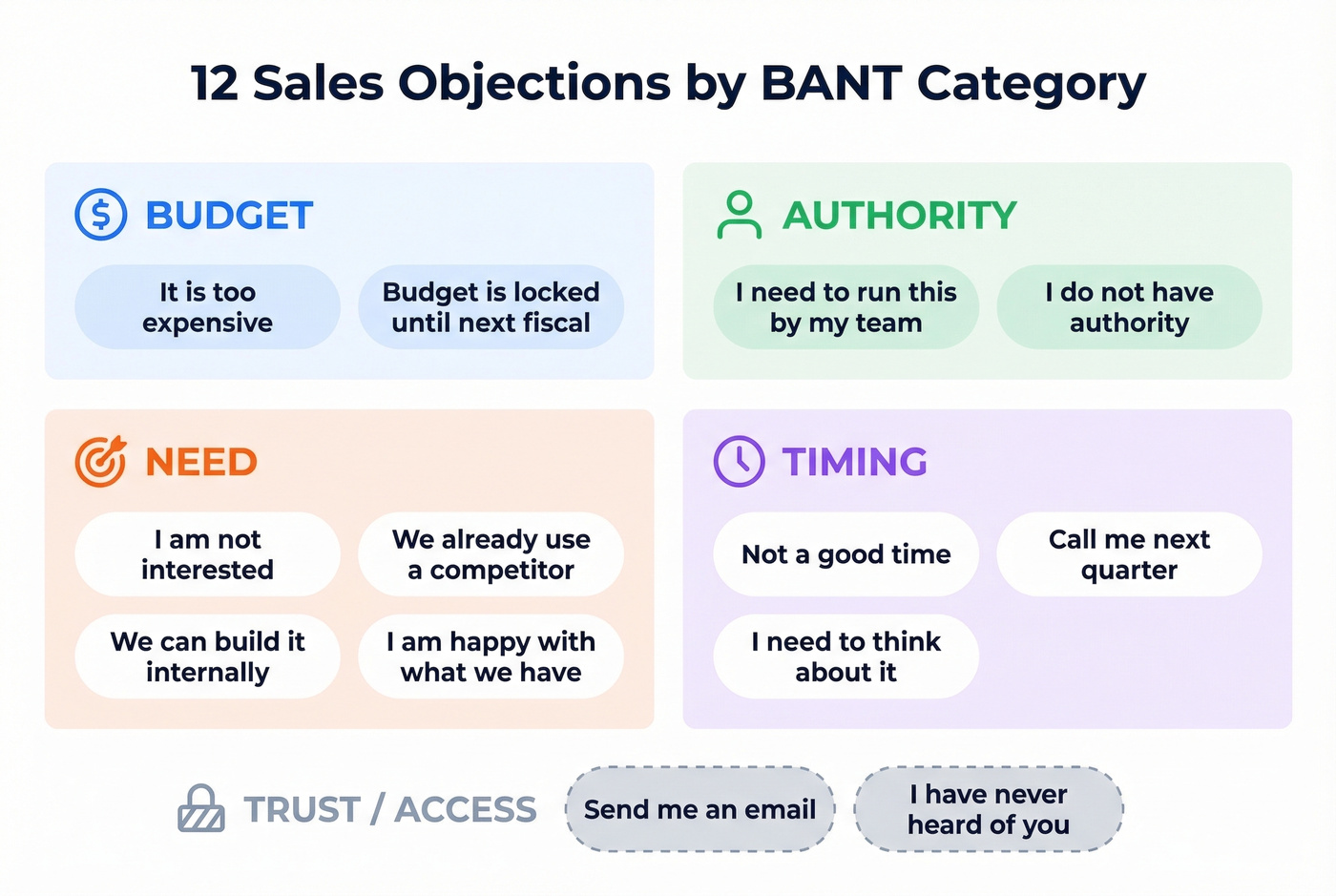
We've organized these by BANT category so you can jump to the type you're hearing most.
Budget
| Objection | What It Really Means | Response | Follow-Up Question |
|---|---|---|---|
| "It's too expensive" | They don't see the ROI yet | "Let's map the cost of not solving this - what's the impact per quarter?" | "What would the ROI need to look like?" |
| "Budget is locked until next fiscal" | They need internal ammunition | "If this backlog compounds like it has, we're talking about 300+ hours lost by next fiscal - is there a process for surfacing that kind of operational risk to leadership now, or should we map out the cost together so you're ready when it comes up?" | "Who controls discretionary spend for urgent items?" |
That second response comes from an r/sales objection challenge thread - it works because it reframes budget as business risk, not a spending request. In SaaS, remember that budget can come from multiple sources: a champion's discretionary fund, a VP's unallocated line item, or by replacing a failing tool.
Authority
| Objection | What It Really Means | Response | Follow-Up Question |
|---|---|---|---|
| "I need to run this by my team" | They're not the decision-maker, or they're hedging | "Absolutely - what would make this easy for you to present internally?" | "Who else would weigh in, and what are their biggest concerns?" |
| "I don't have authority" | You're talking to the wrong person | "Fair enough - who's the right person, and would it help if I put together a one-pager for them?" | "What does their evaluation process usually look like?" |
Need
| Objection | What It Really Means | Response | Follow-Up Question |
|---|---|---|---|
| "I'm not interested" | You haven't earned their attention yet | "You're free to say no. Can I ask one question about how you're handling [specific pain]?" | Let their answer guide you. |
| "We already use [competitor]" | Switching cost feels high | "How's that working - specifically on [area where you differentiate]?" | "If you could change one thing about your current setup, what would it be?" |
| "We can build it internally" | They underestimate the cost | "A lot of teams start there - the 3-year total cost usually surprises people once you factor in engineering time and maintenance." | "What's your engineering team's current bandwidth?" |
| "I'm happy with what we have" | Status quo bias | "Most of our customers were too, until they saw the gap in [specific metric]." | "When did you last benchmark against alternatives?" |
Timing
In our experience, timing objections are the hardest to diagnose because they sound reasonable even when they're pure brush-off.
"Not a good time" - Ask directly: "Is this a 'not this week' or a 'not this year' situation?" The answer tells you everything. If they say "not this week," book the follow-up. If they fumble, it's a polite no - name it so neither of you wastes time.
"Call me next quarter" - Push gently: "Happy to. What specifically would change next quarter that would make this a better conversation?" If they can't answer, they're hoping you'll forget. You won't - because you'll follow up with new value, not the same pitch.
"I need to think about it" - Something specific is holding them back. Ask: "What's the main thing you'd want to get comfortable with?" Then stay silent. Let them fill the space.
Trust / Access
"Send me an email" is almost always an obstruction, not an objection. Don't treat it like a real request. Say: "I will - before I do, can I ask one quick question so I send you something actually relevant?" Then pivot to a single qualifying question. If they engage, you've earned another 30 seconds. If they don't, move on. (If you're getting ignored, fix your sales communication across channels.)
"I've never heard of you" is actually an engagement signal - they're telling you what they need to move forward. Give it to them: "We work with [2-3 recognizable customers in their space]. Here's what changed for them." Then ask: "What would you need to see to feel confident?"
SaaS-Specific Objections
Those 12 cover general B2B conversations. SaaS deals add a few more because you're asking someone to change a workflow, not just buy a product. (More context: SaaS sales.)
Implementation disruption - Acknowledge it's real, then propose a phased rollout or pilot. Get specific: is the worry timeline, bandwidth, or data migration? Vague reassurance kills you here.
Integration concerns - Don't hand-wave. Ask exactly what's in their stack and propose a technical deep-dive. "We integrate with everything" increases skepticism. "Here's our Salesforce and HubSpot integration docs, and we can do a 30-minute technical call with your ops team" builds trust.
Build vs. buy - Compare the 3-year total cost including engineering salaries, maintenance, and opportunity cost. The math almost never favors building, but you need to show the math, not just assert it.
Data portability - Explain export formats, retention policies, and migration support upfront. This objection is really about lock-in fear, and transparency kills it.
Prevent Objections Before They Happen
Look, if your average deal size is under $10K, most objections you're hearing aren't sales problems - they're targeting problems. Fix the targeting and the objections fix themselves. (Start with an ideal customer profile.)
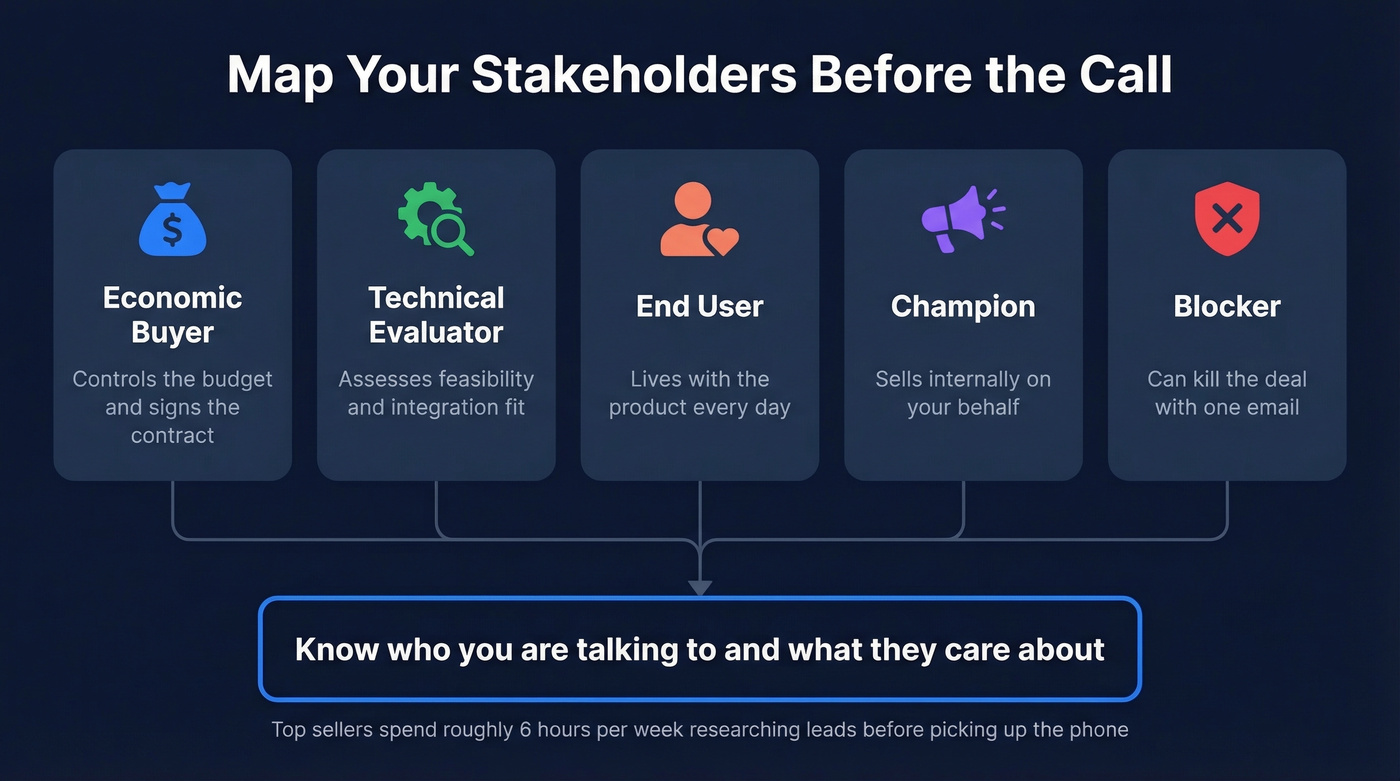
Top sellers spend roughly 6 hours per week researching leads before picking up the phone. That research means stakeholder mapping - identifying the economic buyer who controls budget, the technical evaluator who assesses feasibility, the end user who lives with the product daily, the champion who sells internally on your behalf, and the blocker who can kill the deal with one email. (Related: technical buyer vs economic buyer.)
When you know who you're talking to and what they care about, you anticipate pushback by role before the call starts.
Bad data manufactures objections: wrong person, outdated info, no context. Prospeo's 30+ search filters - including buyer intent across 15,000 topics, job change signals, and headcount growth - let you reach prospects who actually have the problem you solve. With 98% email accuracy and a 7-day data refresh cycle, you're not wasting call blocks on dead leads. (If you're cleaning lists, see email bounce rate.)

"We already use someone" hits different when your emails bounce 35% of the time. Prospeo delivers 98% email accuracy and 125M+ verified mobile numbers so you actually reach the prospect - and get the chance to handle the objection instead of talking to voicemail.
You can't overcome objections from contacts who never see your message.
FAQ
What's the most common sales pitch objection?
"It's too expensive" is widely cited as the most frequent objection, but "not right now" kills more deals in practice - especially in SaaS, where budget cycles create timing mismatches that feel permanent. Diagnose which type you're facing before responding.
How many follow-ups should you send before giving up?
At least five. 80% of sales require 5+ follow-ups, yet 92% of reps quit after four. Space each touchpoint with new value - a relevant case study, a metric, or a stakeholder-specific insight - not the same pitch repackaged.
Can you prevent objections before a sales call?
Yes. Pre-call research eliminates the most common pushback. Stakeholder mapping, intent signals, and verified contact data let you reach the right person with relevant context so you're calling prospects already in-market, not cold leads who default to "not interested."