

Sales Pitch Format: Frameworks, Templates & Data That Close
You've read five pitch articles today. They all said "personalize and tell a story." Great advice - and completely useless when you're staring at a blank email wondering whether to lead with the problem or the product, whether to ask questions or make statements, whether 80 words is too few or 200 is too many.
Those articles didn't tell you which sales pitch format works for your specific deal, channel, and buyer.
Deals that close within 50 days hit a 47% win rate. Drag past that window and you're looking at 20% or worse. Meanwhile, [73% of B2B buyers](https://www.salesforce.com/sales/state-of-sales/sales-statistics/) actively avoid sellers who send irrelevant outreach - and reps already spend 60% of their time on non-selling tasks. A bad pitch structure wastes the 40% that actually matters.
Stop memorizing scripts. Start memorizing frameworks. Scripts break the moment a prospect says something unexpected. Frameworks flex.
The Quick-Reference Cheat Sheet
Before we go deep, here's the summary:
- Outbound (email, DM): PAS (Problem-Agitation-Solution). Under 150 words. One CTA. That's it.
- Live call: SPIN for discovery. Challenger for enterprise meetings where you need to reframe the buyer's thinking.
- Presentation or pitch deck: AIDA structure. Under 18 minutes. Lead with the buyer's problem, not your product.
If you only remember those three rules, you'll outperform most reps who wing it with a generic "just checking in" approach.
What a Sales Pitch Format Actually Is
A pitch format is the structural skeleton of your message - the order in which you present information, not the information itself. The format is the container; the content fills it.
Zendesk frames it well: a pitch should start a conversation, not sell a product. That's a content principle. The format question is different. Do you lead with the problem or the solution? Open with a question or a statement? Build tension or resolve it immediately?
Getting the content right but the structure wrong is like giving a great speech to an empty room.
Six Frameworks and When Each Wins
Find your channel and deal size, then pick the framework.
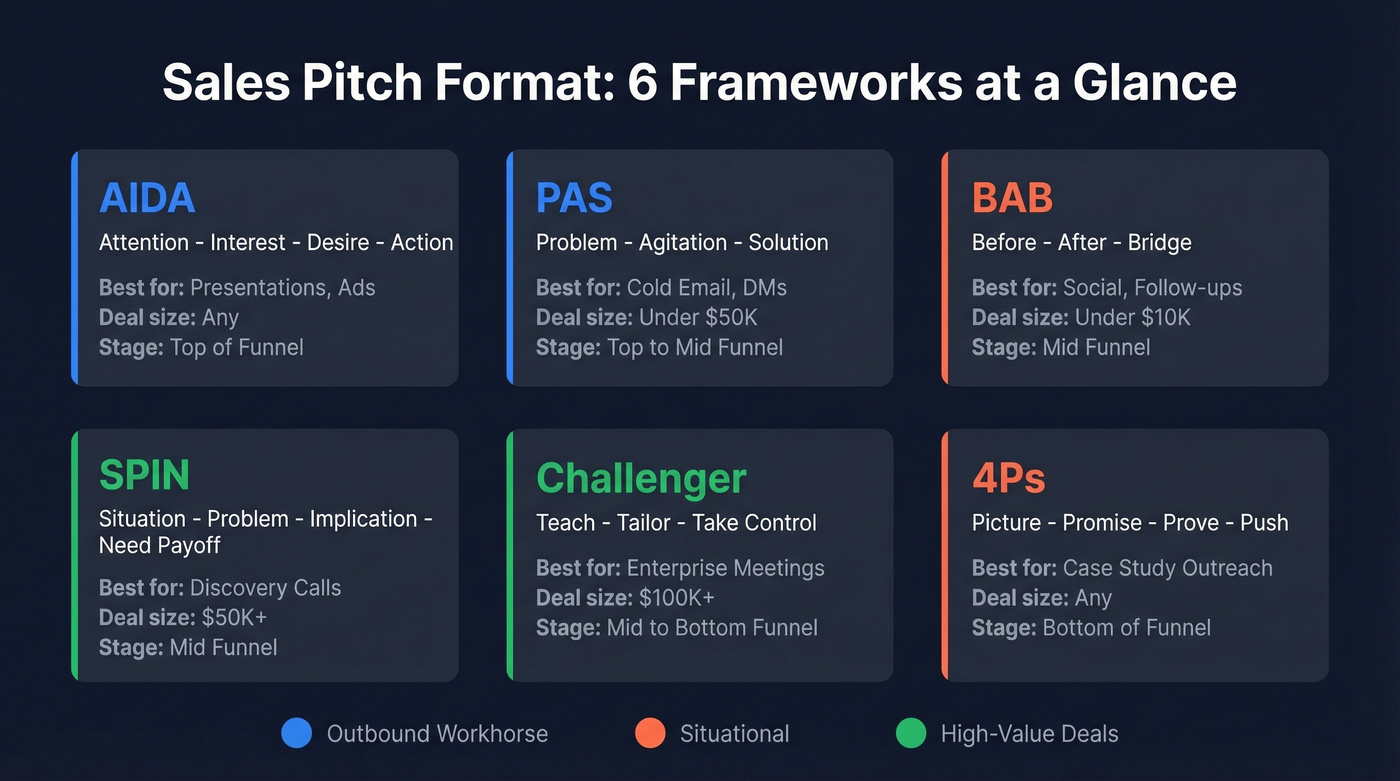
| Framework | Best Channel | Deal Size | Funnel Stage | Seller Role |
|---|---|---|---|---|
| AIDA | Presentations, ads | Any | TOFU | AE, Marketing |
| PAS | Cold email, DMs | <$50K | TOFU-MOFU | SDR |
| BAB | Social, follow-ups | <$10K | MOFU | SDR |
| SPIN | Discovery calls | $50K+ | MOFU | AE |
| Challenger | Enterprise meetings | $100K+ | MOFU-BOFU | AE |
| 4Ps | Case study outreach | Any | BOFU | AE, CS |
AIDA (Attention-Interest-Desire-Action)
The classic persuasion structure and the one most marketers already know - which is exactly why it's overused in cold email, where PAS works better. AIDA shines when you're broadcasting rather than conversing: presentations, landing pages, elevator pitches. Grab attention with a hook, build interest with relevance, create desire with proof, then drive action with a clear CTA. Save it for the stage, not the inbox.
PAS (Problem-Agitation-Solution)
PAS is the most versatile outbound framework we've tested across our own campaigns and client work. Name the problem. Twist the knife by showing what happens if they don't fix it. Then present your solution. It works for cold emails, sales pages, and DMs because it mirrors how buyers actually think - the agitation step is what separates it from generic "we help companies do X" pitches, and it's why PAS emails consistently outperform feature-led openers in A/B tests.
BAB: The 50-Word Workhorse
Most frameworks need room to breathe. BAB (Before-After-Bridge) thrives in tight spaces.
Paint the "before" (current pain), show the "after" (desired state), bridge the gap with your offer. Social posts, quick follow-ups, brief blurbs - anywhere you've got 50 words to make a point. Skip it for complex deals. Reach for it when brevity is the constraint.
SPIN (Situation-Problem-Implication-Need-Payoff)
Imagine you're on a discovery call with a VP of Operations. You could launch into your demo. Or you could ask: "What happens to your Q4 forecast when deals go dark in Stage 3?"
That's SPIN in action. Neil Rackham developed it after studying 35,000+ sales calls across 20+ countries. It's a questioning technique, not a monologue structure. You ask about the buyer's Situation, uncover Problems, explore Implications of inaction, then guide them to articulate the Need-Payoff themselves. If you're selling anything above $50K, SPIN should be your default call framework - the buyer needs to feel like they arrived at the conclusion, because they did.
Challenger: When Discovery Gets You Nowhere
Here's the uncomfortable truth about "tell me about your needs" discovery: in commoditized markets, the buyer has heard that question from your last four competitors. They're bored.
The Challenger model, based on research across 6,000 sales reps at 90 companies, flips the script. Teach the buyer something they didn't know. Tailor the insight to their situation. Take control of the conversation. This is the framework for enterprise deals where you need to reframe how the buyer thinks about their problem - not just respond to how they've already framed it.
4Ps (Picture-Promise-Prove-Push)
Paint a picture of the outcome, promise a specific result, prove it with evidence, then push toward action. 4Ps is your BOFU closer - ideal for case study outreach, testimonial-led emails, and any situation where the buyer already understands the problem and needs proof you can solve it. The "prove" step does the heavy lifting: real numbers, named customers, specific timelines.

Your pitch format is only as good as the data behind it. Sending a perfectly structured PAS email to a dead address kills your domain reputation and wastes the 40% of selling time you actually have. Prospeo delivers 98% email accuracy with a 7-day refresh cycle - so every pitch lands in a real inbox.
Stop perfecting pitches that bounce. Start reaching real buyers.
Pitch Structure by Channel
Frameworks tell you the structure. Channels tell you the constraints.
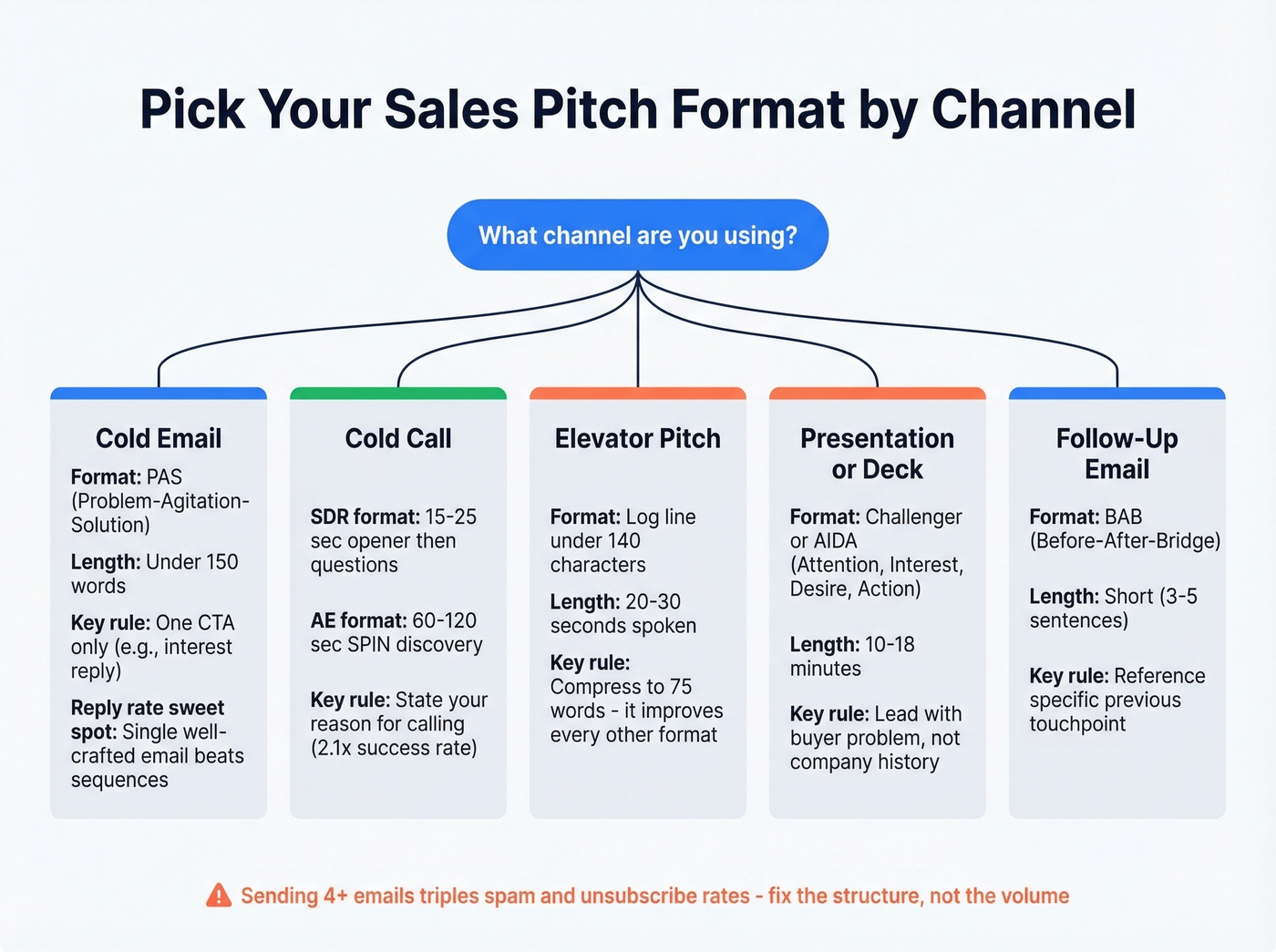
Cold Email (<150 Words)
The consensus on r/smallbusiness and among practitioners is clear: keep cold emails under 150 words with a tight structure - pain story, unique approach, clear next step. Personalize each line so it doesn't read like a mail merge.
A Belkins analysis of 16.5M emails found the highest reply rate - 8.4% - came from a single well-crafted email. Performance declines with follow-ups, and sending 4+ emails more than triples unsubscribe and spam rates. The takeaway: don't compensate for a weak pitch structure with more volume. Fix the structure.
Cold Call (SDR: 15-25 Sec / AE: 60-120 Sec)
SDRs get 15-25 seconds to earn the next 60. AEs get 60-120 seconds for a full discovery pitch. Gong's analysis found that stating your reason for calling increases success rate 2.1x, while opening with "Did I catch you at a bad time?" makes you 40% less likely to book a meeting.
Look - if you're doing most of the talking, you're pitching, not selling. The best cold call format is a tight opener followed by questions, not a monologue.
Elevator Pitch (20-30 Seconds)
Start with a log line under 140 characters - the one sentence that captures what you do and for whom. That's the seed. Then expand to 20-30 seconds of spoken delivery. Your elevator pitch is now a 75-word cold email, honestly. The literal elevator scenario barely exists anymore, but the discipline of compressing your value prop into 30 seconds makes every other format better.
If you want more options, steal from these elevator pitch examples and adapt them.
Presentation or Pitch Deck (10-18 Min)
Use Challenger or AIDA structure. Lead with the buyer's problem and a commercial insight they haven't considered - not your company history slide. Highspot's research shows 84% of business buyers expect reps to act as trusted advisors, yet 59% say reps don't learn their distinct challenges. Your deck should prove you understand their world before you ever show your product.
One angle worth exploring: use AI tools to practice your pitch delivery before the real meeting. Sellers who partner with AI sales tools are 3.7x more likely to meet their quota. Even recording yourself and reviewing the playback catches filler words, pacing issues, and weak transitions that a live audience won't tell you about.
Follow-Up Email
BAB framework. Reference the specific previous touchpoint - the call, the meeting, the event. Paint the "before" they described, show the "after" you discussed, bridge with one clear next step. One CTA. Not three. Not "let me know your thoughts or feel free to book time or forward this to your team." Pick one action.
If you need swipeable copy, use these follow-up templates as a starting point.
How Deal Size Shapes Your Format
The format that closes a $5K deal will actively hurt you on a $500K deal.
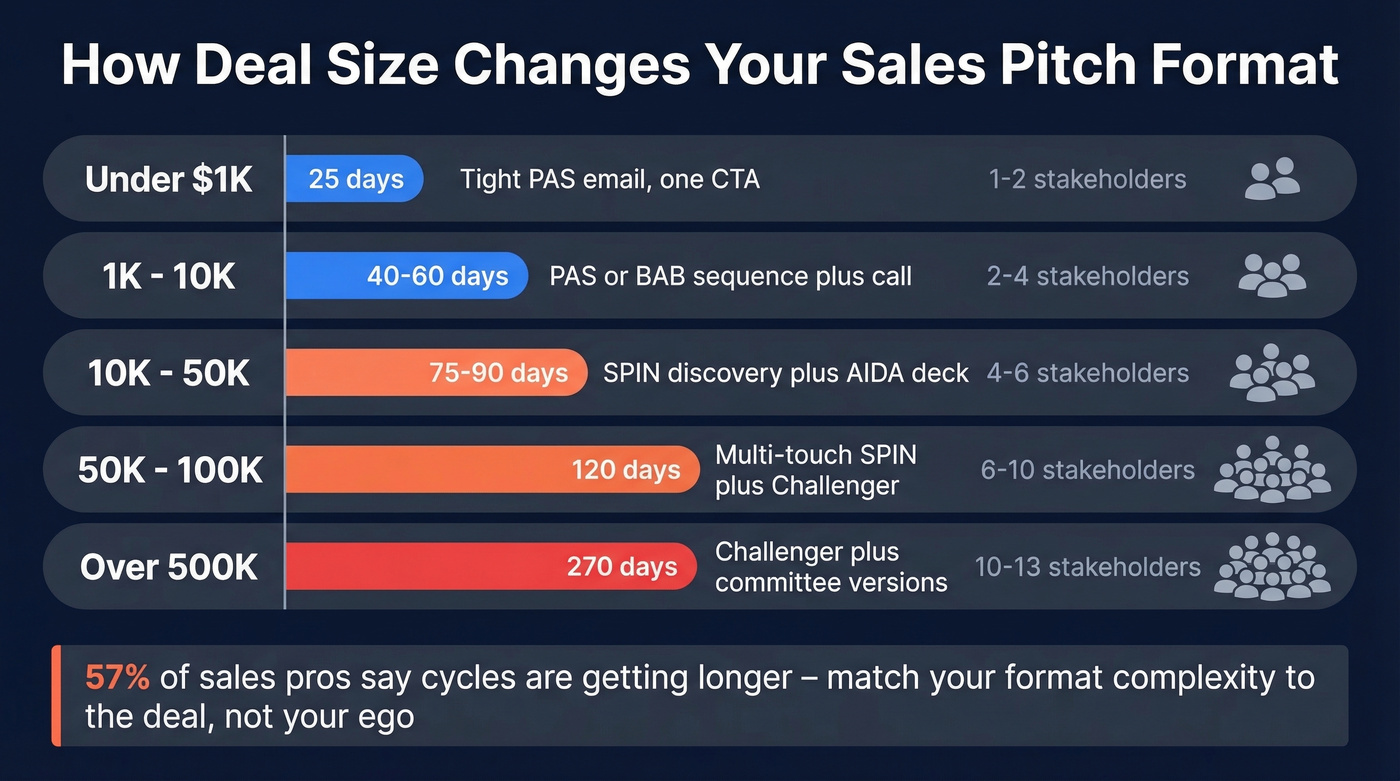
| ACV Range | Avg Cycle | Format | Stakeholders |
|---|---|---|---|
| <$1K | 25 days | Tight PAS email, one CTA | 1-2 |
| $1K-$10K | 40-60 days | PAS/BAB sequence + call | 2-4 |
| $10K-$50K | 75-90 days | SPIN discovery + AIDA deck | 4-6 |
| $50K-$100K | 120 days | Multi-touch SPIN + Challenger | 6-10 |
| >$500K | 270 days | Challenger + committee versions | 10-13 |
Cycle length data comes from Focus Digital's 2026 benchmarks. And it's getting worse - 57% of sales professionals say cycles are lengthening.
The stakeholder counts align with Gartner's research showing typical B2B purchases involve 6-10 decision-makers, each consuming 4-5 pieces of information independently. Corporate Visions puts the number even higher at 11-13 for enterprise deals, with 52% of those buying groups including VP+ decision-makers.
If your deal is under $10K, you probably don't need a multi-touch Challenger sequence. A sharp PAS email and one good call will outperform a bloated 12-step cadence. Save the complexity for deals that justify it.
You're not pitching one person. You're pitching a committee. Your pitch outline needs versions - one for the champion with ROI data and internal talking points they can repeat, one for the economic buyer with cost justification and risk analysis, one for the technical evaluator with integration specs and security details. Same framework, different emphasis.
If you're selling to larger accounts, align your pitch with account-based selling so the whole team stays consistent.
Pitch Mistakes That Kill Deals
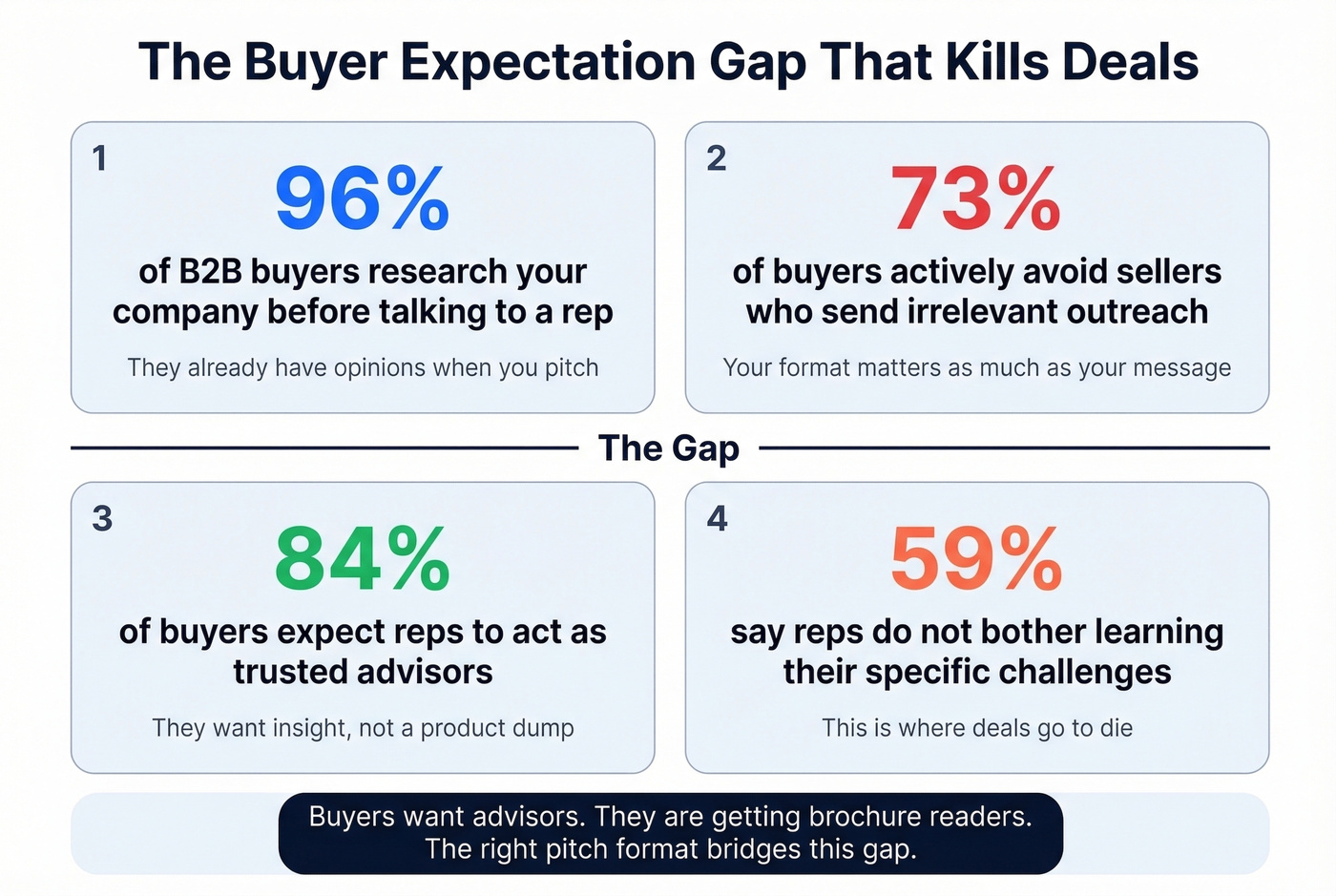
96% of B2B buyers research your company before they ever talk to a rep. By the time you're pitching, they already have opinions. And 73% of those buyers actively avoid sellers who send irrelevant outreach. Despite this, 84% expect reps to act as trusted advisors, while 59% say reps don't bother learning their specific challenges. That gap is where deals die.
Pitching too early. You haven't earned the right to present a solution until you understand the problem. Jumping into features before discovery is the fastest way to lose a deal that was winnable. One sales leader reported a 20% win rate increase over two quarters after replacing urgency-driven CTAs with data-backed proposals and tailored value maps.
If you need a tighter discovery flow, use these discovery questions to keep the call buyer-led.
Talking too much. If your discovery call is 70% you talking, you're not discovering anything. You're performing. The best format for handling objections isn't a rebuttal script - it's a question that lets the buyer talk through their own concern. Marinate in the objection instead of rushing to counter it.
If objections are a pattern, fix the upstream targeting and messaging with sales communication fundamentals.
Fake urgency. "This offer expires Friday" on a B2B SaaS deal is a trust-destroyer. Buyers see through manufactured scarcity instantly.
Pitching the wrong person. Your pitch format is irrelevant if you're sending it to someone who left the company six months ago or doesn't have buying authority. We've seen teams waste entire campaigns on stale lists. Run your contacts through a verification tool like Prospeo before you send anything - a perfect pitch to a dead inbox is just noise.
If you're scaling outbound, protect deliverability with an email deliverability checklist and monitor your sender reputation.
Ignoring the committee. Sending the same deck to the CFO and the engineering lead is lazy. They care about different things. Tailor your pitch for each stakeholder.
Copy-Ready Pitch Templates
Five templates, written for a fictional B2B SaaS company selling pipeline analytics to a VP of Sales. Each illustrates the key elements of a pitch - hook, problem, value prop, proof, and CTA - arranged in a different framework. Copy, adapt, send.
If you want to improve opens before you touch the body copy, start with subject lines.
Template 1: Cold Email (PAS, <150 words)
Subject: Pipeline blind spots at {{company}}
{{First name}}, most VPs of Sales I talk to are forecasting off gut feel because their CRM data is 3 weeks stale. By the time a deal goes dark, it's already been dead for a month.
That lag costs the average mid-market team 15-20% of their forecast every quarter.
We built Acme Pipeline to surface deal risk signals in real time - not after the quarter closes. Teams using it catch at-risk deals 22 days earlier on average.
Worth a 15-minute look? I can show you what your current pipeline risk looks like.
PAS. Cold email. 98 words.
Template 2: Cold Call Opener (SDR, 15 seconds)
"Hi {{First name}}, this is Alex from Acme Pipeline. I'm calling because VPs of Sales at companies your size keep telling us their forecast accuracy drops 15 points in Q4. Is that something you're seeing too?"
PAS (compressed). Cold call. ~12 seconds.
Template 3: Elevator Pitch (30 seconds)
"We help mid-market sales teams stop losing deals they didn't know were at risk. Most CRMs show you what happened last week. Acme Pipeline shows you what's about to happen - deal risk signals, buyer engagement drops, forecast gaps - all in real time. Our customers catch dying deals 22 days earlier and close 18% more of their pipeline."
BAB. In-person/networking. ~25 seconds.
Template 4: Presentation Opening (Challenger angle)
"Your forecast is wrong. Not because your reps are lying - because your data is late. The average CRM updates deal status 18 days after the buyer's behavior actually changed. That means every Monday pipeline review is based on information that's already obsolete. Let me show you what real-time deal intelligence looks like - and why three of your competitors are already using it."
Challenger (teach). Presentation. ~30 seconds of a 15-minute deck.
Template 5: Follow-Up Email (BAB)
Subject: Re: Pipeline review
{{First name}}, when we spoke Tuesday you mentioned your team loses visibility on deals once they pass Stage 3. That's the "before."
The "after": your reps get automated alerts when buyer engagement drops, and your Monday forecast reflects what's actually happening - not what happened two weeks ago.
The bridge: a 30-minute pilot using your live pipeline data. I can set it up for next week. Does Thursday at 2 work?
BAB. Follow-up email. 82 words.
You just learned which framework wins by channel and deal size. Now you need the right prospects to pitch. Prospeo's 300M+ profiles with 30+ filters - buyer intent, technographics, job changes, funding - let you build lists where every contact matches your ICP. At $0.01 per email, a bad list is no longer an excuse.
Match the right framework to the right buyer. Build your list now.
FAQ
How long should a sales pitch be?
Cold emails: under 150 words. SDR cold call openers: 15-25 seconds. AE discovery pitches: 60-120 seconds. Presentations: 10-18 minutes. Elevator pitches: 20-30 seconds. Match the length to the channel and the buyer's available attention - not to how much you want to say.
What's the best framework for cold outreach?
PAS (Problem-Agitation-Solution) is the most versatile outbound framework. It works for cold emails, calls, and follow-ups because it mirrors how buyers process decisions. Use SPIN for live discovery calls above $50K and Challenger for enterprise deals where you need to reframe the buyer's thinking.
What are the five parts of every effective pitch?
Every pitch needs a hook that earns attention, a problem statement showing you understand the buyer's world, a value proposition connecting your solution to that problem, proof backed by data or customer results, and a single clear CTA. Arrange these elements in the order that fits your channel - PAS for email, AIDA for decks, SPIN for calls.
How do I pitch to a buying committee?
Create tailored versions for each stakeholder. The champion needs ROI data and internal talking points they can repeat. The economic buyer needs cost justification and risk analysis. The technical evaluator needs integration specs and security details. Average B2B committees include 6-10 decision-makers consuming information independently.
How do I make sure my pitch reaches the right contact?
Use a data verification tool before sending any outreach. Bounced emails don't just waste your pitch - they damage your sender reputation and tank deliverability for every future campaign. Pair verification with org-chart research to confirm you're targeting the right seniority and department.