

The 7 Sales Process Stages (With Exit Criteria, Benchmarks, and What Actually Goes Wrong)
58% of B2B professionals say their sales cycles got longer over the past year. Average buying committees now run 6.3 stakeholders deep. And yet most teams still treat their sales process stages as a list of names in a CRM - no exit criteria, no conversion benchmarks, no agreement on what actually moves a deal forward.
Teams claim they have a process until you ask them to walk through a real deal. Then it becomes "it depends" and ad-hoc execution.
Here's what we're covering: the seven stages with concrete exit criteria (not definitions - pass/fail checklists), benchmark tables for cycle length and conversion rates by industry, ACV, and company size, and how the whole thing changes depending on whether you're selling to SMBs or enterprise. Because a 30-day SMB cycle and an 18-month enterprise cycle don't use the same playbook.
What Is a Sales Process?
People conflate four distinct concepts, and the confusion leads to reps executing inconsistently while leadership wonders why forecasts are fiction.
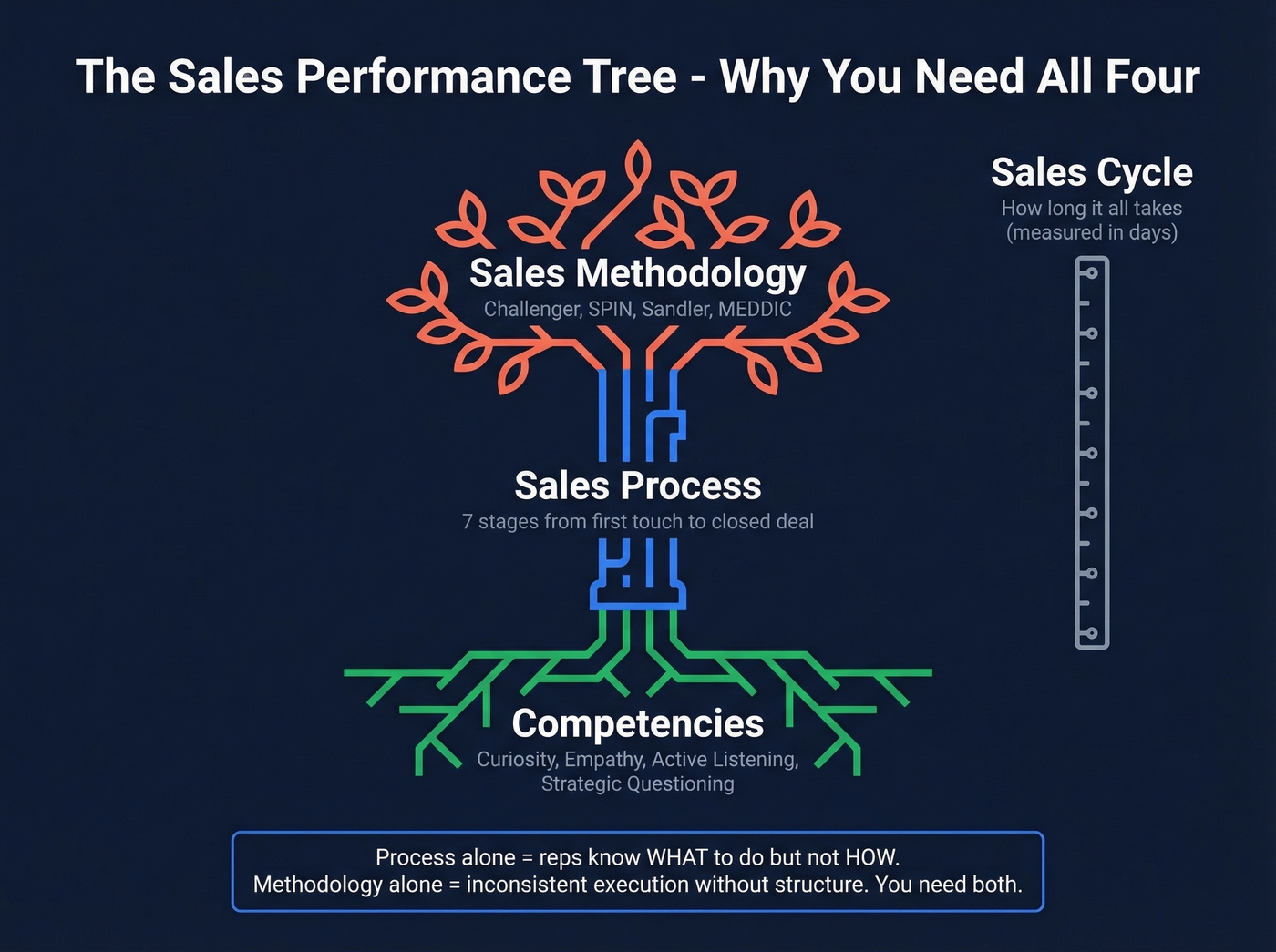
Your sales process is the sequence of stages an opportunity moves through from first touch to closed deal. Think of it as the tree trunk: the structure everything else hangs on. Your sales methodology (Challenger, SPIN, Sandler) is the ornaments on that tree - the tactics and conversational frameworks reps use within each stage. Your competencies are the roots: curiosity, empathy, active listening, the ability to ask a question that makes a VP pause. And your sales cycle is simply how long the whole thing takes, measured in days.
Membrain uses this tree metaphor and it's the clearest framing we've come across. Process alone means reps know what to do but not how. Methodology alone means inconsistent execution without structure. You need both.
The performance data backs this up. Companies with a formal sales process see 18% higher revenue growth, and CSO Insights found that optimized processes yield a 28% revenue increase. 50% of high-performing sales teams have a clearly defined process, compared to just 28% of underperformers. That gap isn't about talent - it's about repeatability.
The 7 Steps in the Sales Process
Here's the contrarian take: stop obsessing over the number of stages. Five stages with clear exit criteria beat seven with vague definitions every time. Some frameworks start with customer research before prospecting; others add an "attraction campaign" phase. We're using seven because it's the consensus framework and maps cleanly to most CRMs, but the exit criteria matter infinitely more than the count.
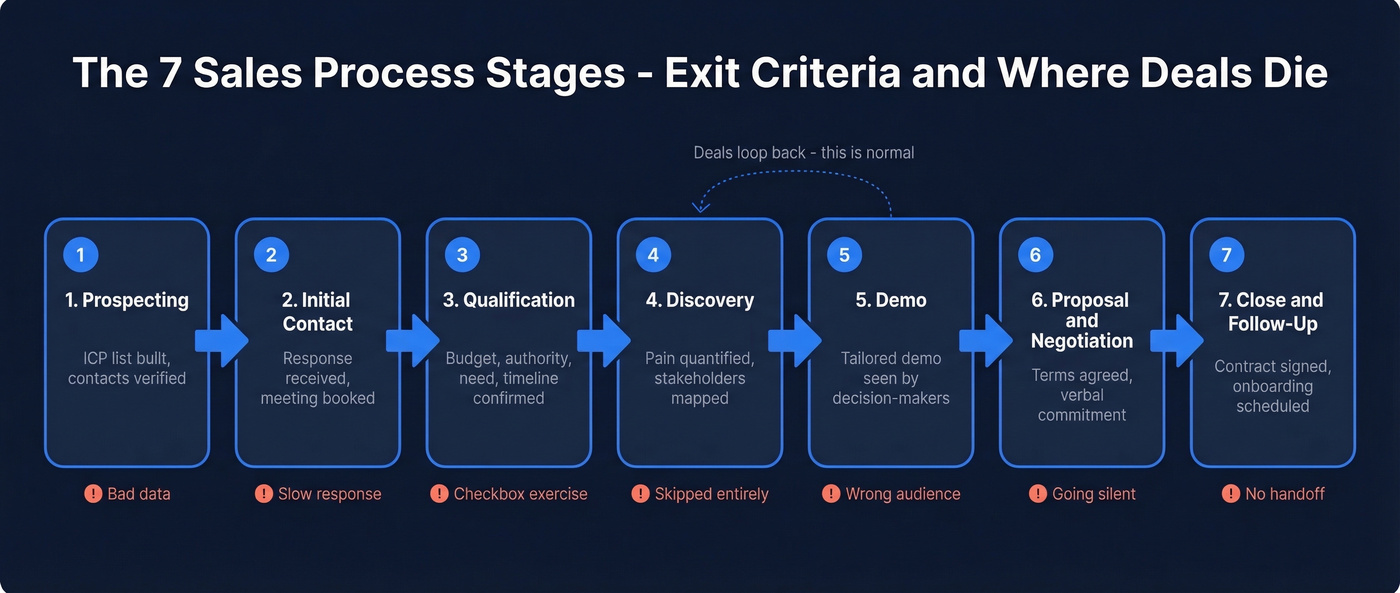
Stages aren't always linear, either. Deals loop back - a prospect who saw a demo might need a second discovery session after a new stakeholder surfaces, or negotiation might reopen objections you thought were resolved. Lucidchart makes the point that a "7-step" process can easily become 13 or 21 steps in practice. The framework below is a spine, not a straitjacket.
As sales process consultant Mike Kunkle puts it, exit criteria are "things that absolutely must be done in a stage to close it before moving on." That's the operating principle for everything below.
Prospecting
This is where most pipelines die - and it's rarely because of bad technique. It's bad data. We've watched teams spend hours building lists, only to see 20-35% of emails bounce on the first sequence. That kills sender reputation, tanks deliverability, and poisons every subsequent campaign.
The fix is straightforward: use a data platform that verifies before you send. Prospeo's database covers 300M+ professional profiles, including 143M+ verified emails, with 98% email accuracy and a 7-day refresh cycle. One customer, Meritt, saw their bounce rate drop from 35% to under 4% after switching - pipeline tripled from $100K to $300K per week. Exit criteria:
- Target account list built and prioritized by ICP fit
- Contact data verified - email deliverability confirmed, direct dials where available
- Initial outreach sequence drafted and loaded into your engagement tool
Common mistake: Skipping ICP definition and prospecting "anyone with a pulse." This floods the pipeline with unqualified leads that waste every downstream stage.
Initial Contact
Contacting leads within 24 hours of first engagement increases conversion by 5x. That single stat should dictate how you structure this stage. First touch - whether cold email, cold call, or inbound response - exists to earn the next conversation, not to sell.
Exit criteria:
- Prospect has responded: reply, call pickup, or meeting booked
- Initial interest confirmed - they've agreed to a discovery call or next step
- Contact record updated in CRM with engagement notes
Pro tip: The recommended talk-to-listen ratio varies by study, but every one agrees: listen more than you speak. Reps who pitch on the first call rarely get a second one. Record your calls for a week and check the ratio - most reps are shocked at how much they talk.
Qualification
This is the stage that separates pipeline from pipe dream. You're determining whether this prospect has the budget, authority, need, and timeline to actually buy - or whether you're about to spend six weeks chasing a dead deal.
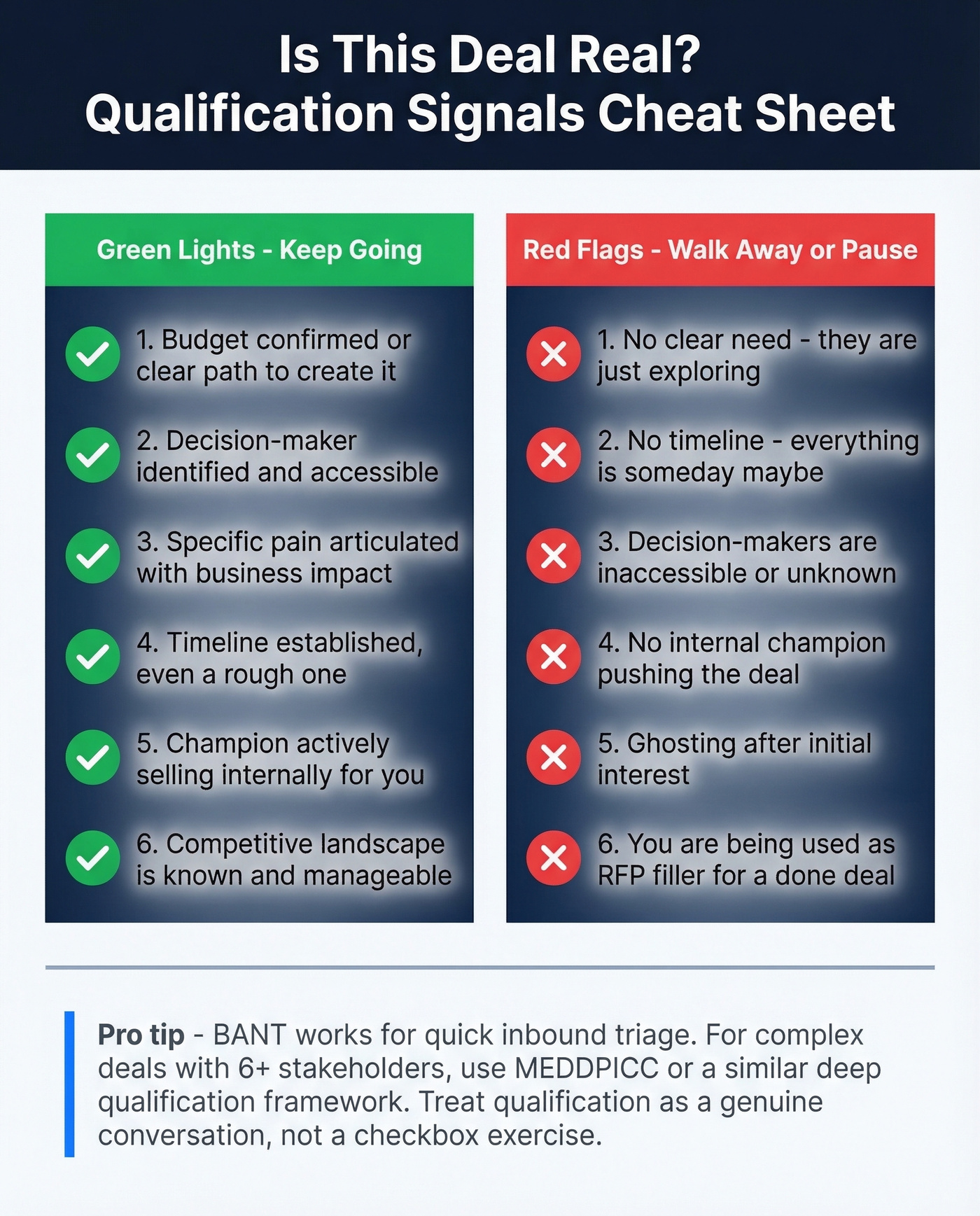
Exit criteria:
- Budget confirmed or a clear path to budget creation identified
- Decision-maker(s) identified and accessible
- Timeline established, even a rough one
- Prospect has articulated a specific pain or use case
- Competitive landscape understood
Qualification fail signals: No clear need, no timeline, decision-makers inaccessible, no champion, ghosting after initial interest, or being used as RFP filler.
Common mistake: Treating qualification as a checkbox exercise instead of a genuine conversation. BANT works for quick inbound triage, but for complex deals, you need a deeper framework. We cover those in the qualification section below.
Discovery / Needs Assessment
Qualification confirmed they could buy. Discovery determines why they should.
We've watched reps skip this stage hundreds of times, and the result is always the same: the demo becomes a generic feature tour, the prospect nods politely, and the deal dies two weeks later. Our team has seen companies lose 40% of their demo-to-proposal conversion rate because reps jumped straight from qualification to demo without mapping pain to solution. Of all the stages in a deal, this is the one most frequently rushed - and the one that costs you the most when it is.
Exit criteria:
- Specific pain points documented with quantified business impact
- Success criteria defined - what does "working" look like for them?
- Key stakeholders mapped: who influences, who decides, who signs
- Prospect agrees to a demo or presentation as the next step
Presentation / Demo
You're showing the prospect how your solution solves their specific problem - not every feature you've ever built. The best demos reference discovery notes by name: "You mentioned your team spends 6 hours a week on manual data entry. Here's how that goes to zero."
Exit criteria:
- Prospect has seen a tailored demo addressing their stated pain points
- Key stakeholders attended - not just the champion
- Objections surfaced and addressed or documented for follow-up
- Prospect agrees to receive a proposal or enters a trial/POC
Common mistake: Demoing to the wrong audience. If the economic buyer isn't in the room, you're performing, not selling. Always confirm attendees before the call.
Proposal and Negotiation
The proposal should feel like a formality if you've done the previous stages well. It restates the problem, maps your solution, and presents pricing in the context of ROI. Negotiation is where procurement, legal, and finance enter the picture - especially in enterprise deals.
Exit criteria:
- Proposal delivered and reviewed by all decision-makers
- Pricing, terms, and timeline agreed upon or specific objections documented
- Legal/security/procurement requirements identified and in progress
- Verbal commitment or clear path to signature established
Common mistake: Sending a proposal and going silent. Follow up within 48 hours. If you don't hear back in a week, the deal is cooling - and a cooling deal rarely warms back up on its own. (If you need copy, use these follow-up templates.)
Close and Follow-Up
Closing isn't just getting the signature. It's ensuring a clean handoff to onboarding, setting expectations for implementation, and planting the seeds for expansion.
Exit criteria:
- Contract signed and payment terms confirmed
- Onboarding kickoff scheduled with customer success
- Internal handoff completed: notes, stakeholder map, and success criteria transferred
- Follow-up cadence established for the first 90 days
Let's be honest about something most sales content ignores: the first 30 days after signature matter more than the last 30 days before it. That's when buyer's remorse hits hardest. A structured follow-up cadence prevents it. If your sales team celebrates the close and disappears, your churn rate will tell the story six months later.
How Stages Change by Deal Size
The seven stages above are a framework, not a fixed recipe. How you execute each one - and how long you spend there - depends entirely on who you're selling to.
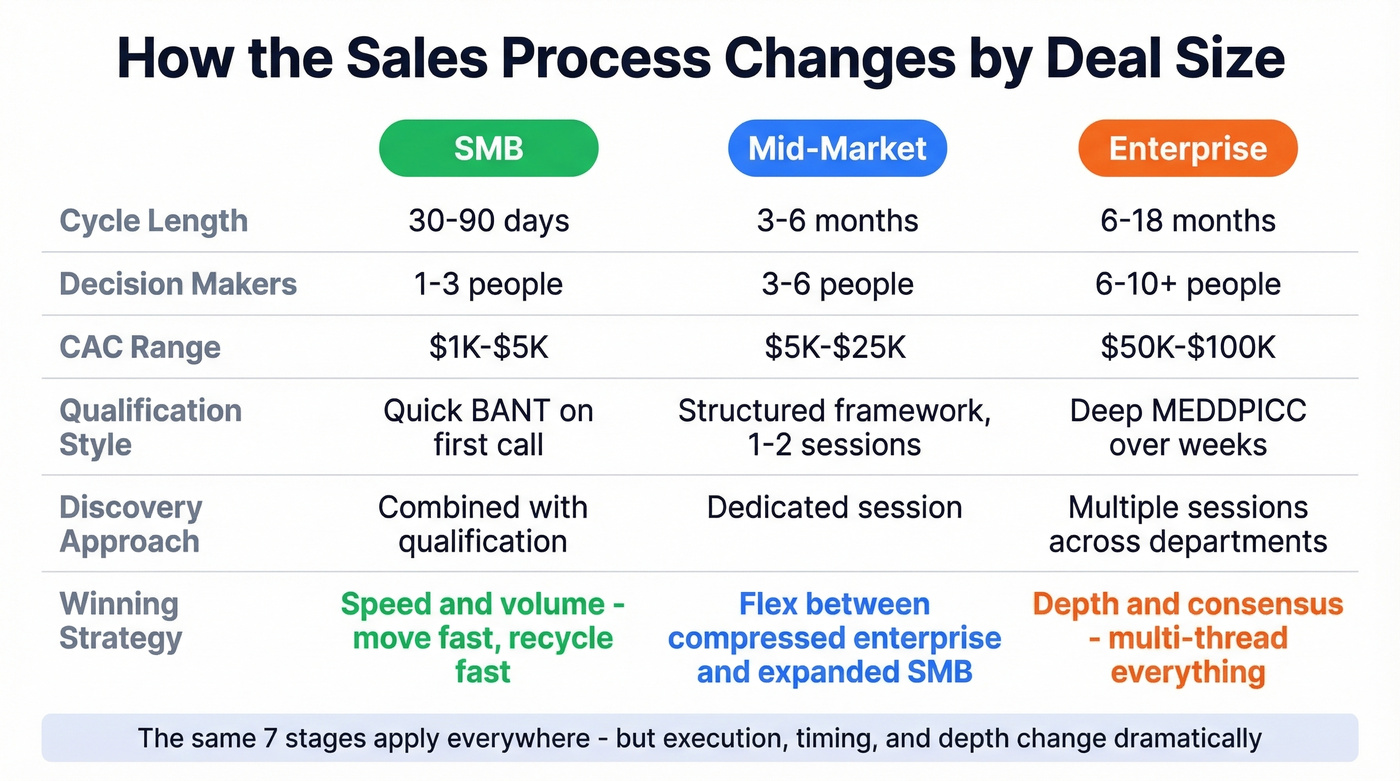
| SMB | Mid-Market | Enterprise | |
|---|---|---|---|
| Cycle length | 30-90 days | 3-6 months | 6-18 months |
| Decision-makers | 1-3 | 3-6 | 6-10+ |
| CAC range | $1K-$5K | $5K-$25K | $50K-$100K |
| Key difference | Speed + volume | Balance | Depth + consensus |
For SMB, the Gartner Peer Community advice is blunt: move prospects in and out of the funnel fast. Give them one or two attempts. If they don't convert, recycle them later. No chasing. Qualification and discovery often happen in the same call.
Enterprise is the opposite. Fewer concurrent deals, deeper work on each one. Company research, POV development, multi-threading across 6-10 stakeholders, security reviews, procurement cycles. The qualification stage alone can take weeks. Discovery might span multiple sessions with different departments. And the proposal stage often includes legal redlines, custom SLAs, and executive alignment meetings that simply don't exist in SMB.
Mid-market sits in the uncomfortable middle. You need enough process to handle 3-6 stakeholders and a real evaluation, but you can't afford the time investment of a full enterprise motion on every deal. The teams that win here are the ones who can flex - running a compressed enterprise process when the deal warrants it, and an expanded SMB process when it doesn't.

Stage 1 kills more deals than any other - and the root cause is bad data. Meritt cut their bounce rate from 35% to under 4% with Prospeo and tripled pipeline to $300K/week. 300M+ profiles, 98% email accuracy, 7-day refresh.
Stop losing deals at prospecting. Start with data that's verified this week.
Sales Cycle Length Benchmarks
Let's put numbers to each stage of the cycle. These benchmarks come from Focus Digital's analysis across industries, company sizes, deal values, and acquisition channels.
By Industry
| Industry | Avg. Cycle (Days) |
|---|---|
| Retail | 70 |
| Software | 90 |
| Financial Services | 98 |
| Healthcare | 125 |
| Manufacturing | 130 |
| Pharmaceuticals | 153 |
| Energy | 155 |
By Company Size (Employees)
| Company Size | Avg. Cycle (Days) |
|---|---|
| 1-10 | 38 |
| 11-50 | 57 |
| 51-200 | 77 |
| 201-500 | 95 |
| 501-1,000 | 115 |
| 1,001-5,000 | 135 |
| 10,001+ | 185 |
By Annual Contract Value
| ACV | Avg. Cycle (Days) |
|---|---|
| Under $1K | 25 |
| $1K-$5K | 40 |
| $5K-$10K | 55 |
| $10K-$50K | 75 |
| $50K-$100K | 120 |
| $100K-$250K | 170 |
| $250K-$500K | 220 |
| Over $500K | 270 |
By Acquisition Channel
This is the data nobody talks about. The channel that generates the lead dramatically affects how long it takes to close:
| Channel | SMB (Days) | Mid-Market (Days) | Enterprise (Days) |
|---|---|---|---|
| Referrals | 20 | 35 | 60 |
| Cold calling | 60 | 85 | 110 |
| Trade shows | 80 | 100 | 150 |
Referrals close 3-4x faster than trade show leads at every company size. If your cycle is running long, the fix might not be process optimization - it might be channel mix.
Look, if your cycle is running 2x the benchmark for your segment, the bottleneck is almost always in qualification or proposal. Deals stall when reps can't confirm authority, when proposals sit in procurement limbo, or when discovery was too shallow to build urgency. The fix is rarely "more pipeline" - it's tighter exit criteria at the steps where deals get stuck.
Stage Conversion Benchmarks
Knowing your cycle length tells you how long deals take. Conversion rates tell you where they die.
Overall Pipeline Benchmarks
MarketJoy's data across their client base shows the average drop-off at each stage:
| Stage Transition | Benchmark Rate |
|---|---|
| Lead to MQL | 22% |
| MQL to SQL | 15% |
| SQL to Opportunity | 11% |
| Opp to Closed Won | 7% |
The biggest drop-off is MQL to SQL. If your number is worse than 15%, your qualification criteria are broken - or your marketing and sales teams disagree on what "qualified" means. This is the single most common pipeline leak we see across teams.
By Industry
First Page Sage's benchmarks show significant variation by vertical. Note that First Page Sage defines stage transitions slightly differently than MarketJoy, so compare within this table rather than across both:
| Industry | Lead to MQL | MQL to SQL | SQL to Opp | Opp to Closed |
|---|---|---|---|---|
| B2B SaaS | 39% | 38% | 42% | 37% |
| Manufacturing | 26% | 41% | 46% | 51% |
| Cybersecurity | 24% | 40% | 43% | 46% |
| IT & Managed Svcs | 19% | 38% | 41% | 46% |
SMB vs. Enterprise
Digital Bloom's analysis reveals a consistent pattern: SMB converts better at every single stage.
| Stage | SMB/Mid-Market | Enterprise |
|---|---|---|
| Visitor to Lead | 1.4% | 0.7% |
| MQL to SQL | 39% | 31% |
| SQL to Opportunity | 42% | 36% |
| Opp to Close | 39% | 31% |
The Visitor to Lead gap is the starkest - SMB converts at double the rate. Enterprise deals convert lower across the board because more stakeholders means more chances for a "no." That's not a problem to fix. It's a reality to plan for, and you should build your pipeline accordingly.
Qualification Frameworks
BANT is fine for inbound triage. It's terrible for enterprise qualification.
| Framework | Stands For | Best For | Weakness |
|---|---|---|---|
| BANT | Budget, Authority, Need, Timeline | High-velocity inbound, sub-$10K deals | Assumes budget exists upfront |
| CHAMP | Challenges, Authority, Money, Prioritization | Consultative mid-market, $10K-$100K | Slower; requires skilled discovery |
| MEDDPICC | Metrics, Economic Buyer, Decision Criteria/Process, Identify Pain, Champion, Competition, Paper Process | Enterprise, $100K+ | Heavy; overkill for simpler deals |
| NEAT | Need, Economic Impact, Access to Authority, Timeline | Modern alternative when legacy frameworks feel like interrogation | Less proven at scale |
| GPCTBA/C&I | Goals, Plans, Challenges, Timeline, Budget, Authority, C&I | Strategic exec conversations | Complex; hard to train |
The real question isn't which framework is "best." It's which one matches your deal complexity. A five-person startup selling $3K annual contracts doesn't need MEDDPICC - that's like bringing a forklift to move a couch. And an enterprise team running $200K deals through BANT is leaving money on the table because they're qualifying on budget before they've built the business case that creates the budget.
Skip MEDDPICC if your average deal closes in under 30 days with fewer than three stakeholders. You'll spend more time filling in the framework than actually selling.
Match the framework to the deal, not to the trend. The consensus on r/sales is that most teams overcomplicate this - pick one, train on it for 90 days, and iterate based on what your win/loss data tells you.
How to Build Your Process
Audit Your Current State
Map how deals actually move through your pipeline - not how you think they move. Pull your last 20 closed-won and 20 closed-lost deals. Track the real sequence of events, the time spent in each stage, and where deals stalled or died. You'll almost certainly find that your CRM stages don't match reality, and understanding the actual steps your reps follow versus the ones on paper is the first step toward fixing the gap.
Define Stages and Exit Criteria
Use the seven stages and exit criteria above as a starting template, then customize for your motion. The exit criteria are the hard part - they're what turn a list of stage names into an actual process. Every stage needs 2-4 pass/fail rules that a rep can evaluate objectively.
Map Stages to Your CRM
Most CRMs - Salesforce, HubSpot, Pipedrive - let you define custom pipeline stages with required fields and validation rules. Use this. Configure your CRM so reps literally can't advance a deal without filling in the exit criteria fields. If your CRM doesn't enforce the process, the process doesn't exist. (If you’re still evaluating, here are some examples of a CRM.)
Select Your Tools
Your CRM manages the pipeline. A data platform feeds it with verified contacts. An engagement tool runs your sequences. These three form the core stack. Prospeo connects natively to Salesforce, HubSpot, Smartlead, Instantly, Lemlist, Zapier, and Make - so reps aren't copy-pasting between tabs. The free tier gives you 75 verified emails plus 100 Chrome extension credits per month, enough to test whether better data actually moves your numbers before committing budget. If you're comparing vendors, start with data enrichment services and a dedicated email deliverability guide.
Measure and Iterate
Track conversion rates by stage monthly. Compare them to the benchmarks from the tables above. When a stage consistently underperforms, dig into why: are exit criteria too loose? Is training needed? Is the stage itself unnecessary? Salesforce's process framework recommends quarterly reviews, but monthly check-ins catch problems before they compound.
Consider layering in conversation intelligence platforms that flag when exit criteria language appears in call transcripts, and automated follow-up sequences that prevent deals from stalling between stages. The goal isn't to automate judgment - it's to automate the reminders and data capture that keep the process honest. For a deeper teardown, use a structured sales process optimization review and track pipeline health monthly.
Exit criteria mean nothing if your contact data is stale. Prospeo refreshes every 7 days - not the 6-week industry average - so your reps reach real buyers at every stage. 143M+ verified emails at ~$0.01 each, no contracts.
Every stage converts higher when your data actually connects you to decision-makers.
FAQ
How many sales process stages should I have?
Most teams use five to eight. The number matters less than having clear exit criteria for each stage. Five stages with defined pass/fail rules outperform seven vague ones every time. Start with seven, then merge or remove stages that don't add decision value for your specific motion.
What's the difference between a sales process and a sales cycle?
The sales process is the repeatable sequence of steps your team follows to move deals forward. The sales cycle is the measurable time from first contact to close. Process equals how; cycle equals how long. You design the process and measure the cycle.
What's the average B2B sales cycle length in 2026?
It depends entirely on deal size. Under $1K ACV averages about 25 days. Deals in the $50K-$100K range average 120 days. Over $500K stretches to roughly 270 days. Software averages 90 days across all deal sizes; manufacturing averages 130.
Which qualification framework should I use?
BANT for high-velocity deals under $10K where budget is usually pre-allocated. CHAMP for consultative mid-market deals in the $10K-$100K range. MEDDPICC for enterprise deals over $100K with complex buying committees. Match the framework to your deal complexity, not to what's trending on sales podcasts.
How do I get verified contact data for prospecting?
Use a dedicated data platform instead of relying on your CRM's built-in data. Prospeo offers 98% email accuracy with a 7-day refresh cycle and a free tier of 75 verified emails per month. Tools like Hunter and Snov.io also offer free tiers, but check accuracy rates - bad data is the fastest way to sabotage an otherwise solid pipeline.