

Sales Quota Calculator: Formulas, Benchmarks, and Methods for 2026
69% of reps missed quota in 2024. Quotas had already been cut 19% from the year before, and most sellers still came up short. Meanwhile, reps track attainment in messy spreadsheets because their company tools can't handle accelerators or multiple comp buckets.
A reliable sales quota calculator starts with honest data, not optimistic assumptions. Bad inputs around win rates, pipeline coverage, and ramp periods produce quotas that look reasonable on screen and fall apart in the field. Everything else is decoration.
What You Need (Quick Version)
Three formulas cover 90% of quota planning:
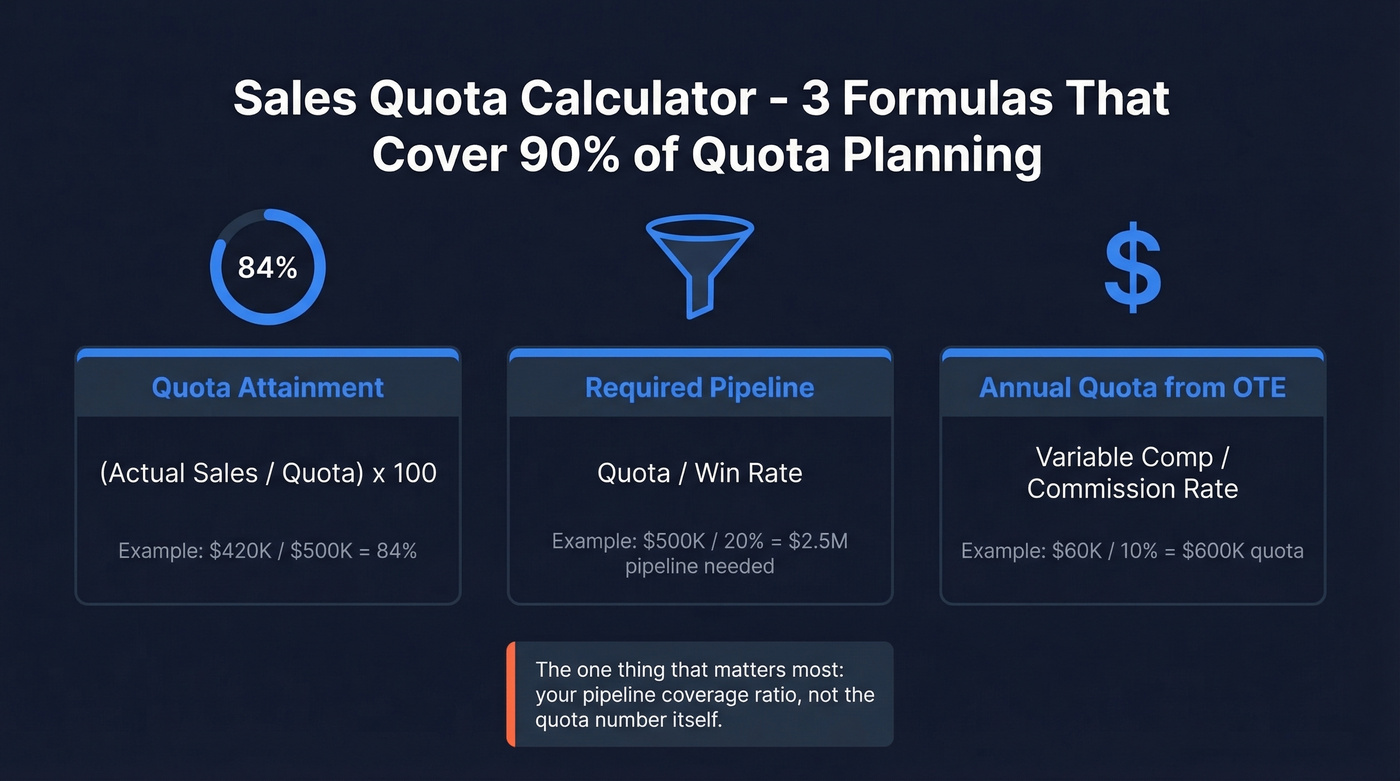
- Quota attainment = (Actual Sales / Quota) x 100
- Required pipeline = Quota / Win Rate
- Annual quota from comp plan = Variable Comp / Commission Rate (where Variable Comp = OTE minus Base Salary)
If you only remember one thing: your pipeline coverage ratio matters more than the quota number itself. A $500K quota with a 20% win rate means you need $2.5M in pipeline - and that pipeline has to be real, not stuffed with stale contacts from two quarters ago.
Core Quota Calculation Formulas
Quota Attainment
Quota Attainment % = (Actual Sales / Sales Quota) x 100
A rep who closes $420K against a $500K quota is at 84%. Simple. But the number only means something if the quota was set correctly in the first place.
Required Pipeline
Required Pipeline = Quota / Win Rate
At a ~20% win rate - in the 19-21% B2B average range - a $500K quota demands $2.5M in qualified pipeline. Most teams underestimate this badly.
Annual Quota from OTE
Annual Quota = Variable Comp / Commission Rate
If variable comp is $60K and commission rate is 10%, quota = $600K. This is the baseline sanity check for comp plan design.
Ramp-Adjusted Quota
Ramp-Adjusted Quota = Full Quota x (Months at Full Productivity / 12)
A rep who ramps over 4 months gets 8 productive months. Their Year 1 quota should be roughly 67% of a tenured rep's number. We've seen too many companies skip this adjustment entirely, then wonder why new-hire attrition spikes at month five.
Pipeline Coverage - The Missing Input
Most quota tools skip this entirely, and it's the single most important reality check.
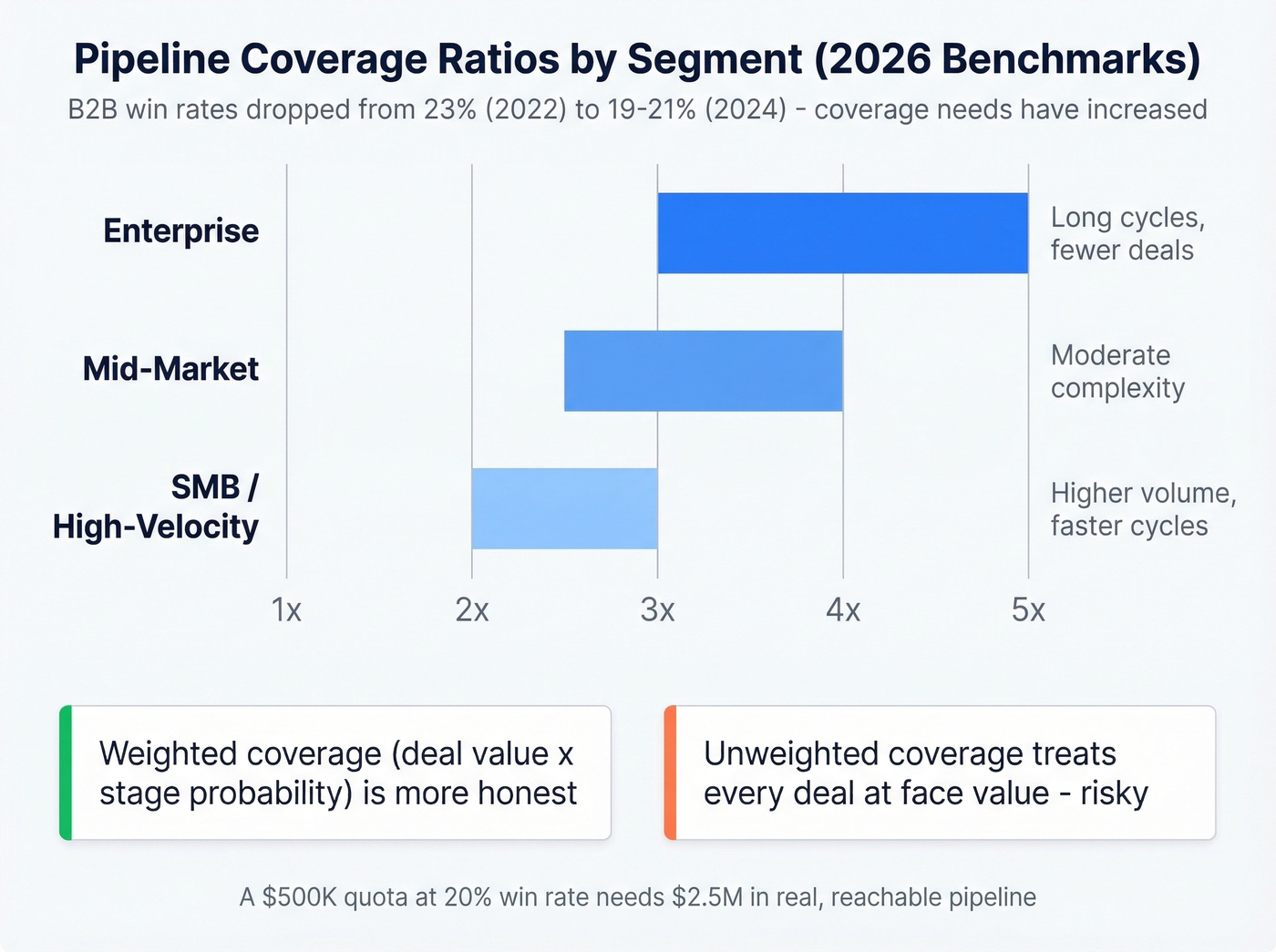
Pipeline Coverage Ratio = Total Pipeline Value / Quota. But the benchmark depends on your segment. B2B win rates dropped from 23% in 2022 to 19-21% by 2024, which means coverage ratios that worked two years ago are now dangerously thin.
| Segment | Coverage Needed | Why |
|---|---|---|
| Enterprise | 3-5x | Long cycles, fewer deals |
| Mid-market | 2.5-4x | Moderate complexity |
| SMB / High-velocity | 2-3x | Higher volume, faster cycles |
These ranges come from Outreach's pipeline coverage analysis and hold up in practice. Unweighted coverage treats every deal at face value; weighted coverage multiplies deal value by stage probability. Weighted is more honest, but only if your stage definitions reflect reality.
Here's the thing: pipeline coverage only counts if the contacts are reachable. If a third of your emails bounce, your effective coverage drops by a third. This is where data quality tools earn their keep. Prospeo's 98% email accuracy and 7-day data refresh cycle mean the pipeline you're counting on actually converts into conversations, not bounced emails. Teams like Snyk cut bounce rates from 35-40% to under 5% after switching, which directly translates to pipeline that holds up against quota targets.

Pipeline coverage ratios collapse when a third of your emails bounce. Prospeo delivers 98% email accuracy on a 7-day refresh cycle, so the $2.5M in pipeline your quota demands actually connects to real buyers - not dead inboxes.
Stop calculating quotas against pipeline you can't actually reach.
Quota-to-OTE Ratio
Use the 3-4x ratio if your AEs run enterprise cycles of 6-9 months, deal complexity is high, and reps manage fewer than 20 accounts. The math has to leave room for the long tail.
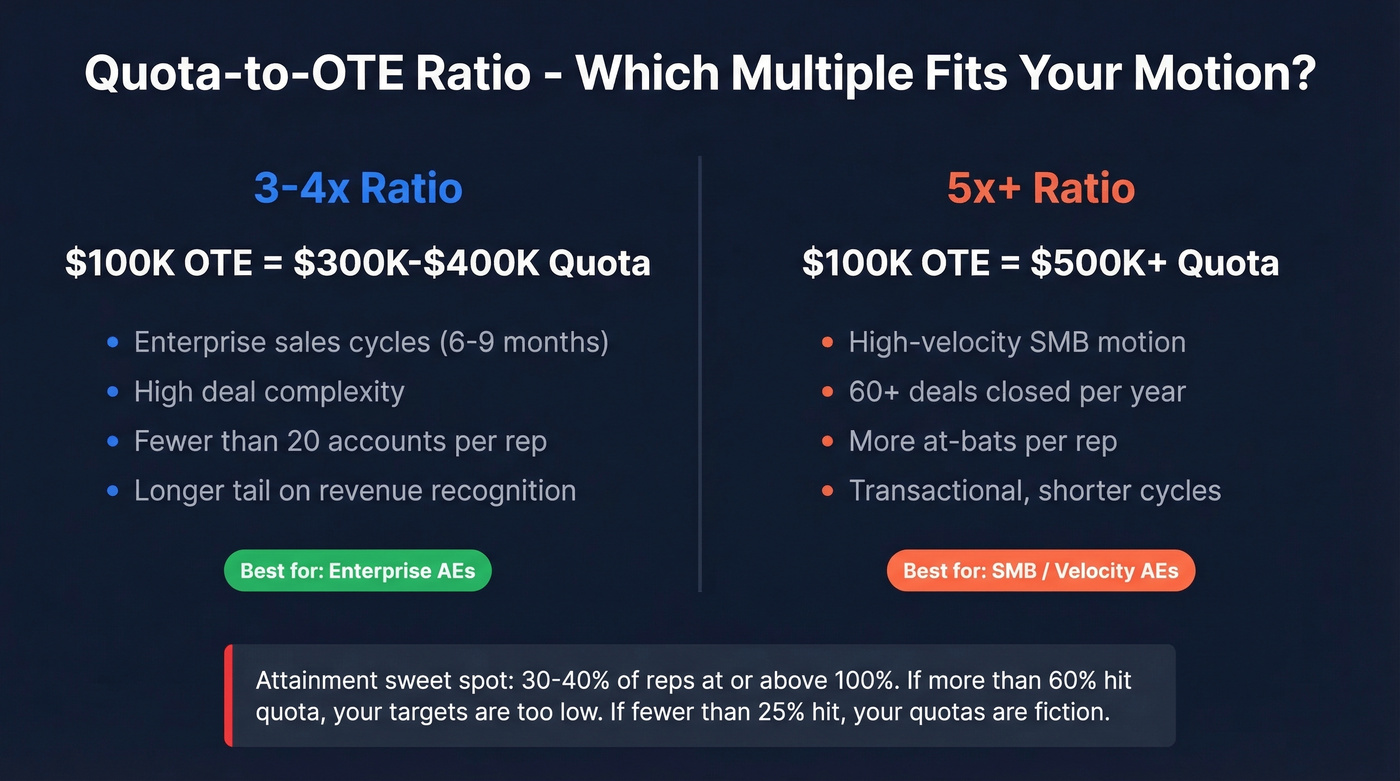
The 5x+ ratio fits when you're running a high-velocity SMB motion where reps close 60+ deals a year. The volume justifies a higher multiple because reps get more at-bats.
The 3x-5x rule is widely cited, but practitioners debate it constantly. A common example: $100K OTE leads to a $500K quota. In our experience, the 5x ratio works for transactional sales but breaks down the moment deal cycles exceed 6 months.
Let's be honest about attainment benchmarks. If more than 60% of your reps are hitting quota, your quotas are too low. If fewer than 25% are hitting it, your quotas aren't "ambitious" - they're fiction. The sweet spot sits around 30-40% of reps at or above 100%.
Ramp Period Math
Average ramp to full productivity runs 3-6 months. A useful shortcut: take your average deal cycle and multiply by two. If deals take 90 days, expect 6 months before a new rep is fully productive.
A solid ramp structure looks like this: guaranteed OTE for the first two months with no quota, then 50% quota with a doubled commission rate until 40% of the sales cycle has elapsed, then full quota at standard rates. This framework from QuotaPath's ramp calculator is one of the cleaner ones we've seen.
For cadence, if reps close fewer than 20 deals a year, use annual quotas - quarterly targets create too much noise. Between 20-60 deals, go quarterly. Above 60, monthly quotas give you faster feedback loops.
How to Set Quotas: Methods That Work
| Method | Best For | Risk |
|---|---|---|
| Flat | Limited data, same roles | Ignores territory gaps |
| Historical | Stable markets, mature teams | "Performance Penalty" |
| Market Factors | Growth, new territories | Needs reliable data |
| Account Potential | Named-account models | Needs firmographic data |
| Opportunity Forecast | Strong CRM discipline | Garbage in, garbage out |
| Account Planning | Strategic enterprise | Doesn't scale |
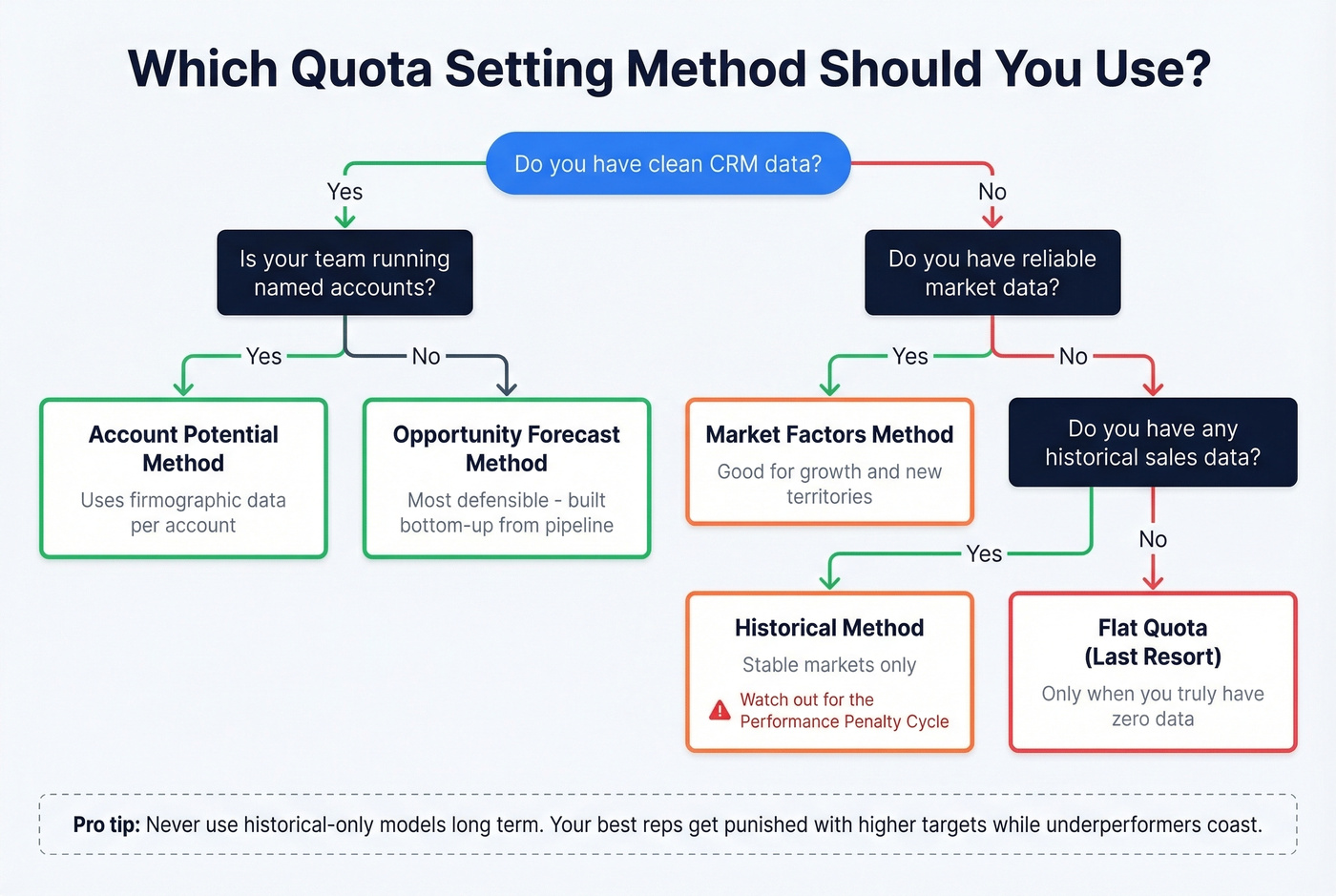
Start with opportunity forecast if your CRM data is clean. It's the most defensible because it's built bottom-up from actual pipeline. Fall back to market factors if you don't have CRM discipline yet. Never use flat quotas unless you genuinely have zero data.
Historical-only quota setting creates a "Performance Penalty Cycle" where your best reps get punished with higher targets while underperformers coast on low baselines year after year. The SalesGlobe framework covers these tradeoffs in depth, and the consensus on r/sales tracks with their analysis - reps hate historical-only models because they feel like a tax on success.
If you need a cleaner way to segment quotas by role and motion, start with a B2B sales baseline and then layer in funnel metrics that match your cycle length.
Mistakes That Kill Quotas
The "last year + 20%" trap. Look, this approach isn't ambitious - it's lazy math. We watched a company bump quotas 20% across the board without adjusting for market conditions. Only 25% of reps hit quota and churn spiked 40%.
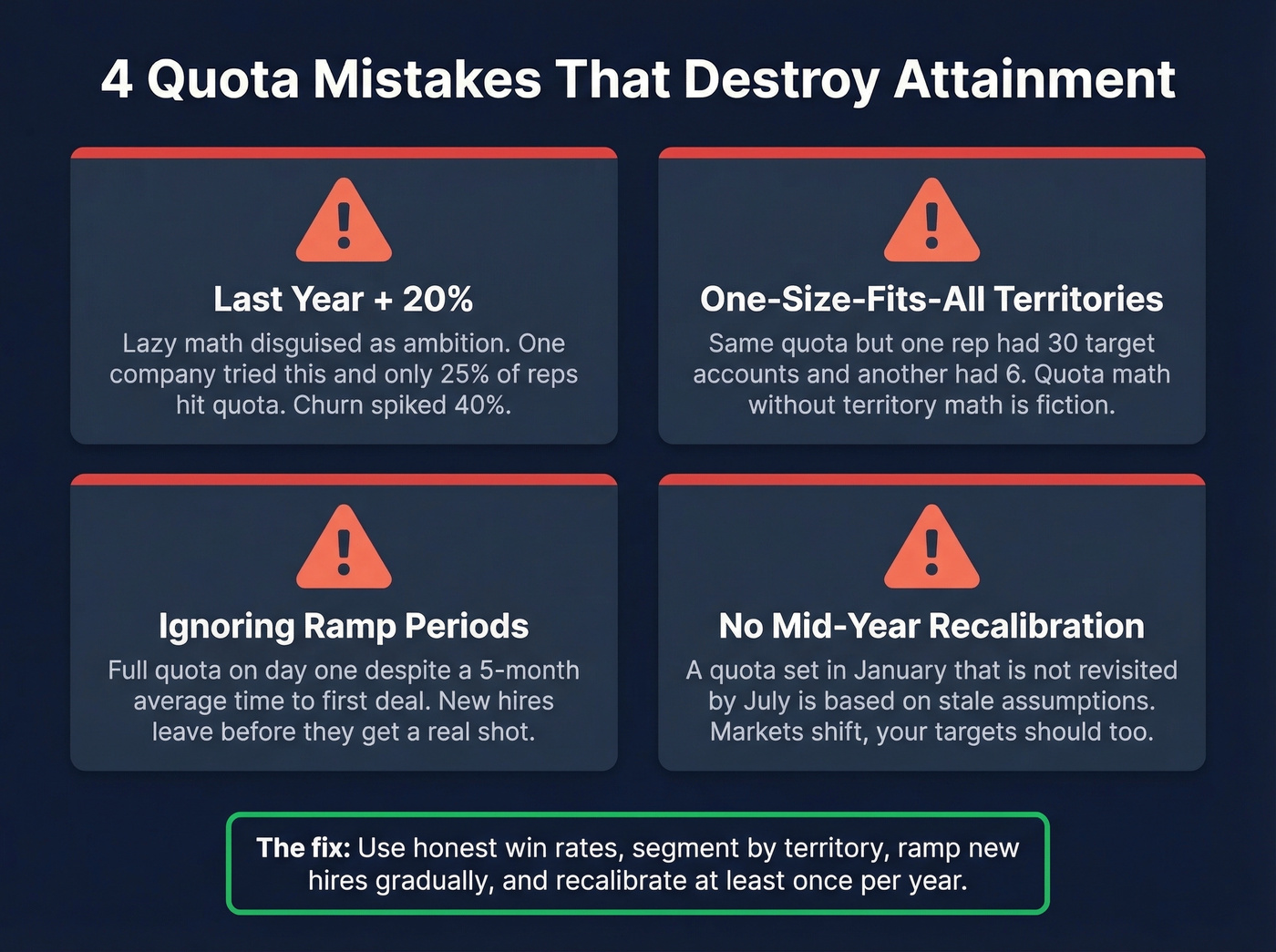
One-size-fits-all territories. Same quota, but one rep had 30 target accounts and another had 6. Quota math without territory math is fiction.
Ignoring ramp entirely. Full quota on day one despite a 5-month average time-to-first-deal. That's a setup for failure that drives new hires out the door before they ever get a real shot. (If you're rebuilding onboarding, use a 30-60-90 day plan to align ramp expectations.)
No mid-year recalibration. A quota set in January that isn't revisited by July is based on stale assumptions. Stop calculating quota attainment and start calculating quota realism - even the best formula degrades when market conditions shift mid-cycle. If you're not recalibrating at least once, skip this if you want to keep pretending your Q4 forecast is accurate.
If your pipeline is "there" but not converting, the issue is often sales pipeline challenges plus list decay. Fixing email bounce rate and email deliverability is usually the fastest way to make coverage real again.
Snyk's 50 AEs cut bounce rates from 35-40% to under 5% and grew AE-sourced pipeline 180%. When your reps need 3-5x coverage to hit quota, every reachable contact matters. Prospeo's 300M+ verified profiles at $0.01/email make the math work.
Give your reps pipeline coverage that actually holds up against quota.
What's a realistic quota attainment rate?
In 2024, only 31% of reps exceeded quota - the "80-90% should hit" benchmark is a myth. Realistic planning assumes 30-40% of your team will reach 100%+. If more than half your reps are crushing it, your quotas are set too low and you're leaving revenue on the table.
How do I calculate pipeline needed to hit quota?
Divide your quota by your win rate. At a 20% win rate, a $500K quota requires $2.5M in pipeline. The formula is simple; the hard part is using an honest win rate instead of the optimistic one your CRM reports.
How does data quality affect attainment?
Bad contact data means bounced emails, dead sequences, and pipeline that exists on paper only. If a third of your emails bounce, effective pipeline coverage drops by a third. Meritt tripled pipeline from $100K to $300K/week after fixing their data quality, and their bounce rate went from 35% to under 4%.
Does this calculator scale for different team sizes?
Yes. The underlying math works whether you're planning across 5 reps or 500. The core inputs stay the same: win rate, average deal size, pipeline coverage, and ramp time. What changes is how you segment quotas by territory, role, and experience level.