

Sales Readiness in 2026: The Operating Manual Nobody Gave You
Your newest AE scored 94% on the product certification quiz. Two days later, she froze on a discovery call when the prospect asked how your platform handles SOC 2 compliance - a question that comes up in half of enterprise deals. The quiz tested recall. The call tested readiness. They're not the same thing.
That gap is everywhere. 69% of B2B sales reps missed quota in 2025, and it wasn't because they skipped onboarding. Most organizations confuse training completion with actual preparedness. Sales readiness is the bridge between knowing the material and executing under pressure, and almost nobody builds that bridge deliberately.
What Sales Readiness Actually Means
Selling Power frames it as a simple equation: continuous training and coaching + knowing how to use enablement tools = readiness. That's the cleanest definition out there. It isn't a one-time event. It's the ongoing state of being prepared and confident to engage a buyer at any stage of the deal cycle.
Why does "ongoing" matter so much right now? Because [96% of prospects research](https://www.hubspot.com/marketing-statistics) before engaging a rep, and 71% prefer independent research over talking to sales at all. Your reps aren't walking into blank-slate conversations anymore - they're walking into rooms where the buyer already has opinions, competitive comparisons, and pricing expectations.
A rep who completed onboarding six months ago but hasn't been continuously sharpened is functionally unprepared. The common organizational failure is providing training or tools but never bridging them into execution. Reps get a week of boot camp, a login to the content library, and a pat on the back. That's not readiness. That's hope.
Readiness vs. Training vs. Enablement
| Dimension | Sales Training | Sales Enablement | Sales Readiness |
|---|---|---|---|
| Scope | Time-bound programs | Ongoing resources | Continuous system |
| Focus | Skill building | Tools, content, process | Execution confidence |
| Ownership | L&D / HR | Enablement / RevOps | Cross-functional |
| Measurement | Completion rates | Content usage, adoption | Revenue impact |
| Buyer alignment | Limited | Moderate | Strong |
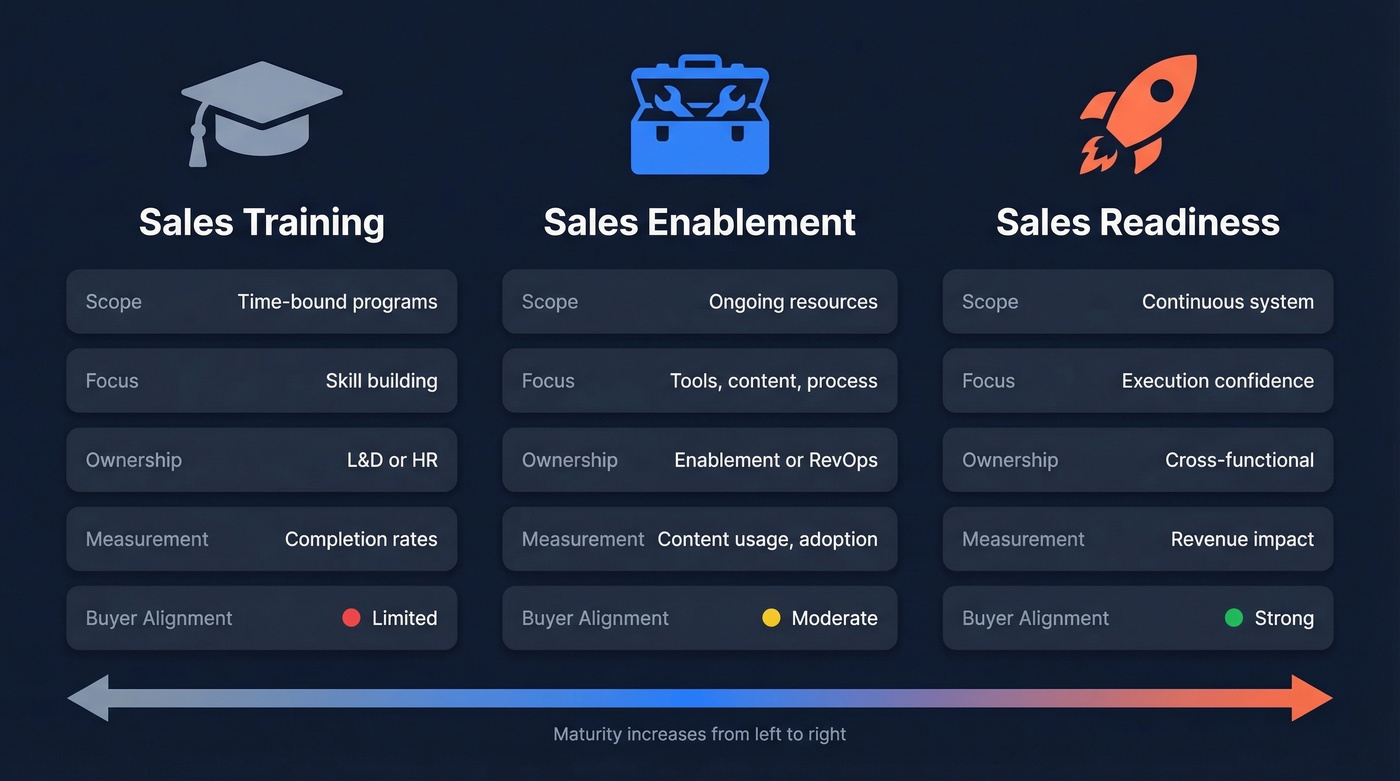
Training builds skills. Enablement equips reps with tools and content. Readiness is the layer that ensures reps can actually perform when it counts - on a live call, in a negotiation, during a competitive displacement. Let's be honest: most companies invest heavily in the first two and barely acknowledge the third.
Why It Matters Now
Effective sales training delivers 353% ROI - $3.53 back for every dollar spent. The global sales training market is projected to grow from $10.32B in 2024 toward $19B by 2032, and the enablement platform market is projected to hit $8.79B by 2029. Organizations with an enablement strategy achieve 49% more wins on forecasted deals. This isn't a nice-to-have line item anymore.
Three forces are accelerating the urgency. First, deal complexity: 81% of revenue leaders say [deals are more complex](https://blog.hubspot.com/sales/sales-statistics) than ever - more stakeholders, longer cycles, higher scrutiny. Second, buyer self-education has made the first rep interaction a high-stakes audition rather than a discovery session. Third, the enablement platform market is consolidating fast. Seismic and Highspot announced a merger in February 2026, Showpad merged with Bigtincan in October 2025, and Gong expanded into full revenue enablement. The tools are getting more powerful, which means the gap between teams that use them well and teams that don't is widening.
And there's channel-level pressure too: 69% of cold email senders report performance declined year over year. Reps can't brute-force their way to quota anymore. Genuine seller preparedness - not just activity volume - is the only sustainable edge.
The 4 Types of Readiness
Not every readiness initiative looks the same. Understanding which type you need prevents the common mistake of applying a one-size-fits-all program.
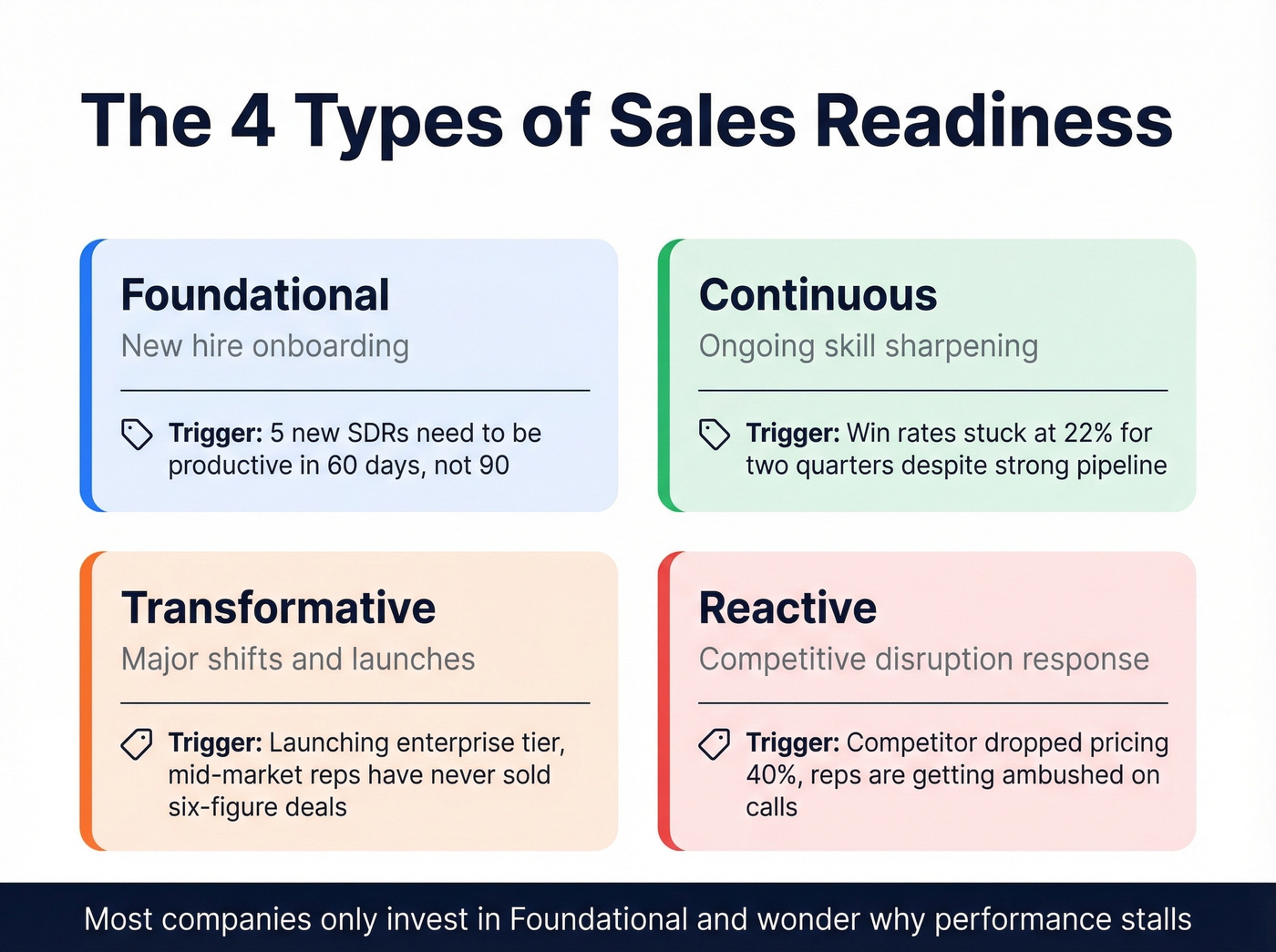
Foundational readiness covers new hire onboarding - getting reps from zero to competent. Trigger: you just hired five SDRs and need them productive within 60 days instead of 90. (If you want a concrete ramp plan, use a 30-60-90 day plan as the backbone.)
Continuous readiness is ongoing skill sharpening for tenured reps. Trigger: win rates have plateaued at 22% for two consecutive quarters despite a strong pipeline.
Transformative readiness kicks in during major shifts - new product launches, market expansions, or pricing model changes. Trigger: you're launching an enterprise tier and your mid-market reps have never sold six-figure deals. (This is where an enterprise deal motion needs different readiness gates.)
Reactive readiness responds to competitive disruption or market changes. Trigger: your biggest competitor just dropped pricing 40% and your reps are getting ambushed on calls with no battlecard to reference. (Ship battlecard updates like product releases.)
Most organizations only invest in foundational readiness and wonder why performance stalls after onboarding.
How to Build a Sales Readiness Program
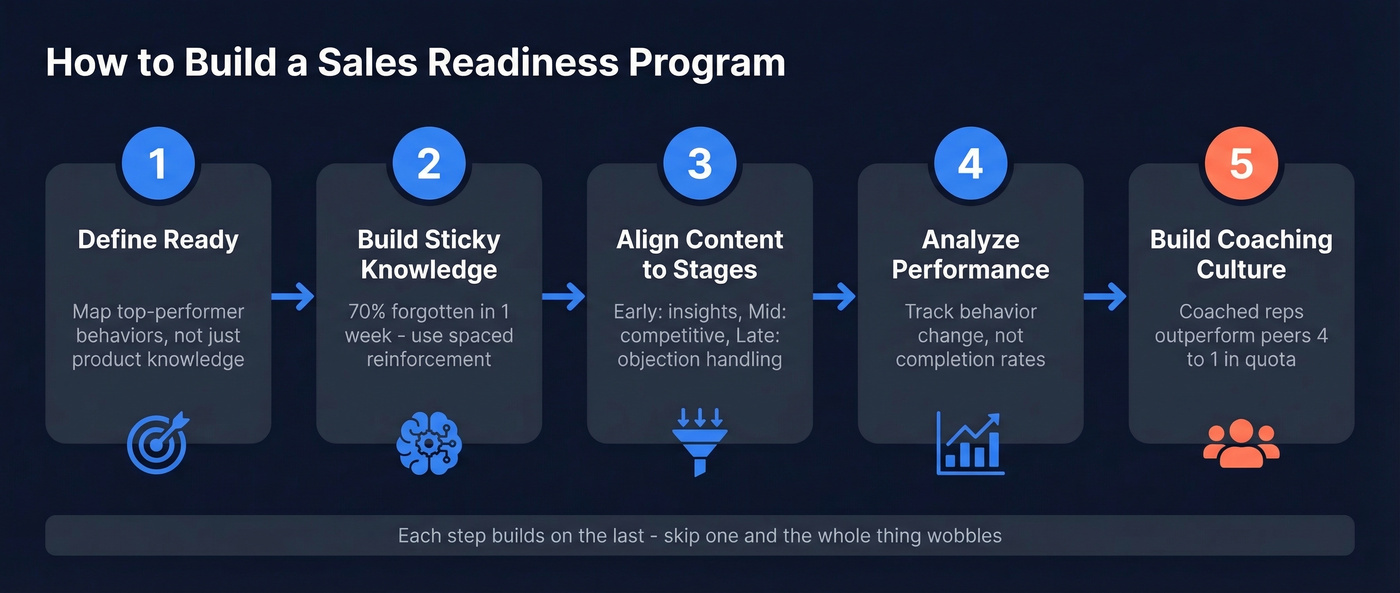
Each step builds on the previous one. Skip a step and the whole thing wobbles.
Step 1: Define What "Ready" Looks Like
You can't measure readiness if you haven't defined it. Identify the specific behaviors and metrics that distinguish your top performers from the middle of the pack. This isn't "knows the product." It's "can articulate the ROI story for a CFO in under 90 seconds" or "handles the competitive displacement objection without escalating to management."
Advanced teams use frameworks like BPEC (Buying Process Exit Criteria) to map what each decision-maker needs at each stage, paired with COIN-OP (Challenges, Opportunities, Impacts, Needs, Outcomes, Priorities) to build deeper persona understanding. We've found that teams who skip this definition step end up training reps on everything instead of what actually moves deals.
Step 2: Build Knowledge That Sticks
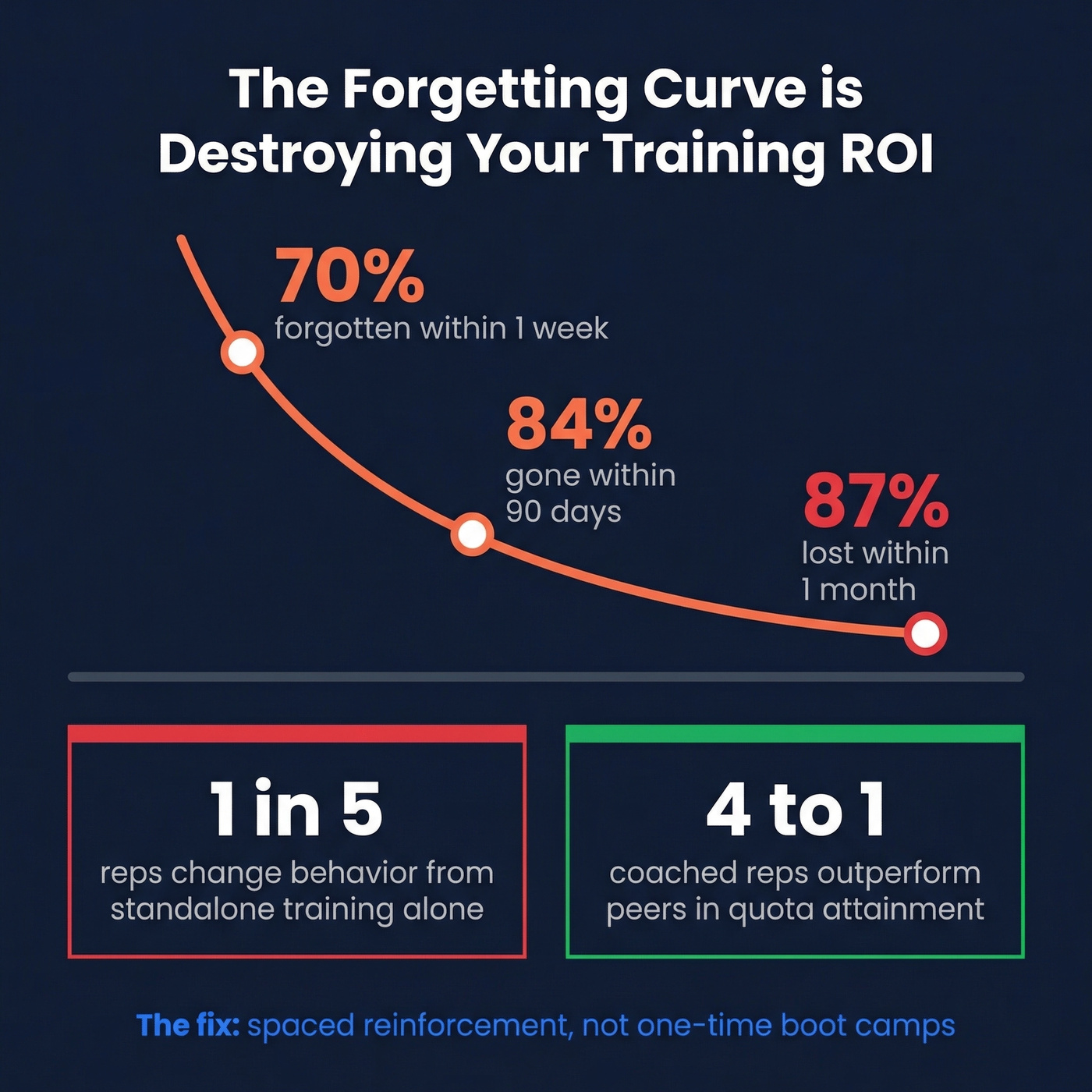
Here's where most programs fail. 70% of training content is forgotten within a week. 87% within a month. That's the forgetting curve in action, and it's brutal.
The fix is spaced reinforcement - short, repeated practice sessions spread over weeks rather than a single boot camp dump. Vary the mechanics: micro-learning modules, scenario-based exercises, peer teaching, and live role-plays. One enablement leader we spoke with described it as "reps need reps" - the gym analogy is overused, but it's accurate. You don't get strong from one workout. (For more tactics, see these sales training tips that actually stick.)
Step 3: Align Content to Buyer Stages
The content that works in a first meeting is useless in a negotiation. Early-stage conversations need insight-led content. Mid-funnel needs competitive positioning and ROI frameworks. Late-stage needs objection-handling playbooks and executive-ready materials.
Map your content library to these stages and make it searchable. Unused marketing content costs enterprises $2.3M annually in missed opportunities. That number should make your marketing team uncomfortable.
Step 4: Analyze Performance, Not Completion
Completion rates are vanity metrics. The question isn't "did they finish the module?" It's "did their behavior change?" Track call quality scores, deal velocity, stage conversion rates, and competitive win rates. Correlate these back to specific training interventions. Only 1-in-5 reps change on-the-job performance from standalone training - the other four need reinforcement and coaching to translate knowledge into action. (Tie this to sales execution metrics, not LMS dashboards.)
Step 5: Build a Coaching Culture
Reps receiving regular structured coaching outperform peers 4-to-1 in quota attainment. That's not a marginal improvement - it's a different league entirely. Build coaching into the operating rhythm: manager-to-rep 1:1s, team-level call reviews, peer-to-peer practice, and manager-to-manager calibration. Coaching isn't a bolt-on. It's the engine that makes everything else work. (If you're building the org around this, start with sales leadership systems.)

Readiness without reliable contact data is theater. Your reps can nail every role-play and still miss quota if they're calling wrong numbers and bouncing emails. Prospeo delivers 98% email accuracy and 125M+ verified mobiles - so when your team is finally ready to execute, the data doesn't let them down.
Stop training reps to perfection, then handing them bad data.
Phased Launch Checklist
Adapted from the Product Marketing Alliance's launch readiness framework, this three-phase checklist works for new product launches, market expansions, or major program rollouts.
| Phase | Timeline | Key Actions |
|---|---|---|
| Pre-Launch | 4-6 weeks | Training curriculum, battlecards, ICP validation, role-play certification, territory/quota updates, messaging validation |
| Launch | 1-2 weeks | Completion tracking, outreach templates, CRM setup, target account prioritization, escalation paths, reinforcement role-plays |
| Post-Launch | First 30 days | Reinforcement training, performance dashboards, win/loss reviews, pipeline reviews, feedback loops, ROI tracking |
The mistake most teams make is treating launch day as the finish line. Post-launch reinforcement is where readiness either solidifies or evaporates. Build the 30-day review cadence before you launch, not after.
How to Measure Readiness: Benchmarks
Use the AIR taxonomy to structure your measurement: Activities (daily inputs), Indicators (weekly/monthly signals), and Results (quarterly outcomes). Measuring only results is shortsighted - by the time you see a win-rate decline, you've already lost the quarter. Activities and indicators give you early warning. (If you need a clean list of inputs, start with sales activities.)
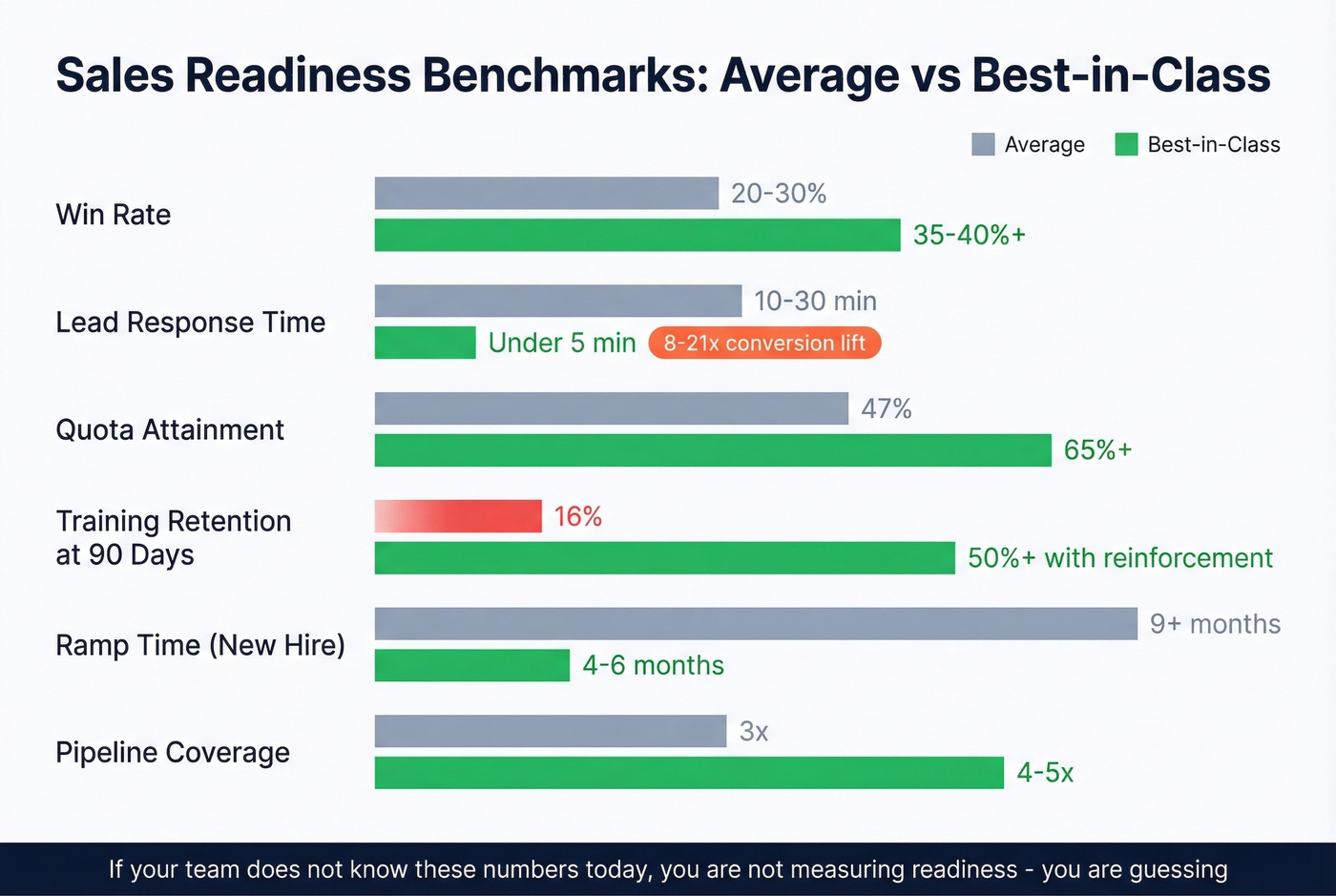
Here are the benchmarks most teams don't have but desperately need:
| KPI | Average | Best-in-Class |
|---|---|---|
| Win rate | 20-30% | 35-40%+ |
| Lead response time | 10-30 min | Under 5 min (8-21x conversion lift) |
| Pipeline coverage | 3x minimum | 4-5x if win rate is low |
| Meeting to opportunity | 25-30% | 35-40% |
| SDR conversations/day | 15-20 | 20+ |
| AE conversations/day | 8-12 | 12+ |
| Quota attainment | 47% | 65%+ |
| Training retention (90 days) | 16% | 50%+ with reinforcement |
| Ramp time (new hire) | 9+ months | 4-6 months |
Three formulas worth tracking monthly: Monthly sales growth % = (current month - prior month) / prior month x 100. Target attainment % = actual revenue / target x 100. Quote-to-close % = closed deals / quotes sent x 100.
If your team doesn't know these numbers today, you're not measuring readiness. You're guessing. (To pressure-test your leading indicators, use a pipeline health view.)
7 Mistakes That Kill Readiness ROI
1. Boot Camp With No Reinforcement
The data is damning: 50% of training isn't retained within five weeks, and within 90 days, 84% is lost. A one-week boot camp followed by "go sell" is the most expensive way to accomplish nothing. Build reinforcement loops - weekly micro-sessions, monthly scenario drills, quarterly certifications.
2. Measuring Completion Instead of Behavior
"100% of reps completed the training" tells you nothing about whether they can execute. Track behavior change: are reps using the new discovery framework on calls? Are competitive mentions being handled differently? Completion is an input. Behavior is the output that matters.
3. One-Size-Fits-All Learning Paths
Your enterprise AE and your inbound SDR don't need the same training. Segment by role, tenure, and performance tier. Top performers need advanced competitive scenarios. New hires need foundational product knowledge. Struggling reps need targeted coaching on specific skill gaps. In our experience, the teams that resist segmentation are usually the ones complaining loudest about training ROI.
4. No Structured Coaching Cadence
Only 26% of reps receive weekly coaching. That's a leadership failure, not a rep failure. The cost is concrete: teams with structured coaching see 25% higher quota attainment and 30% more deals won. Without a weekly cadence - 1:1s with call reviews, monthly skill assessments, quarterly development plans - coaching becomes ad hoc and inconsistent.
5. Tool Overload Without Integration
Nearly 70% of salespeople feel overwhelmed by their tech stack, and sellers spend only 30% of their time actually selling. A thread on r/techsales put it bluntly: tools that "stick" are the ones that keep training short and integrate directly with CRM workflows. Adding another login doesn't improve preparedness. Embedding learning into the tools reps already use does. (If you're evaluating the stack, start with SDR tools and work backward from workflow.)
6. Skipping Certification Before Go-Live
Only 18% of buyers believe salespeople are well-prepared. That perception exists because too many organizations let reps engage prospects before they've demonstrated competency. Build a certification gate - scenario-based assessments, not multiple-choice quizzes - before reps touch live deals.
7. Ignoring Prospect Data Quality
Here's the thing: your reps can be perfectly trained, fully certified, and armed with great content - and still waste a third of their selling time chasing dead ends because the prospect data is garbage. That's not a training problem. It's a data problem masquerading as a performance problem. (If bounces are creeping up, start with email bounce rate benchmarks and fixes.)
We've seen this play out repeatedly. GreyScout watched their bounce rate drop from 38% to under 4% after switching to Prospeo, and rep ramp time fell from 8-10 weeks to 4 weeks. Data quality is a readiness input, and ignoring it undermines everything else you've built.
AI and Seller Preparedness in 2026
AI coaching isn't a future trend. It's current infrastructure. Allego's AI in Revenue Enablement Report shows 60% of teams now use AI for real-time call feedback, 57% run AI-driven coaching simulations, and 53% use personalized AI coaching plans. The impact: 63% report improved coaching quality, 44% say AI reduced onboarding time, and 48% tie AI adoption directly to revenue growth.
The case studies are stacking up. One organization saved 400+ hours per certification cycle after deploying AI-powered practice scenarios, pushing completion rates from 69% to 87% and certifying 2,000 sellers in 4 weeks instead of three months. Neuroscience research suggests AI-written feedback improves memory retention by 50% after 48 hours compared to traditional methods.
Highspot frames readiness as a continuous moving target rather than a fixed certification milestone. AI enables just-in-time retrieval during live calls and personalized scenario generation that adapts to each rep's weak spots. The teams treating AI coaching as a supplement to human managers - not a replacement - are seeing the strongest results.
Skip this if your average deal size is under $15k. You probably don't need a $50k+ enablement platform. A solid coaching cadence, a shared call library, and clean prospect data will get you 80% of the way there. The enterprise readiness stack is built for enterprise deal complexity. Don't over-tool a transactional sales motion.
Readiness Tools Worth Evaluating
The market is consolidating fast. The Seismic-Highspot merger, the Showpad-Bigtincan combination, and Gong's expansion into full revenue enablement mean fewer point solutions and more platform decisions.
Readiness scoring and certification: Mindtickle remains the leader with its Readiness Index scoring and AI role-play capabilities, typically $30-50k/year for mid-market contracts.
AI coaching: Allego has the strongest proof points on AI-driven practice and feedback, in a similar price range.
Conversation intelligence: Gong dominates here and is expanding into enablement workflows, with enterprise contracts running $40-100k+/year.
Content management: Seismic/Highspot (now merging) own the enterprise content layer at $50k+/year. Mid-market enablement platforms like SalesHood and Showpad/Bigtincan typically run $15-40k/year.
The practitioner criteria that actually matter: tools that stick keep training short and integrate with your CRM. If a platform requires a separate login that reps forget about, adoption will crater regardless of how good the features are.
Readiness platforms train your reps. But training on bad data wastes everyone's time. Prospeo fills that gap with 300M+ professional profiles, real-time email and mobile verification, and native integrations with Salesforce, HubSpot, and most major outreach tools. Plans start at $0.01 per email with a free tier to test. (If you're comparing vendors, start with data enrichment services and narrow from there.)
You read it above: 69% of cold email senders saw performance decline last year. Volume won't save you - data quality will. Prospeo refreshes every record on a 7-day cycle and removes spam traps and honeypots automatically, so your ready reps reach real buyers, not dead inboxes.
Cut your bounce rate below 4% like teams already using Prospeo.
Sales Readiness FAQ
What's the difference between sales readiness and sales enablement?
Enablement provides the tools, content, and processes reps need. Readiness ensures they can actually use those resources in live buyer conversations under pressure. Think of enablement as the equipment and readiness as the fitness to use it. Measure it by behavior change, not content consumption.
How long does a readiness program take to show results?
Expect leading indicators - ramp time improvements, certification pass rates, call quality scores - within 30-60 days of consistent execution. Lagging indicators like win rate and quota attainment typically shift within 2-3 quarters. Programs that drop reinforcement after month one rarely move the needle.
How do you measure sales readiness effectively?
Use the AIR framework: track Activities (daily inputs like calls and emails), Indicators (weekly signals like stage conversion and pipeline additions), and Results (quarterly outcomes like win rate and quota attainment). Don't overlook data quality either - email bounce rates above 5% signal a data problem undermining rep productivity.
What tools do you need for a readiness program?
At minimum, three layers: a coaching platform like Mindtickle, Allego, or SalesHood depending on budget; conversation intelligence for call review where Gong leads; and a verified data source so reps aren't burning time on bad contacts. Mid-market teams typically build an effective stack for $50-80k/year.
How does AI improve seller preparedness?
AI accelerates practice through role-play simulations without waiting for a manager, delivers real-time call analysis flagging missed discovery questions, and personalizes training by identifying each rep's skill gaps. Teams using AI coaching report 44% faster onboarding and 63% improvement in coaching quality.