

Sales Rep Coaching: A Practitioner's Guide to What Actually Works in 2026
It's Thursday afternoon. Your 1:1 with a struggling SDR is in ten minutes, and you haven't prepped because you spent the morning on a forecast call and the afternoon firefighting a slipping deal. So the "coaching session" becomes another pipeline review. You ask about the Acme deal, the rep gives you a status update, and you both leave feeling like nothing happened.
That pattern is killing sales teams. Quota attainment has cratered from 53% in 2012 to just 16% in 2024. The reps who need coaching most get the least. And the managers who want to coach can't find the time.
Here's the thing: most sales teams don't have a coaching problem - they have a prioritization problem. Developing your salespeople isn't hard. Finding 30 protected minutes per rep per week is.
What Coaching Actually Is (And Isn't)
The #1 complaint on r/sales and r/salesdevelopment is that "coaching" is really just deal inspection wearing a different hat. Here's the distinction that matters:
Training teaches skills in bulk - a workshop on objection handling, a methodology rollout, an onboarding bootcamp. Pipeline inspection reviews deal status: "Where's the Acme deal? When does it close?" Coaching develops individual skills through observation, feedback, and accountability over time.
A great 1:1 should be 20% inspection and 80% coaching. Most teams have that ratio inverted. External trainers don't stick. Pipeline reviews don't develop skills. Ongoing, individualized coaching is the only lever that compounds.
Why It Matters More Than Ever
Korn Ferry research, as cited by Allego, shows consistent coaching programs deliver 32% higher win rates, 28% higher quota attainment, and almost 30% lower voluntary turnover. Coached reps spend 23% more time selling and 21% less time on post-sales admin.

The perception gap is just as telling. The State of Sales Coaching 2025 survey - 1,600+ salespeople surveyed by My Sales Coach and Aircall - found that 94% of reps say coaching improved their performance and 82% called it critical to their success. Meanwhile, 43% of sales leaders don't even realize their reps want more coaching.
Bain's 2025 research found sellers spend 25% of their time actually selling. Coaching is how you make that 25% count.
The 30-Minute Session That Works
This is the centerpiece. The 10/10/10 framework is the simplest structure we've found that keeps sessions from drifting into pipeline interrogation.
The 10/10/10 Framework
- First 10 minutes - Pipeline & metrics. Quick health check. Where are deals stuck? Any red-flag accounts? This is your inspection window - keep it tight.
- Middle 10 minutes - Game tape. Review a specific call together. Not a summary. A specific moment at a specific timestamp. "Let's listen to the Acme call at 4:32 where the prospect raised budget concerns."
- Final 10 minutes - The human stuff. Roadblocks, motivation, career development, what's frustrating them. This is where trust gets built.
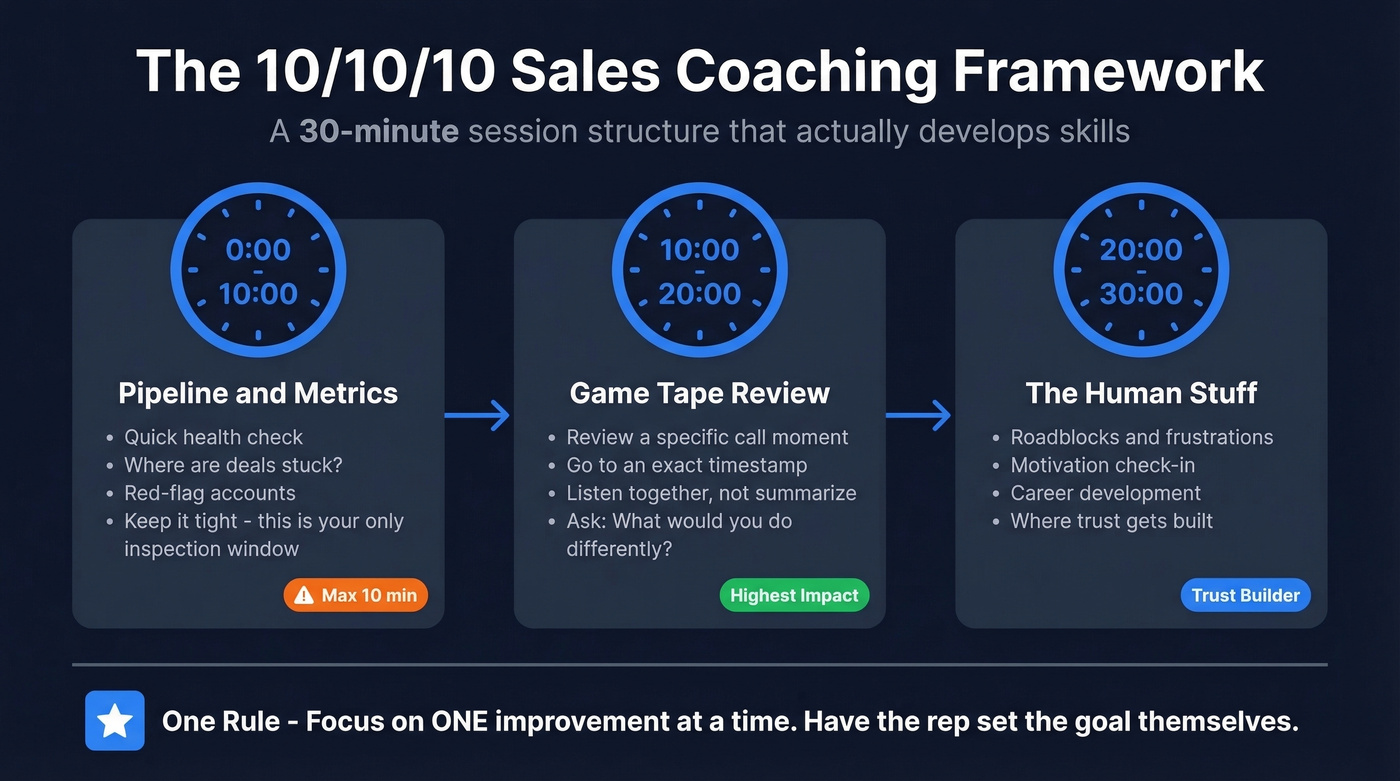
One rule that makes sessions dramatically better: focus on one improvement at a time. Don't give a rep five things to fix. Pick the single behavior that'll move the needle most this week. Have the rep set that goal themselves - rep-led goal setting increases buy-in and kills the "being managed at" feeling that poisons coaching cultures.
Prep Before the Session
The biggest mistake managers make is winging it. Require your rep to self-assess before the session - it reduces defensiveness and increases ownership. Both manager and rep should come prepared with a specific call moment to discuss, not a vague "I think the call went okay."
Seven Questions Worth Asking
- What's your biggest forecast risk this week?
- Which deal is missing a decision-maker?
- What's the one skill you want to improve this week?
- Walk me through how you handled the objection at [timestamp].
- What would you do differently on that call?
- What's blocking you that I can remove?
- What's one win from this week you're proud of?
Link every question to evidence - a call recording, a CRM note, a pipeline metric. Memory-based coaching is just opinion. Evidence-based coaching changes behavior.
Three Frameworks Worth Knowing
You don't need to pick one religion, but it helps to have a structure beyond "let's talk about your deals."
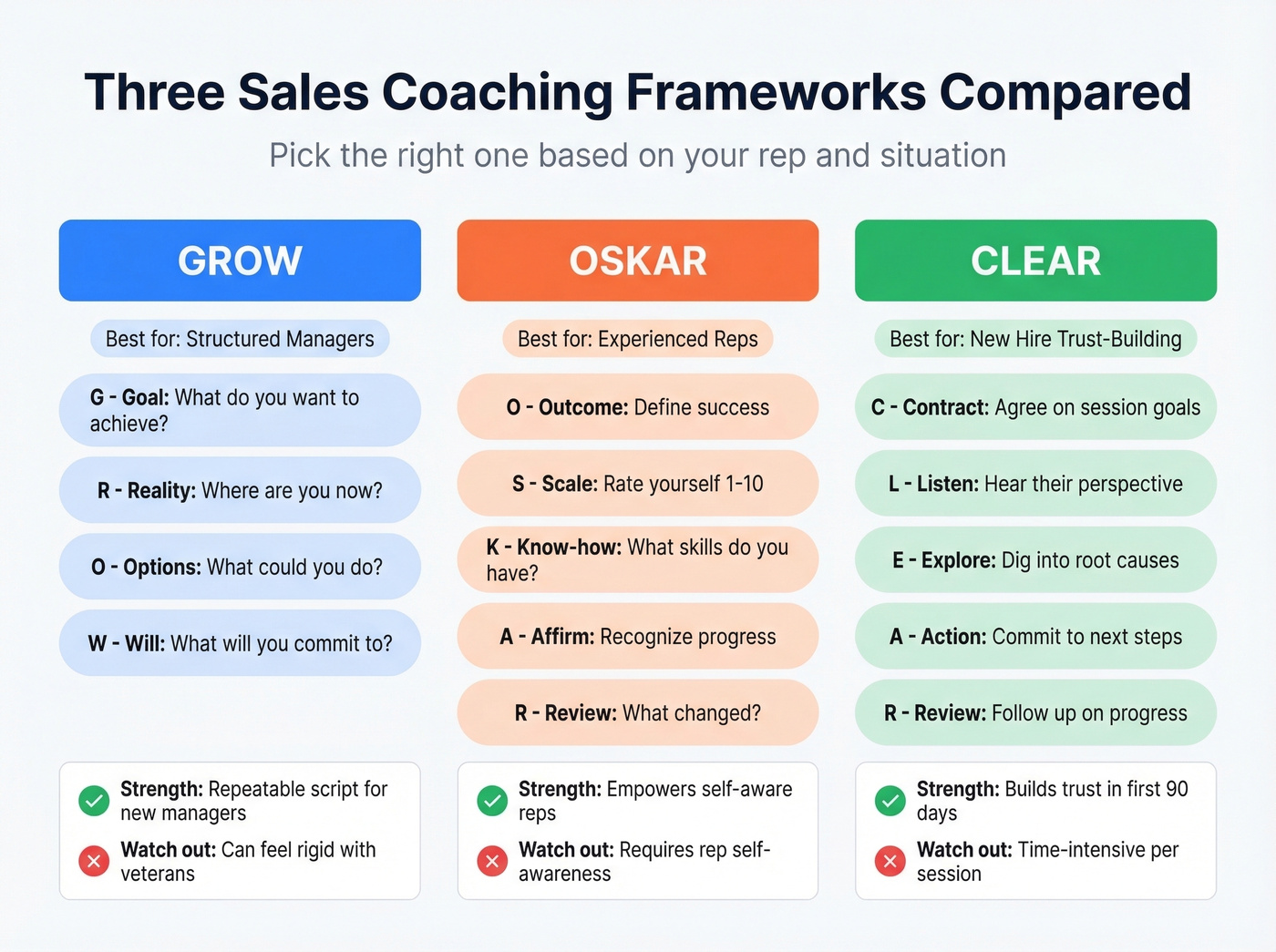
| Framework | Best For | Core Steps | Limitation |
|---|---|---|---|
| GROW | Structured managers | Goal → Reality → Options → Will | Can feel rigid with veterans |
| OSKAR | Experienced reps | Outcome → Scale → Know-how → Affirm → Review | Requires rep self-awareness |
| CLEAR | New hire trust-building | Contract → Listen → Explore → Action → Review | Time-intensive per session |
GROW is the most popular for a reason - it gives new managers a repeatable script. OSKAR works better when your reps already know what good looks like and need help getting unstuck. CLEAR is relationship-first, ideal for the first 90 days when a new hire doesn't trust you yet.

Coaching reps on discovery calls only works if they're talking to the right people. Prospeo gives your team 300M+ verified contacts with 30+ filters - buyer intent, job changes, technographics - so every coached rep walks into conversations with real decision-makers, not gatekeepers.
Stop coaching reps on calls that never should have happened.
Five Mistakes That Kill Coaching Impact
1. Coaching shows up too late. Monthly activity reviews are autopsies, not coaching. Kixie's research suggests coaching within 24 hours of a call makes reps 2.5x more likely to improve. If you're waiting for the monthly 1:1, you've already lost the moment.
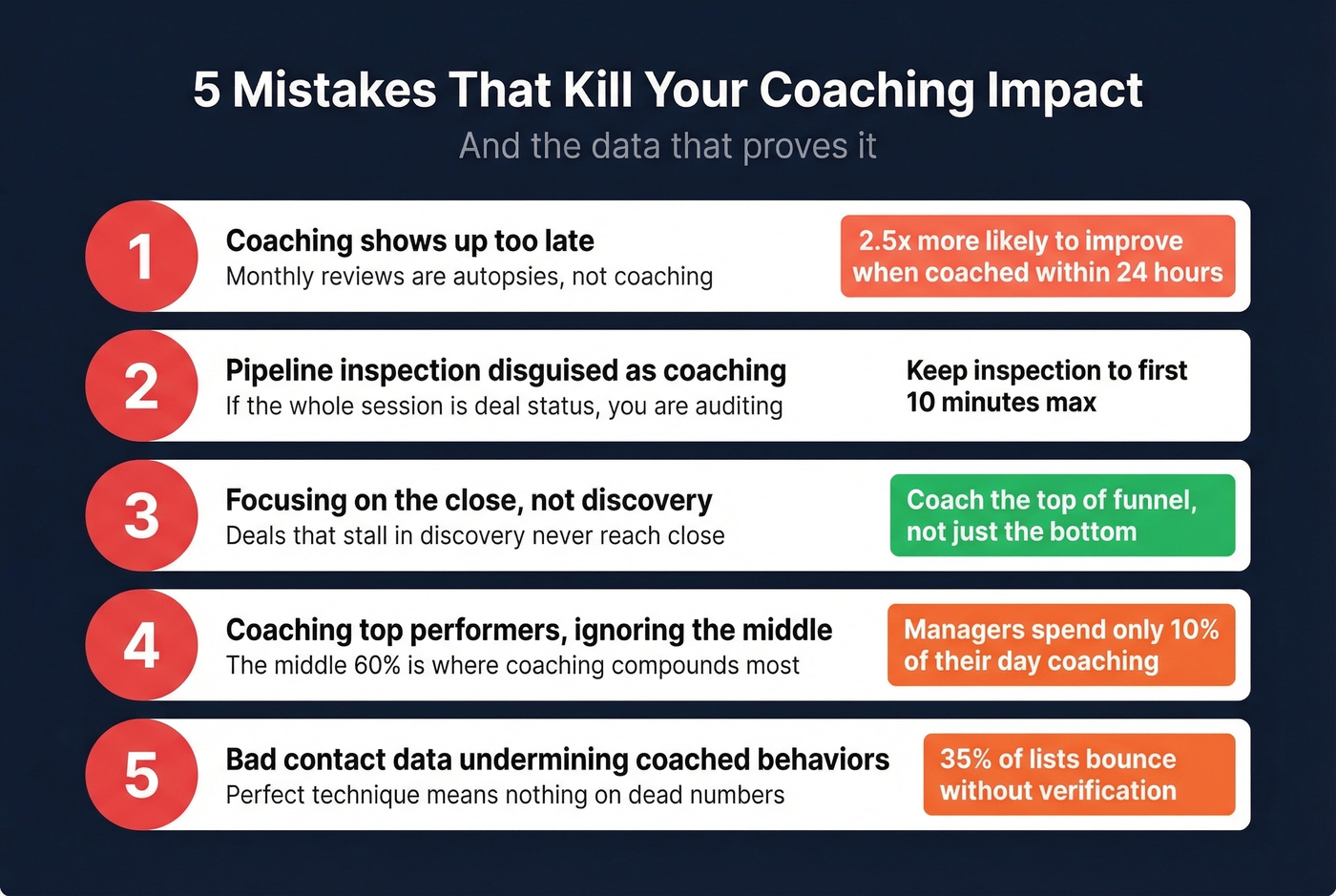
2. Pipeline inspection disguised as coaching. Reddit threads flag this constantly. If your entire session is "where's the Acme deal?" you're not coaching - you're auditing. Keep inspection to the first 10 minutes, max.
3. Focusing on the close instead of earlier-stage skills. Managers love inserting themselves at the finish line. But the deals that stall in discovery never make it to close. Coach the top of the funnel, not just the bottom. (If you need a tighter process, map it to clear steps to close a sale.)
4. Coaching top performers and ignoring the middle. Your top 20% will hit quota regardless. Your bottom 20% may need a different role. The middle 60% is where coaching creates the most return - and they're the ones most often neglected. The average sales manager spends no more than 10% of their day coaching. That time needs to go where it compounds.
Scaling tip: You can't give every rep an hour a week. Two tactics that work: assign one behavior per rep per month so you're not spreading thin, and run group call reviews where the team coaches each other on recorded calls. Peer feedback scales in ways manager-only coaching never will. Async video tools like Allego make this work even for distributed teams.
5. Bad contact data undermining coached behaviors. We've seen this pattern more times than we can count - a team invests in coaching, reps sharpen their technique, and conversion stays flat because 35% of the list bounces. You can run the perfect cold call opener workshop, and it means nothing if your reps are dialing dead numbers. Prospeo verifies emails at 98% accuracy and provides 125M+ verified mobile numbers, so coached behaviors translate to live conversations instead of voicemails and bounced emails. (For a broader stack view, compare data enrichment services and track your email bounce rate.)
Coaching by Rep Level
Not every rep needs the same approach.
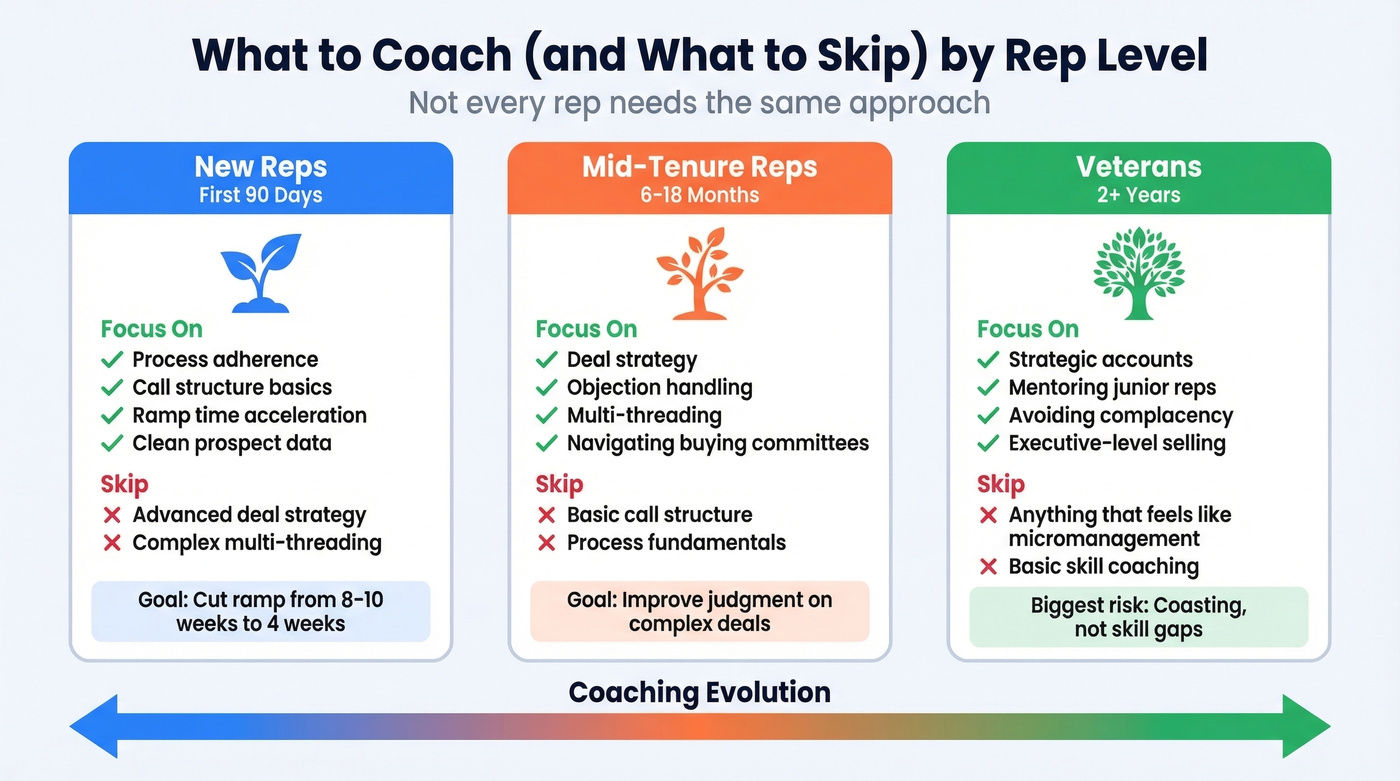
New reps (first 90 days) - Focus on process adherence, call structure, and ramp time. Skip advanced deal strategy; it overwhelms them. Structured onboarding paired with clean prospect data accelerates everything. GreyScout cut rep ramp time from 8-10 weeks to 4 weeks after cleaning up their data layer, so new reps spent time selling instead of chasing bad numbers. (Pair this with a clear 30-60-90 day plan.)
Mid-tenure reps (6-18 months) - Focus on deal strategy, objection handling, and multi-threading. These reps know the fundamentals; they need help with judgment calls and navigating complex buying committees. Skip basic call structure coaching - they've internalized it. (If objections are the bottleneck, use a system to reduce sales objection rate.)
Veterans (2+ years) - Focus on strategic accounts, mentoring junior reps, and avoiding complacency. Skip anything that feels like micromanagement. The biggest risk with tenured reps isn't skill gaps. It's coasting.
Best Coaching Tools for Sales Teams
You don't need a $50K platform to coach effectively. But the right tool saves hours of prep time and surfaces patterns you'd miss manually. Based on the G2 Winter 2026 Grid Reports:
| Tool | Category | Starting Price | Best For |
|---|---|---|---|
| Gong | Conversation intel | ~$120-250/user/mo + platform fee | Deep call analytics |
| Jiminny | Conversation intel | From $85/user/mo | Best value CI |
| Dialpad | Real-time coaching | ~$60-95/user/mo | Live call guidance |
| SalesLoft | Full platform | ~$125-165/user/mo | Existing SalesLoft users |
| Spekit | Enablement | From ~$20/user/mo | Budget teams |
| Allego | Enterprise enablement | ~$30K-80K+/yr | Large distributed teams |
| Mindtickle | Enterprise enablement | ~$30K-80K+/yr | Custom enterprise programs |
| Chorus | CI (ZoomInfo bundle) | ~$15K-40K+/yr bundled | ZoomInfo customers |
| Balto | Real-time guidance | ~$100-150/user/mo | Compliance-heavy industries |

Gong is the category leader for conversation intelligence. The analytics go deeper than any competitor - talk ratios, topic tracking, deal risk scoring. But it's wildly expensive for teams under 50 reps. A 10-seat deployment with the platform fee can easily run $25K-$50K/year. Worth it if you have the budget and the coaching discipline to actually use the insights. In the r/sales thread, Gong "didn't land" for one team because they lacked the coaching process to act on the data - which reinforces the point that tools don't create habits.
Jiminny gets you 80% of Gong's functionality at a fraction of the cost. From $85/user/month, it's the obvious pick for mid-market teams that want conversation intelligence without the enterprise price tag. If your budget won't stretch to Gong, start here.
Dialpad stands out for real-time AI coaching - live prompts during calls, not just post-call analysis. Strong for teams that need in-the-moment guidance, especially remote teams. Spekit is the budget entry point at ~$20/user/month - lightweight enablement for teams just starting to formalize their process. SalesLoft makes sense if you're already running sequences there. Allego and Mindtickle are enterprise enablement plays, typically $30K+ annually, best for organizations with dedicated enablement headcount. Chorus is often bundled with ZoomInfo packages. Balto is the specialist pick for compliance-heavy industries like insurance and financial services. (If you're evaluating call platforms, start with Dialpad alternatives.)
The Role of AI in Coaching
Bain's 2025 data shows 30% or better improvement in win rates when AI is paired with process redesign - not just bolted onto existing workflows. The "paired with process redesign" part matters enormously.
Buying Gong before you have a coaching cadence is like buying a Peloton before you've committed to exercising. The tool doesn't create the habit.
Real-time AI tools like Dialpad and Balto work best for new reps and compliance use cases - live prompts keep them on script. Post-call AI from Gong and Jiminny works better for deeper skill development, reviewing patterns across dozens of calls to identify systemic gaps. In the r/sales thread, Hive Perform got a positive mention for automated post-call coaching that doesn't require much manager time, which makes it interesting for async workflows where reps review AI-generated feedback on their own schedule.
The practical framework: use real-time AI to prevent mistakes, post-call AI to develop skills.
How to Measure Coaching ROI
Track these KPIs on two cadences:
Monthly (leading indicators): pipeline conversion rate by stage, call-to-meeting ratio, rep self-assessment scores, coaching session completion rate. (To tighten measurement, standardize your lead generation metrics and monitor pipeline health.)
Quarterly (lagging indicators): win rate delta pre/post coaching program, ramp time for new hires, quota attainment by cohort, rep retention rate.
Research shows a 72% correlation between well-designed coaching plans and higher engagement levels. If you're not measuring, you're guessing - and guessing is how coaching programs lose executive sponsorship. A manager running sessions without tracking outcomes is flying blind; the data is what earns continued investment from leadership.
Ramp time is a coaching problem and a data problem. Prospeo's 98% email accuracy and 30% mobile pickup rate mean new reps connect with prospects on the first attempt - cutting the trial-and-error that drags onboarding from 8 weeks to 4.
Give every rep enterprise-grade contacts at $0.01 per email.
FAQ
How often should coaching sessions happen?
Weekly 30-minute 1:1s are the minimum effective cadence. The 10/10/10 framework keeps sessions focused so they don't balloon into hour-long pipeline reviews. Consistency matters more than duration - a disciplined weekly rhythm beats sporadic deep-dives every time.
What's the difference between coaching and training?
Training teaches skills in bulk to groups - a methodology workshop, an onboarding program, a product certification. Coaching develops those skills individually through observation, feedback, and accountability over time. Training is the curriculum; coaching is the tutoring.
Can AI replace a manager's coaching?
No. AI surfaces patterns and saves prep time - flagging calls where a rep talked 80% of the time, or identifying deals missing a champion. But the human conversation drives behavior change. Tools like Gong or Jiminny are the diagnostic; the manager is the doctor.
What's the biggest barrier to effective coaching?
Time. The average manager spends 10% of their day on development, and most of that gets eaten by pipeline reviews. The fix is structural: protect 30 minutes per rep per week, prep with call recordings instead of memory, and focus on one behavior change at a time.
How does bad data undermine coaching efforts?
Reps can master every technique you coach and still miss quota if 30%+ of their contacts bounce. Cleaning up your data layer - through verification tools and regular list hygiene - ensures coached behaviors reach real prospects. GreyScout saw bounce rates drop from 38% to under 4% and pipeline jump 140% after fixing this exact problem.