

Sales Segmentation: Frameworks, Scoring Models, and Benchmarks That Drive Revenue
Your VP of Sales just asked why three reps are working the same enterprise account while 200 mid-market accounts sit untouched. That's not a pipeline problem - it's a sales segmentation problem. And it's costing you deals every single week.
The Short Version
Sales segmentation is the operational framework that determines which accounts reps work, what messages they send, and how pipeline gets prioritized. It's not market segmentation with a different label. The three highest-leverage decisions you can make: account tiering with ICP scoring, territory design based on data instead of geography, and pipeline segmentation by velocity. Every one of those decisions is downstream of data quality. If your contact records are six or more weeks stale, every tier and score you've built is based on lies.
The Segmentation Gap
81% of businesses say segmentation is critical for growth. Only 25% believe they're using it effectively. That gap isn't theoretical - it shows up in quota attainment. 78% of sellers missed quota last year, and the top 14% generated 80% of revenue.
The difference between those two groups isn't talent or effort. It's focus. Top performers know exactly which accounts to work and why. Everyone else is spraying activity across a territory and hoping something sticks.
Here's the thing: most advice on segmenting sales accounts is really market segmentation with a different label. That's why your reps still don't know which accounts to call first.
What Sales Segmentation Actually Is (And Isn't)
Most articles conflate three distinct concepts. They're related, but they serve different functions and different teams.
Sales vs. Market vs. Customer Segmentation
| Dimension | Market Segmentation | Customer Segmentation | Sales Segmentation |
|---|---|---|---|
| Scope | Entire addressable market | Existing customers | Active pipeline + targets |
| Owner | Marketing / Strategy | Marketing / CS | Sales / RevOps |
| Data source | Surveys, market research | CRM, purchase history | CRM + enrichment + signals |
| Output | Positioning, pricing | Retention, upsell plays | Rep behavior, territory design |
| Refresh cadence | Annually | Quarterly | Weekly to monthly |
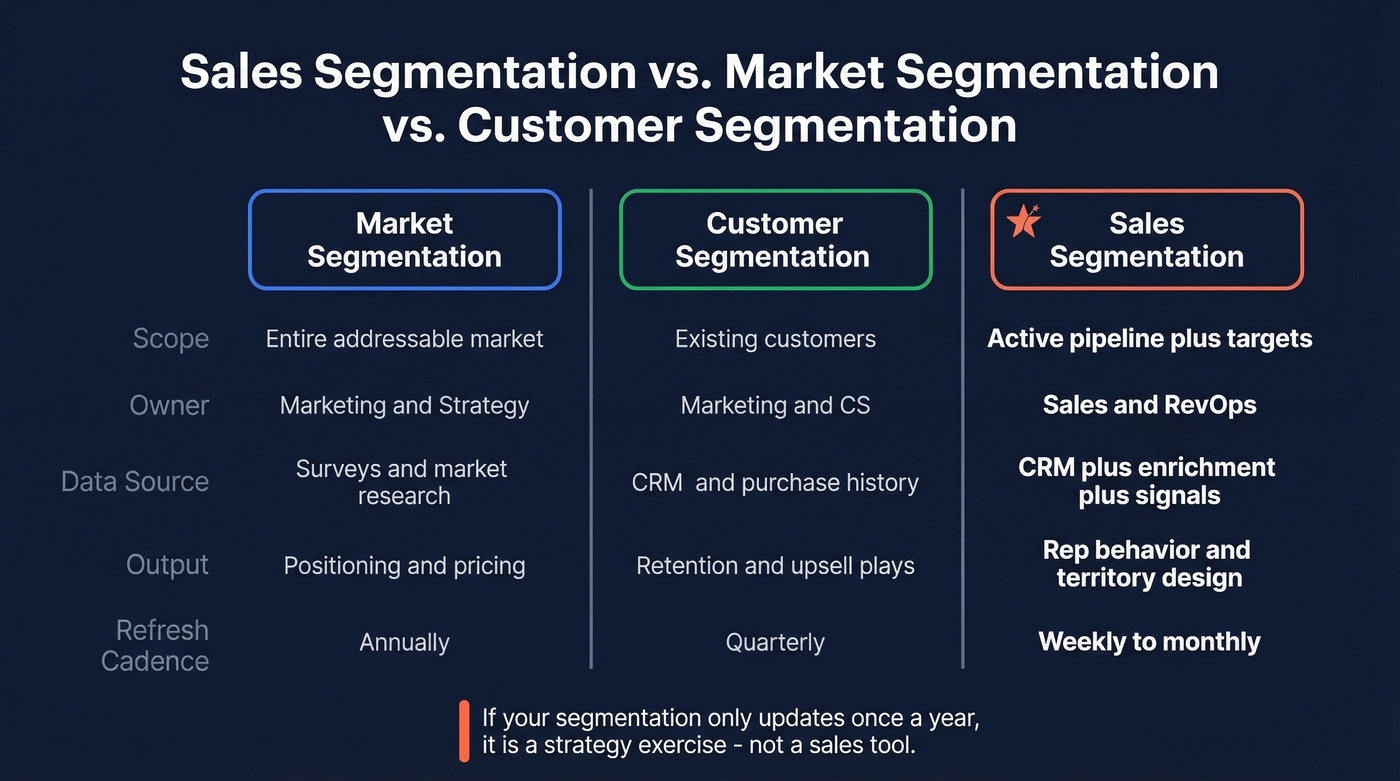
Market segmentation groups potential customers in a broad market for positioning and strategy. Customer segmentation groups existing buyers using first-party data like purchase history, CLV, and engagement patterns. The sales-specific layer is operational - it determines which accounts reps work, how territories get balanced, and how pipeline gets prioritized. That weekly-to-monthly refresh cadence is the giveaway: if your segmentation only updates once a year, it's a strategy exercise, not a sales tool.
The Actionability Test
If two segments get the same message, the same cadence, and the same rep behavior, they aren't real segments. They're just labels in your CRM. Every segment needs a distinct sales motion to justify its existence. If it doesn't change what a rep does on Monday morning, merge it or kill it.
Segmentation Types That Matter in B2B
Demographic, Geographic, Psychographic, Behavioral
These are foundational. Demographic segments by job title and seniority. Geographic splits by region or timezone. Psychographic groups by values and priorities. Behavioral clusters by actions - website visits, content downloads, email engagement. Every CRM can handle these. They're necessary but not sufficient.
Firmographic and Technographic
Firmographic segmentation - industry, company size, revenue, headcount growth, funding stage - is where B2B diverges from the marketing playbook. It's not enough to know someone's title; you need to know if their company fits your ICP structurally.
Technographic data adds another dimension: what tools does the company already use? If you sell a Salesforce integration and the prospect runs HubSpot, that's a different segment with a different motion. The combination of firmographic and technographic data turns a flat prospect list into a prioritized, actionable pipeline.
Intent-Based Segmentation
This is the dimension most guides skip entirely, and it's the one that matters most for outbound teams.
Intent-based segmentation uses buying signals - job changes, funding rounds, hiring patterns, tech adoption, content consumption on third-party sites - to identify accounts actively in-market. A VP of Sales who just joined a Series B company hiring five SDRs and researching sales engagement platforms isn't the same segment as a VP of Sales at a stable enterprise with no open headcount. Same title, completely different buying probability. Intent signals let you segment your target accounts by urgency, not just fit. Teams using trigger-based approaches see 4x higher conversions and 30% shorter sales cycles compared to static list outreach.
The Five-Variable Framework
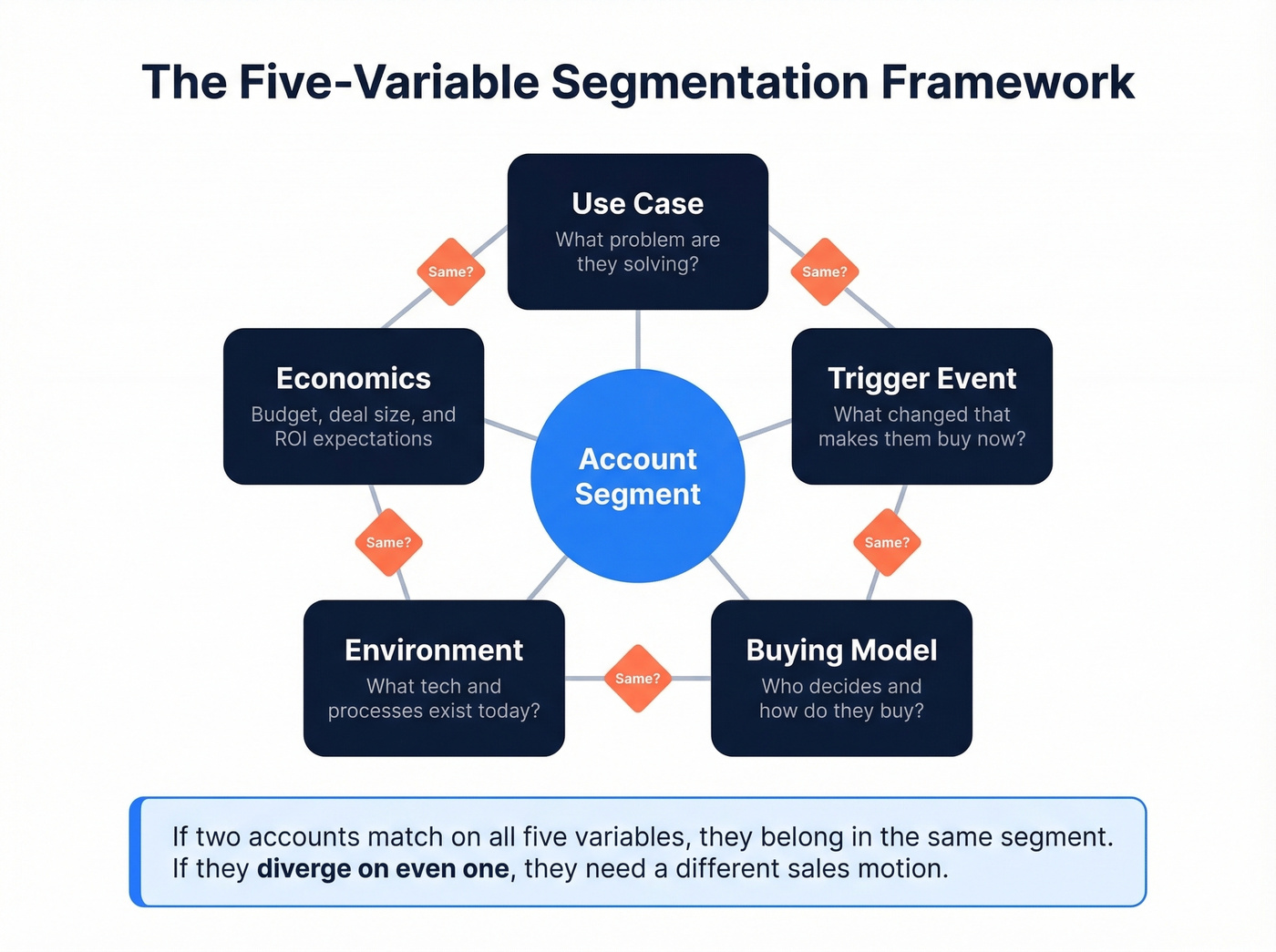
Advanced teams segment by five predictive variables: use case, trigger event, buying model, environment, and economics. If two accounts share the same values across all five, they belong in the same segment. If they diverge on even one, they need a different motion. This framework forces you to think about why someone buys, not just who they are.
Why Most Segmentation Efforts Fail
The failure patterns are predictable. We've seen the same ones across dozens of implementations.
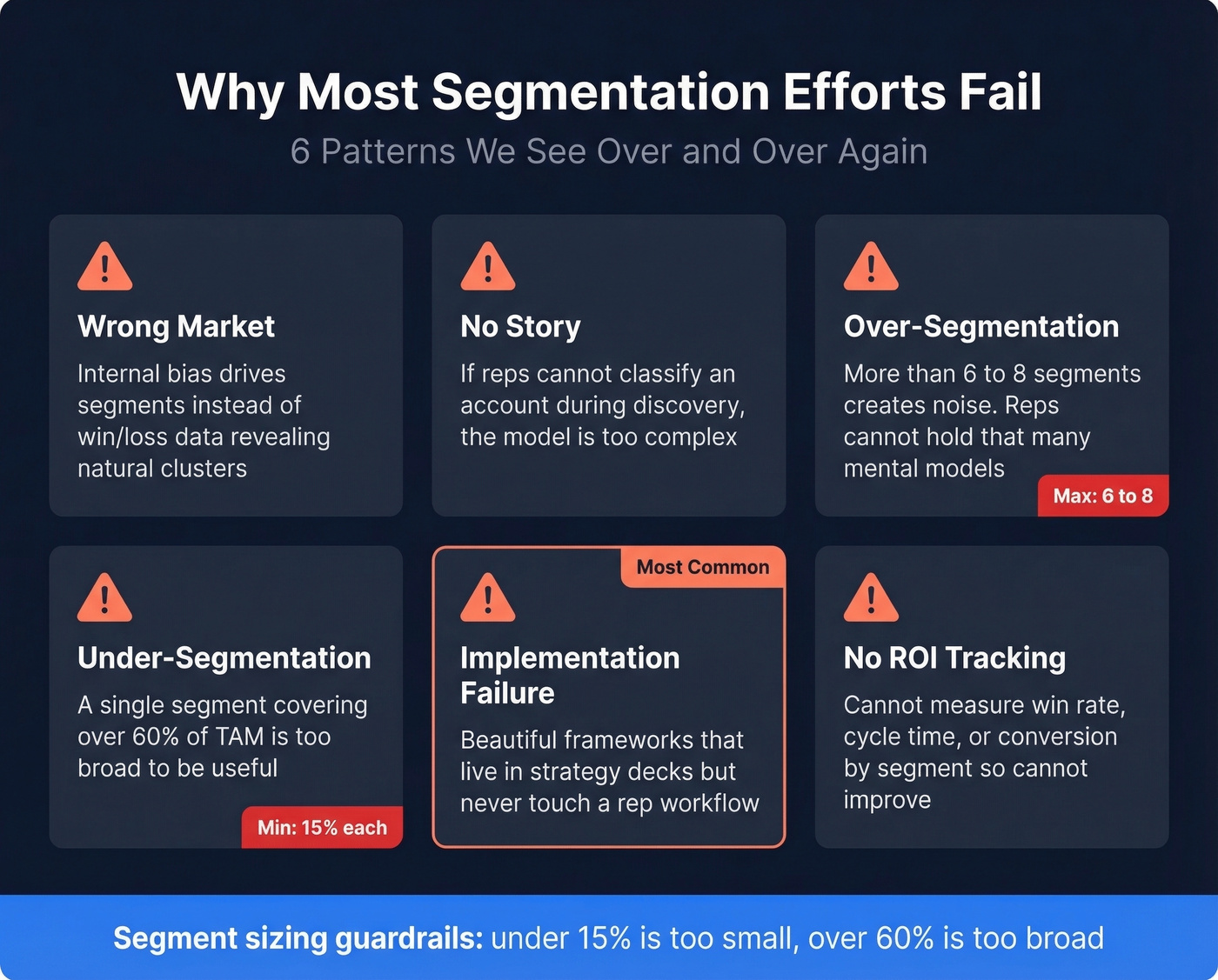
Segmenting the wrong market. Teams let internal bias drive segments instead of letting win/loss data reveal natural clusters.
No story. If reps can't classify an account into a segment during a discovery call, the model is too complex. Build your classification criteria using only information available at the discovery stage - if reps need post-demo data to classify an account, simplify.
Over-segmentation. More than 6-8 segments creates noise. Reps can't hold that many mental models, and each segment needs its own playbook.
Under-segmentation. A single segment covering more than 60% of your TAM is too broad to be useful. Segments under 15% struggle to attract enough investment to matter.
Implementation failure. The segmentation lives in a strategy deck but never makes it into CRM fields, territory assignments, or sequence logic. This is the most common killer we see - beautiful frameworks that never touch a rep's workflow.
No ROI tracking. If you can't measure win rate, cycle time, and conversion by segment, you can't prove the model works and you can't improve it.
The segment sizing guardrails are worth memorizing: under 15% is too small, over 60% is too broad.

Firmographic, technographic, and intent-based segmentation all depend on one thing: accurate, fresh data. Prospeo's 30+ search filters - including buyer intent, technographics, headcount growth, and funding stage - let you build segments that match the exact frameworks in this article. 98% email accuracy. 7-day refresh cycle. Every tier you build stays current.
Stop segmenting accounts with data that's already six weeks stale.
How to Build an Account Prioritization Model
This is the core framework. Everything else in the article supports it.
The Scoring Framework
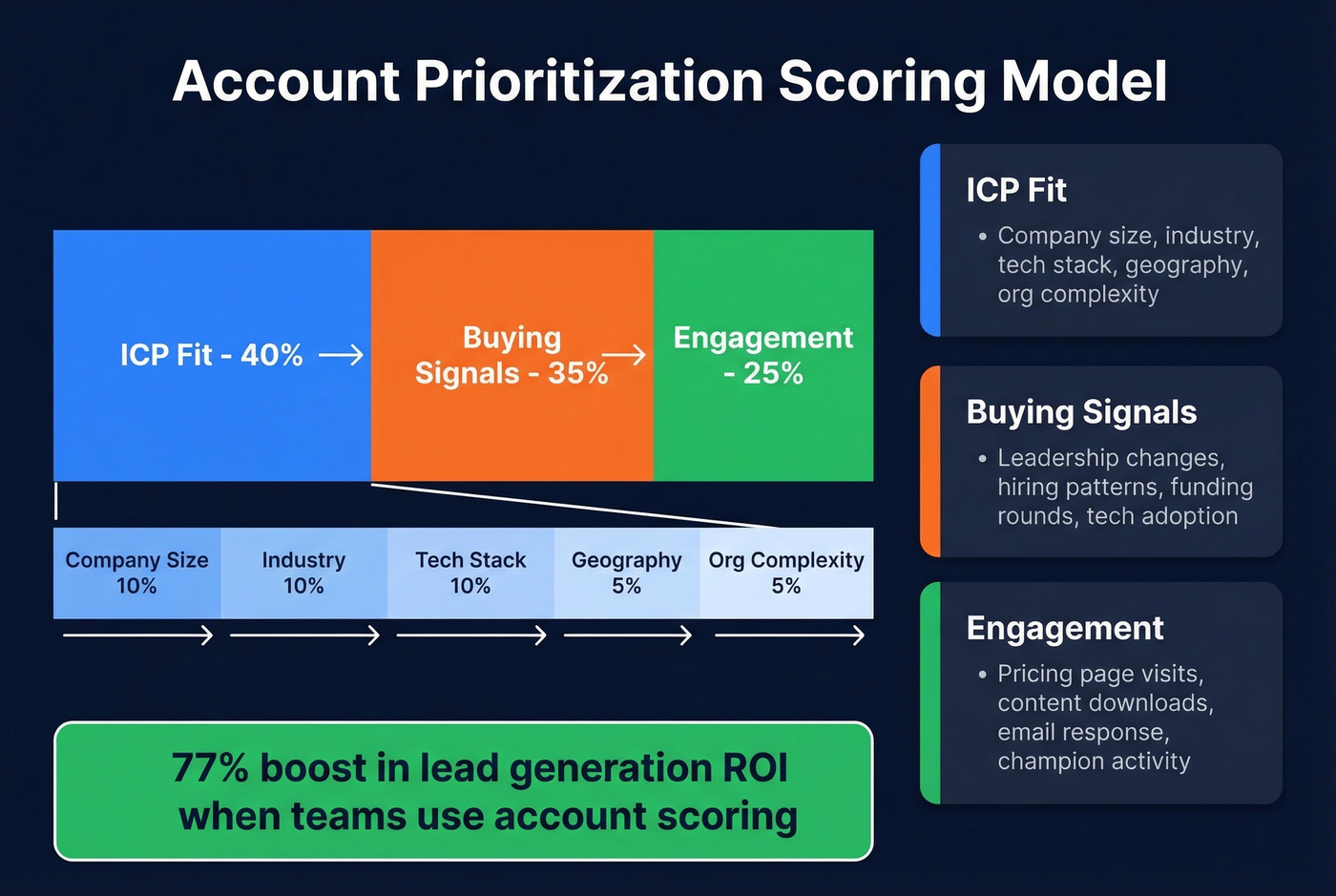
Account prioritization ranks accounts by fit, intent, and engagement to focus limited selling time. Here's a weighted model that works for most B2B teams:
| Category | Weight | What It Measures |
|---|---|---|
| ICP Fit | 40% | Company size, industry, tech stack, geography, org complexity |
| Buying Signals | 35% | Leadership changes, hiring patterns, funding/M&A, tech adoption |
| Engagement | 25% | Pricing page visits, content downloads, email response, champion activity |
Within ICP Fit, weight company size, industry, and tech stack at 10% each, geography at 5%, and org complexity at 5%. The ICP Fit score requires accurate firmographic and technographic data - and that data needs to reflect reality, not a snapshot from two months ago.
Businesses using lead and account scoring see a 77% boost in lead generation ROI. That's the difference between a team that hits plan and one that doesn't.
Turning Scores into Tiers
Scores are useless without actions.
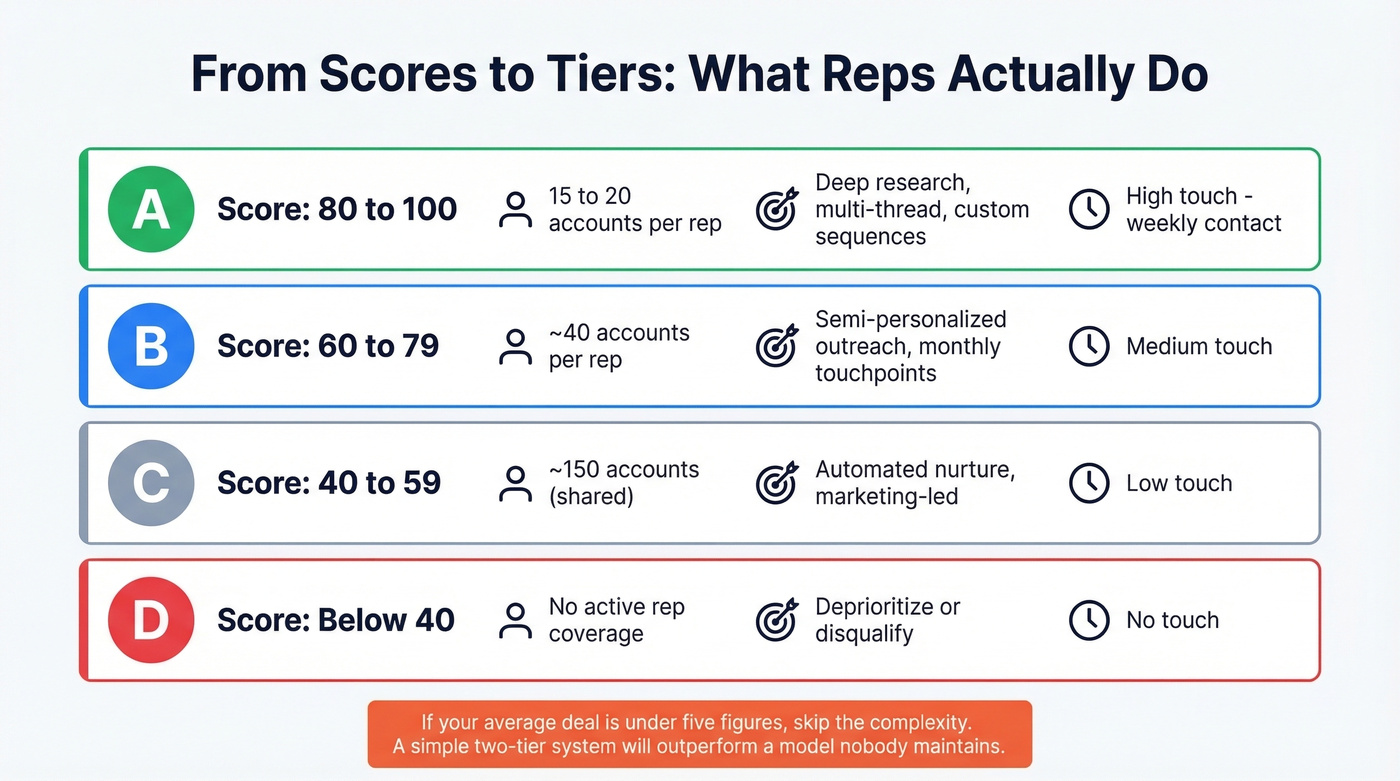
| Tier | Score Range | Rep Action | Coverage Model |
|---|---|---|---|
| A | 80-100 | Deep research, multi-thread, custom sequences | 15-20 accounts per rep |
| B | 60-79 | Semi-personalized outreach, monthly touchpoints | ~40 accounts per rep |
| C | 40-59 | Automated nurture, marketing-led | ~150 accounts (shared) |
| D | Below 40 | Deprioritize or disqualify | No active rep coverage |
Top performers focus deeply on 15-20 accounts, nurture about 40, and let automation handle the rest. That territory breakdown reflects the reality that selling time is finite and attention is the scarcest resource on any sales team.
Let's be honest: if your average deal is under five figures, you probably don't need a complex scoring model at all. A simple two-tier system - "fits ICP and showing intent" vs. "everything else" - will outperform a sophisticated model that nobody maintains. Complexity is only worth it when the deal sizes justify the overhead.
Governance: Quarterly Recalibration
Scores decay. Markets shift. Buying signals change.
Review segment performance - win rate, cycle time, conversion - every quarter and adjust criteria, thresholds, and tier assignments. In our experience, teams that skip governance end up with zombie pipelines within two quarters: hundreds of "active" opportunities that haven't moved in months, clogging forecasts and giving leadership a false sense of pipeline health. A practical rule: any opportunity with an ICP score below 65/100 that hasn't advanced in 30-45 days gets requalified or closed in pipeline review.
Territory and Pipeline Segmentation
Territory Design
Static territory models are revenue killers. Effective territory realignment can increase revenue by 2-7% without adding a single rep. That's pure operational leverage. We've watched teams unlock gains in that range just by rebalancing territories quarterly instead of annually.
Red flags that your territories are unbalanced:
- Some reps consistently over- or underperform through no fault of their own
- Excessive travel time eating into selling hours
- Enterprise reps stuck working SMB accounts
- High turnover in specific territories - the "career killer" territories everyone avoids
- Customer complaints about response times
If you're still drawing territory lines on a map based on zip codes, you're leaving revenue on the table. Data-driven territory design balances TAM, rep capacity, and historical deal performance.
Pipeline Segmentation by Velocity
Not all pipeline is created equal. Opportunities closed within 50 days have a 47% win rate. After that threshold, win rates drop to 20% or lower.
That delta should change how you manage pipeline. Segment by velocity and apply different motions to each bucket. Deals moving fast get executive sponsorship and accelerated procurement support. Deals stalling get a "why now" re-qualification conversation. Deals past your average cycle length get a hard look in pipeline review.
For benchmarking, here are stage-to-stage conversion rates for B2B SaaS:
| Stage | Conversion Rate |
|---|---|
| Lead to MQL | 39% |
| MQL to SQL | 38% |
| SQL to Opportunity | 42% |
| SQL to Closed Won | 37% |
If your numbers deviate significantly from these benchmarks, that's a segmentation signal. Something in your funnel is broken at a specific stage, and the fix is almost always a segment-specific intervention - not a blanket process change.
Lead Scoring as a Segmentation Layer
Use lead scoring if you have more inbound leads than your team can manually qualify. Skip it if your team is purely outbound with a small, curated target list.
Start with 5-7 core criteria that predict conversions. Job title, company size, and high-intent behaviors like pricing page visits and demo requests typically carry the most weight. Layer in negative scoring to keep junk out of the pipeline: competitor employees get -50, personal email addresses get -15, wrong company size gets -20.
Set your MQL threshold to capture the top 20% of leads by score - typically 50-75 points on a 100-point scale. This should yield 15-25% conversion rates from qualified leads to closed deals. Apply a 25% monthly score decay for leads with no new activity. Without decay, your MQL queue fills with stale leads who downloaded a whitepaper eight months ago and never came back.
One important distinction: lead scoring evaluates people, account scoring evaluates organizations. Use both. Account scoring picks the companies; lead scoring picks the contacts within those companies.
RFM Segmentation for Sales Teams
RFM - Recency, Frequency, Monetary - isn't just for e-commerce. It's a powerful retention and expansion framework for any sales team with an existing customer base.
The method is straightforward. Compute raw values: recency equals days since last purchase or renewal, frequency equals count of transactions or expansions, monetary equals total revenue. Score each dimension 1-5 using quintiles - split your customer base into five equal groups, with lower recency (more recent) getting a higher score and higher frequency and monetary getting higher scores. Then combine the three scores to create actionable segments.
| Segment | R Score | F Score | M Score | Sales Motion |
|---|---|---|---|---|
| Champions | 5 | 5 | 5 | Referral asks, case studies |
| Loyal | 4-5 | 4-5 | 3-5 | Expansion, upsell |
| At-Risk | 1-2 | 4-5 | 3-5 | Retention outreach, QBR |
| New | 4-5 | 1-2 | 1-2 | Onboarding, adoption |
| Lost | 1-2 | 1-2 | 1-2 | Win-back campaign |
Operationalize this in your CRM. Make RFM scores visible in account views and dashboards. Trigger tasks or sequences when segments change - especially when a Champion drops to At-Risk due to a recency decline. The most common failure is treating RFM as a one-time report instead of a living system with segment-specific plays attached to each tier.
Data Quality: The Foundation
Every framework in this article - the scoring model, the tier system, the territory design, the RFM analysis - is downstream of data quality. If your enrichment data is six weeks stale, your ICP scores are wrong and your reps are working the wrong accounts. The consensus on r/sales is pretty clear on this: bad data is the silent killer of outbound. You can build the most elegant segmentation model in the world, and it won't matter if half your emails bounce.
Prospeo addresses this at the infrastructure level with 300M+ professional profiles, 98% email accuracy, and a 7-day refresh cycle. The 30+ search filters include buyer intent signals powered by Bombora across 15,000 topics, technographic data, job changes, headcount growth, and funding events - exactly the inputs your scoring model needs. One enterprise security company saw bounce rates drop from 35-40% to under 5% and AE-sourced pipeline jump 180% after switching to a weekly refresh cycle.

Your segmentation model is only as good as the data feeding it. Stale records don't just waste rep time - they systematically corrupt every score, tier, and territory assignment built on top of them.
Intent-based segmentation drives 4x higher conversions - but only if you can actually act on the signals. Prospeo tracks 15,000 intent topics via Bombora and layers them with job changes, hiring patterns, and tech stack data. That means you can score and tier accounts by urgency, not just fit, starting at $0.01 per email.
Turn buying signals into prioritized segments your reps will actually use.
Tools for Sales Segmentation
You don't need a massive tech stack. Three categories cover it.
CRM: Salesforce (from ~$25/user/mo) or HubSpot (free CRM; paid plans from ~$15/user/mo) handles segment fields, scoring rules, and pipeline views. This is your operating layer. If you're evaluating options, start with a few examples of a CRM to map features to your segmentation workflow.
Data enrichment: Prospeo offers 98% email accuracy, a 7-day refresh cycle, and ~$0.01/email with a free tier of 75 emails + 100 Chrome extension credits/month. Clay (from ~$149/mo) adds workflow automation on top of enrichment. ZoomInfo ($15-40k/year) bundles everything but costs accordingly. If you're comparing vendors, see our breakdown of data enrichment options.
Intent data: Bombora ($25-50k+/year), Demandbase ($30-100k+/year), and 6sense ($30-100k+/year) provide the buying signal layer as standalone platforms. For teams that don't need a six-figure intent contract, Prospeo includes Bombora intent data across 15,000 topics within its standard plans. For a practical implementation, use this guide to identifying buying signals and turning them into scoring inputs.
FAQ
What's the difference between sales segmentation and market segmentation?
Market segmentation groups potential customers in a broad market for positioning and strategy. Sales segmentation is the operational layer that determines which accounts reps work, how territories are designed, and how pipeline gets prioritized. Market segmentation informs strategy; the sales-specific approach drives daily rep behavior and quota attainment.
How many segments should a sales team have?
Keep it to 6-8 segments maximum. More than that creates noise - reps can't classify accounts on the fly, and each segment needs a distinct motion to justify its existence. If two segments get the same message and the same cadence, merge them.
How often should you recalibrate segments?
Quarterly at minimum. Markets shift, buying signals change, and score decay erodes accuracy over time. Review segment performance - win rate, cycle time, conversion - every quarter and adjust criteria, thresholds, and tier assignments based on what the data shows.
What data do you need for effective account segmentation?
At minimum: firmographic data (industry, company size, revenue), verified contact data (emails, direct dials), and behavioral signals (website visits, content engagement). For advanced segmentation, add technographic data, buyer intent signals, and job change alerts. The key is freshness - data older than a few weeks starts degrading every score built on top of it.
What's the biggest mistake teams make?
Building segments that don't change rep behavior. If your segmentation lives in a spreadsheet and doesn't translate into different outreach cadences, messaging, or account coverage per tier, it's a reporting exercise - not a strategy. Every segment needs a distinct motion, or it's just a label.