

How to Deliver a Sales Speech That Actually Closes Deals
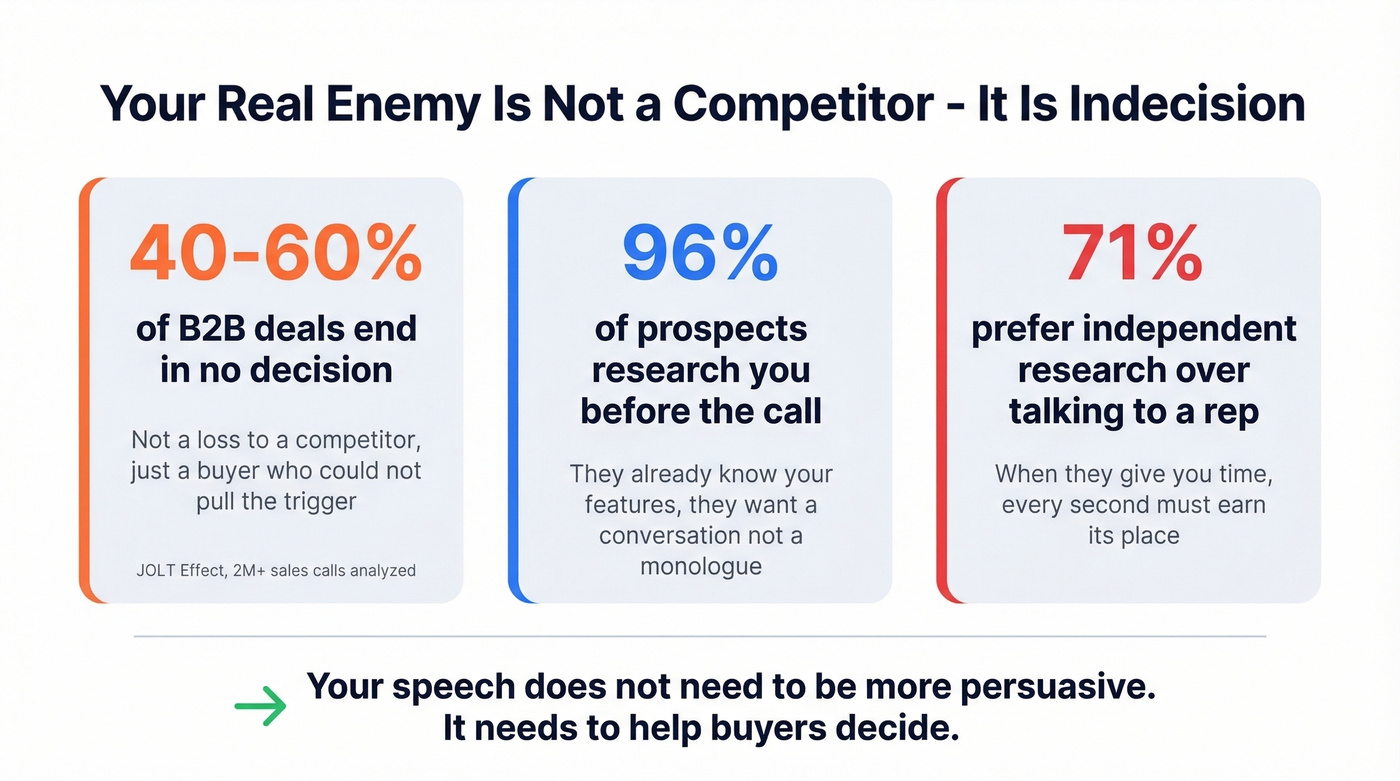
Between 40% and 60% of B2B deals end in "no decision." Not a loss to a competitor - just a buyer who couldn't pull the trigger. That stat, from the JOLT Effect's analysis of over 2 million sales calls, should reshape how you think about every sales speech you deliver. Your speech doesn't need to be more persuasive. It needs to help buyers decide.
The Short Version
- Your real enemy isn't a competitor - it's indecision. 40-60% of B2B deals die because the buyer chose to do nothing. Your sales talk must help them decide, not just impress them.
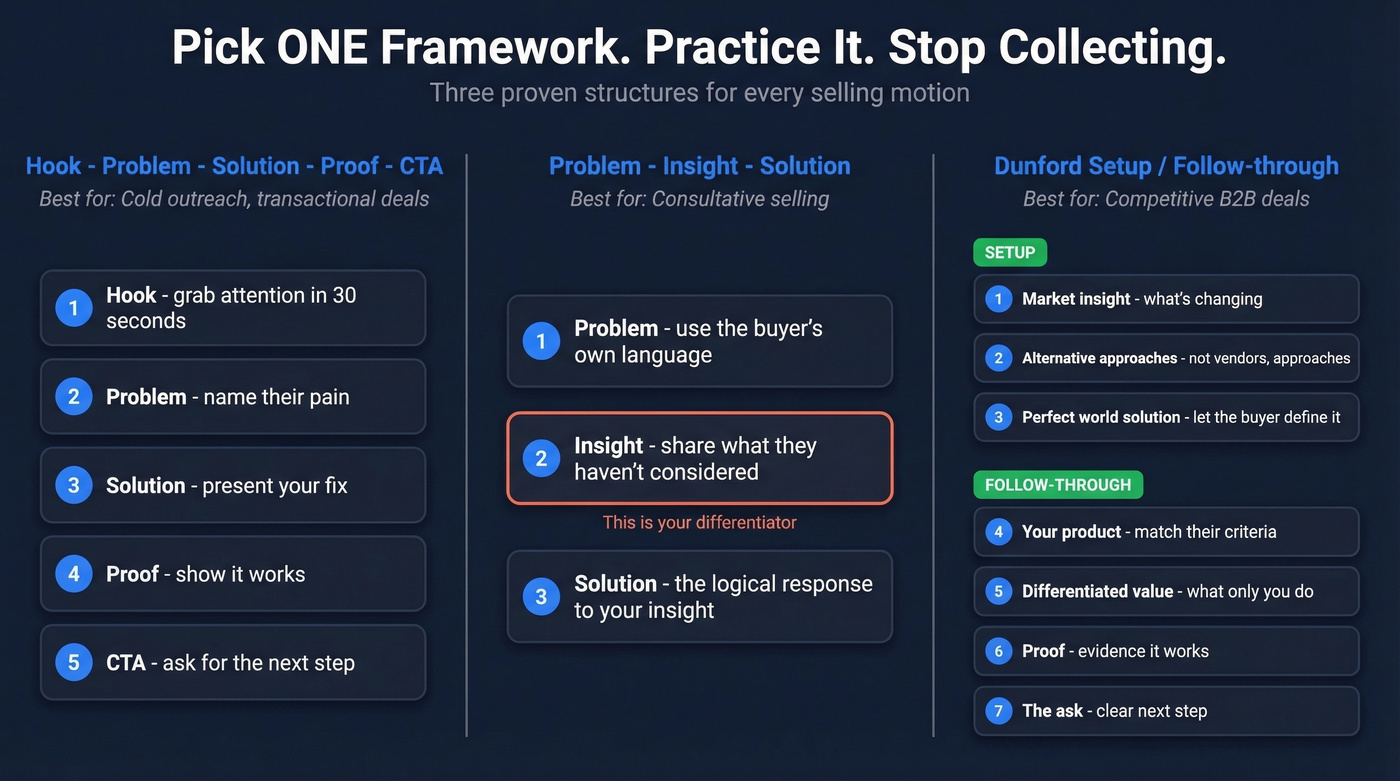
- Pick ONE framework that matches your selling motion. Dunford's Setup/Follow-through for competitive deals, Problem-Insight-Solution for consultative selling, or Hook-Problem-Solution-Proof-CTA for cold outreach.
- Stop memorizing scripts. Memorize structures. A rep on r/salestechniques described it perfectly: mid-sentence, your brain forks into three directions and you stutter. Frameworks prevent that.
What Is a Sales Speech?
A sales speech is any spoken delivery designed to move a buyer closer to a decision - cold calls, discovery meetings, boardroom presentations, elevator pitches. It's distinct from a sales pitch, which can also be written as emails, decks, or one-pagers. The skills overlap, but live delivery adds cognitive load that written pitches don't.
The benchmark for cold outreach? Under two minutes. For scheduled meetings, keep the pitch portion tight, then shift to questions. Most reps blow past both because they don't have a structure forcing them to be concise.
Why Most Sales Speeches Fail
Three problems kill more speeches than bad products or tough markets.
1. Cognitive overload - yours, not the buyer's. That r/salestechniques post nailed it: reps speak fine in casual conversation but freeze when explaining complex value props. The issue isn't confidence. It's that your brain tries to process multiple branching paths simultaneously - which feature to mention, which objection to preempt, which case study fits. Without a framework, you're improvising a jazz solo without knowing the chord changes.
2. Talking too much. Here's the thing: 96% of prospects research your company before the call, and 71% prefer independent research over talking to a rep at all. When they do give you time, they want a conversation, not a monologue. The general guidance is dead simple - listen more than you talk. Most reps invert this ratio completely.
3. No framework for fighting "no decision." Most speech training focuses on beating competitors. But if 40-60% of your pipeline dies to indecision, your spoken pitch needs to help buyers understand tradeoffs and feel confident choosing - not just feel excited about your product. This is the core insight from the JOLT Effect research, and it's why April Dunford's framework below works so well for complex B2B deals.
Three Frameworks That Work
Pick one. Practice it. Stop collecting frameworks.
As Simon Sinek put it: "People don't buy what you do; they buy why you do it." Every framework below works because it leads with why - why the problem matters, why now, why this approach - before it ever gets to what.
| Framework | Best For | Core Sequence |
|---|---|---|
| Hook-Problem-Solution-Proof-CTA | Cold outreach, transactional | Hook, problem, solution, proof, next step |
| Problem-Insight-Solution | Consultative selling | Problem, unique insight, solution |
| Dunford's Setup/Follow-through | Competitive B2B deals | Insight, alternatives, value, proof, ask |
Hook - Problem - Solution - Proof - CTA
This is the workhorse for cold outreach and shorter sales cycles. The core rhythm is simple: open with something that earns attention - a question, a stat, or a bold claim. Name the problem. Present your solution. Prove it works. Ask for the next step.
The key is the hook. "Hi, I'm calling from Acme Software" isn't a hook. "Your competitors are booking 30% more demos since switching to [approach] - want to know how?" That's a hook. You've got about 30 seconds before attention evaporates.
Problem - Insight - Solution
This framework shines in consultative selling where the buyer already knows they have a problem but hasn't figured out the root cause. The "insight" is the differentiator.
Name the problem in the buyer's language. Share an insight they haven't considered - data, a pattern you've seen across similar companies, a counterintuitive finding. Then present your solution as the logical response to that insight. Without the insight, you're just another vendor restating the obvious.
Dunford's Setup / Follow-Through
For competitive B2B deals, April Dunford's framework from Sales Pitch is the most rigorous approach we've seen. The setup establishes context: share a market insight, walk through alternative approaches - not vendors, but approaches - and describe the "perfect world" solution. The follow-through delivers: introduce your product, highlight differentiated value, provide proof, and make the ask.
What makes this powerful is that it directly fights the "no decision" problem. By walking buyers through tradeoffs between approaches, you're helping them build confidence in their choice. Most pitches skip this entirely - they jump to "here's why we're great" without helping the buyer understand why any solution is worth choosing right now. The best version? Get the buyer to articulate the ideal solution themselves. When they pitch themselves on the criteria, your product just needs to match what they already said they wanted.

The best sales speech in the world fails if you're delivering it to a gatekeeper or a dead number. Prospeo gives you 125M+ verified mobile numbers with a 30% pickup rate - so your carefully crafted pitch reaches the actual decision-maker.
Stop perfecting speeches no one hears. Start dialing direct.
Scripts You Can Steal
Don't memorize these word-for-word. Internalize the framework and adapt in real time. These are starting points.
Cold Call Opener
Bad version: "Hi, this is Jake from DataCorp. We're a leading provider of analytics solutions and I'd love to tell you about our platform."
Good version:
"Hi [prospect name], this is [your name] from [company]. I'll be brief - in three minutes, I can share how we help [companies like theirs] with [specific pain point]. Does that sound fair?"
The time-ask works because it reduces perceived risk. Three minutes feels manageable. Pull verified direct dials before your call block - any verification tool beats dialing blind.
If you want a repeatable system for this, build a simple cold calling system and stick to it for 30 days.
Gatekeeper Navigation
"Hi, I'm trying to reach [decision-maker name] - could you transfer me? If they're unavailable, I'd appreciate their direct line or a good time to call back."
Keep it simple and polite. Don't pitch the gatekeeper. Don't lie about knowing the person. Just ask clearly and offer alternatives.
Voicemail Drop
Keep it around 20 seconds.
"Hi [prospect name], it's [your name] from [company]. Quick message - we helped [similar company] [specific result], and I think we can do the same for [their company]. My number is [number]. I'll try you again [day/time]."
End with your callback number and a reason to pick up next time. If your voicemail runs past 20 seconds, you're rambling.
Follow-Up After "Send Me an Email"
"Happy to send that over. Before I do - when's a good time this week to walk you through it live? That way I can tailor it to what matters most to your team."
This reframes "send me an email" - almost always a polite brush-off - into a scheduled conversation. Most reps just send the email and hope. Don't hope.
If you need a few proven follow-up angles, steal from these sales follow-up templates.
Referral-Based Call
"Hi [prospect name], [mutual connection] suggested I reach out. They mentioned you're working on [challenge], and we've helped [similar companies] with exactly that. Would you have 20 minutes this week?"
The mutual connection does the heavy lifting. Name-drop early, then pivot to value immediately.
Elevator Pitch (60 Seconds)
Four beats, in order:
- Question - "You know how [target audience] struggles with [pain point]?"
- Empathy - "Most solutions [common approach that falls short]."
- Pivot - "We [your unique approach], which means [specific outcome]."
- Proof - "[Company X] saw [result] in [timeframe]."
Practice until you can deliver it in under 60 seconds without sounding rehearsed. Record yourself. If it sounds like a script, rewrite it in your own words.
For more examples you can adapt, here are sample elevator pitches.
Seven Mistakes That Kill Your Delivery
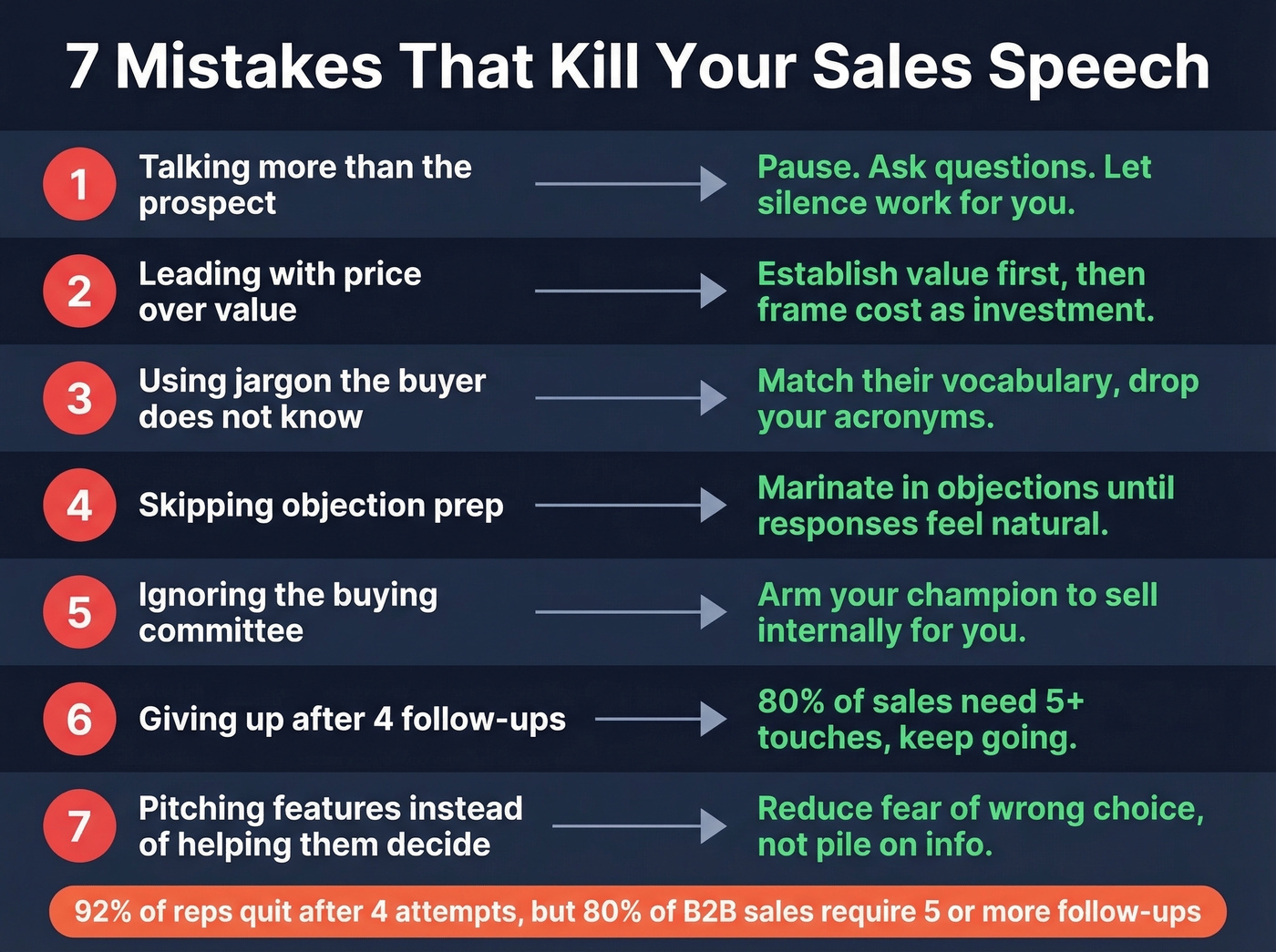
- Talking more than the prospect. If you're monologuing, you're losing. Pause. Ask questions. Let the prospect fill silence.
- Leading with price over value. Price without context is always too high. Establish value first, then frame cost as an investment.
- Using jargon the buyer doesn't know. Your internal acronyms mean nothing to a VP of Operations. Match their vocabulary.
- Skipping objection prep. If you can't handle "we're happy with our current vendor" smoothly, you haven't prepared enough. The best reps marinate in objections - they seek them out, sit with them, and develop responses that feel conversational rather than defensive. (If this is a recurring issue, tighten your discovery questions so objections surface earlier.)
- Ignoring the buying committee. 7.4 decision-makers are involved in a typical B2B purchase. Your speech to the champion needs to arm them to sell internally.
- Giving up after four follow-ups. 80% of B2B sales require 5+ follow-ups, but 92% of reps quit after four attempts. Persistence isn't annoying - it's expected.
- Pitching features instead of helping the buyer decide. Remember: 40-60% of deals die to indecision. Your presentation should reduce the buyer's fear of making the wrong choice, not pile on more information to process.
Adapting for Buying Committees
81% of revenue leaders say their deals are more complex than ever. With 7.4 decision-makers on average, your talk to one stakeholder is really a speech to the whole committee - because your champion will repeat your talking points (badly) in an internal meeting you'll never attend.
If you're selling into larger orgs, it helps to understand what is team selling so you can equip your champion properly.
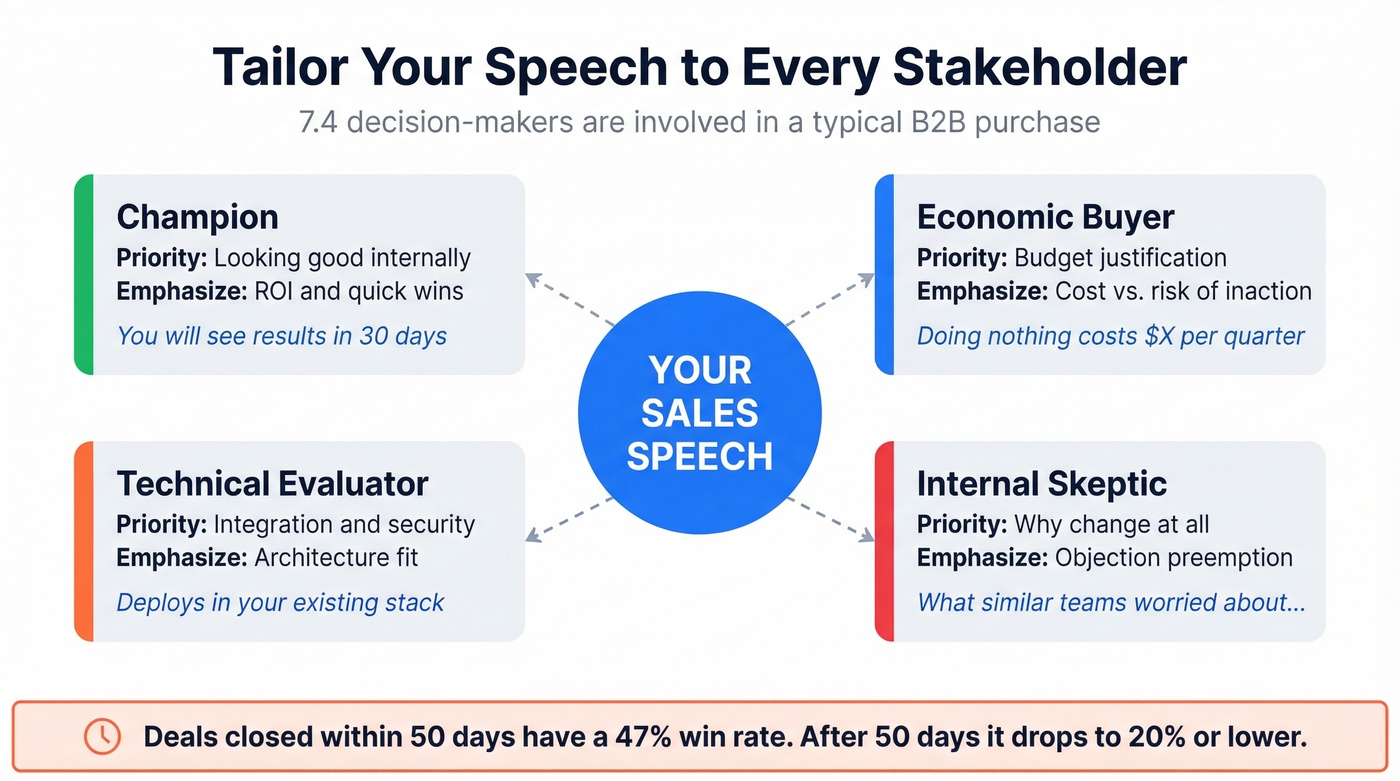
| Stakeholder | Their Priority | Speech Emphasis | Example Line |
|---|---|---|---|
| Champion | Looking good internally | ROI + quick wins | "You'll see results in 30 days" |
| Economic Buyer | Budget justification | Cost vs. risk of inaction | "Doing nothing costs $X/quarter" |
| Technical Evaluator | Integration, security | Architecture fit | "Deploys in your existing stack" |
| Internal Skeptic | Why change at all | Objection preemption | "What similar teams worried about..." |
Here's the urgency angle: deals closed within 50 days have a 47% win rate. After 50 days, that drops to 20% or lower. Every weak presentation to a stakeholder extends the cycle. Tailor your message to each role, or watch your deal die in committee.
Let's be honest - if your deal size is under $15K, you probably don't need to map the full buying committee. Sell to the person with the credit card. Committee-selling is for deals where the juice is worth the squeeze.
This is also where pitch consistency matters. When you're running a team, every rep should work from the same framework with the same proof points. One rogue pitch to a technical evaluator can unravel weeks of work. Enablement platforms like Highspot and Mindtickle exist for exactly this reason.
Your Data Is the Foundation
96% of prospects research you before the call. So you'd better research them too. Personalization requires accurate contact data, and if your CRM data is stale - the industry average refresh cycle is six weeks - your "personalized" speech is built on outdated information.
If you're trying to fix this systematically, start with data enrichment services and a clear lead generation workflow.
We've seen teams spend hours perfecting their pitch framework only to waste it dialing wrong numbers or emailing dead addresses. Before you rehearse your delivery, verify your list. Prospeo covers 300M+ professional profiles with 98% email accuracy and a 7-day data refresh cycle, plus 125M+ verified mobile numbers carrying a 30% pickup rate - which matters when your entire speech strategy depends on actually reaching someone.

You mentioned pulling verified direct dials before your call block. Prospeo delivers 98% accurate emails and verified mobiles for $0.01/lead - 90% cheaper than ZoomInfo. Teams using Prospeo book 26% more meetings because every speech starts with the right person.
Nail the speech. Nail the number. Book 26% more meetings.
AI Tools for Practice and Coaching
AI role-play is the single biggest improvement to sales training in the last decade. Recording yourself and listening back is free and nearly as effective - but if you've got budget, these tools accelerate the feedback loop dramatically.
If you're building a modern outbound stack around coaching + practice, it helps to compare SDR tools and broader outbound lead generation tools.
| Tool | Category | Approx. Price | Best For |
|---|---|---|---|
| Gong | Conversation intelligence | Custom (enterprise per-seat) | Call review, deal insights |
| Chorus | Conversation intelligence | ~$100/user/mo | Call recording + coaching |
| Second Nature | AI role-play | ~$30-60/user/mo | Practicing pitches solo |
| Retorio | AI role-play | ~$30-60/user/mo | Behavioral coaching |
| Highspot | Enablement platform | ~$91K/yr | Content + training at scale |
| Mindtickle | Enablement platform | ~$45K/yr (100 users) | Onboarding + certification |
Skip Second Nature and Retorio if your team is under five reps - the ROI doesn't justify the seat cost at that scale. Just record your calls in Gong or even a free tool like Otter.ai, review them weekly, and you'll improve faster than most reps using expensive platforms halfheartedly.
Recent Outreach research found that AI coaching shaves 11 days off sales cycles and boosts win rates by up to 10 percentage points on deals over $50K. The directional signal is clear: reps who practice with structured feedback close more deals, faster.
FAQ
How long should a sales speech be?
Under two minutes for cold outreach. For scheduled meetings, keep the pitch portion to three-five minutes, then shift to questions. Anything longer and you're monologuing, which kills engagement and deal momentum.
What's the difference between a sales speech and a sales pitch?
A sales speech is spoken live - calls, meetings, presentations - while a pitch can also be written as emails or decks. Live delivery adds cognitive load from processing buyer reactions in real time, which is why practicing out loud matters more than perfecting a written document.
How do I stop rambling during a sales call?
Memorize a framework, not a script. Record yourself, listen back, and cut every sentence that doesn't earn the next one. Most reps cut 30-40% on the first pass.
How many follow-ups should I make?
At least five. 80% of B2B sales require 5+ follow-ups, but 92% of reps quit after four. Build a multi-touch cadence mixing calls, emails, and social touches across 10-14 days.
What tools help me prepare for a sales speech?
AI role-play platforms like Second Nature for practice, conversation intelligence tools like Gong for call review, and a solid data provider for verified prospect info so your personalization is built on current, accurate information rather than stale CRM records.