

How to Run a Sales SWOT Analysis That Actually Changes Your Pipeline
It's Q1 planning. Your VP asks every rep to submit a territory SWOT by Friday. You open a blank slide, type "strong customer relationships" under Strengths, stare at the cursor for ten minutes, and paste in last year's version with the dates changed. The exercise gets filed in a shared drive nobody opens again.
You're not alone. One agency practitioner on r/marketing called SWOT "little more than busy work just to fill a box" and stopped using it entirely without any impact on client wins. The framework isn't broken, though. The way most sales teams run it is.
Here's what we've found after running this exercise across dozens of pipeline reviews: the teams that get value from a sales SWOT analysis start with data, not opinions, and they bridge diagnosis to action with the TOWS matrix. If your past SWOTs felt like busywork, the problem was the process - not the framework.
What Is a Sales SWOT Analysis?
SWOT stands for Strengths, Weaknesses, Opportunities, and Threats - a strategic planning framework developed at the Stanford Research Institute in the 1960s. It maps your situation across four quadrants: what you control (strengths and weaknesses) versus what you don't (opportunities and threats).
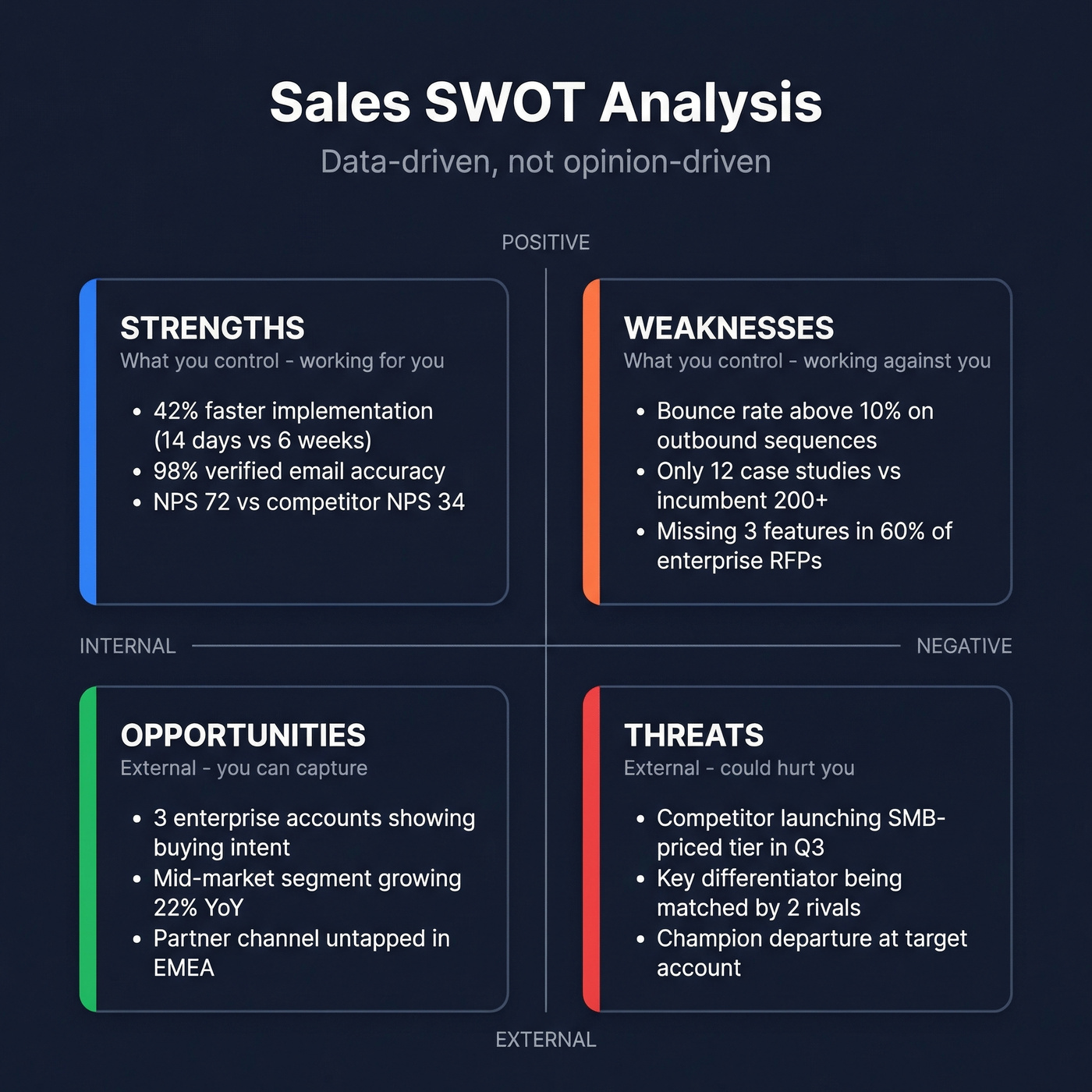
A sales-focused SWOT isn't the same as a generic business assessment. You're not listing "strong brand" and "economic uncertainty." You're working with pipeline metrics, win/loss data, territory dynamics, and competitive positioning. Strengths look like "42% faster implementation validated by 15 deployments." Weaknesses look like "bounce rate above 10% on outbound sequences." Opportunities look like "3 enterprise accounts showing buying intent in a segment where we have zero case studies."
Generic SWOT produces generic output. Sales-specific analysis produces a prioritized list of actions tied to revenue.
Three Levels of Analysis
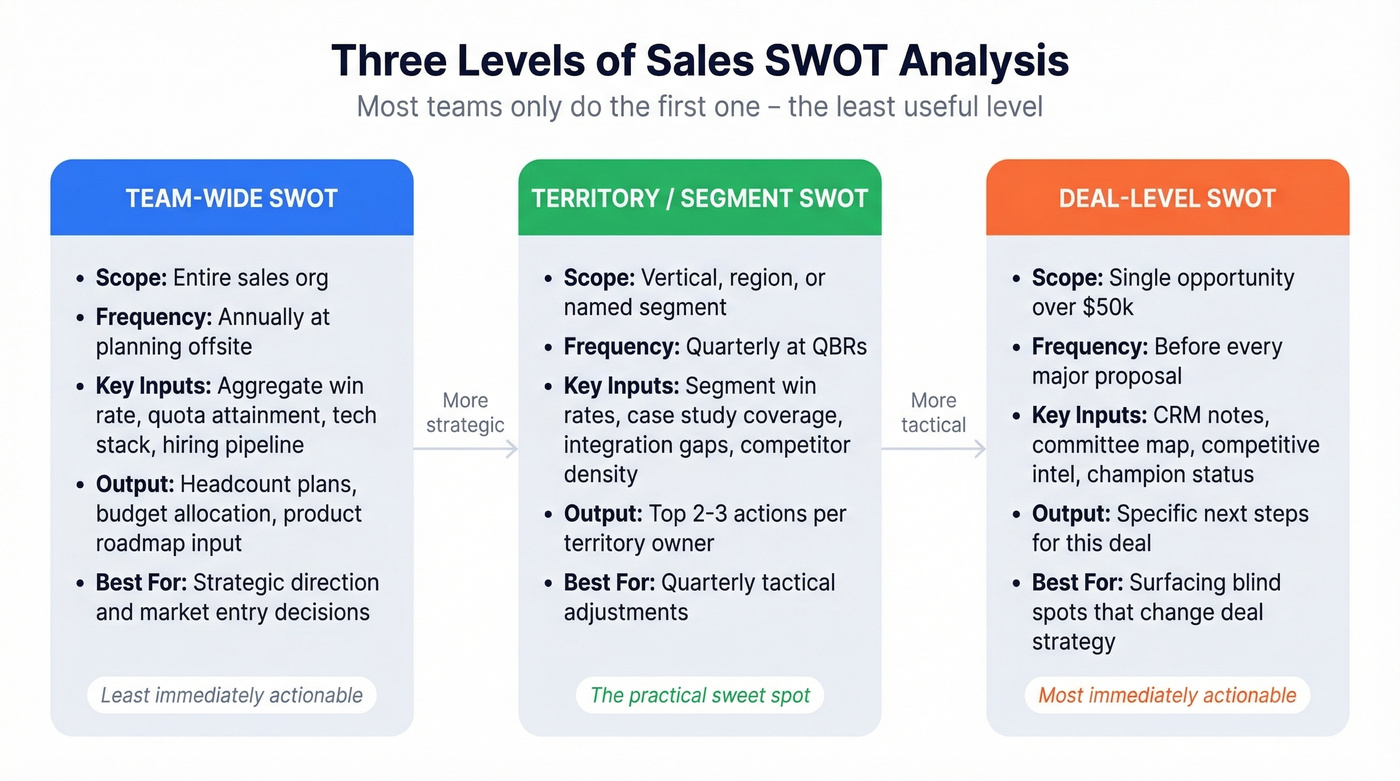
Most teams default to one flavor - usually the annual org-wide version that lives in a strategy deck. That's the least useful level.
Team-Wide SWOT
This is the org-level assessment: overall quota attainment, aggregate win rate, tech stack effectiveness, hiring pipeline strength, and competitive positioning across your entire market. It's the right tool for annual strategic planning or when leadership is evaluating whether to enter a new segment, restructure territories, or invest in a new channel.
Run it annually at your planning offsite, or when a major market shift demands a strategic reset. The output should feed headcount plans, budget allocation, and product roadmap input.
Territory / Segment SWOT
This is where the framework gets practical. A healthcare vertical team might list 8 case studies and HIPAA-compliant infrastructure as strengths, but flag the lack of Epic EHR integration as a weakness that blocks 40% of enterprise deals. The opportunities and threats are segment-specific: adjacent healthcare software markets expanding, but established vendors with 200+ case studies dominating RFP shortlists.
Run territory SWOTs quarterly at QBRs. Each segment or territory owner should own theirs and present the top 2-3 actions they're taking as a result.
Deal-Level SWOT
This is the level no competitor guide covers, and it's the most immediately actionable. Before any proposal over $50k, spend 20 minutes mapping the deal's SWOT: pull CRM notes and recent email threads, map every known buying committee member, flag the ones you haven't contacted, and check competitive intelligence for recent losses to the same vendor, their latest product announcements, and any champion departures.
In our experience, that 20-minute exercise routinely surfaces blind spots that change the entire deal strategy. You discover that 4 of 7 committee members haven't been contacted, the incumbent's NPS is declining, and a competitor just hired a dedicated enterprise rep for this account. The annual offsite SWOT rarely surfaces anything that specific.
Step-by-Step Process
Most SWOT exercises fail because people brainstorm in a vacuum. They sit in a conference room and free-associate. The fix is simple: start with data.
1. Pull your data first. Export win/loss records, conversion rates by stage, average cycle length, and customer feedback from your CRM. Pull competitive intelligence from recent losses. You want facts on the table before anyone writes a sticky note.
2. Fill strengths - but validate each one. Every strength must pass two tests: is it unique versus your competitors, and can you quantify its value in dollars, time, or emotional impact? "Good product" is banned. Instead: "3x faster implementation (14 days vs. 6 weeks), validated by 15 deployments, saving customers an average of $180k in migration costs."
3. Fill weaknesses - and decide what to do with each. For every weakness, choose one of three paths: improve it, delegate it, or accept it. Then quantify the cost of inaction. If your bounce rate is 12% and that's killing 1 in 8 sequences, that's a measurable revenue leak.
4. Fill opportunities - pick the largest, then get specific. Identify 3-5 target accounts that represent the opportunity. Schedule outreach steps. Up to 50% of sales go to the first vendor to respond, so speed-to-lead belongs in your opportunities quadrant if you can act on it. Treat opportunities like a prospecting plan, not a wish list.
5. Fill threats - reject the generic ones. "Economic uncertainty" isn't a useful threat because it affects every competitor equally. Focus on threats you can pre-empt: a competitor's new feature that matches your differentiator, a key champion leaving a target account, or a regulatory change that shifts buying criteria.
Cap each quadrant at 5-7 items. More than that and you're brainstorming, not prioritizing.
2026 Benchmarks to Calibrate Your SWOT
Every SWOT guide tells you to "identify your strengths." But how do you know if a 22% win rate is a strength or a weakness? Without benchmarks, you're guessing.
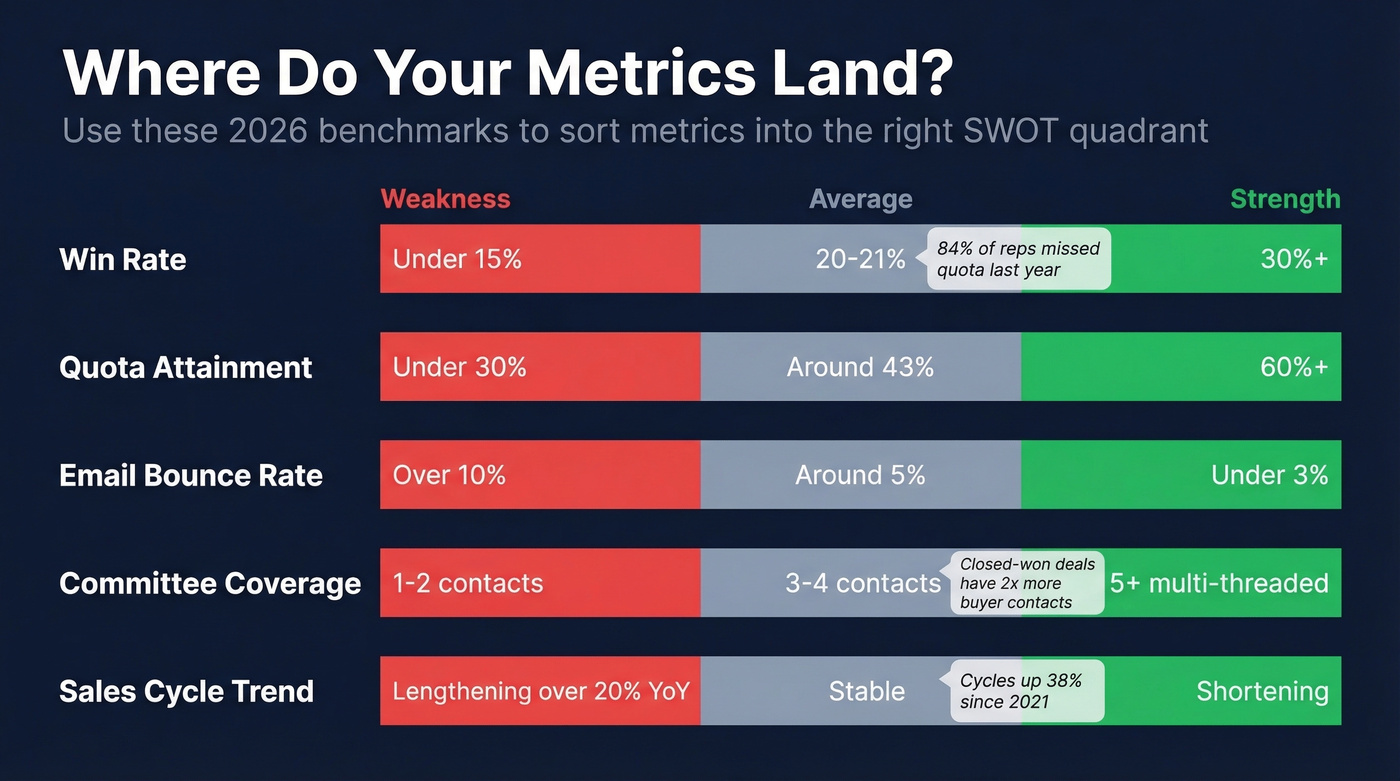
Use this calibration table to sort your metrics into the right quadrant. These thresholds draw from the most recent available industry data.
| Metric | Weakness Zone | Average | Strength Zone |
|---|---|---|---|
| Win rate | <15% | 20-21% | 30%+ |
| Quota attainment | <30% | ~43% | 60%+ |
| Email bounce rate | >10% | ~5% | <3% |
| Committee coverage | 1-2 contacts | 3-4 | 5+ (multi-threaded) |
| Sales cycle trend | Lengthening >20% YoY | Stable | Shortening |
The numbers behind these thresholds paint a clear picture. Sales cycles have increased 38% since 2021, and 57% of sales professionals say the cycle is getting longer. 84% of reps missed quota last year. Buying committees now run 6-10 people on average, stretching to 17 in enterprise deals. And with 80% of B2B sales interactions happening digitally, buyers use around 10 channels before making a decision.
Multi-threading isn't optional anymore. Closed-won deals have roughly 2x as many buyer contacts as lost deals, and for deals above six figures, multi-threading boosts win rates by 130%.
Here's the thing: if your bounce rate is above 8%, your contact data is a weakness - full stop. It's also the single easiest weakness to fix. Snyk's 50-person AE team dropped bounce rates from 35-40% to under 5% and saw AE-sourced pipeline jump 180% after switching to Prospeo's verified contact data with a 7-day refresh cycle. That moved data quality from the weakness column to strengths in a single quarter.

You just read that a 12% bounce rate is a measurable revenue leak. Prospeo's 5-step email verification delivers 98% accuracy and under 3% bounce rates - moving that metric from your Weakness quadrant to Strength. At $0.01 per email, fixing your data quality costs less than one bad sequence.
Turn your biggest SWOT weakness into a strength in under 10 minutes.
Filled Examples at Every Level
Three filled SWOTs, every item quantified. Copy these into your planning doc and adapt.
SaaS Sales Team SWOT
| Strengths | Weaknesses |
|---|---|
| 3x faster implementation (14 days vs. 6 weeks) | Brand recognition 80% lower in enterprise |
| 40% lower TCO over 3 years | 12 case studies vs. incumbent's 200+ |
| NPS 72 vs. incumbent NPS 34 | Missing 3 features in 60% of enterprise RFPs |
| 98% verified email accuracy, bounce rate under 4% | No dedicated field sales team |
| Opportunities | Threats |
|---|---|
| Mid-market segment growing 22% YoY | Incumbent launching SMB-priced tier in Q3 |
| 3 enterprise accounts showing active buying intent | Key differentiator (speed) being matched by 2 competitors |
| Partner channel untapped in EMEA | 84% of reps industry-wide missing quota - talent poaching risk |
Territory SWOT - Healthcare Vertical
Instead of a standard table, here's how a healthcare territory owner might present this at a QBR - as a narrative with clear asks.
What's working: The team has 8 healthcare case studies and HIPAA-compliant infrastructure, plus a dedicated SE with 12 years of healthcare experience. These give us credibility in 60% of initial conversations.
What's blocking deals: No Epic EHR integration - and that blocks 40% of enterprise opportunities before we reach a technical evaluation. We also have zero presence at HIMSS, the industry's largest conference, which means we're invisible to the 30,000+ attendees who build their shortlists there.
Where the growth is: Three regional health systems are actively evaluating new vendors this quarter. Adjacent healthcare software markets are expanding, creating cross-sell opportunities with existing accounts.
What keeps me up at night: Established vendors with 200+ case studies dominate every RFP shortlist. A competitor hired 4 healthcare-specific AEs in Q1. And regulatory changes around interoperability standards could shift buying criteria mid-cycle.
Deal-Level SWOT - $150k Enterprise Opportunity
| Strengths | Weaknesses |
|---|---|
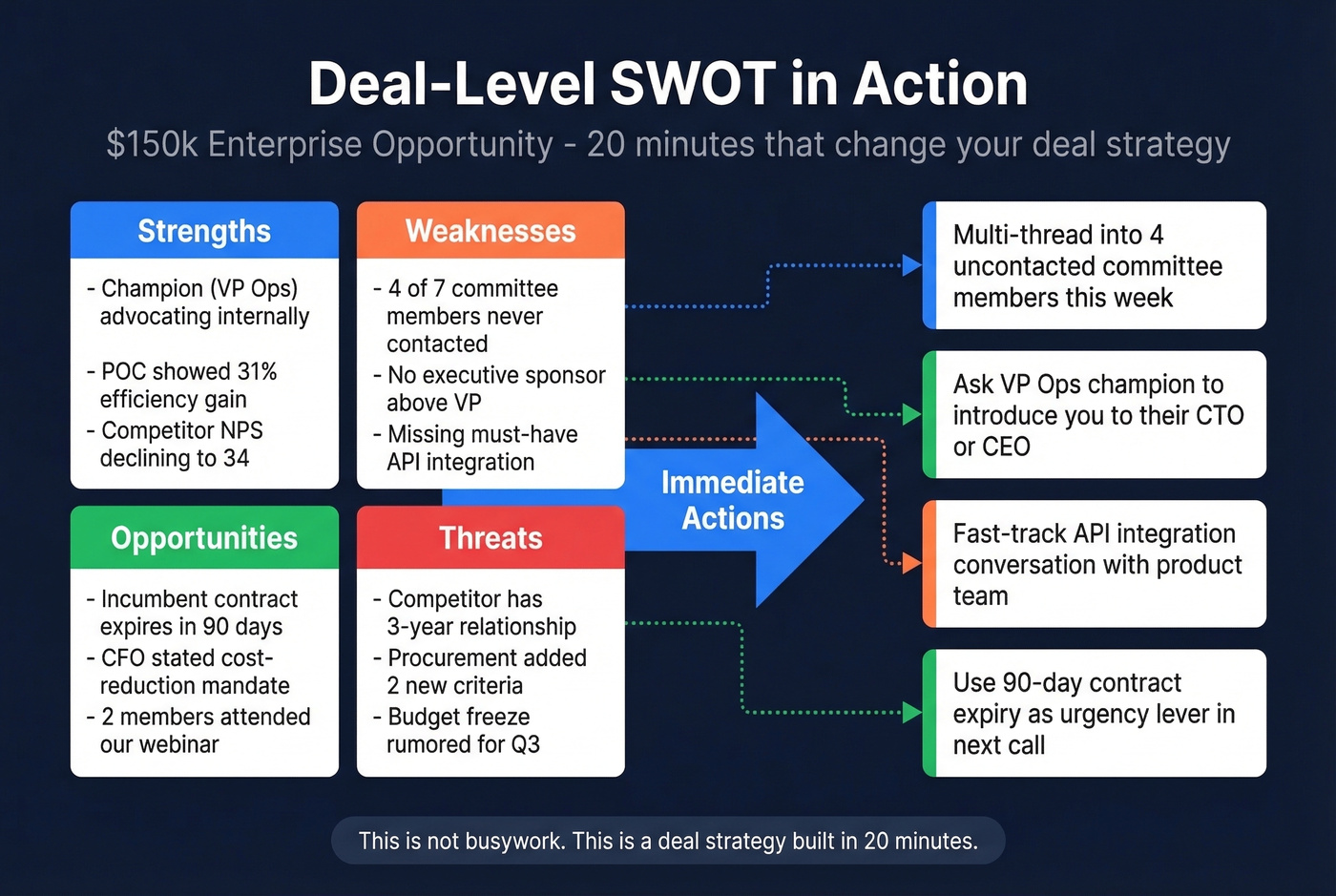
| Champion (VP Ops) actively advocating internally | 4 of 7 committee members never contacted |
| POC results: 31% efficiency gain documented | No executive sponsor above VP level |
| Competitor's NPS declining (34, down from 52) | Missing API integration they listed as "must-have" |
| Opportunities | Threats |
|---|---|
| Incumbent contract expires in 90 days | Competitor has 3-year incumbent relationship |
| CFO publicly stated cost-reduction mandate | Procurement added 2 new evaluation criteria last week |
| 2 committee members attended our webinar | Budget freeze rumored for Q3 |
The rep now knows exactly what to do: multi-thread into those 4 uncontacted committee members, escalate to an executive sponsor, and fast-track the API integration conversation with product. That's not busywork. That's a deal strategy.
From SWOT to Strategy: The TOWS Matrix
Let's be honest - without this section, the rest of the article is just a prettier version of the same SWOT exercise you've already ignored.
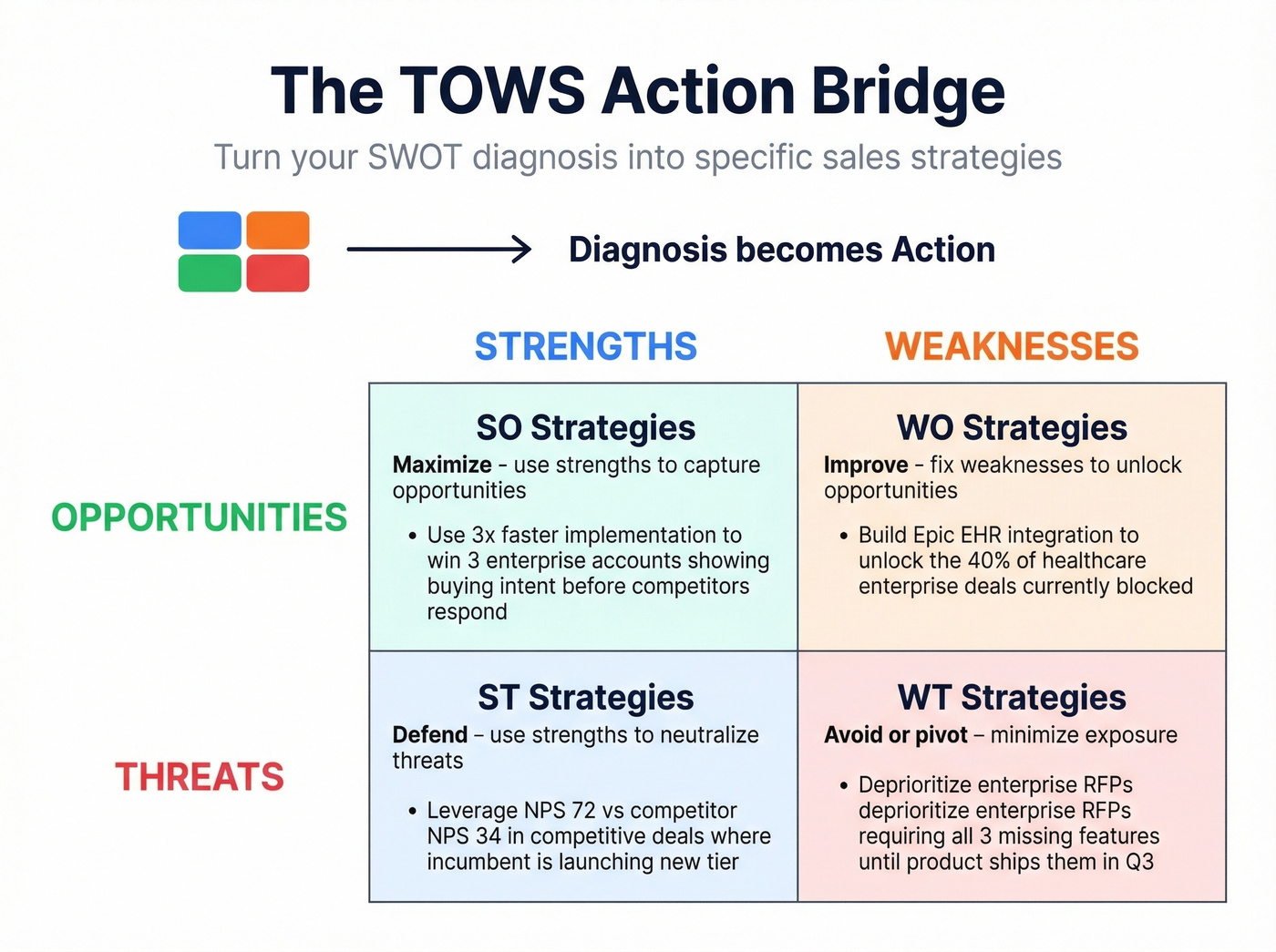
TOWS is a strategy bridge that pairs your internal factors with external ones to generate specific action plans. Where SWOT tends to go inside-out ("we're good at X, so let's do more X"), TOWS forces you to start outside-in - Opportunities and Threats first - which reduces confirmation bias.
| Opportunities | Threats | |
|---|---|---|
| Strengths | SO: Invest aggressively (highest ROI) | ST: Defend and position |
| Weaknesses | WO: Develop or partner | WT: Mitigate immediately (highest risk) |
A concrete example: Your SO strategy might be "Use our high win rate in mid-market (strength) + growing mid-market segment (opportunity) = double territory investment and hire 2 AEs." Your WO strategy: "Fix data quality weakness + capitalize on multi-threading opportunity = deploy verified contact data and train reps on multi-threading into buying committees."
The WT quadrant is your fire alarm. If your weakness is missing RFP features and your threat is the incumbent launching a competitive tier, that combination needs immediate mitigation - not a Q4 roadmap item.
Prioritize in 30 minutes:
- Build the 2x2 TOWS grid from your completed SWOT
- Brainstorm 2-3 strategies per quadrant
- Score each by feasibility x impact (1-10 scale)
- Pick the top 3-5 initiatives
- Assign an owner, deadline, and success metric to each
- Review progress at the next QBR
We've seen teams generate more actionable strategy in 30 minutes with TOWS than in a full-day offsite without it. The structure forces decisions instead of discussion.
Your deal-level SWOT just surfaced 4 buying committee members you haven't contacted. Prospeo's database covers 300M+ professionals with 125M+ verified mobiles - so you can multi-thread every deal and hit the 5+ contact Strength Zone. Layer in intent data across 15,000 topics to fill your Opportunities quadrant with accounts actively in-market.
Stop guessing which accounts are opportunities - use real buying signals.
Common Mistakes That Kill the Exercise
- Listing too many items. Cap at 5-7 per quadrant. Fifteen strengths means you haven't prioritized.
- Confusing internal and external. A competitor's new feature is a threat, not a weakness. Your response to it might reveal a weakness, but the feature itself belongs in the T column.
- Being vague. "Great product" tells you nothing. "3x faster implementation validated by 15 deployments" tells you exactly what to lead with in a pitch.
- Ignoring weaknesses out of defensiveness. The whole point is honesty. If reps won't admit weaknesses, run the exercise anonymously.
- No action plan after the matrix. A SWOT without TOWS is a diagnosis without treatment. Always bridge to strategy.
- Treating it as one-and-done. Markets shift. Competitors move. Your SWOT from January is stale by April.
How Often to Run It
Stop running SWOT at annual offsites. Run it in your pipeline review.
| Traditional SWOT | Dynamic SWOT | |
|---|---|---|
| Cadence | Annual / quarterly | Continuous, signal-triggered |
| Scope | High-level, org-wide | Account-specific, deal-specific |
| Output | Static deck | Actionable plays |
| Owner | Leadership | Reps + managers |
| Goal | Strategic planning | Pipeline generation + deal acceleration |
The recommended cadence: monthly signal checks during pipeline reviews to catch competitive shifts, quarterly deep reviews at QBRs for a full territory SWOT refresh, annual strategic assessment at planning offsites for the team-wide version, and a deal-level SWOT before every major proposal.
The deal-level version takes 20 minutes and has the highest ROI of any cadence. Make it a habit, not a ceremony.
When SWOT Isn't Enough
SWOT is the right starting point for most sales teams, but it doesn't cover everything. Skip this section if you're just getting started - come back when you've outgrown the basics.
| Framework | Best For | Pair With SWOT When... |
|---|---|---|
| PESTLE | Deep external scan | Market is shifting (regulation, economy) |
| VRIO | Evaluating competitive moats | You need to know if a strength is sustainable |
| SOAR | Positive framing + aspirations | Team is demoralized by weakness focus |
| Porter's Five Forces | Industry-level competition | Entering a new market or vertical |
For most sales teams running quarterly territory reviews, SWOT + TOWS is sufficient. Add PESTLE when you're entering a regulated market. Add VRIO when you suspect a "strength" is actually table stakes that every competitor matches.
If you want a more data-first approach to this whole exercise, start with data-driven selling and then layer in a lightweight competitive intelligence workflow.
FAQ
What's the difference between SWOT and TOWS?
SWOT diagnoses your current position across four quadrants. TOWS pairs those internal factors with external ones to generate four strategy types: SO, ST, WO, and WT. Think of SWOT as the X-ray and TOWS as the treatment plan. You need both.
How long should a sales SWOT take?
A team-wide assessment takes 60-90 minutes with the right data pre-pulled from your CRM. A deal-level version takes 15-20 minutes. Don't let it become a half-day offsite - if it takes longer than 90 minutes, you're brainstorming instead of prioritizing. The constraint is what makes it useful.
Can I use SWOT for individual reps?
Yes, and it's underused. A rep-level SWOT surfaces coaching opportunities that pipeline reviews miss. A rep might have a 40% win rate on deals under $30k but close at 8% above $100k. Pairing that with market opportunities gives the manager a clear development plan instead of generic feedback.
What tools help with a sales SWOT analysis?
Your CRM is the starting point - export win/loss data, cycle times, and stage conversion rates. Layer in competitive intelligence from tools like Klue or Crayon, buyer intent signals from Bombora, and verified contact data from Prospeo for the committee-coverage metric. The goal is to fill every quadrant with numbers, not opinions.
What's the fastest way to fix "bad data" as a weakness?
Start with email verification on a short refresh cycle. Meritt saw bounce rates drop from 35% to under 4% within the first month of switching providers - moving data quality from the weakness column to strengths. A 7-day data refresh cycle keeps it there, since contact data decays roughly 30% per year.