

Sales Tech: What It Is, What It Costs, and How to Stop Wasting 67% of It
The sales tech market hit $47.3 billion in 2024 and is on a 17.1% CAGR trajectory through 2034, putting it around $65 billion by 2026 if that growth rate holds. Most of that money is wasted. The average company buys 12+ tools and leaves 67% of the features unused. Reps spend 28% of their time actually selling - down from 34% in 2018 - and the other 72% on admin, data entry, internal meetings, and tool management. Top-performing teams use 4-6 tools. Everyone else is funding shelfware.
What You Need (Quick Version)
Sales technology is the tools your team uses to find, engage, and close buyers. The market is enormous, but the math for individual teams is simpler than vendors want you to believe.
What Is Sales Tech?
Sales tech and tech sales aren't the same thing. The former refers to the software tools that help sales teams prospect, engage, and close deals. Tech sales is a career - selling technology products. Same two words, completely different meanings, and they get conflated constantly.
The formal definition is straightforward: any software designed to improve sales productivity, accelerate pipeline, and increase revenue. The category has exploded over the past decade. What started as CRM and email has fragmented into conversation intelligence, intent data, revenue forecasting, CPQ, AI agents, and dozens of niche subcategories. One market map counts roughly 300 companies arranged in concentric rings from core infrastructure to emerging point solutions. The average SDR team touches 12-15 tools daily, and mid-market to enterprise orgs run 10-25 sales-related apps with overlapping features and redundant licenses.
That fragmentation is both the opportunity and the problem.
Why It Matters in 2026
Picture this: your VP just forwarded a Gartner report about AI-powered sales agents while your SDRs are spending their mornings manually enriching lead lists and their afternoons logging activities in Salesforce. 28% of sales leaders work 60+ hours per week, and the non-selling time breakdown explains why. Between CRM updates, meeting prep, internal syncs, and prospecting admin, the actual revenue-generating work gets squeezed into a fraction of the day.
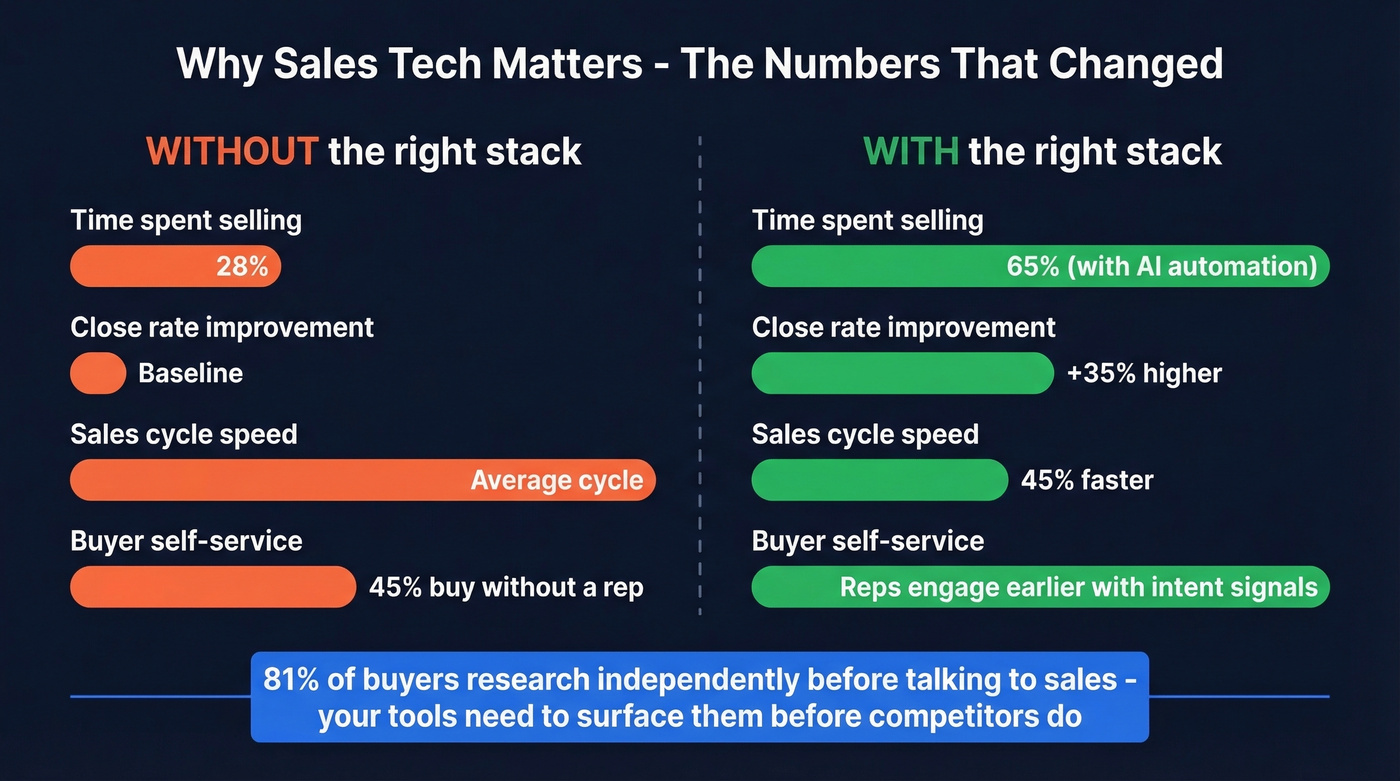
The buyer side has shifted just as dramatically. 45% of B2B purchases now happen without a sales rep involved at all - up from 15% pre-pandemic. And 81% of sales reps say buyers increasingly research independently before reaching out. Your reps aren't just competing with other sellers. They're competing with the buyer's ability to self-educate and self-serve.
This is where the right tools earn their keep. They compress research time, surface buying signals before a competitor does, automate the repetitive work that eats 72% of a rep's day, and put verified contact data in front of reps so they're not guessing at email formats or dialing dead numbers. Companies using sales intelligence tools see 35% higher close rates and 45% faster sales cycles. The returns are real - when the tools actually get used.
The Problem Nobody Talks About
Here's the thing: 63% of sales leaders have 10+ tools in their stack. And 70% of reps feel overwhelmed by the number of tools they're expected to use. Those two stats explain each other.
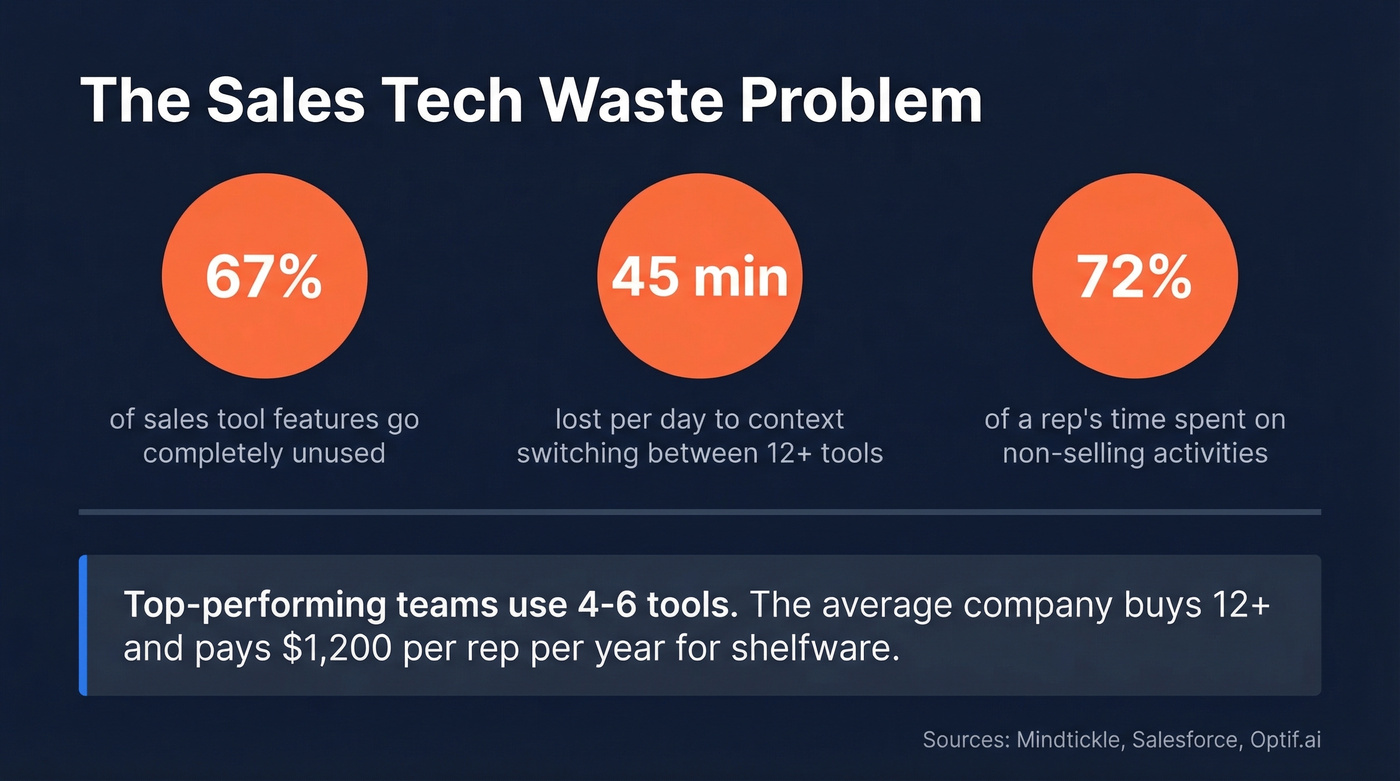
The average company spends roughly $1,200 per rep per year on sales tools, and 67% of the features in those tools go completely unused. That's shelfware - software you're paying for that nobody touches. Context switching between 12+ tools costs teams an estimated 45 minutes per day in lost productivity. Nearly four hours per week per rep, burned on toggling between tabs.
We've seen this pattern repeatedly: a team buys ZoomInfo for the database, Outreach for sequences, Gong for calls, a dialer, an intent tool, a scheduling tool, an enrichment tool - and suddenly they've got a "Franken-stack" held together with Zapier and prayer. The tools overlap. The data doesn't sync cleanly. Reps default to the two or three apps they actually trust and ignore the rest.
The consensus on r/sales and r/techsales echoes this constantly. The biggest complaints aren't about prospecting or closing - they're about post-call documentation, CRM data entry, and juggling too many half-used platforms. The tools designed to save time are eating it instead.
Types of Sales Tech Tools
The market breaks into 10 categories that actually matter. Finer-grained taxonomies exist - one vendor blog maps 20 categories with 100 tools - but for practical purposes, these are the buckets your budget falls into.
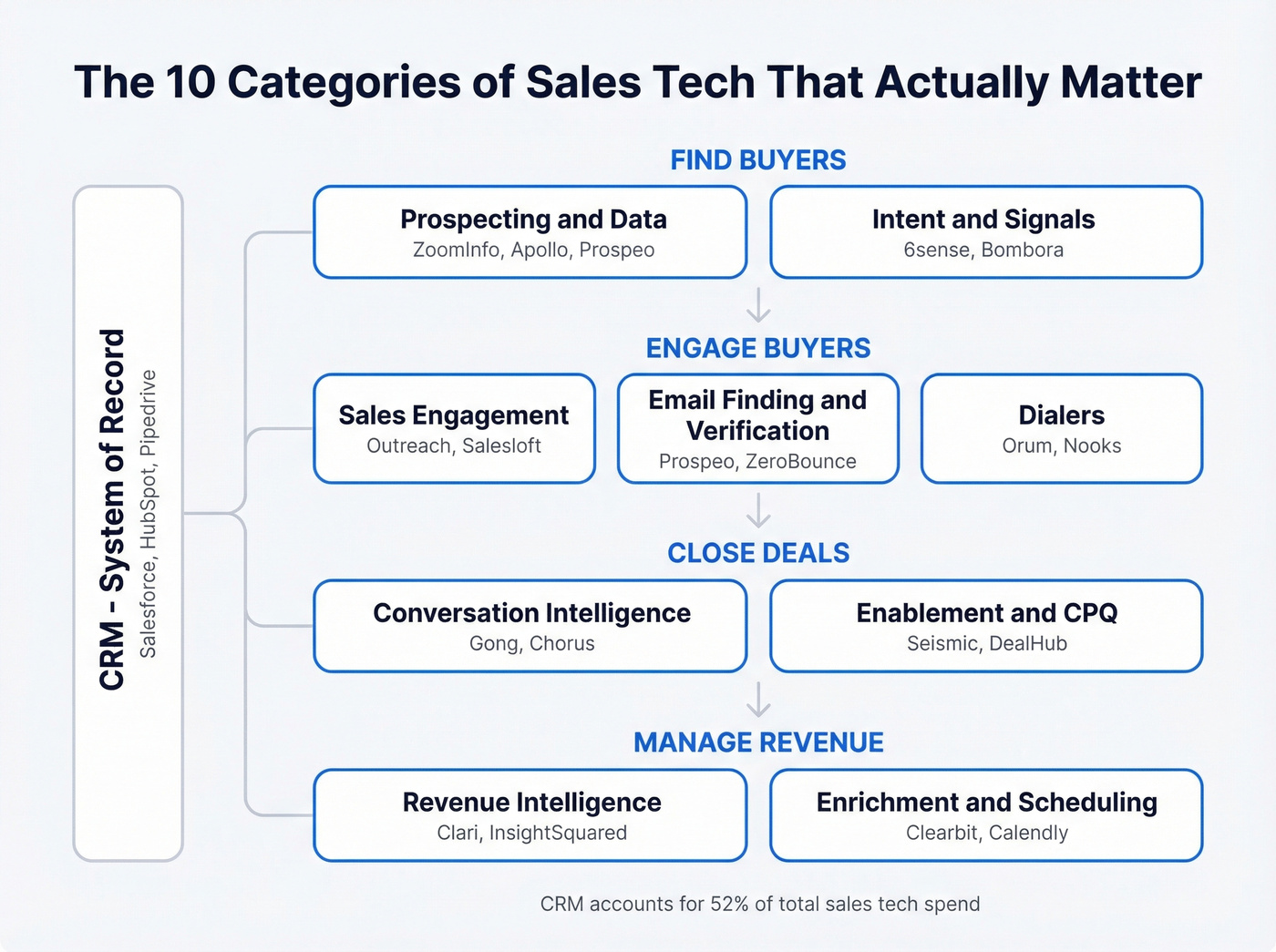
| Category | Top Tools | Price Range | What It Does |
|---|---|---|---|
| CRM | Salesforce, HubSpot, Pipedrive | $0-300/user/mo | System of record |
| Prospecting & Data | ZoomInfo, Apollo, Cognism | $50-500/user/mo | Find and research buyers |
| Sales Engagement | Outreach, Salesloft, Instantly | $25-150/user/mo | Multi-channel sequences |
| Dialers | Orum, Nooks, Aircall | $30-350/user/mo | Call automation |
| Enrichment & Scheduling | Clearbit, Calendly, Chili Piper | $10-200/user/mo | Data append + booking |
| Intent & Signals | 6sense, Bombora | $500-5,000/mo | Buying intent detection |
| Conversation Intelligence | Gong, Chorus | $100-200/user/mo | Call analysis + coaching |
| Revenue Intelligence | Clari, InsightSquared | $80-200/user/mo | Forecasting + pipeline |
| Enablement & CPQ | Seismic, DealHub | $30-150/user/mo | Content + quoting |
CRM
CRM is the largest category, commanding 52% of total market spend. Salesforce sits at the center of most enterprise stacks - everything else integrates with it, reports into it, and depends on it. At $25-300/user/month depending on edition, it's not cheap, but it's the system of record that makes everything else work.
HubSpot CRM offers a genuinely useful free tier that works well for teams under 10 reps. Pipedrive at $14-99/user/month is the best option for small teams that want simplicity over configurability. Close at $29-139/user/month is worth a look if your team lives on the phone.
If you want a quick gut-check on what counts as a CRM (and what doesn't), see these examples of a CRM.
Prospecting & Data
ZoomInfo is the 800-pound gorilla - 260M+ profiles, deep intent data, and a price tag to match. Most teams spend $20-50K/year, and that's before adding modules. Apollo.io has become the default for SMB and mid-market teams with 275M+ contacts, a built-in sequencer, and pricing from free to $79/user/month. Cognism at $15,000-40,000/year wins on EMEA data quality and GDPR compliance. Clay at $134-720/month takes a different approach entirely - it's a workflow tool that chains together dozens of data providers rather than being a database itself.
If you're comparing providers, start with a shortlist of sales prospecting databases before you get pulled into demos.
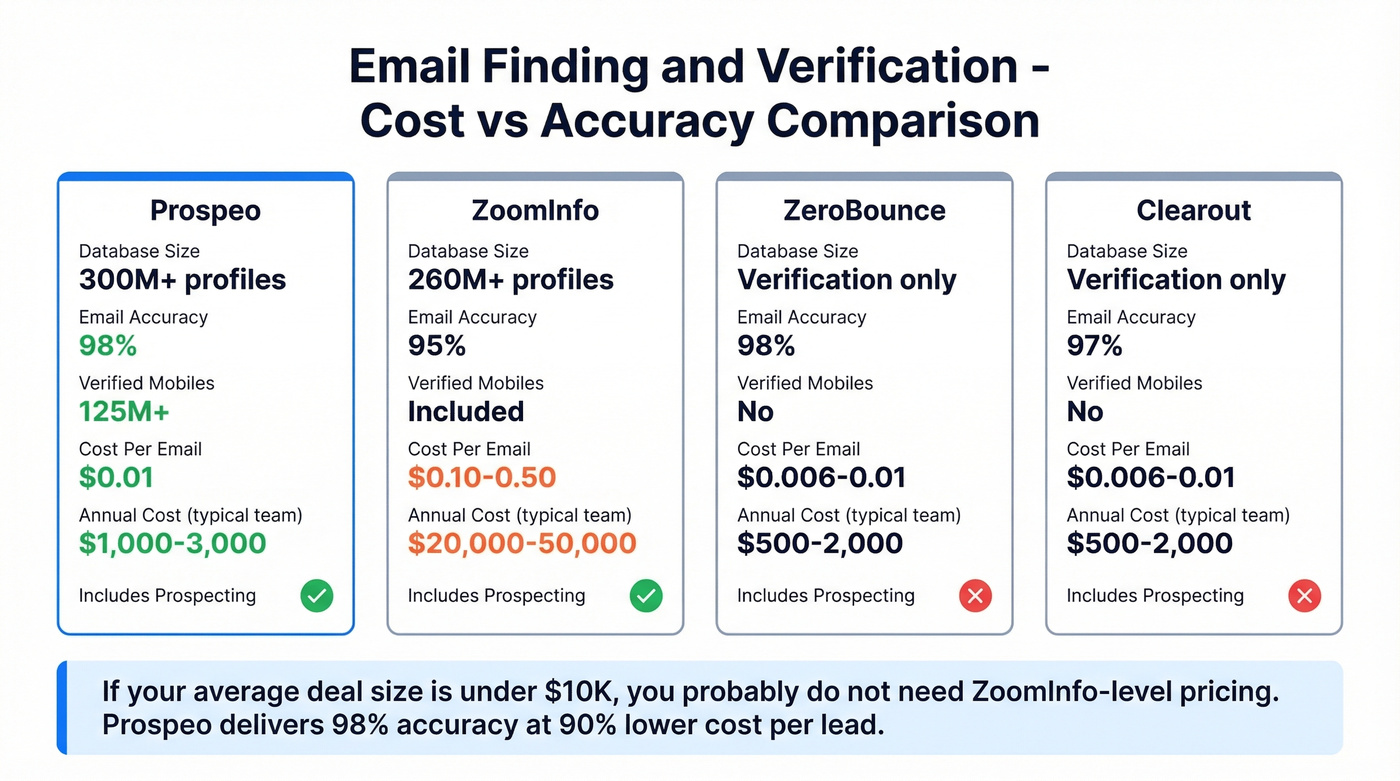
Hot take: If your average deal size is under $10K, you probably don't need ZoomInfo-level data. Apollo or a focused data provider paired with a good sequencer will get you 80% of the results at 10% of the cost.
Email Finding & Verification
This is where your entire outbound operation either works or falls apart. Bad emails mean bounced sequences, damaged sender reputation, and wasted rep time. It's the foundation layer.
If you're seeing bounces, fix the root cause first: email bounce rate.

Prospeo covers 300M+ professional profiles with 143M+ verified emails and 125M+ verified mobile numbers that hit a 30% pickup rate across all regions. The 98% email accuracy rate comes from a proprietary email-finding infrastructure - no reliance on third-party email providers - combined with a 5-step verification process that includes catch-all handling, spam-trap removal, and honeypot filtering. Every record refreshes on a 7-day cycle, which matters because contact data decays 20-30% annually. At roughly $0.01/email with a free tier of 75 emails/month plus 100 Chrome extension credits, it's 90% cheaper than ZoomInfo on a per-lead basis while delivering higher accuracy. ZeroBounce and Clearout are solid verification-only tools at around $0.006-$0.01/email, but they don't include the database and prospecting layer.
If you need verification-only options, compare Bouncer alternatives to see what fits your volume and workflow.
Sales Engagement
Outreach and Salesloft are the two enterprise standards for multi-channel sequencing - email, calls, social touches, all orchestrated in one workflow. Expect to pay $75-150/user/month for either. Instantly and Lemlist have carved out strong positions for smaller teams and agencies running high-volume cold email, typically at $25-80/month.
If you're building sequences from scratch, these sales follow-up templates can save hours.
Dialers
Orum and Nooks run parallel dialers that help reps connect with more prospects per hour. These are expensive, but for teams where phone is the primary channel, the math works out fast. Aircall at $30-50/user/month and Dialpad at $15-25/user/month are more traditional cloud phone systems that integrate with your CRM and sequencer.
If you're evaluating phone systems, start with Dialpad alternatives to benchmark pricing and features.
Enrichment & Scheduling
Clearbit enriches company and contact records in real time. Lusha offers a similar play with a Chrome extension model. On the scheduling side, Calendly and Chili Piper handle meeting booking - Chili Piper adds inbound lead routing that Calendly doesn't. Budget $10-30/user/month for scheduling, $30-200 for enrichment.
If you're shopping this category, compare data enrichment services before you commit to a long contract.
Intent & Signals
6sense and Bombora detect which accounts are actively researching topics related to your product. This is the "know who's in-market before they raise their hand" category. Pricing runs $500-5,000/month depending on volume and features. Enterprise deployments of 6sense can hit $30-100K+/year.
Skip this category entirely if you're under 50 reps. The signal-to-noise ratio isn't worth the spend until you have enough pipeline to act on the data.
If you want a practical framework for operationalizing signals, use this guide to identifying buying signals.
Conversation Intelligence

Gong is the category leader and one of the highest-ROI tools in any stack. It records, transcribes, and analyzes sales calls to surface coaching insights, deal risks, and competitive mentions. At $100-200/user/month, it's not cheap - but the data it produces is genuinely valuable for managers who actually review it. Chorus, owned by ZoomInfo, is the main alternative and often bundled into ZoomInfo contracts.
Revenue Intelligence
Clari at $80-200/user/month gives revenue leaders a single view of pipeline health, forecast accuracy, and deal progression. It's the tool that replaces the spreadsheet your VP of Sales updates every Sunday night. InsightSquared and BoostUp compete in the same space.
If forecasting is the pain point, see our roundup of sales forecasting solutions.
Enablement & CPQ
Seismic handles sales content management and training - making sure reps have the right deck, case study, or battle card at the right moment. DealHub and PandaDoc cover CPQ workflows. Budget $30-150/user/month depending on the tool and team size.

67% of sales tech features go unused because teams buy too many tools. Prospeo consolidates prospecting, enrichment, and verification into one platform - 300M+ profiles, 98% email accuracy, 125M+ verified mobiles, and intent data across 15,000 topics. At $0.01/email, it replaces the $20-50K/year you'd spend on ZoomInfo.
Stop funding shelfware. Start closing with data that actually connects.
What a Real Stack Looks Like
An enterprise AE shared their stack on Reddit: Salesforce, Outreach, Gong, a professional networking prospecting tool, and Dooly for note-taking. Their biggest pain point? Post-call documentation used to take 30+ minutes after every call. They solved it with voice dictation tools, but the underlying problem is universal - reps spend more time logging what happened than making things happen.
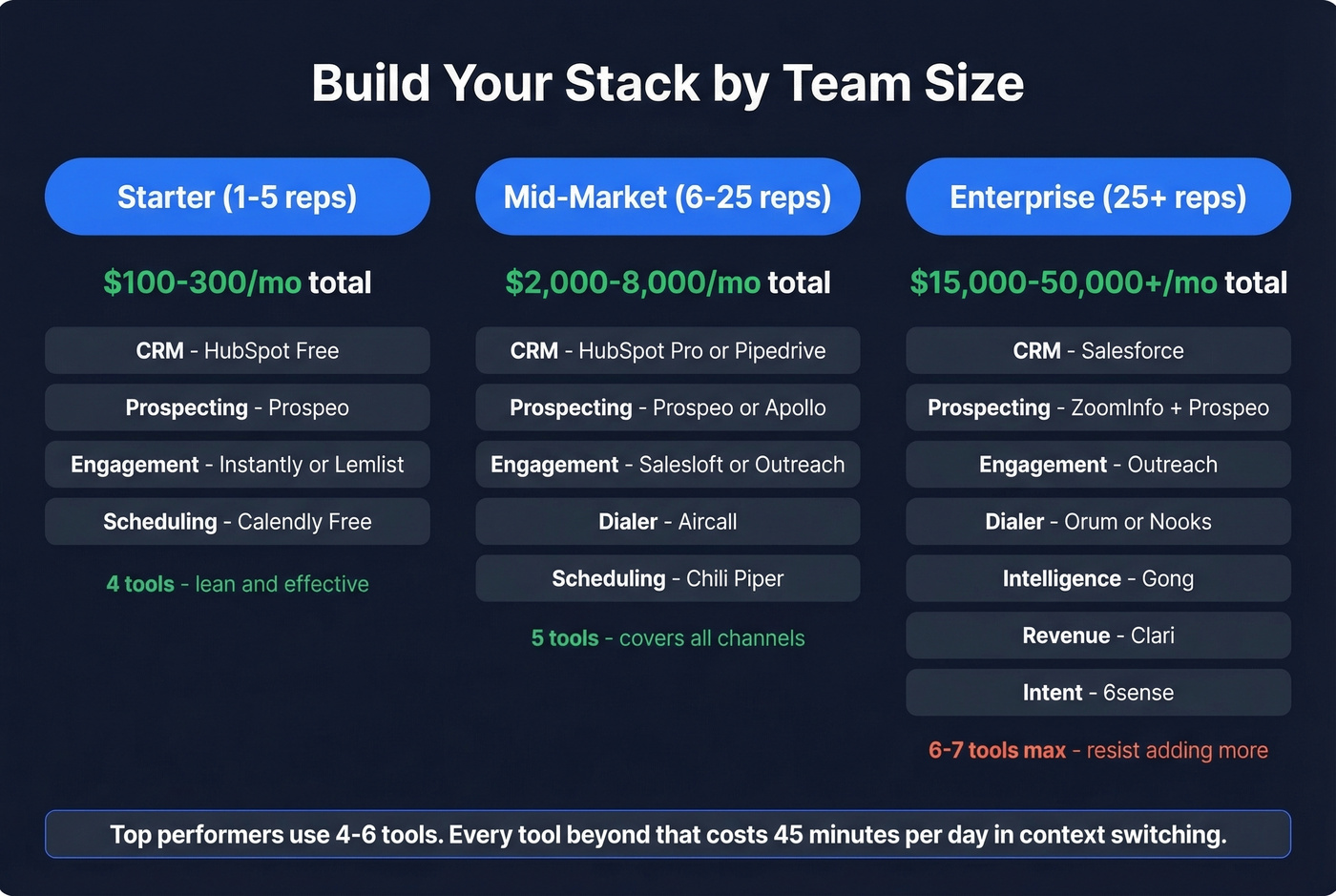
The research is clear: high-performing teams consolidate to 4-6 core tools. Teams running 12+ tools underperform, lose 45 minutes daily to context switching, and leave 67% of their features unused.
Less is genuinely more.
Here's what we'd recommend at each stage:
| Stage | Tools | Cost/Rep/Mo |
|---|---|---|
| Starter (1-10 reps) | HubSpot/Pipedrive + Prospeo + Instantly/Lemlist | $50-200 |
| Growth (10-50 reps) | Salesforce + Prospeo + Outreach/Salesloft + Gong + Calendly | $300-800 |
| Enterprise (50+ reps) | Salesforce + ZoomInfo/Cognism + Outreach + Gong + Clari + 6sense | $1,000-3,000 |
In our experience, the teams that get the best ROI aren't the ones with the biggest budgets - they're the ones that audit their stack quarterly and kill anything that isn't directly tied to pipeline.
ROI Benchmarks by Category
Not all categories deliver equal returns. Here's what the benchmark data shows:
| Category | Avg ROI | Payback Period |
|---|---|---|
| Enablement & Training | 420% | ~4 months |
| Revenue Intelligence | 310% | ~6 months |
| CRM | 280% | ~8 months |
| Conversation Intelligence | 220% | ~7 months |
The single highest-ROI investment isn't a new tool - it's cleaning the data in the tools you already have. Companies using sales intelligence tools report 35% higher close rates and 45% faster sales cycles. But those numbers assume the underlying data is accurate. Run a sequence on a list with 30% bad emails and you won't see any of those gains. You'll just burn your domain.
If deliverability is the constraint, start with an email deliverability guide and fix the basics before scaling volume.
Average spend across all companies lands around $1,200/rep/year. If your stack costs significantly more than that and you can't point to specific pipeline impact, you've got a shelfware problem.
Why Sales Tech Fails
79% of sales teams use automation tools. Only 30% hit their expected ROI. That gap has two root causes, and neither is the software itself.
The data problem. Contact data decays 20-30% annually. People change jobs, companies rebrand, email servers get reconfigured. Poor data quality costs organizations an estimated 12% of revenue, and 65% of sales professionals don't fully trust their organization's data - with good reason. Bad data doesn't just cause bounces. It makes personalization impossible, and 77% of B2B buyers won't engage without it. We've watched SDR teams bounce 35-40% of their sequences and blame the sequencer, when the real problem was the data feeding it.
Meritt, a recruiting firm, tripled pipeline from $100K to $300K per week after switching their data provider. Bounce rates dropped from 35% to under 4%, and connect rates tripled to 20-25%. Snyk's 50-person AE team saw AE-sourced pipeline jump 180% and generated 200+ new opportunities per month after fixing their data foundation.
The adoption problem. Many platforms reach only 30% usage without cultural alignment. You can buy the best tools in the world, but if reps don't use them, you've just created expensive shelfware. The three pillars that actually drive adoption: leadership alignment where execs use the tools visibly, meaningful incentives where the tool answers "what should I do next to hit my number?", and phased rollout starting with auto data capture, then layering in AI insights, then automation. The common killers are forcing manual compliance, ignoring frontline feedback, and measuring vanity metrics instead of outcomes.
Bad data is the silent killer of every sales tech stack. Bounced emails torch your sender reputation, dead numbers waste dialing hours, and stale records mean reps chase ghosts. Prospeo refreshes every record on a 7-day cycle - not the 6-week industry average - with 5-step verification, catch-all handling, and spam-trap removal built in.
Replace your Franken-stack's weakest link with 98% verified contact data.
How to Build Your Stack in 2026
The 2026 trend isn't "more AI tools." It's consolidation. Top-performing teams are collapsing their stacks to 4-6 core tools and getting more from each one. The research backs this up: teams with fewer, better-integrated tools consistently outperform teams drowning in options.
Before you buy anything, run through this checklist:
- Inventory current tools. What do you already have? What's actually being used? Most teams discover they're paying for capabilities they forgot they bought.
- Check unused features. Your CRM probably does half of what that standalone tool does. Turn on the features you're already paying for before adding new vendors.
- Map integration requirements. Every tool that doesn't natively connect to your CRM creates an "Integration Tax" - ongoing engineering and ops overhead to keep data flowing.
- Estimate implementation effort. A tool that takes 3 months to deploy and 6 months to adopt isn't saving you time this quarter.
- Define success metrics per tool. If you can't articulate what success looks like for a specific tool, you don't need it yet.
The architectural decision that matters most is consolidation vs. best-of-breed. All-in-one platforms like HubSpot and the Salesforce ecosystem reduce integration headaches but create walled-garden risk - your data gets locked into their schema, and migration is painful. Best-of-breed stacks give you depth in each category but multiply the integration tax.
There's an emerging third option worth watching: warehouse-native architecture. Your data warehouse - Snowflake or BigQuery - becomes the source of truth, your CRM becomes the UI layer, and reverse ETL tools like Hightouch or Census push enriched data wherever it needs to go. It's more complex to set up, but it eliminates vendor lock-in entirely.
AI in the Sales Stack
Only one-third of sales organizations currently use AI, per Salesforce's research. But the tools that do incorporate AI are operating in three distinct modes.
Predictive AI scores leads, forecasts pipeline, and identifies at-risk deals. Gong AI and Clari use this to surface deal insights that would take a manager hours to find manually. Generative AI writes emails, creates call summaries, and drafts proposals. ChatGPT Enterprise and Lavender are the most-discussed tools here - Lavender specifically coaches reps on email quality in real time. Agentic AI is the newest wave: autonomous agents that handle prospecting sequences, qualify inbound leads, and book meetings without human intervention. Apollo AI is one of the most-discussed options, though the category is still early.
If you're evaluating this category, start with generative AI sales tools to separate real workflow wins from hype.
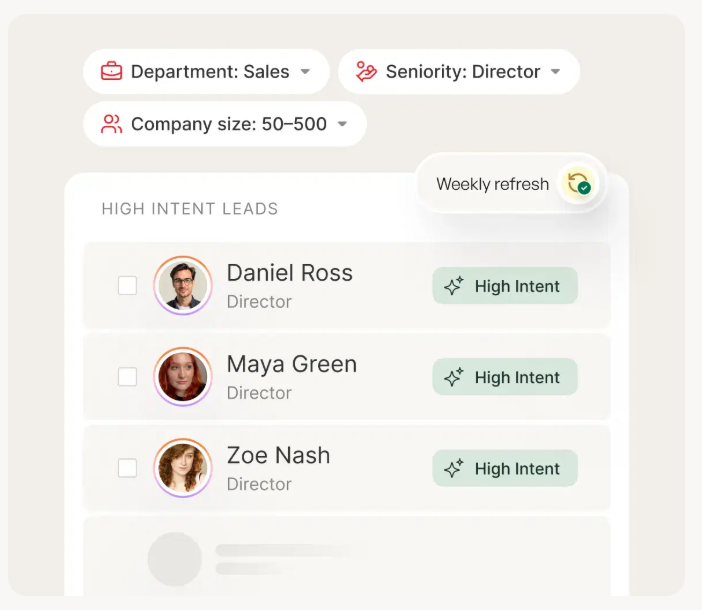
The practical application for most teams isn't replacing reps - it's scaling revenue without scaling headcount. Signal-based prospecting, where intent data surfaces companies actively researching relevant topics, is one example. Instead of reps guessing which accounts to target, the prioritization work that used to eat hours of manual research happens automatically.
Let's be honest: most AI-in-sales hype is ahead of reality. The tools that deliver today are the ones augmenting existing workflows - better forecasting, auto-generated call summaries, email coaching - not replacing the stack entirely. Buy AI features inside tools you already use before buying standalone AI tools.
Sales Tech FAQ
What's the difference between sales tech and tech sales?
Sales tech is the software tools sales teams use to prospect, engage, and close deals. Tech sales is the career of selling technology products. Same words, completely different meanings.
How much does a sales tech stack cost?
Expect $50-200/rep/month for startups, $300-800 for growth-stage teams, and $1,000-3,000+ for enterprise. The cross-industry average is roughly $1,200/rep/year, though teams with heavy intent-data or conversation-intelligence spend can exceed $3,000.
How many tools should a team use?
Four to six. Teams running 12+ tools lose 45 minutes per day to context switching and leave 67% of features unused. Audit quarterly and cut anything not tied to pipeline.
What's the highest-ROI tool category?
Enablement and training tools average 420% ROI with a four-month payback. After that, verified data sources deliver the most leverage - Meritt tripled pipeline after switching from a provider with 35% bounce rates to one delivering under 4%.
Is AI replacing sales tools?
Not yet. Only one-third of sales orgs use AI today. Current AI augments existing workflows - call summaries, email coaching, lead scoring - rather than replacing the stack. Buy AI features inside tools you already own before adding standalone AI products.