

Sales Technology Adoption Is a Data Problem, Not a Change Management Problem
You've sat through three sales technology adoption kickoff meetings this year for tools already gathering dust. The CFO wants to know why the team spent $313K on software nobody uses. The VP of Sales blames "change resistance." But 76% of companies say poor adoption of sales tools is a top reason they miss quota - and the root cause isn't resistance. It's that the last three tools fed reps bad data, wasted their time, and broke their trust.
Only 28% of sales leaders say AI is actually improving revenue performance. The other 72% bought the hype and got shelfware.
What You Need (Quick Version)
Before you launch another adoption initiative, fix these three things:
- Audit your stack for redundancy. The average sales team runs roughly 13 tools. 86% of reps can't tell you which tool to use for which task. If your reps are confused, the tools aren't the solution - they're the problem.
- Fix your data layer. If your email bounce rate is above 5%, reps don't trust the data, and they won't trust the tool that delivers it. A 7-day data refresh cycle with 98% email accuracy is the kind of foundation adoption actually sticks on.
- Measure adoption by pipeline impact, not login frequency. A rep logging in daily but booking zero meetings from the tool isn't "adopted." Track meetings sourced, opportunities created, and time-to-first-pipeline-activity.
The State of Sales Tech in 2026
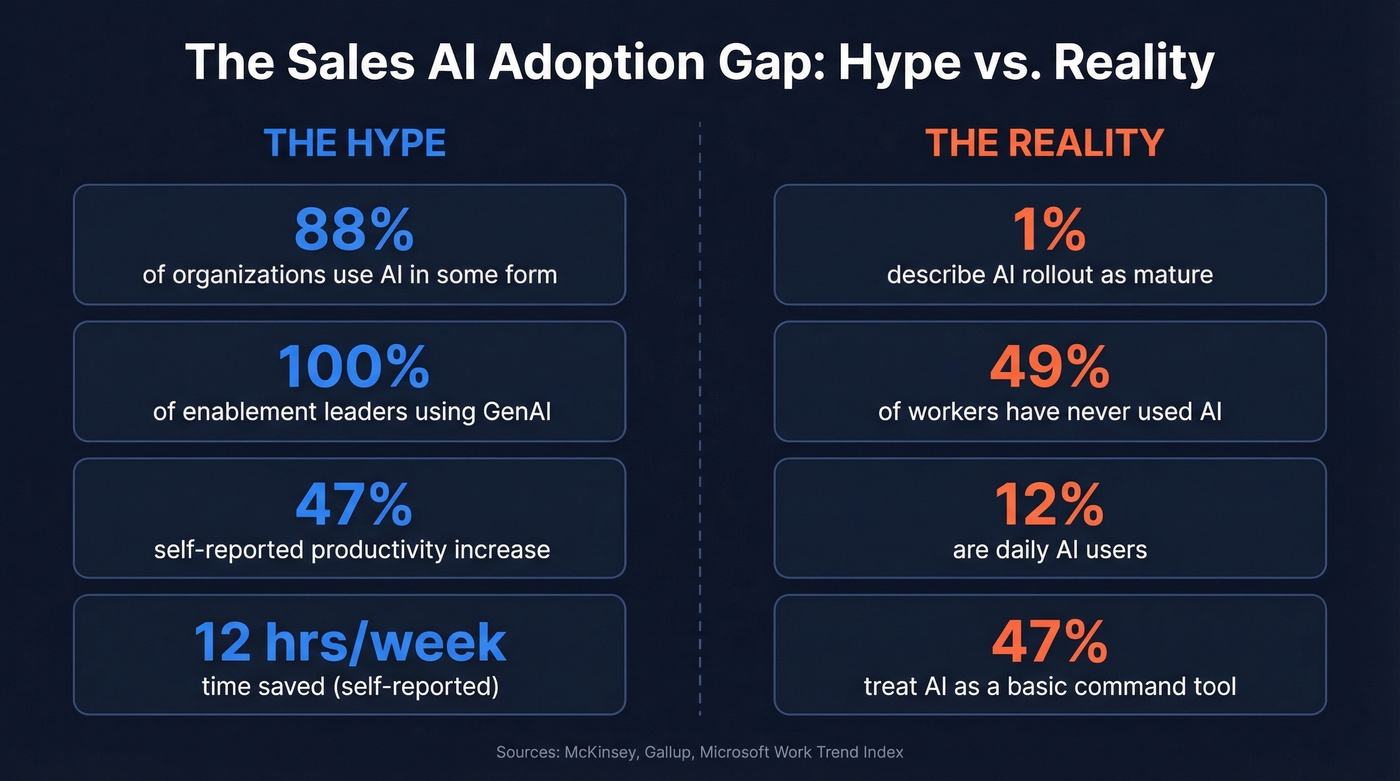
The headline numbers sound incredible. McKinsey's State of AI research shows that 88% of organizations use AI in some form. Allego surveyed 346 enablement leaders and found 100% are using GenAI - up from 62% in 2024. ZoomInfo's survey of 1,000+ GTM professionals reports AI users see a self-reported 47% productivity increase and save roughly 12 hours per week.
Now the reality check.
That same McKinsey research? Only 1% of organizations describe their AI rollout as "mature." Just 6% qualify as high performers seeing meaningful financial returns. Gallup surveyed 20,000+ workers in late 2025 and found 49% have never used AI at work - daily users sit at just 12%. Microsoft's Work Trend Index found 47% of employees treat AI as a command-based tool rather than a thinking partner, which means even the "users" aren't getting real value. Outside the US, adoption lags further: the UK's Office for National Statistics reports only 25% of British businesses use AI at all, rising to 44% among firms with 250+ employees.
The gap between "we use AI" and "AI drives revenue" is enormous. When Highspot surveyed 463 senior sales leaders, 96% reported strain from shifting priorities and stalled deals, and 80% flagged burnout and attrition. The tools are proliferating. The results aren't following. And the reason isn't change management - it's that the foundational data layer most tools depend on is broken.
Why Sales Tool Adoption Fails
Tool Bloat and Integration Gaps
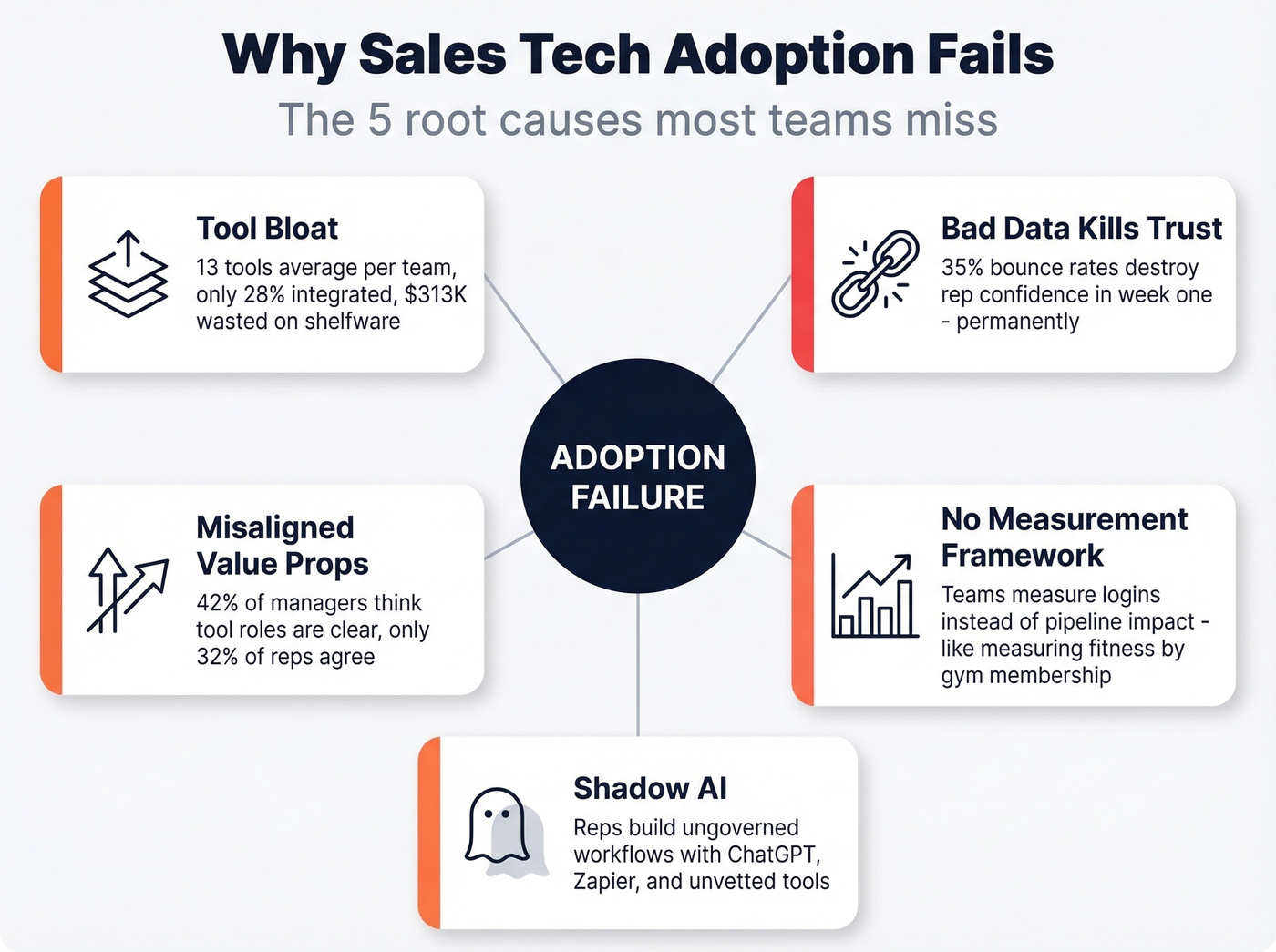
The average sales team juggles roughly 13 tools, and only 28% are integrated with each other. Reps alt-tab between disconnected systems, manually copying data and losing context with every switch. Netguru research found 68% of organizations cite data silos as their top concern, with employees wasting 12 hours per week chasing siloed information. Companies have wasted $313,000 on average on tools that never got fully adopted.
The fix isn't better onboarding for each tool - it's fewer tools that actually talk to each other. Successful stack adoption depends on integration, not accumulation.
Bad Data Kills Trust
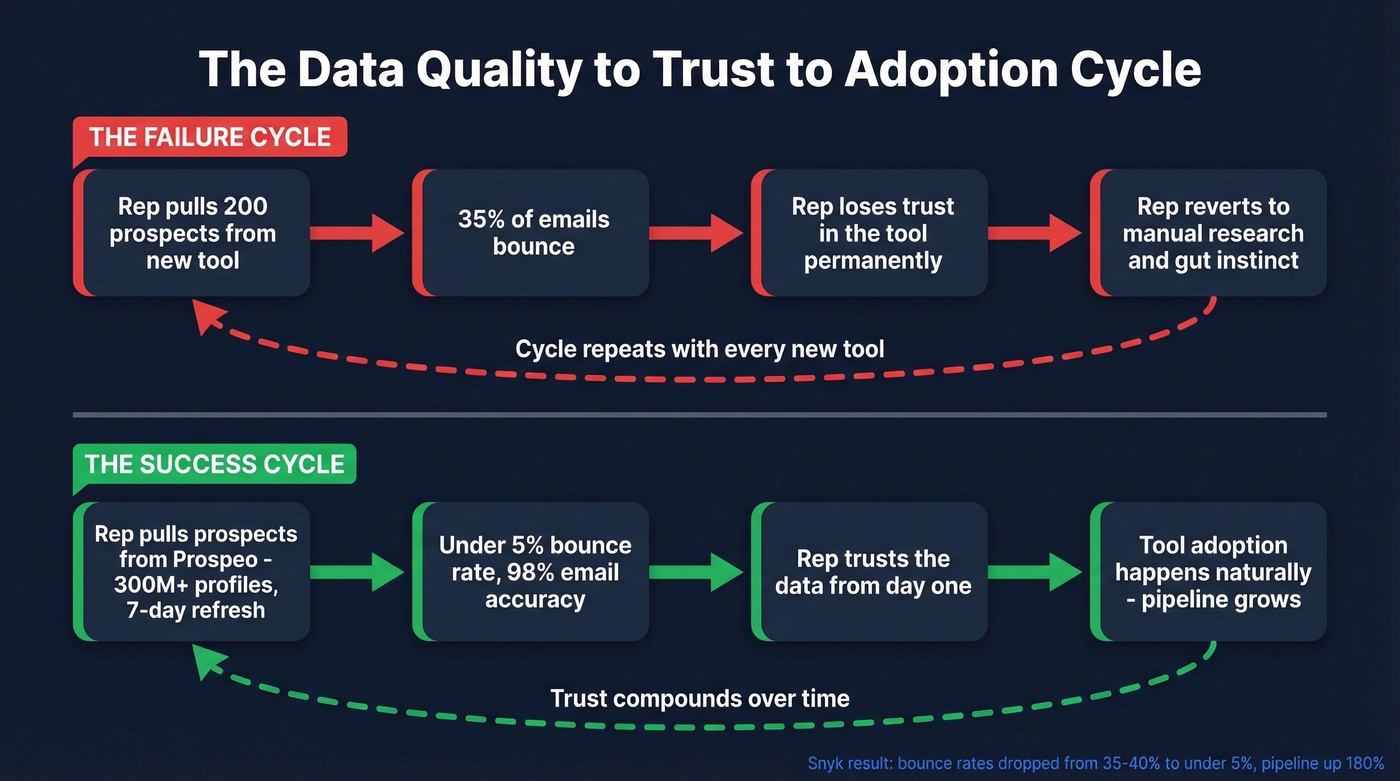
Here's the thing: this is the adoption killer nobody talks about enough. A rep pulls 200 prospects from your shiny new data tool, loads them into a sequence, and 35% bounce. That rep will never trust that tool again. They'll revert to manual research, personal networks, and gut instinct - and honestly, who can blame them? The data quality to trust to abandonment cycle is the single most predictable pattern in sales tech failure, and we've watched it play out at dozens of companies.
If you're evaluating providers, start with data enrichment services and validate accuracy before rollout.
Misaligned Value Props
42% of managers think it's clear which tool to use for which task. Only 32% of reps agree. That 10-point perception gap means managers roll out tools with messaging that resonates with managers - not with the people who actually have to use them.
Reps spend roughly 65% of their time on non-selling work, and every poorly integrated tool makes that number worse. An AE doesn't care about "unified GTM visibility." They care about whether the tool helps them book meetings faster.
If your team is still stuck on activity theater, align tooling to sales activities that actually move pipeline.
No Measurement Framework
Most teams measure adoption by logins. That's like measuring fitness by gym membership. Without a framework tying tool usage to pipeline outcomes, you can't distinguish real adoption from performative compliance - and you definitely can't diagnose why a rollout is stalling.
To make this measurable, borrow a data-driven selling approach: define inputs, outputs, and leading indicators before go-live.
Shadow AI and Zero Governance
A practitioner on r/businessanalysis nailed this: companies are repeating the SaaS-era mistake of expecting employees to self-build AI automations on top of their day jobs. The result is shadow AI - reps using ChatGPT to write emails, feeding prospect data into unvetted tools, building personal Zapier workflows nobody can audit. No governance, no consistency, no accountability.
If you're standardizing AI usage, start with generative AI sales tools and document what’s approved vs. banned.

You just read it: 35% bounce rates kill tool trust permanently. Prospeo's 7-day data refresh and 98% email accuracy are why Snyk's 50 AEs dropped bounce rates from 35-40% to under 5% - and grew AE-sourced pipeline 180%. Adoption sticks when reps trust the data on day one.
Stop blaming change management. Fix the data layer reps actually depend on.
Best Practices for Driving Adoption
Audit Before You Add
Map every tool your team touches - not just the ones you're paying for, but the free trials, browser extensions, and "I just use this for one thing" tools. We've run this exercise with teams that discovered three overlapping data providers, two sequence tools, and a CRM nobody had configured properly. Kill the redundancy first.
One Gartner-backed reality check: a study of 908 B2B salespeople found that nearly 60% said the introduction of new sales technologies generally hinders their overall efficiency. If adding tools is making reps slower, consolidation beats expansion every time.
If you need a structured rollout plan after consolidation, use a 90-day guide to avoid tool sprawl returning.
Fix Your Data Foundation
No adoption framework matters if the data underneath is garbage. Reps form opinions about tools in the first week. If they pull a list and 20-35% of emails bounce, that tool is dead to them - permanently.
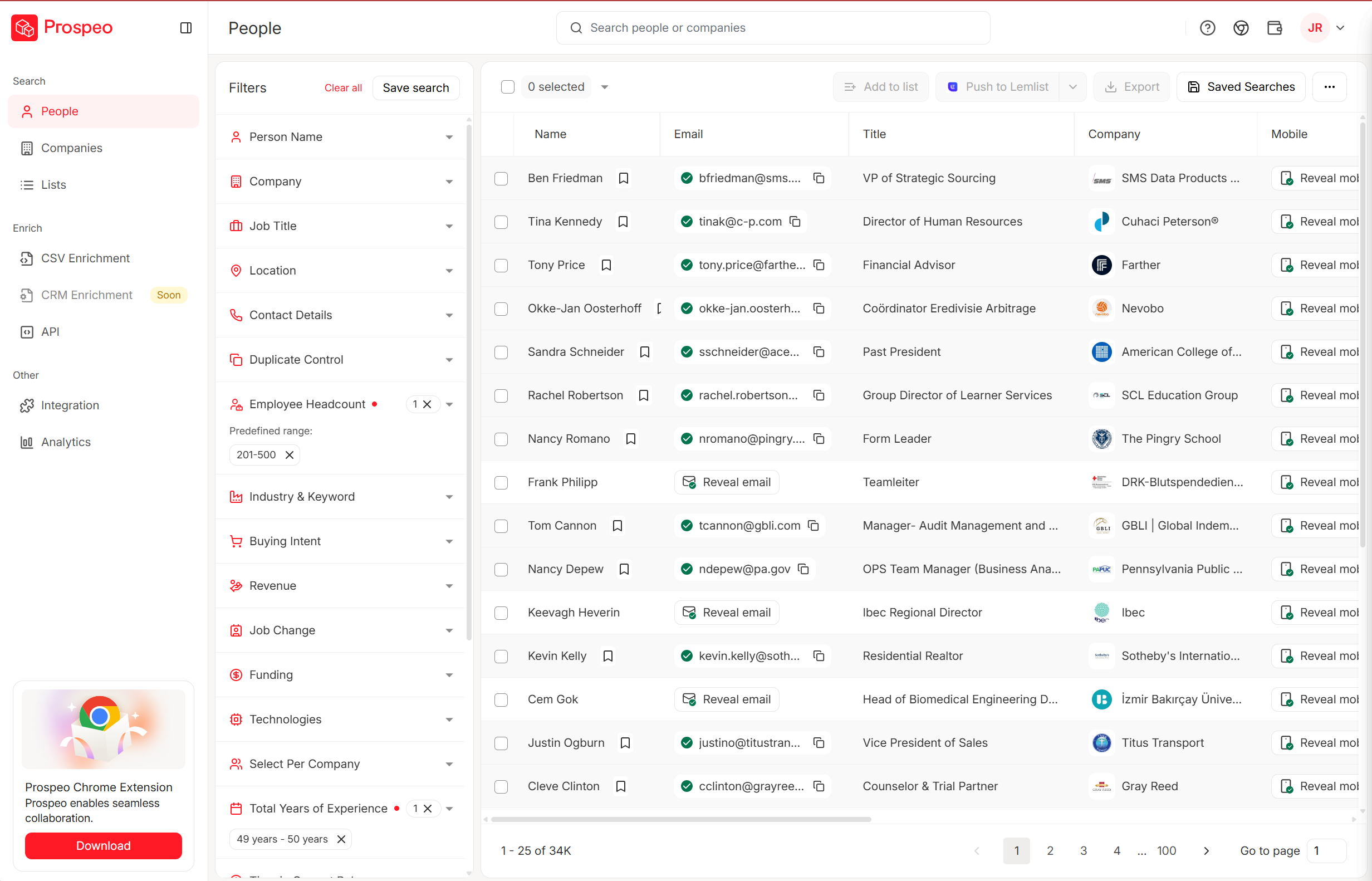
Prospeo's 300M+ profile database runs on a 7-day refresh cycle with 98% email accuracy. Real results back this up: Snyk's 50-person AE team saw bounce rates drop from 35-40% to under 5%, with AE-sourced pipeline up 180%. When reps trust the data, they use the tool. When they use the tool, adoption takes care of itself.
If you're troubleshooting deliverability alongside data quality, start with an email deliverability guide and work backward from bounces.
Build a Champion Network
KPMG's adoption framework recommends appointing "CRM gurus" - tech-savvy sellers embedded in business units who mentor less familiar colleagues. This works because reps trust peers more than they trust enablement decks. Pair early adopters with skeptics and give champions a direct line to the implementation team so feedback loops stay tight.
To operationalize this, define ownership with a dedicated RevOps manager (or equivalent) who can enforce standards.
Communicate the "Why" by Role
An SDR, an AE, a sales manager, and a RevOps lead all need different answers to "why should I care about this tool?" Map the value proposition to each role before go-live. Use an omnichannel communication plan - posts, chat, email, meetings - with feature timelines and role-specific benefits.
Don't launch with a single all-hands demo and hope for the best. That's how tools die quietly.
Let's be honest about something: the next VP of Sales who tells the board "we have an adoption problem" when they actually have a data quality problem is going to lose that job. Stop buying tools to fix problems that bad data created.
Measure Outcomes, Not Logins
Outreach published a benchmark worth memorizing: reps who use their platform 3+ days per week book 2.25x more meetings than occasional users. That's the kind of metric that matters - usage frequency tied to pipeline outcomes. Track activation rate, feature depth, and time-to-value alongside pipeline impact.
If you want a tighter KPI set, borrow from pipeline health metrics and map each tool to a measurable stage impact.
Govern AI Before It Governs Itself
Without dedicated roles for AI governance, you get fragmented automations and zero accountability. Emerging roles like AI Ops Manager and Sales Tech PM aren't luxuries - they're necessities for any team running more than a couple of AI-powered tools. Establish usage policies, approved tool lists, and data handling guidelines before your reps build a dozen ungoverned workflows.
Skip this step if you're running a team of five with two tools. For everyone else, governance isn't optional anymore.
How to Measure Adoption
Login counts are vanity metrics. Here's the framework that actually works:
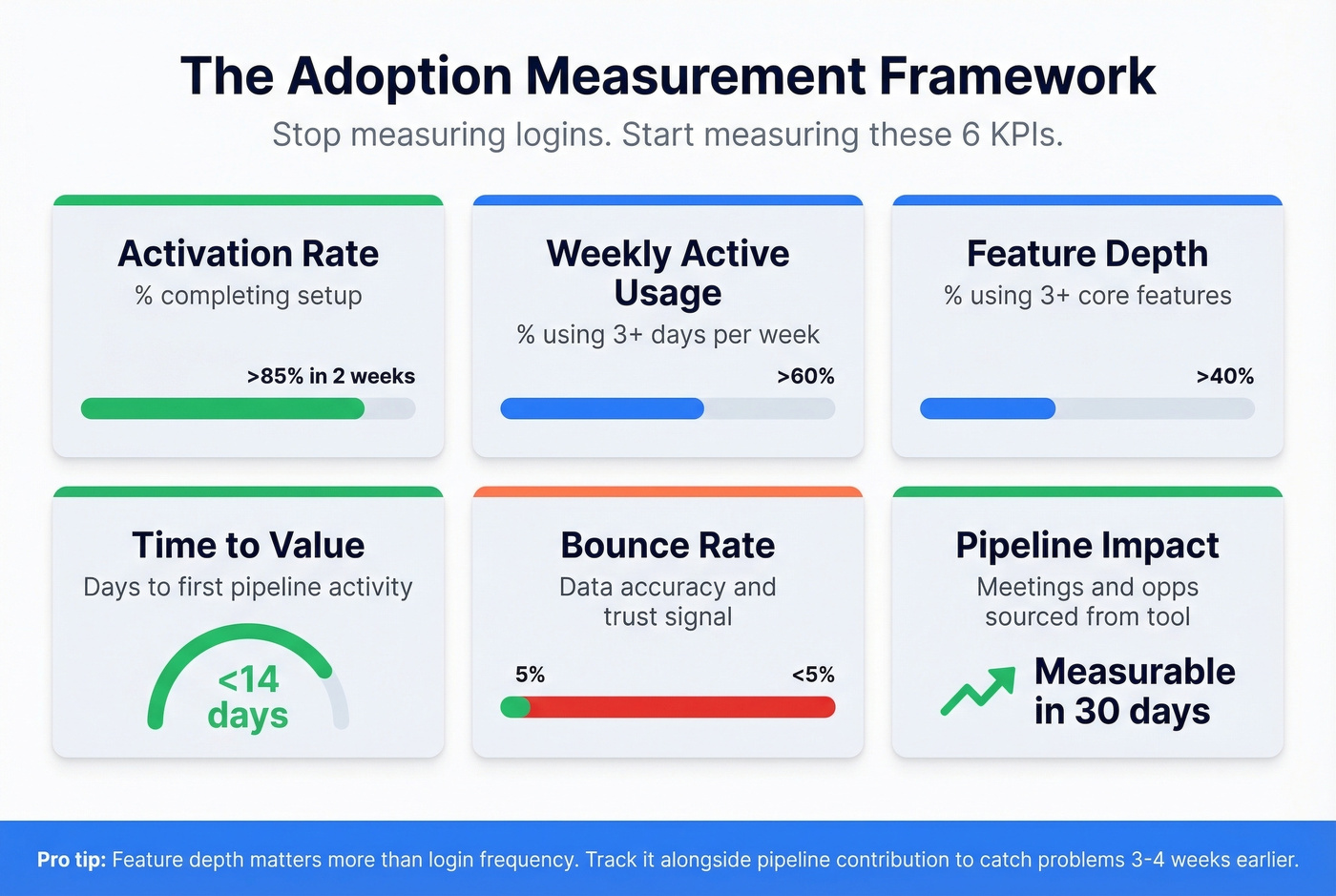
| Metric | What It Measures | Target Benchmark |
|---|---|---|
| Activation rate | % completing setup | >85% in 2 weeks |
| Weekly active usage | % using 3+ days/week | >60% |
| Feature depth | % using 3+ core features | >40% |
| Time-to-value | Days to first pipeline activity | <14 days |
| Bounce rate (data tools) | Data accuracy / trust | <5% |
| Pipeline impact | Meetings/opps from tool | Measurable in 30 days |
Feature depth matters more than login frequency. A rep who uses three core features twice a week is more "adopted" than one who logs in daily to check a dashboard. In our experience, teams that track feature depth alongside pipeline contribution catch adoption problems 3-4 weeks earlier than teams relying on login data alone.
Your team doesn't need a 14th tool. They need one data platform that replaces three. Prospeo combines a 300M+ contact database, verified emails, direct dials, intent data, and CRM enrichment - with native integrations to Salesforce, HubSpot, and every major sequencer. Fewer tabs, more pipeline.
Consolidate your stack and give reps data they'll actually use.
Where Adoption Is Headed
The next two years will reshape what tool adoption even means for revenue teams. 41% of enablement leaders expect AI agents to replace 5-25% of sales roles within two years. Meanwhile, 78% say buyers increasingly favor self-service journeys, which means the tools reps adopt need to support personalized, omnichannel engagement - not just outbound volume.
If you're building for that future, start with sales prospecting techniques that work with (not against) AI-assisted workflows.
New roles are emerging fast. AI Ops managers, Sales Tech PMs, AI Automation Architects - these positions didn't exist two years ago. Allego found that 83% of enablement leaders say AI skills are essential in new hires.
Every one of these trends - AI agents, self-service buyers, new governance roles, intent-powered signals - depends on the same foundation: accurate, fresh data that reps and systems can trust. The teams that win the sales technology adoption game in 2026 won't be the ones with the most tools or the biggest AI budgets. They'll be the ones who got the data layer right first, built governance before chaos set in, and measured what actually matters: pipeline, not pageviews.
FAQ
What's a good sales technology adoption rate?
60%+ weekly active usage (3+ days/week) is strong for most B2B teams. The industry average sits at 30-40%. Measure by feature depth and pipeline contribution, not just logins - a rep using three core features twice weekly outperforms a daily dashboard-checker.
Why do sales reps resist new tools?
Tool fatigue is the primary driver. With roughly 13 tools in the average stack, 86% of reps can't identify which handles which task. Layer in bounce rates above 20% from bad data, and resistance becomes a rational response, not stubbornness.
How long does full adoption take?
Expect 2-4 weeks for activation, 60-90 days for habit formation, and 6 months to measure pipeline impact reliably. Teams with clean data foundations (sub-5% bounce rates) typically hit activation benchmarks 40% faster.
How does data quality affect adoption?
Directly and permanently. If reps experience 20-35% email bounce rates in their first week, they abandon the tool within days. Snyk cut bounces from 35-40% to under 5% after switching to Prospeo, which drove 180% more AE-sourced pipeline - proof that clean data is the prerequisite, not a nice-to-have.
Should we consolidate our sales tech stack?
Almost always yes. Fewer, better-integrated tools with clean data outperform sprawling stacks every time. Start by mapping every tool your team actually touches, kill overlaps, then audit what remains for integration gaps.